Last updated January 2026
In my page session tracking post, I covered what I consider the most important website analytics report: page sessions. Now, I want to cover what I believe is the second most valuable report—sessions by channel.
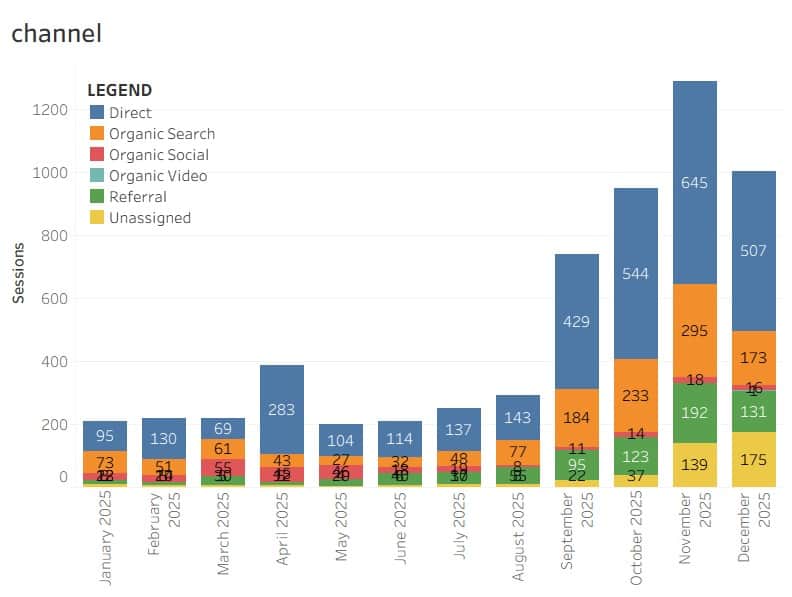
While my site is still early in its growth, the channel data is already enough to illustrate why this report matters. I also don’t have any Paid Search or Email traffic yet, which are common channels for most websites.
Historically, businesses focused on a single channel. That expanded into multi-channel marketing, and today, omnichannel is the goal. Success in all your channels requires regularly evaluating each channel’s performance.
When assessing traffic, keep these key factors, listed in least to most important, in mind:
- Impressions – An indicator of your content being viewed (where available, such as in search or advertising reports) and a basic verification that data collection is functioning.
- Visits – Shows that people are clicking and arriving at your site.
- The Right Visitors – Not just any traffic, but those that fit your target audience.
- Conversions – Typically a form submission, purchase, or engagement with key content like a video or PDF.
General Questions to Ask About Your Channel Data
Before diving into individual channels, consider these broader questions:
- Does anything look inaccurate? Look for anomalies that might indicate tracking issues.
- Are there seasonal trends? Does traffic spike around holidays, industry events, or specific times of the year like when school is/isn’t in session?
- Can traffic spikes be linked to marketing campaigns, news, or other activities?
- Which channels drive the highest engagement and conversions? High traffic doesn’t always mean high value.
- Are your investments (time and money) in each channel yielding proportional returns?
- Are there underperforming channels that need attention? Weak performance could signal issues with visibility, messaging, or targeting.
Industry Benchmarks for Channel Traffic
While every website’s traffic distribution varies based on industry, audience, and strategy, here are some commonly cited directional benchmarks:
- Direct Traffic: ~15% (often influenced by brand recognition and offline marketing).
- Organic Search: ~27% of total traffic (varies widely based on SEO efforts).
- Paid Search Traffic: ~10% (varies based on ad spend and campaign strategy).
- Referral Traffic: ~16% (depends on partnerships, PR, and external links).
- Email Traffic: ~6% (highly dependent on list quality and campaign effectiveness).
- Social Media Traffic: ~5% (higher for industries with strong social engagement).
These averages can fluctuate significantly:
- B2B websites tend to rely more on direct and referral traffic.
- eCommerce often sees more paid search and social traffic.
- Media and entertainment benefit from increased social and referral traffic.
Ultimately, the best benchmark is your own historical data. Google Analytics’ Benchmarking Reports can provide industry-specific comparisons, but tracking your own trends over time is the best way to measure success.
Channel-Specific Insights and Questions
Direct Traffic
Visitors who type your URL directly or use bookmarks.
Industry Benchmark: ~15% of traffic.
- Potential Issues: Can be inflated by tracking errors (e.g., missing UTM parameters in emails or incorrect redirects).
- Key Insights: A high direct traffic percentage often indicates strong brand awareness. However, if it’s unusually high, check for tracking gaps.
Organic Traffic
Visitors from unpaid search engines like Google, Bing, and Yahoo!
Industry Benchmark: ~27% of traffic.
- Key Insights: Monitor keyword rankings, clickthrough rate, and organic conversion rates.
Paid Traffic
Paid traffic from Google Ads, Bing Ads, etc.; Paid social includes Facebook, LinkedIn, etc.; Paid video includes YouTube, TikTok, etc.
Industry Benchmark: ~10% of traffic.
- Key Insights: Keyword performance is crucial; high cost per click’s may indicate a need for better targeting.
Referral Traffic
Visitors from external websites.
Industry Benchmark: ~16% of traffic.
- Key Insights: Monitor where your referral traffic originates. High-quality backlinks improve both referral traffic and SEO.
Email Traffic
Visitors from email or newsletter campaigns.
Industry Benchmark: ~6% of traffic.
- Key Insights: Email UTM tracking is essential; missing tags can cause traffic to be misclassified as direct.
Other Traffic Sources
Affiliates
- Key Insights: Strong for eCommerce; track partner performance.
Audio Ads
- Key Insights: Emerging channel with varying engagement levels.
SMS & Push Notifications
- Key Insights: Highly dependent on user opt-in rates.
Unassigned Traffic
One channel worth calling out explicitly, especially given recent changes in how people discover content, is Unassigned traffic. Historically, unassigned traffic was often treated as a red flag, typically caused by broken tracking, missing UTM parameters, or bot activity. While those issues still exist, unassigned traffic today can also include legitimate sessions that analytics platforms do not yet know how to classify.
An increasingly common example is traffic from AI and LLM tools such as ChatGPT and other conversational interfaces. These sessions can arrive with valid referrers, strong engagement, and clear user intent, yet still fall into Unassigned due to limitations in GA4’s default channel model.
If unassigned traffic is significant, do not assume it is invalid. Evaluate engagement metrics such as engagement rate, events per session, and time on site. High-quality behavior may indicate emerging acquisition channels rather than tracking errors. In some GA4 properties, custom channel group editing can address this. In others, that feature is not yet available, leaving analysts to rely on exploratory analysis or external reporting until the channel model evolves.
Final Thoughts
Analyzing traffic by channel is not just about where visitors come from. It is about understanding intent, engagement, and return on effort.
Channel reporting frameworks need to evolve as user behavior evolves. Discovery is no longer limited to search engines, social platforms, and traditional referrals. AI-driven tools are becoming a real top-of-funnel source, and analytics platforms are still catching up.
Use benchmarks as a reference, but prioritize your own historical trends and engagement quality. When traffic does not fit cleanly into existing channels, the answer is not always better tagging. Sometimes it is acknowledging that the channel model itself is lagging reality.
Consistently reviewing channel performance with this context in mind helps avoid false conclusions and supports better decisions, even when the analytics tooling is imperfect or lagging reality.