Last updated July 2026
Everyone is talking about GEO or if you prefer, AEO.
Everyone has an opinion.
Few people are asking the practical question:
How much of your limited marketing time should actually go toward GEO and AEO?
Not in five years. Not once AI search reaches critical mass. Today, based on the traffic, conversion, and visibility data we currently have.
This article is my attempt to answer that question with evidence first and opinion second.
A Quick Note About GEO, AEO, and AI Visibility
The marketing industry has not agreed on a single name for optimizing visibility inside AI-generated answers.
You may see it described as:
- Answer Engine Optimization, or AEO
- Generative Engine Optimization, or GEO
- AI Search Optimization
- AI SEO
- AI Visibility
The terms are not perfectly interchangeable, but they are often used to describe overlapping goals: helping a brand, product, or piece of content appear accurately and prominently when an AI system answers a question.
I generally prefer the broader term AI visibility, but the strategic question remains the same regardless of which acronym you prefer.
How much of your attention should this emerging channel receive right now?
Why This Question Matters
Every new marketing trend competes for the same limited resource:
Your attention.
Every hour spent rewriting a perfectly good article specifically for AI is an hour you are not spending on conversion optimization, email, link building, customer research, paid acquisition, social media, or the next useful piece of content.
That does not mean GEO and AEO are distractions. It means the opportunity has a cost.
Good strategy is not about doing everything that might work. It is about deciding where your next hour, dollar, or experiment has the best chance of producing a meaningful return.
Before asking whether GEO works, marketers should ask a more useful question:
Given what we know today, how much of a finite week should go toward it?
How Much Traffic Is AI Search Actually Sending?
AI traffic is growing. That part is not especially controversial.
The more important question is how large it is compared with the traffic websites still receive from Google, direct visits, referrals, email, social media, and other established channels.
Ahrefs
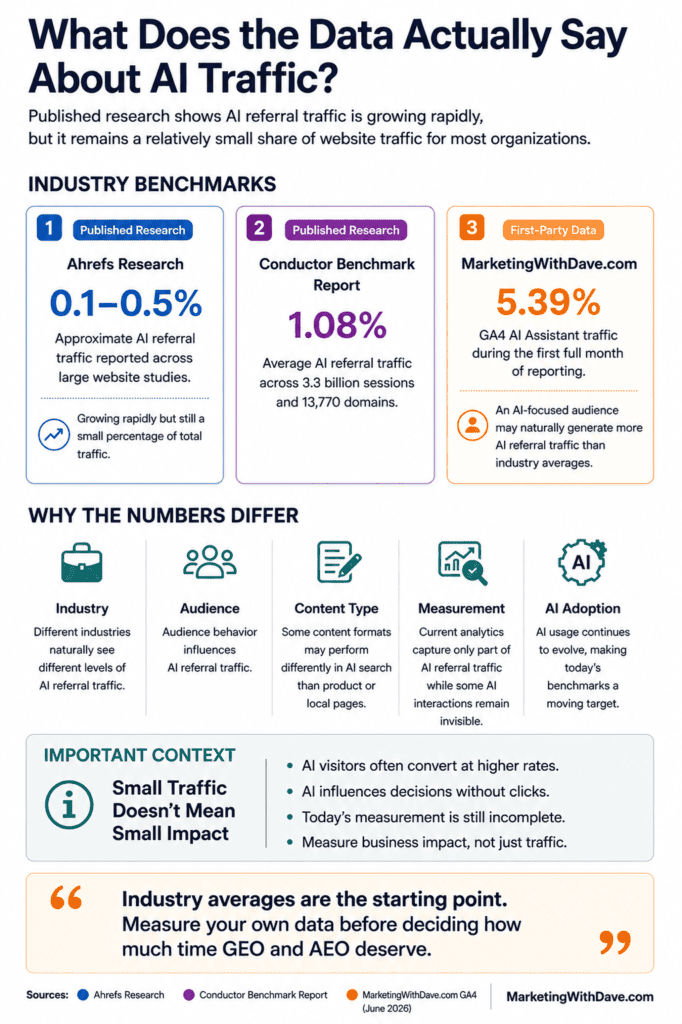
Ahrefs has published several analyses of AI referral traffic across large samples of websites. Depending on the study period and methodology, AI referrals represented roughly 0.1% to 0.5% of total traffic.
The exact percentage changed between studies, but the overall finding was consistent:
AI traffic was growing rapidly while remaining small in absolute terms.
That distinction matters. A channel can grow several hundred percent from a very small starting point and still represent a minor portion of a typical website’s traffic.
Conductor
Conductor’s 2026 AEO and GEO Benchmarks Report analyzed 3.3 billion sessions across 13,770 domains. It found that AI referral traffic accounted for an average of 1.08% of total website traffic.
Neil Patel later highlighted the study publicly, which is where I initially encountered the number. The underlying analysis, however, came from Conductor.
That attribution may seem like a small detail, but it matters. Marketers should be able to trace a statistic back to the organization that collected and analyzed the data.
Conductor’s average was higher than the earlier Ahrefs figures, but both sources pointed in the same general direction:
- AI referrals are increasing
- Industry and audience affect the results
- AI still represents a small share of traffic for most websites
Webflow
Webflow has reported a different but equally important measurement: conversion quality.
In a Webflow 2026 presentation on its AEO maturity model, Webflow reported that AI-sourced visitors converted at approximately six times the rate of unbranded organic search traffic. The company also reported that 8% of its self-service signups came from LLM-sourced traffic during the period discussed.
This is self-reported company data rather than an independent, multi-site study. It should not be treated as a universal conversion benchmark.
It is still useful evidence that a relatively small traffic channel may produce disproportionate business value.
AI Traffic Benchmark Summary
| Source | Reported AI Traffic or Performance | Evidence Type | What I Took Away |
|---|---|---|---|
| Ahrefs | Generally under 1%, with published figures around 0.1% to 0.5% | Large multi-site studies | AI traffic is growing quickly but remains small for most websites |
| Conductor | 1.08% average traffic share | Benchmark study covering 3.3 billion sessions | Industry and audience can create substantial variation around the average |
| MarketingWithDave.com | 5.39% of sessions during the first full month of GA4 AI Assistant reporting | One website and one month of first-party data | An AI-focused marketing audience may significantly over-index for AI referrals |
| Webflow | Approximately 6x conversion compared with unbranded organic search | Self-reported company case study | AI traffic may be worth more than its raw volume suggests |
No single row should be treated as a universal benchmark.
Together, however, they support a fairly defensible conclusion:
AI referral traffic is real, growing, and still a relatively small portion of total website traffic for most organizations.
What I Am Seeing on MarketingWithDave.com
GA4 began reporting an AI Assistant default channel in May 2026, making some AI referral traffic easier to identify without creating a custom channel group.
During June 2026, the first full month in which that channel appeared in my reporting, AI Assistant traffic accounted for 5.39% of sessions on MarketingWithDave.com.
That is approximately five times the 1.08% average reported by Conductor.
I do not think that means the industry benchmarks are wrong. I think it demonstrates why your own data matters more than a broad average.
MarketingWithDave.com publishes extensively about:
- Artificial intelligence
- AI visibility
- SEO and AEO tools
- Marketing software
- Content optimization
That content attracts marketers who are already using ChatGPT, Gemini, Claude, and other AI platforms as part of their research and daily work.
A local service business, restaurant, dental practice, or traditional eCommerce store may see a very different traffic mix.
My 5.39% figure is therefore not a benchmark for other websites. It is a useful first-party example of how dramatically niche and audience can affect AI referral traffic.
It may also understate AI’s actual influence.
Why AI Traffic May Be More Valuable Than It Looks
If AI visitors behaved exactly like traditional organic visitors, allocating effort based on traffic share would be relatively straightforward.
Five percent of traffic might receive roughly five percent of the attention.
The available evidence suggests it is not that simple.
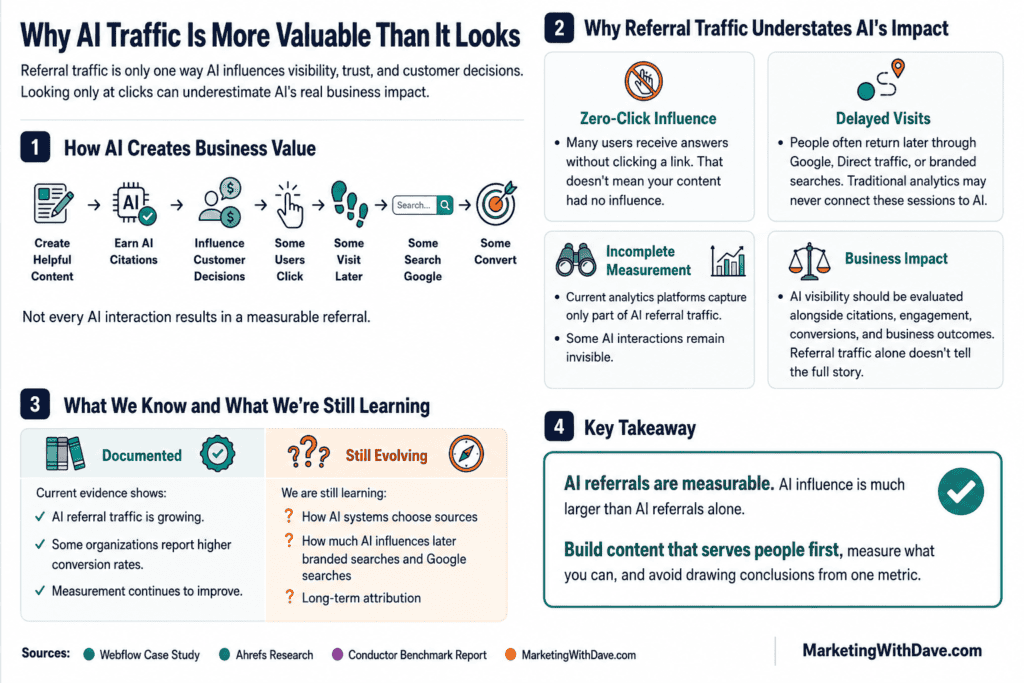
AI visitors may arrive later in the decision process
A traditional search visitor might land on a page after typing a short, broad keyword into Google.
An AI user may have already spent several minutes asking detailed follow-up questions, comparing options, establishing criteria, and narrowing the available choices before clicking a source.
That visitor can arrive with greater context and stronger intent.
This is one plausible explanation for why Webflow and other companies have reported stronger conversion rates from AI-referred traffic.
It is not proof that every AI visitor is more valuable. It is a reasonable explanation for an increasingly common observation.
Visibility can matter without a click
Traffic is only one outcome of AI visibility.
A brand can influence a buying decision when an AI assistant:
- Recommends its product
- Uses its research as a source
- Mentions it during a comparison
- Repeats one of its key messages
- Describes it accurately as an authority in a category
None of those outcomes necessarily produces an immediate website visit.
That is why measuring AI visibility requires more than reviewing referral sessions. My broader AI Visibility Framework covers traffic alongside citations, mentions, accuracy, sentiment, and business outcomes.
Zero-click behavior is not new
AI did not invent zero-click search.
Search engines have answered weather questions, calculations, definitions, local queries, and many informational searches directly on their results pages for years.
Generative answers are expanding that behavior into longer and more complex questions.
This means a decline in clicks does not necessarily mean a brand has disappeared from the customer journey. It may mean the influence is occurring in a place that traditional web analytics cannot fully observe.
Why AI Traffic Measurement Is Still Incomplete
AI traffic is easier to identify than it was a year ago.
It is still far from perfectly measured.
GA4’s AI Assistant channel depends on identifiable referral information. When the referrer is removed or obscured, the visit may be classified somewhere else, including Direct or Unassigned.
Current reporting can also miss or separate several forms of AI-assisted discovery:
- Some AI platforms may not be included in the native channel definition
- Visits without preserved referral data may appear as Direct
- Google AI Overview and AI Mode traffic may be classified as Organic Search
- A user may discover a brand in an AI answer but return later through another channel
- An AI answer may influence a decision without generating any website visit
For those reasons, the 5.39% visible in my GA4 reporting is best viewed as a measured minimum, not a complete accounting of AI-assisted discovery.
That does not mean the missing traffic all belongs in the AI category. My Unassigned traffic, for example, can contain many types of sessions and should not simply be relabeled as AI.
It means current analytics cannot give us a perfectly clean number.
A separate guide on how to measure AI traffic in GA4 would be useful because this topic quickly becomes too detailed for the current article. For now, the practical takeaway is simple:
Use the AI traffic you can identify as a baseline, but do not assume it captures AI’s full influence.
What Is Documented, Observed, and Still Unknown?
One of the biggest problems in GEO and AEO content is that documented findings, practitioner observations, and educated guesses are often presented with the same level of certainty.
My AI Source Preference Matrix uses a similar distinction to separate what is documented from what is observed, inferred, or unknown.
Documented
- AI referral traffic is growing across the major studies reviewed in this article
- Google still drives substantially more website traffic than AI assistants for most organizations
- AI referral traffic varies significantly by industry, audience, and website
- GA4 can now identify some AI Assistant traffic as a distinct channel
- AI-generated answers can influence users without producing a referral visit
Observed
- AI-referred visitors often convert at a higher rate than standard organic traffic
- Question-focused content appears frequently in AI-generated answers
- Recently updated pages are heavily represented in several citation studies
- Brands with strong, consistent third-party mentions tend to appear more often in AI answers
- Clear headings, tables, summaries, and structured answers appear to make content easier for AI systems to use
These patterns are supported by case studies, platform analyses, and repeated practitioner observations.
The exact causal mechanisms are still not fully understood.
Unknown
- Exactly how each AI platform selects, weights, and ranks sources
- How much a Google ranking directly causes AI visibility
- How much the apparent relationship between SEO and AI citations reflects shared quality signals instead
- Which individual optimization tactics will remain effective as models and retrieval systems change
- How much AI-assisted influence occurs without a measurable referral visit
That final list is longer than most AEO content is willing to admit.
Good marketing decisions do not require perfect certainty. They require a clear understanding of the available evidence, honest acknowledgment of its limits, and a willingness to adjust when better information arrives.
How Much Time Should You Spend on GEO and AEO?
Here is my current answer:
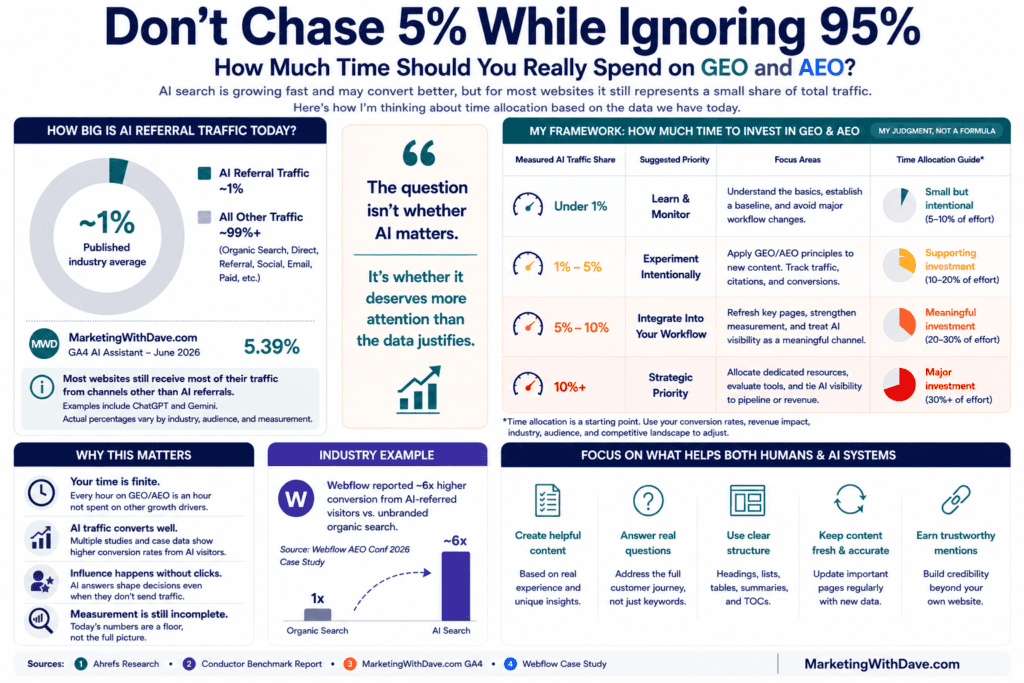
Do not chase 5% while ignoring 95%.
If AI currently sends 5% of your traffic, it probably deserves more than 5% of your attention.
The channel is growing. The visitors may convert better. The influence may extend beyond the clicks you can measure.
But that does not mean it deserves 80% or 100% of your strategy.
For most organizations, Google Search and other established channels are still producing the overwhelming majority of measurable traffic and revenue.
The following framework is not a mathematical formula. It is a practical starting point for deciding how aggressively to invest based on what you are seeing today.
| Measured AI Traffic Share | Suggested Priority | Practical Focus |
|---|---|---|
| Under 1% | Learn and monitor | Understand the fundamentals, establish a baseline, and avoid major workflow changes |
| 1% to 5% | Begin intentional experimentation | Apply AEO principles to new content and track whether traffic, citations, and conversions improve |
| 5% to 10% | Integrate AEO into the content workflow | Refresh important pages, strengthen measurement, and treat AI visibility as a meaningful secondary channel |
| More than 10% | Treat AI as a strategic acquisition channel | Allocate dedicated resources, evaluate tools, and connect AI visibility to pipeline or revenue |
Traffic percentage should not be the only factor.
A company receiving 2% of its traffic from AI with a conversion rate six times higher than organic search may reasonably invest more than a company receiving 5% of low-quality AI traffic.
Your decision should also consider:
- Conversion rate
- Revenue or lead value
- Industry adoption
- Audience behavior
- Competitive visibility
- The importance of organic acquisition to the business
The framework gives you a place to start. Your actual business results should determine where you go next.
Where Should You Start?
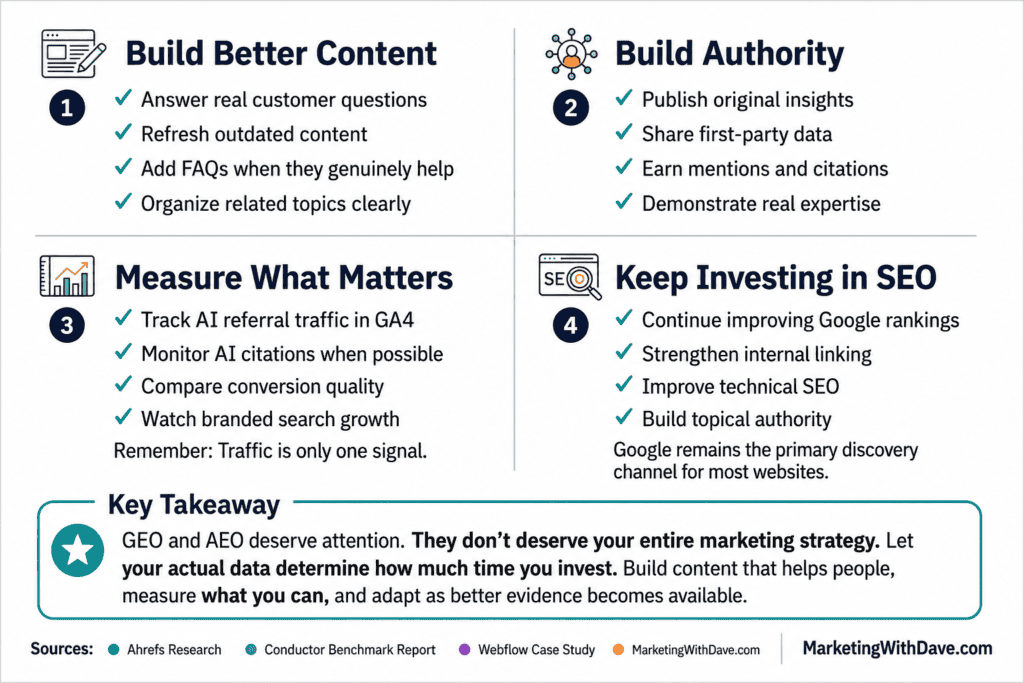
The encouraging part is that most foundational AEO work also supports traditional SEO.
You do not need to choose between creating content that ranks and content that gets cited.
Start with improvements that benefit both:
- Create original, useful content based on real experience
- Answer the specific questions your customers ask throughout the buying process
- Use clear headings and logical page structure
- Add tables of contents when they improve navigation
- Include FAQs when readers have natural follow-up questions
- Keep important pages accurate and current
- Use appropriate schema and descriptive metadata
- Build credible mentions beyond your own website
- Measure traffic and conversions rather than relying only on visibility scores
These practices are unlikely to become wasted work even if the terminology, platforms, and optimization tools continue to change.
Whether someone discovers your content through Google, ChatGPT, Gemini, Claude, Perplexity, or another system, that person is still looking for the same thing:
A trustworthy answer to a real problem.
Frequently Asked Questions
Does GEO/AEO replace SEO?
No. Google still drives the large majority of measurable organic traffic for most websites, and many practices that support AI visibility also support SEO. These include creating useful content, answering real questions, building topical authority, improving site structure, and keeping important information current.
AEO and SEO should be treated as complementary strategies rather than competing choices.
What is the difference between GEO and AEO?
GEO commonly stands for Generative Engine Optimization and focuses on visibility inside generative AI systems. AEO commonly stands for Answer Engine Optimization and focuses on appearing inside direct answers.
In practice, marketers often use AEO, GEO, AI SEO, and AI visibility to describe overlapping work. The industry has not yet standardized the terminology.
How much AI referral traffic is normal?
Broad studies from Ahrefs and Conductor suggest that many websites currently receive less than 1% to slightly more than 1% of their traffic from identifiable AI referrals.
That average can vary substantially based on industry, audience, content, and measurement methodology. MarketingWithDave.com recorded 5.39% during June 2026, but an AI-focused marketing audience is more likely to use AI assistants than the audience of a typical small business website.
How do I measure AI referral traffic in GA4?
GA4 now includes an AI Assistant default channel that identifies traffic from certain recognized AI referrers. No custom configuration was required for this channel to begin appearing in my reporting.
The channel does not capture every AI-influenced visit. Some platforms may be excluded, stripped referral information can move visits into Direct, and Google AI features may appear under Organic Search.
For that reason, the AI Assistant channel should be treated as a useful baseline rather than a complete measurement of AI’s influence.
Do AI-referred visitors convert better than organic search visitors?
Several companies and studies have reported stronger conversion rates from AI-referred visitors, but the reported improvement varies widely.
Webflow reported approximately six times higher conversion than unbranded organic search in its own funnel. That is a useful case study, but it should not be treated as a universal benchmark.
Marketers should compare conversion rates using their own analytics and business outcomes.
Does ranking well in Google improve AI visibility?
There appears to be a relationship between traditional search visibility and AI citations, but the mechanism is not fully understood.
A highly ranked page may receive more AI visibility because the system relies on search results. It may also rank and receive citations because both systems recognize similar signals of quality, relevance, authority, or usefulness.
The evidence supports continued investment in SEO. It does not yet prove that improving a Google ranking will directly cause a proportional increase in AI citations.
Should a small business invest in GEO and AEO?
Yes, but the investment should remain proportionate to the opportunity.
A small business should first make sure its website is technically accessible, its products and services are clearly explained, its business information is accurate, and its content answers real customer questions.
Those fundamentals support SEO, AEO, local visibility, conversion, and the overall customer experience.
Should I rewrite all of my existing content for AI?
No.
Begin with pages that already receive traffic, generate leads, support an important product, or answer high-value customer questions.
Refresh content when you can make it more accurate, useful, complete, or easier to navigate. Rewriting content solely to satisfy an assumed AI preference can consume a great deal of time without producing a measurable return.
Practical Time Allocation Framework
More than the raw traffic percentage alone may suggest, especially if AI visitors convert well or the channel is growing quickly for your audience.
Less than the most aggressive commentary recommends, especially when AI remains a small portion of your traffic and established channels are still driving most of your results.
Start with improvements that benefit SEO and AEO together. Increase your investment as your own traffic, visibility, conversion, and revenue data justify it.
Final Thoughts
The debate should not be SEO or GEO/AEO.
It should be how to build content that deserves both rankings and citations.
AI search is not replacing traditional search overnight. It is expanding the ways people discover information, evaluate options, and encounter brands.
That deserves intentional experimentation.
It does not justify abandoning the channels that still generate most of your traffic and revenue.
Measure your own data. Apply the practices that improve both human experience and machine understanding. Increase your investment as the opportunity becomes more meaningful for your specific audience and business.
Don’t chase 5% while ignoring 95%.
But don’t ignore the next 5%, either.