The 10 Most Common Integrated Marketing Mistakes (and How to Fix Them)
Integrated marketing looks great on slides. Channels line up. Arrows point neatly from left to right. But in practice, a lot of integrated marketing efforts stall, fragment, or underperform.
Let’s look at 10 common mistakes that quietly break integrated marketing systems and offer practical ways to fix each one. The goal is not perfection. The goal is to help your channels, content, data, and systems actually work together instead of pulling in different directions.
1. Treating Integrated Marketing as Campaign Coordination Instead of System Design
Many teams still treat integrated marketing as a way to coordinate messages across a campaign. They match headlines, share creative assets, and review launch calendars. All of that is useful, but it is not enough.
When integrated marketing stops at campaign coordination, the underlying system remains fragmented. Channels fight for credit, data lives in different tools, and customers experience a series of disconnected moments.
How to fix it:
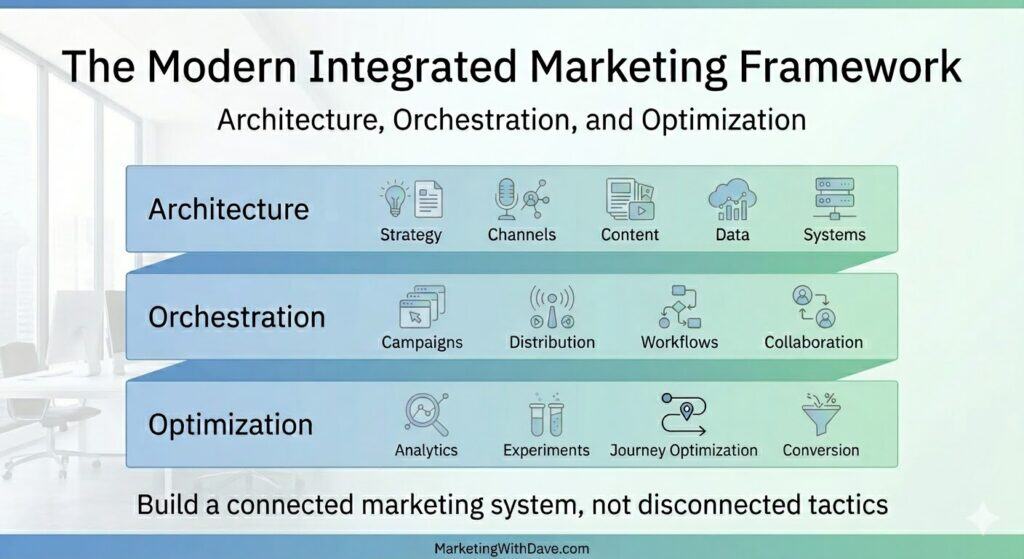
- Think in terms of architecture, orchestration, and optimization, not just campaigns.
- Map how traffic, data, and experiences move across your web properties and tools.
- Ask how each decision affects the whole marketing engine, not just a single campaign.
2. Running Teams in Silos
Silos are one of the biggest reasons integrated marketing fails. Channel teams are measured separately, sit in different tools, and report to different leaders. It is no surprise that the work ends up fragmented.
Siloed teams today can create even more fragmentation than IMC era teams did because each team now owns a different part of the digital experience. Customers feel that fragmentation as friction and confusion.
How to fix it:
- Create shared outcomes that cut across teams, such as full journey conversion or revenue influence.
- Design reporting at the system level and use shared dashboards so every team is working from the same journeys, metrics, and outcomes. Shared reporting prevents channel teams from drifting back into siloed goals.
- Hold regular cross functional reviews that focus on journeys and systems, not just channel performance.
- Encourage channel owners to bring problems and ideas that affect the whole ecosystem, not only their local metrics.
3. Letting Every Channel Try to Do Everything
When every channel tries to drive awareness, consideration, and conversion on its own, the result is a noisy and inefficient system. Channels overlap in some places and leave gaps in others. Customers encounter repeated messages and dead ends.
Without clear roles, no one knows which channels are responsible for what part of the journey. That makes it hard to prioritize, measure, or improve the system.
How to fix it:
- Assign a clear primary role to each channel, such as demand capture, demand creation, nurture, or retention.
- Document those roles and share them widely so teams understand how their work fits into the bigger picture.
- Review channel roles at least once a year so they evolve with your strategy and customer behavior.
4. Building Content Without a Content Architecture
Many organizations publish content reactively. Sales needs a one pager, product needs a feature blog, social needs a quick post, and so on. Over time this creates a pile of disconnected content that is hard to maintain and even harder to reuse.
Without a content architecture, it is difficult to support multiple channels, journeys, and segments with the same core ideas. The result is inconsistent messaging and wasted effort.
How to fix it:
- Define content pillars that align to your strategy and key problems you solve.
- Create pillar web pages and supporting cluster web pages that can serve search, paid, email, and sales at the same time.
- Design content to be modular so pieces can be reused across different formats and channels.
5. Mapping Journeys but Not Fixing the Weak Links
Journey maps often look impressive, but they do not always change how the work happens. Teams map dozens of touchpoints, print a diagram, and then continue operating exactly as before.
The real value of journey mapping is in finding and improving the weak links where people drop off, get confused, or hit a dead end. Without that focus, journey mapping becomes a static exercise rather than a driver of integrated marketing.
How to fix it:
- Start with two or three high value journeys instead of trying to map everything.
- Identify the most common starting points and key moments of truth for each journey.
- Choose one weak link at a time to improve, such as a broken handoff between an ad and a landing web page or between a form fill and a follow up email.
6. Optimizing Channels Instead of Connections
It is tempting to chase siloed wins. Better subject lines. Cheaper clicks. Higher rankings. Those things matter, but they can distract from the bigger opportunity, which is improving how channels work together.
When teams only optimize inside their own channel, they miss the compounding effect that comes from smoother flows across channels. A higher click through rate is nice. A better end-to-end journey is usually worth much more.
How to fix it:
- Include at least one cross channel experiment in every testing cycle.
- Look at assisted conversions and multi step flows, not just single touch performance.
- Ask whether a change improves the entire path from first touch to value, not just a single metric.
7. Missing or Broken Measurement
Integrated marketing depends on integrated measurement. When tracking is incomplete or inconsistent, teams have to fall back on guesswork and channel level reports. That undermines confidence in the system and makes it difficult to justify changes.
Common issues include inconsistent UTM tagging, missing event tracking, and reports that only show last click attribution. These gaps hide how channels support one another.
How to fix it:
- Agree on a simple but consistent naming convention for UTMs and campaign identifiers.
- Ensure key events are tracked across your web properties, app, and product where possible.
- Start from shared system level outcomes and work backward to define what each channel needs to track.
- Add basic multi touch views, such as assisted conversions and simple journey reports, even if you are not ready for full attribution modeling.
- Make dashboards shared and system level so teams see the same journeys, metrics, and results instead of separate reports for each channel.
8. Misaligned Martech That Adds Friction Instead of Flow
It is easy to add tools to the stack and much harder to make them work together. Over time, many organizations end up with overlapping tools, disconnected data, and manual workarounds that increase friction.
When the martech stack is not aligned with the integrated marketing strategy, teams spend more time wrestling systems than improving journeys. Data gets trapped, errors creep in, and customers feel the impact.
How to fix it:
- Map your core systems and define what each one is responsible for.
- Identify where data needs to move automatically between systems to support your key journeys.
- Remove or consolidate tools that duplicate functionality or create unnecessary complexity.
9. Over Relying on Launches Instead of Always On Systems
Campaigns and launches will always be part of marketing, but many teams still behave as if launches are the main way results happen. They sprint toward a release, work late to get assets out the door, then lose momentum until the next big push.
Integrated marketing depends on always on systems that keep capturing, nurturing, and converting demand between launches. Without those systems, each campaign has to work much harder than it should.
How to fix it:
- Separate your planning into always on programs and time bound campaigns.
- Ensure that each campaign strengthens or reuses parts of your always on system instead of starting from scratch.
- Invest in evergreen assets and flows that continue to perform long after a campaign ends.
10. Having No Operating Model to Run the System
Even a well designed integrated marketing system will struggle if there is no clear way to run it. Without shared rituals, workflows, and decision rules, teams default back to ad hoc requests and reactive work.
An operating model defines how planning happens, how work moves, how decisions are made, and how learning is shared. It turns integrated marketing from an idea into a repeatable practice.
How to fix it:
- Establish regular rhythms such as weekly standups, monthly performance reviews, and quarterly planning sessions focused on the system, not just channels.
- Document key workflows for creating briefs, prioritizing work, and routing approvals.
- Agree on who owns the integrated marketing architecture and how changes to it are proposed and approved.
Bringing It All Together
Most integrated marketing failures are not caused by a lack of ideas or effort. They come from treating integration as a campaign task instead of a system to design, run, and improve.
By avoiding these common mistakes and focusing on the connections between channels, content, data, and systems, you can build a marketing engine that works more like a single, coherent experience and less like a collection of disconnected activities.
The goal is not to eliminate every silo or fix every weak link at once. The goal is to make steady progress toward a system where each improvement helps the whole engine run smoother.
The 10 Most Common Integrated Marketing Mistakes (and How to Fix Them) Read More »