Case Studies

Business meeting with diverse professionals analyzing transportation and infrastructure plans in a modern conference room.

Marketing Myopia Revisited: Modern Examples & How to Apply It

Reading Time: 9 minutes

In 1960, Theodore Levitt asked a question that is still uncomfortable to answer honestly: what business are you really in? His Harvard Business Review article, Marketing Myopia, won the McKinsey Award and has been required reading in business schools ever since. The core claim is simple to state and hard to live by: companies decline not because their market dries up, but because they define themselves by what they make instead of what their customers actually need.

Business meeting with diverse professionals analyzing transportation and infrastructure plans in a modern conference room.

Sixty five years later, the railroad example still gets quoted in nearly every marketing class. But the article holds up better as a strategy piece than as a how to guide. Levitt is brilliant at diagnosing the failure. He is much thinner on how realistic it actually was for a company to fix it. That second part is where I want to spend most of this post, because it is the part that actually matters if you run a business today.

The Question That Started It All

Levitt’s opening example is the American railroads. He argued they stopped growing not because people stopped needing to move people and freight, that demand kept growing, but because railroad executives saw themselves as being in the railroad business rather than the transportation business. They were product oriented instead of customer oriented, so when cars, trucks, and airplanes showed up, the railroads watched competitors take customers they should have kept.

He makes the same case with Hollywood (which thought it was in the movie business when it was really in the entertainment business and nearly got buried by television) and with the buggy whip industry (which had no chance once it defined itself by the product instead of the need for personal transportation).

The thesis, in one line: “What business are you really in?”

The Four Myths That Keep Companies Product Bound

Levitt outlines four beliefs that quietly trap companies in product thinking. Each one feels reasonable in the moment and dangerous in hindsight.

  • Myth 1: An expanding, more affluent population guarantees our growth. When the market is growing on its own, nobody has to think hard. Companies improve efficiency instead of value, and innovation slows because there is no pressure forcing it. Levitt’s example: the oil industry got fat on population driven demand for kerosene lighting, then nearly got wiped out overnight when Edison’s incandescent bulb made the product irrelevant. The need for light never went away. The need for kerosene did.
  • Myth 2: There is no competitive substitute for our core product. Believing your product is irreplaceable is exactly what makes you blind to the replacement showing up. Levitt points to the oil industry again, watching outsiders develop natural gas, fuel cells, and electric power systems while the industry stayed narrowly focused on crude oil.
  • Myth 3: Mass production and falling unit costs will protect us. This is where Levitt draws the line between selling and marketing. Selling is about converting your product into cash. Marketing is about understanding and satisfying what the customer actually needs, and letting the product follow from that. He uses Detroit as the case study: automakers spent heavily on consumer research yet kept missing what buyers wanted because they were only testing preferences among options they had already decided to build.
  • Myth 4: Technical R&D will keep us growing. A breakthrough product can create the illusion that selling itself is unnecessary, which pulls a company’s whole orientation toward engineering and away from the customer. This is the buggy whip trap in its purest form: if you define your product as the business instead of the need it serves, no amount of product improvement saves you when the need gets met a different way.

Selling vs. Marketing

This distinction is the most practically useful part of the article for a small business owner. Selling focuses on the seller’s need to move product. Marketing focuses on the buyer’s need to be satisfied, and treats the product as one part of a larger bundle that includes how it is delivered, supported, priced, and experienced. Levitt’s line on this is worth sitting with: the marketing effort is usually treated as something that happens after the product is built, when it should be the thing that determines what gets built in the first place.

Five Companies That Actually Made the Shift

Levitt’s own examples (DuPont and Corning Glass staying customer oriented even with strong technical roots) are useful but dated. Here are five more recent companies that redefined the need they serve instead of clinging to the original product.

  • Netflix started as a DVD by mail company but never defined itself as one. It treated itself as being in the business of getting people the entertainment they want with the least friction, which is why it moved into streaming and then into producing its own content rather than protecting the mail order model.
  • Adobe moved Creative Cloud from boxed software you bought once to a subscription you use continuously. The underlying need never changed: creative professionals wanting current tools and easy collaboration. What changed was the wrapper, from a product you own to a service you stay inside of.
  • IBM went through a wrenching transition from being a hardware manufacturer to being a business services and consulting company. The shift, led by Lou Gerstner in the 1990s, meant treating customers’ operational problems as the business rather than the boxes IBM happened to build.
  • Amazon never defined itself as an online bookstore even when books were the only thing it sold. It defined itself around removing friction from getting customers what they need, which is the same orientation that later produced AWS, a business with almost nothing to do with retail.
  • Apple stopped thinking of itself as a personal computer manufacturer once it saw the broader need it could serve: making technology approachable for ordinary people. That reframing is what made the iPod, iPhone, and App Store possible instead of leaving Apple boxed into the PC category it started in.

Why This Is So Hard in Practice

Knowing you should be customer oriented and actually becoming customer oriented are very different problems, and the gap between them is mostly about capability and leadership, not insight.

Core strength becomes core rigidity

There is a useful concept in strategy research, usually attributed to Dorothy Leonard-Barton, that the same capabilities that make a company excellent in one era become the rigidities that block it in the next. A railroad’s expertise in track, rolling stock, scheduling, and rate setting was a genuine competitive advantage. None of that expertise transfers cleanly to building an airline or a trucking fleet. The skills, the capital structure, the workforce, the regulatory relationships, all of it is built around rail specifically. Telling a railroad executive to “be in the transportation business” is true at the level of strategy and nearly useless at the level of execution, because almost nothing in the organization is built to do anything but run trains.

This is also where Fujifilm is worth a second look, and a more honest one than the standard “they reinvented themselves” version of the story. Fujifilm didn’t follow its photography customer into whatever replaced film for that customer, which was smartphone cameras and cloud photo storage, things Fujifilm had no claim on. What it actually did was take a reusable internal capability, the thin-film and collagen chemistry built for film emulsion, and go find an entirely different customer willing to pay for it: skincare buyers, hospitals, pharmaceutical partners. That’s not Levitt’s move. It’s closer to what strategy researcher David Teece calls a dynamic capability, the ability to sense an opportunity, seize it, and reconfigure existing assets to chase it, even when that means walking away from the original customer rather than following them. Both moves can work. They are just not the same diagnosis, and a company that only asks Levitt’s question (what does my customer need) without also asking Teece’s question (what can I actually reconfigure and deploy) may conclude correctly and still have nothing to execute with.

Is there such a thing as a CEO for all seasons?

Mostly, no. There is real evidence in organizational research, going back to Larry Greiner’s classic work on how companies evolve through growth stages, that the leadership skill set needed to build something is rarely the same skill set needed to scale it, and neither is the same skill set needed to defend it once a disruptor shows up. A founder who is brilliant at building a product from nothing is often the wrong person to manage a mature, process heavy organization, and a operator who is excellent at running a mature business is often the wrong person to lead a turnaround that requires destroying the thing that made the company successful in the first place. That last one is the railroad’s exact problem. The people running the business were selected and rewarded for running railroads well, not for deciding to cannibalize the railroad. Asking them to do that is asking them to act against the incentives and the skills that put them in the job.

The railroad reality check

The railroads’ situation was genuinely harder than “what business are you really in” makes it sound, for a few concrete reasons:

  • Regulation actually kept the modes separate. Railroads were regulated by the Interstate Commerce Commission, and when trucking grew into a real competitor, the ICC extended its authority to cover trucking too, under the 1935 Motor Carrier Act. Notably, the railroads themselves lobbied for that regulation rather than racing to build trucking fleets of their own. That is Levitt’s point in action, a defensive posture instead of an offensive one, but it also shows the industries were not simply sitting there waiting to be entered. Airlines were regulated by an entirely separate federal body. A railroad executive in 1955 who wanted to build an airline was not just making a strategic choice, he was crossing into a different regulatory world with different rules, different capital requirements, and no transferable operating authority.
  • The assets were not portable. Track, depots, and rolling stock are sunk, specific, immobile capital. None of it can be repurposed into trucks or airplanes. Compare that to DuPont, whose actual asset was chemical research capability, something genuinely portable across product lines. The railroads’ core asset was the opposite of portable.
  • The workforce and culture were built for one mode. Decades of hiring, training, union agreements, and operating practice were built around running trains. Telling that organization to become an airline is not a strategy memo, it is closer to building an entirely new company inside the shell of the old one.

None of that excuses the railroads from blame. Levitt’s deeper point still holds: they spent their energy protecting the existing business instead of asking what their customers actually needed next, and that defensiveness is what cost them the natural gas business, the trucking business, and eventually most of the long haul freight business. But the lesson for a modern reader should probably be narrower than “become a totally different kind of company.” It is closer to: ask the question early enough, while you still have capital, time, and the credibility to act on the answer, because the further a company drifts into a single, specific way of operating, the more expensive and unlikely the pivot becomes.

A More Practical Version of Levitt’s Question

For a small business or solopreneur, “what business are you really in” is the right question but too abstract to act on directly. Here is a more granular version you can actually run against your own business.

  • Name the job, not the product. Write down what your product or service actually gets done for the customer, in their words, not yours. A copywriting service is “words on a page.” The job it does might be “make me sound credible enough that a stranger trusts me with their money.” Those lead to very different roadmaps. This is the same move researcher Anthony Ulwick formalized as jobs-to-be-done: customers don’t buy products, they hire them to make progress on something, and naming that progress is the actual starting point for a roadmap.
  • Find your revenue concentration risk. List what share of your revenue depends on one product, one feature, or one delivery method that a competitor or a new technology could make obsolete. That is your railroad track. It is fine to have it. It is not fine to be unaware of it.
  • Separate what is portable from what is sunk. List your real capabilities (customer relationships, domain expertise, distribution, a process you have refined) separately from your sunk assets (a specific tool, a specific format, a specific platform). The portable list is what you can actually pivot on. The sunk list is what tends to keep people defending a shrinking business past the point it makes sense.
  • Look one layer past your current customer’s request. Customers usually ask for a slightly better version of what already exists, because that is the only thing they know to ask for. Levitt’s point about Detroit applies here: researching preferences among the options you already planned to build is not the same as understanding the underlying need.
  • Audit whether your own skill set matches the next phase, not just the current one. This is the leadership question turned inward. If you are a solopreneur, ask honestly whether the thing you are good at (building, selling, operating, fixing) is the thing your business needs most right now, or whether you are doing what you are good at because it is comfortable.

Marketing Myopia earned its reputation because the core insight is true and durable: businesses fail more often from neglecting customer needs than from a shrinking market. But the article’s real value today is not the railroad metaphor, it is the discipline of asking the question before circumstances force the answer on you. The railroads did not lack the imagination to see the transportation business. They lacked the assets, the regulatory freedom, and arguably the leadership bench to act on it once they saw it. For most small businesses, none of those three barriers is anywhere near as fixed. That is the actual opportunity in revisiting a 65 year old article: you almost certainly have more room to pivot than the railroads ever did. The harder part is deciding to look.

One last caveat worth keeping in mind: customer focus itself can become a new kind of myopia if it’s the only thing you’re optimizing for. Employees, partners, and the people affected by how you operate all have a stake in the business too, and a strategy built entirely around the current customer’s voice can miss all of them.

Marketing Myopia Revisited: Modern Examples & How to Apply It Read More »
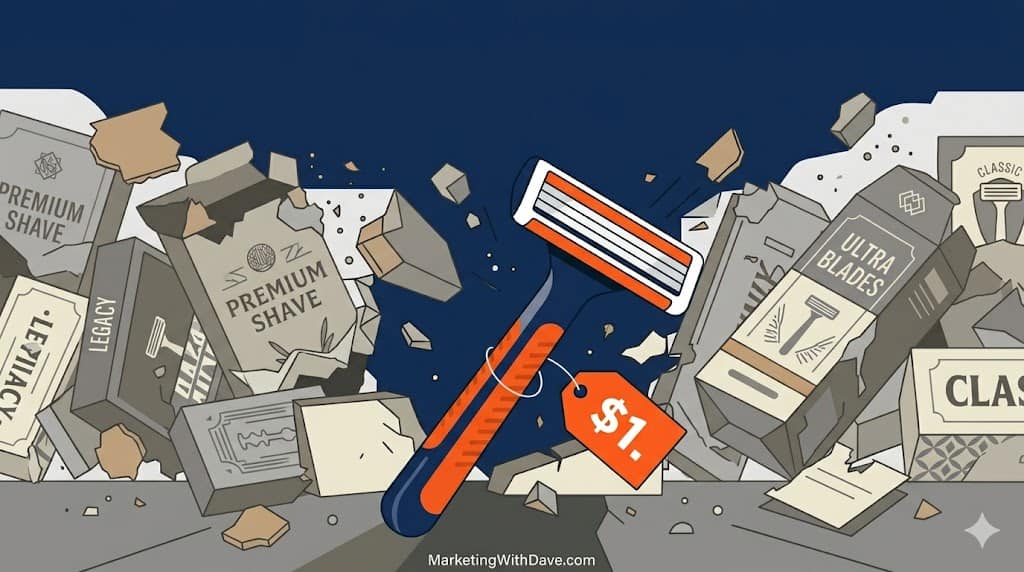
A razor shattering boxes of shaving products with a $1 price tag, symbolizing disruption in the razor industry through innovative marketing and challenger branding.

Case Study: Dollar Shave Club Disrupted the Razor Aisle With Humor, Convenience, and Challenger Branding

Reading Time: 5 minutes

Brief Summary

Dollar Shave Club launched in March 2012 with a simple promise: high-quality razors for a few bucks a month, delivered directly to your door.

What made the brand famous was not just the subscription model, but the way it packaged that model in a low-budget video starring co-founder Michael Dubin, whose deadpan delivery, category mockery, and plain-language value proposition made the ad feel more like a cultural jab than a sales pitch.

A razor shattering boxes of shaving products with a $1 price tag, symbolizing disruption in the razor industry through innovative marketing and challenger branding.

The result was immediate demand, a crashed website, and 12,000 orders in 48 hours. Over the next few years, Dollar Shave Club layered humor, social media engagement, customer support, product line expansion, in-house creative, and eventually omni-channel retail on top of that launch. Unilever bought the business for about $1 billion in 2016, later admitted the economics of direct-to-consumer had changed, and sold control in 2023. That full arc is what makes the case so valuable today: it shows both how challenger brands break into mature categories and how hard it is to preserve that edge as channels, costs, and ownership change.

Company Involved

Dollar Shave Club is the company at the center of this case. The brand launched in 2011 and built its early identity around affordable razors shipped directly to consumers. Today, it sells a broader grooming assortment across razors and shave, skin and body, hair, electrics, and women’s products. As of 2026, control sits with Nexus Capital Management, while Unilever retains a 35 percent minority stake.

Marketing Topic

  • Branding
  • Advertising
  • Customer Experience

Public Reaction or Consequences

The public reaction was overwhelmingly strong at launch because the campaign solved a real frustration in a way that felt funny, fast, and shareable. The launch video overloaded the site, generated 12,000 orders in two days, and helped frame Dollar Shave Club as the irreverent outsider taking on legacy razor brands. That tone carried into later campaigns, industry awards, and social media work that was recognized for platform-specific storytelling and highly responsive member support.

The later consequence was more complicated. Dollar Shave Club became one of the defining direct-to-consumer success stories of the 2010s and was acquired by Unilever in 2016. But years later, Unilever said the business had not delivered as expected and that the economics of direct-to-consumer had changed. In 2023, Unilever sold control to Nexus Capital while keeping a minority stake.

Why It Matters Today

  • The case still matters because it anticipated founder-led branding, first-party customer relationships, recurring revenue, owned content, and omni-channel growth.
  • It also matters because it shows the limits of direct-to-consumer economics when customer acquisition costs rise and cross-sell does not scale quickly enough.
  • Its recent campaigns show how an older challenger brand can refresh itself with channel-specific creative, including both filmed storytelling and AI-generated work.

Three Takeaways

  1. Use humor only when it carries strategy, not just attention.
  2. Build the brand voice into support, packaging, and follow-up channels.
  3. Do not mistake a winning launch channel for a permanent growth engine.

Notable Quotes and Data

  • Michael Dubin said the launch spot was shot in one day for $4,500 and that within 48 hours the company received 12,000 orders.
  • Dubin later said, “Great storytelling is why we’ve been able to grow so fast.”
  • Reuters reported that Unilever expected Dollar Shave Club’s turnover to grow to more than $200 million in 2016 from $152 million in 2015, while Harvard Business Review noted the company had quickly grown to 3.2 million subscribers by the time of the acquisition.

Full Case Narrative

Dollar Shave Club entered a category that looked stable from the outside but was full of consumer resentment. The traditional razor aisle had become synonymous with high prices, locked display cases, confusing product ladders, and a sense that major brands kept adding features to justify margin. Dollar Shave Club reframed that frustration into a cleaner story: people did not need a futuristic shaving ritual, they needed a straightforward product, a fair price, and one less errand. The company did not just sell blades. It sold relief from category nonsense.

The launch video made that argument unforgettable. Dubin used a direct-to-camera style, warehouse staging, visual gags, and a script that moved from joke to benefit without friction. It felt personally authored, which mattered. Consumers were not just hearing a claim from an ad. They were hearing a founder puncture a stale market with wit.

Dollar Shave Club did not treat virality as the whole strategy. It expanded into adjacent products such as shave butter, wipes, shower, hair, and skin care. It invested in internal creative capabilities rather than outsourcing its brand brain. It also built marketing around service, using social channels for customer support and community engagement as well as promotion.

Another important layer was content. Dollar Shave Club tried to become more than a subscription box by funding MEL Magazine and by continuing to maintain owned educational and lifestyle content on its current site through Club Chronicles. That showed an effort to build audience relevance around the broader world of grooming, lifestyle, and identity, not just the transaction itself.

The Unilever chapter adds the cautionary half of the case. In 2016, Unilever bought Dollar Shave Club for about $1 billion, with the deal framed as a strategic response to e-commerce disruption, men’s grooming growth, and the value of direct customer relationships. Yet several years later, Unilever said Dollar Shave Club had not delivered as expected and that the economics of the direct-to-consumer model had changed. In 2023, Unilever sold control to Nexus while keeping a 35 percent stake.

Since then, the brand has leaned back into its roots. In 2025 it launched a national campaign designed to put the brand back on the map after the Unilever split. In 2026 it extended its irreverent disruptor posture into a women’s line, combining traditional filmed ads with AI-generated creative and testing which executions work best on different channels. The current site still emphasizes honest prices, simple shopping, and blunt anti-category messaging.

Timeline

  • 2011: Dollar Shave Club launches with a direct-to-consumer razor proposition.
  • March 2012: The launch video goes live, the site crashes, and 12,000 orders arrive within 48 hours.
  • 2013 to 2014: The brand expands into adjacent products and earns recognition for social and digital work.
  • 2016: Unilever acquires Dollar Shave Club for about $1 billion.
  • 2020 to 2021: The brand redesigns and pushes into omni-channel retail with a major campaign.
  • October 2023: Unilever announces the sale of Dollar Shave Club to Nexus Capital Management and keeps a 35 percent stake.
  • 2025 to 2026: The brand returns to more disruptive humor and expands into women’s grooming with mixed-format creative.

What Happened Next?

Dollar Shave Club evolved from a subscription disruptor into a broader grooming brand with retail distribution, more product categories, and a renewed emphasis on challenger messaging. Its marketing today still draws heavily from the original formula: blunt value communication, category criticism, founder-style directness, and a willingness to test new creative formats while protecting its irreverent voice.

One Sentence Takeaway

Dollar Shave Club won by turning a boring, overpriced category into a story people wanted to repeat, and its later ownership twists prove that memorable branding is powerful, but business model discipline still decides how long the advantage lasts.

Sources and Citations

Inc.: How a $4,500 YouTube Video Turned Into a $1 Billion Company

Reuters: Unilever sharpens P and G rivalry by buying Dollar Shave Club

Harvard Business Review: Unilever’s Big Strategic Bet on the Dollar Shave Club

Unilever: Unilever announces the sale of Dollar Shave Club

Marketing Dive: Dollar Shave Club swipes at competition in first women’s grooming push

Case Study: Dollar Shave Club Disrupted the Razor Aisle With Humor, Convenience, and Challenger Branding Read More »

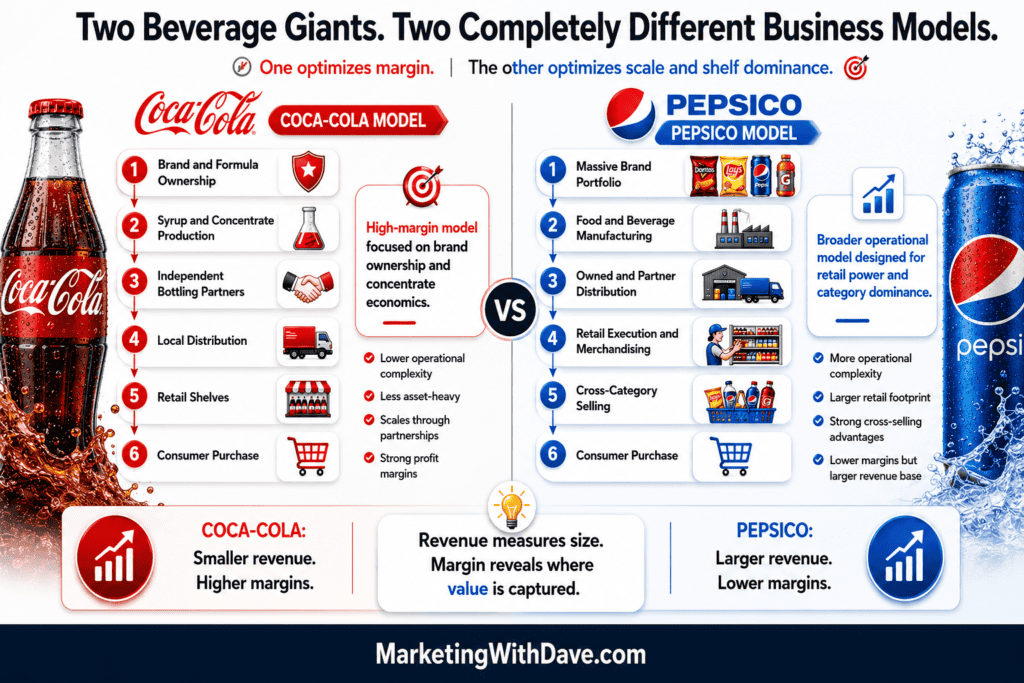
Coca-Cola and Pepsi business models comparison infographic highlighting brand ownership, distribution, revenue, margins, and operational differences for marketing insights.

Case Study: Coke vs Pepsi and the Strategy Behind Revenue, Margin and Market Control

Reading Time: 4 minutes

Brief Summary

Coca-Cola and PepsiCo are often compared as beverage rivals, but their business models are not the same. Coca-Cola has built a high-margin system around brand ownership, concentrate sales and bottling partnerships.

PepsiCo has built a broader food and beverage empire with more manufacturing, distribution and retail execution built into the business. For marketers, the lesson is not that one model is automatically better. The lesson is that strategy determines where profit is captured, where complexity lives and how growth scales.

Company Involved

This case study focuses on The Coca-Cola Company and PepsiCo.

Marketing Topic

  • Strategy
  • Brand positioning
  • Distribution

The Core Difference

Coca-Cola is primarily a brand and concentrate business. It creates the formula, owns the trademarks, manages the brand and sells concentrate or syrup to bottling partners. Those partners handle much of the physical work, including bottling, packaging, delivery and shelf execution.

PepsiCo operates differently. It owns a much broader portfolio that includes Pepsi, Mountain Dew, Gatorade, Lay’s, Doritos, Cheetos, Quaker and other food and beverage brands. That gives PepsiCo more revenue streams, more retail presence and more consumer occasions, but it also creates more operational complexity.

Simple Business Model Diagram

Coca-Cola and Pepsi business models comparison infographic highlighting brand ownership, distribution, revenue, margins, and operational differences for marketing insights.

Strengths of Coca-Cola

Coca-Cola’s biggest strength is focus. The company has built one of the most valuable beverage systems in the world by staying centered on brands, formulas, partnerships and global consistency.

That focus helps Coca-Cola protect margin. It does not need to own every truck, warehouse or shelf-level activity to benefit from global demand. Instead, it captures value through the part of the chain where its advantage is strongest: the brand, the formula and the system.

Weaknesses of Coca-Cola

The same focus that makes Coca-Cola powerful also creates concentration risk. It is still heavily tied to beverages, consumer taste shifts, sugar concerns, packaging regulation, water usage and bottling partner performance.

Coca-Cola also gives up some direct control by relying on partners. That can be a smart trade-off, but it means execution depends on whether the full system performs well locally.

Strengths of PepsiCo

PepsiCo’s biggest strength is portfolio breadth. It is not only competing for what people drink. It competes across snacks, meals, hydration, convenience, sports, breakfast and impulse purchases.

That gives PepsiCo more ways to win a shopping trip. A retailer may care about Pepsi, but they also care about Lay’s, Doritos, Gatorade and Quaker. That portfolio gives PepsiCo more shelf relevance and more leverage in retail relationships.

Weaknesses of PepsiCo

PepsiCo’s broader model is more expensive to operate. Manufacturing, distribution, logistics, merchandising and portfolio complexity all create costs. More revenue does not automatically mean a better business if more of that revenue is consumed by operating expenses.

The company also has to manage more categories, more brands, more supply chains and more consumer expectations. Breadth creates power, but it also creates drag.

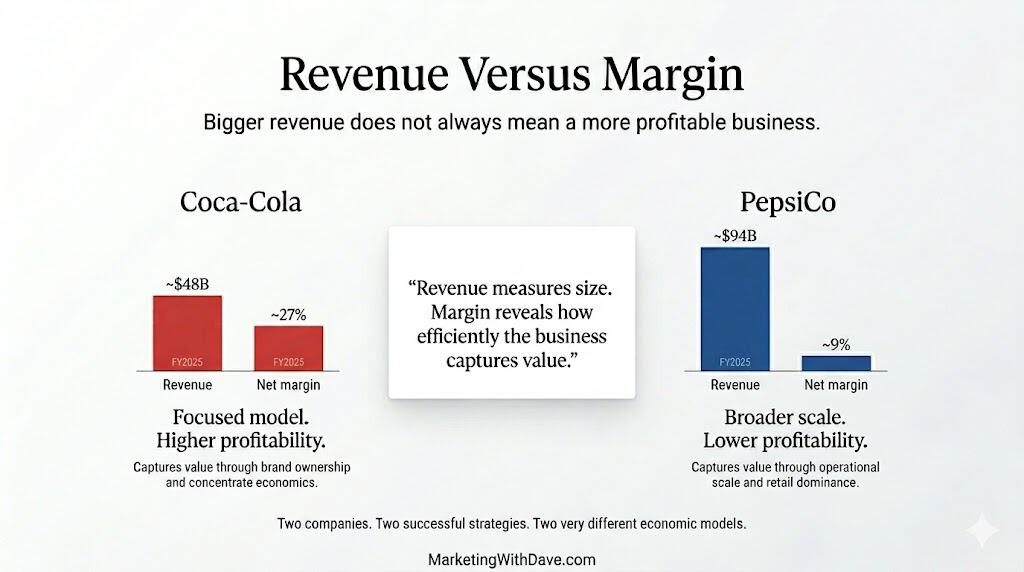
Revenue Versus Margin Diagram

Bigger revenue does not always mean a more profitable business, illustrated with Coca-Cola and PepsiCo revenue versus net margin comparison.

Why It Matters Today

This case matters because modern marketers often obsess over reach, traffic, impressions and revenue growth without asking where value is actually captured. Coke and Pepsi show that distribution strategy, product scope and operating model are not back-office decisions. They shape the entire marketing engine.

A brand that owns the right part of the value chain can grow with less operational weight. A brand that owns more of the physical experience may gain control, data and shelf power, but it has to earn that control through execution.

3 Takeaways

  1. Revenue and profit are not the same strategy. PepsiCo proves that scale can be enormous, but Coca-Cola proves that margin can be more powerful than size alone.
  2. Distribution is part of the brand. Coke uses partners to scale the system. PepsiCo uses more direct execution to win visibility and availability. Both are marketing decisions, not just operations decisions.
  3. Focus and breadth create different advantages. Coca-Cola wins through concentrated brand power. PepsiCo wins through portfolio reach. Marketers need to know which game they are playing.

Full Case Narrative

Coca-Cola and Pepsi are often treated as simple rivals in the same category, but that framing misses the deeper business lesson. The real contrast is not only Coke versus Pepsi. It is focus versus breadth, margin versus scale and brand ownership versus operational control.

Coca-Cola’s model is built around one of the most famous brand systems in the world. The company owns the trademarks, protects the formulas, manages the global brand and works through bottling partners to manufacture and distribute products in local markets. This allows Coca-Cola to benefit from global demand without carrying the same level of physical distribution burden across every market.

PepsiCo built a different kind of machine. Through food and beverage brands, it owns more consumer occasions. A shopper might buy Pepsi with lunch, Gatorade after a workout, Doritos for a party and Quaker for breakfast. That gives PepsiCo a powerful role with retailers because it is not dependent on one beverage brand or one drinking occasion.

But the trade-off is complexity. PepsiCo’s empire requires more operational coordination, more logistics, more manufacturing and more merchandising. It can dominate more of the shelf, but it also has to pay for the machinery that makes that dominance possible.

Coca-Cola’s advantage is that it can remain closer to the highest-margin parts of the value chain. PepsiCo’s advantage is that it can influence more of the store, more of the basket and more of the consumer’s day. Both strategies are strong. They simply optimize for different outcomes.

What Marketers Can Learn

Marketers should not copy Coca-Cola or PepsiCo blindly. The right lesson is to identify where your business creates the most value. If your advantage is brand, intellectual property, audience trust or product uniqueness, a partner-powered model may help you scale without unnecessary weight.

If your advantage is availability, speed, service, shelf control or customer experience, owning more of the execution may be worth the cost. But marketers need to be honest about the trade-off. Control is expensive. Scale is not always efficient. Revenue can hide weakness. Margin can reveal strength.

One Sentence Takeaway

Coca-Cola and PepsiCo prove that the best marketing strategy is not just about selling more, it is about knowing where your business captures value.

Sources and Citations

The Coca-Cola Company.

PepsiCo.

Coca-Cola SEC filings.

PepsiCo SEC filings.

Case Study: Coke vs Pepsi and the Strategy Behind Revenue, Margin and Market Control Read More »

Case Study: Xerox – The GUI That Apple Took to Market

Reading Time: 3 minutes

Brief Summary

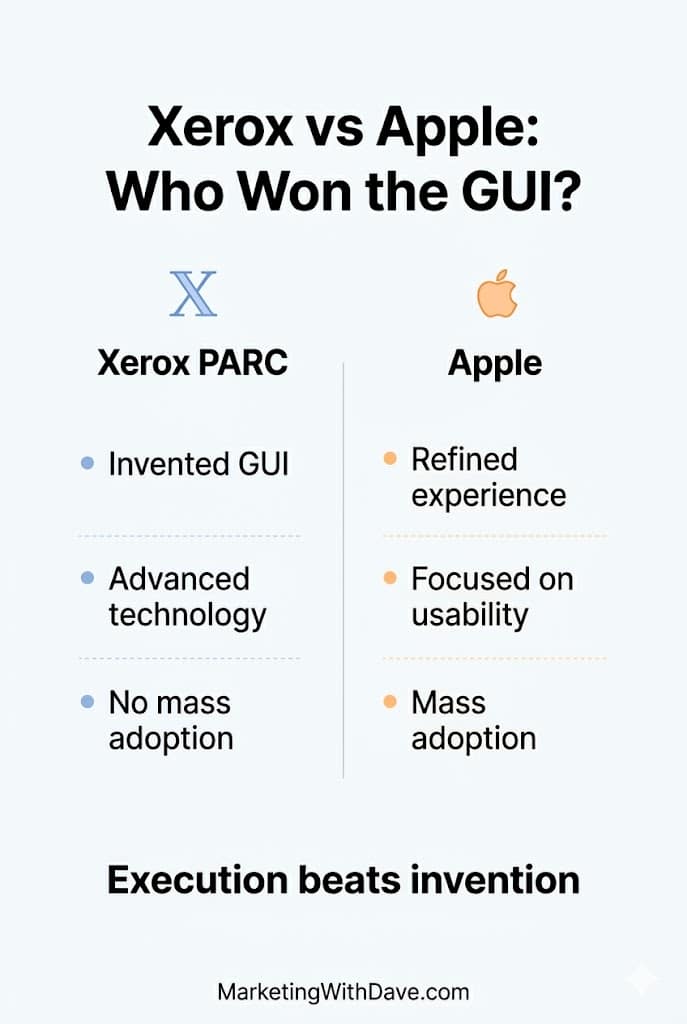
Xerox PARC created many of the core technologies behind modern computing, including the graphical user interface, the mouse, and networked personal computers.

Despite inventing these foundational ideas, Xerox failed to bring them to market effectively. Apple later adopted and refined many of these concepts, launching the Lisa and Macintosh and ultimately defining the personal computing category.

This case highlights a recurring truth in marketing and business: innovation alone does not win, execution does.

Company Involved

Xerox Corporation, a technology company best known at the time for its dominance in copiers and document systems.

Marketing Topic

  • Innovation vs. execution
  • Product commercialization strategy
  • Market positioning and category creation

Public Reaction or Consequences

At the time, Xerox’s innovations at PARC were largely invisible to the broader market. The Alto and Star systems were not widely adopted due to high cost, limited distribution, and unclear positioning. Meanwhile, Apple’s Macintosh generated significant public attention and excitement, introducing a wider audience to graphical computing in a more accessible format. Over time, Xerox PARC became widely known as one of the most famous examples of missed opportunity in business history, while Apple was credited with popularizing and commercializing the interface paradigm.

Why It Matters Today

  • Innovation must be paired with a clear path to market
  • Being first does not guarantee leadership
  • Simplicity and usability drive adoption
  • Organizational alignment determines whether ideas scale
  • Category creation matters more than feature invention

3 Takeaways

  1. Execution matters more than invention. Xerox built groundbreaking technology, but Apple translated similar ideas into products people could understand and use.
  2. Market readiness beats technical superiority. The Alto was advanced, but the Macintosh was accessible, which mattered more for adoption.
  3. Innovation must connect to business strategy. Without alignment between research, product, and leadership, even great ideas fail to reach the market.

Notable Quotes and Data

  • Xerox PARC developed the graphical user interface years before it reached mass adoption
  • Apple’s Macintosh (1984) became the defining product that introduced GUI computing to the mainstream

Full Case Narrative

In the 1970s, Xerox PARC (Palo Alto Research Center) was one of the most advanced research environments in the world. Engineers and scientists there developed technologies that would define the future of computing, including the graphical user interface, the computer mouse, and early forms of networked workstations. The Alto computer embodied many of these innovations, offering a vision of personal computing that was years ahead of its time.

Despite these breakthroughs, Xerox struggled to translate innovation into commercial success. The company’s core business was built around copiers and document systems, and its leadership remained focused on that foundation. PARC operated more as a research lab than a product organization, and there was no strong system in place to convert experimental technology into scalable products.

In 1979, Apple engineers visited Xerox PARC and saw these innovations firsthand. What they recognized was not just a set of features, but a new model for how computers could work. Apple took these ideas and focused on making them usable, simplified, and aligned with a clear product vision. This led to the development of the Lisa and, more importantly, the Macintosh.

While the Macintosh was not as technically advanced as some PARC systems, it was designed for real users. It was more approachable, more affordable, and built as a cohesive product rather than a research demonstration. Apple’s focus was not on inventing the interface, but on delivering it in a way that people could adopt.

Xerox built breakthrough technology but never built a distribution strategy to match. Apple didn’t just simplify the interface. They controlled how it reached users. Distribution, not invention, is what ultimately determines who wins.

Xerox eventually attempted legal action against Apple, claiming improper use of its ideas, but the effort failed. By that point, the market had already moved. Apple had established itself as a leader in personal computing, and the opportunity Xerox once held had passed.

The failure was not technological. It was strategic. Xerox had the innovation but lacked the execution, alignment, and market focus to capitalize on it. Apple succeeded because it connected product, usability, and go-to-market strategy into a unified approach.

Timeline

1970s: Xerox PARC develops the Alto and foundational GUI technologies

1979: Apple engineers visit Xerox PARC

1981: Xerox releases the Star workstation

1983: Apple launches the Lisa

1984: Apple launches the Macintosh

Late 1980s: Xerox pursues legal action against Apple

What Happened Next?

Xerox continued to operate as a leader in document technology but did not establish itself in personal computing. Apple built on the success of the Macintosh and continued refining the graphical interface, eventually shaping modern computing experiences across devices. Xerox PARC remains respected as an innovation hub, but its legacy is often defined by what it failed to commercialize.

One Sentence Takeaway

Inventing the future is not enough if you cannot bring it to market.

Sources

Computer History Museum: Xerox PARC

Stanford Libraries: The Xerox PARC Visit

Xerox PARC Report: Alto

Xerox Corp. v. Apple Computer, Inc.

Case Study: Xerox – The GUI That Apple Took to Market Read More »

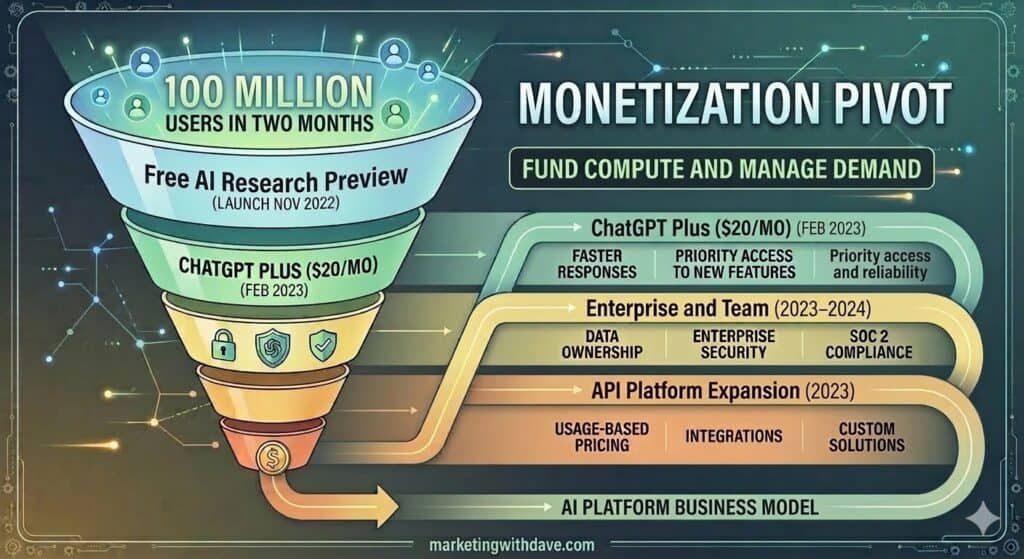
case study openai chatgpt monetization pivot 1

Case Study: OpenAI’s Monetization Pivot From Free AI to ChatGPT Plus

Reading Time: 4 minutes

Brief Summary

OpenAI launched ChatGPT as a free research preview to maximize adoption, collect feedback, and establish product habit. After rapid viral growth, it introduced paid tiers to manage demand and fund compute: ChatGPT Plus for individuals, enterprise offerings for organizations, and usage-based monetization through the API platform.

Over time, OpenAI layered additional tiers and began testing ads on lower-cost plans while publicly emphasizing that ads would not influence answers, highlighting the central tension in its monetization strategy: scale revenue while protecting trust, privacy, and a mission-led brand.

Company Involved

OpenAI (openai.com) is the organization at the center of this case study, with ChatGPT as the primary consumer product that created a mass-market funnel for paid subscriptions and enterprise adoption.

Marketing Topic

  • Strategy
  • Product positioning
  • Customer experience

Public Reaction or Consequences

ChatGPT’s free research preview turned into a cultural moment and a usage surge so large that it created both opportunity and pressure. OpenAI’s early positioning emphasized learning from users and collecting feedback, with free access during the research preview.

The product’s adoption curve quickly became part of the story itself. Reuters reported a UBS estimate that ChatGPT reached 100 million monthly active users in January 2023, roughly two months after launch, with Similarweb data cited in the same report. That scale made monetization feel less like an optional business decision and more like an inevitable next step to support infrastructure costs.

The subscription rollout for ChatGPT Plus introduced a clear trade: pay to avoid capacity constraints and get priority access. OpenAI framed Plus around general access during peak times, faster responses, and priority access to improvements.

As organizations began experimenting with ChatGPT, the dominant friction shifted from capability curiosity to risk concerns: data privacy, compliance, and deployment control. OpenAI’s enterprise positioning directly addressed those buyer objections, emphasizing ownership and control of business data, a claim that enterprise data is not used for training, plus security and compliance signals such as SOC 2 and encryption.

Why It Matters Today

• Freemium can be a deliberate research and distribution strategy when feedback loops and habit-formation are part of the product’s defensibility.

• Subscription tiers can be positioned around access and reliability first, which is often easier to sell than abstract feature bundles during rapid growth.

• Enterprise monetization in AI is as much about trust, security, and data governance as it is about model capability.

• AI vendors are increasingly balancing subscriptions with advertising on lower-cost tiers, but the trust constraints are higher than traditional search or social products because users treat conversations as personal and sensitive.

• OpenAI’s public messaging shows a modern monetization tension: fund compute-intensive products while insisting mission, privacy, and answer quality remain protected.

Takeaways and Notable Data

1. Freemium can be your fastest distribution channel, but it only works long-term if you design clear conversion paths tied to user pain, such as access, latency, or higher usage limits.

2. Enterprise monetization requires trust features that product marketing can explain in plain language: data ownership, training exclusions, and compliance signals that procurement teams recognize.

3. If you introduce ads in an AI assistant, you must explicitly separate incentives from outputs and communicate privacy boundaries, or you risk breaking the user’s mental model of objective assistance.

Notable Quotes and Data:

• Reuters reported a UBS estimate that ChatGPT reached 100 million monthly active users in January 2023, two months after launch.

• OpenAI priced ChatGPT Plus at $20 per month and positioned it around better access during peak times, faster responses, and priority features.

• OpenAI positioned ChatGPT Enterprise around business data control and stated it does not train on business conversations, while also highlighting SOC 2 compliance and encryption.

Full Case Narrative

OpenAI’s monetization story is easier to understand if you separate the narrative into three layers: a consumer growth engine, an enterprise trust engine, and a developer usage engine.

The consumer growth engine began with a research-preview framing. OpenAI introduced ChatGPT as a way to gather user feedback on strengths and weaknesses, and stated that usage was free during the research preview.

This free access acted like a massive public demo, and it turned the product into a social object that people shared. Reuters reported that ChatGPT was made available for free public testing on November 30, 2022, and that usage quickly reached over a million users within about a week.

Once the flood of demand was undeniable, OpenAI’s next challenge was sustainability. OpenAI has described the capital intensity of building advanced AI and said it estimated needing to raise on the order of $10 billion to build AGI, linking mission ambition directly to funding requirements.

The first mainstream consumer monetization step was ChatGPT Plus, positioned around reliability and access rather than only features.

Next came the enterprise trust engine, positioned around ownership and control of business data, training exclusions, and compliance signals such as SOC 2 and encryption.

In parallel, the developer usage engine monetized through the API platform with token-based pricing. OpenAI documented that, as of March 1, 2023, data sent to the OpenAI API is not used for training unless a customer opts in.

Over time, OpenAI expanded segmentation through additional plans, and then moved toward advertising on lower-cost tiers while stating that ads do not influence answers and that conversations remain private from advertisers.

Timeline

• November 30, 2022: ChatGPT launched for free public testing as a research preview.

• February 2023: ChatGPT Plus launched at $20 per month.

• March 1, 2023: OpenAI documented that API data is not used for training unless customers opt in.

• August 2023: ChatGPT Enterprise announced with enterprise security and privacy positioning.

• January 2024: ChatGPT Team introduced for self-serve business adoption.

• December 2024: ChatGPT Pro introduced at $200 per month.

• January to February 2026: OpenAI announced and began testing ads for Free and Go tiers, alongside published trust and privacy commitments.

What Happened Next?

Reuters reported that OpenAI’s CFO said annualized revenue exceeded $20 billion in 2025, alongside a major increase in computing capacity, reinforcing the business logic behind layered monetization.

One Sentence Takeaway

A free research preview created the largest possible top-of-funnel for habit formation, and OpenAI monetized the resulting demand by selling reliability, trust, and integration while trying to protect the integrity of its answers.

Sources and Citations

OpenAI: Introducing ChatGPT Plus

OpenAI: Introducing ChatGPT

Reuters: ChatGPT Sets Record for Fastest-Growing User Base

OpenAI: API Pricing

TechCrunch: OpenAI Launches ChatGPT Plus, Starting at $20 Per Month

Case Study: OpenAI’s Monetization Pivot From Free AI to ChatGPT Plus Read More »

case study twitter acquisition

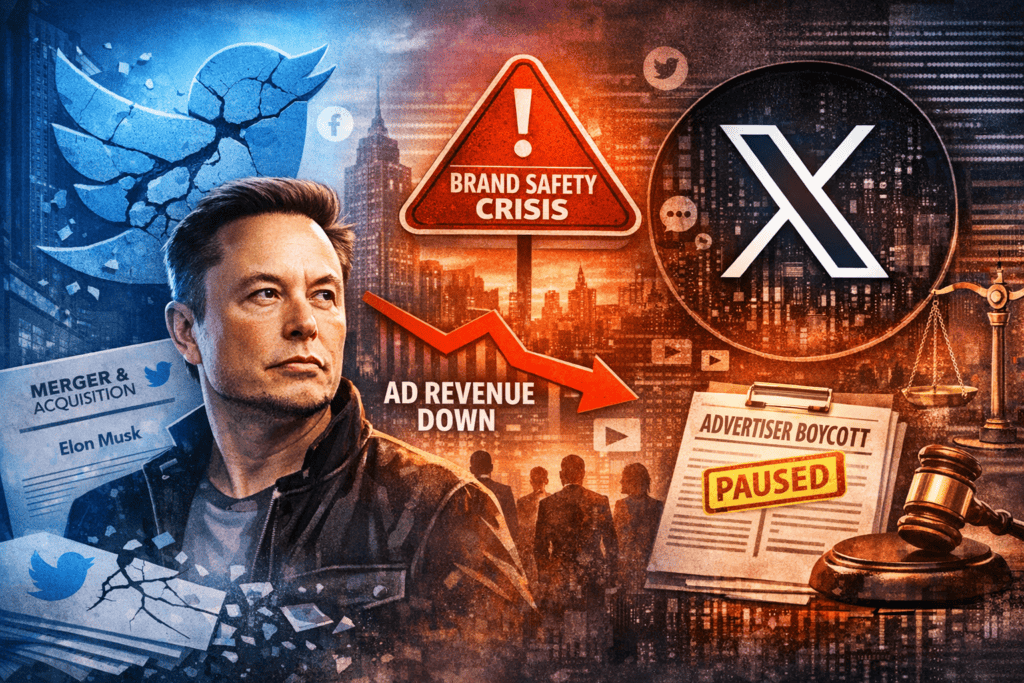
Case Study: Elon Musk’s Twitter Acquisition and the Brand Safety Crisis for Advertisers

Reading Time: 5 minutes

Brief Summary

In 2022, Elon Musk turned an acquisition attempt into a public spectacle: he made an unsolicited bid to buy Twitter, the board deployed a poison pill, the parties signed a deal, litigation followed when he tried to exit, and the transaction ultimately closed in late October 2022.

The marketing lesson is not only about platform volatility.

It is about how quickly advertiser trust can collapse when governance, moderation, verification, and brand identity shift at the same time, and how hard it is to rebuild once brands decide the downside risk is not worth the reach.

Company Involved and Marketing Topic

Company involved: Twitter, Inc., later reorganized under X Corp. The platform was historically advertising-led: Twitter reported in its 2021 annual filing that advertising services were 89 percent of revenue.

Company website: X

Marketing topic: Branding, crisis response, and advertising trust.

Public Reaction or Consequences

Advertiser anxiety was visible before the deal even closed. In an open message to advertisers on the eve of closing, Musk argued he did not want the platform to become a “free-for-all hellscape” and positioned it as a “common digital town square,” implicitly acknowledging that ad dollars depend on controlled risk.

After the acquisition, several changes compounded marketers’ concerns. Ad market data and reporting described deep pullbacks soon after the takeover, including steep declines in ad spending and a broad pause by top advertisers. Verification and checkmark changes increased impersonation risk for brands. The Twitter-to-X rebrand added confusion and threatened long-built brand equity. In 2024, X escalated conflict with advertisers through a lawsuit alleging an unlawful boycott tied to brand safety standards.

Why It Matters Today

• Brand safety is now treated like supply chain risk: measurable, modeled, and acted upon quickly when governance changes raise adjacency concerns.

• Marketer trust metrics shifted in a durable way. Kantar reported historically low trust and perceived brand safety for X, plus a net 26 percent of marketers planning to reduce spend on X in 2025.

• Platform identity can change faster than marketing planning cycles. The abrupt Twitter-to-X rebrand is a reminder that naming and creative conventions can be disrupted quickly.

• AI integration raises new questions about data use and distribution power. By 2025, Musk’s AI company acquired X and framed the value around shared data, models, compute, distribution, and talent. In early 2026, reporting described further consolidation via a SpaceX and xAI deal.

Takeaways and Notable Quotes

Takeaways for marketers:

1) Treat platform stability as a core buying variable. If policies and leadership direction swing overnight, price that volatility into spend and brand safety requirements.

2) Build an exit-ready paid and organic playbook. Use pre-approved criteria for pausing and reallocating when trust signals drop.

3) Protect distinctive brand assets. The Twitter-to-X transition shows how much value lives in name recognition and cultural habits, and how quickly those can be disrupted.

Notable quotes and data:

• “the bird is freed” from Musk when the deal closed.

• Twitter’s 2021 filing reported advertising services represented 89 percent of revenue.

• Kantar reported only 4 percent of marketers believe ads on X provide brand safety, and marketer trust in ads on X fell from 22 percent in 2022 to 12 percent in 2024.

One sentence takeaway: When a platform’s leadership, policies, and identity change at once, marketers stop buying reach and start buying risk reduction.

Full Case Narrative

Twitter entered 2022 as an advertising driven social platform with global cultural influence and a revenue model heavily dependent on brand advertisers. Most of its revenue came from advertising, and marketer trust in content moderation, adjacency controls, and platform governance played a direct role in media buying decisions. Large brands and agencies evaluated Twitter not only on audience reach, but also on brand safety signals, enforcement policies, and third party measurement support.

In April 2022, Elon Musk disclosed a significant ownership stake and made an unsolicited offer to acquire the company. Twitter’s board responded with a shareholder rights plan designed to slow or deter a hostile takeover attempt. On April 25, 2022, Twitter accepted a merger agreement at 54.20 dollars per share. The proposed acquisition quickly became both a financial and governance story, with public debate around spam accounts, platform transparency, and content moderation philosophy. By July 2022, Musk issued a termination notice, and Twitter filed suit in Delaware to enforce the agreement, turning the acquisition into a high profile legal and reputational battle.

For marketers, uncertainty during this period was not abstract. Platform governance and moderation direction directly affect where ads appear and what content they may appear next to. As the dispute and public criticism escalated, advertisers and agency groups began reassessing platform risk. Brand safety frameworks used by major advertisers rely on predictable policy enforcement, third party verification partners, and consistent rule application. Signals that those systems might change created hesitation in media planning and brand placement decisions.

When the transaction closed in late October 2022, reporting described immediate leadership changes, staffing reductions, and rapid product and policy shifts. Several major advertisers paused or reduced spend shortly after closing, citing brand safety and policy clarity concerns. Agency holding companies and brand safety organizations issued updated guidance to clients about risk controls, adjacency filters, and campaign monitoring on the platform. Industry reporting later described a significant decline in United States advertising revenue following the acquisition, reinforcing how sensitive advertiser behavior is to governance and moderation signals.

In July 2023, Twitter rebranded as X, replacing its long standing name and bird logo with a new identity tied to a broader “everything app” vision. From a marketing perspective, this represented a major brand equity reset. The Twitter name carried strong global recognition and established advertiser associations. The X rebrand introduced both strategic flexibility and brand recognition risk, requiring advertisers and agencies to reevaluate platform positioning, audience expectations, and long term fit within media mixes.

Tensions between platform leadership and advertiser groups continued into 2024, including legal action by X against an advertiser trade group and several brands related to coordinated brand safety standards and alleged boycotts. These conflicts highlighted a structural reality for marketers. Platforms depend on advertiser trust and spend, while advertisers depend on platform safety controls and policy transparency. When that balance is strained, marketing investment becomes more volatile and more diversified across channels.

Subsequent consolidation involving X, xAI, and related companies further shifted how analysts and marketers evaluated the platform. The integration narrative emphasized data, distribution, and ecosystem leverage rather than traditional social media advertising alone. For marketers, the case illustrates how platform ownership, governance philosophy, and brand positioning changes can quickly alter advertiser risk models, media allocation decisions, and brand safety requirements.

What Happened Next?

Marketer confidence stayed fragile for years. Kantar findings pointed to continued pullback intent and very low perceived brand safety. The advertiser relationship moved from cautious engagement to public legal conflict through a 2024 antitrust lawsuit. Strategically, the ownership thesis evolved as X was acquired by Musk’s AI company in 2025, framing the platform as a data and distribution asset for AI development. In early 2026, reporting described another consolidation step involving SpaceX and xAI, reinforcing that the platform’s direction is tied to a broader AI and infrastructure narrative, not only social media advertising.

Sources and Citations

US Securities and Exchange Commission: Twitter 2021 Form 10-K

Reuters: Twitter adopts poison pill (shareholder rights plan)

Reuters: Musk completes acquisition and begins leadership overhaul

US SEC filing: DEFA14A describing merger agreement and process

Courthouse News: Twitter v. Musk complaint PDF

Reuters: Ad spending fell 71 percent in December 2022 (Standard Media Index data)

Reuters: Top advertisers pulled back after takeover (Pathmatics estimates)

Reuters: Paid verification and impersonation risk for brands

Reuters: Twitter rebrands as X and the ad industry reaction

Kantar: Media Reactions 2024 findings on X ad pullback and brand safety perceptions

Reuters: X sues advertiser alliance and brands over alleged boycott

CourtListener: Docket: X Corp v. World Federation of Advertisers

Reuters: xAI acquires X (deal framing around data and distribution)

Reuters: SpaceX and xAI consolidation reported in early 2026

Case Study: Elon Musk’s Twitter Acquisition and the Brand Safety Crisis for Advertisers Read More »