AI

Optimize your digital visibility with search, AI answers, and AI tools for better marketing results.

What Actually Drives Digital Visibility in 2026

Reading Time: 8 minutes

SEO, GEO, AIO.

If you spend any time in marketing right now, it can feel like a new acronym shows up every week. Some of these ideas are useful. Some are just repackaged concepts. And some create more confusion than clarity.

The real issue is not the acronyms themselves. It is losing sight of what actually drives visibility. This post is not about adding another term to the mix. It is about simplifying what matters and giving you specific actions you can take today.

Because the goal has not changed. You still need to get found, get mentioned, and continuously improve how you execute. The difference is that those outcomes now happen across more than one system, and the mechanics of each system have shifted significantly since 2024.
The shift from SEO alone to broader digital visibility

For years, SEO was the strategy. If your content ranked, you won visibility. That model still matters, but it is no longer complete.

People still search, but they are increasingly asking AI tools direct questions as part of the same journey. This shift is no longer theoretical. AI-generated answers are showing up more often, especially for longer and more complex queries, and when they do, they can reduce how often users click through to traditional search results.

At the same time, the relationship between search rankings and AI citations is weakening. Ranking highly still helps, but it does not guarantee that your content will be included in an AI-generated answer. In practice, search visibility and AI visibility are becoming related but distinct outcomes that require slightly different approaches.

At the same time, marketers are using AI internally to move faster and make better decisions.

Visibility is no longer tied to a single channel. It exists across search engines, AI-generated answers, and the systems you use to execute your work.

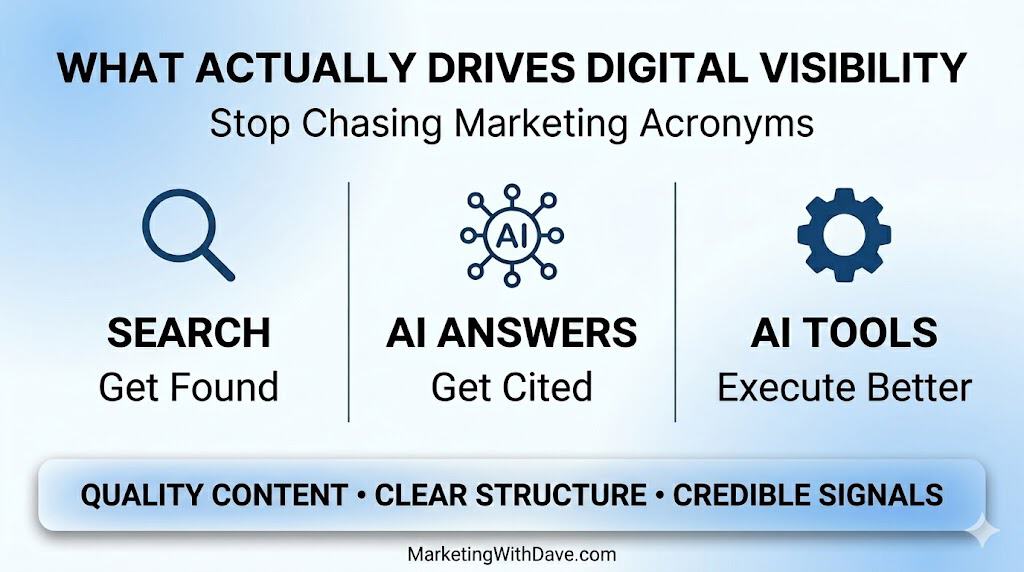
This is why it is more helpful to think in terms of three connected areas: SEO drives discovery, AI visibility influences whether your brand shows up in answers, and AI tools improve how you execute your marketing.

What the “SEO alphabet soup” gets wrong

Terms like GEO (Generative Engine Optimization) and AIO (AI Optimization) are starting to show up more often — along with AEO, LLMO, GSO, and half a dozen others. The challenge is that most marketers do not actually think in acronyms. They think in outcomes.

When you translate these terms into what they represent, things become much clearer. SEO is about being found in search engines. GEO is about being included in AI-generated answers. AIO is about using AI to improve execution.

The ideas themselves are not new. What is new is the environment they operate in. The risk is that the terminology can make simple concepts feel more complex than they need to be. Clarity is more valuable than clever naming.

SEO still drives discovery

SEO remains the foundation of digital visibility. It is still how people find your website when they are actively looking for answers — and Google still accounts for roughly 80% of global search query volume.

That foundation is built on things that are not new, but are still often overlooked:

  • Your website needs to be technically sound, easy to crawl, and easy to navigate.
  • Your internal linking should support discovery and context.
  • Your content should match search intent, not just target keywords.
  • Your authority should be reinforced through credible backlinks.

This is what drives qualified traffic. If this layer is weak, everything else becomes harder.

One nuance worth noting: the relationship between Google rankings and AI citations is decoupling. Ranking highly in traditional search still improves your chances of being cited — pages at position 1 have roughly a 58% chance of being cited by ChatGPT, dropping to 14% by position 10. A meaningful portion of frequently cited pages in AI answers have little or no traditional search visibility.

AI visibility shapes how your brand is mentioned

AI visibility is different from SEO, even though they are closely related. In search, you are competing for rankings. In AI systems, you are influencing whether your content is included in an answer.

When someone asks a question in an AI tool, they may never see a list of results. Instead, they see a summary, a recommendation, or a synthesized response. Your content can still play a role in that answer, but the mechanism is different — and several specific factors influence whether you get included.

Make sure AI crawlers can actually access your site

This sounds obvious, but it is the most commonly overlooked step. Check your robots.txt file for blocks on GPTBot, PerplexityBot, ClaudeBot, or Google-Extended. If you use Cloudflare, check its bot management settings — Cloudflare changed its defaults and may be blocking AI crawlers without you knowing. Also check that important content is server-side rendered and not hidden behind JavaScript or login walls.

Structure your content for extraction, not just browsing

AI systems pull short passages from pages and synthesize them. Content that presents clear ideas, well-organized sections, and credible information is easier to interpret and more likely to be referenced. Practically, this means:

  • Lead each section with a direct answer before providing context
  • Use clear heading hierarchies (H2, H3) with one topic per section
  • Include a well-structured FAQ section that mirrors how people actually ask questions
  • Add an explicit definitional sentence near the top of each page (AI systems weight the first 150–200 words heavily)

Add citations and data — they increase your chances of being cited

Princeton’s GEO research (published at KDD 2024) found that adding citations and statistics to content can boost AI visibility by up to 40%. This is among the highest-impact tactics identified. Link to authoritative external sources at the claim location, not just in a references section. Include specific data points where you have them.

Build external mentions and presence beyond your website

AI systems pull heavily from Reddit, LinkedIn, and YouTube — not just your own domain. Platforms like Reddit and YouTube are disproportionately represented in AI citations compared to most brand-owned websites. Brand mentions, thought leadership posts, and community participation on these platforms contribute to how AI systems perceive your authority. Unlinked brand mentions also appear to carry meaningful weight.

Consider an llms.txt file

Some sites are now adding an llms.txt file (similar in concept to robots.txt) to help AI systems understand their site structure and which pages are most authoritative. It is an emerging convention, not a universal standard yet, but worth considering for sites with a large content archive.

Keep content fresh

Freshness matters more for AI visibility than it did for traditional SEO, particularly on Perplexity and Google AI Mode. Content that has not been updated loses citation priority faster. A simple version note (“Last updated May 2026”) and periodic substantive updates to key pages can help maintain your visibility in AI answers.

What is important to understand about all of this is that it is influence, not control. You are not optimizing a ranking position in the same way. You are increasing the likelihood that your content is trusted and included.

AI tools improve execution

The third piece of this framework is internal. AI tools are changing how marketing work gets done.

They can support content workflows, speed up production, automate repetitive tasks, and help surface insights more quickly. Used well, they can make teams more efficient and more effective.

But AI tools are not a visibility channel by themselves. Using AI does not automatically lead to more traffic or more mentions. It simply improves how you execute.

That distinction matters, because it is easy to overestimate the impact of tools while under-investing in strategy.

The alignment core: what works across everything

At the center of all of this are three consistent factors: quality content, clear structure, and credible signals.

AI systems are not just evaluating pages. They are evaluating entities.
Consistent brand mentions, author identity, and presence across multiple platforms help reinforce credibility beyond a single web page.

These are the elements that support SEO performance. They are also the elements that increase the likelihood of being cited or summarized by AI systems. And they are what make AI tools more effective when you use them.

No matter how the landscape evolves, these fundamentals continue to show up. If your content is shallow, unclear, or difficult to interpret, it will struggle in every environment.

Before you jump to GEO, get the fundamentals right

One of the biggest risks right now is jumping straight into AI visibility tactics without a strong foundation.

If your content is not clear, not structured well, and not providing real value, focusing on GEO will not fix that. AI visibility builds on what is already there. It does not replace it.

Before you prioritize AI visibility, make sure:

  • Your content is clear and understandable to a reader who has no context
  • Your pages are well organized with logical heading structures
  • Your internal linking supports discovery across related topics
  • Your content includes real insight, original perspective, or first-hand data — not surface-level summaries
  • AI crawlers are not accidentally blocked on your site

Those are the things that carry across both search and AI systems.

Why you should be careful with industry data

You may have seen recent charts showing how small AI-driven traffic is compared to Google organic. Across most industries, AI referral traffic sits around 1% of total website traffic versus organic search’s roughly 48% share.

But “industry average” does not equal “your reality.”

Your website is not the average. Your audience is not the average. Your content strategy is not the average.

That matters because I see more traffic from AI-driven sources than from Google on my own website. That does not invalidate industry data. It highlights its limitations.

There is also a measurement problem. An estimated 70% of AI-sourced traffic arrives without referrer headers, making it invisible in standard analytics dashboards. If you are only reading your GA4 referral report, you are very likely undercounting how much AI is influencing your visitors. A good way to check: look at direct traffic trends alongside any AI visibility changes, and consider adding “How did you hear about us?” options that include AI tools to your contact or inquiry forms.

The better approach is to use industry data as context, while letting your own analytics guide your decisions.

How to measure AI visibility

Traditional SEO metrics — rankings, organic sessions, click-through rates — do not capture AI visibility. If you want to know whether your content is being cited, you need to track it separately.

Practical starting points:

  • Manual testing: Define 10–20 queries that are central to your content and test them regularly in ChatGPT, Perplexity, Google AI Mode, and Gemini. Note whether your brand is mentioned and where it appears in the answer.
  • Brand search trends: Monitor branded search volume in Google Search Console. Increases following AI mentions suggest influence even without direct referral clicks.
  • Direct traffic analysis: Users who encounter your brand in an AI answer often type it directly rather than clicking a link. Watch for unexplained direct traffic increases alongside any improvements in AI presence.
  • Dedicated tools: Platforms like BrandMentions, Semrush’s AI visibility features, and purpose-built tools like LLMrefs track citation rates across AI engines if you want more systematic monitoring.

A simple way to evaluate your content

Instead of focusing on acronyms, focus on outcomes. When you look at a piece of content, ask three questions:

  1. Can it be found? Is it technically accessible, well-structured, and targeting the right intent?
  2. Can it be understood and cited? Is it clear, well-organized, factually grounded, and does it include original insight or data?
  3. Can it be created and improved efficiently? Are you using your tools and workflows well enough to keep this content current?

If any of those answers are no, there is an opportunity to improve.

Final takeaway

You do not need to chase every new acronym that appears.

You need to understand what actually drives visibility.

SEO drives discovery. AI visibility shapes how your brand is included in answers. AI tools improve execution.

The advantage comes from aligning all three — and making sure the basics are solid before you layer on AI-specific tactics.

And before you follow any industry trend, make sure you understand what is actually happening on your own website.

What Actually Drives Digital Visibility in 2026 Read More »
Blazly Review: AI-Driven SEO and GEO Visibility Platform

Reading Time: 6 minutes

Blazly positions itself as an all-in-one AI SEO and GEO platform built to help you move from keyword to published content while also tracking AI visibility, competitor gaps, and GEO health.

That is a compelling pitch. It combines content generation, publishing, AI visibility analysis, competitor research, citation flow, GEO crawls, prompt tracking, and brand sentiment in one platform.

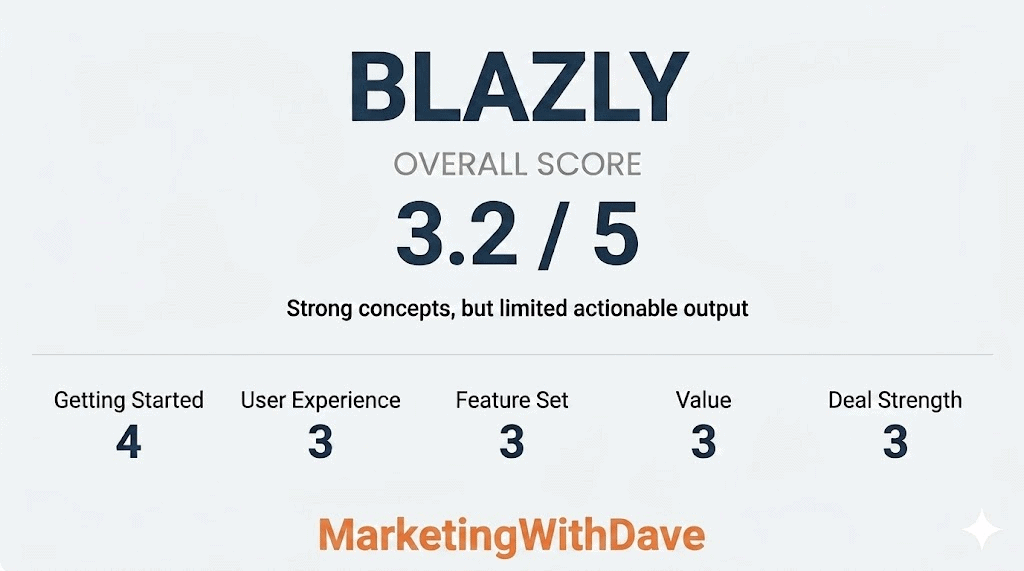
After spending time inside the product, my take is that Blazly is visually polished and clearly built by a responsive team, but many of the outputs felt more exploratory than actionable. There is real potential here, but in its current state I found more interesting ideas than clear decision support.

Blazly introduces strong concepts around AI visibility and GEO, but the outputs often stop short of clear, actionable next steps.

The overall score reflects both product quality and how compelling the current deal is.

A score in the 3 range reflects a product with solid ideas and usable features, but with clear gaps in execution or actionability.

See how this score is calculated

See the AppSumo Deal

Affiliate disclosure: If you buy through my AppSumo link, I may earn a small commission at no additional cost to you. I only share tools I believe are worth your time and consideration.

The 30-Second Decision

Best for: marketers, bloggers, content creators, and solopreneurs who want to explore AI SEO and GEO workflows in one platform and are comfortable testing an early-stage category.

Not ideal for: website owners who mainly want highly actionable insights tied directly to real rankings, measurable demand, and clear next steps.

Entry price: Tier 1 was listed at $79 lifetime on AppSumo.

Risk window: 60-day refund through AppSumo.

My take: Blazly has strong presentation, ambitious scope, and a founder who is highly engaged. The challenge is that several features looked more insightful than they felt useful in practice.

Try Blazly on AppSumo

What Blazly Is Trying to Do

Blazly is not just a writing tool. It is trying to be a broader AI SEO and GEO operating system.

Based on the AppSumo listing, the platform combines content generation, direct publishing to WordPress and Webflow, competitor visibility analysis across AI platforms, GEO crawls, internal linking analysis, AI citation flow, AI visibility tracking, prompt tracking, and brand sentiment analysis.

That breadth is part of the appeal. Instead of piecing together multiple tools, Blazly tries to put modern search, AI visibility, and publishing workflows in one place.

What I Liked

The first thing Blazly gets right is presentation. The product looks polished, modern, and easy to explore. Several features are packaged in a way that makes the platform feel substantial quickly.

I also came away with a positive impression of the team. Jerry was responsive, helpful, and open to feedback. That matters, especially in an early-stage category where the product is still evolving.

I also think the core direction makes sense. AI search visibility, citation patterns, and GEO-style website analysis are real areas of interest. Blazly is clearly trying to build for that future rather than only for yesterday’s SEO workflows.

Where the Product Started to Break Down

The main issue was not lack of features. It was the gap between interesting analysis and usable action.

My standard for tools like this is not whether the concepts are interesting, but whether the outputs help a website owner decide what to do next with confidence.

Several outputs felt difficult to validate against real demand, rankings, or user behavior in a way that made prioritization easy. The platform often answered, “Here is something interesting,” more clearly than it answered, “Here is what you should do next.”

Prompt Tracking Felt More Like Prompt Generation

In theory, prompt tracking sounds useful. If AI search increasingly behaves like prompt-driven discovery, understanding prompts could become a form of keyword research for LLMs.

In practice, what I saw looked more like synthetic prompt generation than true prompt intelligence. The outputs resembled traditional keyword rewrites and variations more than something I could clearly connect to validated user demand.

That does not make the feature useless, but it does change what it is. For me, it worked more like an idea generator than a dependable source of prioritization.

AI Citation and Sentiment Features Were Interesting but Hard to Act On

Blazly also includes AI citation flow and brand sentiment analysis. These are visually strong features that can surface which domains or platforms appear in AI responses and how the platform interprets brand sentiment across tools like ChatGPT, Gemini, Claude, Perplexity, and Grok.

The challenge is actionability. It is one thing to show a citation pattern, a diversity score, or a sentiment label. It is another to connect that output to a specific, defensible action that would improve visibility.

In my testing, that bridge often felt weak. I found myself learning what the platform thought was happening without gaining much confidence in what I should prioritize next.

The Internal Linking Feature Highlighted a Bigger Industry Gap

One of the more interesting parts of my testing was the internal linking analysis.

Blazly’s version looked polished and gave a quick snapshot of internal link structure, orphan pages, and scoring categories. But it mostly reinforced a broader problem I already see across this category: many internal linking tools are good at audits and weak at decisions.

Counting links, scoring navigation, and flagging orphan pages can be useful. But website owners usually need more than that. They need help deciding which web page should link to another web page, why the recommendation makes sense, and where the link belongs in context.

That deeper layer was still missing here.

Some Recommendations Felt More Speculative Than Proven

Another friction point was the recommendation layer itself.

For example, recommendations around ai.json and large AI-specific robots.txt additions may sound forward-looking, but they are not areas I currently see as proven, high-impact work for most website owners.

That matters because tools shape attention. When a product recommends implementation work that is still speculative, it risks pushing users toward busywork instead of higher-value improvements like clearer content structure, stronger internal linking, better positioning, and more useful web pages.

Setup and Ease of Use

The product is relatively easy to explore. The interface is modern, organized, and feature-rich. The bigger issue for me was not how to click through the platform. It was how much confidence to place in the resulting outputs.

I also ran into some friction around reliability and continuity. Certain analyses did not feel as persistent as they should be, and some features seemed to require rerunning or rebuilding when revisiting the web page.

That may sound minor, but it matters. A product like this needs to reduce friction, not create more of it.

Plans and Pricing

Tier 1 was listed on AppSumo at $79 lifetime and included 3 projects, 15 GEO, AEO, and SEO articles per month, 5 AI GEO landing pages per month, 10 strategy generator runs, 3 AI citation flow runs, prompt tracking, integrations, GEO health score, and AI content in your voice.

Higher tiers increase project limits, article limits, AI citation flow runs, competitor research, AI monitor analysis, AI visibility tracker, white-label reports, and CSV reports.

On paper, the pricing looks generous relative to the number of features included. The real question is not feature count. It is whether those features create enough practical value to become part of your workflow.

Check Current Pricing and Tiers

Why You Might Still Buy It

  1. You want to explore the AI SEO and GEO category without paying enterprise-level prices.
  2. You value breadth and want many experimental features in one place.
  3. You are comfortable using the tool as an exploratory layer rather than expecting fully mature decision support.
  4. You believe the team will continue improving the product quickly.

What to Watch Out For

  1. A long feature list does not automatically equal practical value.
  2. Several outputs felt difficult to validate in ways that made prioritization easy.
  3. Some recommendations appear more future-facing than validated.
  4. If you mainly want clear next actions, Blazly may feel less actionable than it first appears.
  5. If your website is content-heavy, you should pressure-test crawl depth and feature limits carefully.

Additional Context from the Founder

After I published my initial review, the founder shared more context around how several features are intended to work.

According to that explanation, prompt tracking is based on real prompts, citation flow is designed to help identify sources that influence AI answers, and some GEO recommendations are based on emerging concepts and internal testing rather than long-established standards.

That context is helpful and makes the product direction clearer.

Even with that added explanation, I still found it difficult to translate many of the outputs into clear, prioritized next steps for my website today. That remains the central reason for my score and overall conclusion.

Bottom Line

Blazly is easy to admire at first glance. It looks modern, covers a lot of ground, and clearly aims at a category that is growing in importance.

But after removing the presentation layer, my experience was that many features were more interesting than useful. The platform often surfaced ideas, labels, and scorecards without giving me enough confidence in what was truly actionable or worth prioritizing.

That does not make Blazly a bad product. It makes it an ambitious early-stage product in a category that still has a long way to go.

If you want a broad AI SEO and GEO sandbox with an engaged team behind it, Blazly may be worth exploring.

If you want a tool that consistently turns insight into action, I would go in with more caution.

Get Blazly Lifetime Access

Disclaimer

This content is for educational purposes and reflects my experience and research. Always evaluate tools based on your specific business needs, goals, and workflows before making a decision.

Looking for more marketing software reviews? See my full list of marketing tools and software I recommend.

Blazly Review: AI-Driven SEO and GEO Visibility Platform Read More »

How to Create Content That Gets Cited in AI Search

Reading Time: 5 minutes

Ranking a web page used to be the goal. Increasingly, it is only the starting point. AI search does not surface the best-ranked page. It surfaces the most useful passage. That distinction changes what good content actually looks like.

Traditional SEO still matters, but the bigger opportunity now is creating content that AI systems can retrieve, understand, and cite. That requires a different way of thinking about what you publish.

This shift changes the rules. It puts more pressure on clarity, structure, and usefulness. It also raises the bar for marketers who still write content as if ranking for a keyword is the only thing that matters.

Why Most Content Fails in AI Search

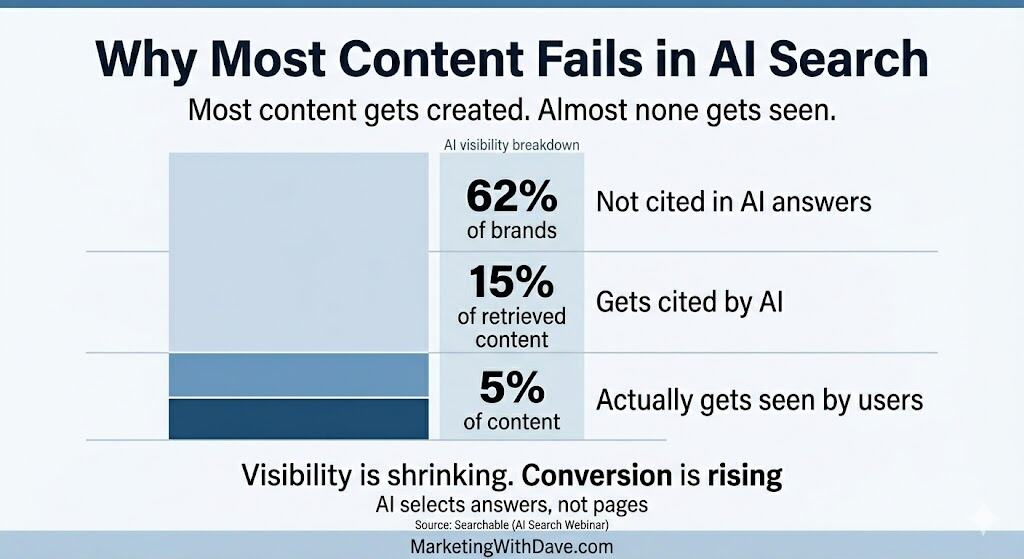
One of the clearest signals in AI search right now is how little content actually breaks through. Based on data shared in a Searchable webinar, roughly 62% of brands are not cited at all, about 15% of retrieved content earns a citation, and only around 5% actually reaches the user.

That matters because AI search is a filtering system. Content is not just competing to rank. It is competing to be selected. In that environment, weak structure, generic writing, and bloated content become even bigger liabilities.

At the same time, the opportunity is still meaningful. AI-referred visitors often convert at a much higher rate than traditional organic traffic. That means visibility may be shrinking, but intent is often stronger when your brand does get surfaced.

The Shift From SEO to AI Search

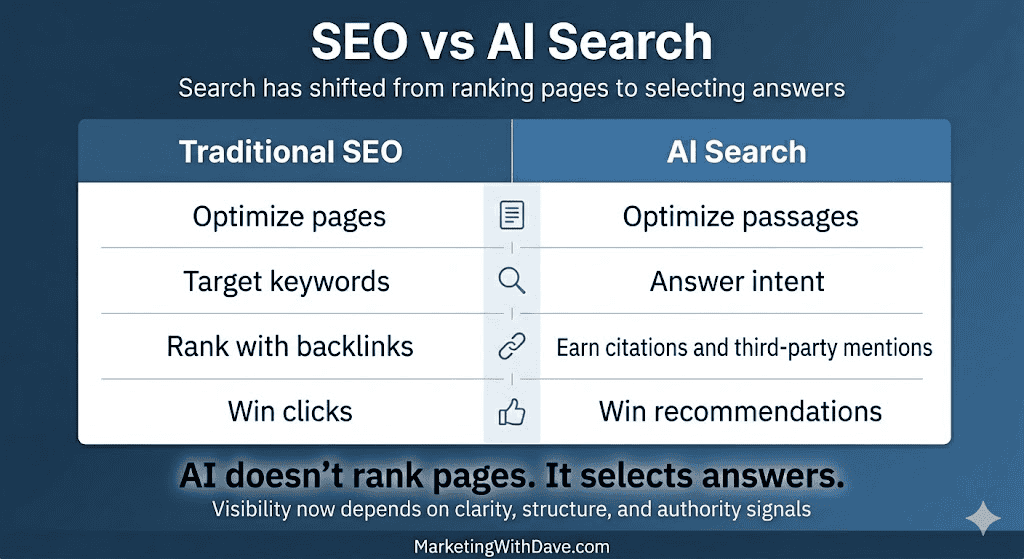
Search has moved from ranking web pages to selecting answers. That does not mean SEO is obsolete. It means the bar for what qualifies as useful content has changed.g

AI systems are not trying to rank everything. They are trying to choose the best answer.

Traditional SEO focused heavily on optimizing entire web pages, targeting keywords, building backlinks, and winning clicks. AI search still benefits from many of those foundations, but it often works at the passage level instead of the full web page level. It looks for sections that can answer a question clearly and credibly.

This is why the mental model matters. If you still think only in terms of web pages and rankings, you will miss how AI systems retrieve and surface information. The better approach is to think in terms of passages, intent, citations, and recommendations.

A Simple Framework for Content That Gets Cited

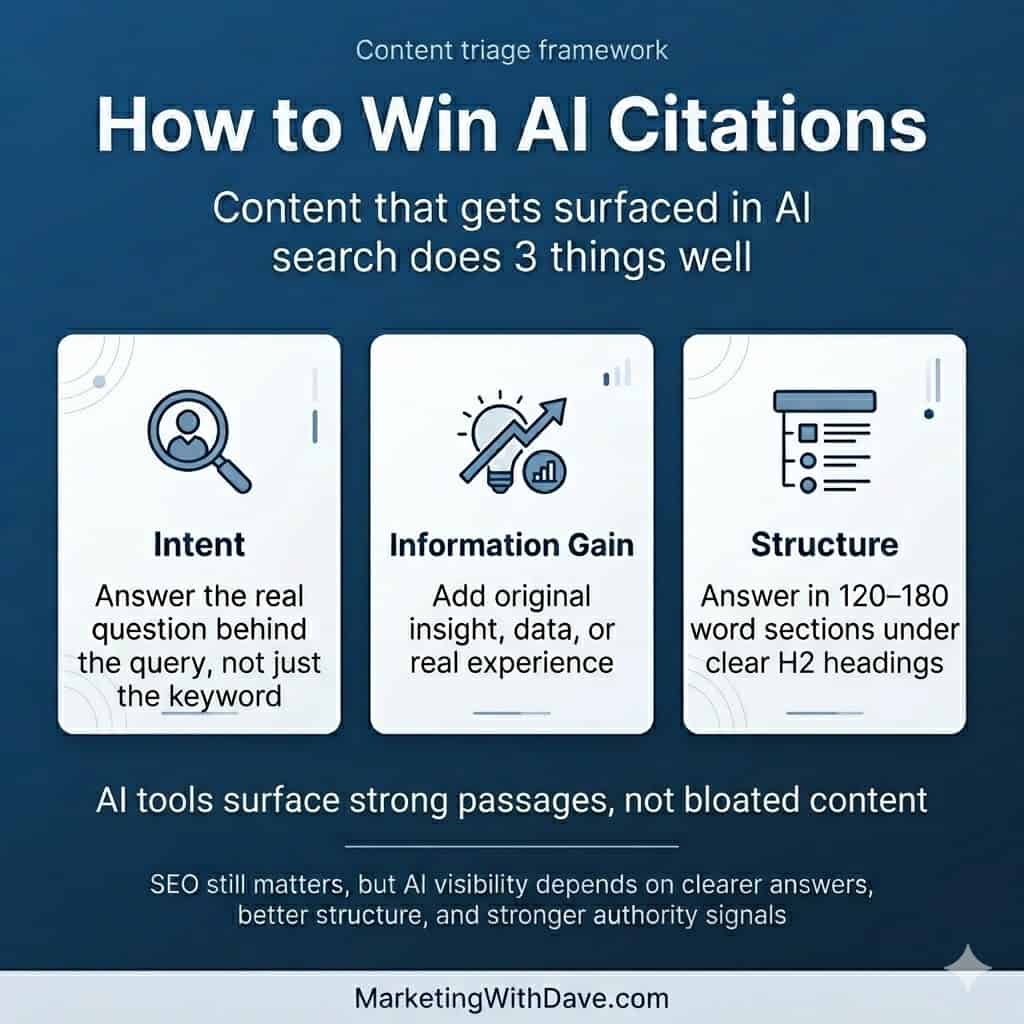
A clear way to approach this is through three elements: intent, information gain, and structure. Together, these create a practical framework for writing content that is more likely to be surfaced in AI-generated answers.

1. Intent

Intent is about answering the real question behind the query, not just matching the keyword. That distinction matters more than ever. A phrase may look informational on the surface, but the hidden user need can be something more specific, more commercial, or more action-oriented.

A similar pattern shows up constantly in marketing queries. Someone might search for “best email marketing tools,” but what they really want is a tool that fits their specific use case, budget, or team size. Content that simply lists tools is less useful than content that helps narrow the decision. That gap between the visible query and the actual need is where stronger content strategy starts.

2. Information Gain

Information gain is what you add beyond the baseline consensus. If every article says the same thing in slightly different words, there is very little reason for AI systems to surface yours. Originality does not have to mean controversy. It usually means adding useful detail, real experience, proprietary data, a stronger synthesis, or a more helpful example.

This is also where real expertise matters. Original testing, lived experience, case studies, and first-hand observations all strengthen content in a way generic summaries cannot.

In practice, this is where most content falls short. Across my own work, I consistently see content that ranks well but adds little beyond what already exists. It summarizes, but it does not contribute. The pieces that perform better are the ones that include a clear point of view, a real example, or a sharper explanation than what is already available.

3. Structure

AI systems retrieve passages, not entire web pages. That is why structure matters as much as the content itself.

Structure is the execution layer. Content should be written so individual sections can stand on their own as complete answers. In practical terms, that means using clear headings, concise sections, direct phrasing, and formats that are easy to parse.

Instead of rambling introductions or filler, the better approach is to answer the question quickly and then support that answer. The presentation also recommended tight sections under clear headings and called out simple formats like tables, bullets, and schema-supported structure as helpful for extractability.

What This Means for Your Content

Most content is written to rank. Very little is written to be cited. If your content still follows the old pattern of stretching topics to hit arbitrary length targets, leading with fluff, or summarizing what everyone else already says, it is likely underperforming in both traditional search and AI search.

The better approach is to write content that is easier to retrieve, easier to extract, and more worth citing. That usually means clearer answers, stronger organization, and more distinctive value.

It also means thinking beyond your own website. Another important point is that AI visibility is often influenced by third-party mentions, earned media, community discussion, and other off-site signals. In other words, what others say about your brand can matter as much as what you publish yourself.

AI search is not replacing SEO. It is building on top of it. Strong organic visibility still helps, but it is no longer the full picture. Brands that want to win in this environment need content that ranks well, reads well, and can be cited well.

That is a higher standard, but it is also a better one. It pushes content toward being more useful, more focused, and more credible.

If your content is not being cited, it is less likely to be seen. That is the real challenge of AI search. The brands that adapt will not just publish more. They will publish clearer answers, add more real value, and structure content in a way AI systems can actually use.

This is not a small tactical change. It is a meaningful shift in how strong content gets discovered.

If you are not sure where to start, pick one post that already ranks and ask a harder question: does this actually answer what someone is trying to do, or does it just match a keyword? Tighten the structure, sharpen the answer, and cut anything that does not add something the reader cannot find in the next result. That is the practical version of writing for AI search, and it is the same thing that makes content worth reading in the first place.

How to Create Content That Gets Cited in AI Search Read More »

why adding a last updated date to your content improes seo, trust, and ai visibility

Why Adding a “Last Updated” Date to Your Content Improves SEO, Trust, and AI Visibility

Reading Time: 5 minutes

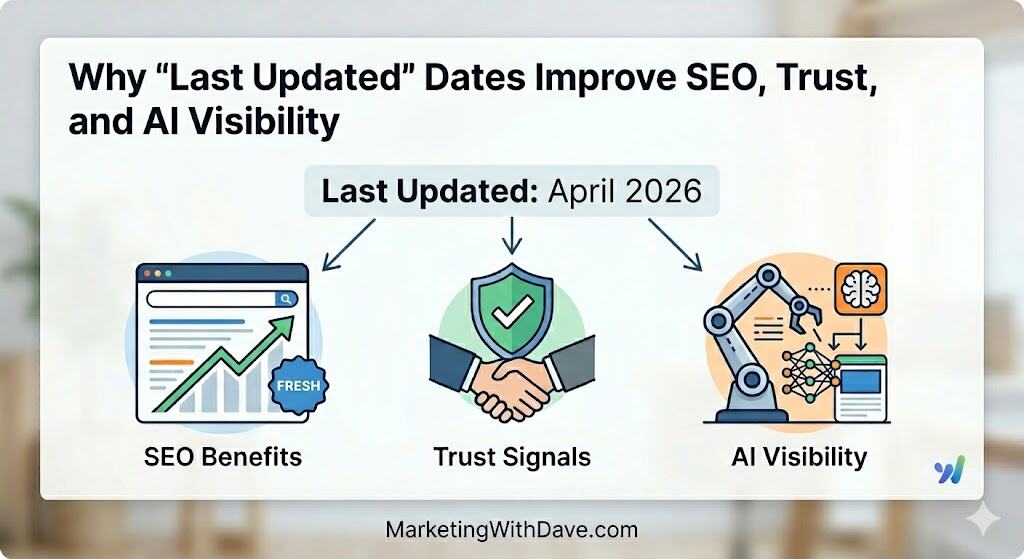
Adding a last updated date to your website content is a small change, but it can send a strong signal to readers, search engines, and AI systems. For content that covers SEO, analytics, AI, digital marketing, and other fast-changing topics, showing that a web page is actively maintained can help reduce doubt before someone even starts reading.

I resisted this idea for a long time because I do not like dating content. A publish date can make something useful look old even when the guidance is still accurate. A last updated date feels different. It does not emphasize age. It emphasizes maintenance.

why adding a last updated date to your content improes seo, trust, and ai visibility

Why a Last Updated Date Matters

When someone lands on a blog post, they often make a quick judgment before reading the first paragraph. They scan the title, the topic, the reading time, and any other metadata near the top of the article. If they see a clear last updated date, that helps answer an immediate question: is this still relevant?

That same signal can also help search engines and AI-driven retrieval systems better understand that your content is current enough to consider. It is not the only factor that matters, but it is a useful one, especially for topics where recency can influence trust and rankings.

Benefits of Showing a Last Updated Date

A visible last updated date can help in several ways:

  • It gives readers a quick trust signal that the content is being maintained.
  • It supports freshness signals for search engines on topics where recency matters.
  • It may improve the likelihood that AI systems view the content as current and relevant.
  • It gives you a better alternative to a publish date if you want content to feel maintained rather than aged.
  • It creates a natural reason to review and improve older web pages over time.

For evergreen content, that last point matters more than it might seem. Even foundational articles usually need updates over time. A framework web page may still need a revised example, a new screenshot, a better internal link, or a more current explanation. A last updated date supports that reality better than a static publish date.

Why This Can Matter for AI Visibility

As more people use AI tools to research, compare, and summarize information, signals of maintenance are becoming more important. These systems are not just evaluating relevance. They are also trying to determine which sources are current enough to trust.

In many cases, your content is not competing against one clearly better result. It is competing against several sources that are all “good enough.” When that happens, smaller signals can influence which source gets selected.

If two articles are similarly relevant, similarly structured, and cover the same topic, the one that appears more current may have an advantage. A clear last updated date does not guarantee selection, but it can help break ties.

This is not about chasing freshness for the sake of it. It is about making real maintenance visible. If you are already improving your content over time, a last updated date is one of the simplest ways to signal that.

Why I Prefer Last Updated Over Publish Date

A publish date tells readers when a piece of content first went live. Sometimes that is useful, especially for news, announcements, and time-sensitive commentary. But for many educational articles, a publish date can work against you. It may create the impression that the content is outdated, even when it has been improved several times since then.

A last updated date shifts the emphasis. Instead of saying, “this was created a long time ago,” it says, “this has been reviewed and improved.” That is a better fit for many how-to articles, resource web pages, and evergreen blog posts.

How to Add a Last Updated Date in WordPress

If your website runs on WordPress, this can usually be done automatically. WordPress already stores the modified date for posts and web pages. The main decision is whether you want to display it with a plugin, a theme setting, or a custom snippet.

One easy option is to use a code snippets plugin such as WPCode Lite. That lets you add a small PHP snippet without editing your theme files directly. It is a practical approach if you want control over the wording, placement, and formatting.

Here is the PHP snippet I used to add a “Last updated” line above the content while excluding the front page and blog index:

add_filter( 'the_content', 'mwd_add_last_updated_date' );

function mwd_add_last_updated_date( $content ) {

    // Only run on the main front-end content area
    if ( ! is_main_query() || ! in_the_loop() || is_admin() ) {
        return $content;
    }

    // Show only on single posts and regular pages
    if ( ! ( is_single() || is_page() ) ) {
        return $content;
    }

    // Exclude front page and blog posts index
    if ( is_front_page() || is_home() ) {
        return $content;
    }

    $updated_date = get_the_modified_date( 'F Y' );

    $updated_html = '<p style="font-size:13px; color:#777; margin-bottom:16px; line-height:1.4;">Last updated ' . esc_html( $updated_date ) . '</p>';

    return $updated_html . $content;
}

This version uses the modified date, formats it as month and year, and places it above the article content. Because it pulls from the modified date, it updates automatically whenever the post is meaningfully revised and saved.

Other Implementation Choices to Consider

There is more than one way to handle this, and the best approach depends on your goals. Here are a few decisions worth thinking through:

  • Whether to show only the last updated date or also keep the original publish date.
  • Whether to use a full date or just month and year.
  • Whether to place the date near the top of the article or farther down the web page.
  • Whether to style it as a quiet metadata element rather than a prominent content block.
  • Whether to use a plugin or a custom PHP snippet.

In my case, I preferred month and year because it feels cleaner and less rigid than a specific day stamp. I also preferred the top-of-article placement because that is where readers already expect to see metadata like category and reading time.

A Few Best Practices

If you add a last updated date, it is worth using it thoughtfully. A few simple rules can help:

  • Only refresh the date when you make a real improvement to the content.
  • Keep the format simple and easy to scan.
  • Make sure the styling does not compete with the title.
  • Use the date as a maintenance signal, not a gimmick.
  • Review older content periodically so the signal reflects actual work.

This is especially important if you want the date to build trust. Readers do not need to know every edit you made, but the signal should still be honest.

Final Thoughts

If you have avoided dating content because you do not want your articles to look old, a last updated date may be the better compromise. It keeps the focus on maintenance rather than age, supports trust, and may help your content stay more competitive in both search and AI-driven discovery.

It is not a magic fix, and it does not replace good content, strong internal linking, or meaningful updates. But it is one of those small changes that can quietly strengthen the way your content is perceived.

For many websites, that makes it worth considering.

Why Adding a “Last Updated” Date to Your Content Improves SEO, Trust, and AI Visibility Read More »

visby llm traffic sources 1

Visby Review: AI Search Visibility and GEO Monitoring Tool

Reading Time: 5 minutes

AI tools are already influencing how people discover brands, but most marketers still cannot see whether they are being recommended or ignored.

Visby helps make that visible. It tracks how your brand appears across AI assistants like ChatGPT, Claude, and Gemini, shows which competitors are winning visibility, and turns those insights into prioritized action.

Visibility is measurable: Visby tracks how often your brand appears across prompts and compares it to competitors.

If you want a clearer view of AI visibility without paying enterprise-level prices, this AppSumo deal is worth a look.

This is a promising tool in an early but increasingly important category. It helps bridge the gap between traditional SEO reporting and how brands actually appear in AI-generated answers.

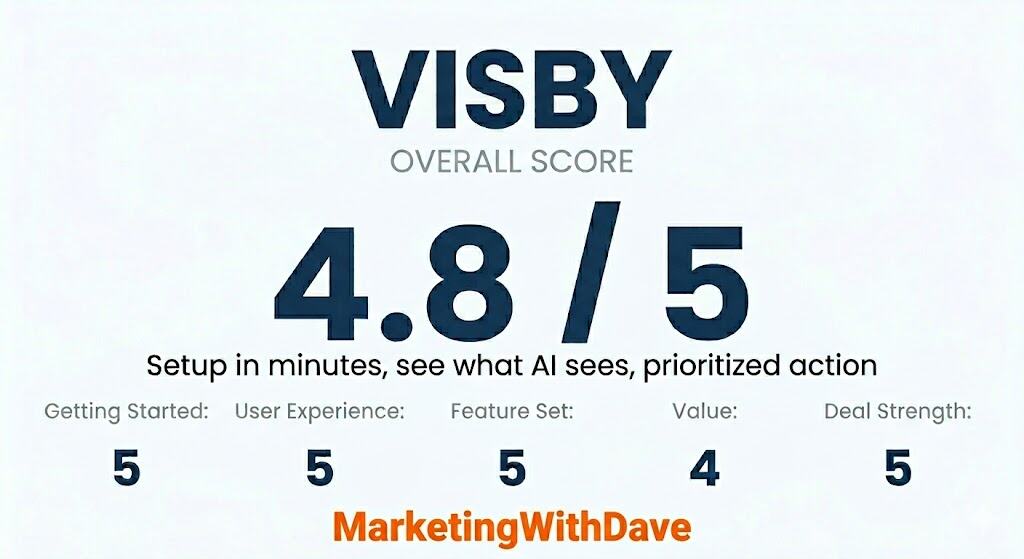
See how this score is calculated

Here’s how to interpret this score:

The overall score reflects both product quality and how compelling the current deal is.

A score in the high 4 range reflects a strong product with clear value and only minor limitations.

See the AppSumo Deal

Affiliate disclosure: If you buy through my AppSumo link, I may earn a small commission at no additional cost to you. I only share tools I believe are worth your time and consideration.

The 30-Second Decision

Best for: marketers, website owners, and teams that want to track how their brand shows up in AI tools and understand which competitors are surfacing instead.

Not ideal for: anyone expecting a full replacement for traditional SEO platforms or a category that is already fully mature and standardized.

Entry price: Tier 1 starts at $59 lifetime for 1 seat, 1 domain, 10 tracked prompts per domain, and 2 article generations per month.

Risk window: 60-day refund through AppSumo.

My take: Visby addresses a real visibility problem that most marketers are not measuring yet. The mix of prompt tracking, competitor comparisons, AI traffic insights, and prioritized recommendations makes it more practical than many tools in this space.

Try Visby on AppSumo

What Visby Helps You See

Most SEO tools tell you how you rank in search engines.

Visby is focused on a different question: when someone asks an AI assistant about your category, does your brand show up at all?

That matters because AI visibility is becoming its own layer of discovery. If your brand is absent from those answers, you may be missing awareness, traffic, and future demand without realizing it.

Visby helps make that gap visible by tracking prompt-level visibility across AI tools, comparing your presence to competitors, and showing how your position changes over time.

What Makes It Useful

The strongest part of Visby is that it does more than report what is happening.

It connects visibility tracking with action. Instead of just showing that competitors are being surfaced more often, it also generates prioritized recommendations tied to your website and content.

Examples from my project included improving title uniqueness, strengthening heading structure, adding more descriptive alt text, implementing article schema, and creating a stronger FAQ section with markup.

That makes the tool more useful than a dashboard that simply tells you that you are behind.

It points toward what to fix next.

AI Traffic Is Already Happening

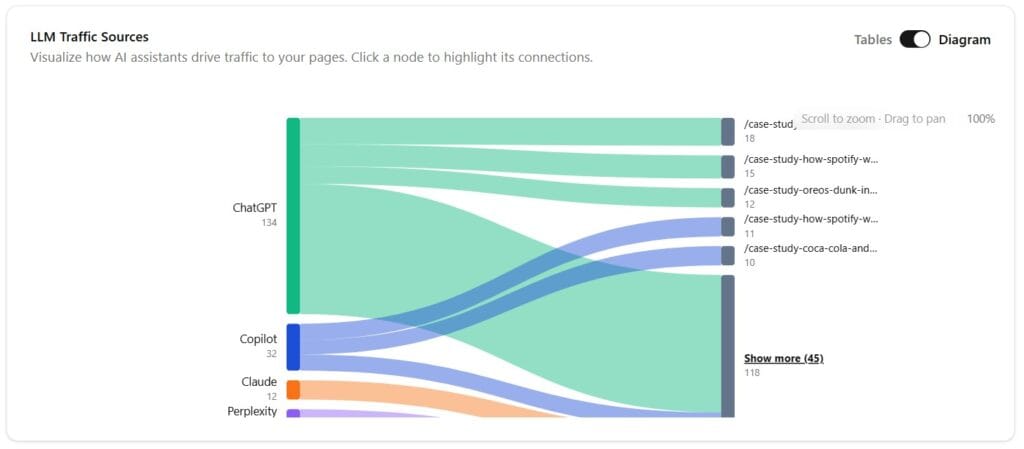
One of the more interesting parts of Visby is its reporting on traffic from AI platforms.

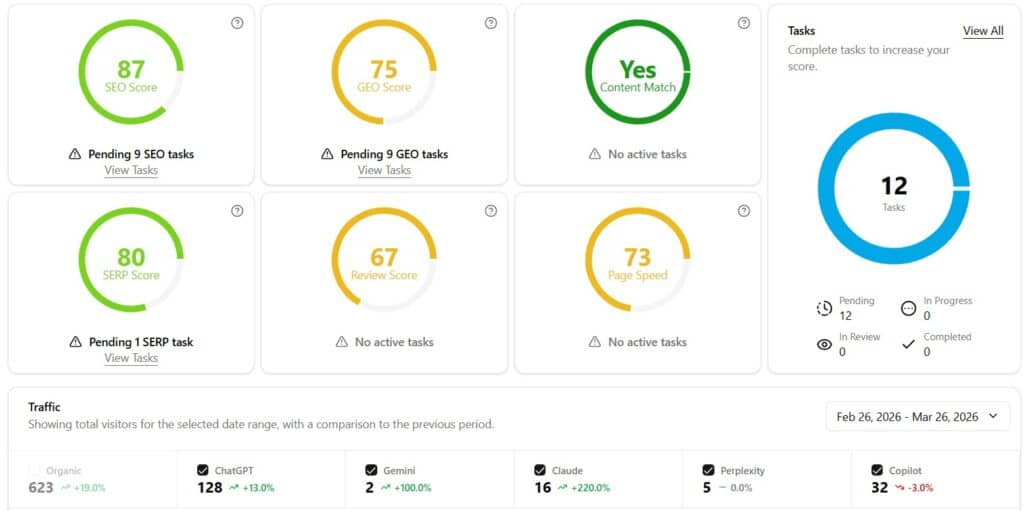
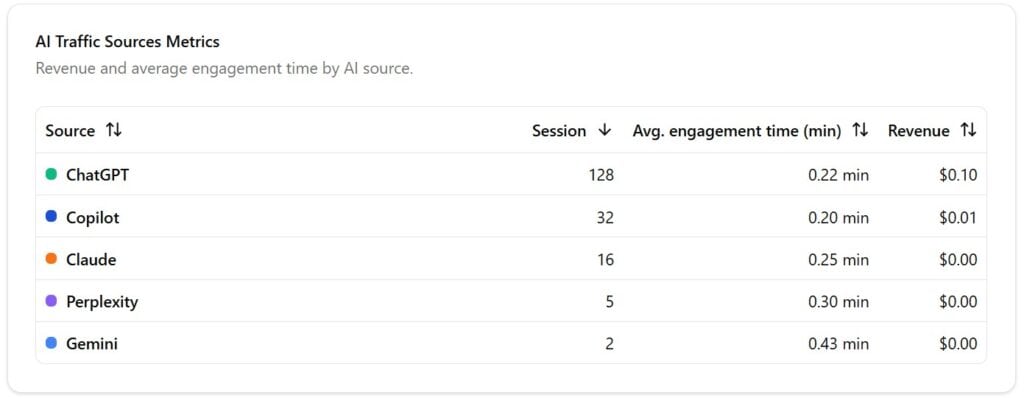
AI traffic is already happening: ChatGPT and other AI tools were already sending visitors to my website.

It breaks out traffic from sources like ChatGPT, Claude, Perplexity, Copilot, and others, which starts to reveal whether AI assistants are already sending visitors to your website.

In my case, ChatGPT was already sending traffic even though my visibility across tracked prompts was still weak.

That matters because it shows this is not just a theoretical trend. AI platforms are already part of the traffic mix, even for websites that are not actively optimizing for AI visibility yet.

The tool also helps show which web pages those visitors are landing on, which gives you a better sense of what content is actually surfacing and getting clicked.

Where AI traffic lands and flows: Entry pages from AI answers and where visitors go next.

Competitor Context Matters

One useful reality check with Visby is that it does not compare you only to businesses your size.

It shows which websites AI systems are already trusting in your space.

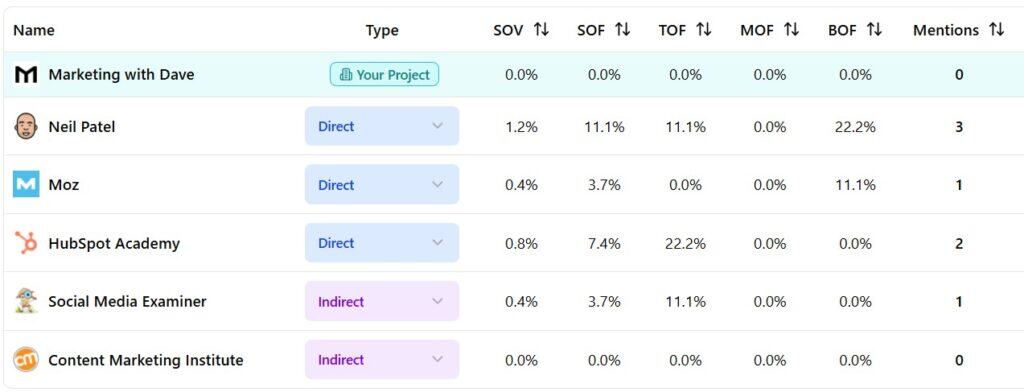
In my case, that meant being compared against much larger and more established brands like HubSpot, Moz, and Neil Patel.

That can be humbling, but it is also useful. It gives you a clearer picture of the actual competitive landscape inside AI-generated answers, not just the one you assume you are in.

AI visibility is competitive: Larger brands like HubSpot and Moz are already being surfaced more often in AI answers.

Setup and Ease of Use

Setup is fairly straightforward.

You add your domain, connect data sources like Google Analytics and Google Search Console, define tracked prompts, and add competitors. From there, the platform starts building a picture of how your brand appears across AI assistants.

For an early-stage category, the product feels approachable and practical. It delivers clear reporting, useful comparisons, and a stronger connection between visibility data and next steps than I expected.

Plans and Pricing

Tier 1 is $69 lifetime for 1 seat, 1 domain, 10 tracked prompts per domain, and 2 article generations per month.

Higher tiers increase seats, domains, tracked prompts, and article generation limits.

For someone who mainly wants to validate whether AI visibility tracking is useful for their business, Tier 1 looks like a reasonable starting point.

If you need broader coverage across multiple domains, more prompts, or more team access, you would likely need to move up tiers.

Check current pricing and tiers

Why I Would Recommend This

  1. AI visibility is becoming a real part of digital discovery, and most marketers are not measuring it at all.
  2. Visby helps connect prompt tracking, competitor analysis, and prioritized recommendations in one place.
  3. The platform surfaces AI traffic data in a way that is easier to understand and act on.
  4. The lifetime price is low enough to make testing this category more realistic for smaller teams and independent marketers.

What To Watch Out For

  1. This is not a replacement for your traditional SEO stack.
  2. The category is still evolving, so the signals and frameworks are not as mature as classic search reporting.
  3. Competitor comparisons may feel discouraging at first if AI tools already favor much larger brands in your niche.
  4. If your positioning is unclear, this tool may expose that quickly.

Bottom Line

Most marketers still have very little visibility into how AI assistants talk about their brand, who gets cited instead, or whether any AI platforms are already sending them traffic.

Visby helps make that clearer.

Its value is not just in the reporting. It is in the combination of prompt-level visibility, competitor context, AI traffic insights, and prioritized recommendations that help turn insight into action.

If you expect a polished enterprise SEO platform, this is not that.

If you want a practical way to start understanding and improving AI visibility, Visby is worth a serious look.

View the Visby AppSumo Deal

Disclaimer

This content is for educational purposes and reflects my experience and research. Always evaluate tools based on your specific business needs, goals, and workflows before making a decision.

Looking for more marketing software reviews? See my full list of marketing tools and software I recommend.

Visby Review: AI Search Visibility and GEO Monitoring Tool Read More »

ai is a tool not a strategy

AI First Is Not a Strategy

Reading Time: 4 minutes

People keep saying they are “AI-first.” I get why. It sounds modern, confident, and inevitable.

But it is also usually a tell.

AI is a tool, not a strategy. And if AI is your strategy, you do not have one.

That does not mean AI is unimportant. It means AI belongs in the execution and optimization layer, not in the leadership layer where direction, trade-offs, and accountability live.

Strategy decides direction. AI increases speed.

Strategy answers questions a tool cannot answer.

Who are we serving, specifically?

What problem are we uniquely solving?

Where do we compete, and where do we refuse to compete?

What trade-offs are we making on purpose?

AI can help you move faster once those decisions exist. It cannot create them for you. When teams go AI-first too early, they often move faster in the wrong direction.

“AI-first” is usually signaling, not substance

Years ago, nobody serious announced they were spreadsheet-first.

Nobody positioned their company as database-first, Excel-driven, or SQL-native.

Those were capabilities, not identities.

Teams used spreadsheets because spreadsheets were useful. The same is true with AI. When a company leads with the tool, it often signals that the real strategy is missing, unsettled, or not differentiated.

Customers do not buy “AI.” Customers buy outcomes.

Digital marketing lens: AI does not create demand, it processes demand

In digital marketing, AI is strongest when it is working on existing signals like search intent, behavior patterns, and historical performance data.

AI can accelerate research, drafting, testing, and optimization.

AI cannot decide what your brand stands for, what category story you should own, or what promise is worth making.

Marketers who go AI-first often optimize channels before they understand why customers are searching, why they convert, and why they churn.

AI scales the funnel you have, even if it is broken

AI will gladly help you scale a mediocre offer, a confusing landing experience, and weak differentiation.

It will improve efficiency inside a system that might be fundamentally misaligned.

That is why tool-led adoption can feel like progress while results stay flat. You did not need more speed. You needed better positioning, clearer messaging, or a stronger conversion path.

AI makes mediocre content cheaper, not great content inevitable

From an SEO and content perspective, AI lowers the cost of production. It does not lower the bar for performance.

Search visibility is still earned through usefulness, credibility, and clarity.

When teams adopt an “AI-first content strategy,” a common outcome is a flood of pages that look complete but are not anchored in real audience insight, true search intent, or firsthand expertise.

In other words, AI can help you publish more. It cannot guarantee you are publishing something worth finding.

AI cannot choose the right metrics

Marketing does not have a data shortage. It has a judgment shortage.

AI can summarize dashboards and generate forecasts. It cannot decide what matters.

Strategy is choosing whether you care most about pipeline quality, customer acquisition cost, retention, lifetime value, or brand trust.

Without that clarity, AI will optimize whatever is easiest to move. That is how teams end up winning vanity metrics and losing the business.

AI shortens feedback loops, which exposes weak positioning faster

In paid media, email, and social, AI can speed up testing and iteration.

That is great until you realize it also accelerates proof that your message is not resonating.

If your positioning is fuzzy, your promise is generic, or your offer is not compelling, AI does not fix it. AI helps you discover the problem faster, and it helps you repeat it faster.

AI-first can quietly weaken marketing leadership

This is the part people are not saying loudly enough.

When AI is used too early in the thinking process, teams outsource judgment before they have earned it.

You see it when decks are generated before insights are earned, when messaging is polished before it is understood, and when volume replaces clarity.

It creates the illusion of progress while weakening the core marketing muscle: reasoning, selection, and trade-offs.

That is not a tooling issue. That is a leadership issue.

AI does not own risk. People do.

Digital marketing lives inside constraints.

Brand trust, compliance, ad policies, reputation risk, and ethical boundaries are not optional.

AI can help enforce guidelines. AI cannot fully grasp reputational cost, contextual nuance, or the long-term impact of short-term optimization.

When a team uses AI as the decision-maker, it often underestimates how expensive public mistakes are.

So what does “AI-first” mean when it is actually valid?

There is a narrow, legitimate version of AI-first, but it is not what most people mean.

It only works when the strategy is already clear, the customer problem is defined, the value chain is understood, and accountability stays human-owned.

In that world, “AI-first” is not an identity. It is a design choice about how work flows through the organization.

Even then, the better framing is simpler and more accurate: strategy-led, AI-enabled.

The question to ask anyone who says they are AI-first

If someone says they are AI-first, the most useful follow-up is this:

What are you second?

If the answer is not customer, problem, or strategy, then AI is not their edge. It is their crutch.

What to do instead: a practical digital marketing posture

Here is a healthier posture for marketers and teams who want the upside without the confusion.

1. Be problem-first

Start with a clear customer problem and a measurable outcome.

2. Be strategy-led

Make the trade-offs explicit, including what you will not do.

3. Be human-led, tool-assisted

Keep positioning, voice, and ethical boundaries owned by people.

4. Use AI where it multiplies execution

Drafting, research acceleration, analysis support, experimentation, and workflow automation are where AI shines.

5. Measure what matters, not what moves

Choose the small set of metrics that reflect real business health, then use AI to help you monitor and improve them.

Closing thought

AI is not the strategy. It is the multiplier.

That is why it rewards teams with strong fundamentals and exposes teams without them.

If you want a durable advantage, lead with clarity, judgment, and trade-offs. Then let AI help you move faster after the direction is set.

AI First Is Not a Strategy Read More »

,