Content Marketing

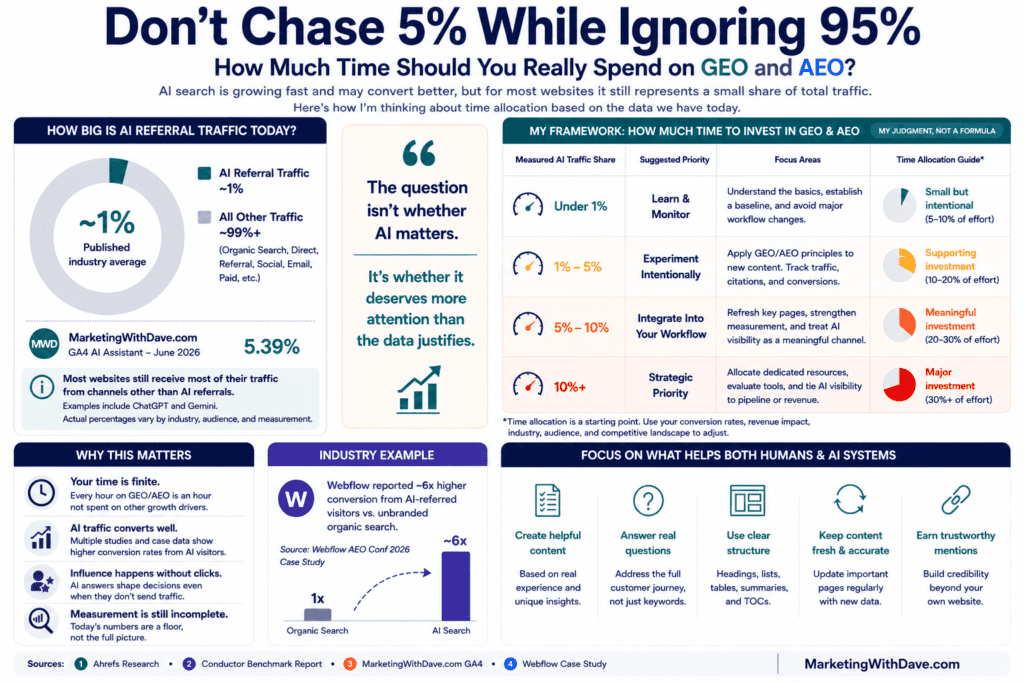
Infographic on GEO and AEO advertising strategies, highlighting time investment, industry benchmarks, and key focus areas for effective digital marketing.

How Much Time Should You Really Spend on GEO and AEO?

Reading Time: 12 minutes

Everyone is talking about GEO or if you prefer, AEO.

Everyone has an opinion.

Few people are asking the practical question:

How much of your limited marketing time should actually go toward GEO and AEO?

Not in five years. Not once AI search reaches critical mass. Today, based on the traffic, conversion, and visibility data we currently have.

This article is my attempt to answer that question with evidence first and opinion second.
Infographic on GEO and AEO advertising strategies, highlighting time investment, industry benchmarks, and key focus areas for effective digital marketing.

A Quick Note About GEO, AEO, and AI Visibility

The marketing industry has not agreed on a single name for optimizing visibility inside AI-generated answers.

You may see it described as:

  • Answer Engine Optimization, or AEO
  • Generative Engine Optimization, or GEO
  • AI Search Optimization
  • AI SEO
  • AI Visibility

The terms are not perfectly interchangeable, but they are often used to describe overlapping goals: helping a brand, product, or piece of content appear accurately and prominently when an AI system answers a question.

I generally prefer the broader term AI visibility, but the strategic question remains the same regardless of which acronym you prefer.

How much of your attention should this emerging channel receive right now?

Why This Question Matters

Every new marketing trend competes for the same limited resource:

Your attention.

Every hour spent rewriting a perfectly good article specifically for AI is an hour you are not spending on conversion optimization, email, link building, customer research, paid acquisition, social media, or the next useful piece of content.

That does not mean GEO and AEO are distractions. It means the opportunity has a cost.

Good strategy is not about doing everything that might work. It is about deciding where your next hour, dollar, or experiment has the best chance of producing a meaningful return.

Before asking whether GEO works, marketers should ask a more useful question:

Given what we know today, how much of a finite week should go toward it?

How Much Traffic Is AI Search Actually Sending?

AI traffic is growing. That part is not especially controversial.

The more important question is how large it is compared with the traffic websites still receive from Google, direct visits, referrals, email, social media, and other established channels.
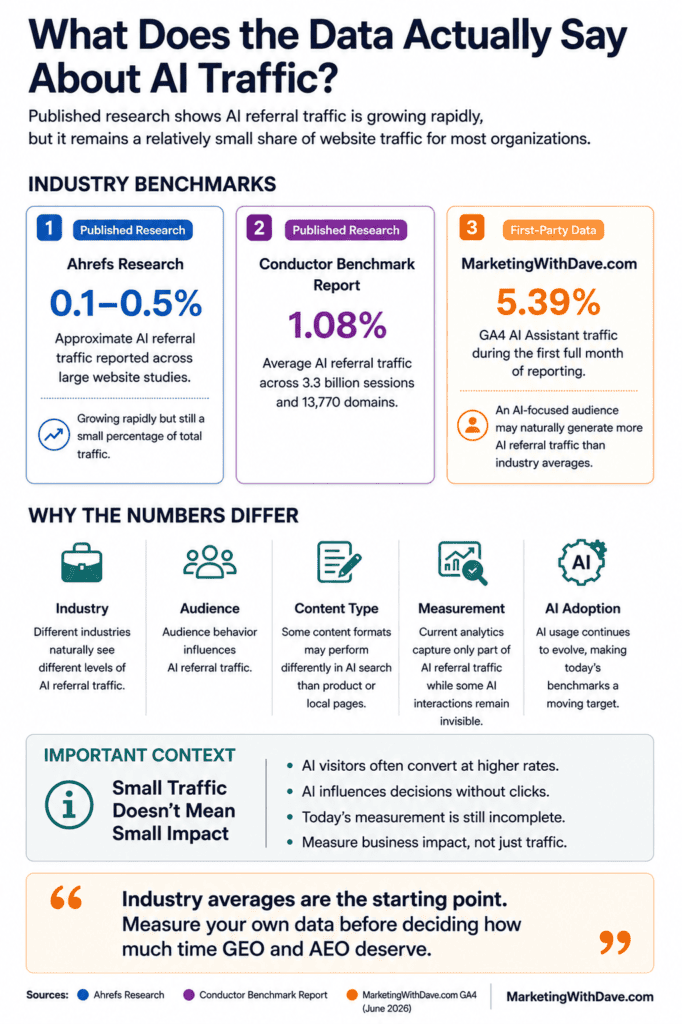
Graphical infographic explaining AI traffic data, industry benchmarks, and the importance of accurate measurement for marketing strategies.

Ahrefs

Ahrefs has published several analyses of AI referral traffic across large samples of websites. Depending on the study period and methodology, AI referrals represented roughly 0.1% to 0.5% of total traffic.

The exact percentage changed between studies, but the overall finding was consistent:

AI traffic was growing rapidly while remaining small in absolute terms.

That distinction matters. A channel can grow several hundred percent from a very small starting point and still represent a minor portion of a typical website’s traffic.

Conductor

Conductor’s 2026 AEO and GEO Benchmarks Report analyzed 3.3 billion sessions across 13,770 domains. It found that AI referral traffic accounted for an average of 1.08% of total website traffic.

Neil Patel later highlighted the study publicly, which is where I initially encountered the number. The underlying analysis, however, came from Conductor.

That attribution may seem like a small detail, but it matters. Marketers should be able to trace a statistic back to the organization that collected and analyzed the data.

Conductor’s average was higher than the earlier Ahrefs figures, but both sources pointed in the same general direction:

  • AI referrals are increasing
  • Industry and audience affect the results
  • AI still represents a small share of traffic for most websites

Webflow

Webflow has reported a different but equally important measurement: conversion quality.

In a Webflow 2026 presentation on its AEO maturity model, Webflow reported that AI-sourced visitors converted at approximately six times the rate of unbranded organic search traffic. The company also reported that 8% of its self-service signups came from LLM-sourced traffic during the period discussed.

This is self-reported company data rather than an independent, multi-site study. It should not be treated as a universal conversion benchmark.

It is still useful evidence that a relatively small traffic channel may produce disproportionate business value.

AI Traffic Benchmark Summary

Source Reported AI Traffic or Performance Evidence Type What I Took Away
Ahrefs Generally under 1%, with published figures around 0.1% to 0.5% Large multi-site studies AI traffic is growing quickly but remains small for most websites
Conductor 1.08% average traffic share Benchmark study covering 3.3 billion sessions Industry and audience can create substantial variation around the average
MarketingWithDave.com 5.39% of sessions during the first full month of GA4 AI Assistant reporting One website and one month of first-party data An AI-focused marketing audience may significantly over-index for AI referrals
Webflow Approximately 6x conversion compared with unbranded organic search Self-reported company case study AI traffic may be worth more than its raw volume suggests

No single row should be treated as a universal benchmark.

Together, however, they support a fairly defensible conclusion:

AI referral traffic is real, growing, and still a relatively small portion of total website traffic for most organizations.

What I Am Seeing on MarketingWithDave.com

GA4 began reporting an AI Assistant default channel in May 2026, making some AI referral traffic easier to identify without creating a custom channel group.

During June 2026, the first full month in which that channel appeared in my reporting, AI Assistant traffic accounted for 5.39% of sessions on MarketingWithDave.com.

That is approximately five times the 1.08% average reported by Conductor.

I do not think that means the industry benchmarks are wrong. I think it demonstrates why your own data matters more than a broad average.

MarketingWithDave.com publishes extensively about:

  • Artificial intelligence
  • AI visibility
  • SEO and AEO tools
  • Marketing software
  • Content optimization

That content attracts marketers who are already using ChatGPT, Gemini, Claude, and other AI platforms as part of their research and daily work.

A local service business, restaurant, dental practice, or traditional eCommerce store may see a very different traffic mix.

My 5.39% figure is therefore not a benchmark for other websites. It is a useful first-party example of how dramatically niche and audience can affect AI referral traffic.

It may also understate AI’s actual influence.

Why AI Traffic May Be More Valuable Than It Looks

If AI visitors behaved exactly like traditional organic visitors, allocating effort based on traffic share would be relatively straightforward.

Five percent of traffic might receive roughly five percent of the attention.

The available evidence suggests it is not that simple.
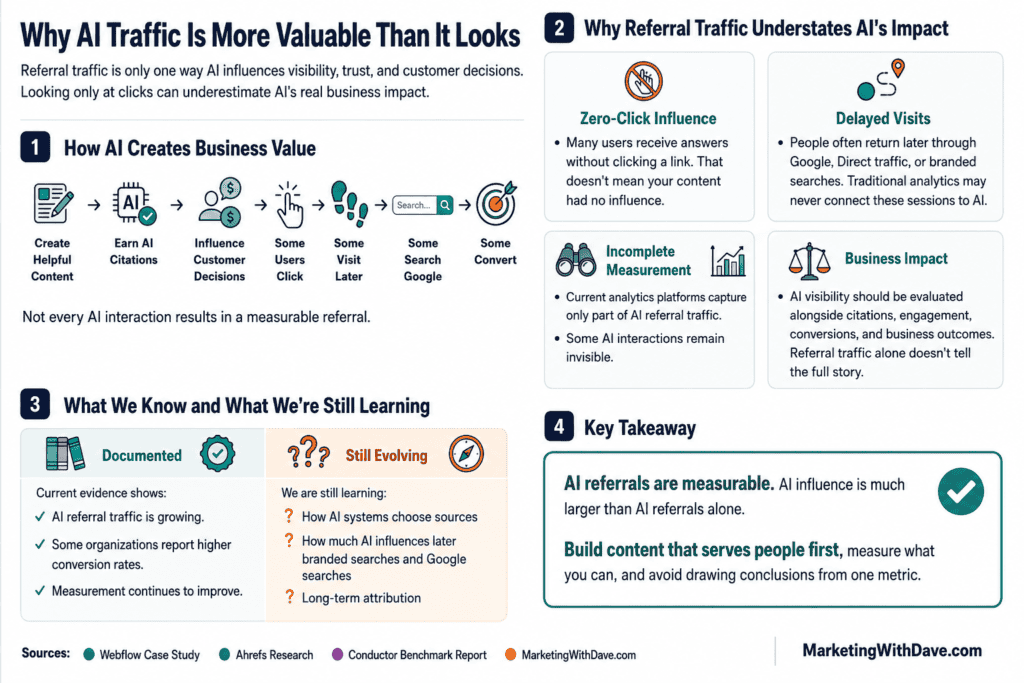
Graph illustrating AI traffic impact, key takeaways, and learning insights for marketing strategies, emphasizing AI's value in business growth.

AI visitors may arrive later in the decision process

A traditional search visitor might land on a page after typing a short, broad keyword into Google.

An AI user may have already spent several minutes asking detailed follow-up questions, comparing options, establishing criteria, and narrowing the available choices before clicking a source.

That visitor can arrive with greater context and stronger intent.

This is one plausible explanation for why Webflow and other companies have reported stronger conversion rates from AI-referred traffic.

It is not proof that every AI visitor is more valuable. It is a reasonable explanation for an increasingly common observation.

Visibility can matter without a click

Traffic is only one outcome of AI visibility.

A brand can influence a buying decision when an AI assistant:

  • Recommends its product
  • Uses its research as a source
  • Mentions it during a comparison
  • Repeats one of its key messages
  • Describes it accurately as an authority in a category

None of those outcomes necessarily produces an immediate website visit.

That is why measuring AI visibility requires more than reviewing referral sessions. My broader AI Visibility Framework covers traffic alongside citations, mentions, accuracy, sentiment, and business outcomes.

Zero-click behavior is not new

AI did not invent zero-click search.

Search engines have answered weather questions, calculations, definitions, local queries, and many informational searches directly on their results pages for years.

Generative answers are expanding that behavior into longer and more complex questions.

This means a decline in clicks does not necessarily mean a brand has disappeared from the customer journey. It may mean the influence is occurring in a place that traditional web analytics cannot fully observe.

Why AI Traffic Measurement Is Still Incomplete

AI traffic is easier to identify than it was a year ago.

It is still far from perfectly measured.

GA4’s AI Assistant channel depends on identifiable referral information. When the referrer is removed or obscured, the visit may be classified somewhere else, including Direct or Unassigned.

Current reporting can also miss or separate several forms of AI-assisted discovery:

  • Some AI platforms may not be included in the native channel definition
  • Visits without preserved referral data may appear as Direct
  • Google AI Overview and AI Mode traffic may be classified as Organic Search
  • A user may discover a brand in an AI answer but return later through another channel
  • An AI answer may influence a decision without generating any website visit

For those reasons, the 5.39% visible in my GA4 reporting is best viewed as a measured minimum, not a complete accounting of AI-assisted discovery.

That does not mean the missing traffic all belongs in the AI category. My Unassigned traffic, for example, can contain many types of sessions and should not simply be relabeled as AI.

It means current analytics cannot give us a perfectly clean number.

A separate guide on how to measure AI traffic in GA4 would be useful because this topic quickly becomes too detailed for the current article. For now, the practical takeaway is simple:

Use the AI traffic you can identify as a baseline, but do not assume it captures AI’s full influence.

What Is Documented, Observed, and Still Unknown?

One of the biggest problems in GEO and AEO content is that documented findings, practitioner observations, and educated guesses are often presented with the same level of certainty.

My AI Source Preference Matrix uses a similar distinction to separate what is documented from what is observed, inferred, or unknown.

Documented

  • AI referral traffic is growing across the major studies reviewed in this article
  • Google still drives substantially more website traffic than AI assistants for most organizations
  • AI referral traffic varies significantly by industry, audience, and website
  • GA4 can now identify some AI Assistant traffic as a distinct channel
  • AI-generated answers can influence users without producing a referral visit

Observed

  • AI-referred visitors often convert at a higher rate than standard organic traffic
  • Question-focused content appears frequently in AI-generated answers
  • Recently updated pages are heavily represented in several citation studies
  • Brands with strong, consistent third-party mentions tend to appear more often in AI answers
  • Clear headings, tables, summaries, and structured answers appear to make content easier for AI systems to use

These patterns are supported by case studies, platform analyses, and repeated practitioner observations.

The exact causal mechanisms are still not fully understood.

Unknown

  • Exactly how each AI platform selects, weights, and ranks sources
  • How much a Google ranking directly causes AI visibility
  • How much the apparent relationship between SEO and AI citations reflects shared quality signals instead
  • Which individual optimization tactics will remain effective as models and retrieval systems change
  • How much AI-assisted influence occurs without a measurable referral visit

That final list is longer than most AEO content is willing to admit.

Good marketing decisions do not require perfect certainty. They require a clear understanding of the available evidence, honest acknowledgment of its limits, and a willingness to adjust when better information arrives.

How Much Time Should You Spend on GEO and AEO?

Here is my current answer:

Do not chase 5% while ignoring 95%.

If AI currently sends 5% of your traffic, it probably deserves more than 5% of your attention.

The channel is growing. The visitors may convert better. The influence may extend beyond the clicks you can measure.

But that does not mean it deserves 80% or 100% of your strategy.

For most organizations, Google Search and other established channels are still producing the overwhelming majority of measurable traffic and revenue.

The following framework is not a mathematical formula. It is a practical starting point for deciding how aggressively to invest based on what you are seeing today.

Measured AI Traffic Share Suggested Priority Practical Focus
Under 1% Learn and monitor Understand the fundamentals, establish a baseline, and avoid major workflow changes
1% to 5% Begin intentional experimentation Apply AEO principles to new content and track whether traffic, citations, and conversions improve
5% to 10% Integrate AEO into the content workflow Refresh important pages, strengthen measurement, and treat AI visibility as a meaningful secondary channel
More than 10% Treat AI as a strategic acquisition channel Allocate dedicated resources, evaluate tools, and connect AI visibility to pipeline or revenue

Traffic percentage should not be the only factor.

A company receiving 2% of its traffic from AI with a conversion rate six times higher than organic search may reasonably invest more than a company receiving 5% of low-quality AI traffic.

Your decision should also consider:

  • Conversion rate
  • Revenue or lead value
  • Industry adoption
  • Audience behavior
  • Competitive visibility
  • The importance of organic acquisition to the business

The framework gives you a place to start. Your actual business results should determine where you go next.

Where Should You Start?

The encouraging part is that most foundational AEO work also supports traditional SEO.

You do not need to choose between creating content that ranks and content that gets cited.

Start with improvements that benefit both:

  • Create original, useful content based on real experience
  • Answer the specific questions your customers ask throughout the buying process
  • Use clear headings and logical page structure
  • Add tables of contents when they improve navigation
  • Include FAQs when readers have natural follow-up questions
  • Keep important pages accurate and current
  • Use appropriate schema and descriptive metadata
  • Build credible mentions beyond your own website
  • Measure traffic and conversions rather than relying only on visibility scores

These practices are unlikely to become wasted work even if the terminology, platforms, and optimization tools continue to change.

Whether someone discovers your content through Google, ChatGPT, Gemini, Claude, Perplexity, or another system, that person is still looking for the same thing:

A trustworthy answer to a real problem.

Frequently Asked Questions

Does GEO/AEO replace SEO?

No. Google still drives the large majority of measurable organic traffic for most websites, and many practices that support AI visibility also support SEO. These include creating useful content, answering real questions, building topical authority, improving site structure, and keeping important information current.

AEO and SEO should be treated as complementary strategies rather than competing choices.

What is the difference between GEO and AEO?

GEO commonly stands for Generative Engine Optimization and focuses on visibility inside generative AI systems. AEO commonly stands for Answer Engine Optimization and focuses on appearing inside direct answers.

In practice, marketers often use AEO, GEO, AI SEO, and AI visibility to describe overlapping work. The industry has not yet standardized the terminology.

How much AI referral traffic is normal?

Broad studies from Ahrefs and Conductor suggest that many websites currently receive less than 1% to slightly more than 1% of their traffic from identifiable AI referrals.

That average can vary substantially based on industry, audience, content, and measurement methodology. MarketingWithDave.com recorded 5.39% during June 2026, but an AI-focused marketing audience is more likely to use AI assistants than the audience of a typical small business website.

How do I measure AI referral traffic in GA4?

GA4 now includes an AI Assistant default channel that identifies traffic from certain recognized AI referrers. No custom configuration was required for this channel to begin appearing in my reporting.

The channel does not capture every AI-influenced visit. Some platforms may be excluded, stripped referral information can move visits into Direct, and Google AI features may appear under Organic Search.

For that reason, the AI Assistant channel should be treated as a useful baseline rather than a complete measurement of AI’s influence.

Do AI-referred visitors convert better than organic search visitors?

Several companies and studies have reported stronger conversion rates from AI-referred visitors, but the reported improvement varies widely.

Webflow reported approximately six times higher conversion than unbranded organic search in its own funnel. That is a useful case study, but it should not be treated as a universal benchmark.

Marketers should compare conversion rates using their own analytics and business outcomes.

Does ranking well in Google improve AI visibility?

There appears to be a relationship between traditional search visibility and AI citations, but the mechanism is not fully understood.

A highly ranked page may receive more AI visibility because the system relies on search results. It may also rank and receive citations because both systems recognize similar signals of quality, relevance, authority, or usefulness.

The evidence supports continued investment in SEO. It does not yet prove that improving a Google ranking will directly cause a proportional increase in AI citations.

Should a small business invest in GEO and AEO?

Yes, but the investment should remain proportionate to the opportunity.

A small business should first make sure its website is technically accessible, its products and services are clearly explained, its business information is accurate, and its content answers real customer questions.

Those fundamentals support SEO, AEO, local visibility, conversion, and the overall customer experience.

Should I rewrite all of my existing content for AI?

No.

Begin with pages that already receive traffic, generate leads, support an important product, or answer high-value customer questions.

Refresh content when you can make it more accurate, useful, complete, or easier to navigate. Rewriting content solely to satisfy an assumed AI preference can consume a great deal of time without producing a measurable return.

Practical Time Allocation Framework

More than the raw traffic percentage alone may suggest, especially if AI visitors convert well or the channel is growing quickly for your audience.

Less than the most aggressive commentary recommends, especially when AI remains a small portion of your traffic and established channels are still driving most of your results.

Start with improvements that benefit SEO and AEO together. Increase your investment as your own traffic, visibility, conversion, and revenue data justify it.

Infographic on SEO strategies including building content, authority, measuring metrics, and investing in SEO for marketing success.

Final Thoughts

The debate should not be SEO or GEO/AEO.

It should be how to build content that deserves both rankings and citations.

AI search is not replacing traditional search overnight. It is expanding the ways people discover information, evaluate options, and encounter brands.

That deserves intentional experimentation.

It does not justify abandoning the channels that still generate most of your traffic and revenue.

Measure your own data. Apply the practices that improve both human experience and machine understanding. Increase your investment as the opportunity becomes more meaningful for your specific audience and business.

Don’t chase 5% while ignoring 95%.

But don’t ignore the next 5%, either.

How Much Time Should You Really Spend on GEO and AEO? Read More »
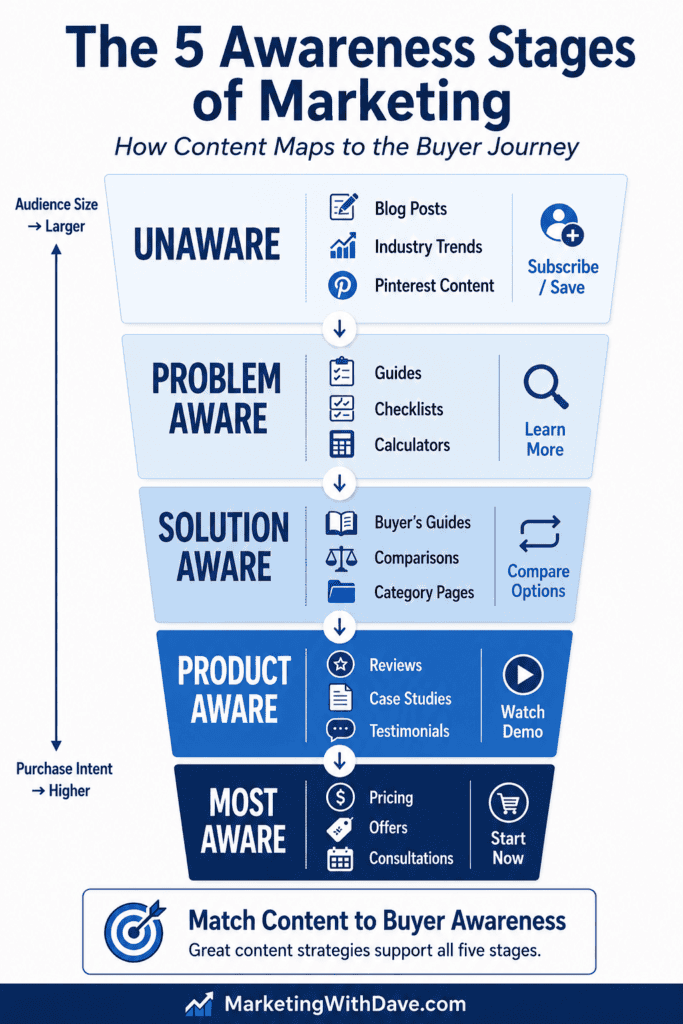
A visually organized infographic illustrating the five awareness stages of marketing, from Unaware to Most Aware, with icons and descriptions to guide content mapping and buyer journey.

The Five Awareness Stages of Marketing: A Practical Guide for Content and SEO

Reading Time: 14 minutes

If you’ve ever wondered why a perfectly good piece of content falls flat, the answer is usually not the writing. It’s not the design, the headline, or the offer either. The real problem is a mismatch between what you’re saying and where your reader actually is.

That’s where the five awareness stages come in.

The framework traces back to Eugene M. Schwartz, whose 1966 book Breakthrough Advertising laid out a model for understanding your prospect’s state of awareness and then writing to that specific state. Schwartz was writing about direct-response advertising, but the logic applies just as well to blog content, email sequences, website pages, and social media today.

In this post, we’ll walk through each of the five stages, show you how to identify which stage your audience is in, connect the framework to modern SEO and search intent, and give you a practical content map for applying all of it across your website, email sequences, and content calendar, including a step-by-step process for auditing the content you already have. We’ll also bring in ideas from some of the best marketing thinkers of the past few decades, because Schwartz wasn’t writing alone into a vacuum. His framework holds up in part because smart marketers keep arriving at the same insight from different directions.

Where the Five Awareness Stages Actually Come From

Schwartz outlined his awareness framework in Chapter 2 of Breakthrough Advertising, under the heading “Your Prospect’s State of Awareness — How to Capitalize on It When You Write Your Headline.” The chapter begins on page 13 of the original Prentice-Hall edition.

His original section titles read differently from the shorthand most marketers use today. He wrote about “The Most Aware,” “The Customer Knows of the Product But Doesn’t Yet Want It,” “How to Introduce New Products,” “How to Introduce Products That Solve Needs,” and “How to Open Up a Completely Unaware Market.” The modern labels — Most Aware, Product Aware, Solution Aware, Problem Aware, Unaware — came later as practitioners simplified and popularized the framework.

It’s worth knowing that Schwartz wasn’t the only person thinking in stages. Philip Kotler taught buyer-readiness stages in his marketing textbooks. Robert Lavidge and Gary Steiner published a hierarchy-of-effects model in 1961. Russell Colley introduced the DAGMAR framework around the same time. These models all share the insight that buyers move through distinct mental states before purchase, and your message needs to meet them in the right state.

What makes Schwartz’s version especially useful for content marketers and copywriters is that it anchors each stage to a specific question: what does this person already know, and what does my message need to do first?

The Five Stages Explained

Stage 1: Unaware

The unaware prospect is not thinking about your product, your category, or even their own problem. They may have a latent need they haven’t consciously connected to yet. They’re not browsing for a solution because they don’t know they need one.

Schwartz’s instruction here is to lead with identity, aspiration, or hidden tension before you say anything about what you sell. You have to get the person to see themselves in your content before they’ll ever care about your offer.

Anne Handley has articulated this as well as anyone working in modern content marketing. Her core principle is to focus on your audience “relentlessly and with pathological empathy” to make the customer the hero of the story rather than your product. That’s the right posture for reaching unaware audiences. They’re not looking for you. You have to find them through content they actually want to consume.

Joe Pulizzi pushes the same idea from a content strategy angle. Before you create anything aimed at an unaware audience, he argues, you need a clear content mission, a statement of who you serve, what you publish, and why it matters beyond making a sale. Without that, content aimed at the unaware stage becomes noise.

What works at this stage:

  • Story-driven blog posts that don’t lead with a product
  • Editorial pieces on trends, ideas, or perspectives your audience cares about
  • Pinterest content and social posts that answer questions or spark curiosity
  • Email newsletter issues that read like a letter, not a promotion
  • Quizzes and assessments that surface a need the reader hadn’t named

Best CTA at this stage: Subscribe, save, or read more. A low-commitment conversion like a quiz or newsletter signup can absolutely work here. The key is not asking for too much too early.

Stage 2: Problem Aware

The problem-aware prospect knows something is off. They feel the friction, the inefficiency, the frustration. But they may not yet know that a solution exists or what category of product or service could help them.

Content at this stage earns trust by diagnosing well. Seth Godin’s contribution here is useful: he consistently argues that effective marketing means finding the smallest viable audience that is genuinely open and eager, and then delivering messages that feel relevant rather than broadcast. At the problem-aware stage, that means going deep on one specific pain cluster rather than trying to address every possible problem in the same piece.

Kotler described this stage as moving an audience from awareness to knowledge. The job of your content is not to pitch your solution yet. It’s to name the problem clearly, explain why it happens, and show the prospect that someone understands exactly what they’re going through. That builds the credibility you’ll need later.

What works at this stage:

  • Symptom checklists and self-assessment tools
  • Diagnostic blog posts that explain “why this happens”
  • Calculators that quantify the cost of the problem
  • Lead magnets built around a single, high-intent pain point
  • Educational webinars that focus on the problem space, not the solution

Best CTA at this stage: Download the checklist, take the assessment, watch the explainer. Free tools and calculators convert well here because they deliver immediate value without requiring a purchase commitment.

Stage 3: Solution Aware

The solution-aware prospect knows the kind of result they want and roughly what kind of tool or approach might get them there. They’re researching. They’re comparing. They don’t know your specific product yet, but they’re in the right category.

This is where David Ogilvy’s emphasis on research and substance becomes most relevant. Ogilvy’s argument was that advertising that sells starts with understanding the product and the prospect deeply, and then making a case grounded in specifics rather than creative flair. Solution-aware prospects are evaluating their options, and vague content won’t hold their attention.

Claude Hopkins’ Scientific Advertising is the older direct-response companion to this idea: give people reasons why. Explain the mechanism. Make measurable claims and back them up. Test what works.

Robert Cialdini’s research is especially applicable here. Solution-aware prospects are uncertain, and in conditions of uncertainty, social proof and authority carry disproportionate weight. Showing that credible people or organizations trust your approach can shift a prospect from passive research mode to genuine consideration.

What works at this stage:

  • Buyer’s guides and option comparisons
  • Category explainer pages (“How does X work?”)
  • Benchmark reports and methodology explainers
  • Expert-led webinars that orient the prospect in a solution space
  • FAQ pages that address the questions an informed buyer asks

Best CTA at this stage: Compare your options, see how it works, download the guide.

Stage 4: Product Aware

The product-aware prospect knows your brand or product. They’ve been to your site. They may be on your list. But they haven’t converted yet. Something is holding them back — a doubt, a competing option, or simply not enough proof that your offer is the right fit for their situation.

Kotler described this phase as moving from liking to preference to conviction. The job of your content and messaging here is not to educate from scratch. It’s to close the gap between “this seems interesting” and “I’m ready to move forward.”

Handley’s customer-hero perspective keeps this from becoming self-centered brand copy. The prospect still wants to see themselves in the outcome, not just a list of your features. Ogilvy adds the demand for specificity: proof needs to be concrete, not vague. Cialdini contributes the mechanics: case studies activate social proof, testimonials activate liking, limited availability activates scarcity. Godin’s “anticipated, personal, and relevant” standard also applies — product-aware audiences have already opted in at some level, so generic follow-up emails are a waste of that permission.

What works at this stage:

  • Case studies with specific, measurable results
  • Comparison pages (your product vs. alternatives)
  • Product demos and walkthroughs
  • Objection-handling email sequences
  • Migration or onboarding guides that reduce perceived switching costs
  • Testimonials organized by customer type or use case

Best CTA at this stage: Watch the demo, see customer results, book a consultation.

Stage 5: Most Aware

The most-aware prospect is ready. They know your product, they want it, and the only thing between them and conversion is friction or a final nudge. Schwartz’s instruction here is almost blunt: don’t overcomplicate the close. Give them a clear path, a compelling reason to act now, and remove anything that slows them down.

Cialdini’s scarcity and consistency principles are strongest at this stage because the person is already convinced. What they need is permission to act and a reason not to wait. Kotler’s later “5 A’s” model is a useful reminder that once someone converts, your job shifts toward advocacy, making the experience good enough that they refer others and return themselves.

Godin’s permission marketing logic also applies: an audience that is enrolled and eager wants direct, expected messages. That’s when a straightforward email with a clear offer outperforms a content piece designed to educate.

What works at this stage:

  • Pricing pages with clear, simple paths to purchase
  • “Start now” or deadline-driven offer emails
  • Retargeting ads for people who visited your pricing or checkout page
  • Cart abandonment or demo follow-up sequences
  • Live sales enablement for higher-ticket offers
  • Onboarding sequences immediately after purchase

Best CTA at this stage: Start now, claim the offer, book your call.

How to Identify Which Awareness Stage Your Audience Is In

Understanding the five stages is one thing. Knowing which stage a specific visitor, subscriber, or prospect is in is what makes this framework operational. Here are three reliable signals to read.

What They Search

Your website search queries are one of the clearest indicators of awareness level, because people tell you exactly what they know and what they’re looking for. You can use this to inform your keyword targeting, your content prioritization, and how you structure your site.

What They SearchAwareness Stage
“Why is my website traffic dropping?”Problem Aware
“How to increase organic traffic”Problem Aware / Solution Aware
“SEO vs PPC which is better”Solution Aware
“Best SEO tools for small business”Solution Aware
“Semrush review”Product Aware
“Semrush vs Ahrefs”Product Aware
“Semrush coupon” or “Semrush free trial”Most Aware

Notice that the query gets more specific as the awareness level rises. Vague, problem-oriented searches signal early-stage awareness. Brand-specific or transactional searches signal late-stage awareness. When you look at which keywords are sending traffic to a page, you’re essentially reading the awareness level of the audience that page is attracting.

Where They Came From

Traffic source is a strong proxy for awareness stage. A visitor arriving from a Pinterest pin on a general marketing topic is almost certainly in the unaware or problem-aware category. A visitor arriving from a Google search for your brand name is already product aware. A visitor clicking through from a retargeting ad they saw after visiting your pricing page is most aware. If your analytics platform lets you segment by traffic source, you can use that to match your follow-up messaging to the likely awareness level of each segment.

What They Do on Your Site

Behavioral signals inside your site are the third indicator. Someone who reads three blog posts and bounces is likely unaware or problem aware — they’re in research and discovery mode. Someone who visits your pricing page multiple times without converting is product aware and has a specific hesitation worth addressing. Someone who starts a free trial and abandons midway through onboarding is most aware but has hit a friction point. Each behavioral pattern points to a different intervention.

The Five Awareness Stages and Search Intent

One of the most underused applications of Schwartz’s framework is mapping it to SEO and search intent. Most SEO guides talk about informational, navigational, commercial, and transactional intent. Those categories are useful, but they don’t connect as cleanly to messaging strategy as the awareness stages do.

When you map awareness to search intent, you get a more actionable picture of what kind of content to create and what job that content needs to do.

Stage / Search IntentWhat the Searcher WantsContent That Fits
Unaware
Informational curiosity
Ideas, entertainment, perspective — not answers to a specific question yetTrend pieces, editorial essays, “why X matters” posts, story-led content
Problem Aware
Problem investigation
Understanding why something is happening and whether it’s a real concernDiagnostic posts, symptom lists, “signs you have X” content, explainers
Solution Aware
Comparative research
Options, categories, trade-offs — trying to understand the landscapeBuyer’s guides, comparison posts, category overviews, “best X for Y” lists
Product Aware
Brand evaluation
Proof, specifics, credibility — trying to decide if this particular option is rightReviews, case studies, demo content, testimonial pages, “vs.” articles
Most Aware
Transactional
A reason to act now and a clear path to purchasePricing pages, coupon and deal posts, “get started” pages, offer pages

The practical implication for your content strategy is that you should be intentional about which stages you’re creating content for. Many sites accidentally create a lot of solution-aware content (comparison articles, best-of lists) while neglecting unaware and problem-aware content that builds an audience over time. Others publish plenty of top-of-funnel content but have no middle-of-funnel content to carry interested readers toward a decision.

Auditing your existing content against this table is a useful exercise. Group your posts by which awareness stage they’re addressing, and you’ll quickly see where you have gaps.

This also connects directly to topical authority. A site that has content at every awareness stage for a given topic signals depth and comprehensiveness to both readers and search engines. Your problem-aware diagnostic posts support your solution-aware comparison posts, which support your product-aware review content — and internal links between those layers make each one stronger.

Mapping the Five Stages to Your Website

The most immediate place to apply this framework is your website. Most small business sites are organized around what the owner wants to say rather than where the visitor is mentally. That mismatch shows up as high bounce rates, low engagement, and CTAs that don’t convert.

A better approach is to treat your website as a content map — a deliberate system where each asset serves a specific stage and passes visitors toward the next one. Many marketers create content without ever asking where it fits in the buyer journey. The result is a site that’s heavy in one or two stages and nearly empty in others. A content map built around awareness stages fixes that. It forces you to look at your full library as a progression rather than a pile of individual pieces.

Here’s how the main content types on a typical marketing site map to the five stages:

Website AssetAwareness StagePrimary Job
Blog posts (editorial, trend-focused)UnawareBuild audience, earn attention, collect subscribers
Educational guides and diagnostic toolsProblem AwareBuild trust by naming and diagnosing the problem
Comparison articles and buyer’s guidesSolution AwareOrient the prospect in the solution landscape
Product reviews, case studies, testimonial pagesProduct AwareBuild conviction through proof and specifics
Pricing pages and offer pagesMost AwareRemove friction and prompt action

Visually, this looks like a funnel where each stage narrows toward a conversion but also feeds back into content clusters that build topical authority across the full topic area:

A visually organized infographic illustrating the five awareness stages of marketing, from Unaware to Most Aware, with icons and descriptions to guide content mapping and buyer journey.

A clean site architecture built around this framework typically groups into four zones:

  1. Learn or Resources hub (unaware and problem-aware content)
  2. Solutions section (solution-aware category pages)
  3. Why Us or Proof section (product-aware evidence)
  4. Pricing or consultation page (most-aware close)

The key discipline is matching your calls-to-action to the stage of the page, not the stage you wish the visitor was in. The real issue isn’t whether you use a conversion-oriented CTA on early-stage content — newsletter signups, free trials, calculators, and assessments can all convert well even on problem-aware pages. The issue is asking for too much commitment too early. A blog post on diagnosing a marketing problem can absolutely end with a free assessment CTA. It should not end with “Book a $500 strategy session.” The ask needs to match the readiness level of the audience.

Save the high-commitment CTAs for pages where the visitor’s behavior signals they’re already evaluating. Someone on your pricing page or comparison page isn’t in an educational mindset. Don’t slow them down with more content when what they need is a clear path forward.

How to Audit Your Existing Content Using the Five Stages

You don’t have to start from scratch to apply this framework. If you have an existing blog or content library, the most useful first step is a content audit. Assign each piece to an awareness stage and then look at the distribution.

Here’s a simple process you can run today:

  1. Export all your blog URLs. Pull a list from your CMS, Google Search Console, or a site crawler. You just need URL and title to start.
  2. Assign each article an awareness stage. Read the title and ask: who is this written for, and what do they already know when they arrive? A post titled “Why Your Traffic Dropped After a Google Update” is problem aware. A post titled “Semrush vs Ahrefs” is product aware. A post titled “How to Get Started With SEO” is solution aware. Work through your list and tag each one.
  3. Count articles per stage. Tally up how many pieces you have at each level. Most sites discover they’re heavily weighted toward one or two stages and nearly empty in others. Solution-aware content (comparison posts, best-of lists) is the most common over-investment. Unaware and problem-aware content is the most common gap.
  4. Identify the gaps. If you have very little unaware-stage content, you have limited ability to build a new audience through organic discovery. If you have very little product-aware content, you’re likely losing people who were close to a decision. The gaps are your content calendar for the next quarter.
  5. Create internal links between adjacent stages. Once you’ve mapped your content, look for natural linking opportunities between pieces at neighboring stages. A problem-aware diagnostic post should link to your solution-aware buyer’s guide. Your buyer’s guide should link to your product-aware review or case study page. These links create a path through the funnel and strengthen topical authority across your content cluster — which is a signal search engines reward.

This exercise also surfaces content cannibalization risks — cases where you have multiple pieces competing for the same awareness-stage keyword without a clear hierarchy. If two posts are both targeting solution-aware searchers asking the same question, they’re splitting authority rather than building it. Identifying those overlaps is as valuable as finding the gaps.

The audit doesn’t have to be exhaustive to be useful. Even a quick pass through your top 20 or 30 posts by traffic will give you a clear picture of where your content is concentrated and where prospects are likely falling out of your funnel.

How to Structure an Email Nurture Sequence Around the Stages

Email is one of the best channels for walking prospects through all five stages over time, because you control the sequence and the pacing. Here’s a seven-email framework that covers the full ladder:

#StagePurposeExample Topic
1UnawareOpen with identity or tension“Why good content still fails to convert”
2Problem AwareName and diagnose the problem“Five signs your messaging is mismatched to where your buyer actually is”
3Problem AwareDeepen consequences and stakes“What awareness mismatch costs in traffic, leads, and conversion friction”
4Solution AwareIntroduce the solution category“What changes when you build content around buyer awareness”
5Product AwareShow your specific approach“How we map your website and email to the right awareness stage”
6Product AwareAdd proof and specifics“Case study: what happened when we matched content to stage”
7Most AwareClose with a clear offer“Ready to map your funnel to the five stages? Here’s how to get started.”

One important nuance: not every subscriber enters your list at the same stage. Someone who found you through a broad editorial post is probably unaware or problem aware. Someone who found you through a product comparison article is already solution or product aware. If your email platform allows segmentation by entry source, route higher-intent subscribers into a shorter, more direct sequence rather than starting them at the beginning of an education track they’ve already passed through.

A Four-Week Content Campaign That Covers All Five Stages

If you want to move an audience through the full ladder with a focused campaign, you don’t need a massive volume of content. You need one strong anchor asset per week, remixed across formats and channels.

#Stages TargetedAnchor AssetSupporting AssetsPrimary CTA
1Unaware + Problem AwareBlog post on why messaging mismatch kills conversionsPinterest pins, newsletter, self-check quiz, short social postsSubscribe / take the quiz
2Problem Aware + Solution AwareWebinar or guide on awareness-based content strategyCompanion blog post, downloadable worksheet, resource hub pageRegister / download
3Solution Aware + Product AwareComparison article or framework overview pageDemo clip, FAQ email, case study excerpt, testimonial blockSee how it works
4Product Aware + Most AwareProof-heavy offer or consultation pageDeadline email, objection-handling email, retargeting, pricing page refreshBook now / start now

The One-Sentence Test for Any Piece of Content You Create

Before you publish anything, try this: write down, in one sentence, who this piece is for and what they already know when they arrive.

If you can’t answer that clearly, the content probably isn’t ready. The five awareness stages give you a simple vocabulary for making that call. You don’t need to label every piece formally — you just need to make a deliberate decision about where your reader is starting from, and then write to that starting point.

Schwartz’s core insight from 1966 still holds: the most important thing you can know about your prospect is what they already believe. Every other decision in your marketing — the headline, the CTA, the offer, the format — flows from that.

Key Takeaways

  • The five awareness stages trace back to Eugene Schwartz’s Breakthrough Advertising (1966). The modern labels are simplifications of his original section titles, added by later practitioners.
  • Each stage requires a different message. Blunt “buy now” language fails at the unaware and problem-aware stages. Educational content underperforms at the most-aware stage.
  • Search queries are one of the clearest signals of awareness level. Vague, problem-oriented queries signal early-stage awareness. Brand-specific or transactional queries signal late-stage awareness.
  • The awareness stages map directly to SEO search intent: informational curiosity, problem investigation, comparative research, brand evaluation, and transactional.
  • Treat your website as a content map, not a collection of random posts. Each asset should serve a specific stage and pass visitors toward the next one.
  • The issue with CTAs on early-stage content isn’t conversion — it’s asking for too much commitment too early. Low-friction offers like assessments, calculators, and newsletter signups can convert well at any stage.
  • A content audit is the fastest way to apply this framework to what you already have. Export your URLs, assign each a stage, count by stage, find the gaps, and add internal links between adjacent stages.
  • The audit also surfaces content cannibalization: pieces competing for the same awareness-stage keyword that are splitting authority rather than building it.

The Five Awareness Stages of Marketing: A Practical Guide for Content and SEO Read More »

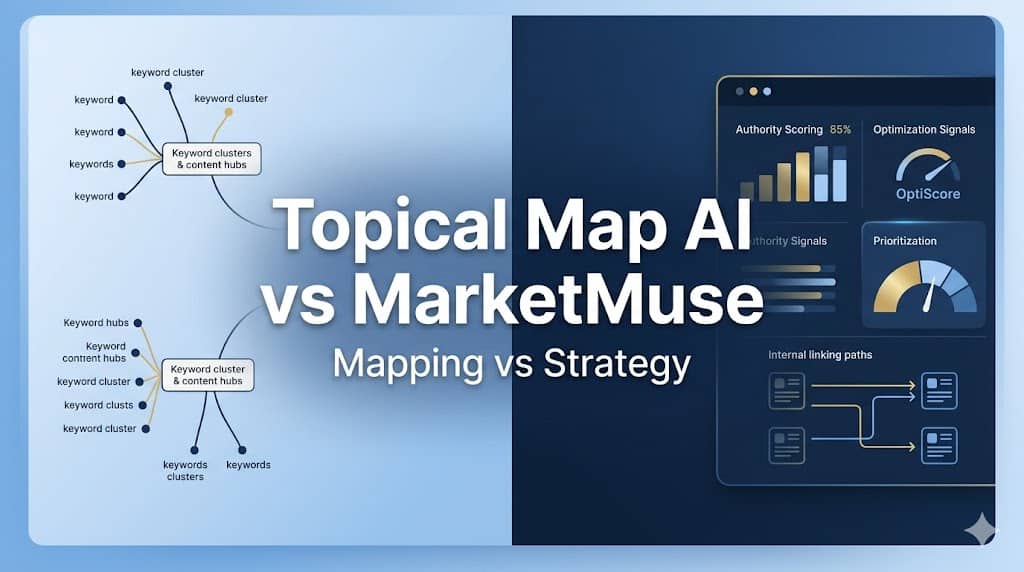
Optimize your SEO with this image showing a comparison between Topical Map AI and MarketMuse for content strategy and keyword clustering analysis.

Topical Map AI vs MarketMuse: Which Content Strategy Tool Fits Your Workflow?

Reading Time: 6 minutes

These two tools share a category label, topical authority and content planning, but they serve fundamentally different buyers. The real question: are you building a content map, or running a content intelligence operation?

What Each Tool Actually Does

Topical Map AI generates up to 1,200 clustered keywords organized into topic hierarchies with real search volume and difficulty scores. You enter a niche, optionally connect Google Search Console and provide your XML sitemap to shape the output around your existing website, and get a structured map with content briefs attached. The output is then something your writers can act on. The briefs are structured outlines, subtopics, word count, and content type, not finished drafts.

MarketMuse starts by crawling your existing website. It calculates your domain’s topic authority, identifies gaps relative to competitors, and generates cluster-level content plans based on your specific competitive position. It also includes an Optimize editor that scores drafts in real time against a topic model, an internal linking tool (Connect), and SERP X-Ray analysis. Like Topical Map AI, it produces briefs rather than finished content, but its Optimize editor stays with you through the writing phase, scoring your coverage against competing pages as you draft.

The clearest summary: Topical Map AI shows you what a topic space looks like. MarketMuse shows you what your specific site should do next, then helps you execute.

Feature Comparison

FeatureTopical Map AIMarketMuse
20+ languages / 25+ countriesYesNo (primarily English)
Automated content inventory of your websiteNoYes
Buyer keyword categorizationYes (in-tool view)No
BYOK (bring your own API key)YesNo
Content briefsYesYes (more comprehensive, SERP-grounded)
Content calendarYesNo
Content Optimize editor (real-time scoring while drafting)NoYes
Competitor gap analysisYes (in-tool + standalone tool)Yes
Competitor sitemap importYesNo
Export optionsCSV, PDF, Google Docs, Claude ProjectsGoogle Docs, Word, Excel
Free tier3 maps, no card required10 queries/month, no inventory
Google Search Console integrationYesYes (Connect feature)
Internal linking recommendationsNoYes (Connect tool)
Launch sequence / publishing order suggestionsYes (in-tool view)No
Live search volume & difficulty dataYesYes
Personalized difficulty (your website vs. generic)NoYes, unique to MarketMuse
PricingLifetime deal $69-$449 (AppSumo)$99-$499+/month
Quick Wins filteringYesNo
REST API accessTier 3+No
SERP X-Ray / competitor page analysisNoYes
Topic Authority scoring per page/topicNoYes
Topical/cluster map generationYes (up to 1,200 keywords)Yes (cluster-level content plans)
White-label PDF exportYesNo
XML sitemap importYesNo

See the current AppSumo deal for Topical Map AI

The Real Gap: What Happens After You Get the Data

Most reviews of Topical Map AI fail to discuss this important limitation.

Here is a real export from the tool, a “digital marketing” niche map covering 26 keyword targets across 4 parent clusters:

  • Digital Marketing Fundamentals (6 topics), definitional and overview content
  • Getting Started with Digital Marketing (6 topics), beginner how-to and roadmap content
  • Digital Marketing Strategies and Channels (7 topics), SEO, social, email, paid, video, influencer, content marketing
  • Digital Marketing Agencies (7 topics), agency selection, reviews, comparisons, pricing

Content types: 18 blog posts, 3 comparisons, 2 listicles, 2 tutorials, 1 guide. Word counts: 1,200 to 2,500. The cluster structure is logical and would take far longer to build manually.

But every single item in the CSV export is marked “Medium” priority, and that is where an important caveat applies.

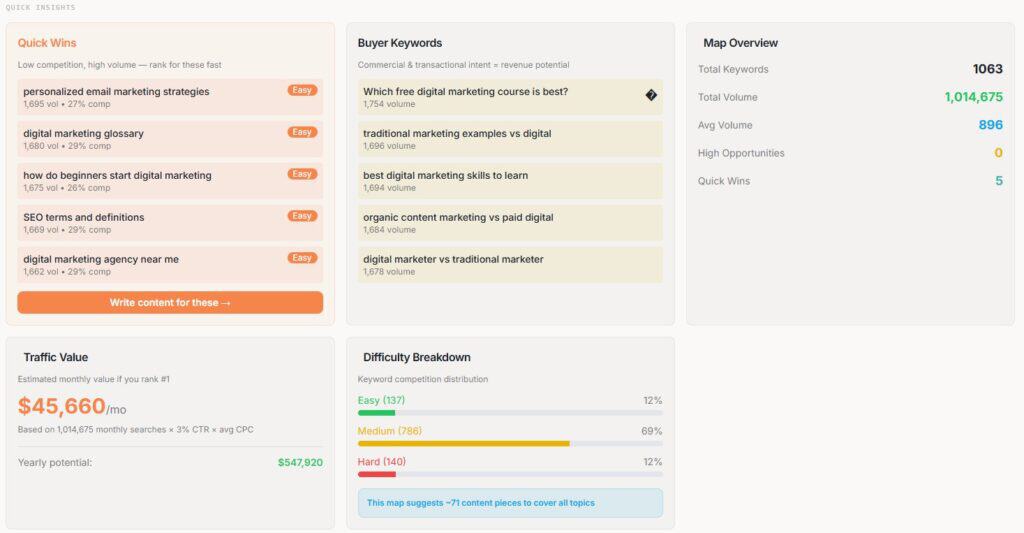
The CSV is a flattened snapshot. Inside the actual tool, the picture is more useful. The map view surfaces difficulty-based filtering including an “Easy” category and a “Quick Wins” designation for topics with high traffic potential and low competition, giving you a starting point for sequencing without leaving the platform. There is also a Buyer Keywords panel that separates commercial-intent topics from informational ones, and a Launch Sequence view that suggests a publishing order. A Competitor Gap Analysis runs inside the map and is also available as a standalone tool, identifying topics competitors cover that you do not.

None of this is visible in the CSV export. If your workflow takes the export straight into a spreadsheet, you lose those signals. The in-tool experience is more decision-ready than the export alone suggests.

A vibrant digital marketing dashboard displaying key metrics, buyer keywords, and traffic value analysis for "Marketing with Dave," emphasizing SEO, digital marketing strategies, and data-driven insig.
Quick Insights dashboard showing Quick Wins, Buyer Keywords, Difficulty Breakdown, and Traffic Value — none of which appears in the CSV export.

That said, there are still questions the tool cannot answer from its own data:

  • Which clusters do you already have partial authority in vs. starting from zero?
  • Where is your website’s current coverage strongest relative to competitors?
  • Which pages are losing ground and need refreshing before you add new content?

Those answers require either your own research or a tool that maintains an ongoing model of your specific domain, which is precisely what MarketMuse’s website inventory does. The gap between these tools is narrower than the raw CSV implies, but it is still real.

Where the Meaningful Differences Live

Personalized Difficulty. Topical Map AI shows generic keyword difficulty, the same score any keyword tool provides. MarketMuse shows how hard a topic is for your specific domain based on existing authority. A topic at generic difficulty 60 might be a 30 for your website if you already have adjacent coverage. That signal changes prioritization decisions significantly and is unique to MarketMuse.

Website Inventory. Topical Map AI uses your GSC data or sitemap to inform map generation, but it does not maintain an ongoing inventory of your website’s performance. MarketMuse crawls your entire content library continuously, surfaces pages losing ground, identifies clusters where you already have partial authority, and flags subject areas with no coverage. According to MarketMuse’s own documentation, there are no minimum site size requirements, though independent reviewers consistently note that the authority scoring becomes more actionable as your published content grows.

Optimize Editor. Once a map is generated in Topical Map AI, you leave to write elsewhere. MarketMuse’s Optimize editor scores content in real time as you draft, flags missing subtopics, and benchmarks your coverage against competing pages. Surfer SEO and Clearscope focus specifically on this phase, MarketMuse includes it alongside the planning layer.

Internal Linking (Connect). MarketMuse identifies orphaned pages and recommends specific anchor text and link targets between related content. Topical Map AI has no equivalent. For sites managing 100+ posts, internal linking is how topical authority actually flows, Connect addresses a real gap.

International SEO. Topical Map AI supports 25+ countries and 20+ languages. MarketMuse is primarily English-focused. For non-English or multi-market campaigns, Topical Map AI has a clear advantage.

Agency Deliverables. Topical Map AI includes white-label PDF export for client-facing work. MarketMuse is built for internal team use only.

See the current AppSumo deal for Topical Map AI

Pricing Reality

Topical Map AI is on AppSumo as a lifetime deal: $69 (15 maps/month) to $449 (150 maps/month, batch generation, REST API). BYOK lets you generate maps at token cost after the one-time purchase, which matters for high-volume users. The company was founded in February 2024 and has 1-10 employees, worth factoring in if long-term product support is a consideration for you.

MarketMuse starts at ~$99/month (5 briefs, 100 queries, 1 website inventory) and scales to $499+/month for the Strategy tier. It was acquired by Siteimprove in October 2024 and is moving toward broader enterprise platform integration. The free plan (10 queries/month, no inventory) is effectively a trial.

At $149-$499/month, MarketMuse needs to deliver measurable impact to justify the spend. At $69-$449 one-time, Topical Map AI is not in the same risk category.

Who Should Use Each Tool

Topical Map AI if you are a blogger, solo operator, or small agency; starting a new site or niche; building client deliverables that need white-label output; working in non-English markets; or prefer controlling ongoing costs with a one-time purchase. The GSC integration and sitemap import give it more website-awareness than a pure niche-input tool, but you will still need to bring your own prioritization logic to turn the map into an ordered execution plan.

MarketMuse if you have a substantial published content library and need to know where your authority sits and where the gaps are; your team writes and edits inside the platform using the Optimize editor; internal linking across a large library is a priority; and your budget supports $149-$499/month for the intelligence layer. It is a team tool, solo operators will pay for features they cannot fully use.

One More Option Worth Knowing

Floyi sits between these two tools in scope and price. It uses SERP-based clustering (not just semantic similarity, which reduces keyword cannibalization risk), includes four-level map building, content briefs, internal link recommendations, and real-time tracking, all in a single credit-based workflow. It addresses the “what do I do after the map” problem more directly than Topical Map AI without MarketMuse’s price or complexity. Worth evaluating if neither tool above is quite the right fit.

Above both tools, Conductor and BrightEdge cover real-time SERP tracking, content decay monitoring, and GEO signals at enterprise contract pricing ($1,000+/month). Relevant context, not a realistic option for most readers here.

Bottom Line

Topical Map AI does more than most reviews give it credit for. The in-tool experience, Quick Wins filtering, Buyer Keywords, Launch Sequence, Competitor Gap Analysis, provides more prioritization support than the CSV export reveals. The gap versus MarketMuse is real but narrower than it first appears: Topical Map AI still lacks an ongoing model of your specific site’s authority, which is where MarketMuse’s inventory and Personalized Difficulty earn their place. That deeper site intelligence requires the content library, team, and budget to justify it. Using MarketMuse as a solo operator at $149/month means paying for an enterprise planning layer when what you need is a faster research workflow.

Founder Response from Topical Map AI

After publishing this comparison, Megan from Topical Map AI responded directly:

“Topical Map AI is not trying to be MarketMuse, different price point, different scope, different buyer. It’s built for individual creators, agencies, and content teams who need structured topic discovery and clustering without enterprise-level investment.”

That is the clearest framing of who this tool is for, and it comes from the founder. If that description fits where you are, the lifetime deal is low-risk, especially with AppSumo’s 60-day test drive. Just go in knowing the map is the starting point, not the finish line.

See the current AppSumo deal for Topical Map AI

Disclosure: This post may contain affiliate links. If you purchase through these links, I may earn a small commission at no additional cost to you.

Topical Map AI vs MarketMuse: Which Content Strategy Tool Fits Your Workflow? Read More »

blog posts published by month

What 200 Blog Posts Taught Me About Digital Marketing and Consistency

Reading Time: 4 minutes

Two hundred blog posts is not a milestone I set out to reach. It is proof of a habit that formed over time.

I did not start with a goal of publishing 200 posts. I started because I had ideas I wanted to share, concepts I wanted to test, and questions I wanted to explore. Somewhere along the way, consistency turned into real momentum.

This is what 200 blog posts taught me about digital marketing, discipline, ego, and the long game.

Lesson 1: The process matters more than the outcome

There is a philosophy from Nick Saban about focusing on the process and not the outcomes which can become distractions. When you obsess over outcomes, you create pressure. When you commit to the process, outcomes take care of themselves.

That mindset shaped this entire journey.

I was far more interested in what was next than in what had already been accomplished. I cared about simplifying aspects of marketing so I could better understand and communicate that to others. I cared about providing true value and insights.

Lesson 2: Traffic takes longer than you think

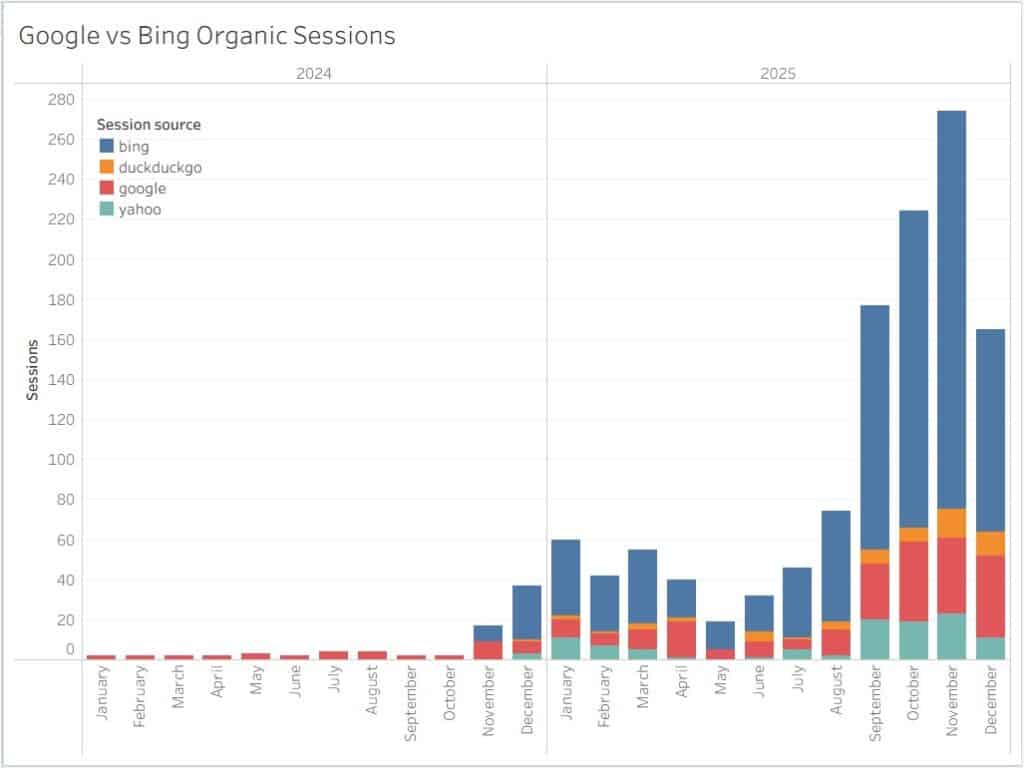
About seven to eight months into consistent publishing, I saw my first real traffic spike. It did not happen in month one. It did not happen in month three. It took time.

You truly have to fall in love with the process because the results lag.

If you obsess over metrics too early, you will quit before compounding has a chance to work.

This chart tells the real story. Traffic did not respond immediately, but it did respond eventually. The early months were quiet. The work was still happening. The results simply had not caught up yet.

Lesson 3: Metrics will humble you

As traffic began to grow, I felt proud. Then I started digging deeper into the data.

I discovered bot traffic. I discovered internal traffic. I discovered that not all growth was as “real” as I had initially believed.

It felt like a blow to the ego.

But it was also a gift. It forced me to care more about clean data than inflated numbers. It forced me to improve tracking, filters, and channel clarity. It reminded me that vanity metrics are fragile.

Lesson 4: Consistency is not optional

I have heard many times that it does not matter how often you publish, as long as you are consistent. After 200 posts, I believe that is true.

Consistency builds skill. Consistency builds indexed assets. Consistency builds confidence. Consistency builds clarity.

Consistency also reveals whether the passion is real.

It is less about frequency and more about respect for time. Respect for the time it takes search engines to trust you. Respect for the time it takes your thinking to mature. Respect for the time it takes to develop a voice.

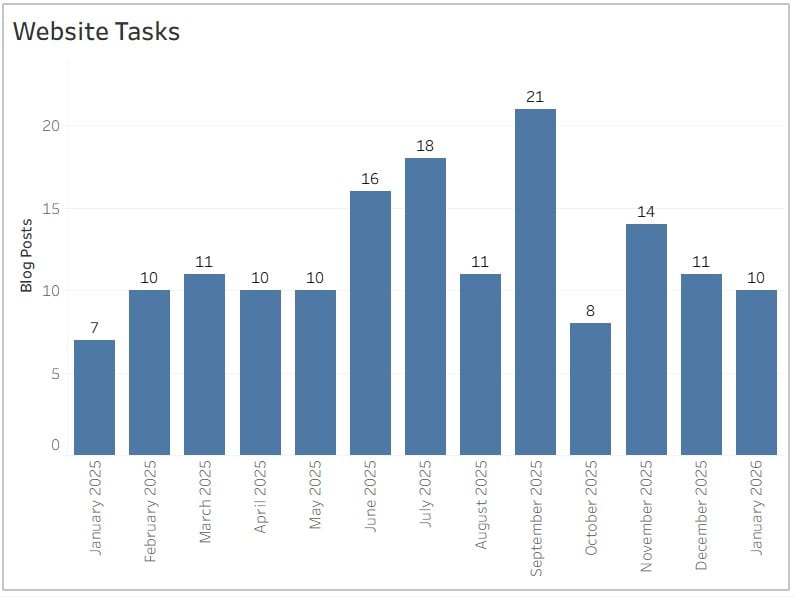
Consistency is easy to talk about but harder to visualize. This chart shows my publishing cadence by month. Some months were heavier than others, but the important part was always returning to the work.

This chart reflects the real work behind the scenes. Not a single spike, but a pattern of consistent effort over time.

Lesson 5: Digital marketing is too big for one person, but curiosity does not scale down

For decades, I have considered myself a digital marketer. The reality is that digital marketing is not a lane. It is an ecosystem.

SEO, paid media, analytics, website optimization, martech, email, strategy, customer data. No single person can master every area at the highest level.

The challenge is that I genuinely love all of it.

The monthly theme structure became my way of introducing discipline. It forced me to identify pillars. It forced me to ask whether I truly had something valuable to say in each area. It forced strategic tradeoffs.

That structure improved the quality of the website and clarified where my depth is strongest.

Lesson 6: I was not ignoring the crowd. I was immersed in my own ideas

I did not intentionally avoid what others were publishing. I was too focused on what I was building to care.

I have a few voices I respect. I pay attention on LinkedIn when something meaningful stands out. But I was never motivated to chase the latest movement or position myself at the front of whatever was trending.

I am fairly introverted, even online. I do not feel compelled to perform. I feel compelled to create and improve.

There is risk in that approach. You can miss tactical best practices. You can miss popularity trends. But you also protect originality. You build from first principles. You create what you would want to read.

Lesson 7: Your best evolves

One of the things I have always loved about digital marketing is that nothing is ever finished. Nothing is permanent. You can always tweak, refine, and improve.

My best last year is not my best today. And my best today will not be my best a year from now.

Publishing 200 posts did not mean getting everything right. It meant creating something I could improve.

Iteration is not a flaw in digital marketing. It is the point.

Final Reflection

If I learned anything from publishing 200 posts, it is this: you cannot shortcut compounding.

You cannot fake consistency. You cannot rush trust. You cannot build depth without time.

You have to fall in love with the process before the results show up. Usually it’s just the onlooker that considers something an overnight success. The one involved who was grinding day-after-day wouldn’t say so.

Two hundred posts did not make me an expert. They made me better than I was when I started.

And if you do, the numbers eventually take care of themselves.

What 200 Blog Posts Taught Me About Digital Marketing and Consistency Read More »

content marketing made easy

Content Marketing Made Easy by John Nemo Book Summary

Reading Time: 3 minutes

Top Three Quotes

  1. “Information + Entertainment = Infotainment.”
  2. “Content has become the currency you use to buy attention.”
  3. “People buy based on emotion, not logic—and your content must make them feel something.”

Book Theme

Content Marketing Made Easy centers on how to attract, engage, and convert your ideal audience through personality-driven, emotionally resonant content. It explains content marketing as both art and science—earning attention by giving value before asking for anything in return.

Why You Should Read This Book

Read Content Marketing Made Easy if you want a practical, story-rich, and highly actionable guide to modern marketing. Nemo translates decades of experience into a relatable framework anyone—entrepreneurs, freelancers, coaches, or marketers—can apply to build a loyal audience using blogs, podcasts, videos, and social media.

Key Ideas and Arguments Presented

  • Content = Currency – Attention must be earned through valuable, entertaining content.
  • Infotainment Wins – Combine useful information with engaging storytelling.
  • Emotion Drives Decisions – People buy based on emotion and justify later with logic.
  • Personality is Power – Infuse your unique voice into your content to stand out.
  • Niche Focus – “The riches are in the niches.” Hyper-targeted audiences convert best.
  • Value First Marketing – Offer free, high-quality content before making any ask.
  • Storytelling Converts – Real stories create emotional connections and memorability.
  • Automation and Systems – Use funnels, email sequences, and scheduling to scale impact.
  • The One-Question Survey – Ask audiences directly what they want most from your content.
  • Repurpose on Purpose – Reuse and reshape strong content across multiple formats.

Book Outline

  • Chapter 1: Step Zero – What is Content Marketing and How Does it Work?
  • Chapter 2: Seamless Selling – Content That Converts
  • Chapter 3: Idea Factory – How to Come Up With Content Your Audience Will Go Bananas For
  • Chapter 4: Gone Fishin’ – How to Set Up a Sales Funnel Using Content
  • Chapter 5: Create vs. Curate – Which One Should You Do?
  • Chapter 6: Simply Irresistible – How To Create Magnetic Content
  • Chapter 7: The Secret Sauce Nobody Else Can Replicate
  • Chapter 8: You Have To See It To Believe It
  • Chapter 9: Can We Talk? Listen To This Advice
  • Chapter 10: The Single Best Content Marketing Tool I’ve Ever Seen
  • Chapter 11–17: Strategies on social media, repurposing, automation, ROI, and next steps.
  • Afterword: Encouragement and reflection on faith, purpose, and storytelling.

Key Takeaways

  • Great content blends emotion, entertainment, and education.
  • Marketing today is about earning trust, not demanding attention.
  • Personal storytelling humanizes brands and attracts the right clients.
  • Asking your audience what they want outperforms guessing.
  • Content marketing is a repeatable system, not random inspiration.
  • Automation allows you to scale personal connection without burnout.
  • Success follows consistency and authenticity, not viral moments.

Key Techniques

  • Infotainment Formula: Information + Entertainment = Engagement.
  • One-Question Survey: “What do you want to know most about [topic]?”
  • Niche Targeting: Create audience-specific content with tailored language.
  • Value Ladder Funnel: Start with free, helpful content → build trust → offer paid products.
  • Repurposing System: Transform one strong idea into blogs, videos, and social posts.
  • Story Framework: Use personal experiences and customer stories to teach and sell.
  • Automation Tools: Calendars, autoresponders, and outsourcing to streamline workflow.

Author’s Qualifications

John Nemo is a bestselling author, LinkedIn marketing expert, and founder of Nemo Media Group. With a background in journalism and public relations, he has helped thousands of entrepreneurs, coaches, and businesses build lead-generating content strategies through his books, podcasts, and online courses.

Comparison to Similar Books

Comparable to:

However, Nemo’s tone is more conversational, faith-based, and deeply personal, combining step-by-step marketing guidance with motivational storytelling.

Target Audience

  • Entrepreneurs and solopreneurs
  • Coaches and consultants
  • Small business owners
  • Digital marketers and content creators
  • Freelancers building personal brands
  • Nonprofits and ministries wanting authentic engagement
  • Corporate professionals transitioning to independent work

Critical Response to the Book

Readers and influencers—including Chris Brogan, John Lee Dumas, and Bob Burg—praise the book for its authenticity, humor, and clarity. It is often cited as a refreshing antidote to over complicated marketing jargon, emphasizing real human connection and storytelling that sells naturally.

One Sentence Takeaway

Content marketing succeeds when you stop selling and start connecting – creating valuable, emotionally engaging stories that build trust, relationships, and results.

Content Marketing Made Easy by John Nemo Book Summary Read More »

five cs of content marketing

Content Marketing’s 5 C’s: Clarity, Consistency, Creativity, Customer, Conversion

Reading Time: 5 minutes

Most content strategies don’t fail for lack of ideas. They fail because the work isn’t clear, consistent, or connected to what the audience needs. The 5 C’s framework exists to fix that by aligning content with purpose and outcomes.

The “Five C’s of Content Marketing” is a popular mnemonic used to structure content strategy, though it has no single official origin. Early references appear in marketing literature (e.g., Content Marketing Strategies For Dummies in 2016) where Stephanie Diamond framed a five-C framework for strategy (Company focus, Customer experience, Channel promotion, Content creation, Check-back analysis).

Decades later, copywriting guru Robert W. Bly (2020) claimed a “Five C’s” formula for content (Clear, Concise, Compelling, Credible, with a Call-to-action). In practice, various authors adapt the 5 C’s to different terms, but they all aim to cover key success factors. In broad terms they boil down to clarity and quality of content, consistent delivery, creative engagement, audience focus, and driving conversions.

The 5 C’s are most often invoked during content strategy planning — essentially as a checklist to align content with business goals. Using a Five C’s framework helps you cover all the bases as you create your content marketing strategy. In other words, these C-words remind you to think about who you’re creating content for (Customer), what you’re giving them (Content & Clarity), how you deliver it (Consistency, Channels/Community), and what outcomes you drive (Conversion). Integrating the 5 C’s into your framework early on — for example, when setting goals, planning your editorial calendar, or auditing existing content — helps ensure nothing crucial is overlooked.

What Are the Five C’s?

Different sources use slightly different labels, but five themes recur. A commonly cited version lists the 5 C’s as Clarity, Consistency, Creativity, Customer-Centricity, and Conversion. Briefly:

  • Clarity (Content Quality): Ensure the content is clear, well-written, and valuable. Audiences (and search engines) should immediately grasp the message and benefit. Clear, jargon-free writing and logical structure build trust and keep readers engaged. (Bly’s variant emphasizes being clear and concise.)
  • Consistency: Publish reliably and uniformly. A steady schedule (for example, weekly blogs or daily social posts) and a cohesive brand voice across channels build audience trust and momentum. Inconsistent cadence or tone confuses prospects; a content calendar and style guide are essential.
  • Creativity (Compelling Content): Make the work interesting and engaging. The web is crowded, so content must stand out with creative ideas, storytelling, or formats. Unique visuals, inventive headlines, or novel angles capture attention. Creativity isn’t decoration — it is how you win the scroll.
  • Customer-Centricity (Audience Focus): Put the audience first. Define who your customer is and tailor content to their needs and context. Treat the audience as the hero. In practice that means useful personas, segmentation, and community engagement so content resonates and earns attention.
  • Conversion (Call-to-Action & Results): Drive the next step. Good content doesn’t just inform — it prompts action (download, sign up, share, buy). Every piece should have a clear CTA and purpose. Track and optimize with KPIs so you can refine what works. (Bly’s version explicitly includes CTA as a “C”.)

While most marketers agree on these five, some expand the model to reflect today’s landscape. You’ll often see Community and Context added (build relationships and deliver the right message at the right time). Others add a Check/Correct phase: publish, measure, and adjust. All of these reinforce a simple idea: keep listening and keep improving.

5 C’s in B2B vs. B2C

Both B2B and B2C use the 5 C’s, but the emphasis differs. Here’s the quick read:

  • B2B: trust, ROI, longer cycles, multiple stakeholders. Clarity = data and proof. Consistency = educational series and webinars. Creativity = making complex ideas accessible. Customer focus = persona-based content for roles. Conversion = demos, trials, consultations.
  • B2C: emotion, lifestyle, faster cycles, bold creativity. Clarity = crisp, catchy messaging. Consistency = recognizable voice in social and ads. Creativity = formats that spark sharing. Customer focus = personalization and community. Conversion = buy now, subscribe, share.

The takeaway: both must be relevant and audience-focused, but B2B optimizes for confidence over time, while B2C optimizes for impact and velocity.

When to Use the 5 C’s Framework

Use the 5 C’s at two moments: planning and improvement. At the start of a campaign, walk through each C to align the team: have we defined the customer, clarified the message, planned a consistent cadence, built creative hooks, and embedded CTAs? During optimization, “check” where performance lags and “correct” by sharpening clarity, rebalancing cadence, refreshing creative, refocusing on the customer, or improving CTAs. Many teams bake the 5 C’s into editorial briefs, content calendars, and quarterly reviews. The model also plays nicely with other tools, like mapping content to your marketing funnel or overlaying keyword clusters on each pillar.

5 C’s in Action: An Example

Consider a fictional B2B SaaS firm, Acme Analytics, using the 5 C’s to guide its blog strategy:

  • Clarity: Acme defines its audience as data analysts and IT managers. It publishes “Demystifying Data Dashboards,” a plain-language whitepaper. Headlines and structure make value obvious at a glance.
  • Consistency: New blog every Tuesday, monthly newsletter, and a uniform tone across channels. A shared calendar prevents gaps and keeps topics on track.
  • Creativity: An interactive visualization quiz and a short animated explainer on dashboard pitfalls outperform plain text. The team experiments with infographics and case-study podcasts.
  • Customer-Centricity: Surveys surface pain points like slow load times. Content is segmented by persona: CFO-friendly ROI calculators and developer-focused deep dives. Guest posts from practitioners build community.
  • Conversion: Every piece ends with a relevant CTA (template download, demo request). Conversions are tracked and underperformers are updated with stronger offers, newer data, and clearer CTAs.

Quick B2C contrast: a food brand might apply Clarity in recipe instructions, Consistency in a reliable social cadence, Creativity in playful challenges, Customer focus through user-generated content, and Conversion via “shop ingredients” links.

Beyond the 5 C’s: Related Concepts

When the 5 C’s come up, adjacent frameworks usually follow. Classic marketing models like the 4 P’s (Product, Price, Place, Promotion) and the funnel (Awareness, Consideration, Decision) complement this approach. Content-specific models — the “four pillars” of Strategy, Creation, Distribution, and Measurement — overlap with the 5 C’s by emphasizing planning, multi-channel delivery, and analytics. You’ll also see “7 C’s” variants (adding Context, Channel, Conversation) and “5 P’s of Content” (often including People/Persona). Under any label, the goal is the same: make helpful, relevant content that serves the audience and the business.

In short, the 5 C’s are a guide, not a gospel. Use them to keep clarity, consistency, creativity, customer needs, and conversion at the center of your strategy — and keep iterating as you learn.

References

  1. Diamond, Stephanie. Content Marketing Strategies For Dummies. Wiley, 2016.
  2. Bly, Robert W. Various writings on the “5 C’s” of effective content (circa 2020): Clear, Concise, Compelling, Credible, Call-to-Action.
  3. HubSpot, Content Marketing Institute (CMI), and MarketingProfs articles and guides discussing the Five C’s variations and their application.
  4. Professional comparisons of B2B vs B2C content emphases (trust/ROI and longer cycles in B2B vs emotion/speed in B2C).
  5. Framework overviews on planning and audits (for example, aligning to goals, mapping to funnels, integrating with calendars and briefs).
  6. Related frameworks frequently cited alongside the Five C’s: the 4 P’s of marketing; funnel stages; the “four pillars” of content marketing; “7 C’s” and “5 P’s” variants.

Content Marketing’s 5 C’s: Clarity, Consistency, Creativity, Customer, Conversion Read More »