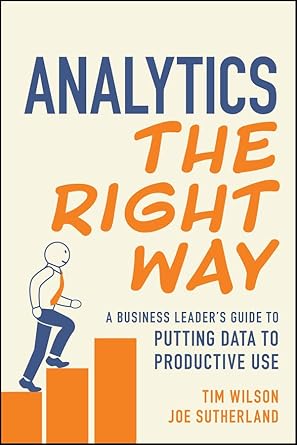
This web page highlights the 21 marketing and business books I read in 2025 that earned a five-star rating. These books focus on topics like marketing strategy, customer experience, leadership, data, analytics, and emerging technology, and they reflect the ideas and frameworks I found most useful throughout the year. The list below includes the full set of five-star reads, along with cover images and links for easy reference.
Version 1.0.0
Goodreads Year in Review
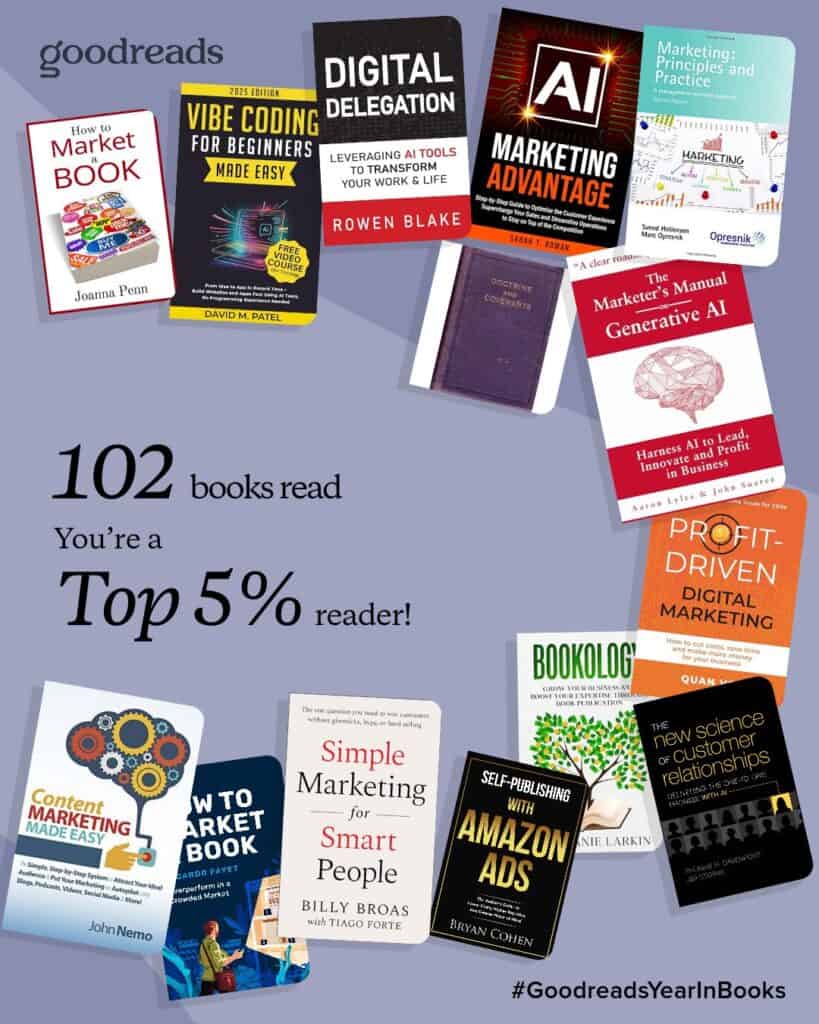
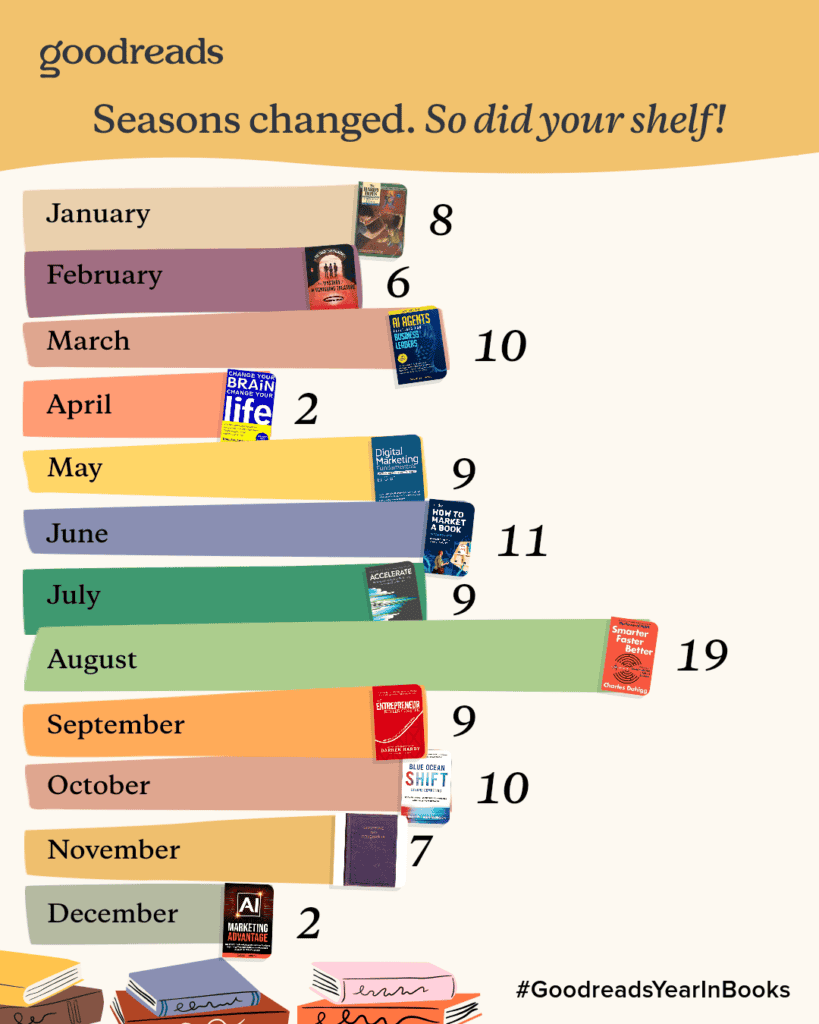
Below is my Goodreads Year in Review for 2025. It provides a quick snapshot of my reading volume, habits, and the types of books I spent the most time with throughout the year.
Strategic competitiveness is achieved when a firm successfully formulates and implements a value creating strategy.
Above average returns are earned when firms create value for customers that exceeds the cost of creating that value.
Firms must analyze both their external environment and their internal resources to develop sustainable competitive advantages.
Book Theme
Strategic Management explains how organizations earn and sustain above average returns by using the strategic management process to analyze the environment, make deliberate strategic choices, and implement those choices effectively in global and fast changing markets.
Why You Should Read This Book
Read this book if you want a structured, repeatable way to think about strategy that goes beyond opinions and slogans.
It gives you a complete toolkit for diagnosing competitive problems, selecting business and corporate strategies, managing global and alliance decisions,
and executing strategy through governance, structure, controls, leadership, and innovation.
Key Ideas and Arguments Presented
The strategic management process is a discipline
Strategy is not a one time plan. It is an ongoing cycle of analysis, strategy choices, and implementation decisions.
The goal is strategic competitiveness and above average returns, not activity for its own sake.
The Analysis, Strategy, Performance logic is the backbone
Analyze external conditions and internal resources before selecting a strategy.
Measure performance and adjust as competitors, technology, and stakeholder expectations change.
External analysis matters because industries shape profits
General environment forces include demographics, economics, political and legal, sociocultural, technology, global forces, and the physical environment.
Industry structure and competition influence how value is captured and what strategic moves are realistic.
Five Forces helps explain industry attractiveness
Threat of entrants, bargaining power of suppliers, bargaining power of buyers, threat of substitutes, and rivalry intensity set the competitive baseline.
Interpretation matters. The same force can affect firms differently based on positioning and capabilities.
Competitor and strategic group analysis sharpen decisions
Strategic groups help you understand who competes in similar ways and why performance differs within an industry.
Competitor analysis clarifies likely moves and responses.
Internal resources can create advantage when they meet strict criteria
Resources and capabilities become core competencies when they meaningfully create customer value.
Sustainable advantage depends on resources that are valuable, rare, difficult to imitate, and not easily substituted.
Value chain analysis explains where value is created and lost
Breaking work into activities helps identify cost drivers, differentiation drivers, and outsourcing decisions.
Strategy often improves when the firm improves a few high impact activities rather than everything.
Business level strategy answers who, what, and how
Who to serve, what needs to satisfy, and how to do so using the right capabilities.
Core options include cost leadership, differentiation, focus strategies, and integrated cost leadership and differentiation.
Business models also matter, including franchise, subscription, and digital platform models.
Competition is dynamic, not static
Competitive rivalry is shaped by actions and responses across time.
Market commonality and resource similarity help predict competitive behavior.
Different market types require different approaches, including slow cycle, standard cycle, and fast cycle markets.
Corporate level strategy defines the scope of the firm
Diversification ranges from low to high, with related and unrelated approaches.
Value can come from sharing activities, transferring competencies, market power, and vertical integration.
Not all diversification creates value. Some is value neutral and driven by incentives or managerial motives.
Mergers, acquisitions, and restructuring are high risk levers
Common goals include market power, speed to market, learning, and reshaping competitive scope.
Common failure causes include poor target evaluation, debt, weak integration, and chasing deals without strategy.
Restructuring tools include downsizing, downscoping, and leveraged buyouts, each with tradeoffs.
International strategy expands opportunity and complexity
Firms expand internationally for scale, location advantages, and learning, but face political, legal, and economic risk.
Entry modes range from exporting and licensing to alliances, acquisitions, and greenfield ventures.
Performance effects depend on the fit between strategy, structure, and local conditions.
Cooperative strategy can create value but introduces risk
Strategic alliances can be used to share resources, reduce uncertainty, or respond to competitors.
Network strategies and multi party alliances matter more in platform and ecosystem contexts.
Managing alliance risk requires governance, clarity, and disciplined partner selection.
Implementation can determine success more than formulation
Governance, incentives, structure, and controls must match the chosen strategy.
Leadership shapes culture, ethics, resource allocation, and strategic change.
Stakeholders and responsible behavior are strategic, not optional
The book treats stakeholders, corporate social responsibility, sustainability, and ESG as forces that shape strategy and performance.
Firms must manage accountability beyond shareholders, especially in global markets.
Entrepreneurship and innovation sustain long term performance
Firms create value through innovation, imitation, internal entrepreneurship, and cooperative innovation.
Both incremental and radical innovation require structures and leadership that support experimentation and integration.
Book Outline
Part 1: Strategic Management Inputs
Chapter 1: Strategic Management and Strategic Competitiveness
Chapter 2: The External Environment: Opportunities, Threats, Industry Competition, and Competitor Analysis
Chapter 3: The Internal Organization: Resources, Capabilities, Core Competencies, and Competitive Advantages
Part 2: Strategic Actions: Strategy Formulation
Chapter 4: Business Level Strategy
Chapter 5: Competitive Rivalry and Competitive Dynamics
Chapter 6: Corporate Level Strategy
Chapter 7: Merger and Acquisition Strategies and Restructuring
Chapter 8: International Strategy
Chapter 9: Cooperative Strategy
Part 3: Strategic Actions: Strategy Implementation
Chapter 10: Corporate Governance
Chapter 11: Organizational Structure and Controls
Chapter 12: Strategic Leadership
Chapter 13: Strategic Entrepreneurship
Part 4: Case Studies
22 cases across industries and global contexts, designed to apply the frameworks and make recommendations under uncertainty.
Guidance section: Preparing an Effective Case Analysis
Key Takeaways
Strong strategy starts with disciplined analysis and ends with disciplined execution.
Industry forces shape what is possible, but internal capabilities shape what is achievable.
Sustainable advantage requires resources and capabilities that competitors cannot quickly replicate.
Competitive markets require anticipating rivals and adapting over time, not just choosing a position.
Corporate scope choices such as diversification, acquisitions, and vertical integration can create value, but often fail without fit and integration.
Global expansion increases both opportunity and risk, and demands careful entry mode choices and organizational alignment.
Alliances and networks can accelerate learning and market access, but require active risk management.
Governance, incentives, structure, controls, and leadership are not supporting topics. They are central to performance.
Stakeholder expectations, sustainability pressures, and ethical failures can reshape competitive landscapes and should be treated as strategic issues.
Innovation and strategic entrepreneurship are required to renew advantages as environments change.
Key Techniques
External environment analysis
Scanning, monitoring, forecasting, and assessing environmental trends.
Segment analysis of demographic, economic, political and legal, sociocultural, technological, global, and physical environment forces.
Industry analysis
Five Forces assessment and interpretation.
Strategic group mapping and competitor analysis.
Internal analysis
Resource and capability assessment.
Core competency identification and evaluation using sustainability criteria.
Value chain analysis to find cost and differentiation drivers.
Strategy selection tools
Business level strategy choice and customer based positioning (who, what, how).
Corporate scope design through related and unrelated diversification logic.
Entry mode selection for international markets.
Alliance design and management approaches.
Implementation tools
Corporate governance mechanisms and board effectiveness considerations.
Matching structure to strategy, including functional and multidivisional forms and global structures.
Strategic and financial controls to track performance and guide behavior.
Leadership actions that shape direction, culture, ethics, and resource allocation.
Case analysis practice
Applying the analysis and recommendation process to real organizational problems using cases and mini cases.
Author’s Qualifications
The authors are widely published scholars and educators in strategic management, corporate governance, stakeholder strategy,
and entrepreneurship, with long academic careers at major universities and extensive editorial and leadership roles in top management associations.
Comparison to Similar Books
Compared to classic positioning focused works, this book is broader and more teachable, combining environment analysis, internal resource logic,
strategy formulation options, and implementation systems in one integrated process. It functions as a full curriculum rather than a single argument.
Target Audience
Undergraduate business students studying strategy or capstone management
MBA and graduate management students
Managers moving into strategy, planning, or general management roles
Consultants and analysts who need a complete strategy toolkit
Entrepreneurs who want structured competitive and growth analysis
Leaders involved in governance, restructuring, or transformation initiatives
Instructors designing strategy courses with cases and applied exercises
Critical Response to the Book
As a comprehensive strategic management textbook, it is designed for structured learning and application, emphasizing current examples and case work.
Its main strengths are breadth, clear frameworks, and a full coverage of both formulation and implementation. The tradeoff is that it is dense and best used as a course text or reference rather than a quick read.
One Sentence Takeaway
To outperform rivals over time, firms must repeatedly align external conditions, internal capabilities, strategic choices, and execution systems in a global and fast changing environment.
“Don’t make me think!” – Steve Krug’s core mantra, meaning a website should be obvious and self-explanatory.
“It doesn’t matter how many times I have to click, as long as each click is a mindless, unambiguous choice.” – Emphasizes that clarity of each action matters more than minimizing the number of clicks (Krug’s second law of usability).
“Get rid of half the words on each page, then get rid of half of what’s left.” – Krug’s third law, urging the elimination of unnecessary content to reduce clutter and cognitive load.
Book Theme
Don’t Make Me Think focuses on web usability and intuitive design. Its central message is that websites (and apps) should be built so that users can navigate and accomplish tasks without having to consciously figure out how to use them. The book emphasizes simplicity, clarity, and common-sense design principles to make the user experience effortless.
Why You Should Read This Book
This book is a highly accessible introduction to usability, packed with practical advice and humor. It distills complex user-experience ideas into simple, memorable principles. Anyone involved in designing or building websites – from UX/UI designers and developers to product managers and entrepreneurs – will learn how to avoid common pitfalls, streamline their designs, and create more user-friendly sites. Even non-technical readers can grasp its concepts quickly, making it a valuable resource for anyone who wants to improve the usability of their digital products.
Key Ideas and Arguments Presented
Don’t Make Me Think: A website should be self-evident. Every page and element should be obvious, requiring minimal conscious thought from the user.
Users Scan and Satisfice: People tend to glance at web pages for relevant information and will pick the first acceptable option (rather than the “best” one). Design should accommodate this behavior.
Design for Scanning: Since users scan rather than read, use familiar layouts (logo links home, menus on top/left), clear visual hierarchies, headings, bullets, and short paragraphs to make content easy to find at a glance.
Mindless Clicks Rule: The number of clicks matters less than the ease of each click. Every link or button should be an obvious, unambiguous choice, giving users confidence they are on the right path (Krug’s second law of usability).
Kill Unnecessary Words: Most people don’t read everything. Eliminate filler text (“happy talk”) and long instructions, writing only what is essential (Krug’s third law: cut half the words on a page, then half of what’s left).
Clear Navigation is Vital: Treat navigation as the backbone of your site. Include persistent menus, a clickable logo/Home link, page titles, breadcrumbs, and a search box so users always know where they are and how to get to key sections.
Home Page Clarity: The home page must quickly answer what the site is and what users can do there. First impressions matter (Krug’s “Big Bang Theory of Web Design”), so clearly state the site’s purpose and primary entry points.
Test, Don’t Guess: Team debates about design often go nowhere. Usability testing with real users (even a few at a time) provides objective evidence of what works and what doesn’t, replacing endless arguments.
Usability is Courtesy: Good design is considerate design. Avoid frustrating users with hidden info or poor organization; every hiccup (broken link, cryptic label, unexpected behavior) wastes their time and erodes trust.
Mobile and Accessibility: Recognize mobile screens as “itty-bitty living spaces” that require ruthless prioritization, and treat accessibility as a moral imperative. Make sites usable for everyone, not just on desktops.
Book Outline
Chapter 1: Don’t Make Me Think
Chapter 2: How We Really Use the Web
Chapter 3: Billboard Design 101
Chapter 4: Animal, Vegetable, or Mineral?
Chapter 5: Omit Needless Words
Chapter 6: Street Signs and Breadcrumbs
Chapter 7: The Big Bang Theory of Web Design
Chapter 8: “The Farmer and the Cowman Should Be Friends”
Chapter 9: Usability Testing on 10 Cents a Day
Chapter 10: Mobile: It’s Not Just a City in Alabama Anymore
Chapter 11: Usability as Common Courtesy
Chapter 12: Accessibility and You
Chapter 13: Guide for the Perplexed
Key Takeaways
Websites should be obvious and intuitive, allowing users to accomplish their tasks without extra effort or thought.
Users are goal-oriented and impatient: they scan pages, click quickly, and avoid reading large blocks of text.
Clarity and simplicity are paramount. Remove distractions and unnecessary content so users can focus on their objectives.
Familiar conventions and clear structure help users navigate quickly (e.g., placing the logo as a home link, organizing menus logically).
Every design decision should be validated by testing with real users. Observing users in action reveals problems far more effectively than theoretical debate.
Good usability is a form of courtesy: respecting users’ time and intelligence builds trust and satisfaction.
Usability principles apply to all contexts, including mobile interfaces and accessibility for people with disabilities.
Key Techniques
Billboard Design: Format pages like billboards. Use clear headings, bullet points, and visual cues so users can instantly grasp the page’s purpose without reading everything.
Trunk Test: A quick navigation check. Imagine landing on a page blindfolded; can a user immediately identify where they are and how to navigate to main sections?
Discount Usability Testing: Conduct simple, regular tests on a small budget. Test with just 3 users (taking one morning per month) to identify major usability issues quickly.
Think-Aloud Protocol: During testing, ask users to verbalize their thoughts. This reveals where they get confused or frustrated and why.
Content Pruning: Systematically eliminate half the words on a page, then half again. This forces you to cut fluff (especially “happy talk” and long instructions) and highlight only essential information.
Conventions vs. Clarity: Follow common UI conventions (standard navigation, link styles, icons) unless you have a clearly better alternative. If breaking a convention, ensure the replacement is unmistakably clear to users.
Author’s Qualifications
Steve Krug is a veteran usability consultant and author. Based in Massachusetts, he has advised and taught web usability practices for decades. Don’t Make Me Think is his most famous work (now in its third edition with hundreds of thousands of copies sold worldwide), and he also wrote Rocket Surgery Made Easy, a companion guide to usability testing. Krug runs the consultancy Advanced Common Sense and conducts workshops on practical UX techniques. His extensive real-world experience and straightforward writing style make him a respected authority on web design usability.
Comparison to Similar Books
The Design of Everyday Things (Don Norman) is a classic on general design psychology and affordances for everyday objects; by contrast, Don’t Make Me Think applies common-sense usability specifically to websites in an easy-to-digest format.
Rocket Surgery Made Easy (Steve Krug) is essentially a follow-up focusing entirely on conducting DIY usability tests. Together, these two books cover both design principles (Don’t Make Me Think) and testing methods.
Usability Engineering (Jakob Nielsen) and related Nielsen books provide research-based guidelines and heuristics. Krug’s book is more anecdotal and conversational, trading academic detail for a practical, engaging approach.
About Face (Alan Cooper) and *The Elements of User Experience* (Jesse James Garrett) offer comprehensive theories and frameworks for interaction design; Don’t Make Me Think zeroes in on the core goal of making the interface obvious and easy to use, with much less technical depth.
Thanks to its concise style and humor, Don’t Make Me Think is often used as an introductory read, whereas many other UX books (like Lean UX or 100 Things Every Designer Should Know) may delve deeper into processes or psychology. However, all of these works share the goal of improving user experience, and readers often pair Krug’s book with more detailed texts as their understanding grows.
Target Audience
Web designers and user-interface (UI) professionals
UX practitioners and user experience researchers
Front-end developers and software engineers working on web products
Product managers and startup founders overseeing digital products
Content strategists and information architects
Digital marketers and e-commerce managers responsible for website usability
Students and beginners learning about web and UX design principles
Critical Response to the Book
Don’t Make Me Think has been widely praised in the tech and design communities as an engaging, no-nonsense introduction to web usability. It consistently appears on lists of top UX books and is often taught in design courses. Reviewers and readers applaud Krug’s clear, humorous writing and the book’s practical focus. It has sold hundreds of thousands of copies and been translated into multiple languages, evidencing its popularity. Critics note that while the book’s advice may seem like “common sense” in hindsight, its real value lies in highlighting principles that many designers overlook. There are few negative critiques; even years after publication its ideas remain relevant, especially after updates for mobile. In short, it’s regarded as a classic and essential resource for anyone interested in usability.
One Sentence Takeaway
Design your website or app so that users can accomplish their goals effortlessly – it should never make them stop and think about how to use it.
• “Design that ignores customers is not design at all.”
• “Conversion rate optimization is web design done right.”
Book Theme
Making Websites Win focuses on conversion rate optimization as a customer-centric, research-driven discipline for designing websites that consistently increase sales, leads, and long-term business value. It argues that most web design fails because it prioritizes aesthetics, opinions, or trends instead of measurable customer behavior.
Why You Should Read This Book
• You should read this book if you want to increase website performance in a measurable, repeatable way rather than relying on guesswork.
• It provides a proven framework for diagnosing why websites fail and shows how to fix those failures using research, testing, and customer insight.
• The book is especially valuable if your website is already getting traffic but not converting at the level it should.
Key Ideas and Arguments Presented
• Most websites underperform because they are designed for internal opinions rather than customer needs.
• Conversion rate optimization has a disproportionate impact on profit, not just revenue.
• Small improvements across multiple steps in a funnel compound into dramatic gains.
• Testing removes opinion-driven decision making and replaces it with evidence.
• A/B testing measures success but does not generate good ideas on its own.
• Customer understanding must come before design changes.
• Large, insight-driven changes outperform small cosmetic tweaks.
• High-performing websites prioritize function over visual novelty.
• Lifetime customer value is a critical metric that is often ignored.
• CRO creates a virtuous cycle that enables growth in advertising, SEO, and competitive advantage.
Book Outline
• Section 1: Why Most Web Design Is Done Wrong and How to Do It Right
• Section 2: Diagnosis Tools and Techniques to Understand Visitors
• Section 3: Common Conversion Problems and Proven Solutions
• Section 4: A Detailed Case Study Demonstrating CRO in Action
Key Takeaways
• Customer-centric design consistently outperforms design driven by trends or aesthetics.
• Diagnosis must always come before solution.
• CRO is one of the fastest ways to improve profitability.
• Large improvements usually come from fixing fundamental issues, not polishing details.
• Testing protects businesses from costly mistakes.
• CRO skills are transferable across industries, platforms, and career paths.
Key Techniques
• DiPS framework: Diagnose, identify the Problem, then apply the Solution.
• A/B testing and multivariate testing to validate changes.
• Visitor research through analytics, surveys, user testing, and session recordings.
• Functional copywriting focused on clarity and persuasion.
• Funnel optimization for both early-stage and late-stage buyers.
• Risk reduction through guarantees, proof, and trust signals.
• Managing complexity in high-consideration purchase journeys.
Author’s Qualifications
• Dr. Karl Blanks holds a PhD from Cambridge and applies scientific methodology to marketing optimization.
• Ben Jesson is a conversion expert with extensive hands-on experience scaling online businesses.
• Together they founded Conversion Rate Experts, a global CRO consultancy.
• Their firm has worked across more than 80 industries, multiple languages, and dozens of countries.
• Conversion Rate Experts has generated billions in additional revenue for clients and received the UK Queen’s Award for Enterprise in Innovation.
Comparison to Similar Books
• Unlike general marketing books, this book focuses narrowly on conversion outcomes rather than broad strategy.
• Compared to analytics books, it emphasizes customer psychology and usability over dashboards and reports.
• Compared to design books, it rejects aesthetics as a primary goal unless supported by evidence.
• It complements books like Web Analytics 2.0 by focusing on action rather than measurement alone.
Target Audience
• Digital marketers responsible for website performance
• Conversion rate optimization practitioners
• Founders and startup teams
• Product managers and growth teams
• UX designers seeking measurable impact
• Executives overseeing digital strategy
Critical Response to the Book
• The book is widely praised for its practical, experience-based approach.
• Industry leaders highlight its focus on real results rather than theory.
• It is frequently cited as a foundational text for CRO professionals.
• Readers value its depth, though some note it requires commitment to fully apply.
One Sentence Takeaway
Making Websites Win shows that deeply understanding customers and rigorously testing solutions is the most reliable way to build websites that grow profitably and sustainably.
This line punctures the assumption that collecting more data automatically creates value.
“Data are not valuable in and of themselves. You have to interact with the data in a particular way to get any insight from it.”
The core thesis of the book: value comes from how you use data, not from its volume.
“A KPI without a target is just a metric.”
A sharp reminder that measurement must be tied to expectations and decisions, not dashboards.
Book Theme
The central theme of Analytics the Right Way is that organizations only get value from data when they use it deliberately to support decision-making and operations—through three distinct but connected uses of data: performance measurement, hypothesis validation, and operational enablement.
Why You Should Read This Book
If you feel “data rich but insight poor,” this book explains why that happens and gives you a concrete way out.
It translates rigorous causal thinking and statistical reasoning into practical language for executives, managers, and product leaders.
It offers a simple, memorable framework you can use to align analytics teams, business stakeholders, and technology investments around real business value instead of “big table mentality.”
It is grounded in real client stories and vignettes that mirror the messy situations leaders actually face.
Key Ideas and Arguments Presented
More data is not the same as more insight.
The shift from “data desert” to “data deluge” created a belief that data itself is valuable, like oil, when in reality it is worthless without refinement and theory.
Four common misconceptions about data distort how organizations invest.
The book challenges four beliefs: that enough data can eliminate uncertainty, that data must be comprehensive to be useful, that data are inherently objective, and that democratizing access automatically makes an organization data-driven.
Decision-making is about minimizing regret under uncertainty, not finding certainty.
Good decisions systematically reduce regret given inevitable uncertainty, rather than pretending uncertainty can be removed.
The “potential outcomes” framework clarifies causality.
Potential outcomes and counterfactuals help leaders think clearly about what would have happened under different choices, grounding causal claims in a simple mental model.
There are three fundamentally different ways to use data.
Performance measurement, hypothesis validation, and operational enablement are distinct business activities that must be approached differently.
Performance measurement should be driven by “two magic questions.”
Start with “What are we trying to achieve?” and “How will we know if we’ve done that?” before defining KPIs, targets, and dashboards.
Hypotheses must be explicit, actionable, and managed as a portfolio.
The book uses a simple “Idea, Theory, Action” template and a hypothesis library to turn scattered ideas into an organized pipeline of tests.
Not all evidence is equal: the ladder of anecdotal, descriptive, and scientific evidence.
Leaders should match the evidence-gathering method to the cost and importance of the decision, rather than defaulting to dashboards or experiments.
Descriptive and scientific analyses have predictable pitfalls.
Unit of analysis errors, omitted variables, time effects, selection bias, and confounding can all mislead decisions if not handled carefully.
Operational enablement turns validated hypotheses into scalable business logic and automation.
Trade secrets and mechanisms discovered through hypothesis validation can be encoded into rules, models, and AI systems with appropriate human oversight.
Book Outline
Chapter 1: Is This Book Right for You?
The Digital Age = The Data Age
What You Will Learn in This Book
Will This Book Deliver Value?
Chapter 2: How We Got Here
Why common misconceptions about data hurt our ability to draw insights.
Exploration of four major misconceptions, including the “data is the new oil” analogy.
Chapter 3: Making Decisions with Data – Causality and Uncertainty
Decision-making under uncertainty, minimizing regret, and introducing the potential outcomes framework.
Chapter 4: A Structured Approach to Using Data
Chapter 5: Making Decisions Through Performance Measurement
Why “What are your KPIs?” is the wrong starting question.
The two magic questions and methods for setting targets and using dashboards effectively.
Chapter 6: Making Decisions Through Hypothesis Validation
Framework for articulating, prioritizing, and tracking hypotheses in a hypothesis library.
Chapter 7: Hypothesis Validation with New Evidence
Introduction to the ladder of evidence: anecdotal, descriptive, and scientific.
Chapter 8: Descriptive Evidence – Pitfalls and Solutions
How to avoid common mistakes in historical and descriptive analysis.
Chapter 9: Pitfalls and Solutions for Scientific Evidence
Selection bias, confounding, and the essentials of controlled experimentation.
Chapter 10: Operational Enablement Using Data
The factory metaphor, trade secrets, automation costs, and the role of machine learning and AI.
Chapter 11: Bringing It All Together
How the three uses of data interconnect, plus guidance on communication, technology, and decision-making.
Key Takeaways
Collecting more data does not solve business problems; refining data with clear theory and purpose does.
Leaders should treat uncertainty as inevitable and focus on minimizing regret, not chasing impossible certainty.
Every use of data should clearly fall into one of three categories: performance measurement, hypothesis validation, or operational enablement.
Performance measurement must start from clearly stated goals and targets; otherwise, dashboards become expensive wallpaper.
Actionable insight requires explicit hypotheses, documented as a portfolio, with methods and levels of evidence appropriate to the stakes.
Descriptive and scientific analyses are powerful but fragile; careless design and bias can systematically mislead decisions.
Operational enablement is where analytics scales—turning tested mechanisms into rules and models embedded in processes and products.
The greatest value arises when all three uses of data operate in unison, like sections of an orchestra working from the same score.
Key Techniques
The Two Magic Questions (Performance Measurement)
1) What are we trying to achieve? 2) How will we know if we’ve done that?
KPI Design with Explicit Targets
KPIs only become meaningful when paired with target values and timelines.
Hypothesis Formulation Template (Idea – Theory – Action)
“We believe [Idea] … because [Theory] … If we are right, we will [Action].”
Hypothesis Library and Life Cycle Management
Document, prioritize, and track hypotheses from ideation through validation and archival.
Evidence Ladder and Method Selection
Choose between anecdotal, descriptive, and scientific evidence based on decision cost and importance.
Bias and Pitfall Checklists
Use simple checks and causal diagrams to guard against unit-of-analysis errors, omitted variables, and selection and confounding bias.
Operational Enablement Factory Model
View data-driven operations as a factory with defined inputs, mechanisms, outputs, and levels of automation and human oversight.
Author’s Qualifications
Tim Wilson
Veteran analytics practitioner who built and led analytics practices at multiple agencies, consulted with Fortune 500 firms, co-founded the consultancy facts & feelings, and co-hosts the Analytics Power Hour podcast.
Holds a BS from MIT and an MBA from the University of Texas at Austin.
Dr. Joe Sutherland
Director of the Emory Center for AI Learning and principal investigator in the US AI Safety Institute Consortium.
Former executive at Amazon and Cisco, founder of two AI/fintech startups, and published researcher in machine learning and AI.
Holds a PhD, MPhil, and MA from Columbia University.
Comparison to Similar Books
Analytics the Right Way is less about algorithms than Data Science for Business and more about how leaders should structure decisions and analytics work.
Relative to Analytics at Work or Competing on Analytics, it dives deeper into causal reasoning, experimentation, and the distinction between measurement, testing, and operationalization.
Versus typical “AI for business” titles, it is more skeptical of hype and more explicit about costs, governance, and when simple approaches beat complex models.
Target Audience
Senior business leaders and executives who sponsor analytics, AI, or data initiatives.
Marketing, product, and digital leaders overwhelmed by dashboards but underwhelmed by insight.
Analytics, data science, and BI leaders seeking a shared language with business stakeholders.
Operations and customer-experience leaders embedding data into processes and automation.
Strategy and innovation teams building AI-first or data-first offerings.
Consultants and agency partners looking for a clearer playbook for delivering value, not just reporting.
Non-technical managers who want to become better consumers of analytics and experimentation.
Critical Response to the Book
Analytics the Right Way is a very recent book, so broad external critical reception is still emerging, but it reflects the authors’ well-established perspectives in the analytics and AI community and even “measures” its own impact by asking readers to rate each chapter against clear performance goals.
One Sentence Takeaway
Real business value from data comes not from hoarding it, but from using a clear framework to measure performance, validate hypotheses, and embed proven mechanisms into operations so leaders can make better decisions under uncertainty.
“Persistent, consistent, and frequent stories, delivered to an aligned audience, will earn attention, trust, and action.”
“Marketing is our quest to make change on behalf of those we serve, and we do it by understanding the irrational forces that drive each of us.”
“The most important lesson I can share about brand marketing is this: you definitely, certainly, and surely don’t have enough time and money to build a brand for everyone. You can’t. Don’t try. Be specific. Be very specific.”
Book Theme
This Is Marketing reframes marketing as the generous, ethical practice of helping people change for the better. Instead of chasing mass attention or short-term hacks, Seth Godin argues that modern marketing is about serving a clearly defined smallest viable audience, understanding their worldview, telling true stories that resonate, and earning trust over time by doing work that actually matters.
Why You Should Read This Book
It gives you a clear philosophy for ethical, human-centered marketing in an age of ad fatigue and algorithm-driven noise.
It helps you stop trying to reach “everyone” and instead focus on a specific audience you can truly serve and delight.
It connects strategy and day-to-day decisions: who you serve, what you offer, how you position it, and how you show up consistently.
It distills decades of Seth Godin’s marketing ideas into one coherent, accessible guide for working marketers.
It is especially helpful if you already know basic tactics and want a deeper, principled lens for deciding what to do (and what to stop doing).
Key Ideas and Arguments Presented
Marketing is about change, not hype. The real job of marketing is to create meaningful change for specific people, not just to get clicks, views, or short-lived attention.
Focus on the smallest viable audience. You do not need everyone; you need a small group of people for whom your work is incredibly valuable and who can sustain your business or mission.
People like us do things like this. Behavior is driven by worldview, identity, and group norms, so effective marketing aligns with the story people already tell themselves about who they are and what their people do.
Tell stories, build connections, and design experiences. Features and specs are secondary; what people really respond to are stories that make sense to them and experiences that reinforce those stories.
Trust and permission are core marketing assets. Instead of interrupting strangers, earn permission to talk to people who want to hear from you and protect that trust by being relevant and generous.
Treat different people differently. Mass-averaged messaging leads to bland work; segment by worldview and desire so you can craft specific messages and offers for specific groups.
Positioning and price are part of the story. Deciding who your product is for and who it is not for, and how you price it, shapes how people perceive its value, status, and fit.
Tribes and culture change matter more than one-off campaigns. Marketing is leading a group of people who share an idea or identity, helping them move together toward a desired change.
Funnels are journeys, not tricks. Awareness, consideration, and action are stages in a relationship; pushing people through a funnel without empathy or value erodes trust.
Because marketing works, it is a responsibility. The ability to shape culture and behavior means marketers have an obligation to use their influence with integrity, not manipulation.
Book Outline
The book is organized into short, idea-dense chapters that build a complete view of modern marketing. Key chapters include:
Not Mass, Not Spam, Not Shameful – why old-school interrupt-and-shout marketing is broken and what must replace it.
The Marketer Learns to See – understanding culture, noticing needs, and seeing opportunities for change.
Marketing Changes People Through Stories, Connections, and Experience – why story and experience drive action.
The Smallest Viable Market – focusing on a tiny audience you can actually serve well.
In Search of Better and Beyond Commodities – how customers define “better” and how to escape commodity status.
The Canvas of Dreams and Desires – mapping what your audience really wants and fears.
People Like Us Do Things Like This – identity, status, and group norms.
Trust and Tension Create Forward Motion – why people act and how to introduce honest, productive tension.
Status, Dominance, and Affiliation – understanding status-driven motivations.
A Better Business Plan – reframing strategy around who it is for and what change it creates.
Semiotics, Symbols, and Vernacular – using language and symbols your audience recognizes as their own.
Treat Different People Differently and Reaching the Right People – segmentation and focused outreach.
Price Is a Story – why pricing communicates value and status.
Permission and Remarkability in a Virtuous Cycle – earning permission by being worth talking about.
Trust Is as Scarce as Attention and The Funnel – how relationships actually develop.
Organizing and Leading a Tribe – turning customers into a community and movement.
Case Studies and Marketing Works, and Now It Is Your Turn – real-world examples and a call to action.
Marketing to the Most Important Person – centering the customer and the change you promise them.
Key Takeaways
Marketing is the act of making positive change for the people you seek to serve, not the act of shouting at everyone.
Trying to reach everyone leads to average products and average messaging; focusing on the smallest viable audience leads to depth, loyalty, and word-of-mouth.
People buy based on worldview, identity, and status; your stories, symbols, and experiences must match the way they already see themselves and their group.
Trust and permission are more valuable than reach; once someone trusts you and wants to hear from you, marketing becomes a service instead of an intrusion.
It is easier and smarter to design products and services for a particular audience than to build something and then hunt for anyone who might buy it.
Marketing is a long-term practice of showing up, keeping promises, and leading a tribe, not a one-time campaign or growth hack.
A strong brand is willing to say “this is not for you” to people outside its tribe so it can more powerfully serve those inside it.
Because marketing shapes culture, marketers have a responsibility to use their skills ethically and for work they are proud of.
Key Techniques
The five-step marketing process: invent something worth making, design it for a specific small group, tell a story that matches their worldview, spread the word in ways they welcome, and keep showing up consistently.
Smallest viable audience design: define the smallest group of people who can sustain your work, based on shared beliefs and desires, and tailor everything to serve them deeply.
The “who is it for, what is it for” test: clarify exactly who your product is for and what change it is supposed to create for them before you worry about tactics.
The three-part story structure: story of self (why you care), story of us (shared values and identity), and story of now (why the change matters today and what action to take).
Positioning with simple maps: plot competitors along two important axes (such as price vs. quality or simplicity vs. flexibility) to see where you can occupy a distinct, underserved position.
Creating honest tension: surface the gap between where your audience is and where they want to be, then offer your product or service as a credible path to close that gap.
“People like us” segmentation: define your audience in terms of identity and shared beliefs rather than demographics, then speak and act in ways that clearly signal “this is for people like us.”
Permission marketing: invite people to opt in, deliver valuable and relevant messages over time, and treat each interaction as a chance to deepen trust instead of just to close a sale.
Tribe building: give your audience ways to connect with you and with each other, highlight member stories, and communicate a clear vision so they can feel part of a movement, not just a customer list.
Author’s Qualifications
Seth Godin is a bestselling marketing author, entrepreneur, and teacher who has shaped how modern marketing is understood and practiced. He has written more than a dozen influential books, including Permission Marketing, Purple Cow, Tribes, and Linchpin, which have been translated into many languages and widely adopted by marketers and business leaders.
He founded Yoyodyne, one of the first online direct marketing companies, which was acquired by Yahoo, where he served as vice president of direct marketing. He also created the altMBA and other education programs that teach leadership and marketing to professionals worldwide, and he writes a long-running, widely-read daily blog on marketing and change.
Godin’s combination of hands-on entrepreneurial experience, decades of writing and teaching, and industry recognition make him a credible and influential voice on what effective marketing looks like today.
Comparison to Similar Books
Compared to Building a StoryBrand by Donald Miller, which gives a clear messaging framework to structure your brand story, This Is Marketing sits one level higher and focuses on who you serve, what change you promise, and how to earn trust so that any story you tell is grounded in the right strategy.
Compared to Contagious by Jonah Berger, which analyzes why ideas and products go viral, Godin is less focused on virality and more focused on serving a focused tribe over time; spreading ideas matters, but only after you know which people you exist to help.
Compared to Influence by Robert Cialdini or other persuasion-focused books, Godin acknowledges persuasion but insists that marketers use these tools inside a larger commitment to generosity, permission, and long-term trust.
Within Seth Godin’s own work, This Is Marketing acts like a synthesis and update of ideas from Permission Marketing, Purple Cow, and Tribes, combining remarkability, permission, and tribe-building into one coherent modern marketing philosophy.
Target Audience
Working marketers and brand strategists who want to move beyond tactics and campaigns to a more strategic, ethical practice.
Entrepreneurs and startup founders who need to find and delight their first true fans without massive ad budgets.
Small business owners who want to build loyal local or niche communities instead of competing on price alone.
Business and marketing students who want a modern, human-centered complement to traditional marketing textbooks.
Nonprofit, cause, and social impact leaders who need to mobilize people around ideas and behavior change, not just products.
Experienced marketers who feel burned out on manipulative tactics and want a more meaningful, sustainable way to practice their craft.
Critical Response to the Book
The book became an instant New York Times and Wall Street Journal bestseller, signaling strong interest and resonance with readers.
Many reviewers and practitioners praise its humane, ethical view of marketing and its focus on empathy, trust, and service rather than manipulation.
It is frequently recommended on lists of modern must-read marketing books as a mindset- and philosophy-setting text.
Some critics note that it feels like a collection or synthesis of Godin’s earlier work and that it can be high-level rather than a step-by-step tactical manual.
Overall, the response has been that it is more valuable as a compass and source of insight than as a how-to guide for specific channels or tools.
One Sentence Takeaway
Marketing that works and feels right is the disciplined, generous practice of choosing a specific group of people, understanding the change they seek, and serving them so well and so consistently that trust, stories, and culture shift in the process.