Content Marketing

content marketing for dummies

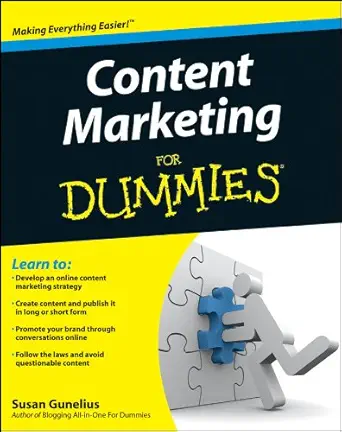
Content Marketing For Dummies by Susan Gunelius Book Summary

Reading Time: 2 minutes

Top Three Quotes

  • “Content marketing is all about publishing useful information that helps your target audience.”
  • “Simply publishing content isn’t enough. You also need to promote that content.”
  • “Never has there been such an exciting opportunity for small and mid-size businesses… now it’s not the depth of your wallet but the depth of your words.”

Book Theme

Content Marketing For Dummies central theme is teaching businesses to think like publishers—creating meaningful, value-driven content across formats (blogs, video, social media, conversations) that engages audiences, builds trust, and drives long-term brand growth.

Why You Should Read This Book

  • It simplifies a complex, often intimidating topic.
  • Offers both theory and actionable tactics (from blogging to SEO to metrics).
  • Provides step-by-step guidance for beginners while also delivering insights useful for experienced marketers.
  • Helps you avoid common mistakes and focus on strategies that yield sustainable brand equity.

Key Ideas and Arguments Presented

  1. Content marketing is about adding value before selling.
  2. Think like a publisher, not a pushy marketer.
  3. Long-form content builds depth; short-form creates immediacy.
  4. Conversations and sharing amplify reach.
  5. Success requires consistency, persistence, and restraint in messaging.
  6. Use the 80/20 rule: 80% valuable content, 20% promotional.
  7. SEO and search visibility are core benefits of publishing.
  8. Integration across platforms is essential.
  9. Measurement and refinement drive improvement.
  10. Content marketing is a long-term, relationship-building strategy.

Book Outline

  • Part I: Getting Started with a Content Marketing Plan
  • Part II: Marketing with Long-Form Content
  • Part III: Marketing with Short-Form Content
  • Part IV: Engaging in Online Conversations
  • Part V: Achieving Long-Term Success
  • Part VI: The Part of Tens (tools, sites, resources)
  • Part VII: Appendixes (Quick Start Plans, Glossary)

Key Takeaways

  • Content marketing = consistent value, not sales pitches.
  • Brands must shift to an audience-centric approach.
  • Promotion is as important as creation.
  • Content fuels trust, loyalty, and word-of-mouth.
  • Long-term results require patience and commitment.

Key Techniques

  • SEO optimization for visibility.
  • Keyword research to target audiences.
  • Cross-promotion and interlinking content.
  • Design that enhances usability.
  • Monitoring online reputation with tools like Google Alerts.
  • Applying the 80/20 rule for balance in promotion.

Author’s Qualifications

Susan Gunelius is President & CEO of KeySplash Creative, Inc. She has 20+ years of marketing experience, including leadership roles at AT&T and HSBC. She has authored multiple marketing books, writes for Entrepreneur.com and Forbes.com, and speaks internationally on branding and content.

Comparison to Similar Books

Unlike Epic Content Marketing (Joe Pulizzi) or Everybody Writes (Ann Handley), which focus on advanced content strategy or writing quality, Content Marketing For Dummies is an accessible, practical beginner’s manual. It provides breadth (covering blogs, video, social, SEO) rather than deep dives into a single niche.

Target Audience

  • Small business owners
  • Marketing beginners
  • Entrepreneurs seeking growth
  • Bloggers/content creators
  • Corporate marketers transitioning to digital
  • Students learning marketing fundamentals
  • Professionals tasked with branding or communications

Critical Response to the Book

As part of the For Dummies series, it has been well-received for its clarity and accessibility. It’s not viewed as groundbreaking theory but rather as a practical, go-to reference for newcomers needing structured, step-by-step support.

One Sentence Takeaway

Content marketing success comes from creating consistent, valuable content that engages audiences and builds long-term brand relationships.

Content Marketing For Dummies by Susan Gunelius Book Summary Read More »
content marketing funnel

The Content Marketing Funnel: A Journey-Focused Guide

Reading Time: 4 minutes

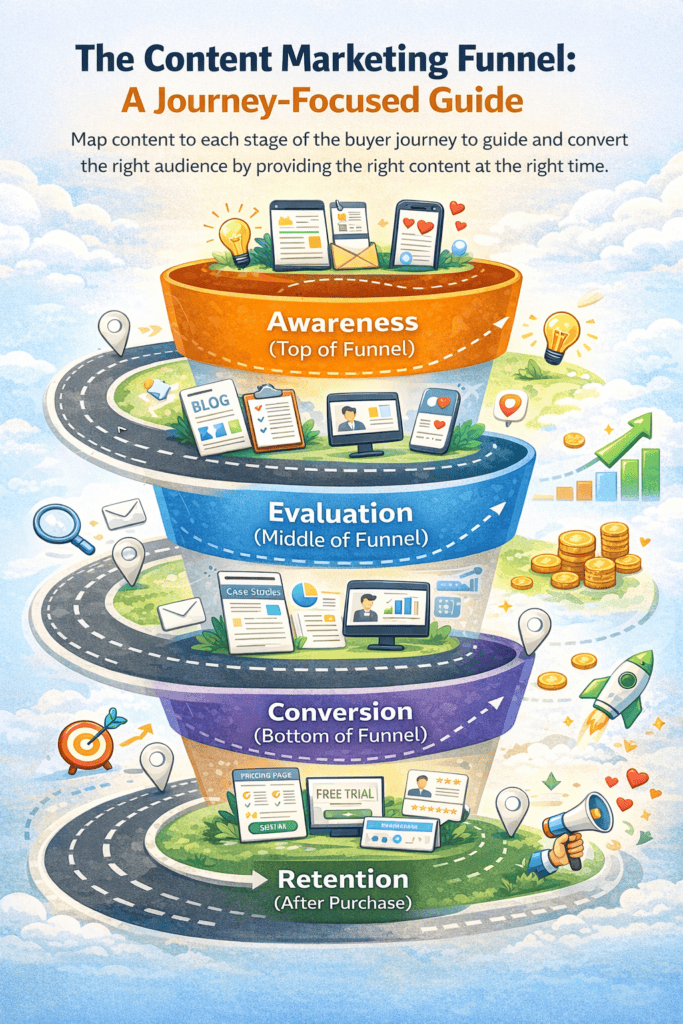
The content marketing funnel maps content to the buyer journey.

It guides people from awareness through evaluation to conversion and retention by giving the right content at the right time.

The aim is to educate, build trust, and convert by design, not by chance.

Key stages of the content marketing funnel

Top of funnel (Awareness)

Audience: people just discovering a need. Goal: brand awareness and education without a hard sell.

Best formats: blog posts, guides, infographics, short videos, social posts, introductory ebooks.

Distribution: search, social, paid amplification, partner channels.

Metrics: organic traffic, unique views, time on page, bounce rate, social shares, new subscribers.

Middle of funnel (Evaluation)

Audience: warm leads actively comparing options. Goal: nurture, prove credibility, and answer detailed questions.

Best formats: case studies, whitepapers, webinars, product tutorials or light demos, nurture emails.

Distribution: segmented email, retargeting, social proof, partner content.

Metrics: asset downloads, webinar registrations and attendance, lead to MQL progression, engagement scores.

Bottom of funnel (Conversion)

Audience: hot leads close to purchase. Goal: remove doubt and prompt action.

Best formats: live demos and trials, testimonials and reviews, pricing pages, comparison tools, sales enablement decks.

Distribution: direct outreach, remarketing, on site chat, sales touchpoints.

Metrics: conversion rate, SQL to close rate, sales cycle length, revenue impact, cost to acquire.

After purchase: Retention

Goal: keep customers successful and turn them into advocates. Formats include onboarding guides, how to content, customer webinars, communities, loyalty programs, and customer advocacy initiatives. Encourage user-generated content, testimonials, and referral programs to amplify trust.

Metrics: engagement, renewals, repeat purchases, referrals, customer lifetime value.

How funnel stage names vary

Different models use different labels for essentially the same buyer journey. Here’s how they compare:

ModelStage 1Stage 2Stage 3Stage 4+
Traditional Marketing FunnelAwarenessConsiderationDecision
HubSpot / WordStreamAwarenessEvaluationConversionRetention
AIDAAwarenessInterestDesireAction
Sales FunnelProspectingQualificationProposalClosing / Post-Sale
Flywheel (HubSpot)AttractEngageDelightLoop (Advocacy)

Stage names vary, but the principle is the same: align content with the buyer’s intent at each point in their journey. The HubSpot / WordStream version is the most common in content marketing today, but referencing other frameworks shows you understand the bigger picture.

B2B vs B2C: what differs

  • Sales cycle: B2B is longer with more stakeholders and touchpoints. B2C is faster and often more impulsive.
  • Tone and proof: B2B favors data, ROI, and depth. B2C favors emotion, lifestyle, and fast formats.
  • Stage emphasis: B2B invests heavily in evaluation nurturing. B2C leans into awareness reach and smooth conversion. For many low-cost B2C purchases, the funnel compresses to Awareness → Conversion.

Adjust your mix to how your buyers decide. Some B2C decisions are considered purchases, and some B2B offers behave more like self-serve B2C. Build for the real journey.

Benchmarks to aim for (ballpark)

  • Blog and content site bounce rate: often 65% to 90% depending on intent and page type. Best-in-class content hubs often perform closer to 50–60%.
  • Webinar attendance: about 30% to 45% of registrants attend live; smaller webinars tend to see higher rates. On-demand webinars often see 55%+ attendance and extend funnel value.
  • Email click rate (CTR): roughly 2% to 4% across industries; click-to-open often around 5% to 10% depending on sector.
  • SaaS free trial to paid: opt-in trials commonly around 17% to 20% on organic traffic; opt-out models convert higher but aren’t always right for trust or product fit.
  • Ecommerce site conversion: typical overall conversion around 2.5% to 3% across categories. Best-in-class ecommerce stores often convert 5% to 7%.

Common mistakes to avoid

  • Pushing product content too early in awareness.
  • Over-investing in awareness while neglecting nurturing.
  • Ignoring retention and advocacy content.
  • Using one funnel approach for both B2B and B2C.
  • Measuring only lead volume instead of depth and quality.

Expert insight

Marketing experts like Ann Handley have emphasized making content more human and empathetic, especially in B2B. The intent behind her message is clear: emotional resonance and storytelling matter at every funnel stage, not just in consumer marketing. Trust and brand building often deliver more long-term value than chasing marketing-qualified leads for the sake of it.

Best practices and current trends

  • Match content to stage and personalize by behavior. Right message, right time.
  • Educate early. Earn attention with useful content, not pitches.
  • Build brand and trust. Invest in newsletters, communities, and consistent voice.
  • Use storytelling. Human narratives improve recall and confidence.
  • Grow first-party audience. Prioritize opt-in channels and respect consent.
  • Be data informed. Set stage metrics, find drop offs, and iterate.
  • Stay agile with formats. Repurpose across blog, video, carousel, and interactive tools. Use AI to draft, add human insight to stand out.
  • Align with sales and success. Share signals and content so the journey feels consistent from first touch to onboarding.

Where the funnel is heading

Buyer journeys are less linear. Many B2B buyers prefer rep-free research and move fluidly across channels before they ever talk to sales. At the same time, much of the conversation now happens in “dark social” spaces — private Slack groups, Discord servers, WhatsApp chats — where attribution is harder to track. Think ecosystem, not just a line. HubSpot’s flywheel model is a useful complement: attract, engage, and delight so customers feed growth through advocacy. Keep the funnel for planning and measurement, and extend it with a loop that centers the customer experience.

References

  1. Plausible: Bounce rate benchmarks by site type (2024–2025)
  2. CausalFunnel: Average bounce rate by industry (2025)
  3. DemandSage: Webinar attendance rate 35–45% (2025)
  4. Contrast: Webinar trends and attendance insights (2025)
  5. MailerLite: Email click rate and CTOR benchmarks (2025)
  6. Brevo: Regional and industry email CTR and CTOR (2025)
  7. First Page Sage: SaaS free trial conversion benchmarks (2025)
  8. Userpilot: Free trial conversion context and ranges (2025)
  9. Shopify: Ecommerce conversion rate baseline ~2.5–3% (2024)
  10. Ann Handley via MarketingProfs: Emotional B2B and brand-building focus (2025)
  11. Gartner: B2B buyers’ preference for rep-free experiences
  12. HubSpot: The flywheel model

The Content Marketing Funnel: A Journey-Focused Guide Read More »

content marketing planning

Content Marketing Planning: How to Label and Maximize Every Piece of Content

Reading Time: 3 minutes

Most marketing teams waste time guessing at intent and rewriting content that misses the mark. Expert content marketing avoids this by labeling each piece upfront so writers know exactly what to create, how it will be used, and why it matters.

1. Start with the core idea

Define the big rock content: a webinar, research study, white paper, or pillar post. Clarify the problem it solves and the business objective it supports. Confirm alignment with brand voice and audience personas before any drafting begins.

2. Label the content for the customer journey

Awareness: educational, thought leadership, trends.

Consideration: comparisons, case studies, problem to solution guides.

Decision: testimonials, demos, ROI calculators, trials.

Post purchase and loyalty: onboarding tips, community content, how to succeed resources.

Pro tip: Mark every piece with its stage so your calendar stays balanced across the funnel.

3. Make it reader first, business second

Label the reader benefit in plain language before labeling the business purpose. Example: “Helps first time managers shortlist tools” is clearer than “Awareness.” This keeps empathy at the center and prevents self-serving content.

4. Identify the SEO keywords and strategy fit

Assign a primary keyword or topic cluster so the writer knows the angle, supported by natural questions the piece should answer. The aim is clarity of intent and strategic fit, not keyword stuffing.

5. Tag by purpose and voice

Purpose: educate, entertain, convert, or retain.

Voice and tone: authoritative, friendly, inspirational, or witty.

Labeling voice reduces rewrites, keeps multi author programs consistent, and ensures every asset feels on brand.

6. Plan repurposing before writing

Think hub and spoke. One core asset should yield multiple smaller pieces. Plan the formats up front and adapt the angle to each channel.

  • Blog spin offs that go deeper on a subtopic
  • LinkedIn carousel that highlights the key argument
  • Short form video that leads with an emotional hook
  • Infographic that distills a framework or data
  • Slide deck for sales enablement or webinars

Repurposing is not copy pasting. Adapt the content to the medium and audience context.

7. Define primary and secondary distribution channels

Choose the primary home for the content, then list secondary channels. Note how format and channel shape length, tone, and CTA. This prevents overlong drafts that do not translate well.

8. Set success metrics and CTAs

Decide what success looks like before drafting so writers can support it in structure and calls to action.

  • Engagement: time on page, shares, comments
  • Conversion: downloads, signups, demo requests
  • Assisted impact: influenced opportunities, replies, referrals
  • Resonance: recurring mentions in your community

9. Add the “why now” factor

Label relevance: evergreen, seasonal, or reactive. Timeliness guides publishing priority and prevents good ideas from sitting in a queue.

10. Plan for reuse and refresh

Give each asset a shelf life and a review date. Decide when it should be updated, expanded, or re-distributed. This shifts the team from “create more” to “sustain better.”

11. Build a lightweight editorial workflow

Labels only help if they live in the workflow. Decide who assigns labels, who approves them, and how they are tracked through creation, review, and distribution. Keep ownership clear so work does not stall.

12. Use a simple checklist to remove guesswork

You do not need to publish a spreadsheet, but an internal template or checklist ensures every field is completed before writing begins. Suggested fields:

  • Customer journey stage
  • Reader benefit
  • Business goal
  • Primary keyword or topic cluster and key questions
  • Purpose and voice
  • Primary and secondary channels
  • Primary CTA
  • Success metrics
  • Shelf life and review date
  • Owner and approver

Example: Filling Out the Checklist

To make this real, here’s a fully filled-out version of the checklist for a single content piece. Here is how the checklist looks when applied to a single piece of content. A guide on building customer loyalty programs:

  • Customer journey stage: Consideration
  • Reader benefit: Help retail managers understand loyalty program options
  • Business goal: Position our brand as a trusted advisor for retention strategies
  • Primary keyword/topic cluster: customer loyalty programs
  • Purpose and voice: Educate, in a friendly but authoritative tone
  • Primary channel: Blog
  • Secondary channels: LinkedIn carousel, short explainer video
  • Primary CTA: Download our free loyalty strategy worksheet
  • Success metrics: Number of downloads, demo requests, and LinkedIn shares
  • Shelf life and review date: Evergreen, review every 12 months
  • Owner and approver: Content strategist drafts, marketing manager approves

With this level of clarity, the writer knows exactly what to deliver, the marketer knows how it fits the strategy, and the business can measure its success without ambiguity.

Conclusion

Content planning is not busywork. It is the discipline that multiplies the impact of every idea and removes friction for writers. By labeling journey stage, reader benefit, keyword focus, purpose, voice, channels, metrics, and review plan, you will create content that is easier to write, easier to reuse, and more valuable to the business and the audience.

When writers have this clarity, content isn’t just easier to create — it’s faster, more consistent, and more likely to move the needle.

Content Marketing Planning: How to Label and Maximize Every Piece of Content Read More »

a historical evolution of content marketing

A Historical Evolution of Content Marketing

Reading Time: 4 minutes

Content marketing has evolved for centuries, from brand-owned print guides and magazines to podcasts, video series, interactive tools, and creator collaborations. The timeline below highlights global milestones that reshaped how marketers educate, entertain, and build trust across B2B and B2C. Each entry shows how formats, distribution, and editorial practice progressed toward audience-first publishing.

Pre-1900s: Foundations of Branded Education and Audience Building

1732–1758 – Almanacs as practical, recurring content: Widely distributed farmer and household almanacs popularize the idea of recurring, problem-solving publications. Though not brand-owned in the modern sense, they establish the template for useful, serialized content that builds loyalty.

1801 – Industrial catalogs and handbooks: Manufacturers begin issuing illustrated catalogs and “how-to” pamphlets to educate buyers on safe and effective product use, foreshadowing modern customer education content.

1888 – Free guides as demand creation: Consumer packaged goods and household brands distribute recipe leaflets and homemaker guides, offering utility first and product references second.

1890s–1910s: Iconic Brand Publications

1895 – John Deere’s “The Furrow”: A farmer-focused magazine launches to share techniques, stories, and practical advice. It becomes a long-running example of audience-first brand publishing that educates rather than sells.

1900 – Michelin Guide (France): The tire maker releases a free travel guide with maps, repair tips, and recommendations to help motorists explore more and drive more, creating demand while delivering genuine utility.

1904 – Jell-O recipe books: Door-to-door distribution of free cookbooks turns a commodity dessert into a household staple by teaching uses, not touting features.

1912 – Club and community newsletters: Hobby and appliance brands begin mailing member bulletins with tips, customer stories, and project plans, cementing community as a growth lever.

1920s–1940s: Sponsored Storytelling and the Birth of Serial Formats

1933 – “Soap operas” on radio: Consumer goods companies sponsor serialized dramas aimed at homemakers. Entertainment becomes a vehicle for brand-adjacent storytelling that earns attention over time.

1936 – Brand booklets and field manuals: Equipment makers publish safety manuals, repair guides, and best practices, setting expectations that brands should be trusted educators.

1940s – Sponsored newsreels and programs: Brands underwrite recurring broadcast segments, aligning their names with valued, regular content rather than one-off ads.

1950s–1970s: Custom Publishing and Education at Scale

1950s – Corporate magazines and customer education: Enterprise brands launch print magazines and technical journals to teach customers how to get more value from complex products.

1962 – Thought-leadership journals: Technology and industrial firms publish periodicals sharing research, case studies, and frameworks, elevating expertise as a brand asset.

1970s – Direct mail newsletters: Financial and B2B companies scale recurring print newsletters that deliver analysis and practical insights, building subscriber bases long before email.

1980s–1990s: Custom Media, Brand Magazines, and Early Digital Publishing

1987 – LEGO fan magazines: Branded magazines for young builders blend projects, community features, and storytelling, showcasing participatory content and UGC before social media.

1993–1999 – Rise of custom publishing: Specialist agencies produce brand magazines and print inserts for retailers, airlines, and financial services, formalizing brand-owned media as a discipline.

1999 – Blog platforms arrive: Self-serve blogging tools make it simple for brands to publish ongoing articles, editorials, and guides without relying on publishers.

2000s: Always-On Digital Content Programs

2003–2006 – Corporate blogs and resource hubs: Brands adopt editorial calendars and topic clusters to answer audience questions in plain language, establishing the modern brand newsroom.

2004–2005 – Podcasting goes mainstream: The term “podcast” is coined and major directories emerge, opening a new channel for serialized brand shows and expert interviews.

2005 – YouTube launches: Video becomes accessible for brands; how-to series, behind-the-scenes, and product education content create durable libraries of evergreen value.

2006 – Inbound and lead magnets: Ebooks, templates, and webinars are packaged as high-value resources exchanged for permission, making gated content a core play.

2007 – Red Bull Media House: A brand formalizes itself as a media company, producing events, films, and magazines that prioritize culture and community over direct promotion.

2006–2009 – Signature video series: Entertaining educational shows like “Will It Blend?” prove that consistent concepts and repeatable formats build audience and brand recall.

2010s: Multimedia, Community, and Experiences

2010 – Content Marketing Institute: The practice gains formal codification through events, frameworks, and benchmarks, accelerating adoption across industries.

2012 – Long-form and interactive storytelling: Rich, scrollytelling experiences normalize multimedia articles. Brands follow with interactive explainers, assessments, and calculators.

2013–2016 – UGC-powered brands: Companies like GoPro and global travel brands scale user-generated content programs that showcase real customer stories at volume.

2014 – Feature-length brand entertainment: Major brands fund films and cinematic content, demonstrating that high-production storytelling can be credible and commercially effective.

2015–2019 – Owned communities and newsletters 2.0: Slack groups, forums, and revamped email newsletters become core retention engines, shifting focus from reach to depth.

2020s: Short-Form, Creators, and Intelligent Workflows

2020 – Virtual programming at scale: Webinars, livestreams, and digital events mature overnight, pushing brands to develop show formats and episodic series for remote audiences.

2020–2022 – Short-form video dominance: Global platforms popularize sub-60-second storytelling. Brands adopt hooks, series arcs, and native editing to teach quickly in-feed.

2021–2023 – Creator collaborations: Partnerships with independent creators produce co-branded education, deep dives, and community challenges that feel native to each platform.

2023–2025 – Generative AI in the workflow: Ideation, outlines, variants, and localization are accelerated by AI while human editors enforce standards for accuracy, originality, and voice.

Ongoing – Content as product: Brands package content into courses, certifications, and toolkits that deliver direct customer value and durable affinity beyond campaigns.

A Historical Evolution of Content Marketing Read More »

ultimate guide to content marketing

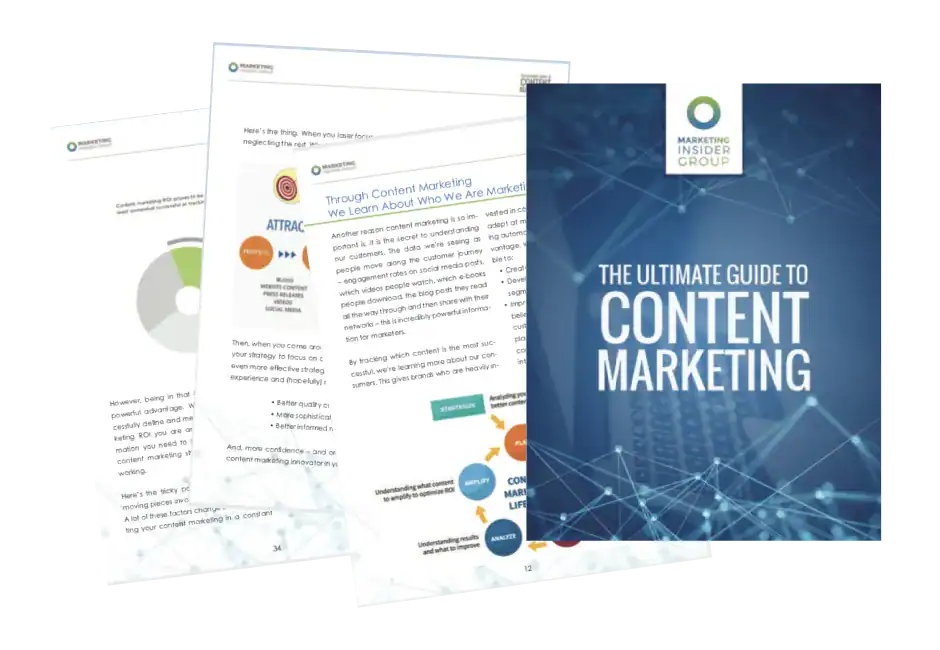
The Ultimate Guide to Content Marketing — Summary and Takeaways

Reading Time: 2 minutes

Overview

Source: The Ultimate Guide to Content Marketing
Date Published: October 2024
Audience: marketers who are building or refining a content strategy
Data Sources Cited: Content Marketing Institute, Demand Metric, Gartner, Neil Patel, and others

The guide frames content marketing as a growth engine when it is strategy led, personalized, measured against business outcomes, and supported by a content hub.

Actionable Tips

  1. Build a content hub. Centralize your best content in one branded home to improve discovery, SEO, and perceived authority. Keep it updated so it stays useful.
  2. Set clear priorities. Pick one or two outcomes at a time such as qualified leads or retention rather than trying to do everything at once.
  3. Personalize. Use customer data and marketing automation to deliver relevant content. Irrelevant content loses attention quickly.
  4. Atomize big assets. Repurpose a major piece into smaller formats such as short posts, clips, and visuals to extend reach and ROI.
  5. Measure what matters. Tie metrics to business goals such as conversion and retention rather than only traffic. Set benchmarks and refine.
  6. Activate advocates. Involve employees and customers to add authenticity and reach. Peer trust outperforms brand messaging.

Key Stats and Sources

Examples cited in the guide include claims such as content marketing driving more leads at lower cost, higher conversion rates, and budget benchmarks reported by Content Marketing Institute and Demand Metric. Always verify percentages against the latest studies for your industry.

Examples You Can Steal

Organize a topic hub that links a research post to a how-to video and a related case study. Repurpose a webinar into three short posts and a checklist. Invite internal experts to answer the top five customer questions as quick articles.

How To Apply This Fast

Today: choose one priority, pick one flagship asset to atomize into three small pieces, and create a simple hub page section that groups your best related content.

This month: add basic personalization rules, define two business-tied metrics, and schedule a monthly hub refresh.

Bold Claims and Counterpoints

Claim: successful teams allocate about forty percent of the marketing budget to content.
Counterpoint: start with a level you can measure and justify, then scale with ROI and capacity.

Claim: a centralized hub is foundational.
Counterpoint: the hub only works if you maintain it and connect it to distribution and measurement.

Claim: atomization maximizes ROI.
Counterpoint: not every piece deserves a full spin-down. Prioritize assets with proven interest and search demand.

Metrics That Matter

Match metrics to goals. For audience growth track share of conversation and engaged time. For pipeline track conversion to subscriber and lead quality. For loyalty track repeat purchase and content-driven retention signals.

What Is Missing or Caveats

Benchmarks vary by industry and stage. The guide promotes hubs, personalization, and higher content budgets, but smaller teams may need phased adoption and a sharper focus on a few formats they can execute well.

One-Sentence Takeaway

Make content a strategy led system with a maintained hub, focused goals, personalization, and business tied metrics, then improve it continuously.

References and Resources

Read the full Ultimate Guide to Content Marketing – Marketing Insider Group

Content Marketing Institute – Research & Insights

Demand Metric – Content Marketing Infographic

Neil Patel – What Is Content Marketing?

Gartner – Insights on Personalization

The Ultimate Guide to Content Marketing — Summary and Takeaways Read More »

everybody writes

Everybody Writes by Ann Handley Book Summary

Reading Time: 3 minutes

Top Three Quotes

  • “Writing is a skill, not a talent. That’s great news, because it means it can be learned.”
  • “Your genuine, engaging voice matters. Robots might write drafts, but no one can copy your voice.”
  • “Utility × Inspiration × Empathy = High-Quality Content.”

Book Theme

The core theme of Everybody Writes is that everybody is a writer in today’s digital world, and writing is both a practical skill and a powerful marketing tool. Handley argues that good writing is the foundation of effective content, communication, and connection.

Why You Should Read This Book

You should read Everybody Writes because it offers a clear, funny, and practical framework for improving all your content—from emails to landing pages to social posts. Whether you’re a marketer, entrepreneur, or professional, the book equips you with the skills to communicate clearly, tell authentic stories, and build trust with your audience.

Key Ideas and Arguments Presented

  • Writing is a habit, not an art—anyone can get better with practice.
  • All communication (emails, posts, blogs) counts as writing.
  • Content succeeds when it blends utility, inspiration, and empathy.
  • “The Ugly First Draft” is essential—write poorly first, then refine.
  • Clarity and brevity matter more than flashy words.
  • Brand voice should be consistent, but tone can adapt to context.
  • Storytelling makes your customer the hero, not your product.
  • Publishing is a privilege—content must respect the reader’s time.
  • Writing evolves with culture; authenticity and inclusivity matter more today.
  • Tools and processes (like the Writing GPS framework) can turn messy drafts into polished, effective work.

Book Outline

The book is organized into seven parts:​

  • Part I: Writing Rules – how to write better and enjoy it more
  • Part II: Grammar and Usage – rules worth keeping (and breaking)
  • Part III: Voice Rules – finding and using your brand voice
  • Part IV: Story Rules – crafting authentic marketing stories
  • Part V: Publishing Rules – sharing responsibly and credibly
  • Part VI: 20 Things Marketers Write – practical writing for formats like email, social media, landing pages, and more
  • Part VII: Content Tools – helpful resources to improve your process

Key Takeaways

  • Good writing is accessible to everyone; it just takes practice.
  • Your words represent you and your brand; clarity is power.
  • Empathy for the reader is the foundation of great content.
  • Storytelling connects more than information ever will.
  • Consistency in voice builds trust and recognizability.

Key Techniques

  • The Writing GPS Framework: A 17-step process with three stages (Go, Push, Shine) to guide content creation.
  • The Ugly First Draft (TUFD): Write freely before editing.
  • Daily Writing Rituals: Short, consistent writing habits build creative muscle.
  • “Dear Mom” Technique: Write as if explaining to someone who loves you but isn’t in your field.
  • Humor and Analogies: Use surprising comparisons and wit to engage readers.

Author’s Qualifications

Ann Handley is a pioneer in digital marketing and content strategy, Chief Content Officer at MarketingProfs, and a globally recognized keynote speaker. She has decades of experience helping businesses and individuals elevate their writing and content marketing.

Comparison to Similar Books

Target Audience

  • Marketing professionals
  • Content creators and copywriters
  • Entrepreneurs and small business owners
  • Social media managers
  • Students and professionals in business communication
  • Anyone who wants to improve their everyday writing

Critical Response to the Book

The book has been widely praised as funny, insightful, and indispensable. Seth Godin calls it essential for learning the craft of professional writing, while Joe Pulizzi places it alongside On Writing as required reading. Reviewers highlight its humor, clarity, and practicality, making it a modern classic for marketers and writers alike.

One Sentence Takeaway

Everybody can write better—and in today’s world, everyone must.

Everybody Writes by Ann Handley Book Summary Read More »