
Last updated August 2026
This review covers Nuwtonic in isolation. If you’re deciding between AI Search platforms, see my Best AI Search Software Compared guide. It compares the leading AppSumo options, explains how plan limits and credit systems work in practice, and evaluates each platform using the same nine questions I believe matter most when choosing AI Search software.
Nuwtonic combines traditional SEO performance data, AI Search visibility monitoring, content generation, competitor and keyword intelligence, topical maps, WordPress integration, and AI-powered optimization into one platform. That feature list is impressive. It is not what stood out to me.
The more time I spent inside Nuwtonic, the clearer its philosophy became. Most SEO software stalls at good: a list of everything wrong with your site. The better tools go one step further and prioritize that list so you know what to tackle first. Almost none of them reach best: actually taking the work off your plate. Nuwtonic is clearly trying to build for that third tier.
It is not particularly interested in crawling every forgotten page on an old website. It assumes you know your website better than anyone else. You decide which pages matter, Nuwtonic analyzes those pages in depth, recommends specific improvements, and in some cases implements the fixes for you.
Worth knowing going in: Nuwtonic is a young, bootstrapped platform founded in 2025 out of Bengaluru, India. That context helps explain both the ambition on display here and a few of the rough edges I ran into.
Nuwtonic Overall Score
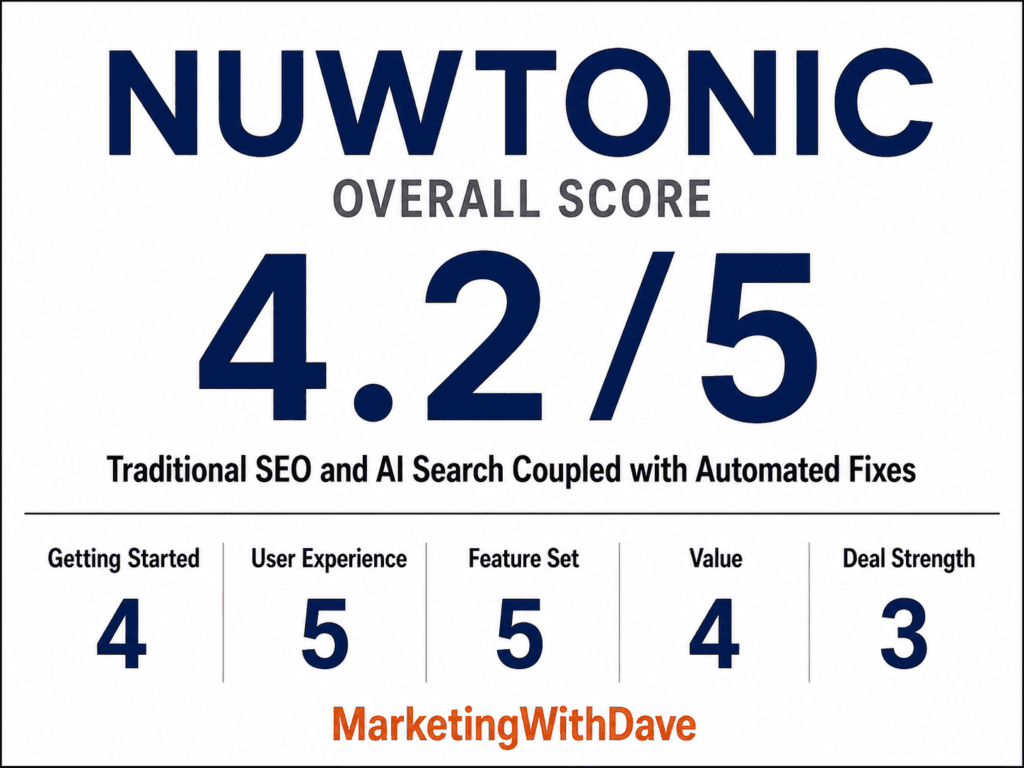
Why 4.2/5: A genuine blend of traditional SEO, AI Search, and real automation, held back by Tier 1’s 15-keyword SERP limit, no WordPress scan yet, and recommendations that sometimes remain too generic to act on.
See the current AppSumo deal for Nuwtonic
Affiliate disclosure: If you purchase through my link, I may earn a small commission at no additional cost to you. I only share tools I have used myself.
The 30-Second Decision
Buy Nuwtonic if: You want SEO and AI Search visibility in one platform, with recommendations specific enough to act on, page-level optimization, content generation, and the ability to automate some fixes instead of just building another task list.
Skip it if: You need to crawl thousands of URLs, track hundreds of SERPs, or replace a dedicated enterprise SEO research platform.
The biggest reason to consider Nuwtonic is not any single report. It is the workflow connecting the reports together: find the opportunity, analyze the page, identify the gaps, generate the improvement, apply the fix, check whether it worked, then keep monitoring. That is where SEO software needs to go.
Why SEO and AI Search Need to Come Together
Traditional SEO and AI Search optimization are getting harder to separate. A page that is hard for Google to understand is unlikely to suddenly become easy for ChatGPT, Gemini, Claude, or Perplexity to understand. Strong topical coverage, clear entities, trustworthy sources, useful internal linking, current information, and well-structured content matter in both environments.
Nuwtonic reflects that overlap throughout the platform. Google Search Console provides the traditional SEO performance foundation. Nuwtonic layers on AI Search monitoring, citation analysis, GEO audits, topical analysis, content generation, and optimization workflows built to improve both search visibility and the odds that AI systems can retrieve and accurately represent your content.
What I Liked
1. Nuwtonic Can Actually Implement Some SEO Fixes
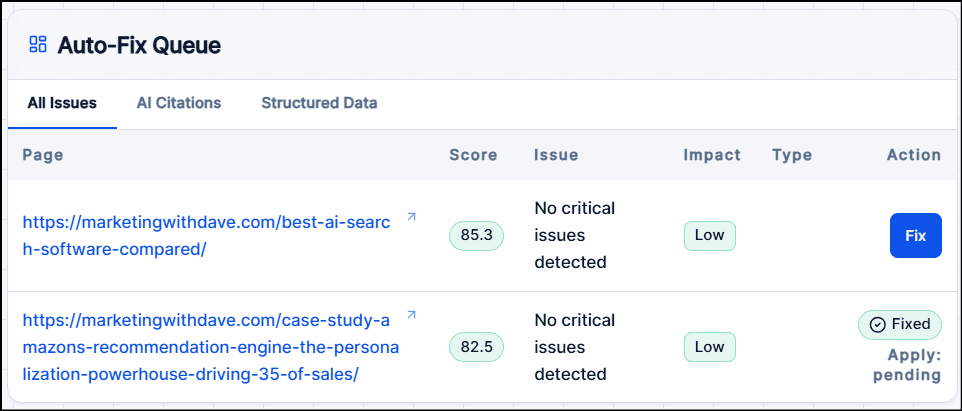
This is the most important feature in Nuwtonic. Most SEO tools stop at Detect → Report → Export → You fix it. Nuwtonic is trying to move toward Detect → Prioritize → Fix → Verify.
Not every recommendation should be automated, and Nuwtonic knows it. During one optimization test, it flagged adding authoritative Philip Kotler source material, reviewing time-sensitive examples for accuracy, and confirming a comparison table stayed usable on mobile, all correctly routed to me instead of auto-published. For other changes, Nuwtonic pushes optimized content, metadata, FAQs, and alt text through its WordPress integration, then lets you re-check completed optimizations later through its Check the Fix workflow.
Finding another problem for me is helpful. Solving some of them is considerably more valuable.
2. Advanced SEO and GEO Optimizations Were Surprisingly Specific
I tested Nuwtonic’s SEO optimization workflow on an article about Philip Kotler’s eight demand states. Instead of generic advice like “add more keywords,” it identified real gaps: connecting each demand state to its corresponding marketing-management task, adding a comparison table, strengthening the diagnostic guidance, expanding demarketing versus countermarketing, and citing original Kotler and Kotler and Keller source material.
Not every suggestion was necessary, but enough were specific enough that I would genuinely consider implementing them. The Advanced GEO Optimization side follows the same philosophy, looking beyond missing keywords toward broader topical and authority gaps that make it harder for AI systems to understand a site’s depth. This is where Nuwtonic feels more strategic than a checklist-style audit.
3. Content Generation Was Much Better Than I Expected
AI-generated SEO content is usually easy to spot: generic, repetitive, and full of statements that say very little. Nuwtonic did noticeably better.
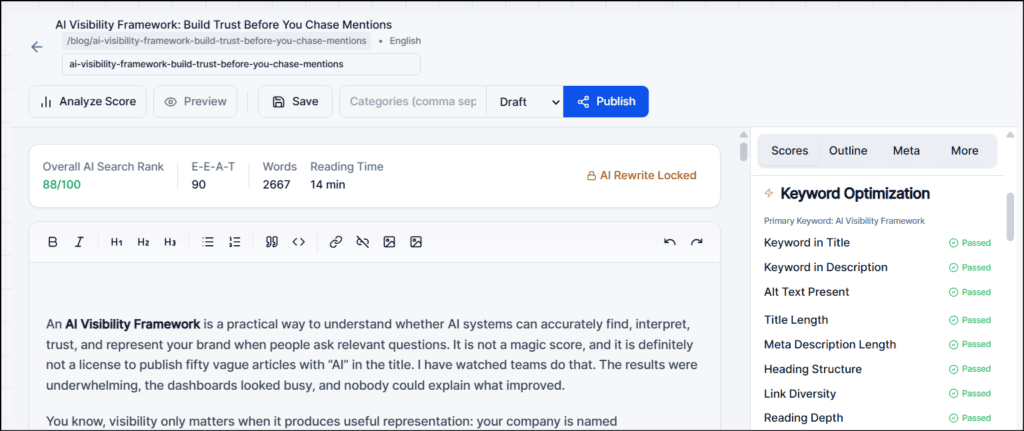
I tested its GEO Content Writer on the keyword AI Visibility Framework, a topic I have already developed extensively on MarketingWithDave.com. It produced a 2,600+ word article with a title and meta description, key takeaways, a table of contents, useful tables, internal links, external references, an FAQ, logical H2 and H3 structure, and two generated images. I would not have published it unchanged, but I would not have deleted it and started over either. That is a meaningful compliment for AI-generated SEO content.
The weakness: Nuwtonic created an AI Visibility Framework instead of extending my AI Visibility Framework. Its Brand Analysis understood what Marketing With Dave covers but not my proprietary frameworks, terminology, or point of view. It also invented first-person lines like “I have watched teams…” that need to be caught before anything publishes under your name.
AppSumo’s own listing promises content “built on your GSC data and existing topical authority” instead of guesswork. In practice, that promise landed only partially. The generated article captured my site’s general themes but had no idea what my existing authority on this specific topic actually said.
4. The Platform Connects Its Tools Instead of Isolating Them
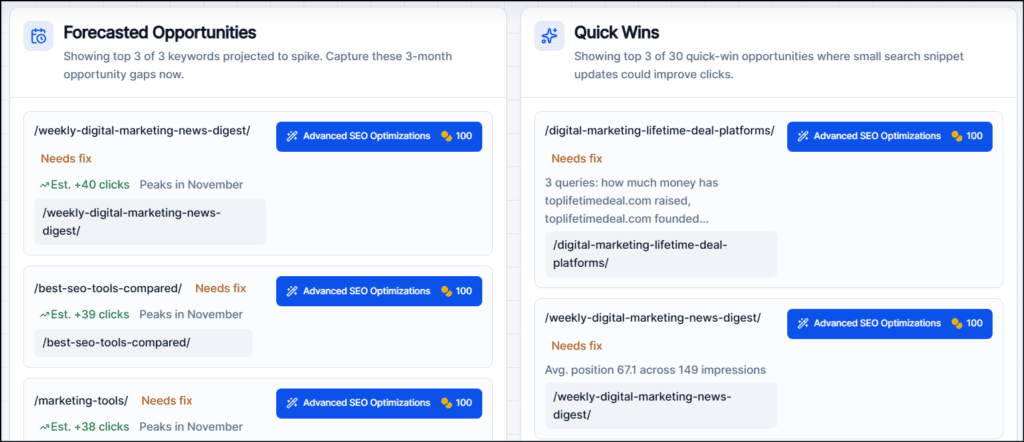
Keyword research feeds keyword clusters. Clusters feed content planning. Content gets generated, scored, optimized, published, monitored, and improved. Google Search Console data feeds performance campaigns that surface pages with low CTR despite strong rankings, growing impressions, declining traffic, page-two rankings, lost visibility, or possible algorithm-update impact. AI Search monitoring adds prompts, citations, competitor visibility, brand authority, and GEO recommendations on top.
Individual feature quality varies, but the workflow is cohesive, and it keeps pointing at the same question: what should I work on next? That beats a platform that hands you twenty reports and leaves you to decide.
5. Nuwtonic Assumes You Know Which Pages Matter
Tier 1 caps you at 200 SEO audits and fixes per month, which felt restrictive at first for a site with hundreds of URLs. Then I realized that is the point. Nuwtonic is not built to crawl every forgotten category page and legacy URL. It assumes you are the expert on your own website: you know which pages make money, earn links, or carry authority.
Most sites have plenty of legacy content that does not deserve equal attention. Choose the pages that matter, and let Nuwtonic help make them better.
Want to see what using Nuwtonic actually looks like? I’ve shared my dashboard so you can explore the same dashboards, analyses, trends, and recommendations I used while evaluating the platform.
See the current AppSumo deal for Nuwtonic
What I Didn’t Like
1. Fifteen SERP-Tracked Keywords on Tier 1 Is Not Enough
Nuwtonic splits keyword monitoring into two systems. Keyword Ranking mostly reflects Google Search Console data, and Tier 1 supports 150 tracked keywords. SERP Ranking actively tracks selected keywords in Google’s results with history and competitor data, but Tier 1 allows only 15 SERP-tracked keywords. A content-heavy site can burn through that fast. The tracker itself is clean and easy to use, but fifteen keywords is better suited to evaluating the feature than relying on it as an ongoing rank-tracking solution.
2. There Are Too Many Reports
The SEO Performance dashboard covers growth and decay, top movers, CTR uplift, zero CTR queries, high CTR queries, device parity, keyword tail analysis, brand versus non-brand performance, cannibalization, topical clusters, authority analysis, and more. Some are excellent. I especially liked the Zero CTR Queries and High Impression / Low CTR reports because they point straight at work worth doing. Others just re-visualize data already available in Google Search Console. I could cut 40% to 50% of these reports without losing much value. I would rather have fewer reports that each end with a strong recommendation or AI-assisted action.
3. Recommendations Are Not Always as Specific as the Best Ones
The Kotler analysis was a great example of Nuwtonic at its best. Other recommendations were generic: get listed on software review sites, expand topic coverage, improve authority, create more comparison content. None of that is wrong, it just does not carry the same value as advice tied to something Nuwtonic actually found in your data. Every AI SEO platform I have tested struggles with this line. Nuwtonic gets on base more often than it strikes out, but I still reviewed every recommendation before acting on it.
4. Nuwtonic Scores Almost Everything, Without Explaining Why
SEO Health, AI Search Rank, Citation Readiness, Authority, Optimization Scores, Projected Scores, Opportunity Scores. During testing, multiple generated alt-text recommendations all landed on the same score of 90 despite noticeable quality differences elsewhere, and I could not find a clear methodology behind the precision. I stopped caring about most of the numbers. If a page’s SEO Health score is 83.9, that does not tell me what to do Monday morning. If a high-impression page has 0% CTR and a title that does not match search intent, now I have something actionable. Your manager cares about traffic, leads, visibility, citations, and revenue, not a score moving from 83.9 to 87.2. I would like to see Nuwtonic lean less on proprietary scores and more on explaining the evidence behind each recommendation.
This isn’t just a Nuwtonic problem. I tested the same prompt across six AI Search tools and found surprisingly large differences in how they measure and report AI visibility. The experiment reinforced why I care more about the evidence behind a score than the score itself.
5. Brand Intelligence Needs More User Control
Nuwtonic’s Brand Analysis correctly identified my audience, tone, content themes, and general positioning straight from the website. What it could not do was let me correct, expand, or teach it what it missed. That showed up clearly during content generation: it understood I write about AI visibility but had no idea about the specific seven-stage AI Visibility Framework I had already built, so it invented its own. A true brand knowledge base, one where I could feed in proprietary frameworks, preferred terminology, writing examples, positioning, products, topics to avoid, and editorial principles, would turn Brand Analysis from a starting point into something that actually understands my thinking.
Pricing and Tiers
At the time of writing, Tier 1 runs $59 for lifetime access. Tier 1 is designed for selective use, not large-scale monitoring. It includes:
- 1 managed domain
- 1 user
- 1,200 monthly AI credits
- Up to 8 full AI content generations
- Up to 12 SEO and GEO boosts
- Up to 240 GEO / AI Search audits
- 200 SEO audits and fixes per month
- 150 keywords tracked
- 15 SERP-tracked keywords
- 2 topical maps / extensions
- 20 AI prompts
The 1,200 monthly credits covered most of what I explored, though keyword research and competitor-gap analysis can each burn hundreds of credits fast. Tier 1 makes sense if you are managing one site and can stay focused on a limited set of important pages, prompts, and tracked keywords. The real reason to move beyond Tier 1 is not content generation, it is monitoring capacity. 15 SERP keywords and 20 AI prompts get restrictive fast once Nuwtonic earns a permanent spot in your workflow.
If Tier 1’s limits become a bottleneck, here is how the higher tiers scale:
- Tier 2, $149: 5 domains, 5 users, 3,000 monthly AI credits, 50 SERP-tracked keywords, 500 SEO audits and fixes per month
- Tier 3, $249: 10 domains, 15 users, 5,000 monthly AI credits, 100 SERP-tracked keywords, 750 SEO audits and fixes per month
- Tier 4, $349: 20 domains, unlimited users, 7,500 monthly AI credits, 200 SERP-tracked keywords, 1,500 SEO audits and fixes per month
For a single-site marketer testing the waters, Tier 1 is the right call. For an agency managing multiple client properties, Tier 3 is the more realistic starting point given how quickly Tier 1’s SERP tracking and domain limits run out. All tiers are lifetime deals covered by AppSumo’s standard 60-day money-back guarantee.
WordPress Integration
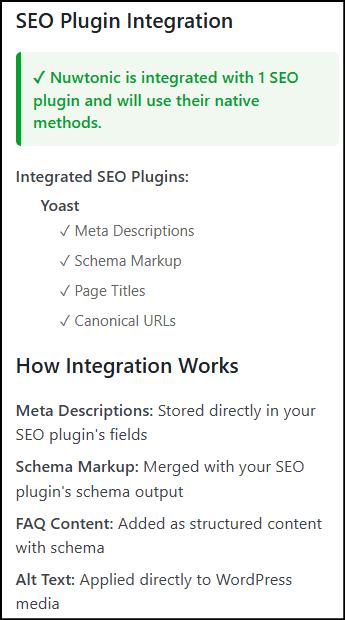
Nuwtonic’s WordPress plugin connects the platform directly to your site. I was concerned it would conflict with Yoast SEO since Nuwtonic can create metadata, schema, and FAQs, but the plugin detected Yoast and used its native fields instead of building a competing layer: meta descriptions store in Yoast’s fields, and schema merges with Yoast’s existing output. That is the architecture I want to see.
The plugin’s individual agents varied in quality. The Alt Text Agent was generally strong. The Meta Agent produced usable output that still needed editing. The FAQ Agent improved substantially once I switched the audience setting to Expert, but still produced questions I would not publish unchanged. The Schema Agent showed why human review still matters: it correctly built detailed Product and Review schema for a software review, but also generated FAQ schema for questions that were not actually presented as FAQs on the page. Technically valid schema is not necessarily appropriate schema.
One feature I could not fully test was the free SEO scan, which repeatedly returned “Scan failed: Could not complete scan request.” Nuwtonic support responded quickly and confirmed the free scan runs locally against WordPress data rather than calling their servers, while publishing and optimization actions do communicate with their servers. I will update this review once the scan issue is resolved.
Bottom Line
Nuwtonic understands where this industry needs to go next.
Most SEO software still lives at good, or if you’re lucky, better. Nuwtonic is one of the few tools I’ve tested that is genuinely reaching for best, and it gets there often enough to notice. It won’t automate its way out of every problem yet. Plenty of what it surfaces still needs your judgment before it ships. But the direction is right, and direction is what separates software worth watching from software worth ignoring.
That selectivity is also why fit matters here. A solo marketer or small team who already knows which pages carry the business can get real value out of Tier 1. Someone trying to blanket-audit a sprawling enterprise site with no clear priorities will find Nuwtonic too narrow no matter which tier they buy.
There is still work to do. The 15-keyword SERP limit on Tier 1 is too restrictive. The platform could lose a significant number of reports without losing much value. Some recommendations remain generic, the proprietary scores need more transparency, and Brand Analysis needs a way for users to teach it their expertise and frameworks.
But the pieces that matter most are already there: strong page-level analysis, surprisingly good content generation, useful SEO and GEO recommendations, integrated WordPress publishing, and the ability to automate some of the work.
The future of SEO software is not another dashboard telling us what is wrong. It is software capable of helping us fix it. Nuwtonic is one of the platforms that appears to understand that.
Interested in trying Nuwtonic?
See the current AppSumo deal for Nuwtonic
This content is for educational purposes and reflects my hands-on experience using the product and the information publicly available at the time of writing. Always evaluate tools based on your specific business needs, goals, and workflows before making a decision.
Looking for more marketing software reviews? See my full list of marketing tools and software I recommend.

