
Last updated May 2026
These two tools share a category label, topical authority and content planning, but they serve fundamentally different buyers. The real question: are you building a content map, or running a content intelligence operation?
What Each Tool Actually Does
Topical Map AI generates up to 1,200 clustered keywords organized into topic hierarchies with real search volume and difficulty scores. You enter a niche, optionally connect Google Search Console and provide your XML sitemap to shape the output around your existing website, and get a structured map with content briefs attached. The output is then something your writers can act on. The briefs are structured outlines, subtopics, word count, and content type, not finished drafts.
MarketMuse starts by crawling your existing website. It calculates your domain’s topic authority, identifies gaps relative to competitors, and generates cluster-level content plans based on your specific competitive position. It also includes an Optimize editor that scores drafts in real time against a topic model, an internal linking tool (Connect), and SERP X-Ray analysis. Like Topical Map AI, it produces briefs rather than finished content, but its Optimize editor stays with you through the writing phase, scoring your coverage against competing pages as you draft.
The clearest summary: Topical Map AI shows you what a topic space looks like. MarketMuse shows you what your specific site should do next, then helps you execute.
Feature Comparison
| Feature | Topical Map AI | MarketMuse |
|---|---|---|
| 20+ languages / 25+ countries | Yes | No (primarily English) |
| Automated content inventory of your website | No | Yes |
| Buyer keyword categorization | Yes (in-tool view) | No |
| BYOK (bring your own API key) | Yes | No |
| Content briefs | Yes | Yes (more comprehensive, SERP-grounded) |
| Content calendar | Yes | No |
| Content Optimize editor (real-time scoring while drafting) | No | Yes |
| Competitor gap analysis | Yes (in-tool + standalone tool) | Yes |
| Competitor sitemap import | Yes | No |
| Export options | CSV, PDF, Google Docs, Claude Projects | Google Docs, Word, Excel |
| Free tier | 3 maps, no card required | 10 queries/month, no inventory |
| Google Search Console integration | Yes | Yes (Connect feature) |
| Internal linking recommendations | No | Yes (Connect tool) |
| Launch sequence / publishing order suggestions | Yes (in-tool view) | No |
| Live search volume & difficulty data | Yes | Yes |
| Personalized difficulty (your website vs. generic) | No | Yes, unique to MarketMuse |
| Pricing | Lifetime deal $69-$449 (AppSumo) | $99-$499+/month |
| Quick Wins filtering | Yes | No |
| REST API access | Tier 3+ | No |
| SERP X-Ray / competitor page analysis | No | Yes |
| Topic Authority scoring per page/topic | No | Yes |
| Topical/cluster map generation | Yes (up to 1,200 keywords) | Yes (cluster-level content plans) |
| White-label PDF export | Yes | No |
| XML sitemap import | Yes | No |
See the current AppSumo deal for Topical Map AI
The Real Gap: What Happens After You Get the Data
Most reviews of Topical Map AI fail to discuss this important limitation.
Here is a real export from the tool, a “digital marketing” niche map covering 26 keyword targets across 4 parent clusters:
- Digital Marketing Fundamentals (6 topics), definitional and overview content
- Getting Started with Digital Marketing (6 topics), beginner how-to and roadmap content
- Digital Marketing Strategies and Channels (7 topics), SEO, social, email, paid, video, influencer, content marketing
- Digital Marketing Agencies (7 topics), agency selection, reviews, comparisons, pricing
Content types: 18 blog posts, 3 comparisons, 2 listicles, 2 tutorials, 1 guide. Word counts: 1,200 to 2,500. The cluster structure is logical and would take far longer to build manually.
But every single item in the CSV export is marked “Medium” priority, and that is where an important caveat applies.
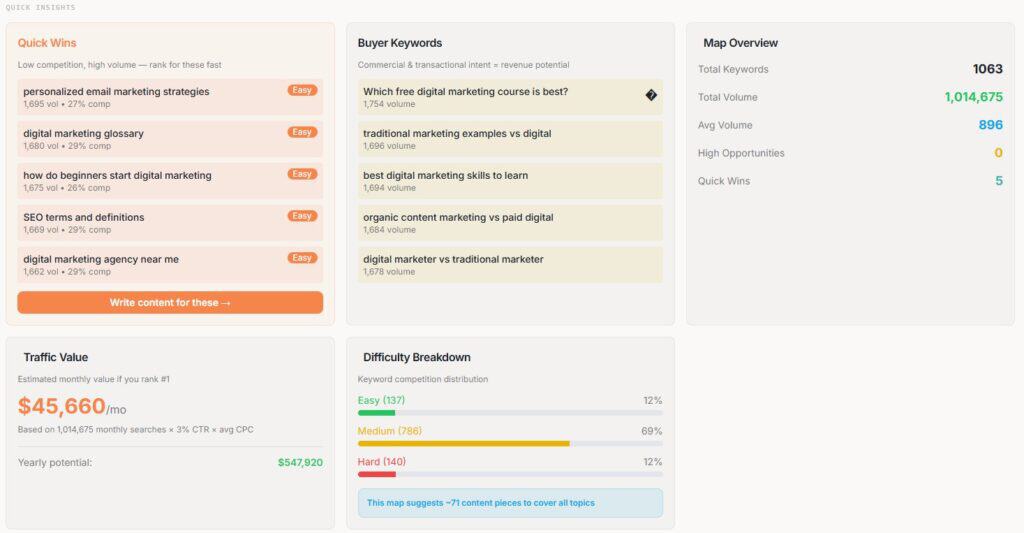
The CSV is a flattened snapshot. Inside the actual tool, the picture is more useful. The map view surfaces difficulty-based filtering including an “Easy” category and a “Quick Wins” designation for topics with high traffic potential and low competition, giving you a starting point for sequencing without leaving the platform. There is also a Buyer Keywords panel that separates commercial-intent topics from informational ones, and a Launch Sequence view that suggests a publishing order. A Competitor Gap Analysis runs inside the map and is also available as a standalone tool, identifying topics competitors cover that you do not.
None of this is visible in the CSV export. If your workflow takes the export straight into a spreadsheet, you lose those signals. The in-tool experience is more decision-ready than the export alone suggests.
That said, there are still questions the tool cannot answer from its own data:
- Which clusters do you already have partial authority in vs. starting from zero?
- Where is your website’s current coverage strongest relative to competitors?
- Which pages are losing ground and need refreshing before you add new content?
Those answers require either your own research or a tool that maintains an ongoing model of your specific domain, which is precisely what MarketMuse’s website inventory does. The gap between these tools is narrower than the raw CSV implies, but it is still real.
Where the Meaningful Differences Live
Personalized Difficulty. Topical Map AI shows generic keyword difficulty, the same score any keyword tool provides. MarketMuse shows how hard a topic is for your specific domain based on existing authority. A topic at generic difficulty 60 might be a 30 for your website if you already have adjacent coverage. That signal changes prioritization decisions significantly and is unique to MarketMuse.
Website Inventory. Topical Map AI uses your GSC data or sitemap to inform map generation, but it does not maintain an ongoing inventory of your website’s performance. MarketMuse crawls your entire content library continuously, surfaces pages losing ground, identifies clusters where you already have partial authority, and flags subject areas with no coverage. According to MarketMuse’s own documentation, there are no minimum site size requirements, though independent reviewers consistently note that the authority scoring becomes more actionable as your published content grows.
Optimize Editor. Once a map is generated in Topical Map AI, you leave to write elsewhere. MarketMuse’s Optimize editor scores content in real time as you draft, flags missing subtopics, and benchmarks your coverage against competing pages. Surfer SEO and Clearscope focus specifically on this phase, MarketMuse includes it alongside the planning layer.
Internal Linking (Connect). MarketMuse identifies orphaned pages and recommends specific anchor text and link targets between related content. Topical Map AI has no equivalent. For sites managing 100+ posts, internal linking is how topical authority actually flows, Connect addresses a real gap.
International SEO. Topical Map AI supports 25+ countries and 20+ languages. MarketMuse is primarily English-focused. For non-English or multi-market campaigns, Topical Map AI has a clear advantage.
Agency Deliverables. Topical Map AI includes white-label PDF export for client-facing work. MarketMuse is built for internal team use only.
See the current AppSumo deal for Topical Map AI
Pricing Reality
Topical Map AI is on AppSumo as a lifetime deal: $69 (15 maps/month) to $449 (150 maps/month, batch generation, REST API). BYOK lets you generate maps at token cost after the one-time purchase, which matters for high-volume users. The company was founded in February 2024 and has 1-10 employees, worth factoring in if long-term product support is a consideration for you.
MarketMuse starts at ~$99/month (5 briefs, 100 queries, 1 website inventory) and scales to $499+/month for the Strategy tier. It was acquired by Siteimprove in October 2024 and is moving toward broader enterprise platform integration. The free plan (10 queries/month, no inventory) is effectively a trial.
At $149-$499/month, MarketMuse needs to deliver measurable impact to justify the spend. At $69-$449 one-time, Topical Map AI is not in the same risk category.
Who Should Use Each Tool
Topical Map AI if you are a blogger, solo operator, or small agency; starting a new site or niche; building client deliverables that need white-label output; working in non-English markets; or prefer controlling ongoing costs with a one-time purchase. The GSC integration and sitemap import give it more website-awareness than a pure niche-input tool, but you will still need to bring your own prioritization logic to turn the map into an ordered execution plan.
MarketMuse if you have a substantial published content library and need to know where your authority sits and where the gaps are; your team writes and edits inside the platform using the Optimize editor; internal linking across a large library is a priority; and your budget supports $149-$499/month for the intelligence layer. It is a team tool, solo operators will pay for features they cannot fully use.
One More Option Worth Knowing
Floyi sits between these two tools in scope and price. It uses SERP-based clustering (not just semantic similarity, which reduces keyword cannibalization risk), includes four-level map building, content briefs, internal link recommendations, and real-time tracking, all in a single credit-based workflow. It addresses the “what do I do after the map” problem more directly than Topical Map AI without MarketMuse’s price or complexity. Worth evaluating if neither tool above is quite the right fit.
Above both tools, Conductor and BrightEdge cover real-time SERP tracking, content decay monitoring, and GEO signals at enterprise contract pricing ($1,000+/month). Relevant context, not a realistic option for most readers here.
Bottom Line
Topical Map AI does more than most reviews give it credit for. The in-tool experience, Quick Wins filtering, Buyer Keywords, Launch Sequence, Competitor Gap Analysis, provides more prioritization support than the CSV export reveals. The gap versus MarketMuse is real but narrower than it first appears: Topical Map AI still lacks an ongoing model of your specific site’s authority, which is where MarketMuse’s inventory and Personalized Difficulty earn their place. That deeper site intelligence requires the content library, team, and budget to justify it. Using MarketMuse as a solo operator at $149/month means paying for an enterprise planning layer when what you need is a faster research workflow.
Founder Response from Topical Map AI
After publishing this comparison, Megan from Topical Map AI responded directly:
“Topical Map AI is not trying to be MarketMuse, different price point, different scope, different buyer. It’s built for individual creators, agencies, and content teams who need structured topic discovery and clustering without enterprise-level investment.”
That is the clearest framing of who this tool is for, and it comes from the founder. If that description fits where you are, the lifetime deal is low-risk, especially with AppSumo’s 60-day test drive. Just go in knowing the map is the starting point, not the finish line.
See the current AppSumo deal for Topical Map AI
Disclosure: This post may contain affiliate links. If you purchase through these links, I may earn a small commission at no additional cost to you.

