
Tim O’Reilly: Give an Emerging Change a Name People Can Test
June 6
Tim O’Reilly
Give an Emerging Change a Name People Can Test
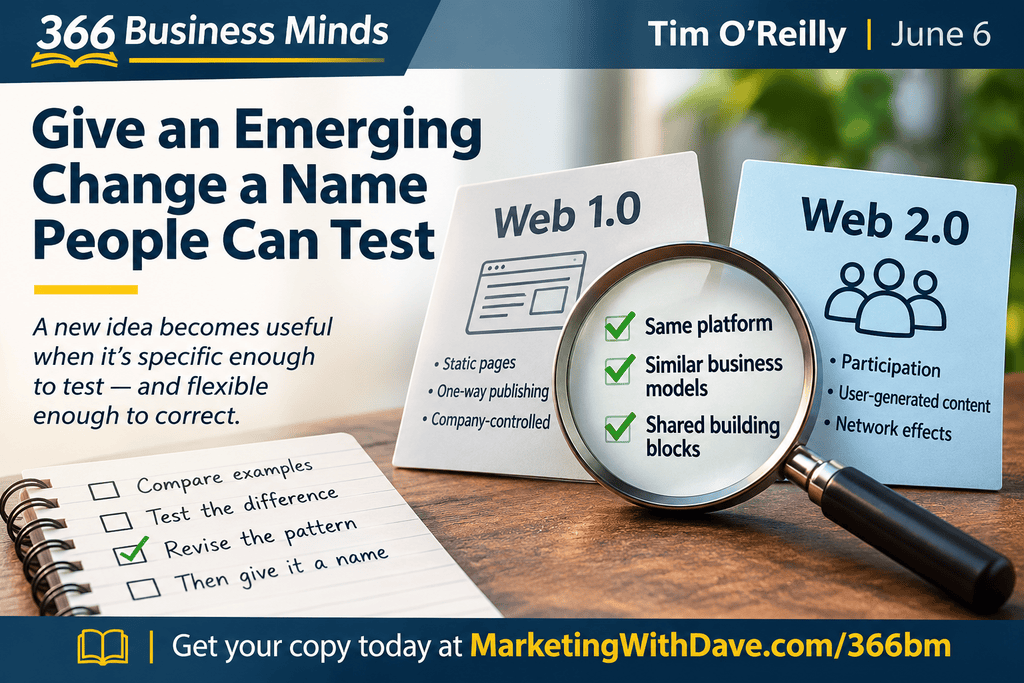
In 2004, with the dot-com bust still fresh, Tim O’Reilly (1954–) and his collaborators began defining a new phase of the internet by listing examples. DoubleClick gave way to Google AdSense. Britannica Online was contrasted with Wikipedia. The comparisons suggested that something important had changed about how businesses created value online.
The idea emerged during conference planning with MediaLive International. O’Reilly Media executive Dale Dougherty observed that the web had not collapsed with the dot-com companies and was becoming more important. The organizers developed the Web 2.0 concept around that observation.
At the first Web 2.0 Conference in October 2004, O’Reilly and John Battelle presented preliminary principles. O’Reilly expanded them in his September 2005 essay, What Is Web 2.0, describing patterns such as treating the web as a platform and building services that improved through participation.
The examples made an abstract idea easier to understand, but they also exposed weaknesses in the framework. O’Reilly acknowledged that two companies initially placed on the Web 1.0 side, DoubleClick and Akamai, had actually pioneered important aspects of the web-as-platform model. His own comparisons needed correcting.
By O’Reilly’s account, the term had generated more than 9.5 million Google citations roughly eighteen months after the conference. Popularity didn’t establish that every use was meaningful. The framework remained useful because people could examine actual businesses, challenge the comparisons, and refine the principles.
O’Reilly helped give an emerging change a common vocabulary. The lasting value came from making that vocabulary specific enough to test and flexible enough to correct.
☐ Put It to Work
Identify a change emerging in your industry. Compare established and emerging approaches using real companies, products, or customer behaviors. Write a short statement describing the pattern those examples reveal. Share it with people who know the market and ask which comparisons don’t fit. Revise your explanation to account for the exceptions before giving the pattern a name.
Putting the Lesson to Work
Marketing keeps adding acronyms: search engine optimization (SEO), answer engine optimization (AEO), generative engine optimization (GEO), and AI optimization (AIO). Instead of debating definitions, we tested these distinctions using O’Reilly’s approach: start with examples.
Our First Comparisons
| Established Approach | Emerging Approach |
|---|---|
| Tracking keyword rankings | Tracking AI citations and brand mentions |
| Writing content around search queries | Creating content that answers questions with verifiable evidence |
| Measuring organic sessions and clicks | Measuring visibility that may not produce a visit |
Each row sounded right. Then we checked the comparisons against what good SEO already did.
Where They Broke
Rankings versus citations. SEO practitioners already tracked impressions, conversions, and revenue, not just ranking positions.
Queries versus trustworthy answers. Search intent, usefulness, and credibility were SEO fundamentals. AI changes how answers are retrieved, assembled, and attributed, not the need for good ones.
Traffic versus zero-click. Google’s featured snippets and knowledge panels were producing zero-click experiences years before generative AI became mainstream.
The pattern was consistent. We made the new approach look new by describing the old one at its weakest, much like the problem O’Reilly discovered with his original DoubleClick comparison.
Three Questions Instead of a New Label
1. Discoverability. Can search engines and AI systems find, access, and understand your content? Technical accessibility, clear structure, useful content, and consistent facts about your business remain foundational.
2. Authorship of the Answer. Traditional search primarily directed users to pages published across the web. Generative AI increasingly uses those pages as source material for answers and recommendations it generates.
Are you included? Is what the system says about you accurate? Whose information is it drawing on?
Reviews, directories, forums, and media coverage can influence how AI systems describe your business. And because answers can vary by system, prompt, and individual response, measuring visibility increasingly requires sampling rather than checking a single position.
Neither challenge is entirely new, but both become more consequential when the generated answer is the destination.
3. Business Impact. Does that visibility contribute to consideration, leads, sales, or other organizational objectives? Rankings, citations, mentions, and clicks are signals, not measures of success in isolation.
These questions apply to both traditional search and AI-powered discovery without requiring us to declare either obsolete.
A Hypothesis Worth Testing
Independent corroboration may play a greater role in AI-generated recommendations than marketers accustomed to optimizing their own websites might expect.
For example, when comparing businesses with similar offerings and comparable owned content, does stronger independent coverage result in more frequent recommendations or more accurate descriptions across AI systems?
That’s a hypothesis, not a finding. It gives us something specific to investigate.
Your Turn
What are you doing for AI visibility that you genuinely weren’t doing for SEO before?
I’m particularly interested in how marketers influence and monitor the descriptions of their businesses across sources they don’t own. Specific practices and counterexamples are more valuable than new terminology.
What the Exercise Taught Me
Selective comparisons can manufacture novelty. We didn’t need a better name. We needed to challenge the comparisons that made a new name seem necessary.
A good business story gives you something to think about. A useful business lesson gives you something to test.
Discover 365 More Business Lessons
366 Business Minds pairs a different entrepreneur, innovator, or business thinker with a practical exercise on their birthday.
Available now in Kindle, hardcover, and audiobook formats, with the Kindle edition launch price at just $3.66.
Tim O’Reilly: Give an Emerging Change a Name People Can Test Read More »