Last updated March 2026
1931 – Birth of brand management: Procter & Gamble’s Neil McElroy pens a now-famous memo establishing “brand men” to coordinate a product’s advertising and promotions. This dedicated focus on unified marketing for each brand becomes widely emulated as an early integrated strategy.
1942 – War Advertising Council unites messaging: The U.S. advertising industry forms the War Advertising Council (now the Ad Council) to rally support for WWII. It mobilizes agencies to push unified national campaigns across radio, print, and film, an early example of industry-wide integrated communications.
1960 – The 4 Ps framework: E. Jerome McCarthy introduces the 4 Ps of Marketing (Product, Price, Place, Promotion), emphasizing that promotion must work in conjunction with other elements of the marketing mix. This concept reinforces thinking about marketing in an integrated, strategic way rather than as isolated tactics.
1970s – Database marketing and early data integration: The advent of computer technology in the 1970s ushers marketing into the digital age. Companies begin harnessing databases and direct mail lists to target customers, gathering data on what works and why to inform strategy. These developments move marketing closer to customer-centricity and set the stage for Integrated Marketing Communications built on data-driven insight.
1980s – Media fragmentation and global agencies: Cable TV, specialty magazines, telemarketing, and other new channels splinter audiences, making a single ad approach less effective. Large agency conglomerates expand globally, highlighting the need for unified campaigns across markets. Professional associations begin advocating for a comprehensive plan that coordinates PR, advertising, direct marketing, and sales promotion to ensure consistency and maximum impact.
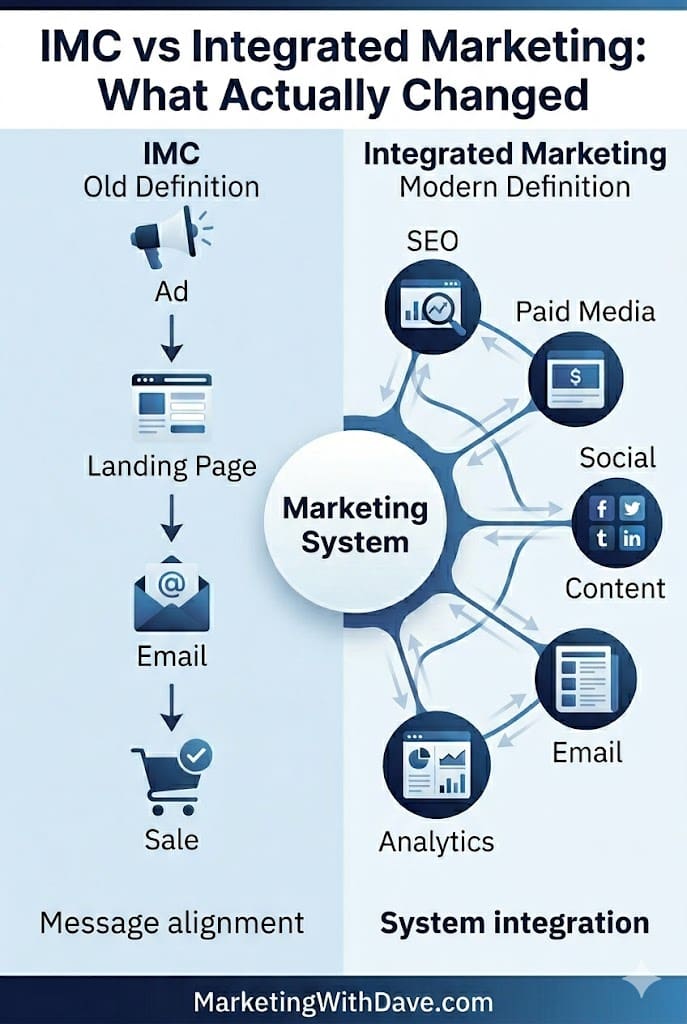
1989 – IMC term and definition: The term Integrated Marketing Communications (IMC) is formally coined. It is defined as planning marketing communications with a comprehensive plan that combines multiple disciplines—advertising, public relations, sales promotion, direct response—to deliver clarity and a unified message for maximum impact. This marks the conceptual birth of integrated marketing as a distinct approach.
1990–1991 – Academic and industry endorsement: Northwestern University launches the first Journal of Integrated Marketing Communications (1990) and an IMC graduate program (1991). A major IMC study finds that advertisers and agencies are embracing integration as a response to media fragmentation and new technologies. These developments legitimize IMC in both academia and practice.
1993 – IMC textbook and curriculum: Schultz and colleagues publish Integrated Marketing Communications: Putting It Together & Making It Work, the first IMC textbook. Medill restructures its curriculum around IMC, signaling a shift from siloed advertising education toward a holistic view of communications—treating the whole of marketing communications as more than the sum of its parts.
Late 1990s – Mainstream adoption: By the end of the decade, most major companies and agencies have embraced IMC. Campaigns increasingly coordinate messaging across TV, print, direct mail, and early digital channels. The discipline evolves from a buzzword into a standard approach for communications planning.
Early 2000s – CRM and email marketing connect the dots: Businesses deploy Customer Relationship Management systems and email marketing at scale, enabling unified customer views and more consistent messaging across channels. CRM data is increasingly used to drive personalized communications and integrated campaign planning.
2004–2006 – Social media joins the mix: With the rise of Facebook, YouTube, and Twitter, marketers gain new channels for engagement. Brands begin integrating social media into campaign planning, ensuring consistent messaging across both traditional and digital platforms.
Late 2000s – Search and mobile integration: As search engines and smartphones reshape consumer behavior, marketers must integrate paid search, SEO, mobile, and offline efforts. Campaigns increasingly connect online and offline touchpoints into unified experiences.
2010 – Omnichannel concept emerges: The omnichannel approach moves beyond multi-channel by focusing on creating seamless experiences across all touchpoints. Retailers and service providers begin integrating physical and digital interactions to improve customer journeys.
2013 – Omnichannel becomes imperative: As smartphone adoption surges, customers increasingly move fluidly between online and offline environments. Marketers respond by unifying promotions, messaging, and data across every platform.
2010s – Martech explosion and marketing automation: Marketing technology tools grow rapidly, from automation to analytics platforms. This proliferation allows marketers to integrate campaigns, personalize messaging, and orchestrate cross-channel workflows—but also increases complexity, making integrated strategy more critical.
Late 2010s – Holistic customer experience: Marketing evolves toward customer-centric integration, aligning marketing, sales, and service touchpoints. Journey mapping and lifecycle design become core practices for delivering coherent experiences across the entire relationship.
2020 – Pandemic-driven integration shift: The COVID-19 pandemic forces rapid digital transformation. Brands with strong integrated foundations adapt quickly, aligning messaging across email, apps, social media, and virtual events while delivering consistent customer experiences.
2020–2022 – Short-form video and cross-platform storytelling: TikTok and similar platforms push marketers to develop channel-specific creative while maintaining consistent brand themes across formats. Integrated storytelling becomes essential.
2023 – AI in marketing workflows: AI becomes a common tool for content generation, personalization, and analytics. Marketing teams balance automation with oversight to keep messaging consistent and brand-aligned across channels.
Ongoing – Seamless experiences as the north star: Integrated marketing continues evolving toward coherent, customer-centered ecosystems. Regardless of new platforms or technologies, the focus remains on delivering unified brand experiences across every touchpoint.