Last updated April 2026
Ask ten marketers what integrated marketing means and you will probably hear ten different answers. Some will describe campaign planning.
Others will talk about product launches or cross channel messaging. Many are really describing what used to be called integrated marketing communications, or IMC.
The term has a lot of history and some baggage. But the work behind it is more important than ever.
Modern marketing only works when channels, data, content, and systems reinforce each other instead of operating in silos. That is the real promise of integrated marketing today.
Where Integrated Marketing Started The IMC Era
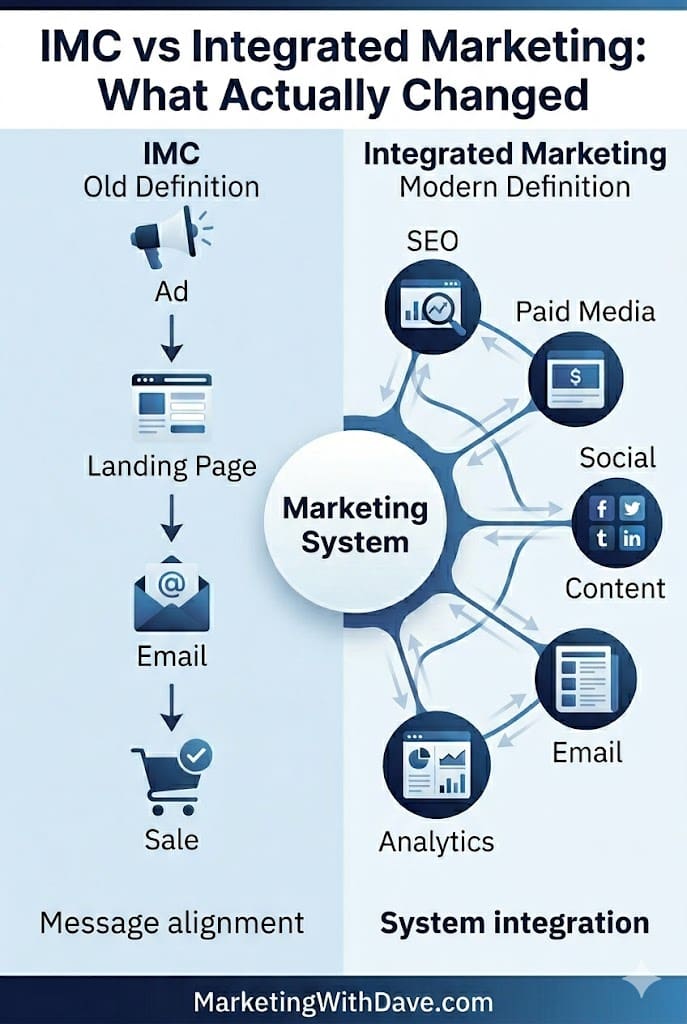
In the 1990s and early 2000s, integrated marketing was usually shorthand for integrated marketing communications. The focus was on campaigns and messaging. The core ideas were simple and useful.
- Make sure the ad matches the landing page.
- Use consistent creative across channels.
- Align sales materials with marketing messages.
- Coordinate media so customers see one clear story.
In practice, IMC often lived inside product marketing or brand teams. It was about message discipline and launch orchestration. When people said integrated marketing, they were usually talking about:
- Product positioning and messaging.
- Launch plans for new products or features.
- Campaign calendars and media plans.
- Ensuring that all assets looked and sounded on brand.
There is nothing wrong with that work. It still matters. The problem is that the world around it changed.
Why The Old Definition Falls Short Today
Digital marketing did not just add more channels. It changed how buyers buy, how systems connect, and how data flows. A few things happened that IMC was never designed to handle.
- Customer journeys became nonlinear and messy.
- Websites, apps, and products became core parts of the experience.
- Analytics and tagging exposed relationships between channels.
- Marketing stacks grew to include CRMs, CDPs, MAPs, and more.
- Teams specialized around SEO, paid, lifecycle, content, and operations.
In this environment, matching the headline in an ad and the headline on a landing page is not enough. A marketer can have perfectly coordinated campaigns and still run a fragmented system that wastes spend and loses customers.
Modern integrated marketing has to include architecture, data, systems, and the full experience, not just communications.
What Integrated Marketing Should Mean Today
A more useful definition for integrated marketing in a digital world is this:
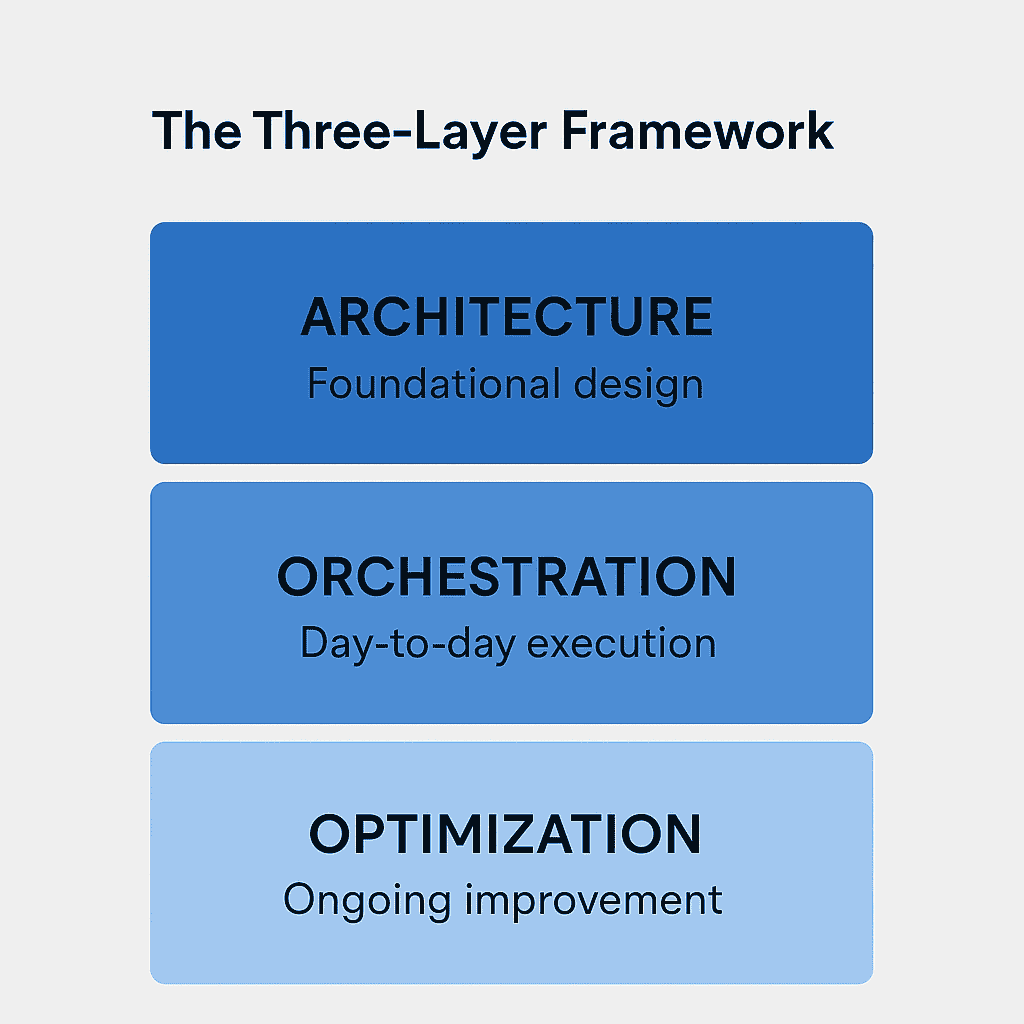
Integrated marketing is the architecture, orchestration, and optimization of the entire marketing ecosystem so every channel and system works together to move customers through a cohesive journey.
That definition makes a few important shifts.
- It is about the ecosystem, not a single campaign.
- It includes channels, content, data, and systems.
- It cares about the journey, not only the message.
- It focuses on how everything fits together, not just what each team does.
Integrated Marketing Versus Related Disciplines
Part of the confusion comes from overlapping job titles. Many teams now use other labels for pieces of this work.
- Product marketing focuses on positioning, messaging, and launches for specific products.
- Growth marketing focuses on experiments that drive acquisition, activation, and revenue.
- Marketing operations focuses on workflows, processes, and the technical stack.
- Lifecycle or retention marketing focuses on ongoing communication with existing customers.
- Customer experience or CX focuses on the overall perception of the brand and interactions.
All of those are important. None of them fully answer the question integrated marketing should answer.
That question is: how does the entire marketing system work together as one engine.
The Name Has Baggage But It Is Still Useful
Given all that history, it is fair to ask if integrated marketing is still the right label. Some teams would rather talk about growth marketing, revenue marketing, marketing architecture, or marketing ecosystem design. Those terms can be helpful, but they are not widely shared or consistently defined.
Integrated marketing has two advantages.
- People already search for it and recognize it as a serious discipline.
- It invites a conversation about how well everything fits together.
The baggage is real. Many leaders still hear the term and think about coordinated campaigns from a previous era. That is also an opportunity. There is real value in explaining why the old definition is too narrow and what has to be added for the term to stay useful.
In other words, the name can stay. The meaning needs to grow up.
A Practical Way To Think About Integrated Marketing
One way to bring this idea down to earth is to picture your marketing as an engine rather than a collection of channels. Each channel has a defined role, and integrated marketing is the work of making the engine run smoothly.
At a high level, the ecosystem might look like this:
- Strategy sets direction and defines who you serve and why.
- SEO captures demand and brings people who are already searching.
- Paid media generates demand and accelerates reach.
- Content educates, builds trust, and answers questions.
- Social media builds awareness and community.
- Website and landing pages convert interest into action.
- Email and lifecycle flows nurture, retain, and upsell customers.
- Surveys and feedback loops surface insights from real customers.
- Analytics and reporting reveal what is working and what is not.
- Martech and operations connect data and automate delivery.
Integrated marketing asks questions at the system level, such as:
- How does traffic from each channel behave once it reaches the website.
- Where are people dropping off in the journey.
- Which content assets support multiple channels at once.
- How do campaigns, evergreen content, and lifecycle flows reinforce each other.
- Where does data get lost between systems.
The goal is to design and improve the connections so that every part of the engine is pulling in the same direction.
How To Start Modernizing Integrated Marketing In Your Team
Moving from an IMC mindset to a true integrated marketing mindset does not require a full reorg. It starts with a few deliberate steps.
Step 1 Map The Ecosystem
List your main channels, tools, and systems. Draw how traffic flows today. Include where data is captured, how contacts are created, and what happens after someone converts.
Step 2 Clarify The Role Of Each Channel
Decide what each channel is responsible for. For example, one channel might focus on demand capture, another on demand creation, and another on retention. This prevents everything from trying to do everything.
Step 3 Connect The Journey
Identify the most common paths people actually take. Look for dead ends, such as emails that go to generic pages or social posts that send people into a maze. Make simple fixes that keep people moving toward a clear outcome.
Step 4 Align Measurement With The System
Update your reporting so it reflects how channels work together, not just how they perform in isolation. Include journey views, assisted conversions, and cross channel breakdowns where possible.
Step 5 Improve One Connection At A Time
Modern integrated marketing is iterative. Choose one high value connection, such as search to landing page to email nurture, and make that flow smoother. Then move to the next weak link.
Why This Shift Matters
When integrated marketing is treated as nothing more than campaign coordination, it becomes a box to check. The team matches taglines and calls it a day. The result is pretty creative that still underperforms.
When integrated marketing is treated as ecosystem design, the focus shifts to how each decision affects the whole system. Spend becomes more efficient. Customer experiences feel more coherent. Teams understand how their work supports the bigger picture.
The term may be old, but the work is not. Updating what integrated marketing means inside your organization can be one of the most important changes you make.