Last updated March 2026
Brief Summary
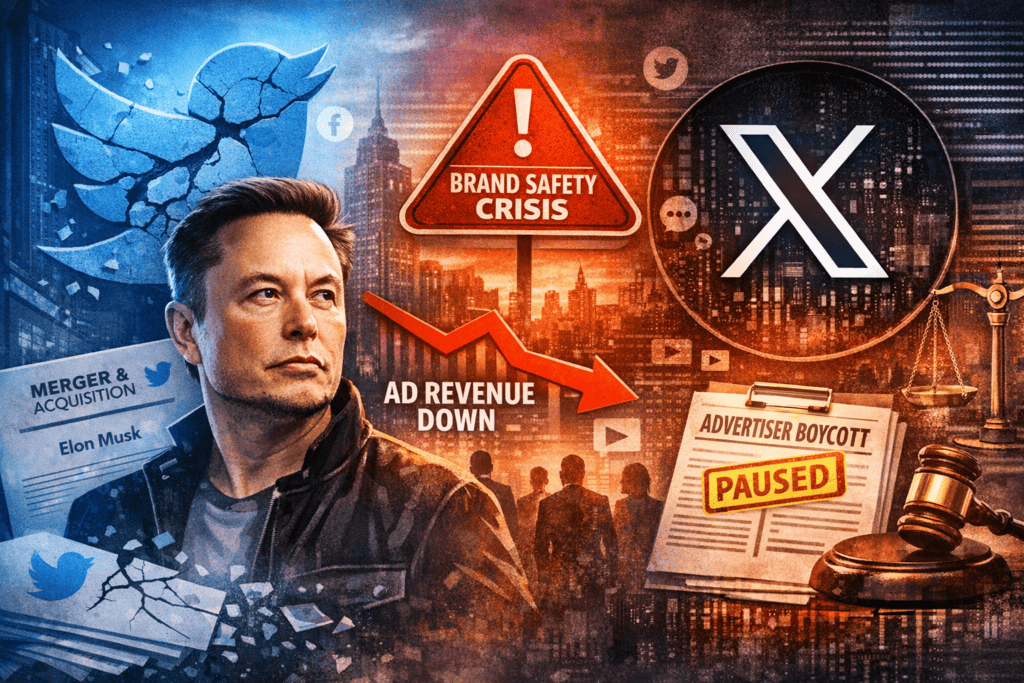
In 2022, Elon Musk turned an acquisition attempt into a public spectacle: he made an unsolicited bid to buy Twitter, the board deployed a poison pill, the parties signed a deal, litigation followed when he tried to exit, and the transaction ultimately closed in late October 2022.
The marketing lesson is not only about platform volatility.
It is about how quickly advertiser trust can collapse when governance, moderation, verification, and brand identity shift at the same time, and how hard it is to rebuild once brands decide the downside risk is not worth the reach.
Company Involved and Marketing Topic
Company involved: Twitter, Inc., later reorganized under X Corp. The platform was historically advertising-led: Twitter reported in its 2021 annual filing that advertising services were 89 percent of revenue.
Company website: X
Marketing topic: Branding, crisis response, and advertising trust.
Public Reaction or Consequences
Advertiser anxiety was visible before the deal even closed. In an open message to advertisers on the eve of closing, Musk argued he did not want the platform to become a “free-for-all hellscape” and positioned it as a “common digital town square,” implicitly acknowledging that ad dollars depend on controlled risk.
After the acquisition, several changes compounded marketers’ concerns. Ad market data and reporting described deep pullbacks soon after the takeover, including steep declines in ad spending and a broad pause by top advertisers. Verification and checkmark changes increased impersonation risk for brands. The Twitter-to-X rebrand added confusion and threatened long-built brand equity. In 2024, X escalated conflict with advertisers through a lawsuit alleging an unlawful boycott tied to brand safety standards.
Why It Matters Today
• Brand safety is now treated like supply chain risk: measurable, modeled, and acted upon quickly when governance changes raise adjacency concerns.
• Marketer trust metrics shifted in a durable way. Kantar reported historically low trust and perceived brand safety for X, plus a net 26 percent of marketers planning to reduce spend on X in 2025.
• Platform identity can change faster than marketing planning cycles. The abrupt Twitter-to-X rebrand is a reminder that naming and creative conventions can be disrupted quickly.
• AI integration raises new questions about data use and distribution power. By 2025, Musk’s AI company acquired X and framed the value around shared data, models, compute, distribution, and talent. In early 2026, reporting described further consolidation via a SpaceX and xAI deal.
Takeaways and Notable Quotes
Takeaways for marketers:
1) Treat platform stability as a core buying variable. If policies and leadership direction swing overnight, price that volatility into spend and brand safety requirements.
2) Build an exit-ready paid and organic playbook. Use pre-approved criteria for pausing and reallocating when trust signals drop.
3) Protect distinctive brand assets. The Twitter-to-X transition shows how much value lives in name recognition and cultural habits, and how quickly those can be disrupted.
Notable quotes and data:
• “the bird is freed” from Musk when the deal closed.
• Twitter’s 2021 filing reported advertising services represented 89 percent of revenue.
• Kantar reported only 4 percent of marketers believe ads on X provide brand safety, and marketer trust in ads on X fell from 22 percent in 2022 to 12 percent in 2024.
One sentence takeaway: When a platform’s leadership, policies, and identity change at once, marketers stop buying reach and start buying risk reduction.
Full Case Narrative
Twitter entered 2022 as an advertising driven social platform with global cultural influence and a revenue model heavily dependent on brand advertisers. Most of its revenue came from advertising, and marketer trust in content moderation, adjacency controls, and platform governance played a direct role in media buying decisions. Large brands and agencies evaluated Twitter not only on audience reach, but also on brand safety signals, enforcement policies, and third party measurement support.
In April 2022, Elon Musk disclosed a significant ownership stake and made an unsolicited offer to acquire the company. Twitter’s board responded with a shareholder rights plan designed to slow or deter a hostile takeover attempt. On April 25, 2022, Twitter accepted a merger agreement at 54.20 dollars per share. The proposed acquisition quickly became both a financial and governance story, with public debate around spam accounts, platform transparency, and content moderation philosophy. By July 2022, Musk issued a termination notice, and Twitter filed suit in Delaware to enforce the agreement, turning the acquisition into a high profile legal and reputational battle.
For marketers, uncertainty during this period was not abstract. Platform governance and moderation direction directly affect where ads appear and what content they may appear next to. As the dispute and public criticism escalated, advertisers and agency groups began reassessing platform risk. Brand safety frameworks used by major advertisers rely on predictable policy enforcement, third party verification partners, and consistent rule application. Signals that those systems might change created hesitation in media planning and brand placement decisions.
When the transaction closed in late October 2022, reporting described immediate leadership changes, staffing reductions, and rapid product and policy shifts. Several major advertisers paused or reduced spend shortly after closing, citing brand safety and policy clarity concerns. Agency holding companies and brand safety organizations issued updated guidance to clients about risk controls, adjacency filters, and campaign monitoring on the platform. Industry reporting later described a significant decline in United States advertising revenue following the acquisition, reinforcing how sensitive advertiser behavior is to governance and moderation signals.
In July 2023, Twitter rebranded as X, replacing its long standing name and bird logo with a new identity tied to a broader “everything app” vision. From a marketing perspective, this represented a major brand equity reset. The Twitter name carried strong global recognition and established advertiser associations. The X rebrand introduced both strategic flexibility and brand recognition risk, requiring advertisers and agencies to reevaluate platform positioning, audience expectations, and long term fit within media mixes.
Tensions between platform leadership and advertiser groups continued into 2024, including legal action by X against an advertiser trade group and several brands related to coordinated brand safety standards and alleged boycotts. These conflicts highlighted a structural reality for marketers. Platforms depend on advertiser trust and spend, while advertisers depend on platform safety controls and policy transparency. When that balance is strained, marketing investment becomes more volatile and more diversified across channels.
Subsequent consolidation involving X, xAI, and related companies further shifted how analysts and marketers evaluated the platform. The integration narrative emphasized data, distribution, and ecosystem leverage rather than traditional social media advertising alone. For marketers, the case illustrates how platform ownership, governance philosophy, and brand positioning changes can quickly alter advertiser risk models, media allocation decisions, and brand safety requirements.
What Happened Next?
Marketer confidence stayed fragile for years. Kantar findings pointed to continued pullback intent and very low perceived brand safety. The advertiser relationship moved from cautious engagement to public legal conflict through a 2024 antitrust lawsuit. Strategically, the ownership thesis evolved as X was acquired by Musk’s AI company in 2025, framing the platform as a data and distribution asset for AI development. In early 2026, reporting described another consolidation step involving SpaceX and xAI, reinforcing that the platform’s direction is tied to a broader AI and infrastructure narrative, not only social media advertising.
Sources and Citations
US Securities and Exchange Commission: Twitter 2021 Form 10-K
Reuters: Twitter adopts poison pill (shareholder rights plan)
Reuters: Musk completes acquisition and begins leadership overhaul
US SEC filing: DEFA14A describing merger agreement and process
Courthouse News: Twitter v. Musk complaint PDF
Reuters: Ad spending fell 71 percent in December 2022 (Standard Media Index data)
Reuters: Top advertisers pulled back after takeover (Pathmatics estimates)
Reuters: Paid verification and impersonation risk for brands
Reuters: Twitter rebrands as X and the ad industry reaction
Kantar: Media Reactions 2024 findings on X ad pullback and brand safety perceptions
Reuters: X sues advertiser alliance and brands over alleged boycott
CourtListener: Docket: X Corp v. World Federation of Advertisers
Reuters: xAI acquires X (deal framing around data and distribution)
Reuters: SpaceX and xAI consolidation reported in early 2026