
Last updated June 2026
If you’ve ever wondered why a perfectly good piece of content falls flat, the answer is usually not the writing. It’s not the design, the headline, or the offer either. The real problem is a mismatch between what you’re saying and where your reader actually is.
That’s where the five awareness stages come in.
The framework traces back to Eugene M. Schwartz, whose 1966 book Breakthrough Advertising laid out a model for understanding your prospect’s state of awareness and then writing to that specific state. Schwartz was writing about direct-response advertising, but the logic applies just as well to blog content, email sequences, website pages, and social media today.
In this post, we’ll walk through each of the five stages, show you how to identify which stage your audience is in, connect the framework to modern SEO and search intent, and give you a practical content map for applying all of it across your website, email sequences, and content calendar, including a step-by-step process for auditing the content you already have. We’ll also bring in ideas from some of the best marketing thinkers of the past few decades, because Schwartz wasn’t writing alone into a vacuum. His framework holds up in part because smart marketers keep arriving at the same insight from different directions.
Where the Five Awareness Stages Actually Come From
Schwartz outlined his awareness framework in Chapter 2 of Breakthrough Advertising, under the heading “Your Prospect’s State of Awareness — How to Capitalize on It When You Write Your Headline.” The chapter begins on page 13 of the original Prentice-Hall edition.
His original section titles read differently from the shorthand most marketers use today. He wrote about “The Most Aware,” “The Customer Knows of the Product But Doesn’t Yet Want It,” “How to Introduce New Products,” “How to Introduce Products That Solve Needs,” and “How to Open Up a Completely Unaware Market.” The modern labels — Most Aware, Product Aware, Solution Aware, Problem Aware, Unaware — came later as practitioners simplified and popularized the framework.
It’s worth knowing that Schwartz wasn’t the only person thinking in stages. Philip Kotler taught buyer-readiness stages in his marketing textbooks. Robert Lavidge and Gary Steiner published a hierarchy-of-effects model in 1961. Russell Colley introduced the DAGMAR framework around the same time. These models all share the insight that buyers move through distinct mental states before purchase, and your message needs to meet them in the right state.
What makes Schwartz’s version especially useful for content marketers and copywriters is that it anchors each stage to a specific question: what does this person already know, and what does my message need to do first?
The Five Stages Explained
Stage 1: Unaware
The unaware prospect is not thinking about your product, your category, or even their own problem. They may have a latent need they haven’t consciously connected to yet. They’re not browsing for a solution because they don’t know they need one.
Schwartz’s instruction here is to lead with identity, aspiration, or hidden tension before you say anything about what you sell. You have to get the person to see themselves in your content before they’ll ever care about your offer.
Anne Handley has articulated this as well as anyone working in modern content marketing. Her core principle is to focus on your audience “relentlessly and with pathological empathy” to make the customer the hero of the story rather than your product. That’s the right posture for reaching unaware audiences. They’re not looking for you. You have to find them through content they actually want to consume.
Joe Pulizzi pushes the same idea from a content strategy angle. Before you create anything aimed at an unaware audience, he argues, you need a clear content mission, a statement of who you serve, what you publish, and why it matters beyond making a sale. Without that, content aimed at the unaware stage becomes noise.
What works at this stage:
- Story-driven blog posts that don’t lead with a product
- Editorial pieces on trends, ideas, or perspectives your audience cares about
- Pinterest content and social posts that answer questions or spark curiosity
- Email newsletter issues that read like a letter, not a promotion
- Quizzes and assessments that surface a need the reader hadn’t named
Best CTA at this stage: Subscribe, save, or read more. A low-commitment conversion like a quiz or newsletter signup can absolutely work here. The key is not asking for too much too early.
Stage 2: Problem Aware
The problem-aware prospect knows something is off. They feel the friction, the inefficiency, the frustration. But they may not yet know that a solution exists or what category of product or service could help them.
Content at this stage earns trust by diagnosing well. Seth Godin’s contribution here is useful: he consistently argues that effective marketing means finding the smallest viable audience that is genuinely open and eager, and then delivering messages that feel relevant rather than broadcast. At the problem-aware stage, that means going deep on one specific pain cluster rather than trying to address every possible problem in the same piece.
Kotler described this stage as moving an audience from awareness to knowledge. The job of your content is not to pitch your solution yet. It’s to name the problem clearly, explain why it happens, and show the prospect that someone understands exactly what they’re going through. That builds the credibility you’ll need later.
What works at this stage:
- Symptom checklists and self-assessment tools
- Diagnostic blog posts that explain “why this happens”
- Calculators that quantify the cost of the problem
- Lead magnets built around a single, high-intent pain point
- Educational webinars that focus on the problem space, not the solution
Best CTA at this stage: Download the checklist, take the assessment, watch the explainer. Free tools and calculators convert well here because they deliver immediate value without requiring a purchase commitment.
Stage 3: Solution Aware
The solution-aware prospect knows the kind of result they want and roughly what kind of tool or approach might get them there. They’re researching. They’re comparing. They don’t know your specific product yet, but they’re in the right category.
This is where David Ogilvy’s emphasis on research and substance becomes most relevant. Ogilvy’s argument was that advertising that sells starts with understanding the product and the prospect deeply, and then making a case grounded in specifics rather than creative flair. Solution-aware prospects are evaluating their options, and vague content won’t hold their attention.
Claude Hopkins’ Scientific Advertising is the older direct-response companion to this idea: give people reasons why. Explain the mechanism. Make measurable claims and back them up. Test what works.
Robert Cialdini’s research is especially applicable here. Solution-aware prospects are uncertain, and in conditions of uncertainty, social proof and authority carry disproportionate weight. Showing that credible people or organizations trust your approach can shift a prospect from passive research mode to genuine consideration.
What works at this stage:
- Buyer’s guides and option comparisons
- Category explainer pages (“How does X work?”)
- Benchmark reports and methodology explainers
- Expert-led webinars that orient the prospect in a solution space
- FAQ pages that address the questions an informed buyer asks
Best CTA at this stage: Compare your options, see how it works, download the guide.
Stage 4: Product Aware
The product-aware prospect knows your brand or product. They’ve been to your site. They may be on your list. But they haven’t converted yet. Something is holding them back — a doubt, a competing option, or simply not enough proof that your offer is the right fit for their situation.
Kotler described this phase as moving from liking to preference to conviction. The job of your content and messaging here is not to educate from scratch. It’s to close the gap between “this seems interesting” and “I’m ready to move forward.”
Handley’s customer-hero perspective keeps this from becoming self-centered brand copy. The prospect still wants to see themselves in the outcome, not just a list of your features. Ogilvy adds the demand for specificity: proof needs to be concrete, not vague. Cialdini contributes the mechanics: case studies activate social proof, testimonials activate liking, limited availability activates scarcity. Godin’s “anticipated, personal, and relevant” standard also applies — product-aware audiences have already opted in at some level, so generic follow-up emails are a waste of that permission.
What works at this stage:
- Case studies with specific, measurable results
- Comparison pages (your product vs. alternatives)
- Product demos and walkthroughs
- Objection-handling email sequences
- Migration or onboarding guides that reduce perceived switching costs
- Testimonials organized by customer type or use case
Best CTA at this stage: Watch the demo, see customer results, book a consultation.
Stage 5: Most Aware
The most-aware prospect is ready. They know your product, they want it, and the only thing between them and conversion is friction or a final nudge. Schwartz’s instruction here is almost blunt: don’t overcomplicate the close. Give them a clear path, a compelling reason to act now, and remove anything that slows them down.
Cialdini’s scarcity and consistency principles are strongest at this stage because the person is already convinced. What they need is permission to act and a reason not to wait. Kotler’s later “5 A’s” model is a useful reminder that once someone converts, your job shifts toward advocacy, making the experience good enough that they refer others and return themselves.
Godin’s permission marketing logic also applies: an audience that is enrolled and eager wants direct, expected messages. That’s when a straightforward email with a clear offer outperforms a content piece designed to educate.
What works at this stage:
- Pricing pages with clear, simple paths to purchase
- “Start now” or deadline-driven offer emails
- Retargeting ads for people who visited your pricing or checkout page
- Cart abandonment or demo follow-up sequences
- Live sales enablement for higher-ticket offers
- Onboarding sequences immediately after purchase
Best CTA at this stage: Start now, claim the offer, book your call.
How to Identify Which Awareness Stage Your Audience Is In
Understanding the five stages is one thing. Knowing which stage a specific visitor, subscriber, or prospect is in is what makes this framework operational. Here are three reliable signals to read.
What They Search
Your website search queries are one of the clearest indicators of awareness level, because people tell you exactly what they know and what they’re looking for. You can use this to inform your keyword targeting, your content prioritization, and how you structure your site.
| What They Search | Awareness Stage |
|---|---|
| “Why is my website traffic dropping?” | Problem Aware |
| “How to increase organic traffic” | Problem Aware / Solution Aware |
| “SEO vs PPC which is better” | Solution Aware |
| “Best SEO tools for small business” | Solution Aware |
| “Semrush review” | Product Aware |
| “Semrush vs Ahrefs” | Product Aware |
| “Semrush coupon” or “Semrush free trial” | Most Aware |
Notice that the query gets more specific as the awareness level rises. Vague, problem-oriented searches signal early-stage awareness. Brand-specific or transactional searches signal late-stage awareness. When you look at which keywords are sending traffic to a page, you’re essentially reading the awareness level of the audience that page is attracting.
Where They Came From
Traffic source is a strong proxy for awareness stage. A visitor arriving from a Pinterest pin on a general marketing topic is almost certainly in the unaware or problem-aware category. A visitor arriving from a Google search for your brand name is already product aware. A visitor clicking through from a retargeting ad they saw after visiting your pricing page is most aware. If your analytics platform lets you segment by traffic source, you can use that to match your follow-up messaging to the likely awareness level of each segment.
What They Do on Your Site
Behavioral signals inside your site are the third indicator. Someone who reads three blog posts and bounces is likely unaware or problem aware — they’re in research and discovery mode. Someone who visits your pricing page multiple times without converting is product aware and has a specific hesitation worth addressing. Someone who starts a free trial and abandons midway through onboarding is most aware but has hit a friction point. Each behavioral pattern points to a different intervention.
The Five Awareness Stages and Search Intent
One of the most underused applications of Schwartz’s framework is mapping it to SEO and search intent. Most SEO guides talk about informational, navigational, commercial, and transactional intent. Those categories are useful, but they don’t connect as cleanly to messaging strategy as the awareness stages do.
When you map awareness to search intent, you get a more actionable picture of what kind of content to create and what job that content needs to do.
| Stage / Search Intent | What the Searcher Wants | Content That Fits |
|---|---|---|
| Unaware Informational curiosity | Ideas, entertainment, perspective — not answers to a specific question yet | Trend pieces, editorial essays, “why X matters” posts, story-led content |
| Problem Aware Problem investigation | Understanding why something is happening and whether it’s a real concern | Diagnostic posts, symptom lists, “signs you have X” content, explainers |
| Solution Aware Comparative research | Options, categories, trade-offs — trying to understand the landscape | Buyer’s guides, comparison posts, category overviews, “best X for Y” lists |
| Product Aware Brand evaluation | Proof, specifics, credibility — trying to decide if this particular option is right | Reviews, case studies, demo content, testimonial pages, “vs.” articles |
| Most Aware Transactional | A reason to act now and a clear path to purchase | Pricing pages, coupon and deal posts, “get started” pages, offer pages |
The practical implication for your content strategy is that you should be intentional about which stages you’re creating content for. Many sites accidentally create a lot of solution-aware content (comparison articles, best-of lists) while neglecting unaware and problem-aware content that builds an audience over time. Others publish plenty of top-of-funnel content but have no middle-of-funnel content to carry interested readers toward a decision.
Auditing your existing content against this table is a useful exercise. Group your posts by which awareness stage they’re addressing, and you’ll quickly see where you have gaps.
This also connects directly to topical authority. A site that has content at every awareness stage for a given topic signals depth and comprehensiveness to both readers and search engines. Your problem-aware diagnostic posts support your solution-aware comparison posts, which support your product-aware review content — and internal links between those layers make each one stronger.
Mapping the Five Stages to Your Website
The most immediate place to apply this framework is your website. Most small business sites are organized around what the owner wants to say rather than where the visitor is mentally. That mismatch shows up as high bounce rates, low engagement, and CTAs that don’t convert.
A better approach is to treat your website as a content map — a deliberate system where each asset serves a specific stage and passes visitors toward the next one. Many marketers create content without ever asking where it fits in the buyer journey. The result is a site that’s heavy in one or two stages and nearly empty in others. A content map built around awareness stages fixes that. It forces you to look at your full library as a progression rather than a pile of individual pieces.
Here’s how the main content types on a typical marketing site map to the five stages:
| Website Asset | Awareness Stage | Primary Job |
|---|---|---|
| Blog posts (editorial, trend-focused) | Unaware | Build audience, earn attention, collect subscribers |
| Educational guides and diagnostic tools | Problem Aware | Build trust by naming and diagnosing the problem |
| Comparison articles and buyer’s guides | Solution Aware | Orient the prospect in the solution landscape |
| Product reviews, case studies, testimonial pages | Product Aware | Build conviction through proof and specifics |
| Pricing pages and offer pages | Most Aware | Remove friction and prompt action |
Visually, this looks like a funnel where each stage narrows toward a conversion but also feeds back into content clusters that build topical authority across the full topic area:
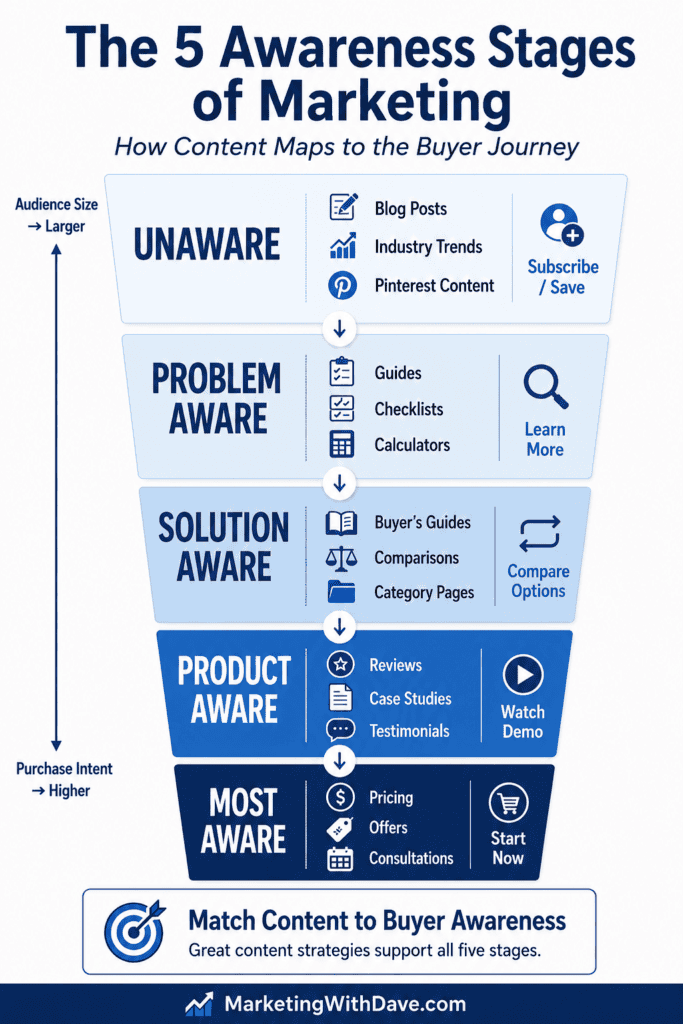
A clean site architecture built around this framework typically groups into four zones:
- Learn or Resources hub (unaware and problem-aware content)
- Solutions section (solution-aware category pages)
- Why Us or Proof section (product-aware evidence)
- Pricing or consultation page (most-aware close)
The key discipline is matching your calls-to-action to the stage of the page, not the stage you wish the visitor was in. The real issue isn’t whether you use a conversion-oriented CTA on early-stage content — newsletter signups, free trials, calculators, and assessments can all convert well even on problem-aware pages. The issue is asking for too much commitment too early. A blog post on diagnosing a marketing problem can absolutely end with a free assessment CTA. It should not end with “Book a $500 strategy session.” The ask needs to match the readiness level of the audience.
Save the high-commitment CTAs for pages where the visitor’s behavior signals they’re already evaluating. Someone on your pricing page or comparison page isn’t in an educational mindset. Don’t slow them down with more content when what they need is a clear path forward.
How to Audit Your Existing Content Using the Five Stages
You don’t have to start from scratch to apply this framework. If you have an existing blog or content library, the most useful first step is a content audit. Assign each piece to an awareness stage and then look at the distribution.
Here’s a simple process you can run today:
- Export all your blog URLs. Pull a list from your CMS, Google Search Console, or a site crawler. You just need URL and title to start.
- Assign each article an awareness stage. Read the title and ask: who is this written for, and what do they already know when they arrive? A post titled “Why Your Traffic Dropped After a Google Update” is problem aware. A post titled “Semrush vs Ahrefs” is product aware. A post titled “How to Get Started With SEO” is solution aware. Work through your list and tag each one.
- Count articles per stage. Tally up how many pieces you have at each level. Most sites discover they’re heavily weighted toward one or two stages and nearly empty in others. Solution-aware content (comparison posts, best-of lists) is the most common over-investment. Unaware and problem-aware content is the most common gap.
- Identify the gaps. If you have very little unaware-stage content, you have limited ability to build a new audience through organic discovery. If you have very little product-aware content, you’re likely losing people who were close to a decision. The gaps are your content calendar for the next quarter.
- Create internal links between adjacent stages. Once you’ve mapped your content, look for natural linking opportunities between pieces at neighboring stages. A problem-aware diagnostic post should link to your solution-aware buyer’s guide. Your buyer’s guide should link to your product-aware review or case study page. These links create a path through the funnel and strengthen topical authority across your content cluster — which is a signal search engines reward.
This exercise also surfaces content cannibalization risks — cases where you have multiple pieces competing for the same awareness-stage keyword without a clear hierarchy. If two posts are both targeting solution-aware searchers asking the same question, they’re splitting authority rather than building it. Identifying those overlaps is as valuable as finding the gaps.
The audit doesn’t have to be exhaustive to be useful. Even a quick pass through your top 20 or 30 posts by traffic will give you a clear picture of where your content is concentrated and where prospects are likely falling out of your funnel.
How to Structure an Email Nurture Sequence Around the Stages
Email is one of the best channels for walking prospects through all five stages over time, because you control the sequence and the pacing. Here’s a seven-email framework that covers the full ladder:
| # | Stage | Purpose | Example Topic |
|---|---|---|---|
| 1 | Unaware | Open with identity or tension | “Why good content still fails to convert” |
| 2 | Problem Aware | Name and diagnose the problem | “Five signs your messaging is mismatched to where your buyer actually is” |
| 3 | Problem Aware | Deepen consequences and stakes | “What awareness mismatch costs in traffic, leads, and conversion friction” |
| 4 | Solution Aware | Introduce the solution category | “What changes when you build content around buyer awareness” |
| 5 | Product Aware | Show your specific approach | “How we map your website and email to the right awareness stage” |
| 6 | Product Aware | Add proof and specifics | “Case study: what happened when we matched content to stage” |
| 7 | Most Aware | Close with a clear offer | “Ready to map your funnel to the five stages? Here’s how to get started.” |
One important nuance: not every subscriber enters your list at the same stage. Someone who found you through a broad editorial post is probably unaware or problem aware. Someone who found you through a product comparison article is already solution or product aware. If your email platform allows segmentation by entry source, route higher-intent subscribers into a shorter, more direct sequence rather than starting them at the beginning of an education track they’ve already passed through.
A Four-Week Content Campaign That Covers All Five Stages
If you want to move an audience through the full ladder with a focused campaign, you don’t need a massive volume of content. You need one strong anchor asset per week, remixed across formats and channels.
| # | Stages Targeted | Anchor Asset | Supporting Assets | Primary CTA |
|---|---|---|---|---|
| 1 | Unaware + Problem Aware | Blog post on why messaging mismatch kills conversions | Pinterest pins, newsletter, self-check quiz, short social posts | Subscribe / take the quiz |
| 2 | Problem Aware + Solution Aware | Webinar or guide on awareness-based content strategy | Companion blog post, downloadable worksheet, resource hub page | Register / download |
| 3 | Solution Aware + Product Aware | Comparison article or framework overview page | Demo clip, FAQ email, case study excerpt, testimonial block | See how it works |
| 4 | Product Aware + Most Aware | Proof-heavy offer or consultation page | Deadline email, objection-handling email, retargeting, pricing page refresh | Book now / start now |
The One-Sentence Test for Any Piece of Content You Create
Before you publish anything, try this: write down, in one sentence, who this piece is for and what they already know when they arrive.
If you can’t answer that clearly, the content probably isn’t ready. The five awareness stages give you a simple vocabulary for making that call. You don’t need to label every piece formally — you just need to make a deliberate decision about where your reader is starting from, and then write to that starting point.
Schwartz’s core insight from 1966 still holds: the most important thing you can know about your prospect is what they already believe. Every other decision in your marketing — the headline, the CTA, the offer, the format — flows from that.
Key Takeaways
- The five awareness stages trace back to Eugene Schwartz’s Breakthrough Advertising (1966). The modern labels are simplifications of his original section titles, added by later practitioners.
- Each stage requires a different message. Blunt “buy now” language fails at the unaware and problem-aware stages. Educational content underperforms at the most-aware stage.
- Search queries are one of the clearest signals of awareness level. Vague, problem-oriented queries signal early-stage awareness. Brand-specific or transactional queries signal late-stage awareness.
- The awareness stages map directly to SEO search intent: informational curiosity, problem investigation, comparative research, brand evaluation, and transactional.
- Treat your website as a content map, not a collection of random posts. Each asset should serve a specific stage and pass visitors toward the next one.
- The issue with CTAs on early-stage content isn’t conversion — it’s asking for too much commitment too early. Low-friction offers like assessments, calculators, and newsletter signups can convert well at any stage.
- A content audit is the fastest way to apply this framework to what you already have. Export your URLs, assign each a stage, count by stage, find the gaps, and add internal links between adjacent stages.
- The audit also surfaces content cannibalization: pieces competing for the same awareness-stage keyword that are splitting authority rather than building it.

