
Last updated June 2026
GrackerAI is not trying to be a traditional SEO platform. That distinction matters.
If you come into it expecting keyword research, backlink tracking, site audits, or an all-in-one SEO workflow, you will likely be disappointed. But if you are trying to understand where your brand shows up in AI-generated answers, which competitors are being cited instead of you, and what content gaps may be keeping you out of those answers, GrackerAI becomes a much more interesting product.
I tested GrackerAI against MarketingWithDave.com to see whether it could help me understand my AI visibility across prompts related to software reviews, SEO tools, AI visibility, and marketing technology. What I found was a product with a strong citation intelligence layer, a promising prompt and response workflow, and a content generation feature that still needs work.
Most AI visibility tools answer a simple question: Was my brand mentioned? GrackerAI tries to answer a more useful one: Why was someone else cited instead? That distinction shapes nearly every feature in the platform, from citation tracking and response analysis to recommendations and task creation.
Affiliate disclosure: If you buy through my AppSumo link, I may earn a small commission at no additional cost to you. I only share tools I believe are worth your time and consideration.
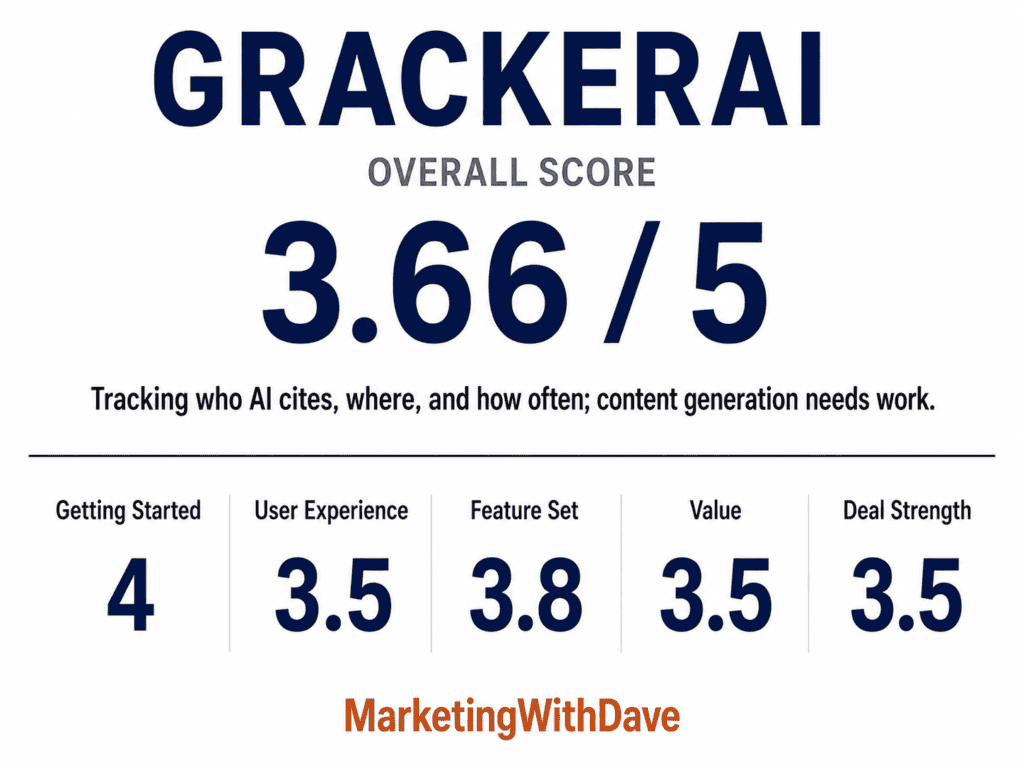
See how this score is calculated
At a Glance
| What I Liked | What Needs Improvement |
|---|---|
| Excellent citation intelligence | Weak AI-generated content |
| Stores complete AI responses | Better entity resolution |
| Strong prompt monitoring workflow | Visibility score needs more explanation |
| Useful recommendation engine | Limited AI engine coverage on the LTD |
| Task management connects insights to action | Monthly refresh cadence limits active monitoring |
The 30-Second Decision
Buy GrackerAI if: You are a marketer, agency, consultant, or business that wants to understand how your brand appears in AI-generated answers. Rather than trying to be a traditional SEO platform, it focuses on monitoring AI responses, tracking citations and competitor mentions, and uncovering visibility gaps that can be turned into content opportunities or actionable follow-up tasks.
Skip it if: You need a polished all-in-one SEO suite, daily monitoring on the lifetime deal, broad AI engine coverage, or publish-ready AI-generated content with minimal editing.
What GrackerAI Actually Does
One thing GrackerAI does well is organize AI visibility into a repeatable workflow. Rather than showing disconnected reports, the platform follows a logical process from prompt creation to actionable recommendations.
The core workflow looks like this:
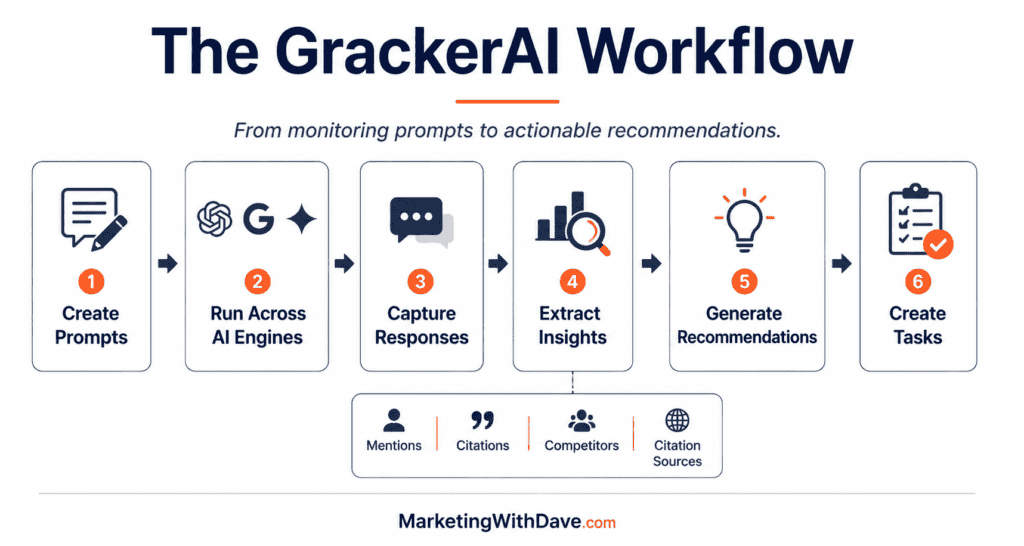
That is a coherent product model. It is not simply another dashboard showing whether your brand was mentioned. It is closer to an AI visibility operations platform.
Which AI Visibility Tool Is Right for You?
Where GrackerAI Fits
GrackerAI isn’t trying to replace a traditional SEO platform. After spending time with it, I think it fits into a different part of the marketing workflow.
If I were choosing between the three AI visibility tools I’ve tested, here’s how I’d think about them.
Choose SnowSEO if…
You want one platform that combines traditional SEO with AI visibility. SnowSEO brings together SEO audits, optimization recommendations, AI visibility tracking, and content guidance in a single workflow.
Choose ZeroRank if…
Your primary goal is monitoring how often your brand appears across AI answer engines. It focuses on AI visibility tracking with a straightforward, monitoring-first approach.
Choose GrackerAI if…
You’re trying to understand who AI is citing, where your competitors are appearing, and where your own visibility gaps exist. Citation analysis, response inspection, recommendations, and task management are where GrackerAI stands out.
They’re solving related problems, but they aren’t trying to be the same product. Choosing the right one depends less on which has the longest feature list and more on which part of your workflow you’re trying to improve.
I’ve also published full hands-on reviews of SnowSEO and ZeroRank, along with a detailed ZeroRank vs. SnowSEO comparison, if you’d like a deeper look at how these tools differ.
Once I stopped evaluating GrackerAI like a traditional SEO suite and started looking at it as an AI visibility research platform, the product made much more sense. These were the features that stood out during my testing.
What I Liked About GrackerAI
1. Citation Intelligence Is the Strongest Feature
The citation area was the most useful part of the product during my testing.

GrackerAI shows which domains AI engines are citing, how often those domains appear, whether citations are brand-owned, competitor-owned, or neutral, and which sources are newly discovered or lost over time.
This matters because AI visibility is not just about whether your brand gets mentioned. It is also about understanding which sources AI systems trust enough to cite.
For my own testing, I could see domains like SnowSEO, ZeroRank, G2, YouTube, Reddit, TechRadar, Trustpilot, and MarketingWithDave.com appearing in the citation data. That immediately gave me a better sense of the ecosystem around my tracked prompts.
This is where GrackerAI started to feel more like a research tool than a reporting dashboard.
2. The Responses Area Gives You the Raw Evidence
I like that GrackerAI stores the actual AI responses behind the metrics.
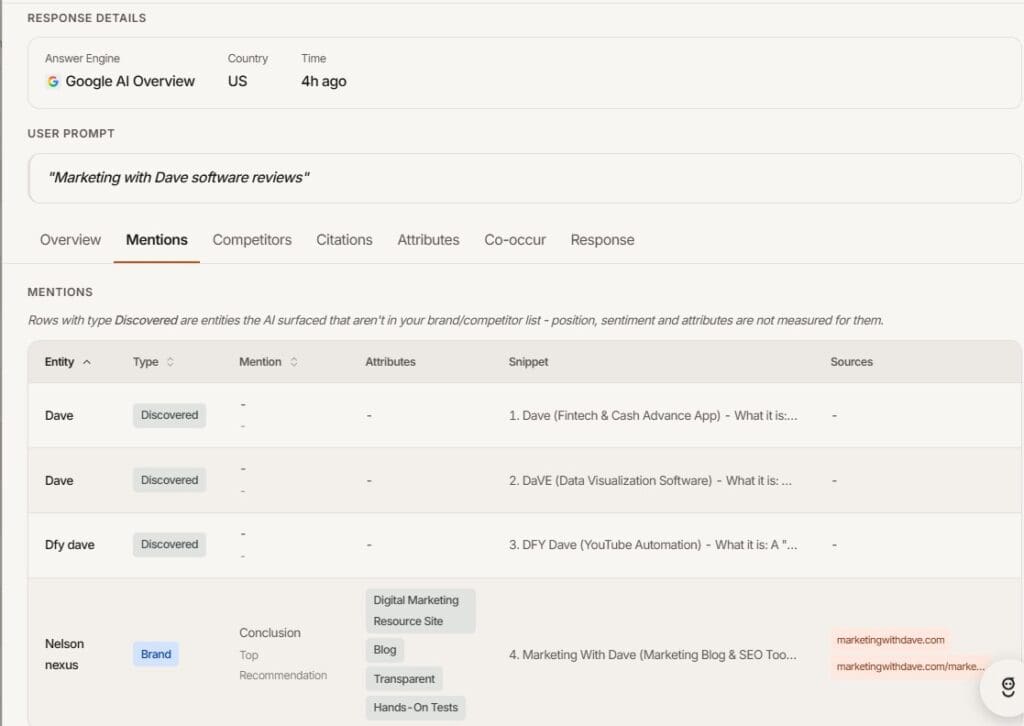
That matters because dashboards summarize. Responses explain.
If a tool tells me my presence rate is low, I want to see the actual answer. Who was recommended? Which sources were cited? Where did my brand appear? Was the mention accurate? Was it buried at the bottom?
The Responses area gives you that context. For me, this is one of the product’s most important features because it lets you inspect the evidence instead of blindly trusting a score.
3. Prompt Monitoring Feels Like the Right Model for AI Search
Traditional SEO tools are built around keywords. AI visibility tools need to be built around prompts.

GrackerAI does this reasonably well. You can monitor specific questions, compare performance across prompts, and see presence rate, score, sentiment, runs, and last-seen data.
That gives you a different kind of visibility model. Instead of asking, “Do I rank for this keyword?” you are asking, “Do I appear when a buyer asks this question?”
That is the right direction for AI search.
4. The Recommendation Layer Is Promising
The recommendations area appears to be designed around action. Instead of simply showing that you were missing from a response, it surfaces prompts, competitors, and offsite domains that may need attention.
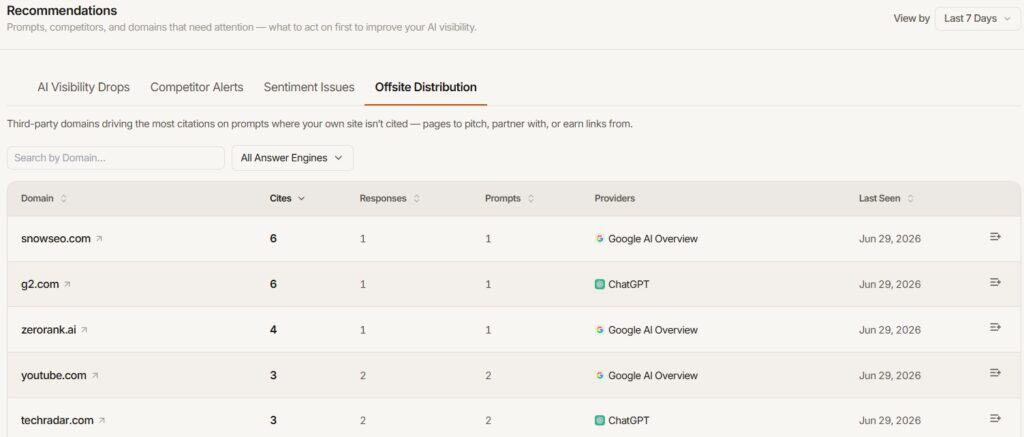
One of the more interesting tabs is offsite distribution, which shows third-party domains driving citations on prompts where your own site is not cited. That is a useful idea because it starts to answer a practical question:
Where is AI getting its information, and what should I do about it?
That could turn into outreach, content updates, comparison pages, review schema improvements, or better source-backed content.
5. The Task Feature Is Simple but Smart
The task feature is not flashy, but I like it.
AI visibility tools can easily become another dashboard you check without taking action. GrackerAI at least acknowledges that insights should turn into work.
If I find that a competitor is cited for a prompt where MarketingWithDave.com is missing, I can create a task from that workflow. That is a small feature, but it connects the data to execution.
What Needs Work
1. The Content Generator Missed the Mark
This was my biggest disappointment.
I tested GrackerAI’s content generation around a gap related to Marketing With Dave software reviews. The article it produced was structured and grammatically clean, but it misunderstood the intent badly.
Instead of creating a useful article about my software review process, trust signals, review methodology, or the types of marketing tools I evaluate, it focused heavily on confusion between Marketing With Dave and the Dave banking app.
It felt like the tool found a semantic association around the word “Dave” and built an entire article around the wrong problem. This is exactly where AI content tools can become dangerous: the writing looks polished, but the strategic direction is wrong.
For me, GrackerAI’s content generation is not ready to publish without major human review and rewriting.
2. Entity Resolution Needs to Be Stronger
This is the issue I care about most as a solo operator with a common name in my business.
My brand is not “Dave” in the abstract. It is MarketingWithDave.com, Marketing With Dave, and the specific body of content connected to my site and social profiles.
During testing, GrackerAI surfaced random “Dave” entities that had nothing to do with me, including examples that were clearly not competitors and not relevant to my business.
That is more than a minor annoyance.
For a company like Salesforce or Adobe, entity recognition is easier because the brand names are unique. But many AppSumo buyers are solopreneurs, consultants, creators, and small businesses with generic or personal-brand names. If the platform cannot reliably distinguish the brand from unrelated entities, the data becomes noisy fast.
GrackerAI needs stronger brand verification and entity disambiguation. Ideally, the platform should allow me to anchor identity around verified domains and approved profiles, such as:
- marketingwithdave.com
- Marketing With Dave
- David Nelson only when tied to Marketing With Dave
- approved LinkedIn or social profiles
It also needs an “ignore this entity” or “not my brand” option. Without that, common names can pollute the dataset.
That may sound like a niche problem, but I suspect it’s more common than it appears.
Many AppSumo buyers are consultants, freelancers, agencies, coaches, and creators whose businesses are built around personal names rather than unique brands. Unlike Salesforce or Adobe, names like Dave, Mike, Sarah, or Johnson Marketing can easily overlap with unrelated people and companies.
Because of that, I’d like to see GrackerAI allow users to anchor their brand to verified domains and approved social profiles while also providing a simple way to ignore entities that clearly aren’t part of their business.
The stronger the entity resolution becomes, the more valuable every other feature in the platform becomes.
3. The Main Visibility Score Needs More Explanation
GrackerAI shows visibility score, presence rate, share of voice, sentiment, citation rate, and responses.

Some of those metrics are useful. Presence rate is easy to understand. Citation rate is also useful. But the main visibility score is less obvious.
If a prompt shows a visibility score of 35 and a presence rate of 50%, I need to know what makes the score 35 rather than 50, 5, or 100.
This is a product where tooltips and methodology explanations matter. AI visibility is already a new category. Users should not have to reverse-engineer the scoring model.
4. The AppSumo LTD Has Limited Engine Coverage
The AppSumo deal is not the full GrackerAI platform.
Tier 1 includes ChatGPT and Google AI Overviews. Tiers 2 and 3 add Perplexity. Gemini, Claude, and Google AI Mode are not included in the lifetime deal at the time of this review. The founder also confirmed in the AppSumo questions that there is no current plan to add Claude and Gemini to the lifetime deal.
That matters because many buyers are comparing GrackerAI against SnowSEO, ZeroRank, Visby, and other AI visibility tools.
If broad engine coverage is your priority, GrackerAI may not be the strongest fit right now.
5. Monthly Refresh on the Lifetime Deal Is a Real Limitation
The founder confirmed that tracking refreshes monthly for the lifetime deal.
That may be fine for broad content strategy, but it is not ideal if you want active AI visibility monitoring.
AI answers can change frequently. If you are running campaigns, testing content updates, or trying to measure movement from a recent optimization, monthly data may feel slow.
Pricing and AppSumo Tiers
GrackerAI is available on AppSumo as a lifetime deal across three tiers.
| Feature | Tier 1 | Tier 2 | Tier 3 |
|---|---|---|---|
| Price | $69 | $169 | $499 |
| Prompts tracked per month | 50 | 150 | 500 |
| Seats | 1 | 5 | Unlimited |
| Companies or brands | 1 | 5 | Unlimited |
| Articles per month | 3 | 10 | 30 |
| AI engines monitored | 2 | 3 | 3 |
| Monitors | 1 | 2 | 4 |
| City-level monitoring | No | Yes | Yes |
One important clarification: Tier 3 includes unlimited companies or brands, but the real practical ceiling is the number of monitors and prompts. The founder clarified that Tier 3’s 4 monitors and 500 monthly prompts apply across the whole account, not per client. If you need four monitors per client, Tier 3 realistically supports one client deeply. If each client only needs one monitor, you could spread the account across more clients.
My Honest Take
GrackerAI is a worthwhile product, but not for the reason I expected.
I would not buy it primarily for the article generation. That was the weakest part of my test. The generated article was too far away from what I would actually publish on MarketingWithDave.com.
I would consider buying it for the AI visibility research workflow.
The prompt tracking, response archive, citation intelligence, discovered entities, recommendations, and tasks create a useful system for understanding how AI engines talk about your category. It helped me see not just whether Marketing With Dave appeared, but which domains AI was citing, which competitors appeared, and where the surrounding ecosystem was forming.
That is valuable.
The product still needs better entity resolution, clearer scoring explanations, stronger generated content, and broader engine coverage on the lifetime deal. But the core idea is sound, and several of the research features are stronger than I expected.
Bottom Line
GrackerAI succeeds when you evaluate it as an AI visibility research platform rather than an all-in-one SEO suite.
But as an AI visibility intelligence platform, it is more interesting than its first impression suggests.
If you want to monitor prompts, inspect raw AI responses, analyze citation sources, discover competitors, and build action lists around AI visibility gaps, GrackerAI is worth a serious look. If you mainly want polished AI content or broad SEO features, SnowSEO or another platform may be a better fit.
For my workflow, GrackerAI sits in the research and monitoring category. It helps answer a different question than traditional SEO tools:
Not “how do I rank higher in Google?”
But “why is AI citing someone else instead of me?”
That is a real question. GrackerAI does not answer it perfectly yet, but it is one of the more thoughtful attempts I have tested.
AI search is not changing what marketers need to do. It is changing what we need to measure.
Rankings tell you who appears in Google.
Citation intelligence tells you who AI trusts.
Frequently Asked Questions
What is GrackerAI?
GrackerAI is an AI visibility platform that monitors prompts across supported AI engines, tracks citations and competitor mentions, captures complete AI responses, and recommends actions to improve how your brand appears in AI-generated answers.
Is GrackerAI an SEO tool?
Not in the traditional sense. GrackerAI focuses on AI visibility rather than keyword rankings, backlink analysis, or technical SEO audits. It is better understood as an AI visibility research and citation intelligence platform.
How is GrackerAI different from SnowSEO?
SnowSEO combines traditional SEO features with AI visibility tracking. GrackerAI focuses more narrowly on AI responses, citation analysis, competitor mentions, recommendations, and task-based follow-up.
How is GrackerAI different from ZeroRank?
ZeroRank is primarily an AI visibility monitoring platform. GrackerAI places more emphasis on citation analysis, response inspection, recommendations, and turning AI visibility findings into actionable tasks.
Which AI engines does GrackerAI support?
On the AppSumo lifetime deal, Tier 1 includes ChatGPT and Google AI Overviews. Tiers 2 and 3 add Perplexity. Gemini, Claude, and Google AI Mode are not included in the lifetime deal at the time of this review.
Can GrackerAI generate blog posts?
Yes, GrackerAI includes AI-generated articles, but based on my testing this was the weakest part of the platform. The generated content was structured and readable, but it misunderstood the intent badly enough that it would require significant editing before publishing.
Is GrackerAI worth buying on AppSumo?
GrackerAI is worth considering if your goal is understanding how AI engines mention brands, cite sources, and surface competitors. If you mainly want polished AI content, broad SEO features, or daily AI visibility monitoring, I would be more cautious.
Who is GrackerAI best for?
GrackerAI is best for marketers, agencies, consultants, SaaS companies, and AI visibility researchers who want to monitor prompts, inspect AI responses, analyze citation sources, and turn visibility gaps into follow-up tasks or content opportunities.
This content is for educational purposes and reflects my hands-on experience using the product and the information publicly available at the time of writing. Always evaluate tools based on your specific business needs, goals, and workflows before making a decision.
Looking for more marketing software reviews? See my full list of marketing tools and software I recommend.

