Last updated June 2026
If you’re reading this, you probably already know your marketing stack has become more complicated than it needs to be. You’re paying for tools you barely use, you’ve forgotten what some subscriptions even do, and new AI products seem to appear every week promising to replace everything that came before. Some tools overlap, others don’t integrate, and you’re not completely sure which ones are actually earning their place.
I’ve been there.
After evaluating more than 50 marketing tools over the past year through hands-on reviews and beta testing, I’ve learned something that surprised me. Finding good software isn’t the hard part. Deciding what deserves a permanent place in your business is.
That’s why I regularly audit my marketing stack. Not because I want fewer tools, but because I want the right tools. This is the same framework I use to decide what to keep, what to replace, and what to cancel.
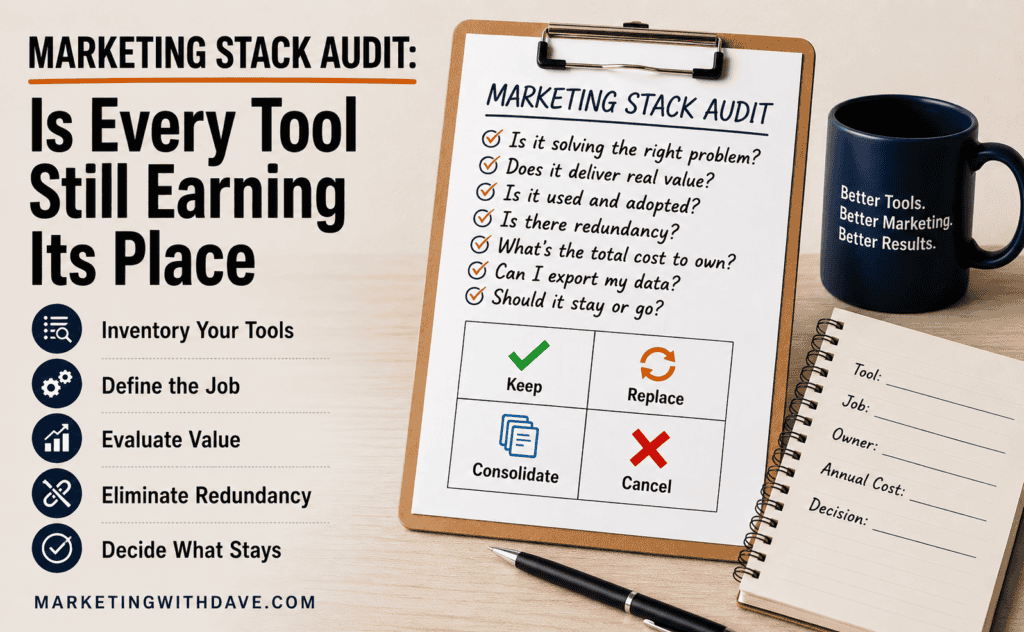
The Marketing Stack Audit Framework
Before we start inventorying software, I want to share one mindset shift that completely changed how I evaluate marketing tools.
When I first started buying marketing software, I usually asked one question: Can this tool do what I need? The answer was almost always yes. Most marketing platforms solve a real problem, which is exactly why it’s so easy to accumulate subscriptions over time.
Today I ask a different question:
Does this tool deserve a permanent place in my business?
That’s a much harder question to answer, and it’s the question that drives every decision in this article.
A tool doesn’t earn its place because it has hundreds of features or because everyone on LinkedIn is recommending it. It earns its place because it consistently performs the job you hired it to do, integrates well with the rest of your marketing stack, and delivers enough value to justify the cost and complexity it adds. Whether you use one feature or one hundred is largely irrelevant if it continues to solve the problem you bought it to solve.
That’s the framework we’ll use throughout this audit.
1. Inventory Every Marketing Tool You Own
You can’t make good decisions if you don’t know what you actually own.
Start by creating a complete inventory of every marketing tool your business uses. Don’t stop at the obvious subscriptions like your CRM or SEO platform. Include AI tools, browser extensions, WordPress plugins, reporting dashboards, design software, accessibility tools, form builders, social media platforms, screenshot tools, and anything else that supports your marketing efforts.
For each tool, capture the information you’ll actually need to make a decision later:
- Monthly or annual cost
- Renewal date
- Contract length
- Primary owner
- Number of users
- Primary job it was hired to do
- Key integrations
- Export options or API availability
Don’t ignore free tools. They often create the same challenges as paid software by introducing another place where data lives, another workflow to manage, or another process that depends on a single person knowing how it works.
By the time you’ve finished this inventory, you’ll probably notice two things. First, your marketing stack is larger than you thought. Second, you’ll already start spotting subscriptions that deserve a closer look.
2. Define the Job You Hired Each Tool to Do
Once your inventory is complete, resist the temptation to compare feature lists.
Instead, define the specific job you hired each tool to do.
This is one of the biggest mindset shifts I’ve made over the past few years. I don’t care whether a platform has 20 features or 200. I care whether it consistently solves the problem I bought it to solve.
For example, I might use one SEO platform almost exclusively for rank tracking, another for technical audits, and an AI tool primarily for brainstorming article ideas. Am I using every feature they offer? Not even close. But each one performs an important job well enough that it continues to earn its place.
That’s a much healthier way to evaluate software than asking whether you’re getting your money’s worth by using every feature. Most businesses never become power users of every platform they own, and they don’t need to. The goal isn’t to maximize feature usage. It’s to maximize business value.
The software is the tool. You should not become its tool.
If you find yourself changing your strategy simply because a platform encourages you to use more of its features, it’s worth asking whether you’re still directing the software or whether the software has started directing you.
3. Evaluate Value Before You Evaluate Usage
One of the biggest mistakes I see during software audits is assuming that heavily used software must be valuable and rarely used software must be expendable.
That’s not always true.
Some marketing tools only need to do one thing exceptionally well to justify their cost. Your analytics platform may only be reviewed during monthly reporting. An accessibility scanner might only be used before publishing new content. Backup software hopefully spends most of its life doing nothing at all.
Frequency of use doesn’t always equal business value.
Instead, evaluate each tool by asking a few simple questions:
- Does it solve an important problem?
- Does it save meaningful time?
- Does it improve marketing performance or decision-making?
- Does it replace another tool or manual process?
- Would the business be noticeably worse without it?
If the answer to several of those questions is yes, the software is probably earning its place, regardless of how often someone logs into it.
On the other hand, be careful not to confuse potential value with actual value.
Almost every software platform promises to save time, improve productivity, or automate repetitive work. Those benefits only matter if your team consistently uses them. Buying software doesn’t create value. Using it effectively does.
One question has become my favorite litmus test during software audits:
If I didn’t already own this software, would I buy it again today?
That question eliminates sunk-cost bias surprisingly quickly.
You’re no longer defending a purchase you made six months ago. You’re evaluating whether that software still deserves your investment based on what you know today.
4. Look for Redundancy, Not Similarity
Once you’ve identified the value each tool provides, the next step is looking for overlap.
Notice I didn’t say similarity.
Most marketing stacks contain software with overlapping features. That’s perfectly normal.
For example, many SEO platforms include site audits, keyword research, rank tracking, backlink analysis, and AI writing features. Most AI assistants can brainstorm ideas, summarize content, and help draft copy.
Feature overlap isn’t the problem.
Redundant outcomes are.
If two tools consistently perform the same job equally well, you probably don’t need both. If each one contributes unique insights or capabilities that improve your marketing, keeping both may be the right decision.
This is where defining the “job” for each tool becomes so valuable. You’re no longer comparing feature lists. You’re comparing outcomes.
One tool might be responsible for technical SEO audits. Another might be your trusted source for competitive research. A third might excel at AI visibility reporting. On paper they overlap. In practice they perform very different jobs.
Don’t ask whether two tools are similar.
Ask whether they’re both earning their place.
That’s a much more useful question.
5. Decide What Stays and What Goes
By this point, you’ve inventoried your marketing stack, defined the job each tool performs, evaluated the value it creates, and identified areas of unnecessary overlap.
Now it’s time to make decisions.
I like to place every tool into one of four categories.
Keep
These are the easy decisions.
The tool performs an important job, consistently creates value, integrates well with the rest of your stack, and continues to justify its cost. Don’t overthink these. Every healthy marketing stack should include software that’s proven its value over time.
Replace
Sometimes a tool still solves an important problem, but a better solution has become available.
Maybe another platform has matured, pricing has changed, or one product now combines features that previously required two separate subscriptions. Replacing software isn’t about chasing the newest shiny object. It’s about recognizing when a better long-term option exists.
Before making the switch, make sure you understand how you’ll migrate your data, update your workflows, and train anyone who depends on the platform.
Consolidate
Consolidation is different from replacement.
Instead of swapping one tool for another, you’re reducing unnecessary complexity by allowing one platform to perform work that currently requires two or three.
For example, if your SEO platform now includes AI visibility tracking that previously required a separate subscription, consolidating those capabilities might reduce costs while simplifying your workflow.
The goal isn’t to own fewer tools.
The goal is to eliminate unnecessary complexity.
Cancel
This is usually the smallest category.
A tool belongs here when it no longer solves an important problem, duplicates capabilities you already have, or simply isn’t delivering enough value to justify the ongoing investment.
Before canceling anything, confirm that you’ve exported any data you want to keep, documented important workflows, and identified any downstream processes that depend on that software.
One of the most expensive mistakes you can make is canceling a subscription only to discover six months later that it contained historical data you can no longer recover.
Protect Your Data Before You Cancel Anything
One lesson I’ve learned over the years is that most buyers spend far more time thinking about how to get data into a new platform than how to get it back out.
Every software company makes importing data look easy. That’s part of the onboarding experience.
Exporting your data is often a very different story.
Before canceling any marketing tool, make sure you understand:
- What data can be exported.
- Whether exports are complete or limited.
- If an API is available.
- Which integrations stop working after cancellation.
- Whether historical data remains accessible.
I’ve become much more cautious about software that treats my business data as if it belongs to them instead of me.
Never let your marketing data become a hostage to someone else’s software.
A good marketing platform should make it easy to join.
It should also make it possible to leave.
Don’t wait until you’ve decided to cancel before testing an export. Verify that your data is complete, usable, and in a format you can actually migrate. An export feature that produces unusable data isn’t much of an exit strategy.
6. Before You Buy Another Marketing Tool
A marketing stack audit shouldn’t be something you do only when budgets get tight or subscriptions become overwhelming. The real value is changing how you evaluate software before it ever becomes part of your stack.
When I’m considering a new marketing tool, these are the questions I ask before I decide to buy.
- What specific problem am I trying to solve?
- What job am I hiring this software to do?
- Does something I already own solve that problem well enough?
- Will this replace an existing tool or simply add another subscription?
- Will it integrate with the rest of my marketing stack?
- Can I export my data if I decide to leave?
- Does it offer an API or other integration options if my needs grow?
- Who else will this affect? Will sales, finance, IT, or another team eventually need to support, integrate with, or use this platform?
- What’s the real cost of ownership? Consider implementation, training, maintenance, data migration, and the time required for your team to become proficient, not just the monthly subscription.
- Would I still buy this tool a year from now if I knew what I know today?
No checklist will guarantee you’ll make the right decision every time, but asking better questions dramatically improves the odds.
I’ve also become much more skeptical of feature checklists. Most software companies compete by adding capabilities, but more features don’t automatically create more value. In many cases, they simply create more complexity.
Every new tool should either replace an existing tool or solve a problem nothing in your current stack can solve. If it doesn’t do one of those two things, it’s probably adding more complexity than value.
The Hidden Costs of Marketing Software
The subscription is only one part of the investment. The time, complexity, and organizational change required to successfully use the software are often much more significant.
One mistake I see businesses make is comparing software based almost entirely on subscription price. That’s certainly part of the equation, but it’s rarely the biggest cost.
Every new platform comes with hidden costs that don’t appear on the pricing page. Someone has to evaluate the software, implement it, migrate data, learn how it works, document new processes, train the rest of the team, maintain integrations, and support it over time. As organizations grow, those costs multiply with every additional person who needs to become proficient with the platform.
I’ve seen organizations where software adoption looked like a success because everyone was using the tool. In reality, the software encouraged teams to bypass established processes, create duplicate content, or work outside existing governance. High usage isn’t always a sign that a tool is creating value. Sometimes it’s simply creating a different kind of problem.
That’s why I try to evaluate the total cost of owning a piece of software, not just the monthly subscription. A tool that costs twice as much may actually be the less expensive option if it replaces multiple platforms, reduces manual work, and requires less ongoing maintenance. Likewise, an inexpensive tool can become surprisingly expensive if it creates extra work or never gains meaningful adoption.
When you’re evaluating software, don’t just ask what it costs.
The subscription tells you what the software costs. Your team tells you what it costs to own.
The subscription is only one part of the investment. The time, complexity, training, and organizational change required to successfully use the software are often much more significant.
Building a Better Marketing Stack
Completing a marketing stack audit isn’t the finish line. It’s an opportunity to rethink how you evaluate software going forward. Every new tool you buy either strengthens your marketing stack or makes the next audit more difficult.
Over the years, I’ve settled on a handful of principles that help me make better software decisions.
Solve problems, not curiosity. It’s easy to get excited about a new platform because it has innovative features or glowing reviews. Before you buy anything, identify the specific problem you’re trying to solve. If you can’t clearly define the problem, you’re probably buying software because it’s interesting rather than necessary.
Choose software that works well with the rest of your stack. The best product isn’t always the one with the longest feature list. It’s often the one that fits naturally into your existing workflow. Good integrations reduce manual work, improve data quality, and make your entire stack more valuable.
Think beyond today’s requirements. When evaluating software, consider where your business will be in two or three years. Will the platform still meet your needs? Can you export your data? Does it provide an API if you need one? Can it grow with your business without forcing you into an expensive migration?
Review your stack before renewal dates. Annual renewals have a way of sneaking up on you. Schedule time to evaluate your software a month or two before major renewals so you can make thoughtful decisions instead of rushed ones.
Ultimately, a great marketing stack isn’t measured by the number of tools you own or the number of features you use. It’s measured by how effectively those tools help you accomplish your marketing goals. The best software quietly supports your strategy, integrates with the rest of your business, and stays out of your way. If you find yourself spending more time managing software than marketing, it’s probably time for another audit.
One mistake I see businesses make is comparing software based almost entirely on subscription price. That’s certainly part of the equation, but it’s rarely the biggest cost.
Every new platform comes with hidden costs that don’t appear on the pricing page. Someone has to evaluate the software, implement it, migrate data, learn how it works, document new processes, train the rest of the team, maintain integrations, and support it over time. As organizations grow, those costs multiply with every additional person who needs to become proficient with the platform.
Those costs often extend well beyond the marketing team. A new platform may require IT to review security, finance to approve the budget, procurement to negotiate contracts, or sales to change existing workflows. The more people a tool touches, the more important it becomes to involve those stakeholders early in the evaluation process rather than after the purchase has already been made.
That’s why I try to evaluate the total cost of owning a piece of software, not just the monthly subscription. A tool that costs twice as much may actually be the less expensive option if it replaces multiple platforms, reduces manual work, and requires less ongoing maintenance. Likewise, an inexpensive tool can become surprisingly costly if it creates additional work, never gains meaningful adoption, or simply shifts the burden somewhere else in the business.
I typically review my marketing stack at least once a year and again before any significant renewal dates. That small investment of time has saved me far more than it takes to complete the audit.
Marketing Stack Audit FAQs
How often should I audit my marketing stack?
I recommend auditing your marketing stack at least once a year and again before major software renewals. If you are actively adding new AI tools or marketing software throughout the year, consider reviewing it quarterly to identify overlap before it becomes expensive.
How do I know whether two marketing tools are truly redundant?
Do not compare feature lists. Compare outcomes.
Two platforms can offer similar features while solving completely different business problems. If each tool consistently performs a unique job that creates measurable value, keeping both may be justified. If they produce the same outcome, it is probably time to consolidate.
Why are APIs and data export options important when evaluating marketing software?
APIs and export options determine how easily a tool fits into your marketing stack today and how easily you can leave it tomorrow. Many buyers focus on getting data into a platform but never ask how they will get it back out.
Before committing to any marketing tool, make sure you understand what data can be exported, whether the export is complete and usable, whether an API is available, and how difficult migration will be if your needs change.
Should I cancel software I do not use often?
Not necessarily.
Some of the most valuable marketing tools are only used periodically, such as analytics platforms, accessibility testing software, or backup systems. Instead of measuring usage frequency, evaluate whether the software performs an important job that would be difficult or costly to replace.
Should free tools be included in a marketing stack audit?
Yes. Free tools can still create workflows, store business data, introduce security considerations, and create reporting silos. Every tool deserves evaluation, whether you pay for it or not.
What should I check before canceling a marketing tool?
Before canceling any software, confirm that you can export your data, understand what historical information will be lost, identify any integrations that will stop working, and verify that another tool or process can perform the same job.
What should I look for before buying another marketing tool?
Start by asking what specific problem you are trying to solve. Then determine whether something you already own can solve that problem, whether the new software integrates with your existing stack, whether your data can be exported, and what the total cost of ownership will be over time.
Is owning fewer marketing tools always better?
No. The goal is not to own the fewest tools possible. It is to own the right tools. A specialized platform that consistently performs an important job may be far more valuable than replacing it with an all-in-one solution that does everything adequately but nothing exceptionally well.