
5 Reasons Why You Want to Customize Your Ad Schedule
Although my example will focus on Google Ads, most paid advertising platforms offer an Ad Schedule feature, often defaulting to running your campaigns 24/7. While running ads continuously may seem logical, strategically segmenting your Ad Schedule is a best practice that can significantly enhance your campaign’s efficiency and effectiveness.
How to Find and Adjust Your Ad Schedule in Google Ads
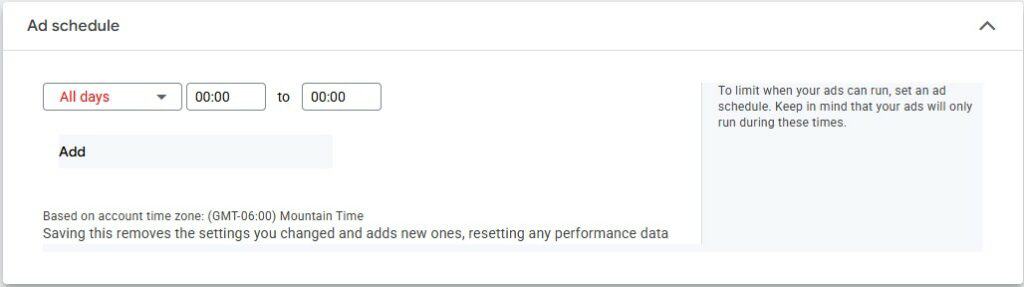
With Google Ads, during the campaign creation process, in Campaign settings, scroll to the bottom where there is a section titled More settings. Click on that to expand those options, and you will see your Ad schedule – not exactly designed so you don’t miss this.
Benefits of a Segmented Ad Schedule
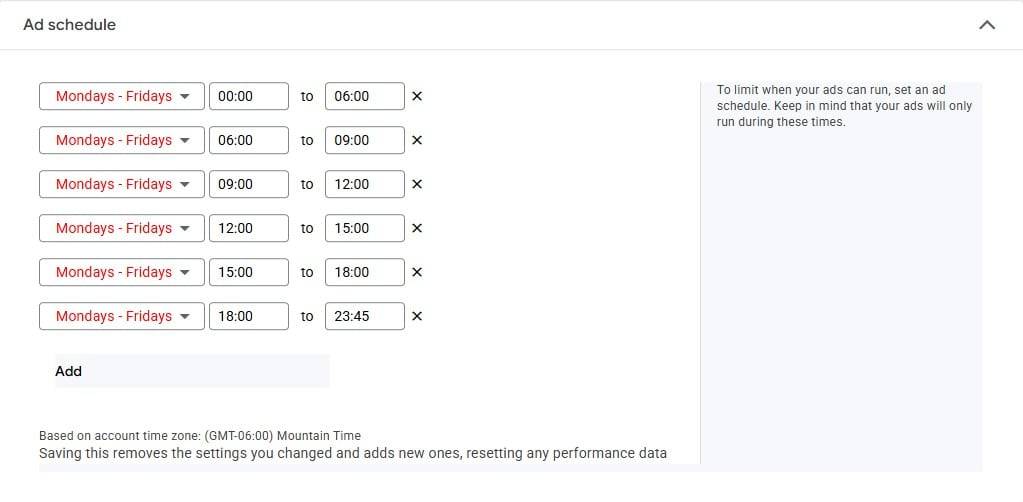
My recommended ad schedule runs Monday through Friday, segmented into six time blocks, ensuring better control over budget allocation and performance analysis. This setup prevents overspending in low-converting hours (like midnight resets), enables bid adjustments for peak traffic periods, and makes it easier to analyze trends across different times of the day.
1. Identify Positive and Negative Trends
Breaking your Ad Schedule into smaller time slots makes it easier to detect patterns in performance.
- Negative Trend Example: You might notice that a significant portion of your daily budget is consumed between 12:00 AM and 1:00 AM, with minimal conversions. This may indicate the platform abusing your budget since your daily budget will start fresh after midnight.
- Positive Trend Example: You may find that weekends generate fewer conversions, but the cost per conversion is significantly lower, making it justifiable to continue running ads on weekends with adjusted bidding strategies.
2. Overlay Key Metrics for Analysis
Segmenting your Ad Schedule allows you to analyze key performance indicators (KPIs) like impressions, clicks, conversions, and cost per click (CPC) during specific time frames.
3. Consider Audience Time Zones and Behavior
Your Google Ads account is set to a specific time zone, but your audience may be distributed across different regions.
- If your account is configured in Pacific Time (California) but a large portion of your traffic comes from the East Coast (New York) or the United Kingdom, this will impact how you interpret ad performance.
- Running ads 24/7 might not be necessary if most of your engagement comes from a specific region and time window.
4. Leverage Bid Adjustments
With a segmented Ad Schedule, you can apply bid adjustments to optimize ad spend for peak traffic times.
- If Monday mornings generate the highest traffic and conversions, you can increase bids to capture more high-value clicks.
- Conversely, if evenings show high spend but low conversions, you can reduce bids or turn off ads during that period.
5. Reduce Ad Fatigue and Improve Budget Allocation
By strategically running ads only during high-performance windows, you can:
- Prevent ad overexposure.
- Ensure your budget is spent on the most effective time slots.
- Test different creative variations during different segments to keep engagement high.
Final Thoughts
Customizing your Ad Schedule is a powerful way to optimize campaign performance, reduce wasted ad spend, and better understand audience behavior. Start by testing weekdays vs. weekends, analyzing key metrics, and leveraging bid adjustments to maximize your ad budget. Over time, fine-tune your schedule based on data insights to continuously improve results.
Are you currently running a 24/7 ad schedule? Try segmenting your schedule and share your results!
5 Reasons Why You Want to Customize Your Ad Schedule Read More »