Advertising

case study target pregnant personalization 1

Case Study: Target’s Personalization Strategy That Went Too Far

Reading Time: 3 minutes

Brief Summary

In 2012, Target used predictive analytics to assign a “pregnancy prediction score” to customers based on their purchasing behavior. The algorithm identified a teenage girl’s pregnancy, prompting her father to complain after she received baby-related coupons.

Target later admitted to interspersing baby offers among general household ads to reduce creepiness, but the incident sparked a national outcry over privacy and personalization.

Company Involved

Target Corporation

Marketing Topic

  • Personalization
  • Data-driven strategy
  • Customer experience
  • Data ethics

Public Reaction or Consequences

  • A widely reported anecdote of a father complaining when baby coupons were delivered to his pregnant teen daughter.
  • Public backlash over ethical implications of inferring personal life events without consent.
  • Coverage in *NYT*, *Forbes*, *Time*, *Slate*.
  • Conversations about customer privacy, transparency, and the adequacy of TOS.

Why It Matters Today

Highlights the tension between hyper-personalization and consumer trust. Serves as a caution for AI-driven lifecycle targeting which is still a privacy concern in a GDPR/CCPA era. Teaches modern marketers about ethical context and consent in data activation.

3 Takeaways

  • Personalization must respect boundaries. Accurate predictions can feel invasive without permission.
  • Transparency is essential. Disclose data usage to maintain trust.
  • Use camouflage sparingly. Mixing targeted and non-targeted content reduces perceived intrusion, but consent trumps camouflage.

Notable Quotes and Data

  • “Target calculated the girl was pregnant by combining data from individual purchases across approximately 25 product categories.”
  • “Target then began interlacing baby product coupons … with coupons for lawn mowers and other random items to avoid the perception that they are spying on their customers.”

Full Case Narrative

In early 2010, Target data scientist Andrew Pole developed a predictive model using baby registry data and purchase histories of products like unscented lotion, calcium, zinc, and magnesium. The goal: detect pregnancy early when purchasing needs change. By assigning each customer a “pregnancy prediction score,” Target could send relevant coupons precisely when the timing aligned with early and mid-pregnancy.

A few years later, journalist Charles Duhigg’s *New York Times Magazine* article detailed an incident where a father discovered his teen daughter’s pregnancy because she received maternity coupons. This narrative went viral under headlines like “How Target Figured Out a Teen Girl Was Pregnant Before Her Father Did.”

After the uproar, Target defended the program, emphasizing that coupon mailers included other products to camouflage sensitive targeting. But the backlash ignited serious debate over privacy, lifespan targeting, and whether TOS consent was sufficient.

Today, marketers view the case as a turning point—an early wake-up call about where personalization meets privacy boundaries.

Timeline

  • 2010: Andrew Pole rolls out pregnancy-prediction model using purchase data from baby registry customers.
  • February 2012: *NYT Magazine* publishes Duhigg’s article; anecdote of teen pregnancy becomes national headline.
  • 2012–2013: Target adds mixed-content mailers to reduce creepiness.
  • Post-2012: Public-private dialogue catalyzes privacy frameworks and regulations.

What Happened Next?

Target continued to refine its analytics with attention to perception, adding unrelated offers to avoid being intrusive. The incident helped spark consumer data bills and frameworks. Predictive personalization persists today, now backed by opt-ins, disclosures, and ethical guardrails.

One Sentence Takeaway

Even the smartest personalization can backfire without transparent consent and respect for customer boundaries.

Sources and Citations

Charles Duhigg, How Companies Learn Your Secrets , New York Times Magazine, February 16, 2012.

Kashmir Hill, How Target Figured Out a Teen Girl Was Pregnant Before Her Father Did , Forbes, February 16, 2012.

Gregory Piatetsky, How Companies Learn Your Secrets , KDnuggets, February 2012.

AIAAIC Incident Repository, Target predicts teen girl pregnancy , AIAAIC, February 2012.

Time, How Target Knew a High School Girl Was Pregnant Before Her Parents Did , Time, February 17, 2012.

Drive Research, How Target Used Data Analytics to Predict Pregnancies , January 8, 2023.

Wikipedia, Target Corporation – Consumer data usage , accessed June 2025.

Case Study: Target’s Personalization Strategy That Went Too Far Read More »
self publishing with amazon ads

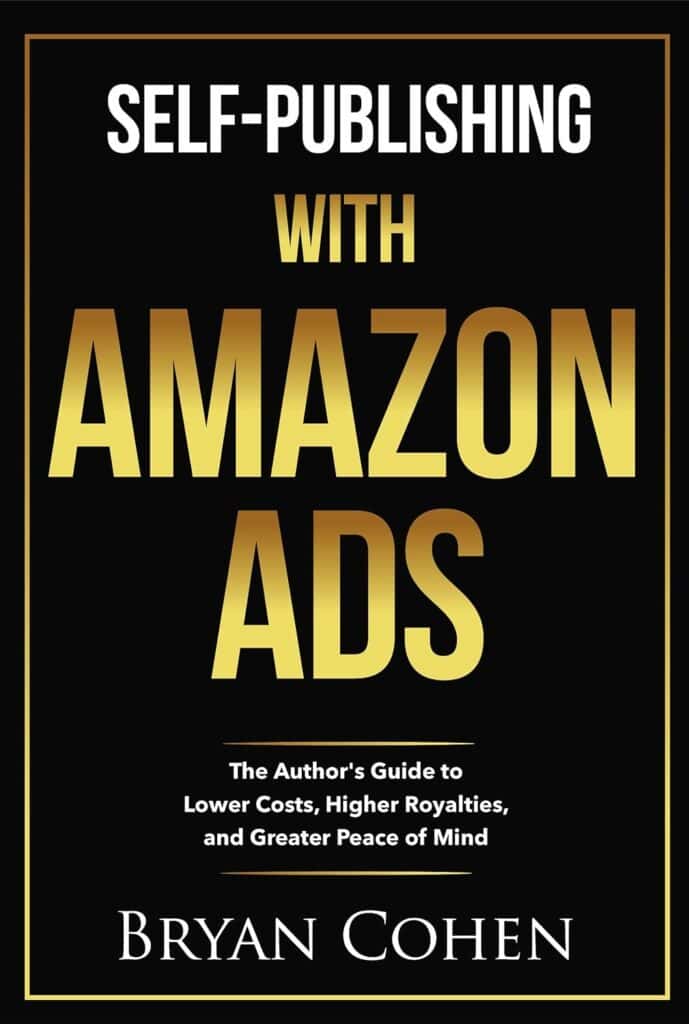
Self-Publishing With Amazon Ads by Bryan Cohen Book Summary

Reading Time: 3 minutes

Top Three Quotes

  1. “Amazon ads can help any author grow with incremental improvements. And those small changes make big opportunities for the future.”
  2. “You can’t pay your car loan with a low ACoS, but you can pay it down with higher monthly profit.”
  3. “If you want something to last that long, then you don’t want to rush it.”

Book Theme

Self-Publishing With Amazon Ads is a hands-on, realistic guide for self-published authors to use Amazon Ads strategically to build long-term royalties, develop profitable advertising campaigns, and regain control of their author career.

Why You Should Read This Book

If you’re a self-published author frustrated with marketing methods that drain your time or money, Bryan Cohen’s approach offers sustainable, low-cost, repeatable strategies. This book focuses on mindset, profitability, and the importance of patience in building ad success, making it invaluable for anyone serious about long-term book sales on Amazon.

Key Ideas and Arguments Presented

  • Amazon ads are not a get-rich-quick tactic, but a long-term investment strategy.
  • Lower ad bids often lead to greater profitability than high bids.
  • Success with Amazon ads depends on consistent practice, not one-time hacks.
  • Understanding and targeting relevant keywords is critical for ad visibility and conversion.
  • Sales reporting in the Amazon ad dashboard can be misleading—track royalties and profit separately.
  • Authors must regularly monitor and optimize ad performance rather than set-and-forget.
  • Running ads leads to organic boosts like increased Amazon visibility and recommendations.
  • Learning your genre deeply is essential for ad targeting success.
  • Patience and a test-and-learn mindset are crucial for ad growth.
  • The author provides formulas and benchmarks to determine profitable ad bidding and expected outcomes.

Book Outline

  • Introduction
  • Chapter 1: Why Is It Worth Trying One More Book Marketing Thing?
  • Chapter 2: What Kind of Time Do I Need to Invest in Amazon Ads?
  • Chapter 3: How Do I Set Up Amazon Ads for Maximum Profit?
  • Chapter 4: How Do I Know If My Ads Are Working?
  • Chapters 5–12: Advanced strategies, keyword research, ad dashboard use, genre-based targeting, and more.
  • Epilogue
  • About the Author

Key Takeaways

  • Start slow and aim for profitability over visibility.
  • Target relevant readers rather than broad categories.
  • Use low bids (e.g., $0.39 for series starters and $0.34 for single books) to improve profit margins.
  • Track performance with the KDP dashboard rather than relying only on ad data.
  • Set aside weekly time for keyword research, ad creation, and optimization.
  • Focus your ad spend on your most profitable book first.
  • Relevancy and genre alignment significantly reduce costs.

Key Techniques

  • The Split Screen Method: Compare Amazon Ad Dashboard with KDP Reports for true profit tracking.
  • Low-Bid Strategy: Bid low (under $0.39) to maintain profitability and control costs.
  • Relevancy Targeting: Choose only hyper-relevant books and keywords to train the algorithm.
  • Weekly System: Research keywords, create 5–10 ads weekly, then analyze metrics in 15-minute sessions.

Author’s Qualifications

Bryan Cohen is a bestselling author, founder of Best Page Forward, and host of The Sell More Books Show. He has run Amazon ad workshops for over 30,000 authors and helped many reach over $10K/month in royalties.

Comparison to Similar Books

Compared to other books on Amazon Ads, Cohen’s book is practical, humble, and focused on low-budget long-term growth. It avoids hyped-up promises and emphasizes consistency and mindset, unlike many ad-centric books that push high-risk bidding or short-term tactics.

Target Audience

  • Self-published authors at any stage
  • Writers with limited marketing budgets
  • Authors struggling to understand Amazon Ads
  • Writers ready to commit to long-term growth
  • Authors who’ve tried other ad platforms without success
  • Genre fiction and nonfiction authors looking to scale
  • Those in KDP Select or Kindle Unlimited programs

Critical Response to the Book

The book was well-received, particularly in the indie author community. It was crowdfunded by over 600 authors via Kickstarter, and praised for being honest, approachable, and results-driven. The mix of narrative and instruction keeps it engaging and motivational.

One Sentence Takeaway

Amazon Ads, when used with strategy, low bids, and patience, can transform a self-published author’s career from stagnant to profitable.

Self-Publishing With Amazon Ads by Bryan Cohen Book Summary Read More »

your first amazon ads campaign sponsored product auto targeting

Your First Amazon Ads Campaign: Sponsored Product Auto Targeting

Reading Time: 3 minutes

If you’ve used Google Ads, Facebook, or other advertising platforms, you may find Amazon Ads surprisingly simple. The interface lacks a lot of bells and whistles, and that’s part of the appeal. Even so, some guidance is needed to ensure your first campaign launch is successful.

The first campaign you’ll want to launch is also the easiest: the Sponsored Product Automatic campaign. As the name implies, you’ll be promoting a product (not a brand), and the targeting will be handled automatically by Amazon’s machine learning system.

Step-by-Step Setup

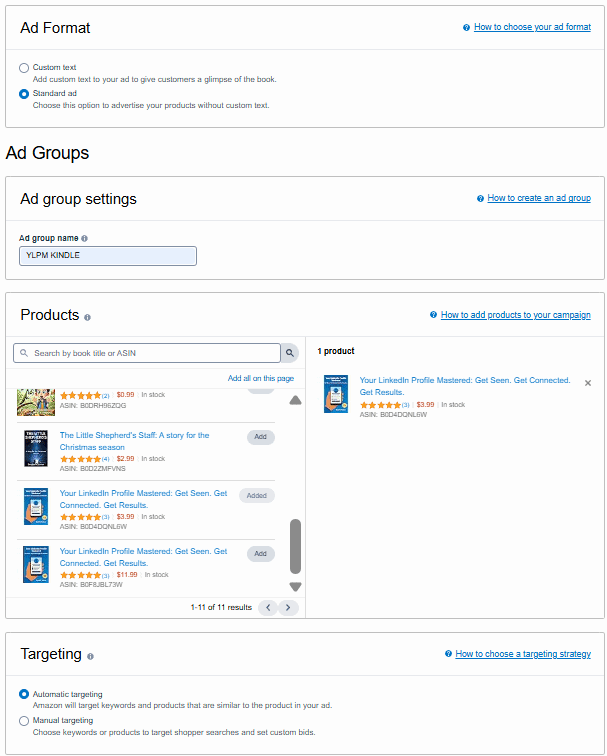
  1. Login to advertising.amazon.com and click Create campaign. Select the Sponsored Products option and click Continue.
  2. Ad Format
    • Select the Standard Ad radio button.
  3. Ad Group
    • Think through your naming convention. A clear and consistent naming strategy will help with reporting and scaling.
    • For example, I used YLPM KINDLE for my book, Your LinkedIn Profile Mastered. You could also use something like ylpm-k.
  4. Products
    • Add a single product. If your book is a book and available in Kindle and paperback formats, choose just one for this campaign.
  5. Targeting
    • Select Automatic targeting.
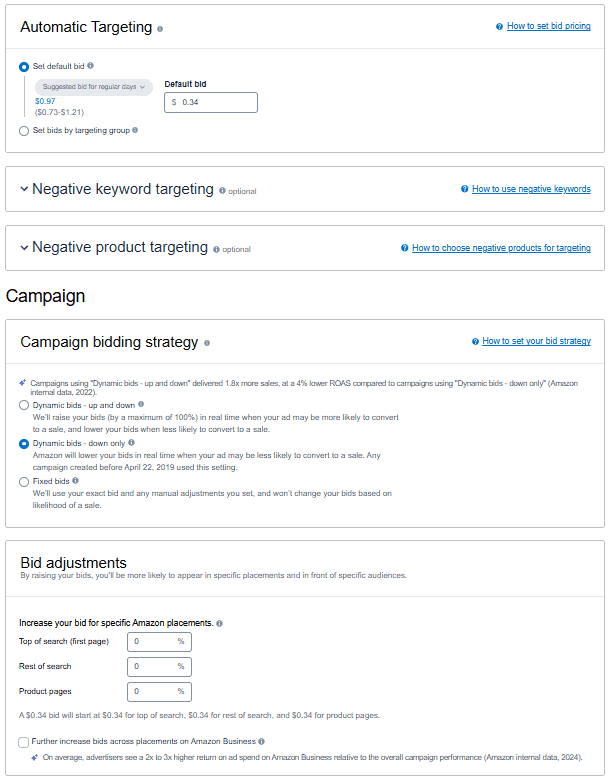
  6. Automatic Targeting Bids
    • Change the default bid to $0.34 for a single book or $0.39 for a book series. This is a tested recommendation from author and Amazon Ads expert Bryan Cohen.
  7. Negative Keyword/Product Targeting
    • Skip this section for now. This becomes more useful in manual campaigns or after reviewing performance data.
  8. Campaign Bidding Strategy
    • Select Dynamic bids – down only.
  9. Bid Adjustments
    • Skip this section for your first campaign.
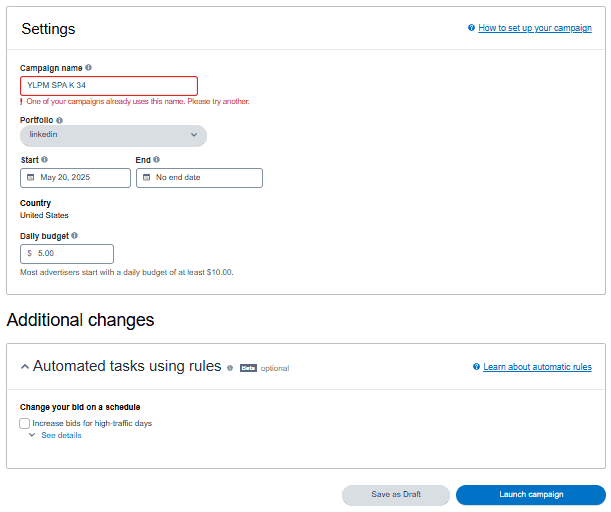
  10. Campaign Settings
    • Name your campaign in a way that makes tracking easy. For example: YLPM SPA K 34
    • Here’s a breakdown of that naming convention:
      • YLPM – product name: Your LinkedIn Profile Mastered
      • SPA – Sponsored Product Auto
      • K – Kindle (use P for Paperback)
      • 34 – your bid amount
    • Use Portfolios to group similar campaigns for better reporting. This can be set up after the campaign is live.
    • You can leave the end date blank. Amazon Ads lets you pause or stop campaigns at any time.
    • Enter $5.00 for the Daily budget. You’ll likely spend much less than this, and it may take several days or even weeks before any spending begins as the campaign ramps up.
  11. Additional Settings
    • Skip this section for now.
  12. Review all your settings, then click Launch campaign.

Best Practices & Final Tips

  • Be patient. Do not make any edits to this campaign for at least 30 days.
  • It’s common to need 1,000–2,000 impressions before you start seeing meaningful click data.
  • Track everything in a spreadsheet — minus metrics, here is an example of the columns I am tracking.
  • Monitor your campaign regularly, but avoid reacting until you have 100 clicks.

Visual Walkthrough: Campaign Setup Screens

Below are screenshots of the full ad creation window, showing the settings as they appear throughout the process. Use these to double-check your selections and get a feel for the full layout before launching your campaign.

Conclusion

And that’s it — your first Amazon Ads campaign is live! While automatic targeting is simple to set up, it’s also incredibly valuable for collecting keyword data and gaining insights into what actually converts. Resist the urge to tweak too early. Slow and steady wins this race.

Your First Amazon Ads Campaign: Sponsored Product Auto Targeting Read More »

breakthrough advertising

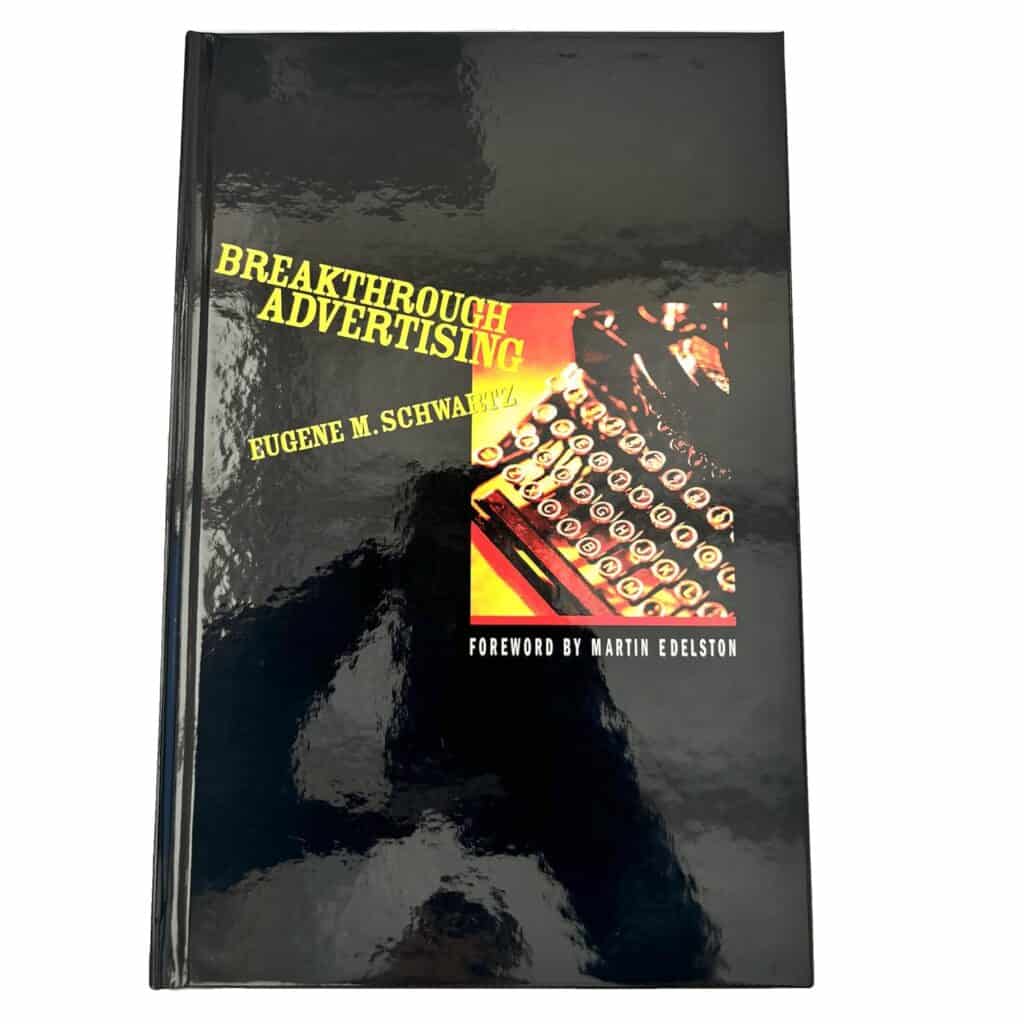
Breakthrough Advertising by Eugene Schwartz Book Summary

Reading Time: 3 minutes

Top Three Quotes

  • “Copy cannot create desire for a product. It can only take the hopes, dreams, fears, and desires that already exist in the hearts of millions of people, and focus those already existing desires onto a particular product.”
  • “The greatest mistake marketers make is trying to create demand.”
  • “Your ad always begins with your market, and leads that market into your product.”

Book Theme

Breakthrough Advertising (not financially feasible to buy currently) centers on understanding and channeling existing consumer desires rather than attempting to create new ones. Schwartz emphasizes that successful advertising identifies the stage of awareness of the target audience and crafts messages that resonate with their existing desires and knowledge.

Why You Should Read This Book

This book is essential for marketers, copywriters, and business owners who seek to deepen their understanding of consumer psychology and enhance their advertising effectiveness. Schwartz provides a framework for identifying consumer desires and tailoring messages that align with their awareness levels, making it a timeless resource for crafting compelling advertisements.

Key Ideas and Arguments Presented

  • Mass Desire: Advertising should tap into existing mass desires rather than attempting to create new ones.
  • Stages of Awareness: Consumers exist in different stages of awareness about a product, ranging from unaware to fully aware. Effective advertising tailors messages to these stages.
  • Stages of Sophistication: Markets evolve, and so should advertising strategies. As markets become more sophisticated, advertisers must find new ways to present their products.
  • Headline Importance: The headline is crucial in capturing attention and should reflect the consumer’s stage of awareness and sophistication.
  • Seven Techniques of Breakthrough Copy: Schwartz outlines techniques such as intensification, identification, gradualization, redefinition, mechanization, concentration, and camouflage to enhance advertising copy.
  • Product Positioning: Positioning a product effectively involves understanding the market’s desires and presenting the product as the solution.
  • Mechanism of Action: Explaining how a product works can enhance credibility and appeal.
  • Emotional Appeal: Advertisements should connect with consumers on an emotional level to drive action.
  • Proof and Credibility: Providing evidence, testimonials, and demonstrations can build trust and persuade consumers.
  • Call to Action: A clear and compelling call to action is essential to guide consumers toward the desired response.

Book Outline

While the exact chapter titles are not publicly available, the book is structured to guide readers through understanding consumer desires, stages of awareness and sophistication, crafting headlines, writing compelling copy, and positioning products effectively.

Key Takeaways

  • Successful advertising channels existing desires rather than creating new ones.
  • Understanding the consumer’s stage of awareness and market sophistication is crucial.
  • Crafting compelling headlines and copy that resonate with the target audience’s desires and awareness levels enhances effectiveness.

Key Techniques

  • Intensification: Amplify the consumer’s desire for the product.
  • Identification: Align the product with the consumer’s self-image or aspirations.
  • Gradualization: Build the argument step by step to lead the consumer toward the desired conclusion.
  • Redefinition: Present the product in a new light to differentiate it from competitors.
  • Mechanization: Explain how the product works to satisfy the consumer’s desire.
  • Concentration: Focus the message on a single, compelling idea.
  • Camouflage: Present the advertisement as informative content to engage the consumer.

Author’s Qualifications

Eugene M. Schwartz was a renowned copywriter and advertising executive known for his expertise in direct-response advertising. His work has influenced generations of marketers and copywriters, and “Breakthrough Advertising” is considered a seminal text in the field.

Comparison to Similar Books

  • “Scientific Advertising” by Claude Hopkins: Focuses on the scientific approach to advertising, emphasizing testing and measurement.
  • “Ogilvy on Advertising” by David Ogilvy: Provides insights into advertising principles and practices from an agency perspective.
  • “The Boron Letters” by Gary Halbert: Offers practical advice on copywriting and direct marketing through personal letters.

“Breakthrough Advertising” stands out for its deep psychological insights into consumer behavior and its strategic approach to crafting persuasive messages.

Target Audience

  • Copywriters seeking to enhance their persuasive writing skills.
  • Marketing professionals aiming to understand consumer psychology.
  • Business owners looking to improve their advertising effectiveness.
  • Entrepreneurs developing marketing strategies for new products.
  • Advertising students studying foundational texts in the field.
  • Digital marketers focusing on direct-response campaigns.
  • Brand strategists interested in positioning and messaging.

Critical Response to the Book

“Breakthrough Advertising” is widely regarded as a classic in the advertising and marketing industry. Despite being out of print for years, it has maintained its reputation for providing timeless insights into consumer behavior and advertising strategy. Many professionals consider it an essential read for anyone serious about marketing.

One Sentence Takeaway

Effective advertising doesn’t create desire; it identifies and channels existing desires by aligning messages with the consumer’s awareness and sophistication levels.

Breakthrough Advertising by Eugene Schwartz Book Summary Read More »

mrc guidelines for digital ad measurement what marketers need to know

MRC Guidelines for Digital Ad Measurement: What Marketers Need to Know

Reading Time: 2 minutes

The Media Rating Council (MRC) sets standards for how digital ad performance should be measured. Marketers should use MRC-aligned vendors and metrics to reduce waste and improve cross-platform comparisons. When marketers talk about impressions, viewability, or audience metrics, how do we know the data is accurate and trustworthy? That’s where the Media Rating Council (MRC) plays a crucial role.

Who Is the MRC?

The MRC is a nonprofit organization that establishes and audits standards for media measurement. Founded in the 1960s and now essential to digital advertising, it ensures consistency across platforms by accrediting vendors who follow its strict measurement standards.

Why MRC Guidelines Matter

Without a standard, platforms can define ad metrics however they want. This leads to inconsistent reporting, wasted spend, and a lack of trust in performance data.

Callout: Not All Impressions Are Equal

MRC defines a valid impression as one where the ad is actually rendered and viewable — but many social media platforms don’t follow this standard.
  • Facebook: May count an impression when the ad is delivered, not necessarily viewed.
  • LinkedIn: Counts impressions even if ads are loaded but instantly scrolled past.
  • X (Twitter): Registers an impression immediately as it appears in a feed.
These inconsistencies make it difficult to compare performance across platforms and show why MRC standards matter for honest, accurate measurement.

Core Areas of MRC Digital Marketing Guidelines

The table below summarizes key areas the MRC addresses and how those guidelines apply to digital marketing:

CategoryGuideline HighlightsMeasurement Standards
Display Ad ViewabilityDefines when a display ad is counted as viewable50% of pixels in view for 1 continuous second; 30% for large-format ads
Video Ad ViewabilityDefines valid video ad impressions50% of pixels in view for 2 continuous seconds; sound-on metrics encouraged
Invalid Traffic (IVT)Protects against bot and fraudulent activityGeneral IVT (bots) and Sophisticated IVT (fraud); requires human and automated detection
Audience MeasurementMeasures reach and frequency across channelsDeduplicated impressions, demographic accuracy, cross-device tracking
Cross-Media MeasurementAligns TV, digital, and other media metricsStandardized methodology, incremental reach, deduplication
Mobile & In-AppConsistency across mobile environmentsTransparent SDKs, accurate viewability in web and app environments
Social MediaStandardizes platform-reported metricsUniform definitions for impressions, video views, engagement
Video Ad MeasurementBeyond basic viewabilityTracks autoplay, user-initiated views, sound status, and completion rates
AccreditationAudits vendors for complianceOnly MRC-compliant vendors pass accreditation (e.g., Moat, IAS, DoubleVerify)

Conclusion: Why Marketers Should Care

Every dollar of ad spend deserves accountability. By aligning with MRC standards, marketers can cut through inflated metrics, eliminate waste, and confidently scale campaigns based on data that actually means something.

MRC Guidelines for Digital Ad Measurement: What Marketers Need to Know Read More »

google my ads center

You Can Control the Ads You See on Google — Here’s How

Reading Time: 2 minutes

Ever felt like the ads you see online are following you a little too closely? Or maybe you’re tired of seeing ads that are totally irrelevant (or worse — annoying)? The good news is: you actually have more control than you think.

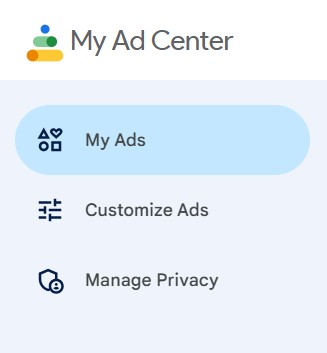
Google’s My Ad Center lets you take the driver’s seat when it comes to the types of ads you see across Google services like Search, YouTube, and Discover.

What You Can Customize

Once you’re in My Ad Center, you’ll find a simple dashboard where you can adjust your ad experience in a few powerful ways:

1. Topics and Brands

Want to see more ads about pets and fewer about jewelry? Prefer car ads over home furniture? You can fine-tune your ad preferences by choosing from categories like:

  • Pets & Animals
  • Social Networks & Online Communities
  • Jewelry
  • Women’s Clothing
  • Building Construction & Maintenance
  • TV Broadcasting
  • Music & Audio
  • Vehicle Dealers
  • Online Grocery Shopping & Grocery Delivery
  • Hotels, Motels & Resorts
  • Games
  • Real Estate
  • Food
  • Health Care Services
  • Internet Service Plans
  • Movies & Films
  • Restaurants
  • Clothing

2. Sensitive Topics

Don’t want to see ads related to more personal or triggering subjects? Google allows you to limit ads from showing on certain sensitive topics:

  • Alcohol
  • Dating
  • Gambling
  • Pregnancy & Parenting
  • Weight Loss

You can’t block them completely, but this setting significantly reduces their frequency.

3. Privacy and Data Controls

You can also manage what data Google uses to personalize ads:

  • Review what account info is being used
  • Control what types of activity Google tracks
  • See and adjust the demographic categories (like age and gender) associated with your account

Think of it like a dimmer switch for ad personalization — you’re not just on or off, you get to adjust.

Why It Matters

Whether you’re a digital marketer like me, or just a curious internet user, understanding how Google serves you ads gives you better awareness — and more control. It’s also a useful tool to teach clients or audiences who may not know they have these options.

At the end of the day, ads aren’t going away. But with My Ad Center, they don’t have to be intrusive or irrelevant.

You Can Control the Ads You See on Google — Here’s How Read More »