Data Driven David

hustle hustle boom

Three Steps to Writing Your Own Marketing Book or… Double H Boom

Reading Time: 3 minutes

Reader Beware: Any blog post tagged as “Data Driven David” may not be as related to marketing as most of my content. I truly love data and love it even more when it is well visualized and wrapped in a great story — now, that’s good marketing.

Before we begin, a quick disclaimer: If you came here expecting actionable value like most of my content, brace yourself—this one leans more on the satirical side (but who knows, you still might walk away with a book idea).

I hit a fairly significant nerd achievement in 2024. I read my one-thousandth book. I can hear my oldest daughter’s voice in my head now saying, “Those don’t count.” So, let me add an asterisk—most of them were audiobooks. Hopefully, you don’t think less of me now.

Most of these books have been marketing or business books. If the title includes the words “analytics,” “data,” or “metric” … here’s my credit card.

I’ve read—or listened to—enough of these books that I’ve cracked the code. I’ve thought about this for too long and it’s time that the secret be unleashed. I’m going to share with you the three-step recipe for writing your own marketing book.

Yep, in just three steps.

Step #1: Find a Clever-Sounding Word or Phrase

This is the foundation of your book. A single word or short phrase that sounds profound and slightly mysterious. A few examples from existing titles:

  • Grit
  • Slight Edge
  • Atomic Habits
  • Radical Candor

Twenty-second time-out. Although you might think I’m taking a jab at these books, I enjoyed each of them. Just using them as examples.

Okay, time back in.

No reason to make this harder than it needs to be. I asked ChatGPT for some ideas, and here’s what it came up with:

  • Bare Minimum Magic – For those who like to do just enough and still make it work.
  • Almost Hustle – Like full hustle, but with built-in nap breaks.
  • Hustle Hustle Boom – Wow. We have a winner.

It’s got everything—repetition for emphasis, action-packed energy, and an ending that makes it sound like something truly revolutionary (or a wrestling move).

Step #2: Find Some Marketing Case Studies

Now that we have our magic phrase, the next step is to find case studies that “prove” it’s the reason for success. Because when you control the narrative, everything conveniently aligns.

Let’s look at a popular marketing case study:

Clayton Christensen, one of my marketing heroes who tragically passed away on my birthday 1/23/2020, and a business consultant at Harvard. You may be familiar with his story about refusing to play in the basketball finals tournament because it was held on Sunday. He was the Center for Oxford standing at 6’8”.

He was hired by McDonald’s to find out why people bought their milkshakes. He and his team observed that about half of all milkshakes were sold before 8:30 AM, typically to solo customers who bought nothing else.

So, what were they really “hiring” the milkshake for?

The alternatives weren’t cutting it. A donut? Too messy. A bagel? Dry and awkward to eat while driving as you must have cream cheese. A Snickers? Induced guilt. A banana? Gone too fast.

The milkshake, however, lasted a full 20-minute commute—delivered through a straw, keeping hands clean, and making the drive slightly less miserable.

And there you have it. If Clayton and his team hadn’t put in the Hustle Hustle Boom, they never would have uncovered the real job of McDonald’s morning milkshakes—keeping solo commuters occupied during their long drives.

But their research didn’t stop there. In the afternoon, the milkshake had a completely different job. Moms buying them for their kids didn’t want to sit around forever waiting for them to finish, so McDonald’s had to make these shakes less thick to speed things up. Same product, two very different jobs—all discovered because of the relentless drive to dig deeper.

Step #3: Write the Rest of the Book

You’ve probably seen that meme on how to draw an owl:

Step 1: Draw some circles.
Step 2: Draw the rest of the damn owl.

Well, that’s basically Step 3. Just write the book. Fill in the gaps, stretch some anecdotes, add a framework or two, and—Double H Boom—you’re an author.

And don’t forget the most important part: selling a high-priced online course about it.

You’re welcome.

Three Steps to Writing Your Own Marketing Book or… Double H Boom Read More »
top 10 companies that turned me into a loyal fan

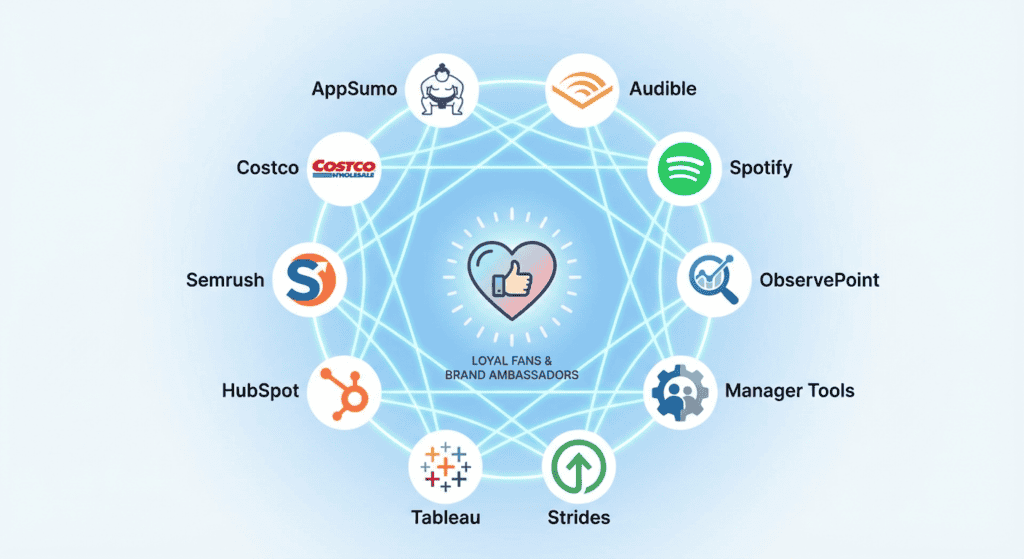
Top 10 Companies That Turned Me Into a Loyal Fan

Reading Time: 4 minutes

The Power of Brand Ambassadors and Loyal Customers

Reader Beware: Any blog post tagged as “Data Driven David” may not be as related to marketing as most of my content. I truly love data and love it even more when it is well visualized and wrapped in a great story — now, that’s good marketing.

In today’s hyper-competitive market, having loyal customers isn’t just a nice-to-have—it’s a game-changer. Loyal customers don’t just buy from you repeatedly; they become your brand ambassadors, spreading the word organically because they genuinely believe in what you offer. Word-of-mouth marketing, fueled by passionate advocates, carries more weight than any ad campaign. Think about it: when someone you trust raves about a product, aren’t you more inclined to try it? That’s the magic of customer loyalty.

To highlight this, I’m sharing 10 companies that I absolutely love, often talk to others about, and feel they separate themselves from others. From compiling this list, I noticed there is both a service and product component that makes me so adamant about them and that there is an aspect that makes them authentic from their peers. These are not followers or me too companies.

1. AppSumo

AppSumo is a marketplace for entrepreneurs, offering lifetime deals on software tools that help businesses grow. What makes them unique is their ability to uncover hidden software gems and provide unbeatable lifetime deals on products typically new to the market. I have been a customer since 2016. have evaluated well over 100 products, and absolutely love the no hassle refund allowing me to try these offerings for 60 days.

2. Audible

Audible is the world’s leading provider of audiobooks, podcasts, and spoken-word entertainment. I love Audible because of their product breadth, amazing service that is helpful and even recommends listens I may like, great 2 for 1 and other promotions throughout the year, and a high quality product. I have been a customer since 2004, long before they were acquired by Amazon and before audio listening was mainstream.

3. Spotify

Spotify is a music streaming platform that gives you access to millions of songs, podcasts, and playlists worldwide. What sets Spotify apart is its personalized recommendations and of course, their Spotify wrapped that comes out the end of the year highlighting your listening consumption. Countless companies have done their own wrapped but rarely hit the mark.

4. ObservePoint

ObservePoint offers data governance and tag auditing solutions to ensure accurate digital analytics tracking. Their platform is invaluable because it automates the tedious process of validating analytics, ensuring data-driven decisions are based on reliable, clean data. Aside from being a powerful must have product for any B2B website, their entire staff is something special. So willing to help and often finding custom solutions in hours. It’s rare to see an employee base with such a passion for what they are doing.

5. Manager Tools

Manager Tools is a management consulting firm that provides practical guidance for becoming a better leader through podcasts, training, and resources. I’m hooked on their no-nonsense, actionable advice that you can implement immediately to improve team performance and personal leadership skills. The founders, Mark and Mike, are not as involved as years past but all of their advice is best practice and in the weeds detailed. I have listened to their podcast since the beginning.

6. Strides

Strides is a goal and habit-tracking app designed to help you stay organized and motivated in achieving your personal and professional goals. What I love about Strides is its intuitive interface and flexible tracking options, making it incredibly easy to monitor progress and to track just about any goal in any way you can imagine. I am tracking around 15 goals a year in this app.

7. Tableau

Tableau is a powerful data visualization tool that helps people see and understand their data through interactive dashboards. The magic of Tableau lies in its ability to turn complex data sets into beautiful, easy-to-understand visuals that tell compelling stories with just a few clicks. I started using Tableau in 2011, long before acquired by Salesforce and even then was an incredibly powerful data visualization tool for its time. Tableau is one of the few visualization tools that you are proud to show management.

8. HubSpot

HubSpot is an all-in-one inbound marketing, sales, and customer service platform that helps businesses grow better. What makes HubSpot stand out is its user-friendly interface combined with powerful automation features, making marketing and CRM tasks feel effortless and highly effective. Their journey has been impressive since the early days when they had an entertaining and actionable content shared on their podcasts targeting small and medium businesses. What they provide for free is second to none and they are becoming the source for just about any marketing topic.

9. Semrush

Semrush is an all-in-one digital marketing toolkit for SEO, content marketing, competitor research, PPC, and social media marketing. I love Semrush because it’s like having a marketing Swiss Army knife—offering deep insights into SEO and competitive analysis that help fine-tune strategies for maximum impact. I have been using their product since at least 2015 and have written an article claiming them as the best SEO audit tool.

10. Costco

Costco is a membership-based warehouse club offering bulk products at discounted prices, from groceries to electronics. What makes Costco irresistible is its unbeatable value, high-quality product selection, and the thrill of discovering unexpected finds with every visit (plus, who doesn’t love the free samples? The rotisserie chicken and hot dog that haven’t changed price since I was a kid and the effortless return policy is mind blowing awesome.

Top 10 Companies That Turned Me Into a Loyal Fan Read More »

baby names popularity david

The Rise and Fall of David: A Baby Name Analysis

Reading Time: 2 minutes

Reader Beware: Any blog post tagged as “Data Driven David” may not be as related to marketing as most of my content. I truly love data and love it even more when it is well visualized and wrapped in a great story — now, that’s good marketing.

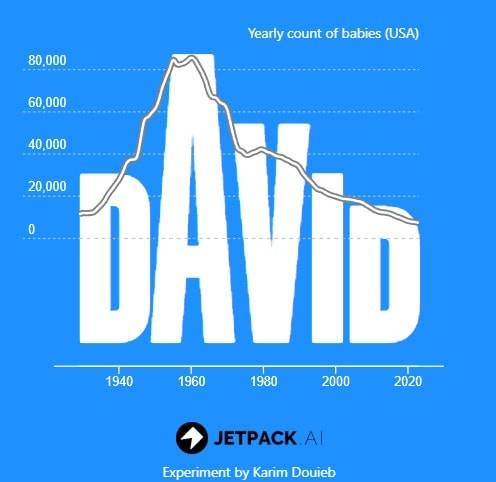
Recently, I stumbled upon an intriguing tool by Jetpack AI Baby Names. This tool allows you to enter your first name and instantly see its historical popularity. Naturally, I had to check my own name: David.

I was born in 1975, and throughout my life, it’s been rare to find myself in a room without another David. In fact, for most of my career, I had another colleague named David Nelson. During a recent conversation with a relative — yes, another David — we speculated that the name might be losing its luster among newer generations. As it turns out, our hunch was spot-on.

The Data Speaks

Using the Jetpack AI tool, I discovered that the name David peaked in popularity in the mid-20th century. Since then, it has been on a steady decline. This aligns with broader trends in baby naming, where traditional names often give way to more unique or culturally diverse options over time. For parents in the 2020s, names like Liam, Noah, and Olivia dominate the charts, while classics like David, Susan, and Karen are becoming rarer.

Why the Decline?

Several factors could explain the waning popularity of the name David:

  1. Cultural Shifts: Parents today often seek names that stand out or carry a unique flair. Traditional names may feel too common or outdated.
  2. Pop Culture Influence: The names of popular celebrities, characters, or influencers can dramatically shape naming trends.
  3. Generational Cycles: Names often fall out of favor only to be rediscovered by future generations. Perhaps David will make a comeback in a few decades.

A Personal Reflection

For me, being a David has always felt like belonging to an unofficial club. It’s a name that’s timeless, strong, and versatile. While I’m intrigued by its decline, I also see it as a reminder of how names — much like brands — evolve with time and cultural shifts. Names carry stories, histories, and identities, and their popularity trends often mirror societal changes.

Look Up Your Name

Curious about your own name’s trajectory? I encourage you to explore the Jetpack AI tool and see what the data reveals. Are you surprised by the results? Let me know in the comments!

Whether you’re a fellow David or have a name with its own unique story, understanding these trends offers a fascinating glimpse into how we’re shaped by the times we live in.

What does your name say about your generation?

The Rise and Fall of David: A Baby Name Analysis Read More »

a marketers mount rushmore the greatest minds in marketing history

A Marketer’s Mount Rushmore: The Greatest Minds in Marketing History

Reading Time: 3 minutes

Reader Beware: Any blog post tagged as “Data Driven David” may not be as related to marketing as most of my content. I truly love data and love it even more when it is well visualized and wrapped in a great story — now, that’s good marketing.

Mount Rushmore, a monumental human creation carved into the Black Hills of South Dakota, stands as a powerful symbol of American history. Few would argue against the four U.S. Presidents who grace its face.

1. George Washington

George Washington was the first President of the United States who led the American Revolution to victory.

2. Thomas Jefferson

Thomas Jefferson was the third President of the United States and author of the Declaration of Independence.

3. Theodore Roosevelt

Theodore Roosevelt was the 26th President of the United States and known for his role in negotiating the construction of the Panama Canal.

4. Abraham Lincoln

Abraham Lincoln was the 16th President of the United States who led the country through the Civil War and abolished slavery.

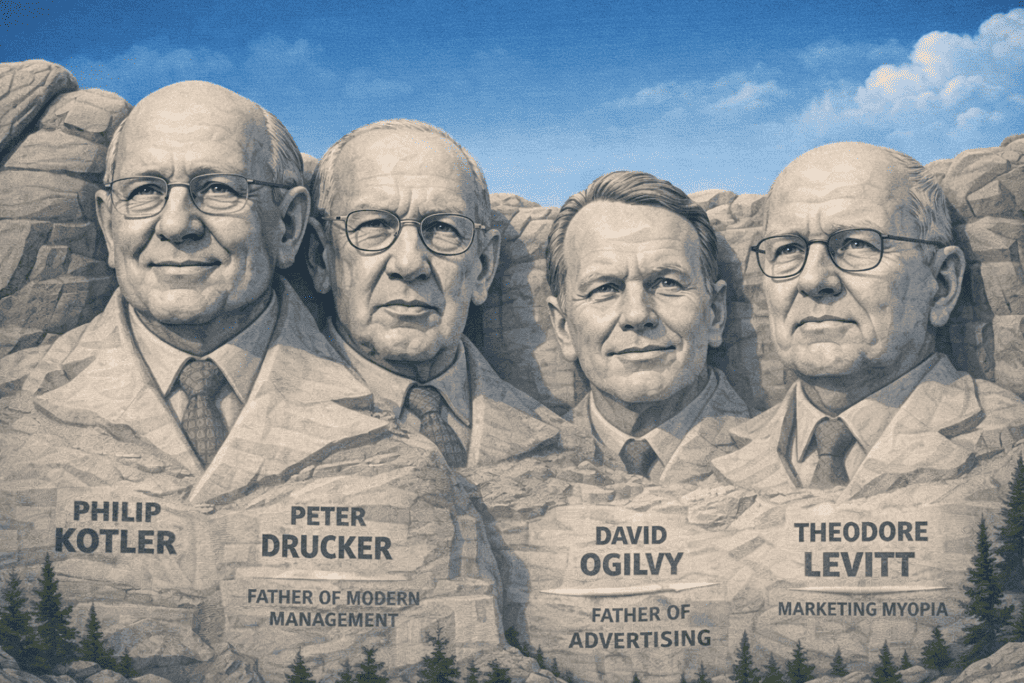
Now, what if there was a Mount Rushmore of the greatest marketing minds, those heroes that have made marketing what it is today? Well, I have gone and done just that, at least digitally. My Proposal:

1. Philip Kotler

Born May 27, 1931, in Chicago, Illinois, USA, and still with us, which I hope we can say for many years to come. Often referred to as the “father of modern marketing,” Kotler’s work has been instrumental in shaping the academic and practical approaches to marketing worldwide.

  • Developed the concept of social marketing, extending marketing beyond just selling products to influencing social change.
  • Authored the landmark textbook Marketing Management, used by universities and businesses globally.
  • Pioneered the idea of marketing as a strategic function rather than just a tactical one.
  • Advocated for customer-centric marketing, influencing how businesses engage with consumers.
  • His 4 Ps of marketing (Product, Price, Place, Promotion) became a foundational framework for marketing practice.

2. Peter Drucker

Born November 19, 1909, in Vienna, Austria, and died November 11, 2005, in Claremont, California, USA. Known as the “father of modern management,” Drucker’s work has had a profound influence on both marketing and business management, shaping corporate strategies for decades.

  • Introduced the concept of management by objectives (MBO), influencing how businesses set and achieve goals.
  • Emphasized the importance of customer orientation in business, shifting focus from products to the needs and wants of customers.
  • Defined marketing as a key business function that drives business growth, not just a support role.
  • Advocated for the concept of innovation and entrepreneurship within organizations.
  • His writings, including The Practice of Management, have become essential reading for leaders in all industries.

3. David Ogilvy

Born June 23, 1911, in West Horsley, Surrey, England, and died July 21, 1999, in Paris, France. Known as the “father of advertising,” Ogilvy’s innovative ad campaigns and focus on research-based marketing revolutionized the advertising industry.

  • Founded Ogilvy & Mather, one of the most successful advertising agencies in the world.
  • Created iconic campaigns for brands like Hathaway Shirts and Schweppes, which are still studied for their effectiveness.
  • Advocated for research-driven advertising, emphasizing the importance of understanding consumer behavior.
  • Wrote Ogilvy on Advertising, a timeless guide that continues to influence marketers today.
  • Pioneered the idea that “the consumer isn’t a moron, she’s your wife,” emphasizing the importance of treating customers with respect and intelligence.

4. Theodore Levitt

Born March 1, 1925, in Hartford, Connecticut, USA, and died June 28, 2006, in Boston, Massachusetts, USA. Levitt’s work in redefining marketing and business strategy, particularly his famous “Marketing Myopia” article, has become foundational to modern marketing thought.

  • Authored the groundbreaking article Marketing Myopia, which challenged businesses to focus on customer needs rather than just their products.
  • Introduced the concept of global marketing, arguing that businesses should see the world as a single market.
  • Emphasized the importance of innovation and customer-driven strategy in business success.
  • Developed the idea of product life cycle management, helping businesses plan for the long-term sustainability of their products.
  • His work on brand differentiation influenced how companies position themselves in competitive markets.

With any short list, there will always be those “runner-ups” who perhaps in certain ways are more deserving or that you wish the list was extended to include a few more. If possible, a few other names quickly come to mind:

  • Seth Godin (permission marketing and reshaped how we think about customer relationships)
  • Gary Vaynerchuk (personal branding and content marketing)
  • Jay Conrad Levinson (father of Guerrilla Marketing, unconventional marketing tactics)

All worthy inclusions. These figures represent the evolution of marketing from traditional to digital, emphasizing new approaches to consumer engagement, branding, and content in the modern world. Their influence on current marketing practices is substantial, particularly in the age of social media and digital marketing.

A Marketer’s Mount Rushmore: The Greatest Minds in Marketing History Read More »

not this but that

Not This But That

Reading Time: 2 minutes

Reader Beware: Any blog post tagged as “Data Driven David” may not be as related to marketing as most of my content. I truly love data and love it even more when it is well visualized and wrapped in a great story — now, that’s good marketing.

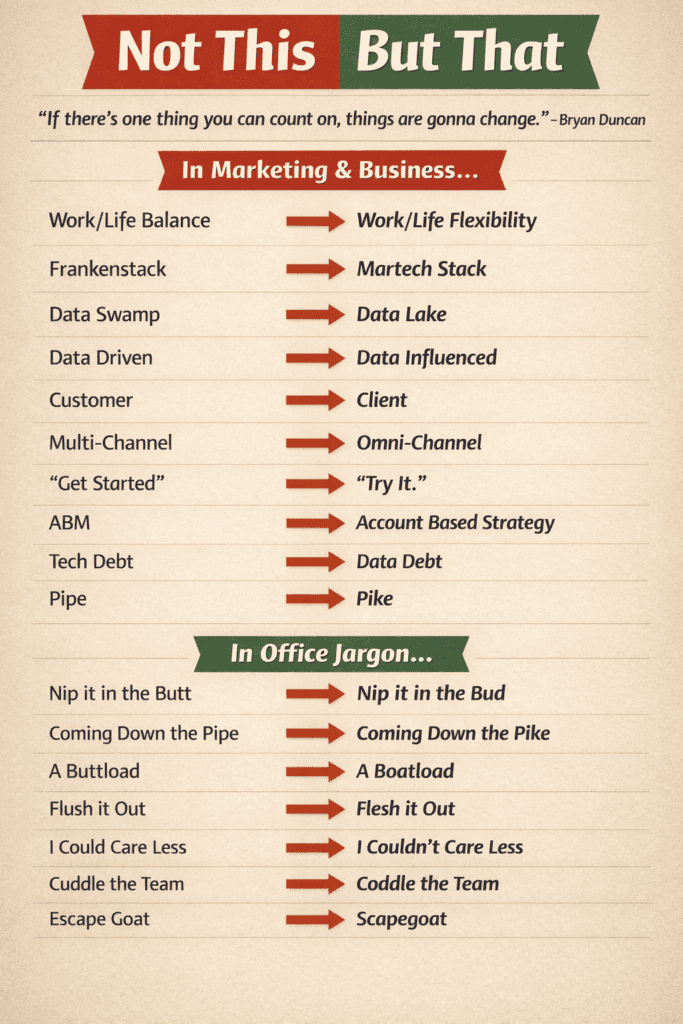
There’s a quote I love from Bryan Duncan that says, “If there’s one thing you can count on, things are gonna change.” This rings especially true in marketing and business, where change is constant and often dizzying. Here are a few notes capturing this shift—from what we used to say, or some more humorous versions, to what’s now taking over.

  1. Not work/life balance, but work/life flexibility
  2. Not frankenstack or frankendatastack, but martech stack
  3. Not data swamp, but data lake
  4. Not data driven, but data influenced
  5. Not customer, but client
  6. Not single channel or multi-channel, but omni-channel
  7. Not get started for call to action, but try it
  8. Not account based marketing (ABM), but account based strategy
  9. Not tech debt, but data debt
  10. Not pipe, but pike

Similarly, I have been keeping a list of business jargon that gets said in the office and often these phrases are said incorrectly.

  1. Not nip it in the butt, but nip it in the bud
  2. Not coming down the pipe, but coming down the pike
  3. Not a buttload, but a boatload
  4. Not flush it out, but flesh it out
  5. Not I couldn’t care less, but I could care less
  6. Not cuddle, but coddle
  7. Not escape goat, but scapegoat

What am I missing?

Not This But That Read More »

2024 best marketing and business books

Best Marketing and Business Books in 2024

Best Marketing and Business Books in 2024 Read More »