
Last updated June 2026
SEO, GEO, AIO.
If you spend any time in marketing right now, it can feel like a new acronym shows up every week. Some of these ideas are useful. Some are just repackaged concepts. And some create more confusion than clarity.
The real issue is not the acronyms themselves. It is losing sight of what actually drives visibility. This post is not about adding another term to the mix. It is about simplifying what matters and giving you specific actions you can take today.
Because the goal has not changed. You still need to get found, get mentioned, and continuously improve how you execute. The difference is that those outcomes now happen across more than one system, and the mechanics of each system have shifted significantly since 2024.
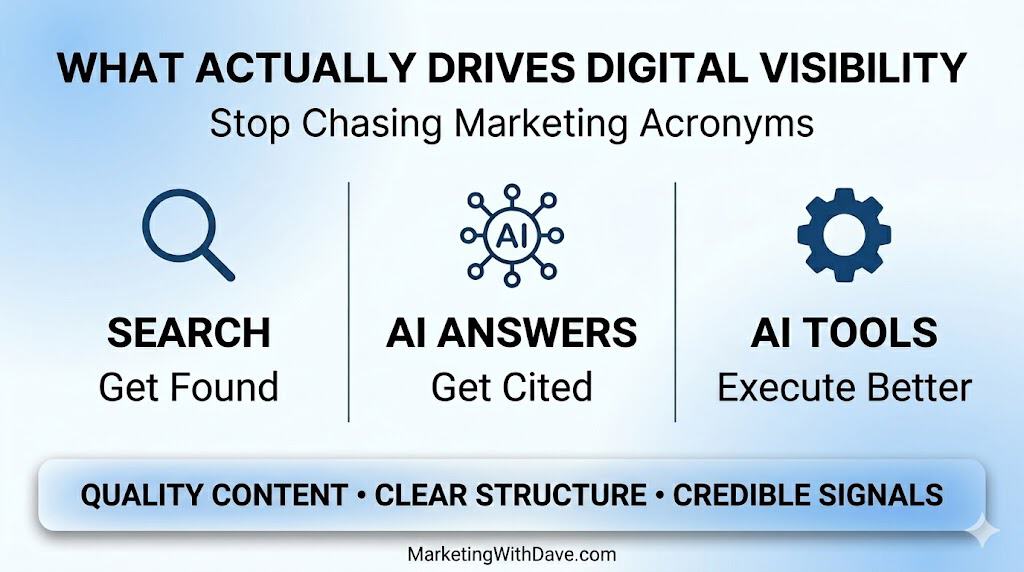
The shift from SEO alone to broader digital visibility
For years, SEO was the strategy. If your content ranked, you won visibility. That model still matters, but it is no longer complete.
People still search, but they are increasingly asking AI tools direct questions as part of the same journey. This shift is no longer theoretical. AI-generated answers are showing up more often, especially for longer and more complex queries, and when they do, they can reduce how often users click through to traditional search results.
At the same time, the relationship between search rankings and AI citations is weakening. Ranking highly still helps, but it does not guarantee that your content will be included in an AI-generated answer. In practice, search visibility and AI visibility are becoming related but distinct outcomes that require slightly different approaches.
At the same time, marketers are using AI internally to move faster and make better decisions.
Visibility is no longer tied to a single channel. It exists across search engines, AI-generated answers, and the systems you use to execute your work.
This is why it is more helpful to think in terms of three connected areas: SEO drives discovery, AI visibility influences whether your brand shows up in answers, and AI tools improve how you execute your marketing.
What the “SEO alphabet soup” gets wrong
Terms like GEO (Generative Engine Optimization) and AIO (AI Optimization) are starting to show up more often — along with AEO, LLMO, GSO, and half a dozen others. The challenge is that most marketers do not actually think in acronyms. They think in outcomes.
When you translate these terms into what they represent, things become much clearer. SEO is about being found in search engines. GEO is about being included in AI-generated answers. AIO is about using AI to improve execution.
The ideas themselves are not new. What is new is the environment they operate in. The risk is that the terminology can make simple concepts feel more complex than they need to be. Clarity is more valuable than clever naming.
SEO still drives discovery
SEO remains the foundation of digital visibility. It is still how people find your website when they are actively looking for answers — and Google still accounts for roughly 80% of global search query volume.
That foundation is built on things that are not new, but are still often overlooked:
- Your website needs to be technically sound, easy to crawl, and easy to navigate.
- Your internal linking should support discovery and context.
- Your content should match search intent, not just target keywords.
- Your authority should be reinforced through credible backlinks.
This is what drives qualified traffic. If this layer is weak, everything else becomes harder.
One nuance worth noting: the relationship between Google rankings and AI citations is decoupling. Ranking highly in traditional search still improves your chances of being cited — pages at position 1 have roughly a 58% chance of being cited by ChatGPT, dropping to 14% by position 10. A meaningful portion of frequently cited pages in AI answers have little or no traditional search visibility.
AI visibility shapes how your brand is mentioned
AI visibility is different from SEO, even though they are closely related. In search, you are competing for rankings. In AI systems, you are influencing whether your content is included in an answer.
When someone asks a question in an AI tool, they may never see a list of results. Instead, they see a summary, a recommendation, or a synthesized response. Your content can still play a role in that answer, but the mechanism is different — and several specific factors influence whether you get included.
Make sure AI crawlers can actually access your site
This sounds obvious, but it is the most commonly overlooked step. Check your robots.txt file for blocks on GPTBot, PerplexityBot, ClaudeBot, or Google-Extended. If you use Cloudflare, check its bot management settings — Cloudflare changed its defaults and may be blocking AI crawlers without you knowing. Also check that important content is server-side rendered and not hidden behind JavaScript or login walls.
Structure your content for extraction, not just browsing
AI systems pull short passages from pages and synthesize them. Content that presents clear ideas, well-organized sections, and credible information is easier to interpret and more likely to be referenced. Practically, this means:
- Lead each section with a direct answer before providing context
- Use clear heading hierarchies (H2, H3) with one topic per section
- Include a well-structured FAQ section that mirrors how people actually ask questions
- Add an explicit definitional sentence near the top of each page (AI systems weight the first 150–200 words heavily)
Add citations and data — they increase your chances of being cited
Princeton’s GEO research (published at KDD 2024) found that adding citations and statistics to content can boost AI visibility by up to 40%. This is among the highest-impact tactics identified. Link to authoritative external sources at the claim location, not just in a references section. Include specific data points where you have them.
Build external mentions and presence beyond your website
AI systems pull heavily from Reddit, LinkedIn, and YouTube — not just your own domain. Platforms like Reddit and YouTube are disproportionately represented in AI citations compared to most brand-owned websites. Brand mentions, thought leadership posts, and community participation on these platforms contribute to how AI systems perceive your authority. Unlinked brand mentions also appear to carry meaningful weight.
Consider an llms.txt file
Some sites are now adding an llms.txt file (similar in concept to robots.txt) to help AI systems understand their site structure and which pages are most authoritative. It is an emerging convention, not a universal standard yet, but worth considering for sites with a large content archive.
Keep content fresh
Freshness matters more for AI visibility than it did for traditional SEO, particularly on Perplexity and Google AI Mode. Content that has not been updated loses citation priority faster. A simple version note (“Last updated May 2026”) and periodic substantive updates to key pages can help maintain your visibility in AI answers.
What is important to understand about all of this is that it is influence, not control. You are not optimizing a ranking position in the same way. You are increasing the likelihood that your content is trusted and included.
AI tools improve execution
The third piece of this framework is internal. AI tools are changing how marketing work gets done.
They can support content workflows, speed up production, automate repetitive tasks, and help surface insights more quickly. Used well, they can make teams more efficient and more effective.
But AI tools are not a visibility channel by themselves. Using AI does not automatically lead to more traffic or more mentions. It simply improves how you execute.
That distinction matters, because it is easy to overestimate the impact of tools while under-investing in strategy.
The alignment core: what works across everything
At the center of all of this are three consistent factors: quality content, clear structure, and credible signals.
AI systems are not just evaluating pages. They are evaluating entities.
Consistent brand mentions, author identity, and presence across multiple platforms help reinforce credibility beyond a single web page.
These are the elements that support SEO performance. They are also the elements that increase the likelihood of being cited or summarized by AI systems. And they are what make AI tools more effective when you use them.
No matter how the landscape evolves, these fundamentals continue to show up. If your content is shallow, unclear, or difficult to interpret, it will struggle in every environment.
Before you jump to GEO, get the fundamentals right
One of the biggest risks right now is jumping straight into AI visibility tactics without a strong foundation.
If your content is not clear, not structured well, and not providing real value, focusing on GEO will not fix that. AI visibility builds on what is already there. It does not replace it.
Before you prioritize AI visibility, make sure:
- Your content is clear and understandable to a reader who has no context
- Your pages are well organized with logical heading structures
- Your internal linking supports discovery across related topics
- Your content includes real insight, original perspective, or first-hand data — not surface-level summaries
- AI crawlers are not accidentally blocked on your site
Those are the things that carry across both search and AI systems.
Why you should be careful with industry data
You may have seen recent charts showing how small AI-driven traffic is compared to Google organic. Across most industries, AI referral traffic sits around 1% of total website traffic versus organic search’s roughly 48% share.
But “industry average” does not equal “your reality.”
Your website is not the average. Your audience is not the average. Your content strategy is not the average.
That matters because I see more traffic from AI-driven sources than from Google on my own website. That does not invalidate industry data. It highlights its limitations.
There is also a measurement problem. An estimated 70% of AI-sourced traffic arrives without referrer headers, making it invisible in standard analytics dashboards. If you are only reading your GA4 referral report, you are very likely undercounting how much AI is influencing your visitors. A good way to check: look at direct traffic trends alongside any AI visibility changes, and consider adding “How did you hear about us?” options that include AI tools to your contact or inquiry forms.
The better approach is to use industry data as context, while letting your own analytics guide your decisions.
How to measure AI visibility
Traditional SEO metrics — rankings, organic sessions, click-through rates — do not capture AI visibility. If you want to know whether your content is being cited, you need to track it separately.
Practical starting points:
- Manual testing: Define 10–20 queries that are central to your content and test them regularly in ChatGPT, Perplexity, Google AI Mode, and Gemini. Note whether your brand is mentioned and where it appears in the answer.
- Brand search trends: Monitor branded search volume in Google Search Console. Increases following AI mentions suggest influence even without direct referral clicks.
- Direct traffic analysis: Users who encounter your brand in an AI answer often type it directly rather than clicking a link. Watch for unexplained direct traffic increases alongside any improvements in AI presence.
- Dedicated tools: Platforms like BrandMentions, Semrush’s AI visibility features, and purpose-built tools like LLMrefs track citation rates across AI engines if you want more systematic monitoring.
A simple way to evaluate your content
Instead of focusing on acronyms, focus on outcomes. When you look at a piece of content, ask three questions:
- Can it be found? Is it technically accessible, well-structured, and targeting the right intent?
- Can it be understood and cited? Is it clear, well-organized, factually grounded, and does it include original insight or data?
- Can it be created and improved efficiently? Are you using your tools and workflows well enough to keep this content current?
If any of those answers are no, there is an opportunity to improve.
Final takeaway
You do not need to chase every new acronym that appears.
You need to understand what actually drives visibility.
SEO drives discovery. AI visibility shapes how your brand is included in answers. AI tools improve execution.
The advantage comes from aligning all three — and making sure the basics are solid before you layer on AI-specific tactics.
And before you follow any industry trend, make sure you understand what is actually happening on your own website.

