Last updated August 2026
Ranking a web page used to be the goal. Increasingly, it is only the starting point. AI search does not surface the best-ranked page. It surfaces the most useful passage. That distinction changes what good content actually looks like.
Traditional SEO still matters, but the bigger opportunity now is creating content that AI systems can retrieve, understand, and cite. That requires a different way of thinking about what you publish.
This shift changes the rules. It puts more pressure on clarity, structure, and usefulness. It also raises the bar for marketers who still write content as if ranking for a keyword is the only thing that matters.
Why Most Content Fails in AI Search
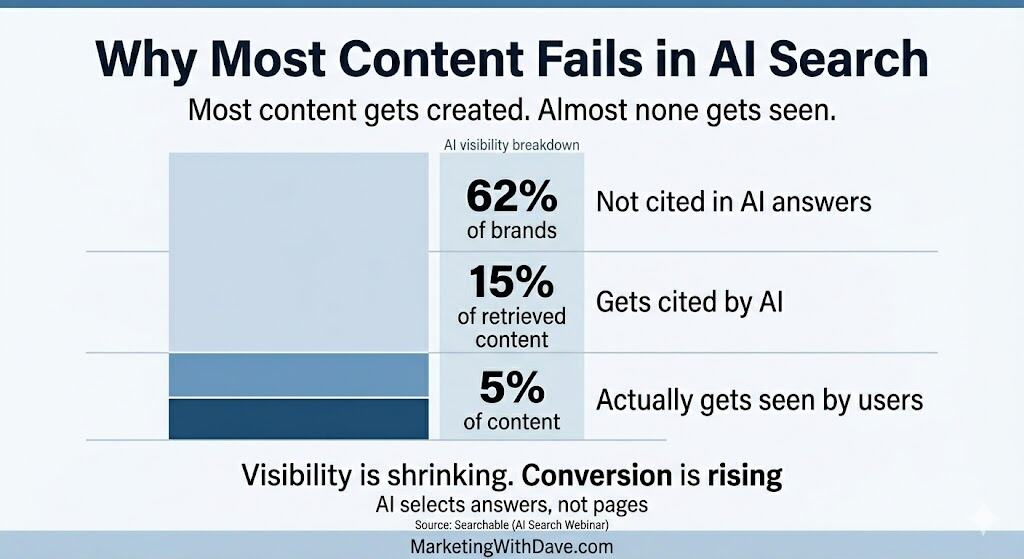
One of the clearest signals in AI search right now is how little content actually breaks through. Based on data shared in a Searchable webinar, roughly 62% of brands are not cited at all, about 15% of retrieved content earns a citation, and only around 5% actually reaches the user.
That matters because AI search is a filtering system. Content is not just competing to rank. It is competing to be selected. In that environment, weak structure, generic writing, and bloated content become even bigger liabilities.
At the same time, the opportunity is still meaningful. AI-referred visitors often convert at a much higher rate than traditional organic traffic. That means visibility may be shrinking, but intent is often stronger when your brand does get surfaced.
The Shift From SEO to AI Search
Search has moved from ranking web pages to selecting answers. That does not mean SEO is obsolete. It means the bar for what qualifies as useful content has changed.
AI systems are not trying to rank everything. They are trying to choose the best answer.
Traditional SEO focused heavily on optimizing entire web pages, targeting keywords, building backlinks, and winning clicks. AI search still benefits from many of those foundations, but it often works at the passage level instead of the full web page level. It looks for sections that can answer a question clearly and credibly.
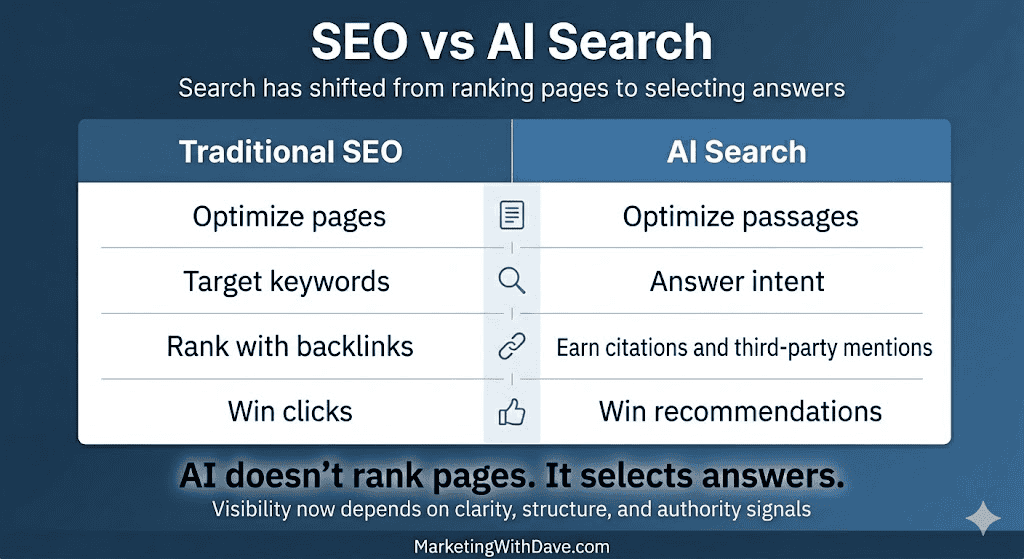
This is why the mental model matters. If you still think only in terms of web pages and rankings, you will miss how AI systems retrieve and surface information. The better approach is to think in terms of passages, intent, citations, and recommendations.
A Simple Framework for Content That Gets Cited
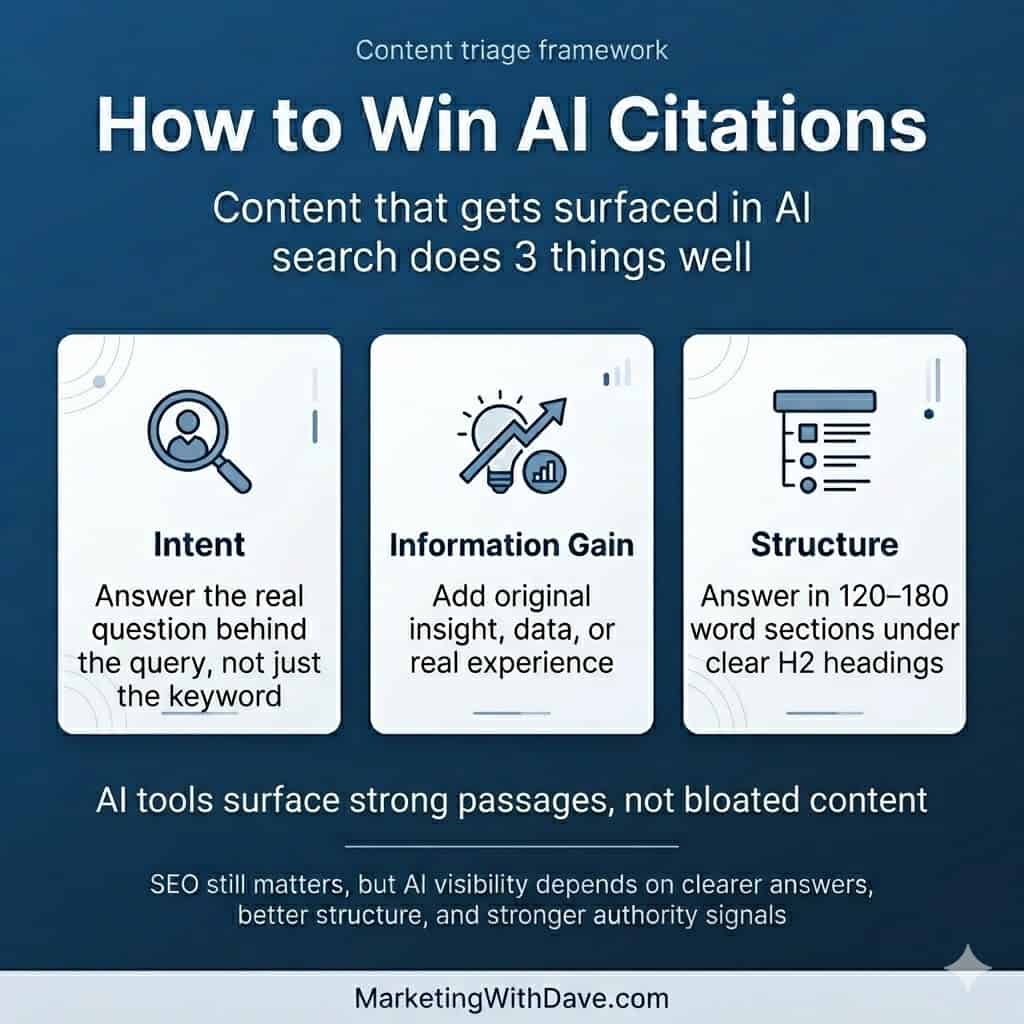
A clear way to approach this is through three elements: intent, information gain, and structure. Together, these create a practical framework for writing content that is more likely to be surfaced in AI-generated answers.
1. Intent
Intent is about answering the real question behind the query, not just matching the keyword. That distinction matters more than ever. A phrase may look informational on the surface, but the hidden user need can be something more specific, more commercial, or more action-oriented.
A similar pattern shows up constantly in marketing queries. Someone might search for “best email marketing tools,” but what they really want is a tool that fits their specific use case, budget, or team size. Content that simply lists tools is less useful than content that helps narrow the decision. That gap between the visible query and the actual need is where stronger content strategy starts.
2. Information Gain
Information gain is what you add beyond the baseline consensus. If every article says the same thing in slightly different words, there is very little reason for AI systems to surface yours. Originality does not have to mean controversy. It usually means adding useful detail, real experience, proprietary data, a stronger synthesis, or a more helpful example.
This is also where real expertise matters. Original testing, lived experience, case studies, and first-hand observations all strengthen content in a way generic summaries cannot.
In practice, this is where most content falls short. Across my own work, I consistently see content that ranks well but adds little beyond what already exists. It summarizes, but it does not contribute. The pieces that perform better are the ones that include a clear point of view, a real example, or a sharper explanation than what is already available.
3. Structure
AI systems retrieve passages, not entire web pages. That is why structure matters as much as the content itself.
Structure is the execution layer. Content should be written so individual sections can stand on their own as complete answers. In practical terms, that means using clear headings, concise sections, direct phrasing, and formats that are easy to parse.
Instead of rambling introductions or filler, the better approach is to answer the question quickly and then support that answer. The presentation also recommended tight sections under clear headings and called out simple formats like tables, bullets, and schema-supported structure as helpful for extractability.
Searchable also reported an internal test in which it restructured existing information around questions users actually ask and saw 2.6 times more AI citations within four days. That is one company experiment rather than proof of a universal ranking factor, but it supports the broader idea: making information easier to extract may also make it easier for AI systems to use.
What This Means for Your Content
Most content is written to rank. Very little is written to be cited. If your content still follows the old pattern of stretching topics to hit arbitrary length targets, leading with fluff, or summarizing what everyone else already says, it is likely underperforming in both traditional search and AI search.
The better approach is to write content that is easier to retrieve, easier to extract, and more worth citing. That usually means clearer answers, stronger organization, and more distinctive value.
It also means thinking beyond your own website. Another important point is that AI visibility is often influenced by third-party mentions, earned media, community discussion, and other off-site signals. In other words, what others say about your brand can matter as much as what you publish yourself.
AI search is not replacing SEO. It is building on top of it. Strong organic visibility still helps, but it is no longer the full picture. Brands that want to win in this environment need content that ranks well, reads well, and can be cited well.
That is a higher standard, but it is also a better one. It pushes content toward being more useful, more focused, and more credible.
If your content is not being cited, it is less likely to be seen. That is the real challenge of AI search. The brands that adapt will not just publish more. They will publish clearer answers, add more real value, and structure content in a way AI systems can actually use.
This is not a small tactical change. It is a meaningful shift in how strong content gets discovered.
If you are not sure where to start, pick one post that already ranks and ask a harder question: does this actually answer what someone is trying to do, or does it just match a keyword? Tighten the structure, sharpen the answer, and cut anything that does not add something the reader cannot find in the next result. That is the practical version of writing for AI search, and it is the same thing that makes content worth reading in the first place.