In the first episode of Mad Men, we’re introduced to Don Draper and his advertising team as they tackle a tough challenge for their cigarette client, Lucky Strike. Reader’s Digest has recently published an article warning about the dangers of smoking, and the ad team must find a way to make Lucky Strike stand out in a now scrutinized market.
Draper’s solution is simple but effective: he suggests they emphasize that Lucky Strike cigarettes are “toasted,” a term that subtly implies quality and care in production. The twist? Every cigarette brand uses the same process—but no one else has claimed it in their messaging. By being the first to spotlight this common quality, Lucky Strike gains an edge in the consumer’s mind.
This approach echoes Claude Hopkins’ famous campaign for Schlitz beer. At the time, all brewers followed a similar process to ensure purity and quality, but none highlighted it in their advertising.
Hopkins recognized the opportunity and crafted a campaign that described Schlitz’s filtration process, showcasing it as a unique commitment to purity. By the time competitors tried to replicate the message, Schlitz had already secured its place as the “pure” beer in consumers’ minds.
Both Mad Men and Claude Hopkins demonstrate the power of the “first claim in advertising” —sometimes, being the first to say something ordinary can make it extraordinary.
Reader Beware: Any blog post tagged as “Data Driven David” may not be as related to marketing as most of my content. I truly love data and love it even more when it is well visualized and wrapped in a great story — now, that’s good marketing.
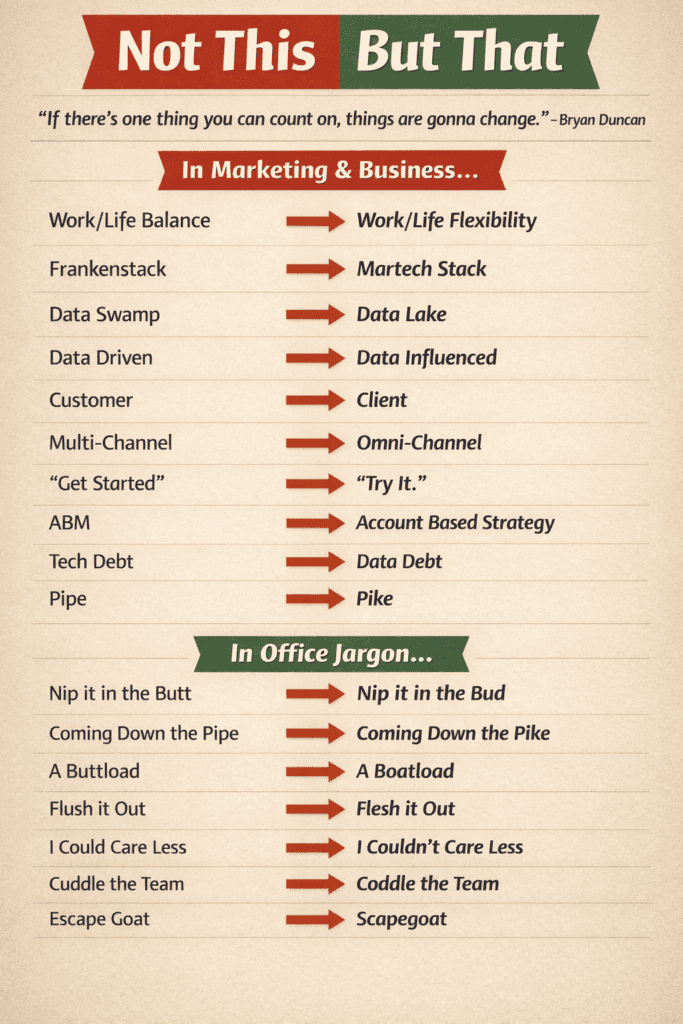
There’s a quote I love from Bryan Duncan that says, “If there’s one thing you can count on, things are gonna change.” This rings especially true in marketing and business, where change is constant and often dizzying. Here are a few notes capturing this shift—from what we used to say, or some more humorous versions, to what’s now taking over.
Not work/life balance, but work/life flexibility
Not frankenstack or frankendatastack, but martech stack
Not data swamp, but data lake
Not data driven, but data influenced
Not customer, but client
Not single channel or multi-channel, but omni-channel
Not get started for call to action, but try it
Not account based marketing (ABM), but account based strategy
Not tech debt, but data debt
Not pipe, but pike
Similarly, I have been keeping a list of business jargon that gets said in the office and often these phrases are said incorrectly.
Not nip it in the butt, but nip it in the bud
Not coming down the pipe, but coming down the pike
Within any Toastmasters meeting are a number of service and leadership opportunities. One of these is sharing an inspirational quote and statement, as well as encouraging others to give one for the best speech, best table topic, and best evaluator. Here is a running list of those quotes I have shared in meetings.
It is not the critic who counts: not the man who points out how the strong man stumbles or where the doer of deeds could have done better. The credit belongs to the man who is actually in the arena, whose face is marred by dust and sweat and blood, who strives valiantly, who errs and comes up short again and again, because there is no effort without error or shortcoming, but who knows the great enthusiasms, the great devotions, who spends himself in a worthy cause, who, at the best, knows, in the end, the triumph of high achievement, and who, at the worst, if he fails, at least fails while daring greatly, so that his place shall never be with those cold and timid souls who know neither victory nor defeat.
Theodore Roosevelt
The right word may be effective, but no word was ever as effective as a rightly timed pause.
Mark Twain
Encouragement is oxygen to the soul.
George M. Adams
When God closes one door, He opens another, but it’s hell in the hallway.
Rev. Susan Gayle
Effective communication is 20% what you know and 80% how you feel about what you know.
Jim Rohn
The way we communicate with others and with ourselves ultimately determines the quality of our lives.
Tony Robbins
They may forget what you said, but they will never forget how you made them feel.
Carl W. Buehner
Are you the kind of speaker that leaves the audience feeling like you’re a great speaker? Or, are you the kind of speaker that leaves each person feeling like they’re a great person.
Bob Kittell
If your actions inspire others to dream more, learn more, do more and become more, you are a leader.
John Quincy Adams
To live a creative life, we must lose our fear of being wrong.
Joseph Chilton Pearce
Do you have a healthy relationship with failure?
A question I also shared with this quote
Never doubt that a small group of thoughtful, committed citizens can change the world. Indeed, it is the only thing that ever has.
Margaret Mead
The only reason to give a speech is to change the world.
John F. Kennedy
These quotes have helped me think differently about speaking, leadership, encouragement, and the responsibility we have when we communicate with others.
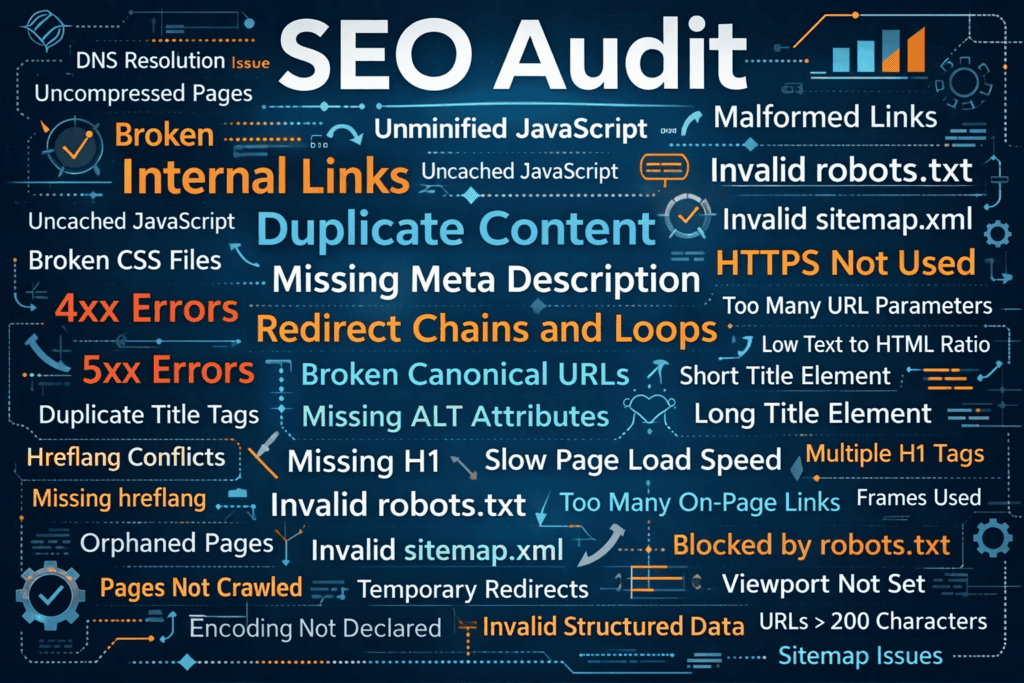
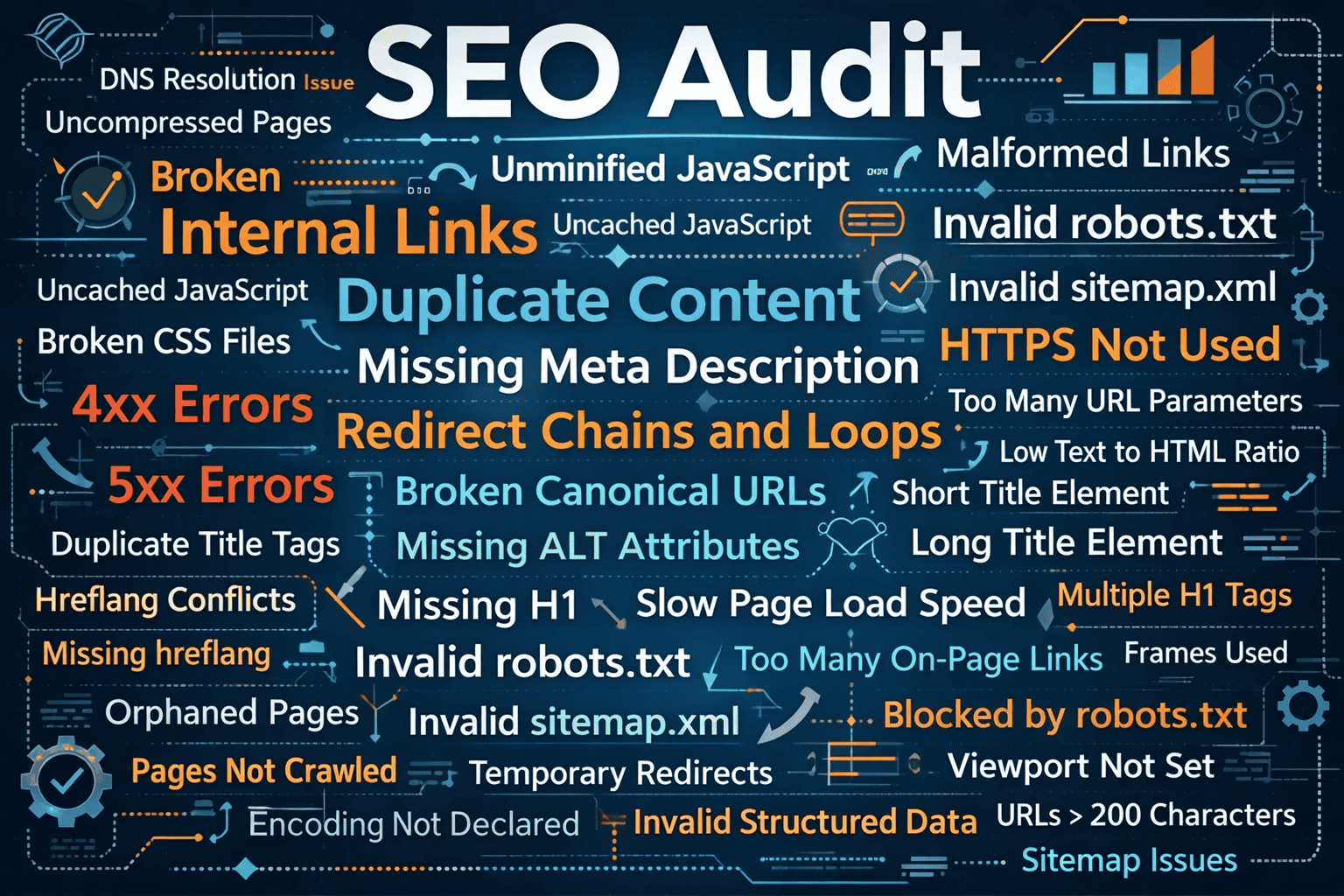
I have used a lot of different search engine optimization (SEO) audit tools over the past two decades. That includes enterprise solutions like BrightEdge and Conductor to lifetime deals like like Ispionage, Serpstat, and Screpy. Hands down, the best tool I have used and continue using is the audit tool within the Semrush platform.
I find it helpful to run this audit on the first day of each month, typically at night to avoid impacting client traffic. You can compare the results with the previous audit to quickly spot major changes and address anything that stands out. Throughout the month, I tackle errors, warnings, and notices as time allows, then reset the process for the following month. This approach has helped me continue reducing the overall issues while also keeping the errors close to zero.
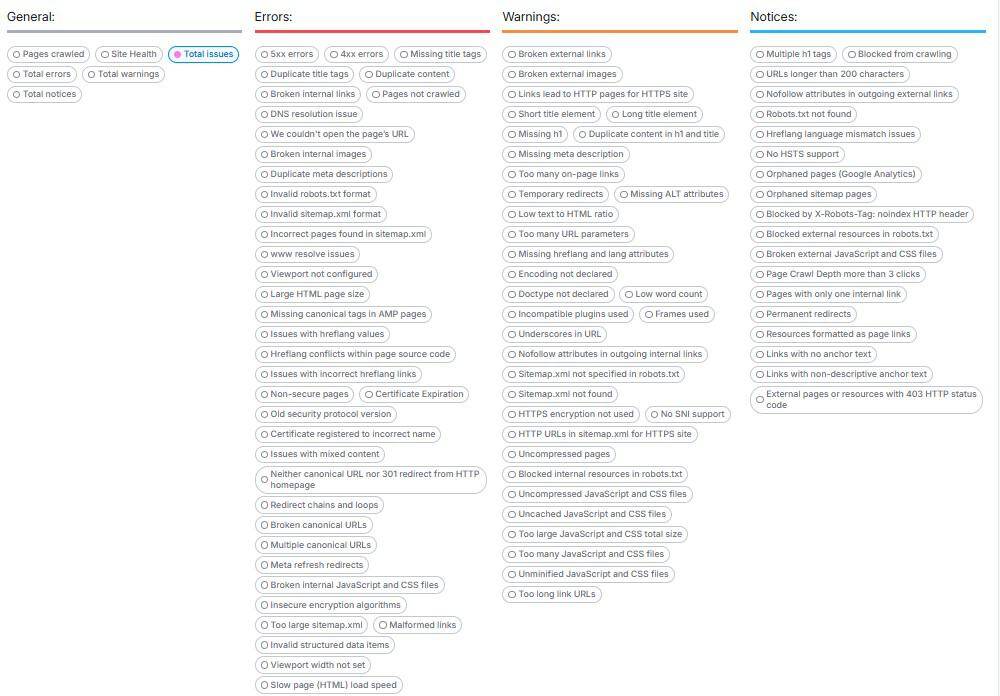
The following image by itself shows you how many things it is checking for which laps any competing solution. I also listed these items alphabetically below the image so you can more easily see and compare them to what you are using today.
GENERAL Pages crawled Site Health Total errors Total issues Total notices Total warnings
ERRORS 4xx errors 5xx errors Broken canonical URLs Broken internal images Broken internal JavaScript and CSS files Broken internal links Certificate Expiration Certificate registered to incorrect name DNS resolution issue Duplicate content Duplicate meta descriptions Duplicate title tags Here is the text from the image, sorted alphabetically: Hreflang conflicts with incorrect hreflang tags Hreflang conflicts within page source code Incorrect pages found in sitemap.xml Insecure encryption algorithms Invalid robots.txt format Invalid sitemap.xml format Invalid structured data items Issues with hreflang values Issues with incorrect hreflang links Issues with mixed content Large HTML page size Malformed links Meta refresh redirects Missing canonical tags in AMP pages Missing canonical URL nor 301 redirect from HTTP homepage Multiple canonical URLs Neither canonical URL nor 301 redirect from HTTP homepage Non-secure pages Old security protocol version Pages not crawled Redirect chains and loops Slow page (HTML) load speed Too large sitemap.xml Viewport not configured Viewport not set We couldn’t open the page’s URL www resolve issues
WARNINGS Blocked internal resources in robots.txt Broken external images Broken external links Broken internal links Doctype not declared Duplicate content in h1 and title Encoding not declared Frames used HTTPS encryption not used HTTPS URLs in sitemap.xml for HTTPS site Links lead to HTTP pages for HTTPS site Long title element Low text to HTML ratio Low word count Missing ALT attributes Missing h1 Missing hreflang and lang attributes Missing meta description No SNI support No SSL support Nofollow attributes in outgoing internal links Short title element Sitemap.xml not found Sitemap.xml not specified in robots.txt Temporary redirects Too large JavaScript and CSS total size Too long JavaScript and CSS files Too long title URLs Too many JavaScript and CSS files Too many on-page links Too many URL parameters Uncached JavaScript and CSS files Uncompressed JavaScript and CSS files Uncompressed pages Underscores in URL Unminified JavaScript and CSS files
NOTICES Blocked by X-Robots-Tag: noindex HTTP header Blocked external resources in robots.txt Blocked from crawling Broken external JavaScript and CSS files External pages or resources with 403 HTTP status code Hreflang language mismatch issues Links with descriptive anchor text Links with no anchor text Multiple h1 tags No HSTS support Nofollow attributes in outgoing external links Orphaned pages (Google Analytics) Orphaned sitemap pages Page Crawl Depth more than 3 clicks Pages with only one internal link Permanent redirects Resources formatted as page links Robots.txt not found URLs longer than 200 characters
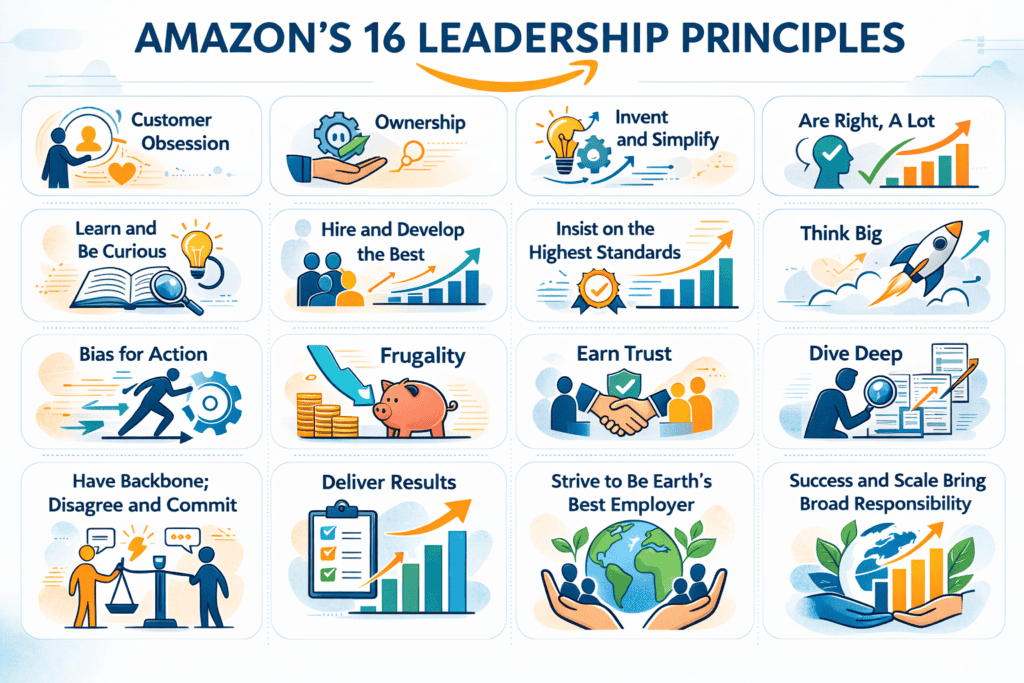
With all of the business and marketing books I have read, I was surprised that it took me so long to learn about these 16 leadership principles taught by Jeff Bezos. These are core to the Amazon’s culture and operational mindset along with guiding decision-making. Here they are:
Customer Obsession Leaders start with the customer and work backward.
Ownership Leaders act on behalf of the entire company, thinking long-term and never saying “that’s not my job.”
Invent and Simplify Innovation and simplification are valued, and leaders seek out ways to simplify processes.
Are Right, A Lot Leaders are expected to have strong judgment and good instincts.
Learn and Be Curious Leaders are never done learning and always seek to improve themselves.
Hire and Develop the Best Leaders raise the performance bar with every hire and coach others to improve.
Insist on the Highest Standards Leaders continuously raise the bar for high-quality products and services.
Think Big Leaders create and communicate a bold direction that inspires results.
Bias for Action Speed matters, and many decisions and actions are reversible.
Frugality Accomplish more with less, focusing on resourcefulness rather than excessive spending.
Earn Trust Leaders work to build trust with others by being transparent, self-critical, and objective.
Dive Deep Leaders operate at all levels, paying attention to details and understanding all aspects of their work.
Have Backbone; Disagree and Commit Leaders are encouraged to respectfully challenge decisions when they disagree but commit fully once a decision is made.
Deliver Results Leaders focus on key inputs for the business and deliver them on time and with high quality.
Strive to Be Earth’s Best Employer Leaders work to make the workplace inclusive, safe, and fulfilling for employees.
Success and Scale Bring Broad Responsibility Leaders consider the impact of their actions on the environment and society, taking responsibility for broader consequences.
These principles were implemented to ensure Amazon’s long-term success and have been integral to its corporate strategy.