Marketers drown in complexity. Too many tools, too many campaigns, too many metrics. Elon Musk’s five-step framework for process improvement, born in engineering, is a surprisingly powerful cure. When applied to marketing, it helps teams cut waste, focus sharper, and deliver faster.
Marketing’s greatest thinkers — from Philip Kotler to Ann Handley — have long argued for simplicity, clarity, and strategy. When we apply Musk’s engineering discipline to marketing, we get a blueprint for better campaigns, smarter teams, and stronger ROI.
Here’s how Musk’s five steps translate into digital marketing, with guidance from the marketing masters.
1. Question Every Requirement
Musk insists that every requirement must trace back to the person who actually uses the product. In marketing, that means every tactic must connect directly to the customer journey.
Philip Kotler reminds us: if it doesn’t create customer value, it’s not marketing.
Michael Porter would ask: does this activity reinforce our competitive advantage or just burn resources?
Practical takeaway: Before greenlighting a new campaign, ask: Does this solve a real customer problem? Or is it just something we’re doing because competitors are doing it?
2. Delete the Part or Process
Musk believes if you’re not deleting, you’re not improving. Marketing is infamous for complexity — bloated approval workflows, endless reports, duplicate campaigns.
Dan Kennedy would cut through with a simple test: Does it drive a measurable result? If not, kill it.
Jack Trout and Al Ries would argue that clutter confuses positioning. By deleting what doesn’t reinforce your brand story, you sharpen your message in the marketplace.
Practical takeaway: Trim your dashboard to a handful of KPIs that leadership actually cares about. Delete everything else.
3. Simplify and Optimize
After deleting, simplify what remains. Musk warns against optimizing what should never exist — marketers fall into this trap often.
Ann Handley teaches that clarity beats complexity. Content must be simple, human, and meaningful.
Philip Kotler reinforces this with his principle of marketing clarity: complexity adds cost but rarely adds value.
Practical takeaway: Replace over-engineered nurture sequences with three simple journeys that align to customer intent stages.
4. Accelerate Cycle Time
For Musk, faster iteration surfaces flaws sooner. In marketing, accelerating means shorter cycles between idea, launch, and learning.
Michael Porter would frame this as agility that reinforces competitive advantage — staying ahead of rivals through faster insights.
Dan Kennedy would push for speed that ties directly to results: test fast, fail fast, scale winners.
Practical takeaway: Don’t spend three months perfecting a whitepaper. Publish a quick series of blog posts, test engagement, and expand what works.
5. Automate
Automation is Musk’s final step, not the first. Automating inefficiency just locks in waste.
Philip Kotler would remind us that technology should enhance the customer experience, not overwhelm it.
Ann Handley would warn that automation must never strip out the human touch — empathy and storytelling still matter most.
Practical takeaway: Automate reporting after you’ve simplified KPIs. Automate email journeys after you’ve deleted clutter. Automate ad bidding after your strategy is clear.
Bringing It All Together
Musk’s framework forces discipline:
Question relentlessly.
Cut mercilessly.
Simplify intentionally.
Move faster.
Automate wisely.
Kotler gives us the foundation of customer value. Porter ensures it aligns with business strategy. Trout and Ries keep us focused on clear positioning. Kennedy demands measurable ROI. And Handley reminds us that behind every process is a person.
Together with Musk’s five steps, this becomes a roadmap for marketers who want not just more campaigns, but better campaigns — faster, leaner, and with more impact. Applied with discipline, Musk’s five steps don’t just improve campaigns — they help marketing become a driver of competitive advantage across the business.
Organizing your company’s brand architecture can significantly impact marketing strategy, budgets, and growth.
The two ends of the spectrum are branded house and house of brands. In this post, we’ll introduce each concept with examples, then provide a comparison grid of positives and negatives from a marketer’s viewpoint.
Finally, we’ll look at one successful and one less successful real-world change in brand architecture with insights on why those transitions fared as they did.
What Is a Branded House? (One Unified Brand)
In a branded house strategy, the company itself is the master brand. All products, services, or sub-divisions share the primary brand name or identity. The goal is a unified brand experience. When customers trust the main brand, that goodwill extends to everything under its umbrella. A win for one product becomes a win for all.
Example:Apple is a classic branded house. Apple’s products and services – Apple iPhone, Apple Watch, Apple Music, Apple Pay, etc. – all carry the Apple name and ethos. Because of this, Apple can leverage its strong brand equity across every new offering. Another example is FedEx, which offers FedEx Express, FedEx Ground, FedEx Freight, and more – different services, but all clearly FedEx. This consistency in branding builds a cohesive identity and trust: if a customer trusts FedEx for shipping, they’re likely to trust FedEx Office or FedEx Freight, too.
The branded house approach works best when a company’s offerings target the same (or closely related) audience and share common values. All marketing efforts reinforce one name, creating synergy. However, as we’ll see, this focus comes with some trade-offs in flexibility and risk.
What Is a House of Brands? (Multiple Distinct Brands)
In a house of brands strategy, the company operates a portfolio of individual brands, each with its own identity, audience, and marketing. The parent company’s name may be downplayed or even unknown to consumers. This approach intentionally keeps brands separate so each can shine on its own.
Example:Procter & Gamble (P&G) is a quintessential house of brands. P&G owns Tide, Pampers, Gillette, Olay, Crest, Febreze, and many more, but consumers recognize each product brand independently; the P&G corporate brand stays in the background. Another example, Unilever, owns Dove, Axe, Ben & Jerry’s, Hellmann’s, etc., each with unique positioning. Customers may not even realize these disparate products share the same owner – and that’s by design.
This model is all about flexibility. Each brand can have a distinct image and target a specific segment without being constrained by a single umbrella identity. It’s great for tailoring offerings to different markets or price points and for isolating risk (one brand’s crisis won’t automatically harm the others). But maintaining many brands comes with higher complexity and costs, as we’ll explore next.
Comparing the Two Approaches: Pros and Cons
The table below summarizes key positives and negatives of branded house vs house of brands from a marketer’s perspective. This comparison grid is meant to be concise and scannable, highlighting how each strategy stacks up on important factors:
Aspect
Branded House
House of Brands
Brand Equity & Trust
Unified brand equity: One brand builds trust that benefits all offerings. Success in one product can boost credibility in others. Customers have a clear, consistent image of the company.
Independent brand equity: Each brand must build trust on its own merits. No automatic carry-over of reputation – but also one brand’s issues won’t tarnish the others.
Marketing Efficiency
Cost-effective marketing: Resources are focused on promoting a single brand, which is economical and efficient. One marketing campaign can lift all products. Shared messaging means less duplication of effort.
Higher marketing costs: Every brand requires its own marketing budget, strategy, and campaigns. It takes more time and money to build each brand from scratch. Efforts aren’t shared, so you may need multiple teams or agencies.
Brand Focus & Clarity
Clear brand story: Easy to present a unified message and identity. All products align with the master brand’s values and voice, which reinforces a clear market positioning.
Targeted positioning: Each brand can develop its own story and vibe tailored to a specific audience or niche. This allows precise positioning (e.g., one brand high-end, another budget) without confusing customers.
Flexibility & Innovation
Constrained flexibility: New products or markets must fit under the main brand’s umbrella. It can be challenging to launch offerings that diverge from the core brand image. Radical innovations might seem off-brand if they stray too far.
Maximum flexibility: Brands have freedom to innovate and even compete with each other. You can enter very different markets by creating or acquiring a new brand for each. If one brand needs a totally different personality or niche, that’s viable in this model.
Risk Management
Shared risk: The entire brand shares one reputation – a crisis or failure in one area can damage the whole company’s image. There’s a single point of failure in terms of brand trust.
Isolated risk: Brands act as firewalls for each other. If one product line has a scandal or flops, the damage is largely contained to that brand. The parent company and other sub-brands are less affected by one brand’s troubles.
Organizational Complexity
Simplified management: With one brand to manage, internal teams can stay aligned on branding, messaging, and strategy. Brand governance is easier – one logo, one website, one set of guidelines.
Complex structure: Juggling multiple brands means more complicated organization. Each brand may need separate teams or at least dedicated brand managers. Ensuring consistency within each brand (and avoiding internal brand conflicts) requires effort.
Market Segmentation
Broad reach, single brand: You use one brand to address multiple segments, which can work if segments are similar. However, if customer groups have very different needs or images of your brand, it’s harder to appeal to all equally under one name.
Niche targeting: Easier to segment markets by assigning different brands to different audiences or product categories. Each brand speaks directly to its target consumers (e.g., one brand for luxury buyers, another for bargain seekers) without one size fits all.
Digital Marketing & Data
Unified digital presence: Often a single website and social media presence for the master brand. This simplifies SEO and content strategy (all traffic and backlinks bolster one domain). Analytics are consolidated, giving a holistic view of performance. However, you’ll need to tag and segment data internally to see how individual products perform. Reporting is simpler at the top level (one brand’s metrics), but you must slice data by product/service to get granular insights.
Multiple digital funnels: Likely separate websites, social accounts, and analytics for each brand. This allows specialized SEO and campaigns (each site targets its own keywords and audience). You can dive deep into each brand’s metrics easily. However, reporting across the whole company is more complex – data is siloed by brand. Comparing performance or sharing customer data across brands may require extra integration. Expect to “slice and dice” data across several platforms when presenting company-wide marketing results.
Growth & Expansion
Brand stretching: Growth often comes by extending the main brand into new offerings. This can be efficient if the brand’s reputation aids the new venture (e.g., launching Google Drive benefited from the Google name). But if you expand into areas far from your core, the brand may not stretch comfortably or could lose focus. Acquisitions typically get rebranded into the one umbrella, which can risk losing the acquired brand’s loyal customers during transition.
Acquisition ready: A house of brands can readily absorb acquisitions and let them continue under their own names if desired. The company can operate in very diverse fields without confusing consumers (since each brand is distinct). You have the option to keep or change an acquired brand name based on its equity. On the flip side, building a cohesive culture and cross-selling across brands might be harder since each brand is distinct.
In short: A branded house offers efficiency, consistency, and a strong unified presence, but it puts all your eggs in one brand basket. A house of brands offers flexibility, targeted branding, and risk insulation, but demands more resources and careful management of many moving parts. Many companies actually blend these approaches. For example, a hybrid model where a strong parent brand exists alongside select sub-brands or endorsements (think Alphabet as a parent of Google, or Marriott with both Marriott-branded hotels and standalone names like Ritz-Carlton).
Lessons from Changing Brand Architecture
Choosing between a branded house and a house of brands isn’t a permanent, one-time decision. Companies often evolve their brand architecture as their business grows or strategy shifts. Let’s look at two historical examples: one where changing the brand structure proved effective, and one that faced challenges. These cases provide insight into what can go right or wrong when re-organizing your brands.
Effective Example: Google Becomes Alphabet (Expanding from One Brand to Many)
Google started as a classic branded house – everything from Search to Gmail to Maps carried the Google name. As the company ventured into new arenas (self-driving cars, health tech, venture capital, etc.), leadership saw the need for a structure that could foster these diverse projects without diluting the core Google brand. In 2015, Google surprised the business world by creating a new holding company, Alphabet, and making Google a subsidiary under that umbrella.
This move essentially shifted Google’s organization toward a hybrid brand architecture. Core consumer products stayed branded as Google (maintaining the familiar brand trust), while riskier or non-core ventures (like Waymo for autonomous cars, Verily for life sciences, Wing for drone delivery) were given their own independent brands under Alphabet. The result? Greater strategic flexibility. Each new business can develop its own identity and culture, pursue its industry, and even fail, without casting a shadow on “Google” itself.
From a marketing perspective, this separation helps because Google’s brand can remain focused on tech products and services consumers know, while the more experimental projects can craft specialized brands aimed at their unique stakeholders. It also simplified reporting and accountability: each Alphabet subsidiary could be evaluated on its own, and the company avoided the confusion of vastly different initiatives all marketed as “Google.” By most accounts, this reorganization has been effective – Google’s core brand remains strong, and Alphabet has the freedom to invest in multiple fields. The key insight is that if your one-brand strategy starts to strain under divergent business lines, moving toward a house-of-brands or hybrid model can protect your flagship brand while enabling innovation.
Cautionary Tale: Facebook Rebrands as Meta (Challenges in Re-Architecting a Brand)
In late 2021, Facebook, Inc. changed its name to Meta Platforms, signaling a shift from a single-brand focus to a broader architecture. The company now positions Meta as the parent brand overseeing Facebook (the social network), Instagram, WhatsApp, Oculus, and other products. The rationale was to align with the company’s growing ambitions in the “metaverse” and to differentiate the corporate identity from the Facebook app, which had been mired in controversy. In theory, this is a move towards an endorsed house-of-brands or hybrid structure – “Meta” is an umbrella, and the social apps remain individually branded. Executed well, this strategy can allow each product to stand on its own and prevent issues with one app from directly infecting the reputation of others.
However, Facebook’s rebranding to Meta illustrates that changing brand architecture alone isn’t a silver bullet. Thus far, the shift has had mixed results. On the positive side, Meta as a corporate brand gives the company room to pursue new initiatives (like VR/AR technologies under the Meta name) without everything being tied to the Facebook identity. And indeed, the average user now sees “from Meta” on Instagram and WhatsApp logins, subtly indicating a family of brands. From a marketing data standpoint, Meta can develop separate messaging and communities (the Horizon Worlds metaverse product, for example, has its own branding).
On the other hand, critics note that renaming the company didn’t instantly fix underlying issues. Facebook the app still faces trust and privacy challenges, which inevitably affect public perception of Meta as a whole. In essence, renaming without addressing core problems is only a cosmetic change. As one branding expert observed, renaming can “invite a breath of fresh air” if your business has evolved, but if it’s done mainly to escape a troubled reputation, it may be “too little, too late.” So far Meta’s stock performance and user sentiment suggest that while the new structure could be beneficial long-term, it hasn’t drastically altered the narrative. For marketers, this serves as a caution: shifting to a house-of-brands model for greater flexibility or PR reasons must be coupled with genuine improvements in products and customer experience. Simply slicing data or campaigns by brand (Facebook vs. Instagram vs. WhatsApp) doesn’t remove the need to maintain trust in each. In Meta’s case, time will tell if the new architecture truly enables the company’s next chapter or if consumers simply see it as the same old Facebook under a new name.
Conclusion: Making the Right Choice for Your Marketing Strategy
Deciding between a branded house and a house of brands comes down to your company’s goals, audience diversity, resources, and risk tolerance. From a marketing perspective, it’s crucial to consider how the choice will affect everything from brand storytelling to budget allocation and data analytics. A branded house simplifies your outward message and can concentrate your SEO, content, and advertising efforts for maximum impact on one brand. A house of brands lets you craft pinpoint marketing for each offering and buffer your other brands from any one product’s issues – but requires juggling multiple marketing plans and careful coordination.
Actionable insight: Before committing, envision your marketing and reporting under each model. How will your digital marketing be organized – one website or many? One set of social channels or separate profiles for each brand? How easily can you slice and dice your data to see which product is performing or which audience is responding? As Hinge Marketing notes, measuring ROI for one unified brand is far simpler than doing so across “multiple parallel brands.” Make sure your analytics infrastructure (tracking, dashboards, KPIs) can handle whichever structure you choose. For instance, if you run distinct brands, plan on a way to aggregate results to see the whole company picture when needed.
In summary, both approaches have merits. A startup or professional services firm might lean toward a branded house to build awareness quickly and economically, whereas a conglomerate or consumer products company might adopt a house of brands to capture different markets and minimize cross-brand fallout. Some of the world’s best marketers navigate a hybrid path, selectively applying a unified brand where it strengthens the story and spinning up new brands where customization wins. By understanding the pros and cons through a marketing lens, you can architect your brand portfolio in a way that aligns with your business strategy and sets you up for long-term success.
“People value brands that help give them an identity and a sense of belonging to a herd.”
“Human beings will nearly always choose the easiest option over time (and then post-rationalize their decision).”
“People tend to buy the brands that they most easily recall. Simple as that.”
Book Theme
R.E.D. Marketing by Greg Creed and Ken Muench advocates a simple, holistic framework for building brands based on three core ingredients: Relevance, Ease, and Distinctiveness. The central theme is that truly effective marketing requires excelling in all three areas – making a brand meaningfully relevant to consumers, extraordinarily easy to notice and purchase, and memorable through distinctive brand assets. The book’s big idea is that by combining cultural insights, frictionless customer experience, and unique brand cues, marketers can drive sustainable brand growth.
Why You Should Read This Book
This book is a frank, practical guide for marketers and strategists seeking proven methods rather than theory. Creed and Muench share a blueprint derived from their success at Yum! Brands (KFC, Taco Bell, Pizza Hut), cutting through academic jargon with simple frameworks and engaging stories. Readers will learn what really works to drive sustainable brand growth, backed by real-world examples and the latest findings in neuroscience and consumer behavior. In a fast-changing marketing landscape (even tested by the pandemic), the R.E.D. approach provides a unifying playbook that is easy to understand and implement, making marketing efforts more focused, nimble, and fun. For anyone tired of buzzwords and looking for actionable strategy, this book offers a clear roadmap grounded in evidence and actual results.
Key Ideas and Arguments Presented
1. The R.E.D. Formula: Marketing works in three ways – a brand must be Relevant to a real consumer need, Easy to access (and recall), and Distinctive in consumers’ minds. All three ingredients are essential; if any are weak, brand growth will stall. This trio forms the backbone of every discussion in the book.
2. Holistic Brand Building: The authors emphasize excelling in all three areas simultaneously. It’s not enough to have a culturally cool brand (relevance) if it’s hard to find or buy, or to have an easily available product if it’s forgettable. Leading brands weave relevance, ease, and distinctiveness together into one strategy for long-term results.
3. Cultural Relevance: Brands should tap into cultural “codes” and trends to give products deeper meaning in people’s lives. A brand needs to stand for something that resonates with the zeitgeist or social values of its audience. The book illustrates this with examples like shifting from “diet” culture to themes of authenticity and wellness. When people feel a brand aligns with their identity or the “herd” they aspire to, they’re more likely to adopt it.
4. Functional Relevance: Beyond culture, relevance also means fitting into consumers’ everyday routines. The authors stress expanding the number of Category Use Occasions (CUOs) – the situations or needs for which your brand is the go-to choice. For instance, Taco Bell’s famous “Fourth Meal” campaign added a new late-night eating occasion for the brand. The more use-cases or occasions a brand can fulfill, the more frequently it will be purchased, driving growth.
5. Social Relevance: A brand should spur conversation – “buzz” – so that people are naturally talking about it in their social circles:. Word-of-mouth and cultural buzz make a brand feel like the one everyone should be buying. The book cites stunts like Taco Bell’s pop-up hotel or Red Bull’s space jump as ways to get people talking. When everyone is talking about your brand, others feel they’re missing out if they don’t buy in.
6. Ease to Access (Remove Friction): “Ease” is presented as equally critical yet often overlooked by marketers. This means ensuring the brand is easy to find, buy, and use. The authors argue that reducing friction in the customer journey – from discovering the product to ordering and receiving it – will win customers over because humans tend to choose the path of least resistance. R.E.D. Marketing urges marketers to consider convenience, distribution, and the user experience as part of marketing strategy (not leave it solely to operations). In practice, brands that are readily accessible in stores, online, or via delivery will “ultimately win”, so marketers must collaborate to strip away barriers (long lines, confusing apps, slow websites, etc.).
7. Ease to Notice (Mental Availability): The book aligns with the insight from marketing science that advertising should reach as many category buyers as possible. Creed and Muench argue against over-segmentation – don’t waste time micro-targeting tiny niches. Instead, use mass reach media to make sure your brand is easily noticed by “everyone in your category”. They also stress creating memorable ads that trigger emotion, since messages that cause an emotional reaction get remembered longer. By building broad mental availability (being the brand people instantly recall when a need arises), you make purchasing decisions easy for consumers.
8. Distinctiveness over Differentiation: Rather than obsessing over being “radically different,” the authors echo a key modern marketing principle: it’s more important to be distinctive than just different. Distinctiveness means using consistent, ownable brand assets – logos, colors, characters, taglines, even sounds – so that your brand is unmistakable and top-of-mind. The book shows that brands with unique, repetitive cues (think of KFC’s Colonel, or the Taco Bell bell sound) build memory structures that make them easier to recall. Over time, that mental availability beats out minor differences in product features. In fact, the authors note “distinctiveness beats even excellence” in product, if nobody remembers who you are.
9. Modern Science vs Old Beliefs: Throughout the book, Creed and Muench address the conflict between data-driven marketing science and traditional marketing habits. For example, old-school marketers might chase differentiation or narrow targeting, whereas R.E.D. preaches broad reach and distinctiveness as proven by empirical studies (citing works like How Brands Grow). The authors weave in findings from neuroscience and behavioral economics to back up their framework, debunking myths like “we must convert non-users with persuasion.” Instead, they suggest ensuring you’re salient and easy enough that customers come to you when ready.
10. The Importance of Fun and Agility: Finally, the tone of the book reminds marketers that marketing should be exciting and creative, not just analytical. The R.E.D. system, while rooted in research, encourages bold ideas (stunts, cultural memes, witty ads) that make brands enjoyable and shareable. Creed and Muench also highlight how having a clear framework allows teams to be more focused and agile, especially in chaotic times. In the wake of challenges like the pandemic, sticking to R.E.D. fundamentals can keep a brand on course when others flounder.
Book Outline
R.E.D. Overview: Early chapters lay out the basics of the Relevance, Ease, Distinctiveness framework. The authors define each pillar clearly (Relevance to culture/needs, Ease of access and mental availability, Distinctiveness via brand assets) and preview how these will be explored. Readers get a “big picture” figure or diagram showing that cultural, functional, and social relevance combined with ease (to notice & to buy) and distinctiveness lead to effective marketing.
Part I – Relevance: This section is broken into three chapters focusing on the sub-components of Relevance. The first is Cultural Relevance, which delves into understanding cultural trends and instilling the brand with meaning that consumers find culturally important. Next is Functional Relevance, centered on identifying category use occasions and innovating products or messaging to fit those usage situations. Then comes Social Relevance, emphasizing word-of-mouth, social media buzz, and creating talk value so that the brand stays in the social conversation. Each of these chapters includes examples (e.g., how KFC tapped into local cultural insights in different countries, or how Taco Bell created new menu occasions) and ends with key tips for making a brand more relevant in that dimension. Notably, the “Social Relevance” chapter is playfully subtitled “I’ll Have What She’s Having!” to highlight the power of social influence.
Part II – Ease: The next part of the book examines Ease in two dimensions: “Easy to Access” and “Easy to Notice.” The Easy to Access chapter (Chapter 8) walks through the entire customer journey from the perspective of convenience. It identifies points of friction – finding where to buy, ordering, paying, waiting, receiving the product, etc. – and offers strategies to streamline each step. The following chapter, Easy to Notice (Chapter 9), focuses on marketing communications and media strategy. It discusses how to maximize reach among all potential customers and how to craft memorable advertising (with emotional triggers and creative consistency) so that the brand stays top-of-mind. The authors cite research and Yum! case studies to show that easy availability + easy recall leads to bigger market share.
Part III – Distinctiveness: Here the authors argue that many marketers under-invest in creating and relentlessly using distinctive brand assets. One chapter, “How to Be Distinctive,” provides guidance on developing unique brand cues and maintaining consistency over time, with examples of brands that own certain colors, symbols, or taglines in consumers’ minds. Another chapter consists of “Distinctiveness Exercises” (Chapter 14) – practical workshops for brand teams. For instance, the book includes an illustration of Hello Kitty’s branding elements to demonstrate how a brand can inventory its distinctive assets. The Hello Kitty example breaks down the iconic red bow, the stylized font, the white cat silhouette with whiskers, and color scheme, showing how consistently these elements are used to make the character instantly recognizable. Such exercises encourage readers to catalog and evaluate their own brand’s assets for uniqueness and consistency.
Conclusion and Further Reading: The book concludes with a rallying call that marketing grounded in R.E.D. principles will drive long-term growth, and that marketers should continuously learn and stay curious. The authors even provide a reading list of influential marketing books and research. They explicitly suggest reading Byron Sharp’s How Brands Grow (for the science of broad reach and mental availability) and then Douglas Holt’s How Brands Become Icons (for cultural branding) to get both perspectives. This underscores that R.E.D. Marketing synthesizes multiple schools of thought. The closing notes encourage marketers to keep observing culture, experimenting, and sharing insights within their teams, ensuring that the R.E.D. approach becomes an ongoing, fun part of their marketing culture.
Key Takeaways
Greg Creed and Ken Muench distill decades of experience into a simple truth: a brand grows when it’s relevant, easy, and distinctive.
The most important conclusions can be summarized as follows.
Success comes from hitting all three notes – relevance, ease, distinctiveness – together. If your marketing strategy lacks one of these, plug the gap.
Make your brand culturally meaningful and socially buzzworthy, but also tied to real usage needs in people’s lives.
Make your product ridiculously easy to find and buy; remove any friction because consumers will gravitate to the path of least resistance.
Invest in distinctive brand assets and consistent messaging – you want to stick in people’s memories so they recall you first when a need arises
Another takeaway is that marketers should embrace evidence-based practices (like broad reach media and emotional advertising) over outdated dogmas. The R.E.D. system is ultimately about focus and simplicity: it gives marketers a checklist to ensure their brand is showing up where it counts (in culture, in the consumer’s routine, at the point of purchase, and in memory). Following this framework can align teams and significantly “increase marketing effectiveness” as demonstrated at Yum! Brands. In short, a R.E.D.-optimized brand is one that people feel good about, can obtain with ease, and never forget.
Key Techniques
The book doesn’t just stay high-level – it offers concrete techniques and tools to put R.E.D. into practice. One notable tool is the “Ease Safari.” This is an exercise where you go on a “safari” through the customer’s buying journey for your brand (and even a competitor’s) to hunt for friction points. The authors provide a rubric (Figure 8.2 in the book) that breaks down each step: finding where to order, choosing a product, placing the order, payment, waiting, receiving the product, consuming it, and post-purchase follow up.
At each step, you mark if the experience is Green (smooth), Yellow (some friction), or Red (problematic). By scoring your brand’s ease versus competitors, you can pinpoint exactly where you need to improve convenience or speed. This hands-on technique encourages marketers to view buying through the customer’s eyes and is a direct way to apply the Ease principle.
Another technique is conducting a Distinctive Brand Asset Audit. The authors show how to list out all your brand’s signature elements (logos, slogans, colors, characters, sounds, etc.) and assess them for uniqueness and consistency. Using examples like the Hello Kitty case, they illustrate measuring which assets are most recognized and associated with the brand. Marketers are advised to then relentlessly use and protect these top assets across every touchpoint to cement distinctiveness. If certain assets aren’t pulling their weight, consider refining them. This exercise translates the abstract concept of “be distinctive” into a practical project for brand teams.
On the Relevance front, Creed and Muench suggest cultural trend mapping as a technique. While not branded with a fancy name, the idea is to regularly study cultural shifts and emerging consumer values (e.g., the rise of plant-based eating, or changes in social media behavior) and then brainstorm how your brand can authentically connect to those trends. In the book, they recount how Yum! Brands created internal “cultural briefs” and even set up WhatsApp groups with young trendsetters to keep a pulse on cultural movements. For functional relevance, a technique is Category Use Occasion analysis – basically, charting all possible occasions for using your category and identifying gaps or new occasions to target. Taco Bell’s late-night “fourth meal” was born from such analysis, revealing an unmet occasion their restaurants could serve. By systematically expanding when and how consumers use your product, you grow relevance.
Lastly, the authors champion a disciplined approach to mass marketing with memory in mind. They advise creating an “always on” plan to reach all potential buyers (for example, using TV, broad digital, or outdoor ads) rather than hyper-targeting small segments. A key technique here is testing ads for emotional punch and branding: does your campaign both evoke feeling and clearly tie to your brand’s distinctive cues? The book references the principle that ads which trigger emotion make the brand easier to recall later. So, a practical tip is to evaluate creative with that lens – if it doesn’t move people or isn’t branded strongly, go back to the drawing board. By combining these techniques – the Ease Safari, asset audits, trend mapping, usage occasion mapping, and memory-focused advertising – marketers can operationalize the R.E.D. approach in their day-to-day work.
Author’s Qualifications
Greg Creed is the former CEO of Yum! Brands, one of the world’s largest restaurant companies. Over a 40-year career in marketing and operations, he helped build global brands like KFC, Pizza Hut, and notably led a major turnaround at Taco Bell. Creed’s marketing savvy was demonstrated in campaigns such as “Think Outside the Bun” and product innovations like the Doritos Locos Taco, which became a cultural phenomenon. His leadership at Yum! saw significant growth, and he brings a high-level executive perspective to the book, showing how R.E.D. principles drive results at scale (over 50,000 restaurants in 150+ countries under his watch).
Ken Muench is the Chief Marketing Officer of Yum! Brands and co-founder of the company’s internal think tank, Collider Lab. With 25+ years in marketing strategy, Muench has a background in cultural anthropology and consumer insights. He pioneered the R.E.D. marketing system alongside Creed, first as an outside agency partner and then within Yum! after Collider Lab was acquired. Ken’s specialty is “marketing science” – he acts as a “master aggregator of marketing discoveries,” scanning research in neuroscience, psychology, and global case studies to inform strategy. Prior to Yum!, he led strategy at advertising agencies and has won awards for innovative campaigns. In short, Muench is the architect of much of the R.E.D. framework, ensuring it’s grounded in data and behavioral science. Together, Creed (the bold marketing leader) and Muench (the analytical strategist) combine practical corporate experience with cutting-edge theory, making them well-qualified guides on what drives brand growth.
Comparison to Similar Books
R.E.D. Marketing stands on the shoulders of other marketing thought leaders, and the authors are upfront about it. In fact, they encourage readers to explore works like Byron Sharp’s How Brands Grow and Jenni Romaniuk’s Building Distinctive Brand Assets. Fans of Sharp will recognize his influence in the R.E.D. framework: the emphasis on reaching all category buyers (mental and physical availability) and on distinctive brand assets directly echoes Sharp’s principles. What Creed and Muench add is a stronger dose of cultural marketing – an area Sharp largely downplays. In that sense, R.E.D. Marketing bridges Sharp’s evidence-based marketing with Douglas Holt’s cultural branding ideas. They cite Holt’s How Brands Become Icons as the “other side” of the argument and integrate it by making cultural relevance one of the three pillars. Compared to pure data-driven texts, R.E.D. Marketing is more conversational and example-rich, similar in tone to books like Eat Your Greens (which they also reference) that compile real marketers’ insights.
Unlike traditional marketing handbooks (or academic textbooks like Kotler’s Marketing Management), R.E.D. Marketing is not a laundry list of the 4 Ps or a treatise on branding theory – it’s closer in spirit to books like Donald Miller’s StoryBrand or Byron Sharp’s works in that it offers a clear framework and challenges some conventional wisdom. For example, where many classic books stress differentiation, Creed and Muench align more with Sharp in saying distinctiveness and relevance trump having a unique selling proposition for its own sake. Readers who enjoyed Building Distinctive Brand Assets will find the Distinctiveness section of R.E.D. very complementary, as it provides the why and how behind using brand assets (even including exercises to identify them). Similarly, those who liked Mark Ritson’s practical approach to marketing fundamentals will appreciate that R.E.D. is down-to-earth and not overly academic.
In contrast to some newer marketing books that focus heavily on digital marketing tactics or data analytics, R.E.D. Marketing keeps its recommendations high-level and principle-based, ensuring they are timeless. It’s more about strategy than tactics, akin to How Brands Grow in its universality. In summary, if you imagine a Venn diagram between Sharp’s scientific marketing laws and Holt’s cultural strategy, R.E.D. Marketing sits in the overlap, delivering “the best of both” in a digestible playbook. It distinguishes itself by insisting that ease (customer convenience) is part of the equation – something many other branding books ignore.
Target Audience
Marketing professionals: Anyone working in marketing, from brand managers to CMOs, will find value. The book is designed so that even “the greenest of marketing professionals” can grasp the blueprint and start applying it, while seasoned marketers will get a useful refresher on fundamentals that truly drive growth. It’s especially useful for brand strategists and campaign planners looking to boost effectiveness.
Business leaders and executives: CEOs, founders, and general managers who want to understand how marketing can sustainably grow the business will benefit. The framework is simple enough for non-marketers to appreciate, and as one CEO reviewer noted, it’s a “must-read for all brand builders and business leaders” who need a clear, powerful blueprint for marketing.
Students and newcomers to marketing: For MBA students or new marketing hires, R.E.D. Marketing provides an accessible entry point. It covers a lot of ground (from cultural insights to media strategy) in plain language and with vivid examples. One early reviewer noted that as a new student of marketing, they found it “simple, straightforward, and full of practical advice,” and it did a great job making important concepts easy to understand.
Advertising and agency professionals: Folks in ad agencies – whether creatives, account planners, or media buyers – can use R.E.D. to better align their work with client brand goals. The American Marketing Association’s CEO praised the book as a wake-up call to focus on relevance, ease, and distinctiveness, which suggests that even those creating ads can recalibrate their approach using these principles (e.g. ensuring creative is distinctive and easy to recall, not just clever).
Entrepreneurs and small business owners: If you’re running a small or medium business without a big marketing department, this book can serve as a crash course in what really matters. Its lessons are just as applicable to a local startup as to global brands. Creed and Muench’s advice (like remove friction, be part of culture, stand out uniquely) can help an owner prioritize limited marketing resources effectively.
Critical Response to the Book
R.E.D. Marketing has generally been well-received, especially among industry practitioners, though it has drawn a mix of praise and some critique. On the positive side, many readers and reviewers call it a “game-changing guide” and celebrate the simplicity of the framework. They highlight the engaging real-world examples and the fact that the book breaks down complex marketing ideas into practical strategies that can be applied across industries. Endorsements from high-profile CEOs and marketing leaders (like David Gibbs of Yum! and Diane Dietz of Rodan+Fields) reinforce that the book’s advice is sound and valuable for business growth. Several reviewers also note that the writing is clear and the lessons are easy to absorb, making it accessible to a wide audience. The inclusion of illustrations and tools (like the Ease Safari worksheet and diagrams) has been appreciated for adding an interactive element to the learning experience.
On the critical side, some experienced marketers found the content less groundbreaking. A few reviews mention that for veterans the book can feel a bit “basic” or repetitive of well-known concepts. One NetGalley reviewer commented that parts of the book felt like a prolonged introduction and that the truly “concrete” strategies only kicked in about 4 chapters in. There were remarks about the tone, with one reader feeling the authors spent a lot of time touting their successes at Yum! (“braggy,” as one put it) rather than diving straight into teaching the framework. Additionally, because many examples skew toward fun B2C campaigns (fast-food, retail stunts, etc.), readers in B2B or more serious industries wondered how easily the ideas translate to their context. However, even among some skeptics, the consensus is that the core principles of R.E.D. are sound – it’s often the presentation or depth that drew critique. In summary, most find it a useful and enjoyable marketing playbook, while a minority wished for less fluff and more advanced insight. The authors’ decision to write in third person and include personal anecdotes was a stylistic choice that not everyone loved, but the framework itself – Relevance, Ease, Distinctiveness – emerges unscathed as a valuable contribution to marketing literature.
One Sentence Takeaway
To build a leading brand, make it deeply relevant to consumers’ lives, utterly easy to access and recall, and unmistakably distinctive at every touchpoint.
“A confused customer buys nothing.” This old marketing maxim holds true in the data: when people are overwhelmed or confused by too many options, they often make no choice at all.
In marketing psychology, this is known as choice overload or the paradox of choice. The human brain has a limited capacity for decision-making, and too many options create friction leading the potential buyer to abandon the decision.
In practical terms, simplifying your offerings and messaging can dramatically improve customer response.
Too Many Options, No Decision (The Paradox of Choice)
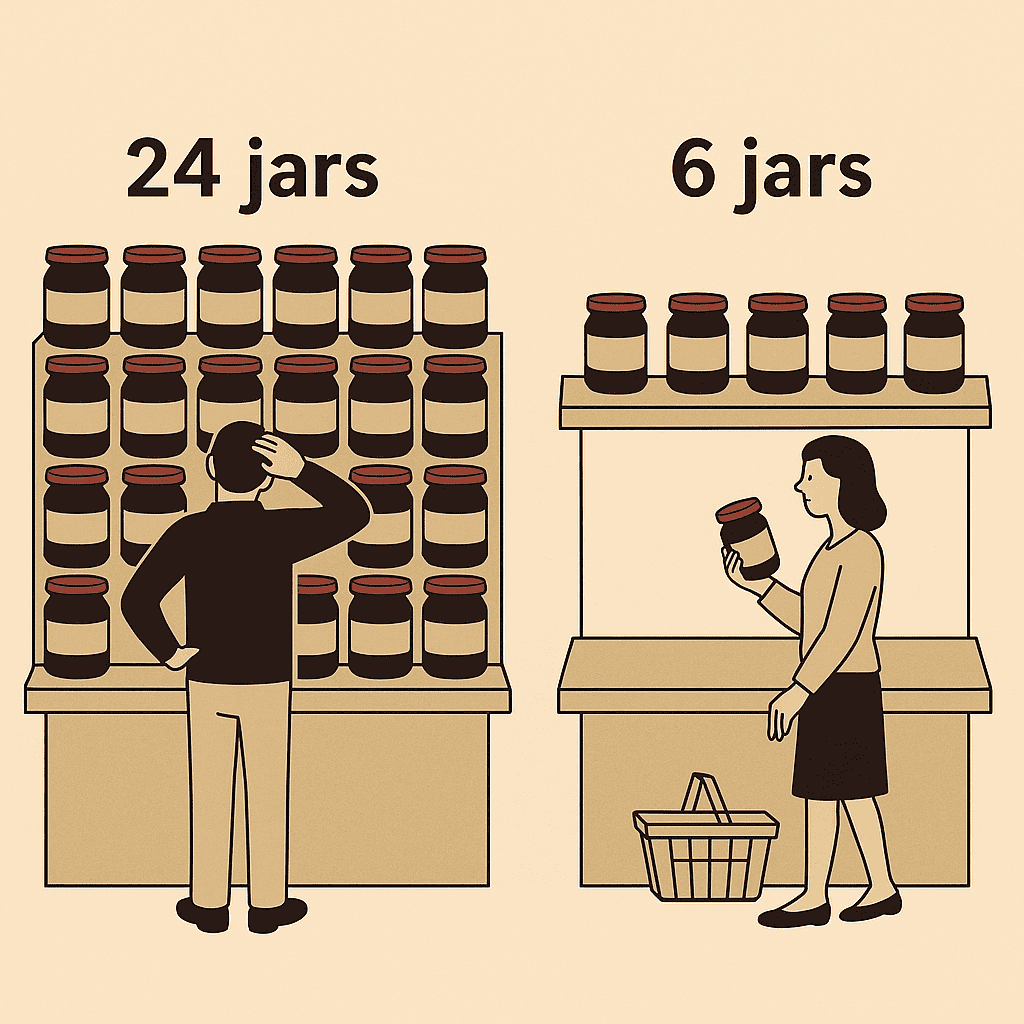
One of the most famous demonstrations of choice overload is the jam experiment by psychologist Sheena Iyengar. In a gourmet market, Iyengar set up a tasting booth that offered 24 flavors of jam on some days and only 6 flavors on other days. The results were striking: the larger 24-jam display attracted more browsers, but only 3% of those who stopped by ended up buying any jam. In contrast, the smaller 6-jam display led to purchases from 30% of tasters. In other words, shoppers were 10× more likely to buy when only six choices were available, compared to when they had two dozen options. This counterintuitive result – more choice yielding fewer sales – is a classic example of the paradox of choice in action.
This effect isn’t limited to trivial decisions like jam flavors. Even high-stakes choices can suffer from over-choice. A study of nearly 800,000 employees’ retirement plans found that the more investment fund options a 401(k) plan offered, the lower the employee participation rate overall. Plans offering just a “handful” of funds had significantly higher enrollment, whereas plans with 10 or more options saw participation drop sharply. In fact, as the number of fund choices in the plan went up, employees increasingly failed to choose any – a classic analysis paralysis that left many not enrolling at all. These findings underscore a key point: when faced with excessive complexity or too many alternatives, people often default to the status quo (choosing nothing) because it feels safer than making a “wrong” choice.
Real-World Examples: Less Choice, More Sales
Smart companies have learned that simplifying choice can boost sales and customer satisfaction. Retailers and product brands have seen tangible gains from pruning their offerings:
Wal-Mart’s discovery:“Folks can get overwhelmed with too much variety. With too many choices, they actually don’t buy,” observed Duncan MacNaughton, a Wal-Mart merchandising executive. After the 2008 recession, many retailers (including Wal-Mart) reduced their assortment of products, finding that trimming slow-moving items made shopping less confusing and actually increased sales in those categories. Fewer products on the shelf meant customers could find what they wanted faster, leading to higher conversion rates.
Procter & Gamble’s shampoo simplification: P&G famously cut its Head & Shoulders shampoo line from 26 different variants down to 15. The result? Sales jumped by 10% for the streamlined product line. By eliminating nearly half of the choices (many of which were redundant or low-sellers), P&G made the purchase decision easier for shoppers, and more people ended up buying the shampoo.
Cutting to profitability: In another case, a pet products company (“Golden Cat”) axed its 10 poorest-performing cat litter products. Freed from the clutter of too many similar choices, customers gravitated to the remaining options and the company’s profits surged 87% after the cutback. Similarly, warehouse retailer Costco carries a deliberately limited selection in each category, and has seen higher per-product sales by focusing customers on a few quality options. These examples show that reducing choice can eliminate buyer confusion and directly drive up revenue.
The takeaway for marketers is clear: offering every possible flavor, feature, or configuration might seem customer-friendly, but it can backfire if the customer gets overwhelmed. Often, it’s better to curate your offerings – focus on the most valuable and distinct choices – rather than bombard customers with an over-assortment that dilutes their ability to decide.
The 3-Option Rule in Pricing Pages (Finding the Sweet Spot)
Nowhere is the “less is more” principle more evident than in SaaS pricing web pages. If you’ve noticed, many software companies present exactly three pricing plans (e.g. Basic, Pro, Enterprise) side by side. This is by design. Presenting three options hits a psychological sweet spot: it’s enough variety to cater to different needs, but not so many as to overwhelm. In fact, multiple studies have confirmed that three is often the magic number for pricing tiers:
Price Intelligently study: In an analysis of 512 SaaS companies, those with 3 pricing tiers achieved about 30% higher average revenue per user than companies that offered 4 or more tiers. More tiers did not mean more revenue – instead, having too many plans tended to confuse customers and dilute the impact of each option.
ConversionXL A/B test: Reducing the number of pricing options can boost conversion rates substantially. One study found that when SaaS companies moved from 4 price tiers down to 3, their conversion rates increased by an average of 27%. Removing that fourth option helped more buyers pull the trigger, rather than freezing up over analysis of four different plans.
HubSpot benchmark data: Broad industry data backs this up. Companies with three pricing plans have roughly 40% higher conversion rates on their pricing pages compared to those offering five or more choices. Beyond three options, every additional plan tends to add more friction than benefit.
Why do three-tier structures perform so well? Psychologically, they create a clear “good-better-best” comparison that humans can process intuitively. With three choices, many customers will gravitate to the middle option (a well-known compromise effect), or confidently choose the tier that best fits their needs. In contrast, five or six pricing options can create analysis paralysis. The differences blur together and the effort to compare them feels daunting, increasing the odds that the customer gives up. One well-known SaaS company, Intercom, discovered this the hard way: after years of adding more and more plans for different use cases, their sign-ups were stalling. When Intercom consolidated from six pricing tiers down to three, they saw an immediate 17% jump in conversions on their website. Simplifying the choice made it much easier for customers to decide, “Yes, I’ll go with this plan,” instead of bouncing away to think it over.
The lesson for pricing (and product packaging in general) is that you should prioritize clarity over quantity. Offer enough choices to segment your audience, but not so many that the differences become confusing. Three well-differentiated options (often labeled in a way that highlights a “most popular” or recommended choice) tend to maximize conversion efficiency in many markets. As one SaaS pricing report put it succinctly: more tiers often create a “paralyzing paradox of choice” that sends potential customers running for the exit.
Keep It Simple in Calls-to-Action and Messaging
Choice overload isn’t just about product options or pricing plans – it also applies to your marketing messages and calls-to-action (CTAs). If your web page or email presents multiple competing actions for the user (“Download our whitepaper! Check out our blog! Sign up for a demo!” all at once), you risk confusing and losing them. The same principle of focus yields better results in communication.
Consider email marketing: Having one clear CTA in an email tends to dramatically outperform emails with several different links or buttons. According to Campaign Monitor data, emails limited to a single call-to-action got up to 371% more clicks than emails that crowded in multiple CTAs. That’s an astonishing lift in engagement simply by not distracting the reader with too many choices of where to click. It appears that when readers see just one prominent action to take, they’re far more likely to take it, whereas multiple buttons or links lead them to hesitate or ignore them all. This aligns perfectly with the adage we started with: if you confuse them, you lose them. Each additional choice or piece of information in a marketing message is another chance to lose the customer’s attention or sow doubt.
The key for any marketing communication – whether it’s a landing page, an advertisement, or a sales email – is to decide what you want the customer to do most, and focus them like a laser on that. Trim away extraneous offers and secondary options that might pull them off the path. In web design, this might mean featuring one primary button (e.g. “Start Your Free Trial”) in a bold color and removing other lesser links or menu items on that page. In copywriting, it means crafting a single, crystal-clear value proposition rather than dumping every feature and detail at once. By reducing cognitive load and guiding the customer’s eyes and mind to one focal point, you make it easy for them to act.
Conclusion: Simplify to Amplify
From consumer products to SaaS software to email campaigns, the pattern is consistent: simplicity sells. When in doubt, cut the clutter – be it trimming down a product lineup or streamlining the choices in a marketing offer. The data and examples above show that a well-curated set of options outperforms an abundance of options. Customers feel more confident in their decision when they aren’t bogged down comparing dozens of alternatives or wading through complicated messaging. As Sheena Iyengar advised after studying choice overload for years: “Less is more.” Companies that embrace this mantra have seen higher conversions, higher sales, and happier customers.
In practical terms, take a hard look at your own marketing and product presentation:
Are you giving your audience just enough options to find a fit, but not so many that they freeze up?
Is your pricing page clean and limited to a few plans that are easy to compare?
Does each campaign or page have one primary CTA that stands out, or are you asking the customer to consider multiple actions at once?
By focusing your offerings and communications, you respect your customer’s time and mental energy. You make their decision simple. And a simpler decision is a faster decision – one that is more likely to end in a “yes, I’ll buy”. In the end, reducing choice reduces confusion, and reducing confusion increases conversions. The confused customer buys nothing, but the confident, unconfused customer is far more likely to buy something. Keep it concise, keep it clear, and watch your marketing metrics climb.
Bottom line: When it comes to guiding customer decisions, less truly can be more – more sales, more sign-ups, and more satisfied customers with less mental friction in getting there. By strategically limiting choices and simplifying your message, you make it easy for customers to choose you.
Sources
Iyengar, Sheena. The Art of Choosing (TED Talk) – Research on choice overload and its effects on consumer decision-making.
Schwartz, Barry. The Paradox of Choice – Psychology of why too many options can lead to decision paralysis.
MarketingProfs (2010): “Don’t Confuse the Customer: Limit Choices, Make More Sales” – Wal-Mart merchandising insights on reducing product variety to boost sales.
Inc.com (2018): Examples of P&G and others cutting product lines resulting in higher sales/profits.
SaaStock (2023): “The SaaS Pricing Trap: When Too Many Tiers Kill Conversions” – Data showing optimal three-tier pricing (Price Intelligently, ConversionXL, HubSpot benchmarks) and case studies like Intercom.
Campaign Monitor via Amra & Elma (2025): Statistic on single-CTA emails getting 3× higher click rates than multi-CTA emails.
Intradiem Blog (2014): “A confused customer buys nothing” – on the importance of clarity in customer experience.
Volkswagen’s acclaimed “Clean Diesel” marketing campaign backfired disastrously when it was revealed in 2015 that the company had deliberately cheated on emissions tests.
The German automaker had promoted its diesel cars as low-emission, eco-friendly vehicles only for regulators to discover a hidden software “defeat device” that made them appear clean in tests while they actually emitted up to 40 times the legal pollution on the road.
The ensuing scandal (dubbed “Dieselgate”) led to a global outcry, billions in fines and recall costs, and a crisis of trust that tarnished Volkswagen’s reputation as an industry leader in innovation and sustainability.
Company Involved
Volkswagen is the company at the center of this story. A leading German automaker – at one point the world’s second-largest car manufacturer – Volkswagen (VW) had built its brand on engineering prowess and even owned luxury marques like Audi (also implicated in the diesel saga). VW’s ambitious “Clean Diesel” initiative was intended to showcase its technological leadership and commitment to environmental innovation, until it unraveled in scandal.
Marketing Topic
Advertising
Branding
Honesty
Public Reaction or Consequences
The public and media response to Volkswagen’s deception was swift and severe. The scandal dominated headlines worldwide as “Dieselgate,” and customers felt deeply betrayed by a brand that had marketed itself as eco-conscious. Volkswagen’s stock price plunged almost 20% in the first trading day after the news broke, and the company’s market value and goodwill evaporated virtually overnight. Consumers and commentators openly mocked VW’s prior advertising: the company’s proud slogan “Das Auto” (“The Car”) was derisively twisted into “Das Cheater,” and Audi’s tagline “Truth in Engineering” was parodied as “Engineering the Truth” by disillusioned customers. This popular outrage reflected how severely Volkswagen’s actions violated public trust.
Beyond reputational damage, the concrete consequences were immense. Governments around the globe launched investigations, and regulators in the U.S. and Europe ordered massive recalls of VW and Audi diesel models. In the United States, Volkswagen’s sales nosedived – in November 2015 (not long after the revelations) VW’s U.S. sales fell 25% compared to the previous year. The company soon faced a cascade of lawsuits and record-breaking fines. Top executives resigned under pressure, including VW’s longtime CEO Martin Winterkorn. Within months, Volkswagen agreed to settlements totaling over $15 billion in the U.S. alone to buy back or fix nearly half a million affected cars and compensate owners. Worldwide, about 11 million diesel vehicles were ultimately identified as having the cheating software. The scandal triggered broader scrutiny of the auto industry’s environmental claims, with many observers likening its impact on corporate credibility to a corporate earthquake.
Why It Matters Today
Greenwashing and Authenticity: Volkswagen’s case is a cautionary tale about “green” marketing gone wrong. In today’s era of climate awareness and ESG (Environmental, Social, and Governance) accountability, consumers and regulators are quicker than ever to call out false environmental claims. VW’s downfall heightened skepticism toward corporate sustainability messaging – brands now must back up eco-friendly promises with genuine action, or risk severe backlash.
Trust in the Age of Transparency: The Dieselgate saga underscored that trust is a marketer’s most precious asset. In the age of social media and instant information, any deception can be exposed and go viral overnight, inflicting lasting damage. Volkswagen’s collapse in credibility showed that once customer trust is broken, it’s extraordinarily hard to rebuild, no matter how big your advertising budget. Modern audiences reward transparency and punish dishonesty, making ethical marketing an imperative.
The Cost of Ethical Lapses: This case remains relevant as a dramatic example of how ethical lapses can carry massive financial and legal consequences. Today’s marketers operate in a landscape of stricter regulations (such as tougher emissions standards and advertising guidelines) inspired in part by scandals like Volkswagen’s. The case reinforces that unethical marketing or product claims can lead to multi-billion dollar penalties and criminal investigations – a sobering reminder in an era of heightened corporate accountability.
3 Takeaways
1. Never make promises you can’t keep. A bold unique selling proposition (USP) means nothing if the product itself doesn’t deliver. Volkswagen’s “clean diesel” pitch was compelling, but it proved to be a disingenuous promise built on cheating. The company’s collapse shows that no amount of slick marketing can save a false claim. It will eventually crumble and take your brand’s credibility with it.
2. Trust is hard to win and easy to lose. Volkswagen learned the hard way that decades of brand loyalty can be destroyed in an instant by a breach of integrity. Once customers feel deceived, winning them back is an uphill battle. No campaign or PR effort can quickly undo the damage of lost trust. Marketers must treat honesty and consumer trust as sacred, because a reputation shattered by scandal may take years (and enormous resources) to rebuild – if it can be rebuilt at all.
3. “Green” marketing must be genuine (avoid greenwashing). Touting environmental benefits is powerful, but only if they’re true. Misleading the public about eco-friendly qualities is a recipe for disaster in the long run. Volkswagen’s ads claimed its diesels dramatically cut emissions, yet in reality the cars emitted far above legal limits. The backlash from this deceit shows that today’s savvy consumers (and regulators) will ferret out the truth. The lesson: align your marketing with actual product performance and values, especially when positioning something as environmentally beneficial – otherwise expect severe fallout.
Notable Quotes and Data
“Our company was dishonest with the EPA, and the California Air Resources Board and with all of you, and in my German words: we have totally screwed up.” – Michael Horn, Volkswagen America CEO (admitting the scandal)
“By duping the regulators, Volkswagen turned nearly half a million American drivers into unwitting accomplices in an unprecedented assault on our atmosphere.” – Sally Yates, U.S. Deputy Attorney General (condemning VW’s actions)
11 million – The number of Volkswagen and Audi diesel vehicles worldwide that were equipped with the emissions-cheating software. (Volkswagen ultimately paid over $25 billion in fines, settlements, and buybacks in the years following the scandal.)
Full Case Narrative
Background: By the late 2000s, Volkswagen was eager to shake up the automotive market with its diesel technology. Diesel engines, long popular in Europe, had a tarnished reputation in the U.S. for being noisy and dirty. VW saw an opportunity: if Americans could be convinced that clean diesel was real, the company could carve out a larger U.S. market share and meet tightening environmental regulations, all while offering drivers high fuel efficiency and performance. In 2009, Volkswagen launched a massive marketing offensive to rebrand diesel. It rolled out a campaign called TDI Truth & Dare, complete with a dedicated website and Super Bowl commercials, aiming to educate consumers that VW’s new TDI diesel cars were eco friendly without sacrificing power. The company’s ads were clever and upbeat, for example, one TV spot featured three elderly ladies, the Golden Sisters, giddily talking about dirty topics, only to reveal they were playfully referring to low emissions and clean diesel technology. Volkswagen even enlisted its rally driver Tanner Foust to showcase diesel’s pep, and boasted of a Guinness World Record 58 mpg achievement in a VW Jetta TDI.
These marketing efforts painted a picture of a revolution in car fuel, diesel, but clean and fun. And initially, the strategy seemed to work brilliantly. Over the next several years, VW’s diesel models garnered critical praise and even environmental awards. The Clean Diesel vehicles were marketed as meeting the strictest emissions standards in all 50 states, reducing harmful pollutants by 90 percent, and giving consumers guilt free driving with great mileage. Volkswagen’s green branding grew so strong that the company, traditionally known for iconic gas models like the Beetle, won accolades for sustainability. In fact, VW had burnished its image by adopting rigorous environmental goals early on; it was the first automaker to commit to the ISO 14001 environmental standard and even won an international sustainability award in 2014. By 2015, Volkswagen was on the verge of becoming the world’s largest automaker, and its diesel cars were selling in record numbers, with over 550,000 clean diesel VWs and Audis sold to American consumers since 2008.
The Deception Uncovered: Behind the scenes, however, the reality was very different. Unknown to car buyers and most VW employees, Volkswagen’s engineering and management had made a fateful decision back in 2006 to 2007: when they realized their new diesel engines could not meet U.S. emissions standards and satisfy cost and performance goals, they chose to cheat rather than come clean. VW had secretly installed sophisticated software in its diesel cars’ engine control units. This defeat device could detect when a vehicle was undergoing an official emissions test, for example, sensing the car was on a lab dynamometer. During tests, the software would put the engine in a special low emission mode to ensure it passed regulations. But once the car returned to normal driving on the road, the emissions controls were virtually turned off to restore full power and fuel economy, causing the vehicle to emit far more pollutants than allowed. This duplicitous software tweak meant VW could advertise the best of both worlds, great mileage, peppy performance, and clean emissions, when in truth the cars only ran clean in lab conditions.
From 2009 to 2015, Volkswagen managed to keep this deception under wraps. The ruse started to unravel thanks to independent researchers and regulators. In early 2014, a small non profit group, the International Council on Clean Transportation, commissioned West Virginia University to test real world emissions of diesel cars. The WVU researchers found startling discrepancies: on the road, VW’s clean diesel Jetta and Passat were belching out nitrogen oxide pollutants at levels 30 to 40 times higher than regulatory limits, even though they passed lab tests. This anomaly raised red flags at the California Air Resources Board and the U.S. Environmental Protection Agency. Over more than a year, CARB and EPA pressed Volkswagen for an explanation. VW engineers allegedly feigned ignorance and even performed a limited recall claiming to fix the issue in late 2014, but the problem persisted. Finally, under threat that EPA would withhold approval for its 2016 models, Volkswagen leadership admitted in early September 2015 that it had installed defeat devices in its diesel cars.
The Scandal Erupts: On September 18, 2015, U.S. regulators publicly announced that Volkswagen had violated the Clean Air Act by rigging emissions tests. The news exploded across global media. Within days, VW went from hero to pariah in the court of public opinion. The company issued a blanket apology and halted sales of new diesel models. Volkswagen’s U.S. CEO, Michael Horn, candidly stated, we have totally screwed up, during an event that week, and Volkswagen AG’s CEO Martin Winterkorn declared he was endlessly sorry for the betrayal, he resigned shortly thereafter. The scandal broadened as other countries began examining VW diesels; authorities in Europe and Asia initiated their own probes, and the term Dieselgate caught on to describe the fiasco.
Customers who had bought into VW’s green promises felt cheated. Clean diesel owners suddenly learned their cars were emitting smog forming pollutants at astonishing levels, up to 4,000 percent the legal limit of nitrogen oxides in real driving. Environmental groups pointed out the public health implications: these excess emissions contributed to respiratory problems and smog, undercutting VW’s eco friendly claims. The media and late night comedians skewered Volkswagen’s hypocrisy, turning the company into a punchline. In one striking example, Time magazine’s cover replaced VW’s logo with a toxic cloud. Social media lit up with outrage, as well as support for regulators to punish the wrongdoing.
Immediate Fallout: The impact on Volkswagen was dramatic. In the week after the story broke, VW’s stock price in Frankfurt plummeted roughly 30 percent, erasing tens of billions of dollars in market capitalization. Consumers started shunning the brand, Volkswagen’s U.S. sales for the month of November 2015 dropped 25 percent year over year, and in some European markets, VW’s sales stalled as well. Volkswagen swiftly set aside €6.7 billion, about $7.3 billion, to cover potential costs, but many analysts suspected the final bill would be much higher. The scandal also sent shockwaves through the broader auto industry. Other manufacturers’ stocks fell in sympathy, and there were widespread calls for more rigorous emissions testing across the board. It became clear that VW’s deception had not only damaged its own brand, but also undermined trust in diesel technology and corporate environmental claims generally.
Regulatory and legal consequences mounted quickly. In the U.S., the Department of Justice launched a criminal investigation, and the Federal Trade Commission filed a lawsuit accusing Volkswagen of false advertising for its Clean Diesel campaign. By early 2016, Volkswagen was negotiating one of the largest consumer class action settlements in automotive history. Meanwhile, environmental regulators in Europe ordered Volkswagen to recall millions of vehicles to remove or update the software. Some countries temporarily banned the sale of affected VW models until fixes were in place. Top executives faced personal accountability: several Volkswagen engineers and managers were indicted or arrested in the U.S. and Germany. This included an American based VW compliance manager who was sentenced to seven years in prison for his role in the cover up. Perhaps most notably, long serving CEO Martin Winterkorn resigned in disgrace in September 2015, and later he, along with other VW leaders, was charged by German authorities with fraud for failing to stop the scheme.
Crisis Management and Response: Volkswagen’s initial response to the crisis was widely criticized as slow and evasive. In the first days, the company issued generic apologies but provided little detail, fueling public frustration. However, as the pressure intensified, VW attempted to course correct its PR strategy. In November 2015, about two months into the scandal, Volkswagen’s U.S. division took out full page ads in dozens of American newspapers to say sorry directly to customers. The plain text ads bore the headline We are working to make things right, acknowledging the company’s failure and asking for patience as they developed a fix. In these open letters, VW promised to regain customer trust and announced a goodwill package for owners of affected cars, including $500 Visa gift cards, an additional dealership credit, and free roadside assistance. This gesture, while small relative to the scale of the damage, was aimed at staunching customer anger and preventing defection to other brands.
At the same time, Volkswagen began the technical work of remedying the cars. The company’s engineers scrambled to engineer software updates or modifications to bring the cars into compliance, though this proved challenging without harming performance. In the U.S., regulators eventually approved fixes for some models, but many owners opted for buybacks instead, taking Volkswagen’s offer to repurchase the cars at pre scandal market value. By mid 2016, a U.S. federal court approved a civil settlement in which Volkswagen agreed to spend up to $14.7 billion to buy back or repair around 475,000 2.0L VW and Audi diesel cars and to compensate owners and invest in environmental mitigation. This unprecedented settlement included $10 billion for consumer buybacks and repairs and an additional $4.7 billion earmarked for environmental initiatives, such as promoting zero emission vehicles and pollution remediation. In a separate agreement, VW later pleaded guilty to criminal charges in the U.S. and paid a $2.8 billion criminal fine in 2017, underscoring the severity of the fraud. All told, when including Canada and the rest of the world, Volkswagen’s financial penalties and remediation costs have exceeded $30 billion over the years, a staggering sum even for a giant automaker.
Throughout 2016 and 2017, Volkswagen worked to rebuild its reputation under new leadership. The new CEO, Matthias Müller, vowed to instill a more ethical culture and cooperate fully with authorities. VW’s marketing communications shifted tone as well. The company abandoned its long time global slogan Das Auto, judging it too arrogant for a firm trying to show contrition. Instead, Volkswagen’s branding became more modest and customer focused. Internal communications from late 2015 show VW’s leaders emphasizing humility and the need to listen to customers and regulators in a way the company had not before.
Reflection, Why It Failed: In hindsight, Volkswagen’s Clean Diesel campaign was doomed because it was built on a lie. The marketing itself was highly effective, maybe too effective, as it convinced not only consumers but also many within the company that VW was a champion of eco friendly innovation. This created a dangerous echo chamber. By prioritizing image over honesty, Volkswagen set itself up for catastrophe the moment the truth emerged. The case illustrates a fundamental principle in marketing ethics: a great campaign cannot compensate for a bad product or bad behavior. Eventually, reality catches up. In VW’s case, the disconnect between the promise, low emissions, high trust, and the reality, willful emissions cheating, was so stark that it not only destroyed an entire marketing initiative, but also severely damaged the company’s overall credibility. The scandal also highlighted issues in VW’s corporate culture, an environment that some reports described as pressuring employees to achieve ambitious targets at all costs, perhaps contributing to the rationalization of unethical decisions.
For marketers, Dieselgate underscores the potential unintended consequences when a campaign crosses ethical lines. Volkswagen had sought to position itself as a forward thinking, trustworthy brand for the environmentally conscious consumer. Ironically, their fraudulent actions produced the opposite effect, a collapse of trust that became a textbook example of corporate greenwashing. In marketing textbooks and business schools, the VW case is now studied alongside infamous failures like New Coke or Enron’s misrepresentations, except Volkswagen’s tale is one of deliberately misleading on environmental integrity, which strikes a particularly sensitive chord in an era of climate change awareness.
Timeline
2009: Volkswagen launches its “Clean Diesel” TDI models in the U.S., backed by the extensive “TDI Truth & Dare” marketing campaign to convince American consumers that diesel can be clean and efficient.
May 2014: Researchers from West Virginia University publish a study finding that VW’s diesel cars emit far more NOx in real driving than in lab tests.
September 18, 2015: U.S. EPA publicly accuses Volkswagen of installing defeat devices to cheat emissions tests in about 482,000 diesel cars. The scandal erupts globally.
September 21–23, 2015: Volkswagen’s stock price plunges nearly one-third in two days as investors react to the crisis. CEO Martin Winterkorn resigns.
October–November 2015: Investigations expand. VW runs its first apology ads and offers a $1,000 goodwill package to affected U.S. owners.
June 28, 2016: Volkswagen agrees to a historic civil settlement in the U.S., including up to $14.7 billion to buy back or fix 2.0L diesel cars and compensate owners, plus investments in environmental mitigation.
January 2017: Volkswagen pleads guilty to fraud and obstruction of justice and agrees to pay $2.8 billion in criminal fines.
2018–2019: Legal fallout continues. VW pivots to electric vehicles and undertakes marketing reforms to rehabilitate its image. By 2019, VW’s global sales have bounced back to record levels.
What Happened Next?
After the initial crisis, Volkswagen undertook a long journey to rebuild trust and transform its business. Key changes started at the top: new CEO Matthias Müller, and later Herbert Diess, reorganized VW’s management, bringing in new compliance officers and emphasizing an open, values driven culture to prevent future ethical breaches. The company implemented stricter internal controls and gave its ethics and legal teams more clout. As noted, Volkswagen also made a symbolic break from the past by dropping its tagline Das Auto, which company leaders felt implied an arrogance that was no longer tenable. In its advertising and public statements, VW adopted a tone of humility and responsibility, focusing on winning back customers one step at a time.
Crucially, Volkswagen pivoted its business strategy toward electric vehicles in a bid to redeem its environmental credibility. In the years following Dieselgate, the company announced massive investments in electric mobility and set ambitious targets for new EV models. It launched an initiative called Electric for All, signaling a commitment to make electric cars mainstream. As part of this campaign, Volkswagen revealed plans to roll out 70 new electric models by 2028 and poured resources into developing its ID series of electric cars. The automaker even invested about $800 million to build a new EV production plant in Chattanooga, Tennessee, a tangible move to show it was serious about zero emission vehicles. VW’s marketing now highlights these electric models, like the ID.4 SUV and ID.Buzz van, and positions the company as forward looking and sustainability focused. This dramatic strategic shift from clean diesel to electric is often seen as Volkswagen’s effort to turn its darkest crisis into an impetus for positive change.
In terms of performance, Volkswagen gradually recovered in many markets. By 2018 and 2019, the company actually achieved record global sales volumes, thanks to growth in China and a strong overall product lineup, including SUVs and new generations of vehicles. This indicated that the scandal, while devastating, was not fatal, Volkswagen remained a dominant player in the auto industry. However, the comeback was not uniform: in the U.S., VW’s market share took years to rebound, and diesel passenger cars essentially disappeared from its American showrooms, Volkswagen agreed to a ban on selling diesels in the U.S. for a period as part of its settlements. The company decided that regaining consumer confidence was more important than trying to push diesel in skeptical markets, so it doubled down on electrification and on polishing its once blemished image.
Volkswagen’s efforts to rehabilitate itself have included continued apologies and outreach. The company has run marketing campaigns highlighting its heritage and commitment to making things right, and it frequently references its shift to cleaner technology as evidence of lessons learned. On social media and in public forums, VW has been markedly more transparent about its progress and setbacks. For example, the company’s officials regularly publish updates on compliance measures and environmental goals, acknowledging the Dieselgate episode as a turning point. This transparency is aimed at rebuilding trust through accountability.
From a corporate responsibility standpoint, Volkswagen has also funded environmental programs beyond what was legally required, such as initiatives to promote electric charging infrastructure and investments in renewable energy projects, partly to atone for the pollution caused by its cheating. These actions, along with the mandated mitigation funds, are gradually helping to offset the environmental damage of the excess emissions.
As of today, Volkswagen appears to have stabilized and learned some hard lessons. Its current marketing emphasizes reliability, innovation, and responsibility. The automaker still faces skepticism from some quarters, and occasional reminders of the scandal in press or court proceedings, but it has largely moved forward, focusing on becoming a leader in the electric vehicle transition. The company has publicly stated goals to achieve significant EV sales targets and carbon neutrality in the coming decades. In a sense, Volkswagen is attempting one of the biggest image overhauls in automotive history, from the company that synonymously cheated on emissions to a company that wants to define the future of clean transportation. Only time will tell if these efforts fully restore the trust it lost, but the early signs, strong sales of new models, positive reception to its electric ID lineup, and the absence of any further major scandals, suggest that VW is on a better path.
In sum, Volkswagen did recover financially and continues to be a global industry force, but the Dieselgate case remains a permanent cautionary chapter in its legacy. The company’s leaders have often stated that they will never forget the lessons of this crisis. The real measure of VW’s rehabilitation may lie in whether it can indeed avoid such ethical lapses going forward and live up to the sustainable, honest image it now strives to project. The industry at large, meanwhile, has been put on notice by this saga: in the digital age, deception can be ruinous, and authenticity is the currency that truly drives long term brand success.
One Sentence Takeaway
Even the most brilliant marketing campaign cannot cover up a lie. Volkswagen’s downfall shows that authenticity and trust are irreplaceable in marketing, and any short-term victory gained through deception will ultimately lead to a long-term disaster.
“The ’40/40/20 Rule’ makes this clear: 40% of a campaign’s success comes from targeting the right audience, 40% from the offer itself, and 20% from everything else.”
“There is no sale without marketing and no marketing without sales.”
“If content is king, context is key.”
Book Theme
Full Funnel Marketing centers on the Predictable Pipeline Method—a framework for aligning marketing, sales, and customer success teams to create scalable, consistent revenue growth through full-funnel marketing orchestration.
Why You Should Read This Book
This book is essential for B2B leaders and marketers seeking a clear, actionable framework to align teams, sharpen their Ideal Customer Profile (ICP), and orchestrate go-to-market strategies that eliminate inefficiencies and drive long-term growth.
Key Ideas and Arguments Presented
Defining and auditing your Ideal Customer Profile (ICP) is the foundation of successful marketing.
Understanding the human side of B2B buying—committees, roles, and psychology—is crucial.
Trust is built through consistent, audience-centered messaging and reputation.
Content must be contextual, continually refreshed, and strategically repurposed.
The buyer’s journey is non-linear, requiring adaptive, personalized engagement strategies.
Sales and marketing alignment is mandatory for predictable revenue growth.
Technology supports strategy—it is not the strategy itself.
Metrics and KPIs provide accountability and shared visibility across teams.
Internal orchestration is as important as external buyer engagement.
Predictable growth comes from removing friction and focusing on high-value accounts.
Book Outline
Target Market
Messaging & Content
Buyer’s Journey & Sales Cycle
Resources & Technology
Metrics & KPIs
Go-to-Market Motion
Go-to-Market Orchestration
Key Takeaways
ICP clarity drives efficiency and growth.
Customer journeys are complex and require flexibility.
Sales and marketing must align on goals, data, and personas.
Trust and reputation accelerate pipeline velocity.
Technology must fit strategy, not replace it.
Key Techniques
The 40/40/20 Rule for campaign success.
Building validated buyer personas using data and sales insights.
Content taxonomy and repurposing (“Content Legos”).
Account-based GTM strategies.
Shared playbooks for cross-team alignment.
ICP audits to ensure ongoing market fit.
Author’s Qualifications
Matt Heinz is President of Heinz Marketing, with decades of experience in B2B demand generation, pipeline growth, and go-to-market consulting. His team contributes insights, blending research and practical application for modern marketing organizations.
Comparison to Similar Books
Compared to ABM is B2B or Challenger Sale, this book is more comprehensive in covering both sales and marketing orchestration. Unlike tactical-only books, it balances frameworks with actionable processes, making it similar in approach to Play Bigger but focused on pipeline predictability.
Target Audience
B2B marketing leaders
Sales executives seeking better alignment with marketing
Demand generation and revenue operations professionals
CEOs and founders of growth-stage companies
Customer success leaders integrating with sales/marketing
MarTech and RevOps specialists
Critical Response to the Book
The book is praised for being highly practical and grounded in real-world applications. Critics highlight its clear frameworks, digestible chapters (many derived from proven blog posts), and its relevance for modern, complex B2B buying environments.
One Sentence Takeaway
Building a predictable pipeline requires aligning every function—marketing, sales, and success—around a clear customer profile, unified strategy, and adaptive orchestration to drive sustainable growth.