Case Study: Blockbuster’s Demise and the Missed Opportunity to Buy Netflix
Brief Summary
Blockbuster, once the king of video rentals, failed to adapt to the digital revolution and paid the ultimate price. In 2000, Blockbuster infamously passed on buying Netflix for $50 million, dismissing the then-small DVD-by-mail upstart as a niche play.
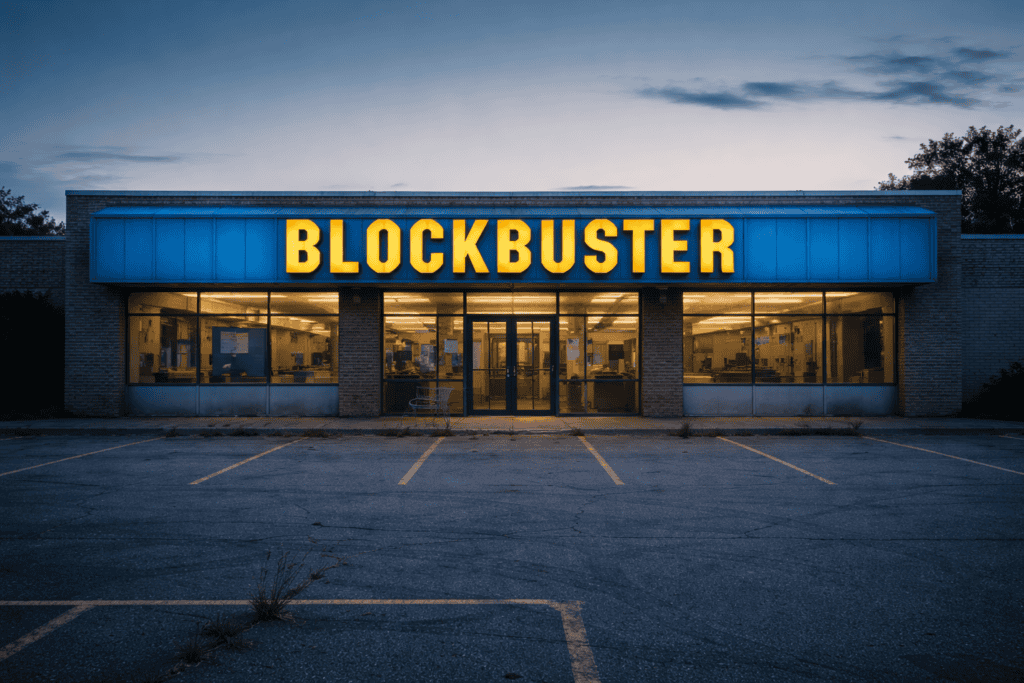
A decade later, Blockbuster went bankrupt as Netflix (and emerging streaming technology) stole its customers and rendered the video rental model obsolete.
This case is a classic cautionary tale of a market leader’s failure to innovate and put customers first, and it holds enduring lessons for modern marketers navigating disruption.
Company Involved
The brand at the center is Blockbuster. For years, Blockbuster was synonymous with home movie rental, operating thousands of video stores worldwide at its peak. Its story intersects with Netflix, the then-fledgling competitor that Blockbuster once had a chance to acquire – a chance that, in hindsight, could have changed the course of media history.
Marketing Topic
Strategy: business model innovation and failure to adapt.
Digital Disruption: technological change overturning an industry.
Customer Experience: convenience and removing friction like late fees.
Public Reaction or Consequences
Initially, many consumers remained loyal to Blockbuster, but frustration was growing. Late fees were a huge pain point – Blockbuster made $800 million a year from late fees around 2000, but that policy bred customer resentment. Netflix capitalized on this by offering no late fees and easy-by-mail rentals, winning praise from movie lovers who were tired of punitive charges. In response, Blockbuster launched a heavily advertised “No More Late Fees” campaign in 2005, but the fine print revealed sneaky fees (like restocking charges) that led to public backlash and legal action from 47 state attorneys general. The media lampooned Blockbuster’s half-hearted changes, and consumers increasingly saw the brand as out-of-touch. By the time Blockbuster filed for bankruptcy in 2010, the public narrative was clear: the once-dominant giant had failed to give people what they wanted – and paid dearly for it.
Why It Matters Today
Disruption can hit any industry: Blockbuster’s downfall shows how quickly digital innovation can upend market leaders, a warning that echoes today amid AI and other emerging tech upheavals.
Customer-centric innovation wins: The case highlights the importance of removing friction and focusing on customer experience (Netflix’s no-fee, on-demand model) in building loyalty.
Adapt or perish: In a fast-changing landscape, even big brands must continually reinvent their strategy. Blockbuster’s fate underscores that clinging to old models instead of disrupting yourself is a recipe for irrelevance.
3 Takeaways
1. Never stop innovating in the face of change. If you don’t disrupt your own business model, a competitor will – as Blockbuster learned the hard way.
2. Put customer experience over short-term profit. Profiting from customer pain points (like late fees) breeds backlash and opens the door for friendlier alternatives.
3. Don’t underestimate new competitors or channels. Dismissing emerging trends (online rentals, streaming) as “hype” can blind you to shifting consumer expectations and cost you your crown.
Notable Quotes and Data
John Antioco (Blockbuster CEO, 2000): Netflix was a “niche business” and “the dot-com hysteria is completely overblown.” (explaining his rejection of a Netflix buyout)
Marc Randolph (Netflix cofounder): “If you are unwilling to disrupt yourself… someone else will disrupt your business for you.”
$800 million in late fees (2000): the annual revenue Blockbuster earned from late charges, at the cost of massive customer frustration.
Full Case Narrative
In the 1990s, Blockbuster was an entertainment powerhouse. The chain had a ubiquitous presence – at its peak in 2004, Blockbuster ran over 9,000 stores worldwide, with $6 billion in annual revenue. Renting movies was a weekly ritual for many families, and Blockbuster enjoyed near-monopoly status in the home video market. However, by the end of that decade, storm clouds were gathering in the form of new technology and shifting consumer habits.
Netflix’s Emergence: In 1997, a small startup called Netflix began offering DVD rentals by mail. Netflix’s founders, Reed Hastings and Marc Randolph, pitched their model as a convenient alternative to driving to a store – a way to get movies without late fees or hassles. Initially, Netflix was very niche: early adopters of DVD players and cinephiles willing to wait for discs by mail. By 2000, Netflix was still unprofitable and relatively small, but it was growing. That year, Hastings and Randolph approached Blockbuster about a buyout. Famously, they offered to sell Netflix to Blockbuster for just $50 million – essentially inviting Blockbuster to absorb their online rental service and run it while Netflix would handle the digital side. Blockbuster’s CEO at the time, John Antioco, laughed off the idea. He and his team saw Netflix as an insignificant player and felt DVD-by-mail was no real threat to their lucrative storefront business. Antioco’s stance was summed up by his remark that “dot-com hysteria” was overblown hype. With the dot-com bubble bursting in 2000, this dismissive attitude wasn’t entirely crazy – but it was short-sighted. Blockbuster declined the offer, leaving Netflix to forge ahead on its own.
The Missed Opportunity: Blockbuster’s decision not to buy Netflix has become legendary in business circles – a what-if scenario as iconic as any. At the time, Blockbuster was a giant and Netflix a minnow. Blockbuster’s confidence bordered on complacency. It’s worth noting that even Netflix’s founders didn’t fully realize how big their idea would become; they themselves had set a relatively low price on their company. Yet, they understood something fundamental that Blockbuster didn’t: customers hated late fees and loved convenience. Netflix’s subscription model (one monthly fee for unlimited rentals, no due dates or late fees) directly attacked Blockbuster’s biggest pain point. In 2000 alone, Blockbuster earned around $800M from late fees, but that revenue came at the cost of customer goodwill. By refusing to adapt their model (or buy a competitor that had), Blockbuster essentially handed Netflix a golden opportunity.
Blockbuster Strikes Back (Too Little, Too Late): As Netflix gained traction through the early 2000s, Blockbuster eventually realized this wasn’t just a fad. In 2004, Blockbuster launched an online DVD subscription service to compete with Netflix, and later a hybrid online-and-store program called “Total Access.” They even started advertising “No More Late Fees” in 2005, acknowledging the negative sentiment late fees caused. However, these moves were either half-hearted or costly missteps. The “No Late Fees” campaign became a PR fiasco – it turned out Blockbuster would still charge customers if they kept a movie more than a week or so (by selling the movie to them and charging a restocking fee on return). This fine print felt like a bait-and-switch. Dozens of state Attorneys General pounced, investigating the advertising as deceptive. Blockbuster ended up settling with 47 states and paying fines to cover refunds. The incident not only hurt Blockbuster’s reputation, but also underscored an important difference in philosophy: Netflix built goodwill by eliminating late fees entirely, while Blockbuster couldn’t quite let go of that crutch.
Around the same time, Blockbuster’s internal strategy was in turmoil. The company’s leadership and shareholders were divided on how aggressively to pursue the new online model. Blockbuster’s CEO John Antioco did push for the online platform and the end of late fees, recognizing the need to change. But these changes cut into short-term profits, upsetting shareholders. Activist investor Carl Icahn led a revolt over Antioco’s spending on new initiatives and what he viewed as the CEO’s high compensation. The conflict led to Antioco’s departure in 2007. The new CEO, James Keyes (formerly of 7-Eleven), took a much more cautious approach. Keyes believed Blockbuster’s strength was its physical presence and that many customers still preferred in-store browsing. In one interview, he even expressed skepticism about streaming and digital on-demand video, comparing it to people still preferring bookstores for new releases. Under Keyes, Blockbuster scaled back its aggressive online efforts – effectively relinquishing the nascent online rental war to Netflix.
The Netflix Ascendancy: Meanwhile, Netflix kept innovating. In 2007, Netflix introduced video streaming for subscribers, just as broadband internet was becoming common. This move proved prophetic: while still offering DVDs, Netflix prepared for a future beyond physical discs. Blockbuster, on the other hand, was hamstrung by its brick-and-mortar legacy. It did make a foray into streaming by acquiring a small service (Movielink) in 2007, but by then Netflix’s brand and user base were far ahead. Redbox kiosks also entered the scene, undercutting Blockbuster’s rentals with $1-a-night DVD vending machines. Blockbuster’s massive store network – once an advantage – became a liability as foot traffic declined. The company had long-term leases and high overhead costs that Netflix and Redbox didn’t bear.
By 2010, the situation was dire. Blockbuster’s revenue was plummeting and the company was burdened with nearly $1 billion in debt. Stores were closing by the hundreds. That year, Blockbuster’s stock was delisted from the NYSE, and in September 2010 the company filed for Chapter 11 bankruptcy protection. It was an astonishing fall for a company that just a few years prior had been on top. In the bankruptcy auction, a winning bid of $320 million from Dish Network bought Blockbuster’s remaining assets in 2011 – a tiny fraction of Blockbuster’s former multibillion-dollar valuation.
Reflection – Why Blockbuster Failed: There are many reasons often cited for Blockbuster’s demise. Some say it was simply outdated technology meeting new tech (VHS and DVD rentals giving way to streaming). Others point to mismanagement and missed opportunities. In truth, it was a combination. Blockbuster failed to anticipate how quickly consumer preferences were changing. The convenience and simplicity offered by Netflix’s subscription model addressed unmet customer needs (no due dates, no driving to the store, personalized recommendations online). Blockbuster did too little, too late to counter that. Strategically, Blockbuster was wed to a business model – retail storefronts – that had been hugely profitable, and it hesitated to disrupt that cash cow. Ironically, Netflix’s founders initially wanted to partner with Blockbuster to combine the best of both worlds (online + stores). Blockbuster’s rejection of that idea, and later half-measures, meant that Netflix eventually beat Blockbuster at both convenience and content delivery.
Crucially, Blockbuster’s marketing and branding strength (everyone knew the name and their blue-and-yellow tickets) couldn’t save it when the value proposition no longer appealed. All the Super Bowl ads and slogans (“Make it a Blockbuster Night!”) weren’t enough to overcome the fact that Netflix offered a fundamentally better customer experience. This case underscores that effective marketing isn’t just about campaigns – it’s about aligning to what customers want and where the market is headed. Blockbuster’s story has become a parable in business schools and marketing circles about the perils of complacency.
Timeline
1985: Blockbuster is founded and quickly grows into a video rental titan through the 1990s.
2000: Netflix offers to sell itself to Blockbuster for $50 million; Blockbuster’s CEO rejects the deal, viewing Netflix’s online model as trivial.
2004: Blockbuster reaches its peak with 9,100 stores and $6 billion in revenue worldwide. The company launches an online DVD rental service to compete with Netflix.
2005: Blockbuster advertises “No More Late Fees.” The campaign backfires when fine print reveals hidden fees; 47 states take legal action, forcing Blockbuster to modify ads and refund customers.
2007: Netflix introduces streaming video for subscribers, accelerating the shift to online viewing. Blockbuster’s longtime CEO John Antioco resigns under investor pressure; James Keyes becomes CEO and emphasizes store-based strategy while downplaying the threat of streaming.
2010: With revenue in freefall and nearly $1 billion in debt, Blockbuster files for bankruptcy protection. Its store count drops rapidly as outlets close nationwide.
2011: Dish Network acquires Blockbuster out of bankruptcy for $320 million and attempts to integrate the brand into its services. Blockbuster’s remaining company-owned stores continue to shut down.
2019: The once-mighty chain is reduced to a single independent Blockbuster store (in Bend, Oregon) still operating as a nostalgic holdout – the last relic of an era.
What Happened Next?
After bankruptcy, Blockbuster never recovered as a national brand. Dish Network initially kept about 1,700 stores open and experimented with using the Blockbuster brand for on-demand video, but these efforts fizzled amid heavy competition. By 2014, Dish had closed all remaining corporate-owned Blockbuster stores. The last store in Bend, Oregon – a locally franchised outlet – survived by embracing nostalgia and community support (it even became the subject of a 2020 Netflix documentary about itself). Blockbuster’s marketing today is essentially nonexistent, aside from occasional social media nostalgia posts and the odd “remember when?” viral content. In 2023, a cryptic revival buzz sparked when Blockbuster’s website briefly went live again, but as of now no real comeback has materialized.
On the flip side, Netflix grew into a streaming behemoth with hundreds of millions of subscribers worldwide, and it now produces award-winning original content. Netflix’s marketing emphasizes innovation and personalization – the very values Blockbuster had struggled to adopt. The contrast between the two companies’ trajectories couldn’t be more stark. For modern marketers, Blockbuster’s demise remains a vivid reminder that even legendary brands can vanish if they fail to keep up with consumer trends and tech disruption.
One Sentence Takeaway
Even a dominant market leader can fall when it stops innovating and ignores evolving customer needs – Blockbuster’s fate is a lesson to never grow complacent.
Sources and Citations
Los Angeles Times: Blockbuster Settles State Probes Into Late-Fee Ads
The Guardian: Blockbuster files for Chapter 11 protection
Reuters: Dish expands its scope with Blockbuster win
Reuters: Dish Network to close all Blockbuster stores, lay off 2800
TIME: “It’s Just Us Left.” Meet the Manager Running the World’s Last Blockbuster
Case Study: Blockbuster’s Demise and the Missed Opportunity to Buy Netflix Read More »