Strategy

how to use swot analysis for a winning marketing campaign

How to Use SWOT Analysis for a Winning Marketing Campaign

Reading Time: 2 minutes

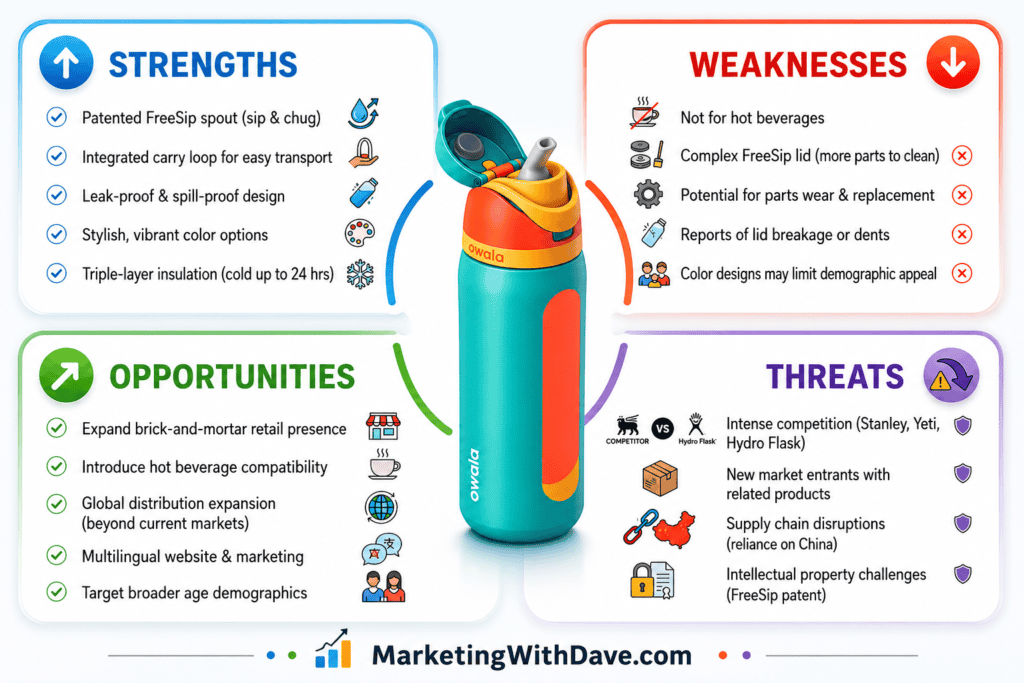
Once you’ve completed your SWOT analysis, see our Owala SWOT analysis for reference, the next question is, “Now what?” If you’re in marketing, you likely want to turn these insights into a campaign.

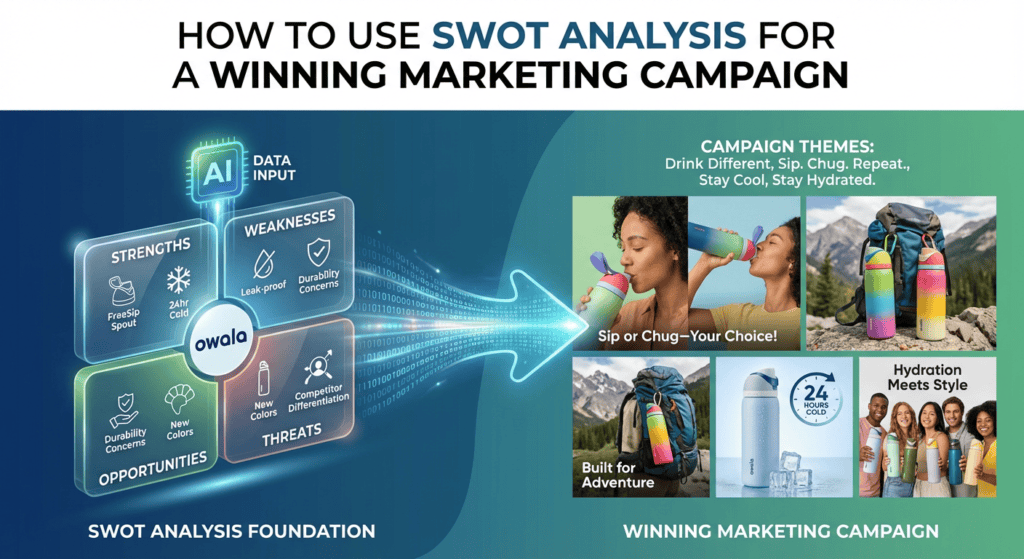
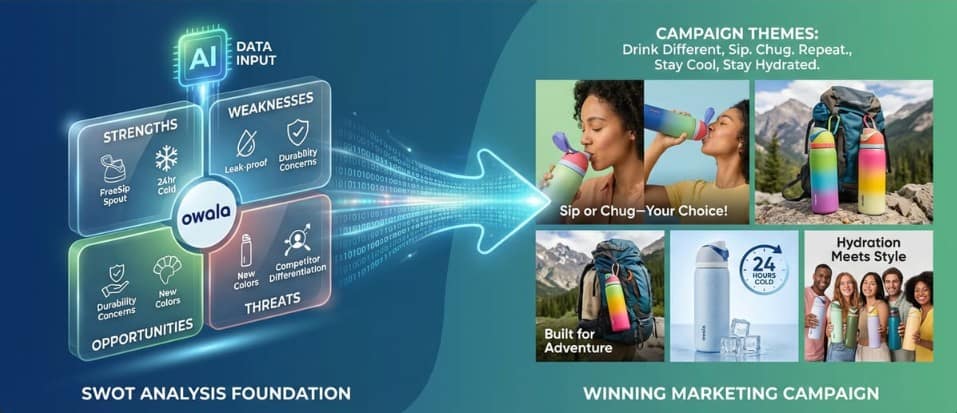
This is where AI can be a powerful tool—if given the right input. AI isn’t a mind reader; it thrives on detailed data. Our SWOT analysis provides exactly that, making it the perfect foundation for generating impactful campaign ideas. Here’s what we discovered.

Possible Campaign Themes

This SWOT analysis highlights what sets Owala apart from other water bottle brands. Here are four campaign themes that emphasize these unique strengths.

“Drink Different” – Emphasizing the FreeSip innovation.
“Sip. Chug. Repeat.” – Simple, repetitive, and catchy.
“Stay Cool, Stay Hydrated” – Focused on the 24-hour cold retention.
“The Water Bottle That Gets You” – Personalization, different colors, and easy use.

Six Ad Ideas

  1. Highlight the Unique FreeSip Spout
    Ad Copy: “Sip or chug—your choice! Owala’s patented FreeSip spout lets you drink your way. Leak-proof, stylish, and built for adventure.”
    Imagery: Close-up of the FreeSip spout in action (someone sipping vs. chugging). Split-screen showing a competitor’s traditional bottle vs. Owala’s innovative design.
  2. Address Durability Concerns While Reinforcing Portability
    Ad Copy: “Built for life’s adventures—Owala is leak-proof, durable, and always ready to go. Clip it, sip it, and never worry about spills.”
    Imagery: A traveler or hiker clipping an Owala bottle onto a backpack. A slow-motion shot of the bottle being dropped and staying intact.
  3. Overcome Cleaning Concerns with Ease-of-Use Messaging
    Ad Copy: “Hydration should be easy. Owala’s FreeSip spout is designed for effortless sipping AND simple cleaning—because your water bottle shouldn’t be a chore.”
    Imagery: A quick demo of how to clean the bottle (dishwasher-safe parts). A time-lapse of someone easily taking apart and reassembling the spout.
  4. Emphasize Cold Retention and Performance
    Ad Copy: “Stay cool all day—Owala keeps your drink ice-cold for 24 hours so you can hydrate longer, no matter where life takes you.”
    Imagery: A side-by-side comparison of ice cubes still intact in Owala after 24 hours. A person reaching for their Owala bottle after a workout, showing condensation on the bottle for a refreshing feel.
  5. Appeal to a Broader Demographic with New Color Variants
    Ad Copy: “Hydration meets style—find your perfect Owala in bold, bright, or classic neutral tones. Designed for every taste, every adventure.”
    Imagery: A flat lay of multiple Owala bottles in different colors. A diverse group of people, each with a bottle that fits their personality.
  6. Social Proof and Competitor Differentiation
    Ad Copy: “Move over, bulky water bottles—Owala is the sleek, leak-proof alternative designed for how YOU drink. Join thousands making the switch today!”
    Imagery: A side-by-side of Owala vs. a clunky competitor’s bottle. A happy customer review as an overlay with an image of someone using the bottle.

How to Use SWOT Analysis for a Winning Marketing Campaign Read More »

what is marketing the 10 functions of marketing

SWOT Analysis for Owala Water Bottles Using Oncely AI Tool

Reading Time: 2 minutes

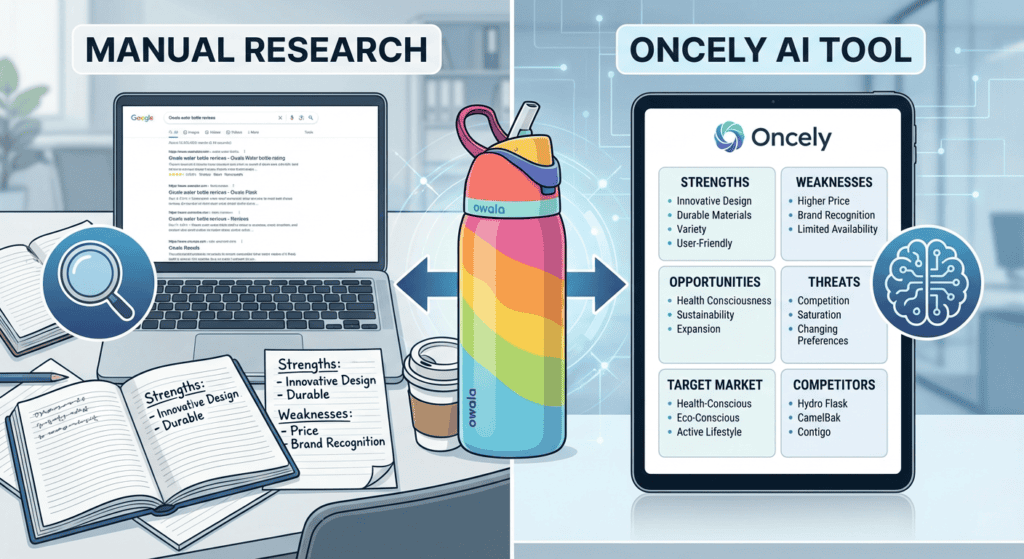
I performed a SWOT analysis for Owala water bottles using manual research. No AI was used, just the old school internet to find and compile the strengths, weaknesses, threats, and opportunities for Owala.

I discovered Oncely, an AI tool that will perform a SWOT analysis for you. Below are those results which you can compare with my manual research version. Overall, it’s comparable and I was impressed. Of course, with anything AI, trust a little and verify a lot. I would use Oncely the next time I need to perform a SWOT analysis.

Strengths

  • Innovative Design: Owala bottles feature a unique design with a built-in straw and a wide mouth for easy filling and cleaning.
  • Durable Materials: Made from high-quality, BPA-free materials, ensuring safety and longevity.
  • Variety of Colors and Sizes: Offers a wide range of colors and sizes to appeal to diverse consumer preferences.
  • User-Friendly Features: Includes a one-handed push-button lid for easy access to hydration on-the-go.

Weaknesses

  • Higher Price Point: Owala bottles may be more expensive than traditional plastic bottles, potentially limiting their market.
  • Brand Recognition: As a relatively newer brand, Owala may struggle with brand awareness compared to established competitors.
  • Limited Availability: May not be available in all retail locations, affecting accessibility for potential customers.

Opportunities

  • Growing Health Consciousness: Increased consumer focus on hydration and healthy living can drive demand for reusable water bottles.
  • Sustainability Trends: With rising awareness of environmental issues, promoting the eco-friendly aspects of Owala bottles can attract eco-conscious consumers.
  • Expansion into New Markets: Opportunities to expand into international markets or new demographic segments.

Threats

  • Intense Competition: Strong competition from established brands like Hydro Flask, CamelBak, and Contigo.
  • Market Saturation: The water bottle market is crowded, making it difficult to differentiate the brand effectively.
  • Changing Consumer Preferences: Shifts in consumer behavior or preferences towards different hydration solutions (e.g., flavored waters, smart bottles) could impact sales.

In-Depth Results

The following target market and competitors sections are what you get when choosing the in-depth setting.

Target Market
Health-Conscious Consumers: Individuals focused on fitness and hydration.
Eco-Conscious Shoppers: Consumers looking for sustainable and reusable products.
Active Lifestyle Enthusiasts: People engaged in outdoor activities, sports, and travel.

Competitors
Hydro Flask: Known for high-quality insulated bottles.
CamelBak: Popular for hydration packs and bottles with built-in straws.
Contigo: Offers a range of travel mugs and water bottles with spill-proof features.
This SWOT analysis provides a comprehensive overview of Owala water bottles, highlighting key areas for strategic focus and potential growth.

What’s Next

Once you’ve completed your SWOT analysis, the next step is putting it into action. See how we used Owala’s SWOT insights to shape a strategic marketing campaign.

SWOT Analysis for Owala Water Bottles Using Oncely AI Tool Read More »

swot analysis for owala water bottles

SWOT Analysis for Owala Water Bottles

Reading Time: 2 minutes

When it comes to innovative hydration solutions, Owala has made a significant splash in the market. Known for their stylish, functional water bottles designed with features like flip-top lids, built-in straws, and triple-layer insulation, Owala focuses on making it easier—and more enjoyable—to stay hydrated. Competing with industry giants like Hydro Flask, Yeti, and S’well, Owala differentiates itself through bold designs, user-friendly features, and a commitment to sustainability.

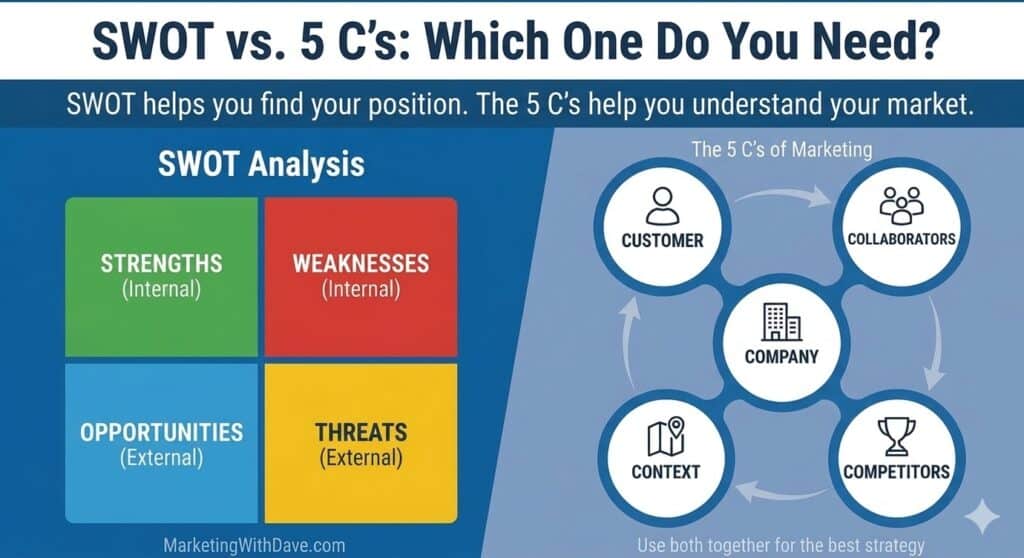
New to SWOT analysis? If you’re looking for a deeper explanation of the framework, start with SWOT Analysis: Strengths, Weaknesses, Opportunities and Threats Explained. If you want to see how these insights can be turned into action, check out How to Use SWOT Analysis for a Winning Marketing Campaign. Curious how AI compares with manual research? I also created this same SWOT using Oncely AI so you can compare the results.

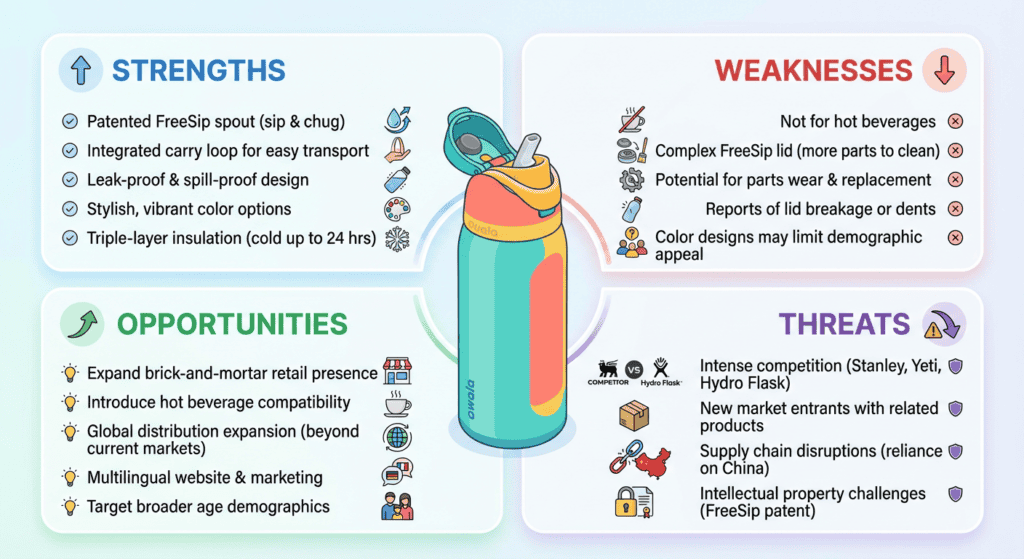
Here is the SWOT analysis I performed for Owala.

Strengths

  1. Patented FreeSip spout with a flip-top lid that allows for both sipping and chugging.
  2. Easier to transport with the integrated carry loop.
  3. Designed to be leak-proof and spill-proof.
  4. Stylish and vibrant color designs.
  5. Ice cold for up to 24 hours.

Weaknesses

  1. Not intended for hot beverages.
  2. FreeSip contains more parts resulting in more cleaning challenges.
  3. FreeSip contains more parts resulting in parts wearing out or needing to be replaced.
  4. Lids breaking or bottle denting issues more likely than competitors.
  5. Vibrant color designs targeting a younger, more active demographic may not appeal to other segments.

Opportunities

  1. Available in more brick-and-mortar retailers.
  2. Support hot beverages like its competitors (Stanley for example).
  3. Expand distribution outside of the US, Canada, UK, and Australia.
  4. Support non-English website and marketing content.
  5. Target other age groups outside young adults and children.

Threats

  1. Brand recognition compared to well-established brands like Stanley, Yeti, and Hydro Flask.
  2. New entrants that are already well-positioned in related markets or with related products.
  3. Supply chain disruptions like with covid; China is a significant material source.
  4. Being unable to protect or continue developing its intellectual property, the patented FreeSip.

SWOT Analysis for Owala Water Bottles Read More »

entrepreneurial marketing

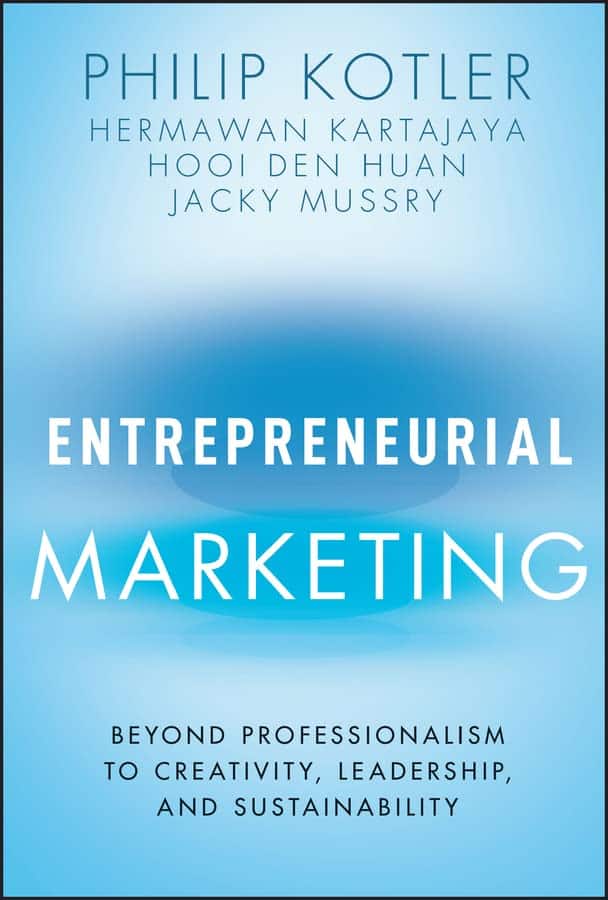
Entrepreneurial Marketing by Philip Kotler Book Summary

Reading Time: 2 minutes

Top 3 Quotes

  • “The best marketing doesn’t feel like marketing; it feels like helping.” – Emphasizes the shift from transactional to relational marketing.
  • “Entrepreneurs must market not just their products but also their ideas, their vision, and themselves.” – Highlights the multi-faceted nature of entrepreneurial marketing.
  • “In an era of disruption, agility and creativity are the most important marketing assets.” – Underlines the need for adaptability in today’s fast-paced markets.

Book Theme

Entrepreneurial Marketing focuses on how entrepreneurial ventures can leverage innovative and cost-effective marketing strategies to compete in dynamic and resource-constrained environments.

Why You Should Read This Book

Entrepreneurial Marketing provides actionable strategies for building brand equity, engaging customers, and scaling operations in competitive markets without relying on traditional marketing playbooks.

Key Ideas or Arguments Presented

  • Customer-Centricity: Understand and deliver exceptional value to your target audience.
  • Agility: Stay flexible to pivot strategies in response to market changes.
  • Innovation on a Budget: Creativity often trumps capital in entrepreneurial marketing.
  • Storytelling: Build emotional connections with customers through compelling narratives.
  • Digital Transformation: Leverage digital tools and platforms to amplify your reach.
  • Networking and Partnerships: Collaboration can unlock growth opportunities.
  • Metrics and Analytics: Data-driven decisions are crucial for sustainable success.
  • Brand Building: A strong brand identity can differentiate you from competitors.
  • Personal Branding: Entrepreneurs themselves must be the face of their businesses.
  • Experimentation: Treat marketing as an iterative process, learning from failures.

Book Outline

  • The Entrepreneurial Mindset
  • Understanding Your Customer
  • Innovation and Value Creation
  • Digital Marketing for Entrepreneurs
  • Leveraging Storytelling and Branding
  • Building Agile Marketing Systems
  • Measuring Success in Entrepreneurial Marketing

Key Takeaways

  • Focus on delivering value and solving customer problems.
  • Marketing strategies must be adaptable and innovative.
  • Entrepreneurs should embrace risk and learn from failures.
  • Digital tools are indispensable for modern marketing success.

Key Techniques

  • Value Innovation: Focus on creating unique customer value rather than competing on price.
  • Rapid Experimentation: Use A/B testing and MVPs to refine marketing strategies.
  • Customer Co-Creation: Engage customers in product development and marketing campaigns.

Author’s Qualifications

Philip Kotler is a renowned marketing expert and professor emeritus at Northwestern University’s Kellogg School of Management. Known as the “Father of Modern Marketing,” he has authored over 80 books and is celebrated for his contributions to marketing theory and practice.

Comparison to Similar Books

Target Audience

  • Entrepreneurs and startup founders
  • Small business owners
  • Marketing professionals in resource-constrained environments
  • Students of marketing and business
  • Innovators and product developers
  • Freelancers and consultants
  • Digital marketers

Critical Response to the Book

Entrepreneurial Marketing has been praised for its practical insights and accessible language. Critics commend Kotler for blending theory with actionable advice, making it a valuable resource for both beginners and seasoned professionals.

One Sentence Takeaway

Entrepreneurial marketing is about creativity, agility, and customer-focus, enabling ventures to thrive by delivering exceptional value in competitive markets.

Entrepreneurial Marketing by Philip Kotler Book Summary Read More »

inbound marketing

Inbound Marketing by Brian Halligan Book Summary

Reading Time: 2 minutes

Top Three Quotes

Version 1.0.0
  • “To win in the age of Google, you have to stop shouting and start listening.”
  • “Content is king, but context is God.”
  • “You can’t buy attention anymore. You have to earn it by creating something interesting and valuable.”

Book Theme

Inbound Marketing focuses on the transformative concept of inbound marketing, which emphasizes attracting customers through valuable content, search engine optimization (SEO), and social media engagement rather than traditional outbound marketing methods.

Why You Should Read This Book

This book is essential for marketers, entrepreneurs, and business owners looking to adapt to the digital age by understanding how to attract, engage, and delight customers through modern, cost-effective marketing techniques.

Key Ideas or Arguments

  1. Traditional marketing methods are becoming less effective; inbound marketing is the future.
  2. Creating high-quality, relevant content is crucial to attract potential customers.
  3. SEO and keyword strategies are foundational to getting found online.
  4. Social media platforms are essential for engaging with audiences and building brand awareness.
  5. Lead nurturing and email marketing help convert visitors into customers.
  6. Analytics and metrics are vital for tracking success and optimizing strategies.
  7. Personalization and understanding the buyer’s journey enhance customer experience.
  8. Blogging is a cornerstone of inbound marketing success.
  9. Calls-to-action (CTAs) and landing pages are critical for capturing leads.
  10. Inbound marketing is about building trust and providing value, not hard selling.

Book Outline

  • Getting Found Online
  • Converting Visitors into Leads
  • Converting Leads into Customers
  • Making Better Marketing Decisions

Key Takeaways

Inbound marketing is about creating value for your audience, leveraging digital tools to attract and engage them, and building lasting relationships that drive business growth.

Key Techniques

  • Keyword research and SEO optimization for content creation.
  • Developing a content calendar for consistent blogging.
  • Using analytics tools to measure and refine marketing efforts.
  • Creating compelling CTAs and optimized landing pages.

Author’s Qualifications

Brian Halligan and Dharmesh Shah are the co-founders of HubSpot, a leading marketing and sales software company. Their expertise in digital marketing and entrepreneurship provides a solid foundation for the principles shared in this book.

Comparison to Similar Books

Compared to books like Content Rules by Ann Handley and Epic Content Marketing by Joe Pulizzi, “Inbound Marketing” offers a more structured, step-by-step guide to building an inbound strategy from scratch.

Target Audience

  • Marketing professionals
  • Small business owners
  • Entrepreneurs
  • Content creators
  • Social media managers
  • SEO specialists
  • Business students

Critical Response to Book

The book has been widely praised for its actionable advice and practical insights, making it a go-to resource for digital marketers. Critics have highlighted its clarity and relevance in the modern marketing landscape.

One Sentence Takeaway

Inbound marketing is about earning attention through valuable content and meaningful engagement, making it the most effective way to connect with today’s consumers.

Inbound Marketing by Brian Halligan Book Summary Read More »

focus

Focus: The Future of Your Company Depends on It by Al Ries Book Summary

Reading Time: 2 minutes

Top Three Quotes

Version 1.0.0
  • “When you try to be everything to everyone, you end up being nothing to anyone.”
  • “The more variations you add to your brand, the weaker it becomes.”
  • “Focus is the key to success in a world of infinite choices.”

Book Theme

The central theme of the book Focus is the critical importance of focus in business strategy. Al Ries argues that companies succeed when they concentrate their efforts on a singular, well-defined niche or market position rather than diversifying excessively.

Why You Should Read This Book

Al Ries provides actionable insights and compelling arguments for the power of focus in achieving long-term business success. This book is essential for business leaders, marketers, and entrepreneurs looking to streamline their strategies and avoid the pitfalls of over extension.

Key Ideas or Arguments Presented

  • Focus is the cornerstone of a successful business strategy.
  • Over-diversification dilutes brand strength and market positioning.
  • Companies must identify and dominate a single niche.
  • Expanding product lines can lead to brand confusion and diminished value.
  • Specialization fosters expertise and builds customer trust.
  • Market leadership is achieved through a focused approach rather than being a jack-of-all-trades.
  • Businesses should avoid chasing short-term trends that conflict with their core focus.
  • Focus applies not only to products but also to messaging, target audience, and operational priorities.

Book Outline

  • The Power of Focus
  • Why Companies Lose Focus
  • The Dangers of Diversification
  • Case Studies in Focus
  • Building a Focused Brand
  • The Future of Focus

Key Takeaways

  • Focus is a strategic imperative for long-term success.
  • Businesses that prioritize simplicity and specialization outperform their more diversified competitors.
  • Maintaining focus requires discipline and a willingness to forego short-term opportunities that conflict with the core mission.

Key Techniques

  • Conducting a “focus audit” to identify areas of overextension.
  • Using the “one-word test” to determine a brand’s core essence.
  • Developing a clear and narrow value proposition.

Author’s Qualifications

Al Ries is a renowned marketing strategist and author, best known for co-authoring Positioning: The Battle for Your Mind. With decades of experience in branding and marketing, Ries has advised leading global companies and shaped modern marketing principles.

Comparison to Similar Books

Target Audience

  • Entrepreneurs seeking to build strong, sustainable businesses.
  • Marketing professionals focused on brand development.
  • Business leaders looking to refine their strategic priorities.
  • Students of business and marketing.
  • Small business owners navigating competitive markets.
  • Consultants advising companies on growth strategies.
  • Corporate executives aiming to avoid the pitfalls of over-diversification.

Critical Response to the Book

Focus has been widely praised for its clarity and practical advice. Critics have highlighted its compelling case studies and its relevance in an increasingly complex business landscape. Some have noted that its message is particularly vital for startups and small businesses.

One Sentence Takeaway

Focus is the ultimate competitive advantage in a crowded and complex marketplace.

Focus: The Future of Your Company Depends on It by Al Ries Book Summary Read More »