AI

ai agents explained

AI Agents Explained: Key Distinctions and Marketing Use Cases for Business Leaders

Reading Time: 3 minutes

AI agents are poised to transform how businesses operate and how we interact with technology. According to a report by McKinsey & Company, the AI market is projected to deliver up to $13 trillion in additional global economic activity by 2030. Microsoft CEO Satya Nadella predicts that “AI agents will become the primary way we interact with computers in the future.”

Understanding the nuances of AI agents is essential for any business leader aiming to stay ahead in this rapidly evolving landscape.

In the book AI Agents Explained for Business Leaders by David M. Patel, six critical distinctions in AI agent design are explored. These distinctions highlight the diverse capabilities, applications, and trade-offs organizations must consider when integrating AI into their operations.

1. Task-Specific vs. General-Purpose Agents

Task-Specific Agents: These agents are designed to perform a single function efficiently. For example, a chatbot handling customer support inquiries is a task-specific agent tailored for a specific purpose.

General-Purpose Agents: These are more flexible and capable of performing various tasks across different domains. For instance, virtual assistants like Siri or Alexa can handle scheduling, answer questions, and control smart home devices.

2. Reactive vs. Proactive Agents

Reactive Agents: These respond to stimuli or commands but lack the ability to predict future needs. An example is a spam filter that reacts to incoming emails and classifies them based on their content.

Proactive Agents: These anticipate needs and act accordingly. For example, an AI-powered recommendation engine on an e-commerce platform proactively suggests products based on user behavior.

3. Learning vs. Static Agents

Learning Agents: These improve their performance over time by analyzing new data. For instance, a personalized marketing AI can refine its customer targeting as it gathers more purchase history.

Static Agents: These operate with fixed rules and do not adapt over time. A rule-based chatbot using predefined responses is an example of a static agent.

4. Physical (Embodied) vs. Virtual Agents

Physical Agents: These exist in the physical world, such as autonomous delivery robots navigating urban environments.

Virtual Agents: These exist purely in digital spaces, like AI-powered virtual customer assistants interacting through websites or apps.

5. Single-Agent vs. Multi-Agent Systems

Single-Agent Systems: These involve a solitary AI performing a task independently, such as a virtual assistant handling voice commands on a smartphone.

Multi-Agent Systems: These involve multiple AI agents working together. For example, autonomous vehicles in a delivery fleet communicate to optimize routes and reduce delays.

6. Autonomous vs. Human-AI Collaborative Agents

Autonomous Agents: These operate without human intervention. An autonomous drone delivering packages independently falls into this category.

Human-AI Collaborative Agents: These work alongside humans, enhancing productivity. For example, AI-powered medical diagnosis tools assist doctors in analyzing patient data and suggesting potential treatments.

Why These Distinctions Matter

Understanding these distinctions helps business leaders make informed decisions when implementing AI solutions. By choosing the right AI agent type, organizations can enhance efficiency, reduce costs, and stay competitive in the age of artificial intelligence.

AI Agent Use Cases in Marketing:

As a digital marketer, I found these AI agent use cases particularly valuable for enhancing marketing efforts and improving customer engagement.

1. Personalized Content Creation

Generate tailored email campaigns, social media posts, and product recommendations by analyzing customer data such as browsing behavior, purchase history, and engagement patterns.
Example: An AI agent can craft personalized emails with product suggestions based on past purchases.

2. Customer Behavior Analysis

Track user activity across websites and social platforms to identify patterns, predict trends, and assign lead scores for better audience targeting.
Example: AI agents monitor web page visits and assign lead scores to prioritize high-potential customers.

3. Campaign Analytics and Optimization

Extract, process, and analyze large datasets to identify key patterns, measure performance metrics (e.g., click-through and conversion rates), and recommend campaign improvements.
Example: An AI agent tracks engagement rates and suggests optimized messaging for better ROI.

4. Automated Social Media Management

Assist with content scheduling, audience targeting, and sentiment analysis while providing real-time feedback to improve future posts.
Example: AI agents identify trending topics and automatically post optimized content for better engagement.

5. eCommerce Support

Manage inventory, predict restocking needs, and offer personalized product recommendations to boost sales and ensure seamless customer experiences.
Example: AI agents update inventory in real-time during high-traffic shopping seasons.

6. Decision Support for Marketing Teams

Analyze data, suggest strategies, and provide actionable insights while leaving final decision-making to human marketers.
Example: AI agents suggest target audience segments based on historical campaign data.

7. Enhanced Customer Experiences

Deliver relevant, engaging content at scale, improving customer satisfaction and increasing loyalty.
Example: An AI agent anticipates customer questions and provides proactive, personalized support.

AI Agents Explained: Key Distinctions and Marketing Use Cases for Business Leaders Read More »
Marketing with Dave logo on a professional website header, emphasizing SEO and digital marketing expertise for boosting online visibility.

AI-Powered H1 Title Tag Optimization: Boost Your SEO Rankings

Reading Time: 2 minutes

One of the most valuable elements on any web page for Search Engine Optimization (SEO) is the H1 title tag. This tag helps both search engines and users quickly understand what a page is about. However, despite its importance, H1 tags are often overlooked. Sometimes, they’re an afterthought—added hastily when a web page is built—or they’re simply not optimized for search intent and readability.

To maximize your website’s SEO potential, optimizing your H1 tags should be a core part of your strategy—not just an afterthought. Fortunately, artificial intelligence (AI) can streamline this process, helping you generate better H1 tags that are both keyword-rich and engaging.

Let’s walk through an AI-powered approach to refining your H1 title tags.

Step 1: Collect Your H1 Title Tags

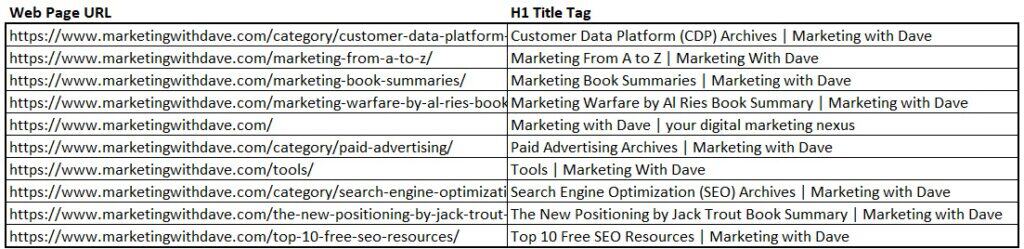
Before optimizing your H1s, you need to gather all existing H1 tags across your website. The easiest way to do this is by exporting them into a spreadsheet, which will allow for quick analysis and batch improvements.

How to Collect H1 Tags:

  • Use an SEO auditing tool like Screaming Frog (free for up to 500 pages) to crawl your website and extract H1 tags.
  • Alternatively, use tools like Ahrefs, Semrush, or Google Search Console to collect H1 data.
  • Export the data into a spreadsheet with two columns:
    • Web Page URL
    • H1 Title Tag

Step 2: Write Your AI Prompt

AI tools like ChatGPT, Claude, Gemini, or Google’s Bard can suggest optimized H1 tags if given the right prompt. The key is crafting a detailed and specific prompt to ensure high-quality results.

Example AI Prompt:

“As an SEO content expert, suggest improved, SEO-optimized H1 title tags for the following pages. Each title should be between 20-60 characters (never exceeding 70). Titles should be engaging, relevant to the content, and include primary keywords naturally. Exclude ‘| Marketing with Dave’ from the suggestions. Here are the existing H1 tags:”

Step 3: Review and Compare Your AI-Generated Suggestions

After running your prompt, AI will generate a list of alternative H1 title tags. The best approach is to compare AI-generated results from multiple tools like ChatGPT and Claude, as they may offer different perspectives.

Step 4: Implement, Tweak, and Test

AI can accelerate the brainstorming process, but it doesn’t fully replace human judgment. Since AI doesn’t understand your audience as well as you do, review each suggestion carefully and tweak it where necessary.

What to Look for When Choosing an H1 Title Tag:

  • Keyword Relevance – Does it include the right keywords for SEO?
  • User Intent Alignment – Does it match what visitors are looking for?
  • Clarity & Conciseness – Is it clear and under 60 characters?
  • Engagement Factor – Does it make someone want to read further?

Conclusion

AI is a powerful tool for optimizing H1 title tags, saving time while ensuring your titles are engaging and SEO-friendly. However, it’s not a replacement for human oversight. The best approach is to use AI-generated recommendations as a starting point, then refine them with your expertise and audience insights.

AI-Powered H1 Title Tag Optimization: Boost Your SEO Rankings Read More »

what is marketing the 10 functions of marketing

SWOT Analysis for Owala Water Bottles Using Oncely AI Tool

Reading Time: 2 minutes

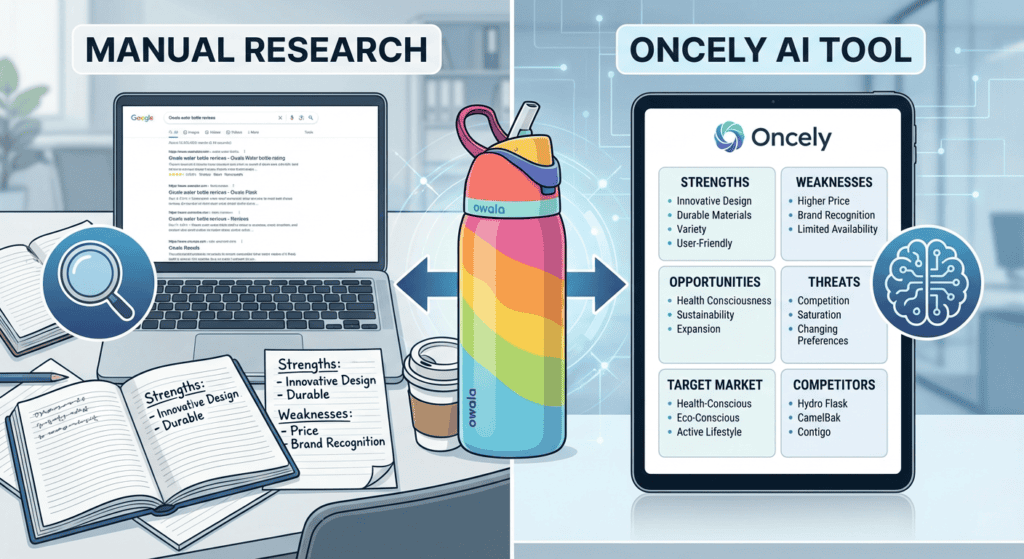
I performed a SWOT analysis for Owala water bottles using manual research. No AI was used, just the old school internet to find and compile the strengths, weaknesses, threats, and opportunities for Owala.

I discovered Oncely, an AI tool that will perform a SWOT analysis for you. Below are those results which you can compare with my manual research version. Overall, it’s comparable and I was impressed. Of course, with anything AI, trust a little and verify a lot. I would use Oncely the next time I need to perform a SWOT analysis.

Strengths

  • Innovative Design: Owala bottles feature a unique design with a built-in straw and a wide mouth for easy filling and cleaning.
  • Durable Materials: Made from high-quality, BPA-free materials, ensuring safety and longevity.
  • Variety of Colors and Sizes: Offers a wide range of colors and sizes to appeal to diverse consumer preferences.
  • User-Friendly Features: Includes a one-handed push-button lid for easy access to hydration on-the-go.

Weaknesses

  • Higher Price Point: Owala bottles may be more expensive than traditional plastic bottles, potentially limiting their market.
  • Brand Recognition: As a relatively newer brand, Owala may struggle with brand awareness compared to established competitors.
  • Limited Availability: May not be available in all retail locations, affecting accessibility for potential customers.

Opportunities

  • Growing Health Consciousness: Increased consumer focus on hydration and healthy living can drive demand for reusable water bottles.
  • Sustainability Trends: With rising awareness of environmental issues, promoting the eco-friendly aspects of Owala bottles can attract eco-conscious consumers.
  • Expansion into New Markets: Opportunities to expand into international markets or new demographic segments.

Threats

  • Intense Competition: Strong competition from established brands like Hydro Flask, CamelBak, and Contigo.
  • Market Saturation: The water bottle market is crowded, making it difficult to differentiate the brand effectively.
  • Changing Consumer Preferences: Shifts in consumer behavior or preferences towards different hydration solutions (e.g., flavored waters, smart bottles) could impact sales.

In-Depth Results

The following target market and competitors sections are what you get when choosing the in-depth setting.

Target Market
Health-Conscious Consumers: Individuals focused on fitness and hydration.
Eco-Conscious Shoppers: Consumers looking for sustainable and reusable products.
Active Lifestyle Enthusiasts: People engaged in outdoor activities, sports, and travel.

Competitors
Hydro Flask: Known for high-quality insulated bottles.
CamelBak: Popular for hydration packs and bottles with built-in straws.
Contigo: Offers a range of travel mugs and water bottles with spill-proof features.
This SWOT analysis provides a comprehensive overview of Owala water bottles, highlighting key areas for strategic focus and potential growth.

What’s Next

Once you’ve completed your SWOT analysis, the next step is putting it into action. See how we used Owala’s SWOT insights to shape a strategic marketing campaign.

SWOT Analysis for Owala Water Bottles Using Oncely AI Tool Read More »