
Last updated August 2026
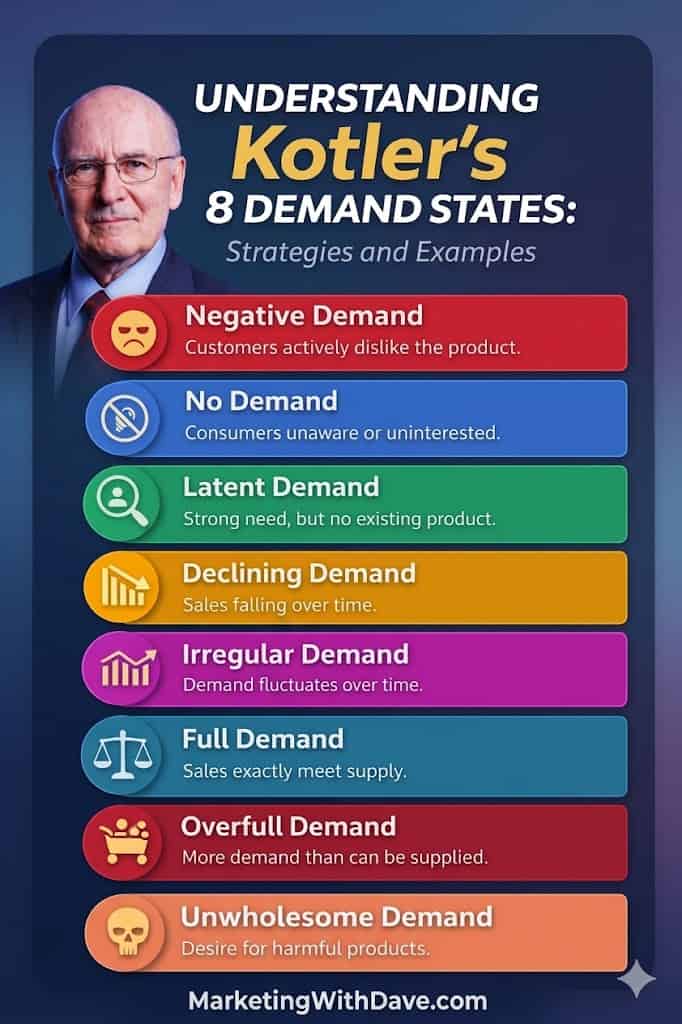
Philip Kotler, often called the father of modern marketing, introduced the idea that products can fall into one of eight distinct demand states.
These range from Negative Demand (customers actively dislike the product) to Full Demand (sales exactly meet supply) to Unwholesome Demand (desire for harmful products).
Kotler emphasized that marketing is about managing demand – controlling its level, timing and nature to meet business goals.
Classifying your product into the correct demand state helps you pick the right strategy: whether to educate the market, stimulate sales, or even discourage consumption.
Negative Demand
Definition: Negative demand occurs when a significant portion of the target market dislikes a product so much that they might even pay to avoid it. In other words, customers have an aversion to the offering rather than mere indifference.
Example: Kotler cites vegetarians’ aversion to meat as a classic example of negative demand. Other examples include widespread reluctance to go to the dentist or get vaccinations – services people need but actively resist.
Marketer Actions:
- Investigate Objections: Use research and feedback to understand why consumers reject your product. It may be due to bad experiences, misconceptions, or poor positioning.
- Reframe Messaging: Adjust your branding or education efforts. For instance, emphasize the benefits (e.g. the long-term health payoff of dental care) through educational campaigns.
- Build Trust: Consider promotions or guarantees to reduce resistance. Sometimes lower prices or trial offers can change perceptions over time.
No Demand (Nonexistent Demand)
Definition: No demand is when consumers are unaware of or uninterested in your product. They simply don’t recognize a need or know your solution exists.
Example: Many innovations start here. Before electric cars went mainstream, most people weren’t searching for them. Similarly, early on no one was asking for ride-sharing apps or smartwatch features until they saw the possibilities.
Marketer Actions:
- Educate the Market: Create awareness of the problem and show how your product solves it. Use content marketing, demos, or free trials to connect product benefits to customer needs.
- Highlight Hidden Needs: Help people discover needs they didn’t know they had. For example, explain the hidden costs of car fuel to sell electric vehinces, or illustrate new lifestyles a smartwatch enables.
- Long-Term Engagement: Invest in brand awareness and education. Convert no-demand requires time – first convince customers to care before focusing on sales.
Latent Demand
Definition: Latent demand exists when customers share a strong need but no existing product satisfies it. The desire is there, but the solution either doesn’t exist yet or isn’t known.
Example: Think of innovations like noise-canceling headphones, ride-sharing apps, or novel fitness wearables. Before they appeared, people had unmet needs (quieter workspaces, easier travel, better health tracking) but no solution on the market.
Marketer Actions:
- Innovate to Fill the Gap: Develop new products or services that meet the unmet need. R&D and innovation are key.
- Assess Demand: Research how many customers share this latent need and what they’d pay. Use market studies or pilot launches to gauge potential demand.
- Launch and Educate: Once a solution exists, make it clear how it satisfies the latent need. Use vivid messaging and, if appropriate, a price-skimming launch strategy to capture early adopters’ willingness to pay.
Faltering (Declining) Demand
Definition: Declining demand (or faltering demand) means sales are falling over time. In Kotler’s terms, it’s when current demand is below past levels and is expected to keep dropping without intervention.
Example: Many technologies have this pattern: DVD players declined with streaming, landline phones declined with mobile, and print newspapers declined with online news. Kotler notes that developed markets for cigarettes and CDs exemplify faltering demand as healthier or digital alternatives emerge.
Marketer Actions:
- Analyze Causes: Identify why demand is shrinking. Is it due to new competitors, shifting tastes, or replacement technologies? Use customer research to diagnose the issue.
- Revitalize or Niche: Try repositioning, improving, or bundling the product. For example, bundle a declining product with a stronger one, or target a niche market where the need remains strong.
- Maintain Price if Viable: Sometimes it’s wiser to avoid steep discounts. Kotler’s pricing insight suggests sustaining the price (or even raising it) to milk the remaining loyal customers rather than triggering a short-term spike that won’t last.
- Plan Exit: If revival isn’t feasible, consider phasing out the product gracefully and redirecting resources to growing areas.
Irregular (Seasonal/Variable) Demand
Definition: Irregular demand refers to sales that fluctuate substantially over time (seasonal, cyclical or random spikes).
Example: Many products are seasonal. Beachwear and ice cream peak in summer; winter gear peaks in cold months. Industries like tourism or fitness see predictable highs and lows (e.g. ski resorts vs. beach resorts, or gym memberships each January).
Marketer Actions:
- Smooth Demand: Use promotions or discounts to boost sales in slow periods. For example, offer off-season sales or bundle deals to encourage purchases during typical lulls.
- Flexible Pricing: Adopt high/low pricing (yield management). Airlines and hotels raise prices in peak season and lower them off-season to better match demand with supply.
- Off-Season Products: Introduce complementary products or services to fill downtime (e.g. a ski resort offering summer hiking tours) or market to different segments to even out usage.
Full Demand
Full demand requires active maintenance, not inaction. The goal is to keep demand at the organization’s desired level while preserving customer satisfaction and operational reliability. Monitor repeat purchase, cancellations, stock availability, service capacity, competitor moves, and changing preferences so small shifts do not turn full demand into faltering or overfull demand.
Definition: Full demand is a balanced state where current sales exactly meet the desired level of sales.
Example: This occurs in stable, mature markets. For instance, a long-established consumer staple (like table salt) may have steady demand that matches manufacturing capacity. Companies in this state are neither over- nor undersupplied.
Marketer Actions:
- Maintain Equilibrium: Focus on customer satisfaction and retention rather than aggressive growth.
- Fair Pricing: Avoid drastic price changes. Kotler recommends an “Every Day Fair Price” approach to signal stability and deter competitors.
- Monitor Trends: Stay alert to changes in preferences or competition that could disrupt the balance.
- Selective Innovation: Introduce improvements cautiously so as not to unbalance a healthy market.
Overfull Demand
Demarketing is the matching task for overfull demand. Its purpose is not to eliminate demand; it is to bring demand back in line with capacity, service standards, inventory, or a deliberately chosen customer mix. General demarketing reduces overall demand, while selective demarketing steers demand away from less profitable, less suitable, or harder-to-serve segments.
Definition: Overfull demand occurs when more customers want the product than you can serve. Demand exceeds the supply capacity (or the organization’s desired level).
Example: This happens with cult products or during shortages. Think of instant sell-outs of concert tickets, toy crazes at holiday season, or toilet paper hoarding in a crisis. Kotler notes demarketing situations (like the California energy crisis) as classic overfull demand cases.
Marketer Actions:
- Demarketing: Deliberately cool demand. Kotler himself coined this term for situations where demand outpaces supply. Tactics include raising prices, reducing advertising, or rationing supply to reduce demand.
- Targeted Pricing: Use higher prices or premium tiers to deter non-core buyers and align demand with capacity.
- Channel Control: Limit availability (e.g. exclusive releases, pre-orders) to manage buyer flow.
- Scale Up: If the surge is sustainable, invest in capacity expansion (increasing production or distribution) for the long run.
Unwholesome Demand
Countermarketing is the matching task for unwholesome demand. Unlike demarketing, which manages excess demand for a capacity-constrained offer, countermarketing seeks to reduce demand because the pattern of consumption can harm individuals or society. It may emphasize risks, restrict promotion, encourage safer substitutes, or support behavior-change initiatives.
Definition: Unwholesome demand refers to products that many consumers want but which are harmful or socially undesirable. In Kotler’s framework, these attract demand that society would rather discourage.
Example: Classic examples include tobacco, excessive junk food, addictive video games, or illicit drugs. Consumers may crave them, but health or ethical considerations mean society (and often regulators) want consumption to drop.
Marketer Actions:
- Social Marketing: Use public health campaigns or ethical marketing to reduce consumption. Partner with NGOs or governments to educate consumers (e.g. anti-smoking ads, healthy eating promotions).
- Product Reformulation: If possible, make the product less harmful (e.g. reduced-sugar versions of foods) to shift it out of the “unwholesome” category.
- Corporate Responsibility: Acknowledge the issue. Implement CSR programs that support healthier alternatives or support research to mitigate harm.
Kotler’s 8 demand states at a glance: The framework connects each market condition to a specific marketing-management task. Marketers do not use one strategy for every demand problem; they adjust the level, timing, and nature of demand based on the condition they observe.
| Demand state | Kotler marketing task | Strategic goal |
|---|---|---|
| Negative demand | Conversional marketing | Convert aversion into acceptance |
| No demand | Stimulational marketing | Create awareness and interest |
| Latent demand | Developmental marketing | Develop a solution for an unmet need |
| Faltering demand | Remarketing | Revitalize weakening demand |
| Irregular demand | Synchromarketing | Synchronize demand with capacity |
| Full demand | Maintenance marketing | Maintain the desired demand level |
| Overfull demand | Demarketing | Reduce demand to a manageable level |
| Unwholesome demand | Countermarketing | Discourage harmful consumption |
How the states fit together: Most demand-management decisions can be organized around three capacity conditions. Underdemand includes negative, no, latent, faltering, and irregular demand, where demand must be created, restored, or better timed. Adequate demand is full demand, where the priority is maintaining alignment between sales and capacity. Overdemand is overfull demand, where demand exceeds the organization’s desired level. Unwholesome demand is distinct because the objective is to reduce socially harmful consumption rather than simply balance capacity.
How to diagnose your demand state: Start with a defined market segment and compare current demand with your desired sales level and available capacity.
- Customers avoid or resist the offer: negative demand.
- Customers neither know nor care about the offer: no demand.
- Customers describe a need that available offers do not satisfy: latent demand.
- Demand is falling versus earlier periods: faltering demand.
- Demand rises and falls by season, day, or event: irregular demand.
- Demand reliably matches the desired sales level: full demand.
- Orders, waitlists, or traffic exceed service capacity: overfull demand.
- Demand exists, but reducing consumption benefits consumers or society: unwholesome demand.
Modern examples make the framework easier to apply:
- Negative demand: buyers resist a software migration after a poor onboarding experience.
- No demand: a business is unaware that an AI governance tool could solve an emerging compliance problem.
- Latent demand: apartment residents want dependable EV charging, but available options do not meet their needs.
- Faltering demand: a physical-media rental business loses customers as streaming substitutes improve.
- Irregular demand: travel bookings surge during school breaks and fall during off-peak periods.
- Full demand: a mature staple brand consistently sells at its planned production level.
- Overfull demand: ticket demand for a limited live event exceeds available seats.
- Unwholesome demand: demand for addictive gambling products prompts harm-reduction efforts.
Why Categorizing Demand States Helps Marketers
Classifying a product into one of these demand states offers a powerful strategic lens. Kotler reminded us that marketing managers should regulate demand across products. For example, a “no demand” product signals an awareness challenge, whereas “overfull demand” calls for demarketing tactics. As a summary puts it, Kotler’s framework “gives you a lens to understand where your audience is and how to move them forward”. In practice, knowing the demand state helps allocate resources and shape the marketing mix appropriately – whether to educate the market, maintain momentum, or dampen demand.
In short, Kotler’s demand states serve as a roadmap. They help marketers diagnose market conditions and decide whether to stimulate, sustain, or reduce demand. This categorization ensures that strategy is aligned with the product’s reality, making marketing efforts more effective and focused.

