
Last updated March 2026
One of the easiest ways to hurt a Facebook ad campaign is to make changes before the campaign has gathered enough data to teach you anything useful. That is especially true for small local campaigns with limited budgets, tight geography, and simple goals like driving landing page visits and form submissions.
That was the lesson from a recent local business campaign. We were running ads in two neighboring cities, later preparing to expand into a third city, with the goal of getting local businesses to visit the website and reach out about being included in our welcome baskets. Because the website was on a Squarespace tier that does not support deeper tracking tools, landing page views became our best working proxy for intent.
That limitation forced a more disciplined approach. Instead of constantly tweaking the campaign, we had to define mileposts that would tell us when to leave things alone, when to test something new, and when there was finally enough signal to optimize with confidence.
Although the example in this article comes from a Facebook campaign, the discipline behind the milestone framework applies to almost any paid media platform. Google Ads, LinkedIn Ads, TikTok Ads, and other platforms all face the same fundamental challenge: marketers often make changes before the campaign has collected enough data to justify the decision. The milestones described here are less about Facebook itself and more about developing a structured approach to campaign learning.
Why landing page views mattered so much
In a perfect world, every campaign would optimize toward actual business outcomes like leads, calls, booked meetings, or purchases. In this case, those deeper signals were not fully available. That meant the cleanest measurement available was whether someone clicked through and actually loaded the web page.
In an ideal world, every campaign would optimize around the final business outcome: purchases, qualified leads, booked calls, or revenue. Unfortunately, many campaigns operate with incomplete measurement. Legacy websites, privacy restrictions, or platform limitations can make it difficult to track the exact action you care about.
That is why landing page views became the primary operating metric. It is not the final business outcome, but it is much better than relying on impressions, clicks, or generic engagement. A landing page view at least tells you the ad was compelling enough to earn a visit and the user stayed long enough for the web page to load.
The practical milestone framework
The following framework is the one I would recommend for local advertisers running smaller campaigns with limited tracking. It is not built around theory alone. It reflects what happened in a real campaign and the points where the data was and was not trustworthy.
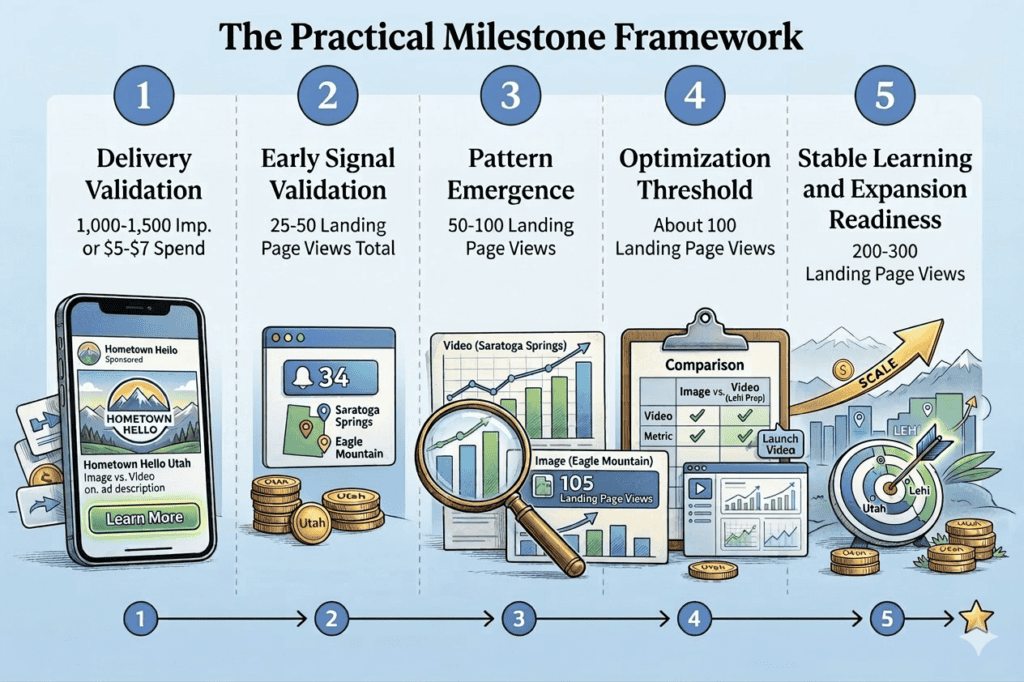
Milestone 1: Delivery validation
Do not touch anything until each ad set has either roughly 1,000 to 1,500 impressions or about $5 to $7 in spend. At this stage, the goal is not optimization. The goal is simply to confirm that the campaign can deliver.
This first milestone answers basic questions.
- Is the audience too small?
- Is the ad approved?
- Are impressions coming in?
- Is Meta serving the creative at all?
If the answer is yes, then the campaign has passed the first gate. At this stage, changing copy, turning placements on and off, or introducing new creative usually creates more confusion than insight.
Milestone 2: Early signal validation
Once the campaign reaches about 25 to 50 landing page views total, you can start to look for directional signals. This is still too early for strong conclusions, but it is enough to tell whether the campaign is fundamentally broken or viable.
This is where you look for things like whether landing page views are happening at all, whether one placement is consuming spend without results, and whether costs are wildly out of line. What you should not do yet is start making aggressive structural changes based on tiny differences.
This stage is about validating that the campaign deserves more time.
Milestone 3: Pattern emergence
At around 50 to 100 landing page views, repeatable patterns start to appear. This is the point where you can begin to see whether one city is stronger than another, whether one placement is consistently carrying the campaign, and whether one media type appears more promising.
This is also the earliest point where introducing a new creative format, such as video when you started with image only, becomes reasonable. The key is that the original campaign must first prove that it can generate real visits.
Before this point, adding more variables usually muddies the learning. After this point, adding one new variable can be productive.
Milestone 4: Optimization threshold
At around 100 landing page views, you finally have enough data to make modest optimizations with some confidence. This is where you can begin comparing image versus video, evaluating whether placements should be trimmed, and deciding whether a rising cost per landing page view is a real pattern or just normal noise.
If you started with image ads only, this is the point where it makes the most sense to launch a video version. If you already added video earlier as an observational test, this is the point where the comparison starts to become meaningful.
This is also the stage where dashboards become much more useful. Before this, they mostly confirm delivery. After this, they begin to reveal real trends.
Milestone 5: Stable learning and expansion readiness
Once a campaign reaches 200 to 300 landing page views, it moves from testing into stable pattern recognition. At this point, you can start making more meaningful decisions such as introducing new cities, testing a second wave of creatives, splitting image and video more intentionally, or increasing budgets gradually.
This is not the same as saying the campaign is fully mature. It simply means there is finally enough signal to make more than tiny changes without guessing.
What this looked like in a real campaign
In our campaign, image ads launched first. That was the right call because it simplified the initial learning. Once the campaign had enough landing page views to show the ads were viable, video was introduced. Over time, the data showed that video was competitive and in some cases more efficient than image, especially in certain cities.
At the same time, there were also signs that performance softened after the first month. Landing page views dropped in month two and three relative to spend. That did not automatically mean the campaign was broken. Frequency remained healthy, which suggested the issue was not simple audience saturation. The more likely explanations were a combination of creative fatigue, small-budget volatility, and Meta shifting spend toward placements that generated more impressions but less efficient traffic.
That is exactly why milestone-based decision making matters. Without those thresholds, it is too easy to panic after one bad week or overreact to one strong placement.
Best practices that matter more than people think
Use one primary metric for operating decisions
If you do not have backend conversion tracking, pick the best proxy and commit to it. In this case, landing page views were the right choice. Do not bounce between impressions one week, clicks the next, and vague “engagement” after that. That creates chaos.
Keep variables isolated whenever possible
If you want to know whether video works better than image, the cleanest answer comes from isolating format. If you change the media, the copy, the placements, and the geography all at once, you have not really run a test. You have just changed everything.
Do not trust low-volume placement results too quickly
A placement that produced one cheap landing page view is not automatically a winner. The campaign needs enough data to show a repeated pattern before you start trimming or expanding based on placements.
Use clear naming conventions for campaigns and creatives
One of the most useful discipline moves in this campaign was naming ads clearly by city, creative type, and version. That made reporting possible even when Meta’s own reporting labels were messy. Clean naming is not glamorous, but it is one of the easiest ways to keep future analysis honest.
Do not let Meta’s warnings bully you into bad placements
Meta often recommends enabling more placements. Sometimes that helps with delivery. Sometimes it just opens the door to cheaper but lower-quality inventory. The right response is not to ignore all recommendations or accept all of them. The right response is to compare the recommendation against actual campaign data.
Do not confuse low frequency with strong creative
A healthy frequency tells you you are probably not exhausting the audience yet. It does not prove the creative is still sharp. A campaign can still lose efficiency because the message is getting stale or because Meta is drifting into weaker delivery patterns.
When to refresh creative
Creative refreshes should be driven by pattern, not boredom. If frequency stays modest but cost per landing page view rises over several weeks, that is a strong signal that the creative may need fresh energy. That does not always require a complete reinvention. Sometimes it simply means introducing one new image ad and one new video ad while keeping the core offer and call to action consistent.
The safest practical workflow is to duplicate the current ad, replace only the media, rename it clearly, launch it, and then pause the old creative once the new one is live. That keeps reporting cleaner and prevents tiny budgets from being split across too many active creatives.
When to expand geography
New locations should usually be added only after the existing campaign has shown stable enough performance to justify expansion. In our case, city one and city two were kept separate because they are neighboring cities and overlapping targeting would have made the reporting much harder to trust. Adding the third city made sense only after the campaign had delivered enough traffic to show that the structure itself was viable.
If you expand into a new city too early, you risk multiplying uncertainty rather than scaling what works.
A simple way to think about the phases
There is a useful way to summarize the whole framework:
At around 50 landing page views, observe. At around 100 landing page views, optimize carefully. At around 200 to 300 landing page views, expand with more confidence.
That is not a law. It is a practical operating model that keeps advertisers from making emotional decisions too early.
Final takeaway
If a campaign is underperforming, the answer is not always to make changes immediately. Sometimes the smartest move is to leave the campaign alone until it has actually earned the right to be judged.
That discipline is especially important in local campaigns with limited budgets, smaller audiences, and imperfect tracking.
The most dangerous thing in paid social is not bad data. It is acting too confidently on too little of it.
If you can define clear milestones before you touch the campaign, you give yourself a far better chance of making decisions that improve performance instead of resetting learning over and over again.
The specific metric you use may vary — purchases, leads, or the best proxy metric available — but the discipline remains the same: wait until the campaign has gathered enough signal before making the next decision.

