Last updated March 2026
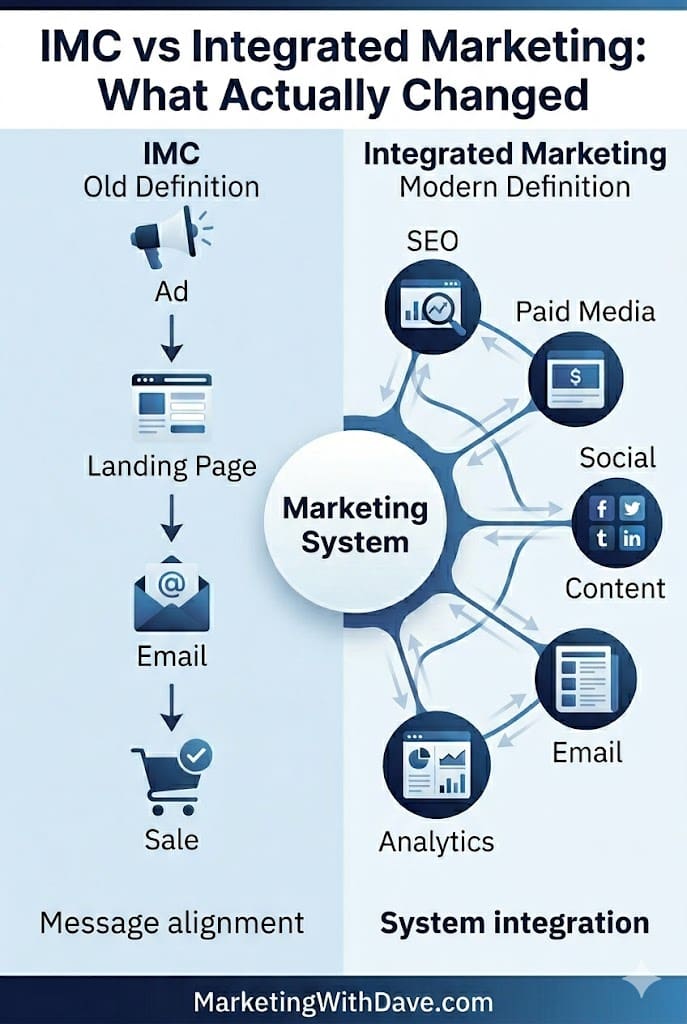
Most teams have strategies. Many have channels. Some have journeys. Few have a system that makes all of those things work together. That is the gap this framework aims to close.
Integrated marketing today is less about pretty alignment and more about system design. This web page outlines a practical, usable structure to help marketers connect channels, content, data, and technology into one functioning engine.
This framework is not academic. It brings together widely recognized practices from marketing strategy, IMC, growth, and operations into a structure that reflects how modern teams actually work.
The Problem This Framework Solves
Marketers are surrounded by pieces.
Channels. Tools. Data. Teams. Campaigns.
But none of these pieces perform well in isolation.
Common symptoms of under integrated systems include:
- Paid media that drives traffic but not revenue
- SEO content that ranks but does not support conversion
- Social content that builds awareness but sends people into dead ends
- Lifecycle flows that do not align with the product experience
- Martech stacks with overlapping or misconfigured tools
- Data that exists but does not inform decisions
This framework is meant to solve the problem of pieces moving without purpose.
The Integrated Marketing Framework
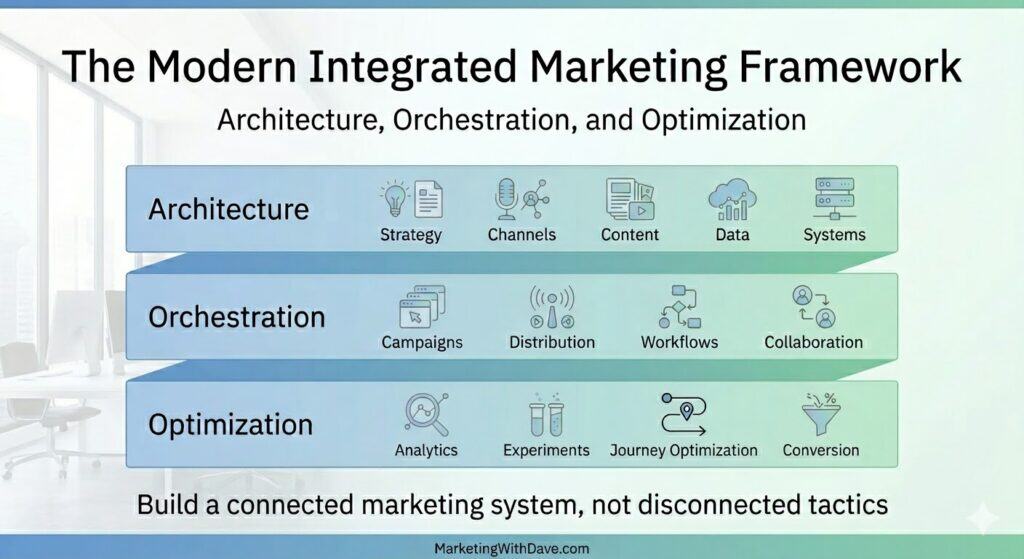
Your modern integrated marketing engine is built on three layers.
Architecture, orchestration, and optimization.
Layer 1: Architecture
Architecture is the foundational design. It is the blueprint.
Architecture answers the question:
What is the role of every channel, tool, and content asset, and how do they connect?
Key architectural elements include:
- Strategy and audience definition
- Channel roles, such as demand capture, demand creation, retention, community, and conversion
- Core customer journeys
- Content pillars that support multiple channels and stages
- Data capture and tagging
- Martech systems such as CMS, CRM, CDP, marketing automation, analytics, and ad platforms
- Measurement structure and key outcomes
Architecture turns marketing from a collection of efforts into an intentional system.
Layer 2: Orchestration
Orchestration is the day-to-day execution inside the architecture.
Orchestration answers the question:
How does work move through the system?
Orchestration includes:
- Campaign planning across channels
- Always on programs that run alongside campaigns
- Distribution models for content and creative
- Publishing cadences and calendars
- Cross channel reinforcement so messages and offers support each other
- Workflow and routing of requests, briefs, and approvals
- Asset reuse and translation for different channels
- Collaboration between SEO, paid, lifecycle, social, and operations teams
- Governance, such as who owns what decisions and how exceptions are handled
Orchestration is where strategy meets reality.
Layer 3: Optimization
Optimization is the ongoing improvement of the system.
Optimization answers the question:
What is the next high value connection to improve?
Optimization activities include:
- Journey analytics that show how people really move through the ecosystem
- Views that include assisted conversions, not only last click
- Experiments that test changes across a full flow, not just a single ad or web page
- Channel-to-channel collaboration to reduce overlap and gaps
- Simplifying or consolidating technology where it adds friction
- Turning rough handoffs into smoother transitions between touchpoints
- Reducing friction and drop offs at known weak points in the journey
Optimization is where small improvements unlock compounding returns.
The Roles of Channels Inside the Framework
One of the biggest failures in marketing is that every channel tries to do everything.
Integrated marketing works when channel roles are defined and respected.
An example model for channel roles might look like this:
- SEO captures existing demand and educates people who are already searching
- Paid media accelerates awareness and tests new messages and audiences
- Social builds connection, community, and lightweight engagement
- Content marketing supports every channel and builds trust by answering real questions
- The website converts interest into actions such as signups, trials, or sales
- Email and lifecycle programs nurture, retain, and grow customer value over time
- Surveys and voice of customer programs tighten the feedback loops
- Martech and operations automate delivery and unify data
- Analytics clarifies what works, what does not, and where to focus next
This kind of model becomes the shared mental map that the team operates from.
How Channels Reinforce Each Other
Integration lives in the connections between channels, not inside the channels themselves.
Some of the highest leverage integration points inside any marketing system include:
- Search to website
- Paid media to landing pages
- Social to content
- Content to lifecycle
- Lifecycle to product experience
- Product experience to retention and expansion loops
- Surveys and feedback to optimization and testing
When any of these links fail, the whole engine loses power.
When you fix even one of them, the engine runs smoother.
Journey Mapping for Integrated Marketing
Most journey maps are designed for slides, not for decisions.
For integrated marketing, the goal is to map enough of the journey to improve it, without trying to model every possible path.
A practical approach looks like this:
- Define the two or three core journeys that matter most for the business
- Identify starting points such as search, referrals, social, ads, and direct visits
- Identify the key moments of truth such as web pages, emails, product touchpoints, and sales conversations
- Identify typical drop offs and dead ends
- Strengthen the weakest link in each priority journey
The goal is not to map everything.
The goal is to map what matters and improve what is broken.
Content Architecture as the Glue
A modern marketing engine depends on a content structure that supports multiple teams and channels at once.
A strong content architecture often includes:
- Pillar web pages that explain key topics in depth
- Cluster web pages that support those pillars and explore subtopics
- Evergreen assets that multiple channels can point to over time
- Modular content that can be reused in different formats and channels
- Content mapped to journey stages and channel roles
- Web pages built for both organic search and conversion paths
Content is the connective tissue of the entire system.
The Data and Measurement Layer
Integrated marketing requires integrated measurement.
Without a shared view of performance, teams fall back into channel silos and siloed metrics.
Essential elements of the data and measurement layer include:
- Event tracking aligned to the journeys you actually care about
- Cross channel attribution, even if it starts simple
- Dashboards that show assisted conversions, not just single touch performance
- Source and medium discipline so traffic and outcomes can be trusted
- Measurement tied to clear roles and business outcomes
- Regular reviews that look at system level performance, not just isolated channels
When measurement aligns with the integrated system, the team moves faster and makes better decisions.
A One Page Integrated Marketing Blueprint
To keep this framework practical, it helps to capture it on a single page that the team can reference.
A one page blueprint might summarize:
- Your strategy and audiences
- Channel roles across the ecosystem
- The most important journeys to support
- Key content pillars and cornerstone assets
- Your data and tagging plan
- The main systems in your stack and how they connect
- The top connections or weak links you plan to improve next
This kind of blueprint becomes a living document that anchors conversations and decisions.
How to Put the Framework to Work
A framework only matters if it changes how you operate.
One simple way to put this model into practice is to work through five steps:
- Define your architecture by listing channels, systems, and key journeys
- Assign clear roles to each channel so they are not all trying to do everything
- Map the most important journeys that connect channels and product experience
- Create or reorganize content so it supports those journeys and roles
- Install measurement and optimization habits that focus on connections, not just channels
This does not require a full reorganization. It is a better way to operate with the team you already have.
Why This Framework Works
Modern marketing success comes from compounding effects.
When channels reinforce each other, results multiply.
When channels act independently, results often cancel out.
This framework creates alignment, reduces waste, and amplifies the impact of every marketing decision.
Marketing will continue to change quickly. Customers will continue to move across channels on their own terms. They will never experience your marketing in silos.
This is why integrated marketing matters. Not as a nostalgic label, but as a practical way to design a more connected, more coherent, and more effective marketing engine.