Last updated August 2026
Most AI Search visibility tools follow a similar playbook: enter prompts, run them through AI models, and see if your brand shows up. Subsig does that too, but prompt tracking isn’t the most interesting part of the platform.
Subsig combines AI visibility with citations, competitors, reviews, brand mentions, sentiment, keyword intelligence, and AI Agents designed to turn that data into recommendations. It’s less a dedicated AI Search tool than a broader brand-intelligence platform that includes AI visibility.
That makes Subsig one of the more unusual platforms I’ve tested, and also harder to evaluate. Some features were genuinely impressive, others need more explanation, and several make far more sense for an established brand generating regular reviews and online conversations than they do for Marketing With Dave.
Subsig Overall Score

Why 3.8/5: Subsig combines strong AI Search reporting with unusually broad brand intelligence, but confusing UX, opaque data processing, and restrictive Tier 1 limits hold it back.
See the current AppSumo deal for Subsig
Affiliate disclosure: If you purchase through my link, I may earn a small commission at no additional cost to you. I only share tools I have used myself.
The 30-Second Decision
Buy Subsig if: You run a SaaS company or established brand with products people actively review, mention, and discuss online. It makes the most sense when you have recognizable brand or product names to track and want AI visibility, citations, competitors, reviews, mentions, sentiment, and keyword conversations in one platform.
Skip it if: Your brand is still too small to generate meaningful reviews or online discussion, or you primarily want high-volume prompt tracking across multiple AI models. Tier 1 limits you to 10 prompts, 5 keywords, and ChatGPT, making a dedicated AI Search tool a better fit for that use case.
The bottom line: Subsig gets more compelling as your brand gets more visible. Its advantage isn’t simply tracking whether AI mentions you. It’s connecting AI visibility with what customers, review sites, competitors, and the broader web are saying about your brand.
What Subsig Actually Does
Subsig splits into several connected areas:
- AI Visibility tracks whether your brand appears in AI answers, how often, where it ranks, share of voice against competitors, citations used, and sentiment.
- Review Monitoring pulls in reviews from supported platforms for reputation and feedback analysis.
- Brand Mentions tracks conversations about your brand across supported online and social sources.
- Keyword Intelligence tracks conversations around topics you care about, even without a brand mention.
- Agents analyze the collected data and turn it into recommendations instead of leaving you with more dashboards.
That combination separates Subsig from tools focused entirely on AI Search Visibility. It’s part AI Search visibility platform, part reputation manager, part brand monitor. Whether those pieces add up to more than the sum of their parts is still an open question, but the idea is compelling.
The Wait for Data Needs to Be Clearer
Setup itself wasn’t hard. Not knowing what was happening after setup was the problem.
I added Marketing With Dave, configured what to monitor, added prompts and competitors, then waited. Some sections populated hours later, with almost no indication of how long that should take. That’s a UX problem, not a performance one.
If Subsig told me “we’re analyzing your brand, initial results typically take 2-4 hours,” I’d close the browser and come back later. Without it, an empty dashboard just leaves you guessing whether it’s processing, misconfigured, or broken. Subsig needs better processing indicators and a real estimated timeframe.
Once data started arriving, the product got a lot more interesting.
What I Liked
1. The AI Visibility Reporting Is Surprisingly Complete
I ran the same set of 10 prompts I use to benchmark every AI Search platform I test. Marketing With Dave appeared in only one of them, which is my visibility problem, not Subsig’s.
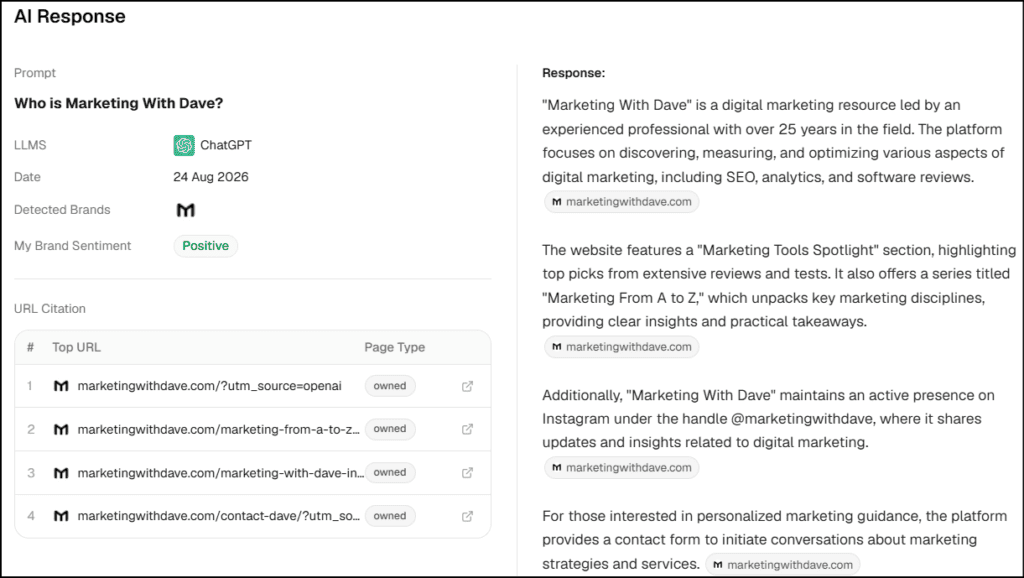
For “Who is Marketing With Dave?”:
- Brand rank: #1
- Brand mentions: 16.7%
- Brand sentiment: Positive
- Multiple MarketingWithDave.com URLs retrieved as sources
Subsig also preserved the actual AI response, not just an aggregate score. ChatGPT described Marketing With Dave as a digital marketing resource led by an experienced professional with 25+ years in the field, focused on SEO, analytics, and software reviews. A fair representation.
More importantly, that result exposed the real gap. ChatGPT recognizes Marketing With Dave, retrieves the site directly, and understands what the brand is about. I’m just not yet showing up for broader category questions around AI Search resources, marketing software reviews, or measuring AI traffic. That’s more actionable than simply knowing my visibility score is 6.7%.
The sentiment score was 80/100, entirely positive, but based on a single response. Subsig does display the response count, so you can weigh the number appropriately, but an 80/100 built on one data point isn’t something to make decisions around yet.
2. Citation Analysis Goes Deeper Than a List of Links
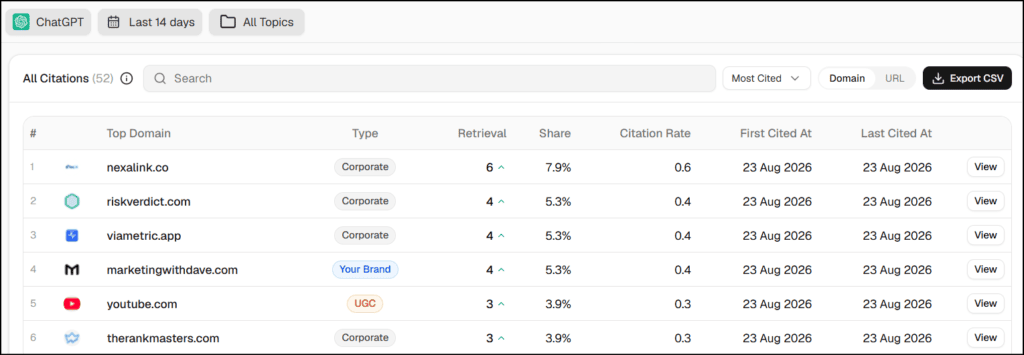
Across tracked responses, Subsig identified 52 domains and 62 URLs, with MarketingWithDave.com contributing 5.3% of both. It categorizes citation sources by type (corporate, UGC, editorial, owned, institutional, and other), and corporate sources dominated my early dataset at 72.4% of retrievals.
That surfaces a useful question: if AI systems keep retrieving certain sites to answer the questions I care about, what can I learn from those sources? One Subsig recommendation pointed toward getting Marketing With Dave included on a site that was already being retrieved frequently. Whether every recommendation holds up remains to be seen, but the underlying citation intelligence is genuinely useful.
3. Competitor Reporting Gives the Numbers Context
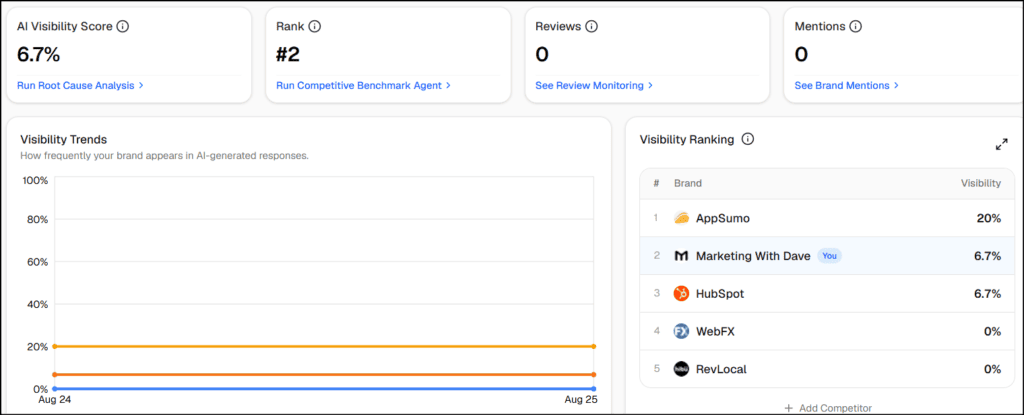
A 6.7% visibility score means little on its own. Adding competitors (AppSumo, HubSpot, RevLocal, Search Engine Journal, Search Engine Land, WebFX) changed that:
| Brand | Visibility | Share of Voice | Avg. Position |
|---|---|---|---|
| AppSumo | 20% | 60% | 2.1 |
| Marketing With Dave | 6.7% | 20% | 2.0 |
| HubSpot | 6.7% | 20% | 2.5 |
| RevLocal | 0% | 0% | — |
| Search Engine Journal | 0% | 0% | — |
| Search Engine Land | 0% | 0% | — |
| WebFX | 0% | 0% | — |
Ten prompts and one AI model is too small a sample to treat this as real competitive intelligence, but it shows the reporting’s value: Marketing With Dave trailed AppSumo on visibility but had the best average position of any brand that appeared. That’s a far more useful signal than a bare visibility percentage. Subsig also suggests additional competitors worth monitoring.
4. The Prompt-Level Drilldown Is Where the Real Story Lives
The dashboard reported a 6.7% AI Visibility Score, #2 visibility rank, 20% share of voice, and #2 share-of-voice rank. Useful for tracking change over time, but not for optimization decisions on their own.
That distinction matters more than I initially realized. I tested the same prompt across six AI Search tools, including Subsig, and found dramatically different visibility scores depending on the platform measuring it. The experiment reinforced why I put more weight on the underlying responses, citations, and prompt-level data than any single visibility score.
The real value is in the individual prompts. Nine told me I have a visibility problem. One told me something better: when someone directly asks who Marketing With Dave is, ChatGPT knows the brand, describes it accurately, ranks it first, and pulls pages straight from the site. That’s a starting point. The real opportunity isn’t “raise 6.7%,” it’s figuring out why the site has strong entity recognition on a branded query but isn’t surfacing for the broader category questions I actually want it associated with. That’s exactly what I want AI Search software to help me investigate.
5. The Agents Are One of Subsig’s Most Interesting Features
Subsig doesn’t stop at dashboards. Its Agents turn your visibility data into standalone reports: root-cause analysis, prompt discovery, competitive benchmarking, even a 180-day AI visibility roadmap.
The Root Cause Analysis Agent was the standout. It examined where Marketing With Dave was and wasn’t appearing, dug into citation sources, and prioritized actions. The Prompts Discovery Agent suggested new questions to track, organized by buyer intent, which matters because deciding what to track is half the battle. The reports are polished, too: my 180-day roadmap broke recommendations into phases with separate tactics for ChatGPT, Perplexity, and Gemini.
But polished doesn’t always mean correct.
I hadn’t added competitors to this project. The Competitive Benchmark Agent correctly flagged that it couldn’t run a true comparison, then speculated that the absence of tracked competitors might mean Marketing With Dave operates in a niche without real rivals. Another report skipped the caveat entirely and invented generic “Competitor A,” “Competitor B,” and “Competitor C” profiles. Neither conclusion is supported by my data.
Treat the Agents as AI-assisted analysis, not a finished analyst’s report. Read it, question it, and verify before acting on it.
Several more Agents are marked “coming soon”: Social Mentions Plan, Reputation Playbook, Review and Listings Plan, Keyword Strategy, Authority Building, Review Response, and a Custom Agent for building your own workflows. If those deliver, the Agents could become the platform’s biggest differentiator.
6. Review Monitoring Could Be Valuable for the Right Business
Marketing With Dave showed zero review data at first, unsurprising for a site that doesn’t generate hundreds of customer reviews. I added AppSumo as a second brand specifically to see what Subsig does when review data exists. A local business, SaaS company, eCommerce brand, or established product with real review volume will get far more out of this feature than I can demonstrate here, which is part of why I wouldn’t judge Subsig purely against dedicated AI visibility platforms.

7. Keyword Intelligence Has Potential, but I Couldn’t Properly Test It
Keyword Intelligence is one of Subsig’s more interesting features because it can track conversations around topics even when your brand isn’t mentioned. I configured all five keywords available on Tier 1, including “AI Search Visibility,” “SiteSqueeze,” and “Marketing With Dave,” but Subsig had not returned any results by the time I completed this review.
That leaves a significant part of the platform I can’t fairly evaluate yet. The setup also needs clearer guidance around how keyword matching works, particularly the distinction between “All of these keywords” and “Any of these keywords.” I’ll revisit this feature once I have enough data to judge what it actually finds.
See the current AppSumo deal for Subsig
What I Didn’t Like
1. Tier 1 Has Some Significant Limits
Tier 1 gives you 10 tracked prompts, ChatGPT as the only AI provider, 5 keywords, 5 brands, 2,000 reviews, and 1,000 mentions. Ten prompts were enough to run my standard benchmark, but not much more, and meaningful cross-platform AI visibility requires moving up to Tier 3.
Some limits also aren’t obvious until you hit them. Review and mention capacities don’t reset, and deleting records doesn’t restore capacity. Subsig also limits monitoring to its supported platforms rather than letting you add any source. None of these are dealbreakers, but buyers should understand them before choosing a tier or configuring broad monitoring.
2. Data Processing Needs Much Better Communication
Data taking time is fine; making users guess whether the system is processing, broken, or misconfigured is not. During my testing, some data took hours to appear with little indication of what was happening. Something as simple as “7 of 10 prompts processed” or “next mention scan scheduled for…” would solve much of the problem.
3. The Product Needs More Explanation and Guidance
Subsig has a lot going on, and it sometimes assumes you understand how everything works together. Metrics such as Citation Rate, Retrieval, and Contribution need better explanation. Keyword Intelligence’s All/Any matching wasn’t clear. The distinction between competitors configured in different parts of the platform can also be confusing.
The same applies to the Agents. They’re promising, but I’d like to see more context showing which underlying data produced a recommendation, especially after seeing some reports make conclusions the data didn’t support.
Pricing and Tier 1
Subsig is currently on AppSumo across four lifetime tiers, all with unlimited users and all Agents included:
| Tier 1 | Tier 2 | Tier 3 | Tier 4 | |
|---|---|---|---|---|
| Price | $49 | $119 | $269 | $499 |
| Workspaces | 2 | 3 | 10 | 20 |
| Tracked prompts | 10 | 25 | 50 | 100 |
| Lifetime AI credits | 240 | 450 | 900 | 1,500 |
| Review capacity | 2,000 | 3,500 | 7,000 | 13,000 |
| Mention capacity | 1,000 | 3,000 | 5,500 | 12,000 |
| Keywords | 5 | 15 | 25 | 50 |
| Brands | 5 | 15 | 25 | 50 |
| Trackable review platforms | 12 | 18 | 32 | 64 |
| Supported review platforms | 4 | 6 | 10 | 15 |
| Social platforms | 5 | 7 | 7 | 7 |
| AI providers | OpenAI | OpenAI | OpenAI, Perplexity, Google AI Overview | OpenAI, Perplexity, Google AI Overview |
| Notifications | Email & Slack | Email & Slack | Email & Slack | Email & Slack |
Tier 3 is where the biggest unlock happens. It’s the first tier to add Perplexity and Google AI Overview alongside OpenAI, while increasing prompt capacity to 50. If cross-platform AI visibility is a priority, that’s the tier I’d look at.
Tier 1 makes more sense if you’re interested in Subsig’s broader brand-intelligence capabilities and can live with ChatGPT-only visibility and 10 tracked prompts. That’s an important distinction: the value looks considerably different depending on whether you’re buying Subsig as an AI Search tracker or as a broader brand-monitoring platform.
Bottom Line
Subsig is hard to put in a neat category, and that’s what makes it interesting. As a pure AI Search visibility tracker, its reporting, citation analysis, competitor tracking, and prompt-level data hold their own, but Tier 1’s 10-prompt limit and ChatGPT-only access are restrictive.
The bigger story is the combination of AI visibility with reviews, brand mentions, sentiment, keywords, citations, competitors, and Agents designed to turn that data into recommendations. Not every part was a natural fit for Marketing With Dave today, and the platform still needs better guidance and transparency around data processing.
Most AI visibility platforms essentially ask, “Does AI mention my brand?” Subsig is aiming at a bigger question: “What does the digital world know and say about my brand, and what should I do about it?” If that’s the problem you’re trying to solve, Subsig is considerably more interesting than another AI visibility dashboard.
See the current AppSumo deal for Subsig
This content is for educational purposes and reflects my hands-on experience using the product and the information publicly available at the time of writing. Always evaluate tools based on your specific business needs, goals, and workflows before making a decision.
Looking for more marketing software reviews? See my full list of marketing tools and software I recommend.