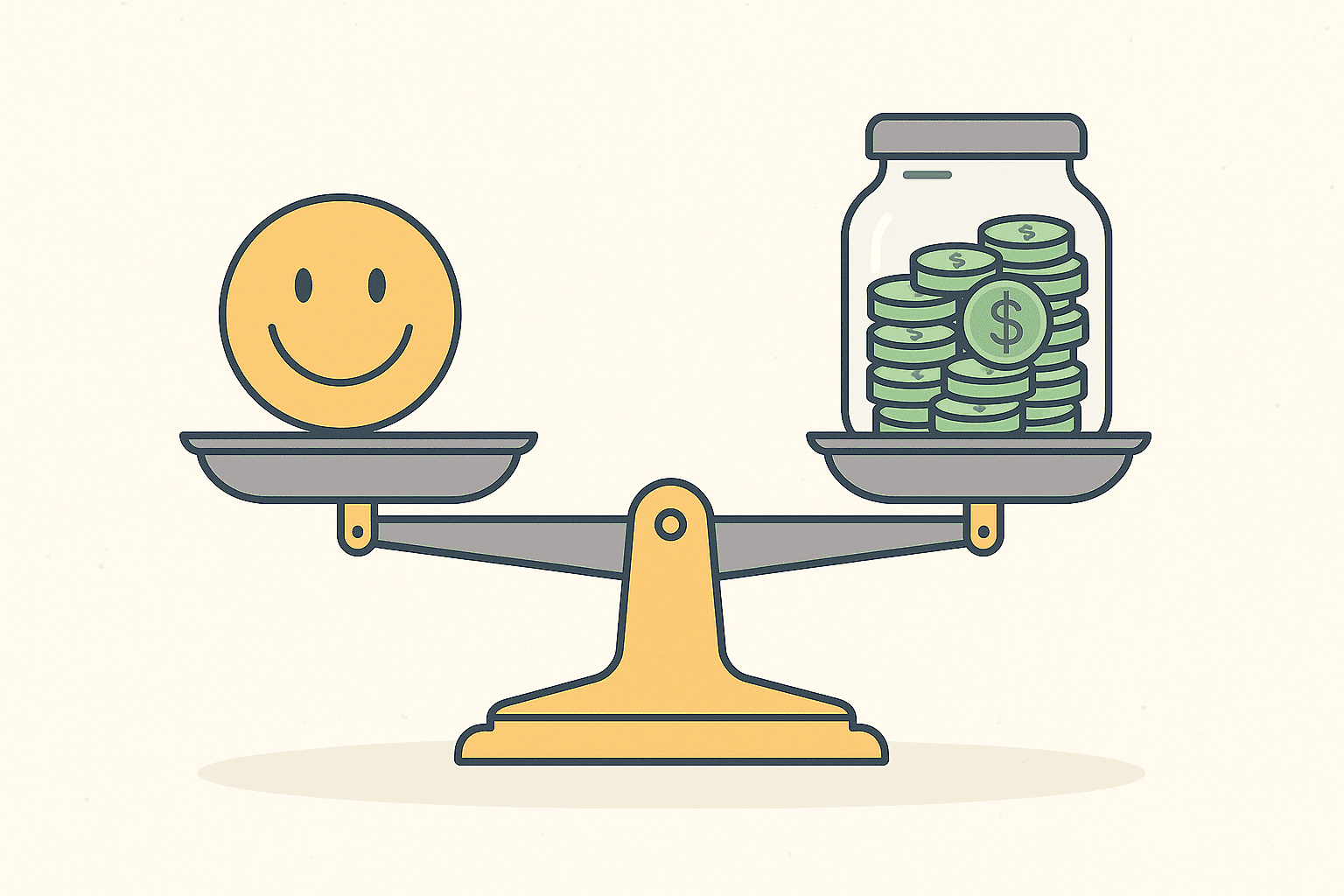
When I first added Google AdSense to my website, it wasn’t about chasing ad revenue. I wanted to understand how it really worked—how websites earn money from ads, what trade-offs exist, and whether it’s even realistic to make enough to cover basic website costs.
This post comes from more than a year of experimenting, learning, and slowly improving my website to see what’s possible.
It actually took me three tries to get approved for Google AdSense. After each rejection, I devoted more time to creating meaningful content that was better organized and implementing more SEO best practices. Google doesn’t provide much detail for why you’re not approved, but looking back, I knew I didn’t yet have the quality or depth required. That process turned out to be one of the most valuable parts of the journey.
How AdSense Earnings Are Calculated
Google AdSense earnings are primarily based on two components: clicks and impressions.
Clicks × CPC (Cost Per Click): You earn money every time a visitor clicks on an ad, and the amount depends on what advertisers in your niche are willing to pay.
Impressions × CPM (Cost Per Thousand Impressions): Even if no one clicks, you can still earn a small amount for each ad displayed on your pages.
For most new websites, the majority of revenue comes from clicks, with a much smaller portion coming from impressions. AdSense reports this automatically, but breaking it down helps you understand what really drives your income. However, even if you do earn consistently, Google will not send payment until your account balance reaches the payout threshold—$100 USD in most countries. That means you must accumulate at least $100 in total earnings before receiving your first payment.
My AdSense Journey in Numbers
Here’s a look at my own performance over several months. These figures include estimated earnings, page views, and the resulting Page RPM (revenue per thousand page views).
Month
Estimated Earnings
Page Views
Page RPM
July 2025
$0.12
157
$0.76
August 2025
$0.90
685
$1.31
September 2025
$1.67
979
$1.71
October 2025
$2.11
1,213
$1.74
Across these months, my website averaged roughly $1.40–$1.70 per thousand page views. That’s typical for a newer website without heavy ad optimization or niche targeting.
The Math Behind $100 a Month
One of the biggest questions I had early on was: how much traffic would I need to earn just $100 in a month?
The formula is simple:
Required Page Views = (100 / RPM) * 1000
Using my average RPM of about $1.70, here’s what that looks like:
RPM
Page Views Needed for $100
$1.50
≈ 66,667
$5.00
≈ 20,000
$10.00
≈ 10,000
$25.00
≈ 4,000
At my current rate, I’d need nearly 59,000 monthly page views to reach $100. That’s a humbling but eye-opening number. It shows that while AdSense can generate passive income, it takes serious traffic to make it meaningful.
The Trade-Off: Ads vs. Audience Experience
Of course, there’s a trade-off. I could increase my RPM by adding more ad placements or using more aggressive formats, but every extra ad makes the user experience worse. Pop-ups, sticky banners, or excessive in-content ads may boost short-term revenue but risk annoying visitors and reducing trust.
For me, it’s a balance. I want to understand ad performance and potential, but not at the cost of driving readers away. Knowing that I’d need tens of thousands of page views to make even $100 a month helps keep expectations realistic—and priorities focused on building value first, not clutter.
Lessons Learned After a Year with AdSense
1. Getting approved requires patience and quality content. Google doesn’t want thin or incomplete websites.
2. Most small sites earn only a few dollars a month at first. RPM varies by niche, region, and ad type.
3. The biggest factor you control is your content. More useful, searchable, and shareable content means more qualified traffic—and that’s the foundation for every other monetization option.
4. AdSense can teach you a lot about digital advertising economics, even if you never make much money from it. For me, the insights have been the real value
After a year of experimentation, I’ve come to see Google AdSense as a learning tool rather than a paycheck. It’s shown me exactly what’s possible—and what it really takes—to turn traffic into income without compromising the experience for readers.
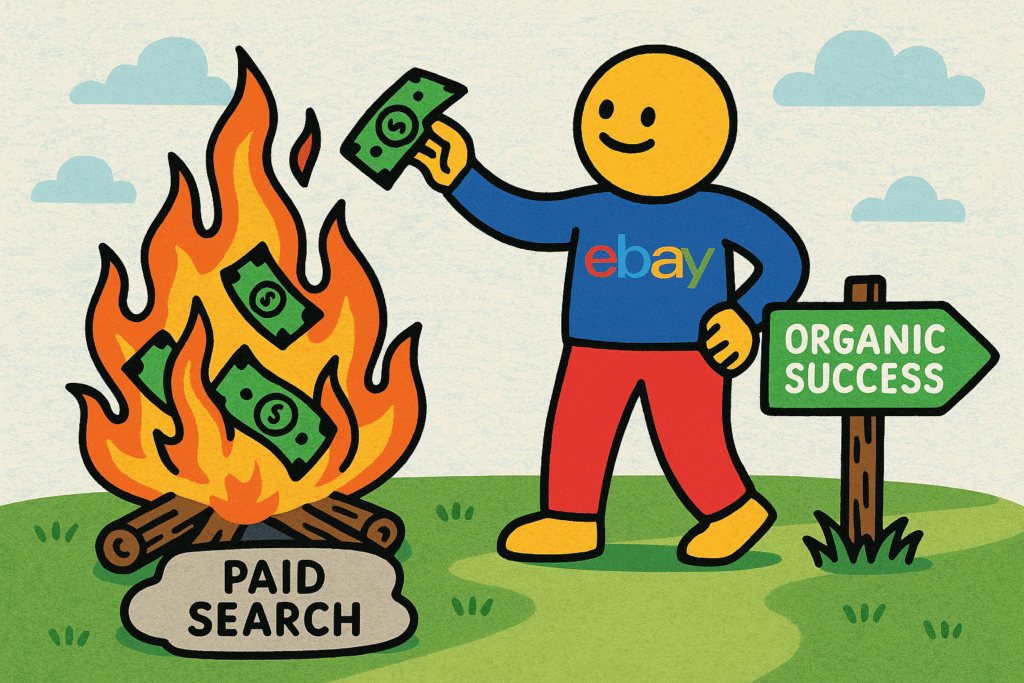
In a bold marketing experiment, eBay temporarily halted its paid search ads on Google to measure what would happen. The result?
The eCommerce giant discovered that free organic search listings generated almost the same click traffic as its costly Google ads.
This finding shocked the industry because it suggested eBay was paying millions for ads that didn’t bring in many new customers.
The case highlights the importance of testing advertising ROI and reminds marketers that sometimes organic search can capture demand without extra ad spend.
Company Involved
eBay is a global eCommerce marketplace founded in 1995, known for its auctions and vast product catalog. By the early 2010s, eBay was not only a top online retailer but also one of the biggest spenders on Google’s advertising. This made the company uniquely positioned – and motivated – to investigate whether its substantial investment in paid search ads was truly worthwhile.
Marketing Topic
Advertising
Strategy
Search Engine Optimization (SEO)
Public Reaction or Consequences
eBay’s findings, published in collaboration with economists at UC Berkeley and the University of Chicago, sparked widespread discussion in the marketing world. Industry experts were astonished – if a top advertiser like eBay saw “no measurable benefits” from certain Google ads, what did that mean for the billions spent on search marketing? Some marketers applauded eBay for questioning “business as usual” and using scientific rigor to test advertising ROI. The study concluded that “substitution between paid and unpaid traffic was nearly complete” – in other words, when eBay turned off its paid ads, customers simply clicked the organic result instead.
Google responded by pointing out that results can vary. Google’s own research claimed 89% of ad clicks are incremental, meaning those visits would not occur without ads. This contrast set off debate: eBay’s case suggested that well-known brands might be overpaying for ads, while Google urged advertisers to run their own experiments rather than assume all ads are ineffective. Many marketers began reconsidering their ad budgets and attribution models, and the eBay experiment quickly became a case study discussed in marketing conferences and even classrooms.
Why It Matters Today
AI-driven ad buying: Automated bidding algorithms can optimize for clicks and conversions, but without human oversight they might overspend on keywords that don’t drive incremental sales. eBay’s case shows that even advanced systems need a reality check on true ROI.
Marketing attribution: Modern attribution models are sophisticated, yet the core lesson remains: correlation is not causation. Marketers must distinguish between customers acquired due to ads versus those who would buy anyway (as eBay did through its testing).
Search optimization vs. ad spend: The experiment underscores the value of SEO and brand equity. A strong organic presence can yield “free” traffic – saving millions in ad spend. In today’s budget-conscious environment, maximizing organic reach before paying for ads is more critical than ever.
3 Takeaways
Test for incremental impact: Don’t take ad performance at face value. Use controlled experiments (geo holdouts, A/B tests) to see if ads truly add sales or just cannibalize organic traffic.
Prioritize new customer acquisition: eBay found its ads mainly influenced new or infrequent users, not loyal repeat buyers. Focus your paid search budget on audiences who wouldn’t visit otherwise, and don’t waste spend chasing customers you already have.
Bolster SEO for core keywords: If your brand already ranks high organically, paying for the top ad spot may be redundant. Invest in SEO so that your site captures demand naturally – and reserve paid ads for areas where you need the boost.
Notable Quotes and Data
“No measurable benefits.” The eBay study reported that its search ads had “no measurable short-term benefits” for well-known brand terms – customers clicked the free organic link instead.
99.5% organic replacement: When eBay turned off its brand keyword ads, 99.5% of the traffic that the ads would have generated still came to eBay via organic search results.
$0.25 per $1 ROI: The experiment showed that eBay got only about $0.25 in revenue for each $1.00 spent on search ads, meaning the vast majority of its paid search budget was wasted.
Full Case Narrative
Background: By 2012, eBay was spending massive sums on Google AdWords – advertising on generic product terms as well as on its own name. However, some within eBay (including a team of internal economists) wondered whether these ads were truly driving additional sales or simply capturing clicks from people who would have come to eBay anyway. John Wanamaker’s famous adage came to mind: “Half the money I spend on advertising is wasted, I just don’t know which half.” To find out which half was which, eBay embarked on a bold experiment.
The Experiment: eBay partnered with academics to design a large-scale field test of paid search advertising. In early 2012, they turned off brand keyword ads (like ads for searches containing “eBay”) on certain search engines and in certain regions. They also halted non-branded search ads (generic keywords such as “camera” or “vacuum cleaner”) for a randomly selected 30% slice of U.S. users over 60 days. By comparing user behavior in markets with no eBay ads to markets where ads continued as normal, eBay could isolate the true causal impact of its search ads.
Key Findings: The results were striking. For searches where eBay’s organic listing already appeared prominently (e.g. someone Googling “eBay”), the paid ads were essentially superfluous. The researchers found that “almost all of the forgone click traffic and attributed sales were captured by natural search” once the ads were turned off. In fact, eBay revealed that the clicks it lost by not advertising were almost entirely made up by clicks on the unpaid organic link. In plain terms, if eBay didn’t pay for an ad, the customer still found their way to eBay via the next available (free) link.
When it came to generic product searches, the lift from ads was minimal. Shutting off ads on broad, non-branded terms led to only a 0.66% change in sales – a difference so small it was statistically insignificant. As the study put it, “on average, US consumers do not shop more on eBay when they are exposed to paid search ads. In other words, overall sales stayed about the same whether eBay ran those Google ads or not.
However, there were a few important exceptions:
New or infrequent users: The ads did have some effect on people who were not regular eBay shoppers. First-time buyers and very infrequent customers were slightly more likely to make a purchase if they saw a search ad, whereas frequent eBay users’ behavior was “unaffected by the presence of paid search advertising. In fact, the more purchases a user had made on eBay in the past, the less impact the ads had. This implies that the incremental value of ads came largely from new customer acquisition, not from the loyal base.
Competitive scenarios: The researchers acknowledged that if eBay didn’t bid on certain keywords, a competitor could step in. For instance, if someone searches for an eBay product (say “eBay shoes”) and no eBay ad appears, a rival retailer’s ad might grab that click. In theory, brand ads can serve a defensive role – the only time a brand ad truly adds value is if it prevents a competitor (e.g. Adidas) from “hijacking” a search for your brand (e.g. Nike). Thus, some companies might still buy their own keyword to block others, even if the direct sales impact is negligible.
The study’s publication served as a wake-up call across the industry. It highlighted the danger of attributing sales to ads that didn’t truly cause them – many of eBay’s ad clicks were from loyal buyers who would have purchased regardless. Without careful analysis, a marketing team might have wrongly credited those sales to advertising, vastly overestimating the ads’ effectiveness. These findings prompted many companies to rethink their search engine marketing investments.
Some large advertisers quietly reduced or even stopped bidding on their own brand names after seeing eBay’s results, reasoning that their loyal customers would find them organically. Meanwhile, smaller businesses and lesser-known brands viewed the findings with caution. If a company lacks eBay’s name recognition, appearing in sponsored results might be crucial to visibility. Even the eBay researchers noted that paid search could be more valuable for companies without a strong brand or organic presence. Google, for its part, encouraged advertisers to use tools like AdWords experiments to measure effectiveness for themselves, emphasizing that “outcomes differ among advertisers. Still, eBay’s case has forever raised skepticism about blindly pouring money into search ads without evidence of incremental gain.
What Happened Next?
In the aftermath, eBay reportedly scaled back its spending on paid search ads that merely duplicated its organic traffic. For example, eBay realized it didn’t need to pay Google for an ad when someone searches “eBay” – since eBay’s own organic result would be at the top for free. Instead, the company refocused its search marketing budget on more targeted areas. eBay continued to run ads for certain product keywords and competitive categories where it didn’t dominate the organic results, and especially for campaigns aimed at acquiring new users (where the data showed ads had some positive effect).
Over time, eBay also diversified its marketing strategy beyond just Google search. The company put more resources into SEO – making sure eBay listings and pages rank well in organic search so that shoppers find them easily without paid ads. It also expanded efforts in email marketing, social media, and affiliate partnerships, and even developed its own internal advertising for sellers (Promoted Listings on the eBay platform). The overarching strategy for eBay became clear: spend advertising dollars where they truly bring in additional business, and avoid “vanity” ad buys that simply pay for traffic eBay would get anyway.
The industry at large felt eBay’s influence. In the years since, many big advertisers have become more sophisticated about testing ad effectiveness. Concepts like incrementality and causal lift are now common parlance – marketers want to know not just if an ad gets clicked, but if it leads to extra sales beyond baseline. eBay’s pioneering experiment helped shift the focus toward data-driven marketing and accountability. To this day, its bold test is cited whenever questions arise about the real ROI of digital ads.
One Sentence Takeaway
Don’t assume your ads are driving new sales – as eBay proved, you might be paying for clicks you’d get anyway, so always test and trust the data.
Apple’s “Get a Mac” advertising campaign from 2006 to 2009 personified Mac and PC in witty TV spots that highlighted ease of use, security, and simplicity.
The work quickly boosted Apple’s image and Mac sales, with Apple reporting 1.3 million Macs sold in the July 2006 quarter and a 39 percent sales increase for the fiscal year.
Microsoft later replied with the “I am a PC” effort, but Apple had already framed the narrative of Mac as the modern and friendly choice.
Company Involved
Apple created the campaign with TBWA Media Arts Lab. Justin Long portrayed Mac and John Hodgman portrayed PC in a minimalist white set that kept the focus on the comparison.
Marketing Topic
Advertising
Branding
Product Positioning
Public Reaction or Consequences
The ads became a cultural reference point, widely shared and parodied. Apple credited the period following launch with substantial sales momentum, including an additional two hundred thousand Macs sold after the campaign began and a 39 percent full year sales increase in 2006. The campaign won major industry awards and helped reposition Mac as approachable and cool. Some commentators criticized the tone as smug, which shows the risk inherent in comparative advertising. Microsoft pivoted with “I am a PC” to rebuild pride and shift attention away from Vista’s issues.
Why It Matters Today
It demonstrates how challenger storytelling can redefine a category, how tone in comparative advertising can help or hurt, why speed of response matters in narrative control, and how product truth must support the claim or the market will reject the message.
3 Takeaways
1. Make technical benefits human. Personify differences so everyday users grasp the value without specs.
2. Control the narrative before your rival does. Slow reactions cede cultural ground that is hard to win back.
3. Back claims with product reality. Advertising accelerates momentum only when it aligns with real experience.
Notable Quotes and Data
One month after launch Apple saw an increase of two hundred thousand Macs sold, and by July 2006 Apple reported 1.3 million Macs sold with a 39 percent sales increase for the fiscal year. Source: Wikipedia: Get a Mac.
Critique on tone: “Smug superiority can be off putting as a brand strategy.” Source: Slate: Mac Attack.
Full Case Narrative
In 2006 Apple needed a broader Mac audience in a market where Windows dominated. The answer was a simple stage with two characters. “Hello, I am a Mac.” “And I am a PC.” Each spot humorously surfaced a single comparison such as virus resistance, ease of setup, or fewer interruptions. When Windows Vista arrived to mixed reviews, Apple leaned into cultural truth about intrusive prompts and compatibility headaches. The format made technical points memorable and shareable.
Results followed quickly. Apple’s reported unit lift and the 39 percent 2006 sales increase aligned with the campaign’s early momentum. Recognition arrived as well, including top effectiveness honors and later Adweek’s campaign of the decade. The work spread through parodies and became shorthand in pop culture for a product comparison that felt human and clear.
Microsoft initially tested abstract celebrity work, then pivoted to “I am a PC” with real users to reclaim identity and pride. The response improved tone but did not directly address Vista concerns, which Apple satirized with spots about spending on advertising rather than fixing the product. The eventual Windows 7 launch reset the product story, while Apple retired the series after more than three years and over sixty ads.
The lesson is that advertising can set the frame, but the product must carry it. Apple’s claims resonated because they lined up with lived experience. Microsoft improved outcomes once the underlying product improved. Timing and tone shaped how each message landed during a period when technology brands were defining their identities for mainstream consumers.
Timeline
May 2006: Apple launches the first “Get a Mac” commercials.
January 2007: Windows Vista launches and Apple releases new comparative spots that reflect user frustrations.
September 2008: Microsoft launches “I am a PC” to counter Apple’s framing.
October 2009: Windows 7 launches to positive reviews and Apple winds down the campaign.
What Happened Next?
Apple shifted away from direct comparison and focused future creative on product benefits and ecosystem stories. Microsoft moved forward with Windows 7 messaging that highlighted listening to customers and value narratives like “Laptop Hunters.” The rivalry informed later brand storytelling across the industry, where personality and clarity continued to outperform feature lists.
One Sentence Takeaway
A simple and human story can reframe a category, but the message only endures when the product reality supports it and when rivals respond with speed and substance.
Promoting a free or discounted book can quickly get expensive, but it doesn’t have to. If you’re using Amazon KDP (Kindle Direct Publishing), you can run a free book promotion for up to five days every 90 days. These windows are perfect opportunities to list your book on websites that don’t charge anything to help spread the word.
The websites in this list let you promote your book at no cost, and many are beginner-friendly. Just keep in mind: you get what you pay for. These platforms are a great starting point to test interest and see how much traction your book can gain organically. After trying a few, you can evaluate whether any are worth pursuing further through their paid tiers or explore other paid advertising options.
Tier 1: Websites That Ask for Both a Start and End Date
These websites request both the first and last day of your promotion, meaning they are likely taking action to promote your book during that exact window. Whether that’s featuring it in a newsletter, highlighting it on their home page, or including it in a genre-specific roundup, these are the websites most actively coordinating with your promotional schedule. If you’re planning a time-limited free or discounted book promotion, start here.
Tier 2: Websites That Ask for a Single Promotion Date
These platforms only require you to provide a start date or a single promotion day. While they may not align as precisely with a multi-day campaign, they still offer a great chance to get extra visibility, especially if you’re doing a one-day push or want to spread mentions across several days during your promo window.
These platforms don’t require any start or end dates for your promotion. Instead, they’ll list your book on their website once you submit it. While they may not provide time-sensitive exposure, they can still help with long-term discoverability, especially for free books or permanent price drops.
If you’re serious about marketing your book but working with a tight budget, these free platforms are a great place to start. Keep in mind that results can vary widely depending on your genre, timing, and presentation. Try a few during your next Amazon KDP free promotion window and track which ones drive the most downloads or engagement.
Did we miss one of your favorite free promotion websites? Let us know in the comments. We will keep this list updated as new resources emerge.
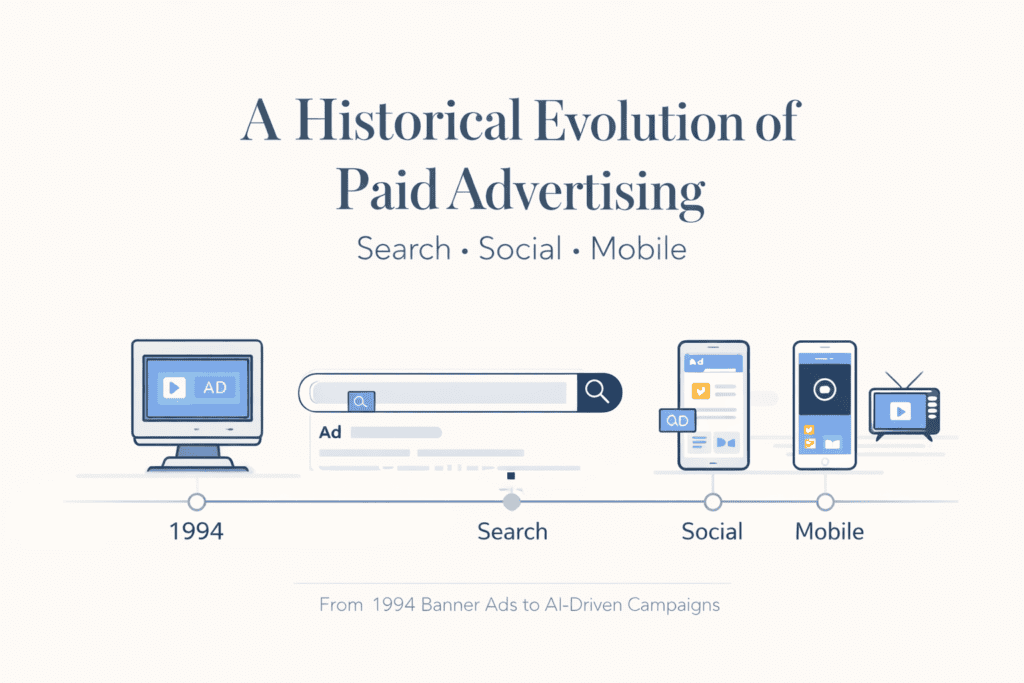
Paid digital advertising has come a long way since the first banner ad appeared on the web in 1994. From the early days of pop-ups and static banners to today’s sophisticated, AI-driven campaigns, online advertising has reshaped how brands reach and engage audiences. This timeline highlights the pivotal moments, platforms, and innovations, from Google Ads and Facebook to TikTok and connected TV, that turned the internet into the world’s most powerful advertising medium.
1994
October – The first banner ad appears on HotWired.com, promoting AT&T, and achieves a 44% click-through rate.
1997
– Pop-up ads are invented at Tripod.com, quickly spreading across the web.
1998
February – Goto.com launches pay-per-click search advertising, pioneering keyword bidding.
2000
October – Google AdWords launches with self-serve ads and cost-per-impression pricing.
2002
– Google AdWords transitions to cost-per-click auctions, factoring in ad relevance.
2003
– Google launches AdSense, enabling contextual ads on publisher websites.
2005
– Google introduces Quality Score in AdWords, rewarding relevant ads with better placements and lower costs.
2007
November – Facebook launches its Ads platform, combining Pages, targeting, and Social Ads.
2009
– Google introduces remarketing, enabling advertisers to retarget past website visitors.
2010
April – Twitter launches Promoted Tweets, entering the paid social advertising market.
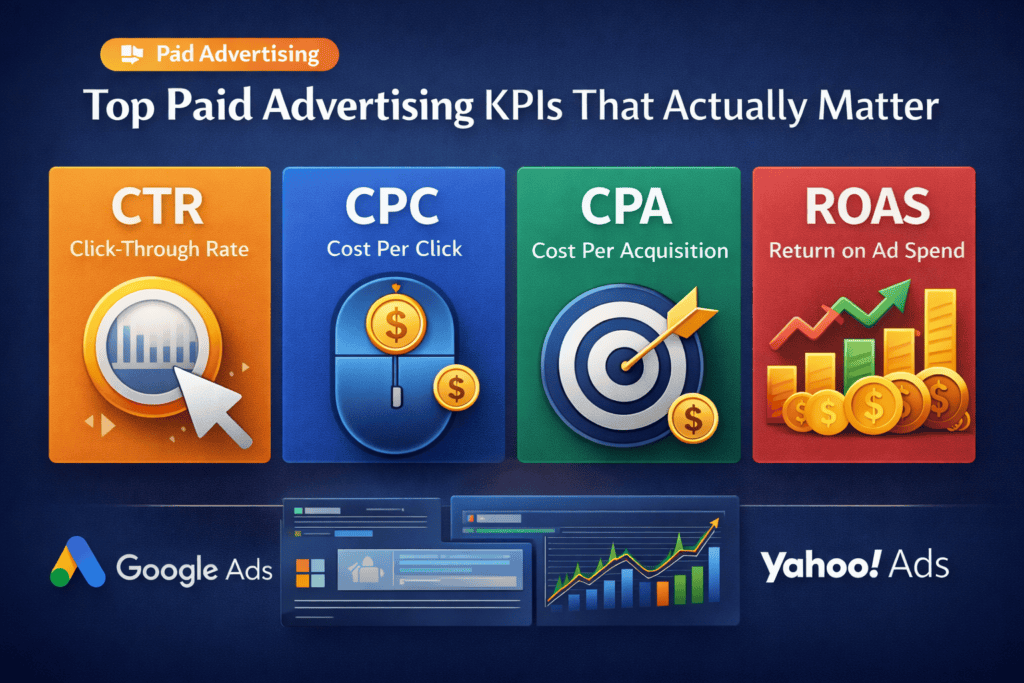
Want to track what really matters in paid advertising? This guide breaks down the most important PPC (pay-per-click) KPIs for 2024 and beyond, with a focus on search and display networks like Google Ads, Microsoft Ads, and Yahoo.
We’re not covering paid social metrics such as Facebook, Instagram, or LinkedIn ads. Instead, we’re diving into the core performance metrics that matter for search marketers: things like click-through rate (CTR), cost per click (CPC), cost per acquisition (CPA), and return on ad spend (ROAS).
Whether you’re managing campaigns in Google, Bing, or Yahoo, these are the KPIs you should be tracking. Each metric includes current benchmarks to help you compare, optimize, and improve the ROI of your PPC campaigns. These are not vanity metrics. They are essential measurements for campaign auditing, performance reporting, and long-term growth.
If you’ve been wondering what a good ROAS looks like in 2024, how your Google Ads CTR compares to industry averages, or which PPC benchmarks actually matter, you’re in the right place.
Want to stay ahead in paid search? These KPIs are your roadmap. Revisit them quarterly, benchmark annually, and use them to build campaigns that scale with profit in mind.