Last updated June 2026
Most AI visibility dashboards tell you whether your brand appeared. That is not the same as knowing whether your brand influenced the answer.
In This Article
- The real problem with AI visibility measurement
- What today’s AI visibility tools measure well
- Why AI visibility is sampled, not measured
- The questions we still need to answer
- Visibility vs. influence
- What AI influence might be made of
- Which gaps will tools solve?
- The bigger picture
- Frequently asked questions
The Real Problem with AI Visibility Measurement
For years, SEO professionals obsessed over rankings.
Eventually, we realized rankings were not the goal. Rankings were a proxy for something that mattered more: traffic, leads, revenue, trust, and market demand.
I think AI visibility is now going through a similar phase.
Marketers are asking a very understandable question:
Is my brand being mentioned or recommended by AI?
That question matters. If ChatGPT, Gemini, Claude, Perplexity, Grok, or Google AI Overviews are shaping how buyers compare solutions, brands need to know whether they are showing up.
But after spending time with AI visibility tools, I keep coming back to a more important question:
Are we measuring the right thing? There is a meaningful gap between knowing your brand appeared in an AI response and knowing whether your brand actually influenced the recommendation.
That distinction matters.
A brand can be mentioned without being recommended. A brand can be listed without being trusted. A brand can appear in a response without shaping the final decision.
Visibility is useful. But visibility is only the starting point.
What Today’s AI Visibility Tools Measure Well
The current generation of AI visibility platforms has made real progress.
Tools like Visby, ZeroRank, SnowSEO, Profound, Peec AI, Semrush’s AI visibility tools, Ahrefs Brand Radar, and others are helping marketers answer questions that were difficult or impossible to answer just a short time ago.
Depending on the platform, you can often measure:
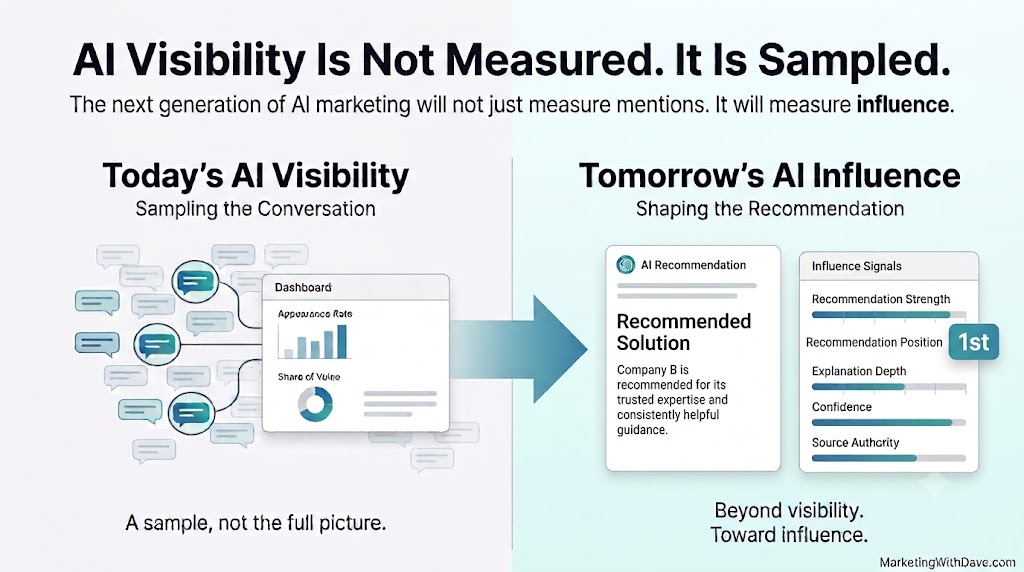
- Appearance rate: how often your brand appears
- Share of voice: how often you appear compared to competitors
- Prompt-level visibility: which prompts mention your brand
- Citation sources: which pages or domains AI appears to reference
- Brand accuracy: whether AI describes your product correctly
- Competitive visibility: who appears beside you or instead of you
- Historical trends: whether visibility is improving or declining
Those are useful metrics.
Before these tools existed, marketers were mostly guessing. Now we can at least observe patterns across a chosen set of AI prompts.
That is not a small thing.
But it is also not the full picture.
Why AI Visibility Is Sampled, Not Measured
Every AI visibility platform depends on the prompts being tracked.
That sounds obvious, but it is one of the most important limitations in this entire category.
Imagine your potential customers could ask AI 400 different questions before buying your product.
Your dashboard tracks 30 of them.
If your visibility score looks excellent, what do you actually know?
You know your brand performs well for those 30 prompts.
You do not know how your brand performs across every possible conversation your buyers might have.
AI visibility is not measured. It is sampled. Every dashboard represents a selected sample of conversations, not the full universe of questions your market may ask.
This is not a flaw in Visby, SnowSEO, ZeroRank, or any other specific tool.
It is the nature of conversational AI.
Traditional SEO tools can crawl keywords, rankings, backlinks, pages, and search volume. AI visibility tools cannot crawl every possible conversation because the number of possible prompts is effectively unlimited.
That means the quality of your AI visibility data depends heavily on the quality of the prompts you choose to monitor.
If you track the wrong prompts, your dashboard can look clean while your market reality is messy.
If you track only obvious prompts, you may miss the deeper buying questions where real decisions happen.
If you track only high-level category prompts, you may miss niche use cases where your brand has a better chance to win.
That changes how we should interpret every AI visibility report.
A visibility score is not a complete market measurement.
It is a directional signal based on the conversations you decided were worth observing.
The Questions We Still Need to Answer
The more I work with AI visibility tools, the more I find myself asking questions that current dashboards only partially answer.
Was I recommended or just mentioned?
There is a major difference between these two responses:
“This is the best option for small businesses that need AI visibility tracking.”
and
“Other tools in this category include…”
Both may count as appearances.
They should not carry the same weight.
Was I the first recommendation?
If AI lists five products, position matters.
Being the first recommendation likely carries more influence than being listed fourth or fifth.
Most AI visibility reporting still has room to improve here.
How strong was the recommendation?
“You may want to consider this tool” is not the same as “this is the tool I would recommend.”
Both are positive.
Only one sounds like a confident endorsement.
How much explanation did my brand receive?
Was your brand mentioned once in a list?
Or did AI spend several sentences explaining what makes your product useful?
Depth matters.
A brief mention may create awareness. A detailed explanation may create trust.
Did I appear immediately or only after follow-up prompts?
AI conversations are not always one-and-done searches.
A user may start broad, then narrow by budget, industry, use case, company size, or pain point.
A brand that appears on the first prompt has a different visibility profile than a brand that appears only after three follow-up questions.
Today, most dashboards are still much better at tracking individual prompts than full conversational journeys.
Which source actually influenced the answer?
AI may cite your website.
But it may also pull from YouTube, Reddit, LinkedIn, reviews, documentation, third-party comparisons, podcasts, or industry publications.
Knowing which sources are cited is useful.
Knowing which sources actually influenced the recommendation is much harder.
Can AI recommend me through content I do not own?
Yes, and this is one of the biggest mindset shifts.
Traditional SEO trained marketers to think visibility lived primarily on their own websites.
AI search changes that.
Your brand can be shaped by:
- Your website
- Review platforms
- YouTube videos
- Reddit threads
- LinkedIn posts
- Customer discussions
- Third-party comparisons
- Industry publications
In other words, your AI reputation may be built across the entire public web, not just on pages you control.
Visibility vs. Influence
This is the distinction I think the AI visibility industry needs to make more clearly.
Visibility asks: Was my brand mentioned?
Influence asks: Did my brand shape the recommendation?
| Company A | Company B |
|---|---|
| Appears in 90% of tracked AI responses | Appears in 40% of tracked AI responses |
| Usually listed fourth or fifth | Often recommended first |
| Mentioned briefly | Explained with confidence |
| High visibility | Lower visibility, stronger influence |
Which company is in a better position?
A basic appearance-rate dashboard favors Company A.
But commercially, Company B may be far more powerful.
That is why AI visibility alone is not enough.
Eventually, marketers will care less about whether they were mentioned and more about how they were framed.
- Were they trusted?
- Were they recommended?
- Were they explained?
- Were they positioned as the obvious choice for a specific buyer?
Those questions get us closer to influence.
What Could AI Influence Be Made Of?
While today’s tools focus primarily on visibility, I expect future platforms measuring influence through several dimensions:
- Recommendation Strength — Was your brand merely mentioned or actively recommended?
- Recommendation Position — Were you the first recommendation or the fifth?
- Explanation Depth — How much context did AI provide about your brand?
- Confidence — Did AI sound certain or tentative?
- Source Authority — Which trusted sources contributed to the recommendation?
These metrics don’t fully exist today, but they illustrate how the conversation may evolve beyond simple appearance rates.
Some of the current gaps feel solvable in the near future.
I expect AI visibility platforms to improve around:
- Recommendation order
- Recommendation strength
- Explanation depth
- Sentiment and confidence scoring
- Prompt clustering by intent
- Multi-turn conversation tracking
- Better source and citation analysis
These are difficult, but they are not impossible. The evidence often exists in the response itself. The challenge is turning that evidence into consistent, useful reporting.
Other questions are much harder.
- Why did one brand earn the recommendation instead of another?
- How much influence came from your website versus third-party sources?
- Would AI still recommend your brand if your website disappeared tomorrow?
- Can we separate model training influence from real-time retrieval influence?
- Can we accurately connect AI exposure to revenue when no click happens?
Those questions may take years to answer well.
Some may never be fully measurable from the outside.
That does not make AI visibility tools less valuable.
It means we need to understand what they can and cannot tell us.
The Bigger Picture
AI visibility tools are not failing because they cannot answer every question.
They are valuable because they finally give marketers a way to observe part of the AI discovery process.
But we should be careful not to confuse what is measurable with what matters most.
Right now, the industry is counting mentions because mentions are trackable.
That is where SEO started too.
Rankings were easy to understand, so marketers obsessed over rankings.
Then we matured.
We learned to care about traffic quality, conversion, attribution, revenue, brand demand, and customer intent.
I think AI visibility will follow a similar path.
The progression may look something like this:
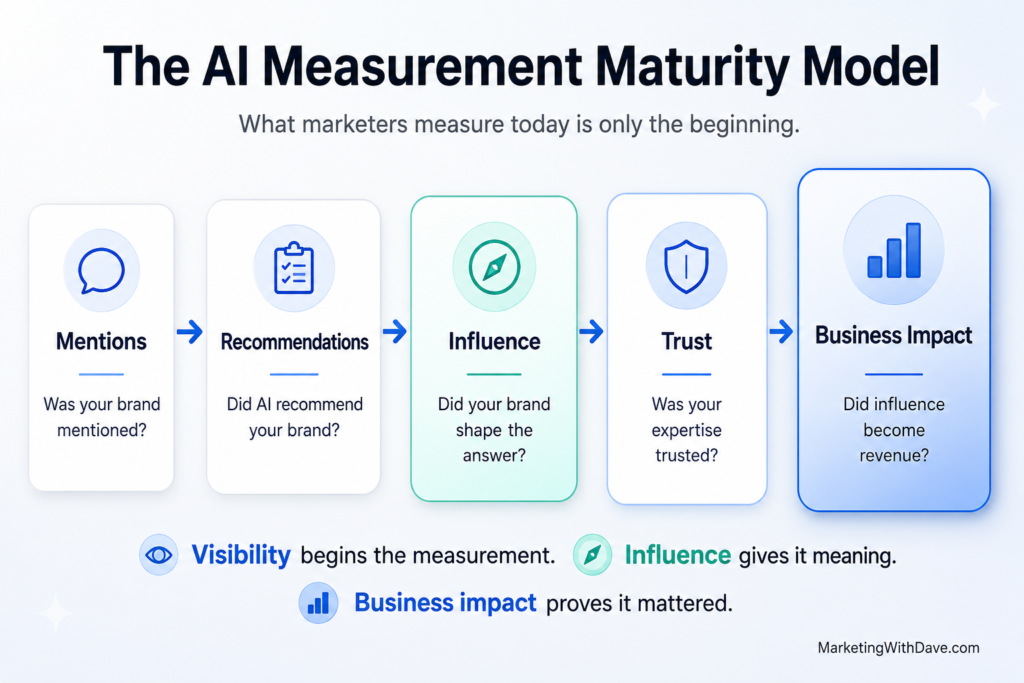
Mentions are only the first step.
The real question is whether your brand is becoming part of how AI understands the category.
Are you associated with the right problems?
Are you connected to the right use cases?
Are you trusted by the sources AI relies on?
Are you recommended when the buyer’s question becomes specific?
That is the next layer of AI visibility.
Not just whether AI mentioned you.
Whether you shaped the answer.
Visibility tells you whether AI mentioned you. Influence tells you whether AI chose you.
Frequently Asked Questions
What is AI visibility?
AI visibility refers to how often your brand, product, website, or content appears in AI-generated answers from tools like ChatGPT, Gemini, Claude, Perplexity, Grok, and Google AI Overviews.
What is the difference between AI visibility and GEO?
AI visibility is the measurement of whether your brand appears in AI-generated answers. GEO, or Generative Engine Optimization, is the practice of improving your chances of being included, cited, or recommended in those answers.
Can AI visibility tools track every possible prompt?
No. AI visibility tools track a selected set of prompts. Because AI conversations can take nearly unlimited forms, every visibility report is based on a sample of prompts, not every possible question a customer might ask.
Does being mentioned by AI mean my brand was recommended?
Not always. A brand can be mentioned in passing, listed as one of several options, or strongly recommended as the best choice. These are different levels of visibility, and they should not be treated as equal.
Why is AI visibility difficult to measure?
AI visibility is difficult to measure because users ask questions in many different ways, AI responses can change, and the systems may rely on many sources across the web. Unlike traditional keyword rankings, AI visibility is based on conversations, not fixed search queries.
Can AI recommend my brand through content I do not own?
Yes. AI can mention or recommend your brand based on your website, but it can also rely on third-party reviews, Reddit discussions, YouTube videos, LinkedIn posts, podcasts, and industry publications.
What is the difference between AI visibility and AI influence?
AI visibility asks whether your brand appeared. AI influence asks whether your brand shaped the recommendation. Influence includes factors like recommendation order, confidence, explanation depth, source authority, and whether the AI positioned your brand as the best fit for a specific need.
What should marketers track beyond AI mentions?
Marketers should look beyond basic mention rate and track recommendation strength, share of voice, competitor comparisons, citation sources, brand accuracy, prompt intent, and whether AI describes the brand in a way that matches its actual positioning.
Dave Nelson is a digital marketing practitioner with more than 25 years of experience in SEO, analytics, content strategy, and marketing technology. He reviews software tools and writes about digital marketing strategy at MarketingWithDave.com.