
Last updated March 2026
The 1987 PSA “This Is Your Brain on Drugs” (Partnership for a Drug-Free America) became an iconic anti-drug image. It was credited with raising teens’ perception of cocaine risk (from 78% to 88%), but later research found fear-based youth campaigns had little beneficial effect, and in some cases correlated with increased drug use.
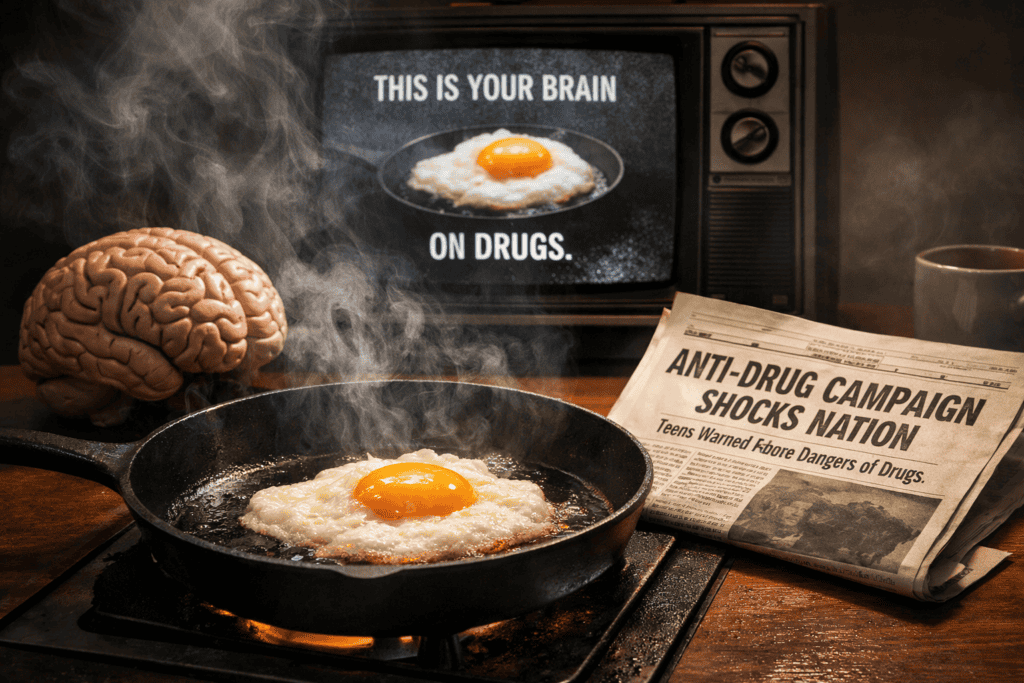
The slogan and frying-egg imagery went viral in pop culture (even drawing an Egg Board protest, but experts (and Syracuse professor Robert Thompson) argue it was too “preachy” and may have backfired.
The concept was later updated in 1997 (a heroin-themed spot with Rachael Leigh Cook and 2017 (Cook again, this time condemning the “war on drugs”. Modern analyses suggest marketers today should balance emotional impact with audience research and relevance, learning both from the campaign’s iconic strengths and its shortcomings.
Background: Partnership for a Drug-Free America
Founded in 1986 by advertising and public health leaders (with $300,000 seed funding from the American Association of Advertising Agencies, the Partnership for a Drug-Free America (PDFA) was a nonprofit social-marketing coalition. Its strategy was to “treat [illicit drugs] like any other purchasing choice” – using marketing tactics to “un-sell” drugs rather than sell them. In practice, volunteer agencies created hard-hitting PSAs and donated airtime, aiming to influence teens as if they were consumers. The organization (now renamed the Partnership to End Addiction) applies research-backed tools to prevent youth substance abuse. In short, PDFA pioneered social marketing and public service advertising, applying commercial creativity to a public health cause.
Marketing Categories
- Social Marketing / Public Service Advertising: The campaign is a classic PSA – no paid media, high-profile creative aimed at social good. It targeted youth with a stark visual metaphor, akin to marketing a product (but with a negative message).
- Cause Branding / Coalition Marketing: PDFA became a brand. Dozens of big agencies (Saatchi & Saatchi, J. Walter Thompson, etc.) volunteered creative work, giving PDFA an industry gloss. The partnership leveraged celebrity culture (“Liken potential addicts to consumers… by celebrity endorsements…Then use those tricks not to sell the product, but to un-sell it” and claimed ~$1 million/day in donated media (over $2 billion total) to saturate TV and print.
- Behavior Change Communication: It falls under health promotion campaigns. Its use of fear appeals (making the brain look fried) and repetition was designed to change teen attitudes and norms, following PDFA’s strategy of using “the best ad minds to denormalize drug use”.
The Original 1987 PSA (“Brain on Drugs”)
In 1987 PDFA aired a 30-second spot featuring actor John Roselius cracking an egg into a hot frying pan, declaring: “This is your brain… [sizzle] …This is drugs. This is your brain on drugs. Any questions?”. The simple, graphic metaphor and tagline made it instantly memorable. Paul Keye – a creative director involved – recalls the campaign was born from the ad industry’s eagerness to “un-sell” hard drugs during Nancy Reagan’s “Just Say No” era. Agencies convinced networks to donate airtime; Keye estimates over $300 million worth of free spots were aired. The PSA ran heavily for months. Audience research later claimed ~92% of teens saw it, and 88% reported believing even occasional cocaine use was dangerous (up from 78% before the ads). Dealers allegedly joked “Let’s go fry an egg” to mean using drugs, showing the line’s penetration into youth slang.
Timeline of Key Events
- 1987: Original “Brain on Drugs” PSA airs nationwide.
- 1989–90: PDFA continues high-profile anti-drug campaigns; by 1990 the Fried-Egg spot was ranked No. 11 on TV Guide’s Top 50 commercials.
- 1997: A new “Brain on Drugs” PSA debuts featuring Rachael Leigh Cook; in this spot her character smashes eggs and even a kitchen to dramatize heroin’s ravages.
- 2016: A third “Brain on Drugs” PSA (without Cook) is released, targeting teens.
- 2017: Cook stars in a remade PSA (released on 4/20/2017) with a twist: it critiques U.S. drug policy, noting that white users are unlikely to be arrested vs. people of color, and condemning the “war on drugs” as costly and ineffective.
- 2010s: PDFA rebrands (first as Partnership at DrugFree.org, then Partnership for Drug-Free Kids) and shifts to digital/parent-focused campaigns (e.g. the “Time to Talk” prescription-drug prevention initiative).
Public and Media Response
The Fried-Egg PSA struck a chord. It was widely cited as *“iconic”* in advertising lore (Time called it iconic in a top-10 PSA list and spawned countless parodies on TV, T-shirts, and the Web. Medill News notes it became “one of the most well-recognized… health campaign ads of all time, evoking parodies and drawing the ire of comedians and musicians”. The tagline “Any questions?” became a catchphrase. Even the American Egg Board complained that the ad unfairly linked their product with drugs. Over time, the image became a cultural shorthand: teen slang picked it up (“fry an egg” for using), and comedians joked about it. Critics, however, called it heavy-handed. Some students reported it felt more like a dare than a deterrent, while others said it truly scared them. Syracuse professor Robert Thompson quipped that he’d “ready to go score some cocaine… to spite the commercial… It was so irritatingly preachy and not effective”. In short, the spot was unforgettable, but it polarized audiences.
Effectiveness: What Really Happened?
Positive Indicators: PDFA cited surveys showing increased risk perception. For example, after the ads 88% of teenagers said even occasional cocaine was dangerous, up from 78% before. The campaign achieved enormous reach, and some analyses (like PDFA’s own press and a 1994 Johns Hopkins commentary) claimed it contributed to youth drug-use deterrence.
Critical Findings: Independent research painted a more nuanced picture. A 2008 *American Journal of Public Health* analysis found that, overall, the National Youth Anti-Drug Media Campaign (which included these PSAs) had no positive effect on teens, and in some cases higher exposure predicted *earlier* drug initiation. A Lancet review concluded drug prevention ads generally showed **“little effect”** on substance use (unlike anti-tobacco campaigns). Notably, a study cited by Prevention specialists observed that youths who saw the campaign were actually *more* likely to use drugs later. Qualitative feedback supports this skepticism: one teen said the ad “stirred my curiosity” and called it a dare, while another said it had genuinely scared her. These findings suggest that despite its fame, the PSA’s actual influence on behavior was limited or mixed. As analysts warn, a campaign that isn’t aligned with audience perceptions can even “move [the] target audience away” from desired change.
Relevance Today
For today’s audiences, the original PSA’s approach feels dated. Media consumption is fragmented (social media, streaming), and many young people distrust blunt scare tactics. Neuroscientific research implies that the best health ads are those that combine emotional engagement with clear rationale. For instance, one study found the most persuasive anti-drug PSAs evoked strong emotional brain responses while using *“less yelling”* – meaning they conveyed consequences in a compelling, nuanced way. This suggests modern campaigns should avoid just shouting warnings; they need narrative hooks or real stories. Cultural shifts also matter.
With increasing acceptance of marijuana and criticism of the War on Drugs, an ad showing a frying brain might lack credibility. The 2017 remake reflects current values: instead of scaring viewers, it used the egg to critique systemic injustice (“the war on drugs is ruining lives… it doesn’t work”. This aligns with today’s trend of addressing social context (racial disparity, policy) and health equity. Marketers now often blend digital outreach and peer-based messaging rather than relying solely on TV PSAs.
Finally, experts emphasize combining ads with broader measures: Wakefield’s Lancet review noted health campaigns work best when paired with policies or education (anti-tobacco ads succeeded when governments taxed and banned smoking). In short, the “brain on drugs” ad remains a powerful symbol, but effective drug prevention today requires data-driven, multi-channel strategies that fit modern culture and media.
3 Actionable Marketing Takeaways
- Use audience research to target messaging: Don’t assume scare tactics work for all groups. Studies warned that a misalignment between the ad’s tone and teens’ own experiences can backfire, even “moving [them] away” from the goal. Test ads with focus groups and be ready to adjust your framing to what resonates with your audience’s knowledge and values.
- Balance emotion with clarity: Impactful ads do not have to be preachy. A neuroscience-informed study found the most effective anti-drug ads triggered emotional engagement while still being understandable (they were “less yelling, but more compelling”. Aim for storytelling that connects with viewers emotionally but clearly illustrates consequences or solutions. Avoid oversimplification or heavy-handedness that might cause resistance.
- Adapt to context and culture: Modern campaigns should incorporate current trends and media. For example, the 2017 PSA smartly re-used a classic image to address today’s issues. Similarly, align your message with popular platforms (social media, influencers) and broader initiatives (education programs, policy changes). Remember, combining marketing with systemic support (like in tobacco control) boosts effectiveness.
Single-Sentence Takeaway
An arresting slogan like “This Is Your Brain on Drugs” can build awareness, but truly effective campaigns require evidence-based, culturally relevant messaging tailored to the audience’s context.
References
Partnership to End Addiction: Official website
Partnership at drugfree.org: Name change announcement (2010)
Adweek: Campbell Ewald and Allison Janney bring back the egg that was your brain on drugs (2016)

