
Last updated April 2026
Brief Summary
Xerox PARC created many of the core technologies behind modern computing, including the graphical user interface, the mouse, and networked personal computers.
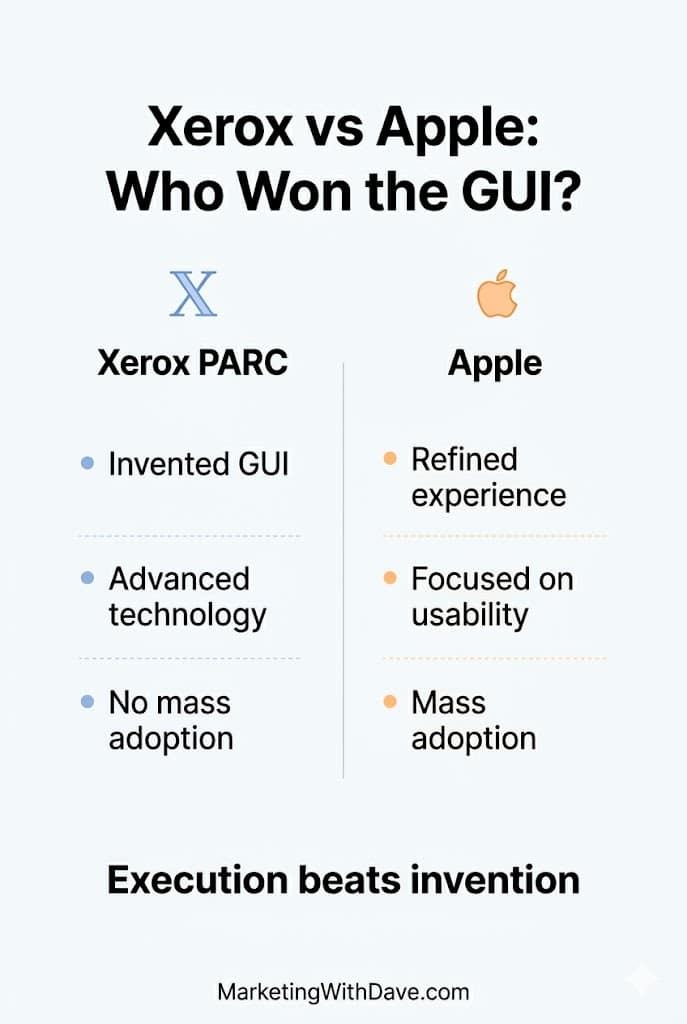
Despite inventing these foundational ideas, Xerox failed to bring them to market effectively. Apple later adopted and refined many of these concepts, launching the Lisa and Macintosh and ultimately defining the personal computing category.
This case highlights a recurring truth in marketing and business: innovation alone does not win, execution does.
Company Involved
Xerox Corporation, a technology company best known at the time for its dominance in copiers and document systems.
Marketing Topic
- Innovation vs. execution
- Product commercialization strategy
- Market positioning and category creation
Public Reaction or Consequences
At the time, Xerox’s innovations at PARC were largely invisible to the broader market. The Alto and Star systems were not widely adopted due to high cost, limited distribution, and unclear positioning. Meanwhile, Apple’s Macintosh generated significant public attention and excitement, introducing a wider audience to graphical computing in a more accessible format. Over time, Xerox PARC became widely known as one of the most famous examples of missed opportunity in business history, while Apple was credited with popularizing and commercializing the interface paradigm.
Why It Matters Today
- Innovation must be paired with a clear path to market
- Being first does not guarantee leadership
- Simplicity and usability drive adoption
- Organizational alignment determines whether ideas scale
- Category creation matters more than feature invention
3 Takeaways
- Execution matters more than invention. Xerox built groundbreaking technology, but Apple translated similar ideas into products people could understand and use.
- Market readiness beats technical superiority. The Alto was advanced, but the Macintosh was accessible, which mattered more for adoption.
- Innovation must connect to business strategy. Without alignment between research, product, and leadership, even great ideas fail to reach the market.
Notable Quotes and Data
- Xerox PARC developed the graphical user interface years before it reached mass adoption
- Apple’s Macintosh (1984) became the defining product that introduced GUI computing to the mainstream
Full Case Narrative
In the 1970s, Xerox PARC (Palo Alto Research Center) was one of the most advanced research environments in the world. Engineers and scientists there developed technologies that would define the future of computing, including the graphical user interface, the computer mouse, and early forms of networked workstations. The Alto computer embodied many of these innovations, offering a vision of personal computing that was years ahead of its time.
Despite these breakthroughs, Xerox struggled to translate innovation into commercial success. The company’s core business was built around copiers and document systems, and its leadership remained focused on that foundation. PARC operated more as a research lab than a product organization, and there was no strong system in place to convert experimental technology into scalable products.
In 1979, Apple engineers visited Xerox PARC and saw these innovations firsthand. What they recognized was not just a set of features, but a new model for how computers could work. Apple took these ideas and focused on making them usable, simplified, and aligned with a clear product vision. This led to the development of the Lisa and, more importantly, the Macintosh.
While the Macintosh was not as technically advanced as some PARC systems, it was designed for real users. It was more approachable, more affordable, and built as a cohesive product rather than a research demonstration. Apple’s focus was not on inventing the interface, but on delivering it in a way that people could adopt.
Xerox built breakthrough technology but never built a distribution strategy to match. Apple didn’t just simplify the interface. They controlled how it reached users. Distribution, not invention, is what ultimately determines who wins.
Xerox eventually attempted legal action against Apple, claiming improper use of its ideas, but the effort failed. By that point, the market had already moved. Apple had established itself as a leader in personal computing, and the opportunity Xerox once held had passed.
The failure was not technological. It was strategic. Xerox had the innovation but lacked the execution, alignment, and market focus to capitalize on it. Apple succeeded because it connected product, usability, and go-to-market strategy into a unified approach.
Timeline
1970s: Xerox PARC develops the Alto and foundational GUI technologies
1979: Apple engineers visit Xerox PARC
1981: Xerox releases the Star workstation
1983: Apple launches the Lisa
1984: Apple launches the Macintosh
Late 1980s: Xerox pursues legal action against Apple
What Happened Next?
Xerox continued to operate as a leader in document technology but did not establish itself in personal computing. Apple built on the success of the Macintosh and continued refining the graphical interface, eventually shaping modern computing experiences across devices. Xerox PARC remains respected as an innovation hub, but its legacy is often defined by what it failed to commercialize.
One Sentence Takeaway
Inventing the future is not enough if you cannot bring it to market.
Sources
Computer History Museum: Xerox PARC

