
Last updated June 2026
Brief Summary
Dollar Shave Club launched in March 2012 with a simple promise: high-quality razors for a few bucks a month, delivered directly to your door.
What made the brand famous was not just the subscription model, but the way it packaged that model in a low-budget video starring co-founder Michael Dubin, whose deadpan delivery, category mockery, and plain-language value proposition made the ad feel more like a cultural jab than a sales pitch.
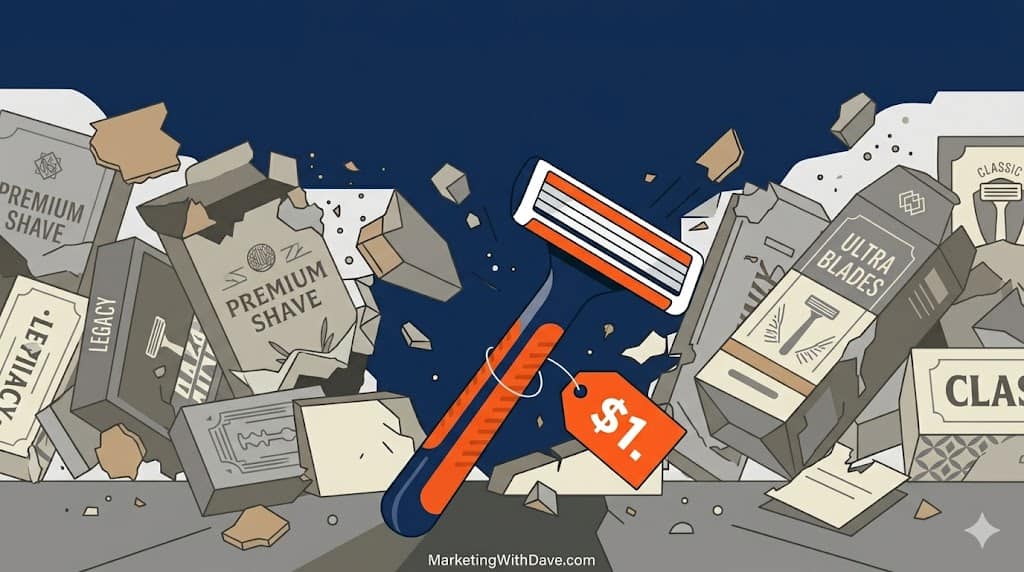
The result was immediate demand, a crashed website, and 12,000 orders in 48 hours. Over the next few years, Dollar Shave Club layered humor, social media engagement, customer support, product line expansion, in-house creative, and eventually omni-channel retail on top of that launch. Unilever bought the business for about $1 billion in 2016, later admitted the economics of direct-to-consumer had changed, and sold control in 2023. That full arc is what makes the case so valuable today: it shows both how challenger brands break into mature categories and how hard it is to preserve that edge as channels, costs, and ownership change.
Company Involved
Dollar Shave Club is the company at the center of this case. The brand launched in 2011 and built its early identity around affordable razors shipped directly to consumers. Today, it sells a broader grooming assortment across razors and shave, skin and body, hair, electrics, and women’s products. As of 2026, control sits with Nexus Capital Management, while Unilever retains a 35 percent minority stake.
Marketing Topic
- Branding
- Advertising
- Customer Experience
Public Reaction or Consequences
The public reaction was overwhelmingly strong at launch because the campaign solved a real frustration in a way that felt funny, fast, and shareable. The launch video overloaded the site, generated 12,000 orders in two days, and helped frame Dollar Shave Club as the irreverent outsider taking on legacy razor brands. That tone carried into later campaigns, industry awards, and social media work that was recognized for platform-specific storytelling and highly responsive member support.
The later consequence was more complicated. Dollar Shave Club became one of the defining direct-to-consumer success stories of the 2010s and was acquired by Unilever in 2016. But years later, Unilever said the business had not delivered as expected and that the economics of direct-to-consumer had changed. In 2023, Unilever sold control to Nexus Capital while keeping a minority stake.
Why It Matters Today
- The case still matters because it anticipated founder-led branding, first-party customer relationships, recurring revenue, owned content, and omni-channel growth.
- It also matters because it shows the limits of direct-to-consumer economics when customer acquisition costs rise and cross-sell does not scale quickly enough.
- Its recent campaigns show how an older challenger brand can refresh itself with channel-specific creative, including both filmed storytelling and AI-generated work.
Three Takeaways
- Use humor only when it carries strategy, not just attention.
- Build the brand voice into support, packaging, and follow-up channels.
- Do not mistake a winning launch channel for a permanent growth engine.
Notable Quotes and Data
- Michael Dubin said the launch spot was shot in one day for $4,500 and that within 48 hours the company received 12,000 orders.
- Dubin later said, “Great storytelling is why we’ve been able to grow so fast.”
- Reuters reported that Unilever expected Dollar Shave Club’s turnover to grow to more than $200 million in 2016 from $152 million in 2015, while Harvard Business Review noted the company had quickly grown to 3.2 million subscribers by the time of the acquisition.
Full Case Narrative
Dollar Shave Club entered a category that looked stable from the outside but was full of consumer resentment. The traditional razor aisle had become synonymous with high prices, locked display cases, confusing product ladders, and a sense that major brands kept adding features to justify margin. Dollar Shave Club reframed that frustration into a cleaner story: people did not need a futuristic shaving ritual, they needed a straightforward product, a fair price, and one less errand. The company did not just sell blades. It sold relief from category nonsense.
The launch video made that argument unforgettable. Dubin used a direct-to-camera style, warehouse staging, visual gags, and a script that moved from joke to benefit without friction. It felt personally authored, which mattered. Consumers were not just hearing a claim from an ad. They were hearing a founder puncture a stale market with wit.
Dollar Shave Club did not treat virality as the whole strategy. It expanded into adjacent products such as shave butter, wipes, shower, hair, and skin care. It invested in internal creative capabilities rather than outsourcing its brand brain. It also built marketing around service, using social channels for customer support and community engagement as well as promotion.
Another important layer was content. Dollar Shave Club tried to become more than a subscription box by funding MEL Magazine and by continuing to maintain owned educational and lifestyle content on its current site through Club Chronicles. That showed an effort to build audience relevance around the broader world of grooming, lifestyle, and identity, not just the transaction itself.
The Unilever chapter adds the cautionary half of the case. In 2016, Unilever bought Dollar Shave Club for about $1 billion, with the deal framed as a strategic response to e-commerce disruption, men’s grooming growth, and the value of direct customer relationships. Yet several years later, Unilever said Dollar Shave Club had not delivered as expected and that the economics of the direct-to-consumer model had changed. In 2023, Unilever sold control to Nexus while keeping a 35 percent stake.
Since then, the brand has leaned back into its roots. In 2025 it launched a national campaign designed to put the brand back on the map after the Unilever split. In 2026 it extended its irreverent disruptor posture into a women’s line, combining traditional filmed ads with AI-generated creative and testing which executions work best on different channels. The current site still emphasizes honest prices, simple shopping, and blunt anti-category messaging.
Timeline
- 2011: Dollar Shave Club launches with a direct-to-consumer razor proposition.
- March 2012: The launch video goes live, the site crashes, and 12,000 orders arrive within 48 hours.
- 2013 to 2014: The brand expands into adjacent products and earns recognition for social and digital work.
- 2016: Unilever acquires Dollar Shave Club for about $1 billion.
- 2020 to 2021: The brand redesigns and pushes into omni-channel retail with a major campaign.
- October 2023: Unilever announces the sale of Dollar Shave Club to Nexus Capital Management and keeps a 35 percent stake.
- 2025 to 2026: The brand returns to more disruptive humor and expands into women’s grooming with mixed-format creative.
What Happened Next?
Dollar Shave Club evolved from a subscription disruptor into a broader grooming brand with retail distribution, more product categories, and a renewed emphasis on challenger messaging. Its marketing today still draws heavily from the original formula: blunt value communication, category criticism, founder-style directness, and a willingness to test new creative formats while protecting its irreverent voice.
One Sentence Takeaway
Dollar Shave Club won by turning a boring, overpriced category into a story people wanted to repeat, and its later ownership twists prove that memorable branding is powerful, but business model discipline still decides how long the advantage lasts.
Sources and Citations
Inc.: How a $4,500 YouTube Video Turned Into a $1 Billion Company
Reuters: Unilever sharpens P and G rivalry by buying Dollar Shave Club
Harvard Business Review: Unilever’s Big Strategic Bet on the Dollar Shave Club
Unilever: Unilever announces the sale of Dollar Shave Club
Marketing Dive: Dollar Shave Club swipes at competition in first women’s grooming push

