Website analytics are only as good as the story they tell. If your dashboard just shows ‘posts’ and ‘pages,’ you’re missing the real insights about which content formats actually win. While that may be technically accurate, it isn’t particularly helpful when you want to evaluate which parts of your content strategy are actually working.
That’s where categorizing your pages by type comes in. Instead of treating everything as a “post” or “page,” you can create meaningful groups that reflect your actual content strategy. For my website, this includes book summaries, tools, case studies, and more. This makes your analytics far more actionable.
Example: Understanding Content Performance with Page Types
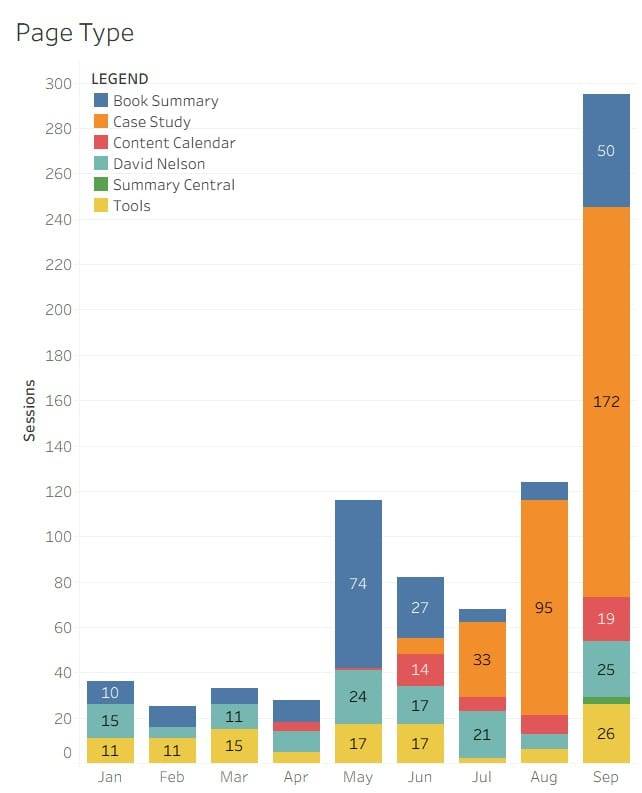
Take a look at the chart below:
At first glance, this view of traffic by page type makes it obvious which categories are performing. For my site, Case Studies have become the breakout performers, driving consistent growth in sessions throughout the year.
Without this level of categorization, I’d just see a long list of URLs making it much harder to recognize that case studies are pulling in the most readers.
Going Beyond Traffic: Measuring Engagement
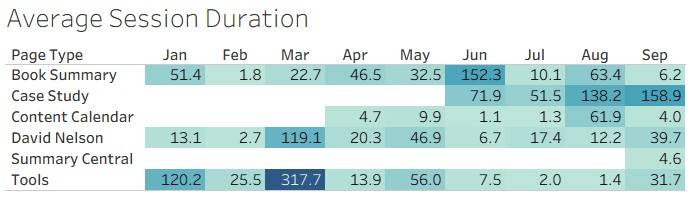
Traffic tells only part of the story. That’s why I also look at average session duration by page type:
Here, the data shows that people are spending more time on my case study pages compared to other types of content. That makes sense, these are longer form, research driven posts. But the key takeaway is that my readers are actually engaging with them, not just clicking in and bouncing out.
This insight helps me decide where to invest more time or at least confirm my reader’s interests.
Why This Matters for Marketers
Categorizing your content into meaningful page types unlocks three major benefits:
Clearer performance insights , You’ll quickly see which content types drive the most traffic.
Better engagement metrics , You can measure not just visits, but whether people are actually engaging with the format.
Smarter resource allocation , Instead of guessing, you’ll know exactly which kinds of content deserve more of your effort.
The Bottom Line
If you only look at your website through the default “posts” and “pages” lens, you’re missing the real story. By categorizing your content by page type, you can easily spot which areas are winning, how readers engage differently with each format, and where to focus next.
For me, the lesson was clear: case studies are my most valuable content type right now. And that clarity only came from taking the extra step to classify my pages in a way that actually reflects my content strategy.
If you haven’t looked at your website analytics this way before, start by grouping your content into a handful of meaningful page types. It’s a simple step that can reveal surprising insights about your audience and your strategy.
Marketers drown in complexity. Too many tools, too many campaigns, too many metrics. Elon Musk’s five-step framework for process improvement, born in engineering, is a surprisingly powerful cure. When applied to marketing, it helps teams cut waste, focus sharper, and deliver faster.
Marketing’s greatest thinkers — from Philip Kotler to Ann Handley — have long argued for simplicity, clarity, and strategy. When we apply Musk’s engineering discipline to marketing, we get a blueprint for better campaigns, smarter teams, and stronger ROI.
Here’s how Musk’s five steps translate into digital marketing, with guidance from the marketing masters.
1. Question Every Requirement
Musk insists that every requirement must trace back to the person who actually uses the product. In marketing, that means every tactic must connect directly to the customer journey.
Philip Kotler reminds us: if it doesn’t create customer value, it’s not marketing.
Michael Porter would ask: does this activity reinforce our competitive advantage or just burn resources?
Practical takeaway: Before greenlighting a new campaign, ask: Does this solve a real customer problem? Or is it just something we’re doing because competitors are doing it?
2. Delete the Part or Process
Musk believes if you’re not deleting, you’re not improving. Marketing is infamous for complexity — bloated approval workflows, endless reports, duplicate campaigns.
Dan Kennedy would cut through with a simple test: Does it drive a measurable result? If not, kill it.
Jack Trout and Al Ries would argue that clutter confuses positioning. By deleting what doesn’t reinforce your brand story, you sharpen your message in the marketplace.
Practical takeaway: Trim your dashboard to a handful of KPIs that leadership actually cares about. Delete everything else.
3. Simplify and Optimize
After deleting, simplify what remains. Musk warns against optimizing what should never exist — marketers fall into this trap often.
Ann Handley teaches that clarity beats complexity. Content must be simple, human, and meaningful.
Philip Kotler reinforces this with his principle of marketing clarity: complexity adds cost but rarely adds value.
Practical takeaway: Replace over-engineered nurture sequences with three simple journeys that align to customer intent stages.
4. Accelerate Cycle Time
For Musk, faster iteration surfaces flaws sooner. In marketing, accelerating means shorter cycles between idea, launch, and learning.
Michael Porter would frame this as agility that reinforces competitive advantage — staying ahead of rivals through faster insights.
Dan Kennedy would push for speed that ties directly to results: test fast, fail fast, scale winners.
Practical takeaway: Don’t spend three months perfecting a whitepaper. Publish a quick series of blog posts, test engagement, and expand what works.
5. Automate
Automation is Musk’s final step, not the first. Automating inefficiency just locks in waste.
Philip Kotler would remind us that technology should enhance the customer experience, not overwhelm it.
Ann Handley would warn that automation must never strip out the human touch — empathy and storytelling still matter most.
Practical takeaway: Automate reporting after you’ve simplified KPIs. Automate email journeys after you’ve deleted clutter. Automate ad bidding after your strategy is clear.
Bringing It All Together
Musk’s framework forces discipline:
Question relentlessly.
Cut mercilessly.
Simplify intentionally.
Move faster.
Automate wisely.
Kotler gives us the foundation of customer value. Porter ensures it aligns with business strategy. Trout and Ries keep us focused on clear positioning. Kennedy demands measurable ROI. And Handley reminds us that behind every process is a person.
Together with Musk’s five steps, this becomes a roadmap for marketers who want not just more campaigns, but better campaigns — faster, leaner, and with more impact. Applied with discipline, Musk’s five steps don’t just improve campaigns — they help marketing become a driver of competitive advantage across the business.
Most content strategies don’t fail for lack of ideas. They fail because the work isn’t clear, consistent, or connected to what the audience needs. The 5 C’s framework exists to fix that by aligning content with purpose and outcomes.
The “Five C’s of Content Marketing” is a popular mnemonic used to structure content strategy, though it has no single official origin. Early references appear in marketing literature (e.g., Content Marketing Strategies For Dummies in 2016) where Stephanie Diamond framed a five-C framework for strategy (Company focus, Customer experience, Channel promotion, Content creation, Check-back analysis).
Decades later, copywriting guru Robert W. Bly (2020) claimed a “Five C’s” formula for content (Clear, Concise, Compelling, Credible, with a Call-to-action). In practice, various authors adapt the 5 C’s to different terms, but they all aim to cover key success factors. In broad terms they boil down to clarity and quality of content, consistent delivery, creative engagement, audience focus, and driving conversions.
The 5 C’s are most often invoked during content strategy planning — essentially as a checklist to align content with business goals. Using a Five C’s framework helps you cover all the bases as you create your content marketing strategy. In other words, these C-words remind you to think about who you’re creating content for (Customer), what you’re giving them (Content & Clarity), how you deliver it (Consistency, Channels/Community), and what outcomes you drive (Conversion). Integrating the 5 C’s into your framework early on — for example, when setting goals, planning your editorial calendar, or auditing existing content — helps ensure nothing crucial is overlooked.
What Are the Five C’s?
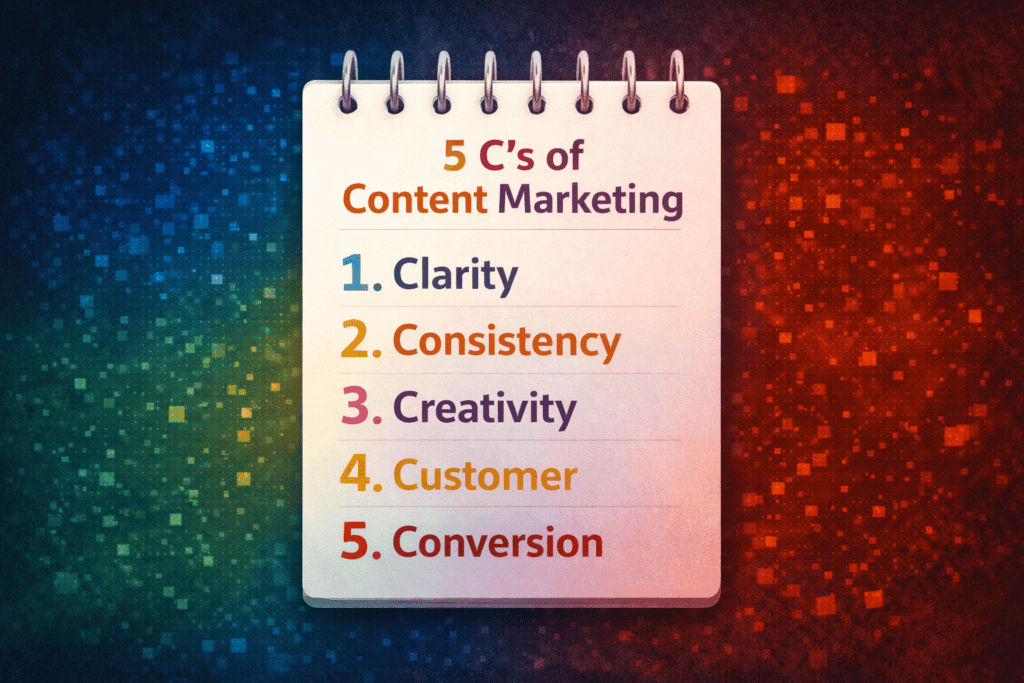
Different sources use slightly different labels, but five themes recur. A commonly cited version lists the 5 C’s as Clarity, Consistency, Creativity, Customer-Centricity, and Conversion. Briefly:
Clarity (Content Quality): Ensure the content is clear, well-written, and valuable. Audiences (and search engines) should immediately grasp the message and benefit. Clear, jargon-free writing and logical structure build trust and keep readers engaged. (Bly’s variant emphasizes being clear and concise.)
Consistency: Publish reliably and uniformly. A steady schedule (for example, weekly blogs or daily social posts) and a cohesive brand voice across channels build audience trust and momentum. Inconsistent cadence or tone confuses prospects; a content calendar and style guide are essential.
Creativity (Compelling Content): Make the work interesting and engaging. The web is crowded, so content must stand out with creative ideas, storytelling, or formats. Unique visuals, inventive headlines, or novel angles capture attention. Creativity isn’t decoration — it is how you win the scroll.
Customer-Centricity (Audience Focus): Put the audience first. Define who your customer is and tailor content to their needs and context. Treat the audience as the hero. In practice that means useful personas, segmentation, and community engagement so content resonates and earns attention.
Conversion (Call-to-Action & Results): Drive the next step. Good content doesn’t just inform — it prompts action (download, sign up, share, buy). Every piece should have a clear CTA and purpose. Track and optimize with KPIs so you can refine what works. (Bly’s version explicitly includes CTA as a “C”.)
While most marketers agree on these five, some expand the model to reflect today’s landscape. You’ll often see Community and Context added (build relationships and deliver the right message at the right time). Others add a Check/Correct phase: publish, measure, and adjust. All of these reinforce a simple idea: keep listening and keep improving.
5 C’s in B2B vs. B2C
Both B2B and B2C use the 5 C’s, but the emphasis differs. Here’s the quick read:
B2B: trust, ROI, longer cycles, multiple stakeholders. Clarity = data and proof. Consistency = educational series and webinars. Creativity = making complex ideas accessible. Customer focus = persona-based content for roles. Conversion = demos, trials, consultations.
B2C: emotion, lifestyle, faster cycles, bold creativity. Clarity = crisp, catchy messaging. Consistency = recognizable voice in social and ads. Creativity = formats that spark sharing. Customer focus = personalization and community. Conversion = buy now, subscribe, share.
The takeaway: both must be relevant and audience-focused, but B2B optimizes for confidence over time, while B2C optimizes for impact and velocity.
When to Use the 5 C’s Framework
Use the 5 C’s at two moments: planning and improvement. At the start of a campaign, walk through each C to align the team: have we defined the customer, clarified the message, planned a consistent cadence, built creative hooks, and embedded CTAs? During optimization, “check” where performance lags and “correct” by sharpening clarity, rebalancing cadence, refreshing creative, refocusing on the customer, or improving CTAs. Many teams bake the 5 C’s into editorial briefs, content calendars, and quarterly reviews. The model also plays nicely with other tools, like mapping content to your marketing funnel or overlaying keyword clusters on each pillar.
5 C’s in Action: An Example
Consider a fictional B2B SaaS firm, Acme Analytics, using the 5 C’s to guide its blog strategy:
Clarity: Acme defines its audience as data analysts and IT managers. It publishes “Demystifying Data Dashboards,” a plain-language whitepaper. Headlines and structure make value obvious at a glance.
Consistency: New blog every Tuesday, monthly newsletter, and a uniform tone across channels. A shared calendar prevents gaps and keeps topics on track.
Creativity: An interactive visualization quiz and a short animated explainer on dashboard pitfalls outperform plain text. The team experiments with infographics and case-study podcasts.
Customer-Centricity: Surveys surface pain points like slow load times. Content is segmented by persona: CFO-friendly ROI calculators and developer-focused deep dives. Guest posts from practitioners build community.
Conversion: Every piece ends with a relevant CTA (template download, demo request). Conversions are tracked and underperformers are updated with stronger offers, newer data, and clearer CTAs.
Quick B2C contrast: a food brand might apply Clarity in recipe instructions, Consistency in a reliable social cadence, Creativity in playful challenges, Customer focus through user-generated content, and Conversion via “shop ingredients” links.
Beyond the 5 C’s: Related Concepts
When the 5 C’s come up, adjacent frameworks usually follow. Classic marketing models like the 4 P’s (Product, Price, Place, Promotion) and the funnel (Awareness, Consideration, Decision) complement this approach. Content-specific models — the “four pillars” of Strategy, Creation, Distribution, and Measurement — overlap with the 5 C’s by emphasizing planning, multi-channel delivery, and analytics. You’ll also see “7 C’s” variants (adding Context, Channel, Conversation) and “5 P’s of Content” (often including People/Persona). Under any label, the goal is the same: make helpful, relevant content that serves the audience and the business.
In short, the 5 C’s are a guide, not a gospel. Use them to keep clarity, consistency, creativity, customer needs, and conversion at the center of your strategy — and keep iterating as you learn.
References
Diamond, Stephanie. Content Marketing Strategies For Dummies. Wiley, 2016.
Bly, Robert W. Various writings on the “5 C’s” of effective content (circa 2020): Clear, Concise, Compelling, Credible, Call-to-Action.
HubSpot, Content Marketing Institute (CMI), and MarketingProfs articles and guides discussing the Five C’s variations and their application.
Professional comparisons of B2B vs B2C content emphases (trust/ROI and longer cycles in B2B vs emotion/speed in B2C).
Framework overviews on planning and audits (for example, aligning to goals, mapping to funnels, integrating with calendars and briefs).
Related frameworks frequently cited alongside the Five C’s: the 4 P’s of marketing; funnel stages; the “four pillars” of content marketing; “7 C’s” and “5 P’s” variants.
“Content marketing is all about publishing useful information that helps your target audience.”
“Simply publishing content isn’t enough. You also need to promote that content.”
“Never has there been such an exciting opportunity for small and mid-size businesses… now it’s not the depth of your wallet but the depth of your words.”
Book Theme
Content Marketing For Dummies central theme is teaching businesses to think like publishers—creating meaningful, value-driven content across formats (blogs, video, social media, conversations) that engages audiences, builds trust, and drives long-term brand growth.
Why You Should Read This Book
It simplifies a complex, often intimidating topic.
Offers both theory and actionable tactics (from blogging to SEO to metrics).
Provides step-by-step guidance for beginners while also delivering insights useful for experienced marketers.
Helps you avoid common mistakes and focus on strategies that yield sustainable brand equity.
Key Ideas and Arguments Presented
Content marketing is about adding value before selling.
Success requires consistency, persistence, and restraint in messaging.
Use the 80/20 rule: 80% valuable content, 20% promotional.
SEO and search visibility are core benefits of publishing.
Integration across platforms is essential.
Measurement and refinement drive improvement.
Content marketing is a long-term, relationship-building strategy.
Book Outline
Part I: Getting Started with a Content Marketing Plan
Part II: Marketing with Long-Form Content
Part III: Marketing with Short-Form Content
Part IV: Engaging in Online Conversations
Part V: Achieving Long-Term Success
Part VI: The Part of Tens (tools, sites, resources)
Part VII: Appendixes (Quick Start Plans, Glossary)
Key Takeaways
Content marketing = consistent value, not sales pitches.
Brands must shift to an audience-centric approach.
Promotion is as important as creation.
Content fuels trust, loyalty, and word-of-mouth.
Long-term results require patience and commitment.
Key Techniques
SEO optimization for visibility.
Keyword research to target audiences.
Cross-promotion and interlinking content.
Design that enhances usability.
Monitoring online reputation with tools like Google Alerts.
Applying the 80/20 rule for balance in promotion.
Author’s Qualifications
Susan Gunelius is President & CEO of KeySplash Creative, Inc. She has 20+ years of marketing experience, including leadership roles at AT&T and HSBC. She has authored multiple marketing books, writes for Entrepreneur.com and Forbes.com, and speaks internationally on branding and content.
Comparison to Similar Books
Unlike Epic Content Marketing (Joe Pulizzi) or Everybody Writes (Ann Handley), which focus on advanced content strategy or writing quality, Content Marketing For Dummies is an accessible, practical beginner’s manual. It provides breadth (covering blogs, video, social, SEO) rather than deep dives into a single niche.
Target Audience
Small business owners
Marketing beginners
Entrepreneurs seeking growth
Bloggers/content creators
Corporate marketers transitioning to digital
Students learning marketing fundamentals
Professionals tasked with branding or communications
Critical Response to the Book
As part of the For Dummies series, it has been well-received for its clarity and accessibility. It’s not viewed as groundbreaking theory but rather as a practical, go-to reference for newcomers needing structured, step-by-step support.
One Sentence Takeaway
Content marketing success comes from creating consistent, valuable content that engages audiences and builds long-term brand relationships.
Caesars Entertainment, historically known as Harrah’s, pioneered a data-driven loyalty strategy that used customer insights to personalize offers and service across gaming, hotel, dining, and entertainment.
Rather than compete with flashier resorts, the company built a unified view of the guest, tested targeted incentives, and scaled what worked.
The result was higher retention, greater share of wallet, and a loyalty platform that became a durable competitive moat.
This case shows how customer insight, experimentation, and thoughtful personalization can outperform spectacle while respecting customer comfort and privacy.
Company Involved
Caesars Entertainment (originating as Harrah’s, where the loyalty and personalization playbook began)
Marketing Topic
Personalization
Customer Experience
Loyalty Strategy
Public Reaction or Consequences
Customers adopted the program at scale and responded to relevant perks, which deepened loyalty and cross-property engagement. Industry press and business schools highlighted the approach as a model for turning data into measurable marketing impact. Caesars also discovered that personalization has limits. When interactions felt overly intimate, some guests perceived it as intrusive. The company pulled back those touches and emphasized transparency and comfort. Overall, the program delivered strong business results while reinforcing that trust is foundational to long-term loyalty.
Why It Matters Today
• Customer insight plus experimentation can beat expensive acquisition tactics.
• A unified profile enables targeted incentives that lift incremental behavior.
• Personalization works best with clear value exchange, consent, and restraint.
• The playbook endures. Caesars continues to evolve personalization with mobile experiences and AI while keeping loyalty at the core.
3 Takeaways
1. Build a single view of the customer across all touchpoints and measure lifetime value, not one-off transactions.
2. Test everything. Use experiments to find the right offers for the right segments and scale only the winners.
3. Personalize with care. Aim for relevance that feels helpful, not invasive. Protect privacy and give customers control.
Notable Quotes and Data
“When your loyalty card is listed in someone’s obituary, I would maintain you have traction.” Gary Loveman on the depth of loyalty created by the program.
A mid-decade analysis reported Caesars increased its share of customer gaming spend from roughly 36 percent to about 45 percent after scaling its loyalty and data strategy.
Modern tests with AI optimized campaign language and lifted email engagement by double digits, signaling ongoing gains from iterative personalization.
Full Case Narrative
Background and context. In the 1990s and early 2000s, Harrah’s did not compete on mega-resorts or grand spectacles. Guided by Gary Loveman, the company chose to compete on analytics, loyalty, and service. A unified program captured play, stay, dining, and entertainment behaviors and tied them to a single customer identity. The move reframed marketing from giveaways to evidence-based incentives that influenced behavior.
What the company did. The team built a nationwide loyalty program, later known as Total Rewards, to enroll guests at every property and earn points across the portfolio. Data revealed that consistent mid-tier guests drove the majority of revenue. Caesars tested targeted offers for segments and measured lift against controls. Modest, well-aimed incentives often beat expensive bundles. The program encouraged cross-property travel by honoring tiers and benefits everywhere, increasing visit frequency and total enterprise value.
Why they did it. Competing on amenities was costly and easy to copy. Caesars focused on profitable customer behavior. By quantifying theoretical worth and measuring response to offers, marketing spend moved from guesswork to return on investment. The unified program unlocked cross-sell opportunities and created switching costs as members accrued status and points they did not want to abandon.
What happened next. Results included higher retention, more cross-property visitation, and a clear share-of-wallet lift. The database became a strategic asset that shaped acquisitions and integrations. Later, as the company rebranded as Caesars Entertainment, the loyalty platform remained central. The program was renamed Caesars Rewards and continued to grow to tens of millions of members worldwide.
Reflection and analysis. The playbook worked because it combined strong data foundations, a culture of experiment and learn, customer-centric service, and disciplined ROI. The company also learned the boundary between helpful and creepy. Personalized touches that referenced sensitive history were toned down in favor of value-forward, opt-in experiences. In the 2010s and 2020s, Caesars extended the model through mobile messaging, a virtual concierge, and AI-assisted creative testing, showing that the core strategy adapts as channels and tools evolve.
Timeline
• Late 1990s to early 2000s: Harrah’s scales a nationwide loyalty program, later branded Total Rewards. A test and learn culture takes hold.
• Mid 2000s: Acquisition of Caesars accelerates portfolio reach. Loyalty and analytics expand across more properties with measurable share-of-wallet gains.
• 2010: Corporate name changes to Caesars Entertainment. Loyalty strategy remains core.
• 2019: Total Rewards rebrands to Caesars Rewards and continues global expansion.
• Late 2010s to 2020s: Mobile, virtual concierge, and AI-assisted optimization extend personalization while loyalty stays central.
What Happened Next?
Caesars Rewards remains the connective tissue across casinos, hotels, and entertainment brands, encouraging members to keep activity within the network. New channels and capabilities have been layered onto the same foundation. The company positions personalization as a value add and continues to calibrate for comfort, clarity, and trust in an era of stronger privacy expectations.
One Sentence Takeaway
Caesars showed that the safest bet is not a bigger spectacle but smarter personalization that earns loyalty, grows lifetime value, and respects the customer.
Best formats: case studies, whitepapers, webinars, product tutorials or light demos, nurture emails.
Distribution: segmented email, retargeting, social proof, partner content.
Metrics: asset downloads, webinar registrations and attendance, lead to MQL progression, engagement scores.
Bottom of funnel (Conversion)
Audience: hot leads close to purchase. Goal: remove doubt and prompt action.
Best formats: live demos and trials, testimonials and reviews, pricing pages, comparison tools, sales enablement decks.
Distribution: direct outreach, remarketing, on site chat, sales touchpoints.
Metrics: conversion rate, SQL to close rate, sales cycle length, revenue impact, cost to acquire.
After purchase: Retention
Goal: keep customers successful and turn them into advocates. Formats include onboarding guides, how to content, customer webinars, communities, loyalty programs, and customer advocacy initiatives. Encourage user-generated content, testimonials, and referral programs to amplify trust.
Different models use different labels for essentially the same buyer journey. Here’s how they compare:
Model
Stage 1
Stage 2
Stage 3
Stage 4+
Traditional Marketing Funnel
Awareness
Consideration
Decision
—
HubSpot / WordStream
Awareness
Evaluation
Conversion
Retention
AIDA
Awareness
Interest
Desire
Action
Sales Funnel
Prospecting
Qualification
Proposal
Closing / Post-Sale
Flywheel (HubSpot)
Attract
Engage
Delight
Loop (Advocacy)
Stage names vary, but the principle is the same: align content with the buyer’s intent at each point in their journey. The HubSpot / WordStream version is the most common in content marketing today, but referencing other frameworks shows you understand the bigger picture.
B2B vs B2C: what differs
Sales cycle: B2B is longer with more stakeholders and touchpoints. B2C is faster and often more impulsive.
Tone and proof: B2B favors data, ROI, and depth. B2C favors emotion, lifestyle, and fast formats.
Stage emphasis: B2B invests heavily in evaluation nurturing. B2C leans into awareness reach and smooth conversion. For many low-cost B2C purchases, the funnel compresses to Awareness → Conversion.
Adjust your mix to how your buyers decide. Some B2C decisions are considered purchases, and some B2B offers behave more like self-serve B2C. Build for the real journey.
Benchmarks to aim for (ballpark)
Blog and content site bounce rate: often 65% to 90% depending on intent and page type. Best-in-class content hubs often perform closer to 50–60%.
Webinar attendance: about 30% to 45% of registrants attend live; smaller webinars tend to see higher rates. On-demand webinars often see 55%+ attendance and extend funnel value.
Email click rate (CTR): roughly 2% to 4% across industries; click-to-open often around 5% to 10% depending on sector.
SaaS free trial to paid: opt-in trials commonly around 17% to 20% on organic traffic; opt-out models convert higher but aren’t always right for trust or product fit.
Ecommerce site conversion: typical overall conversion around 2.5% to 3% across categories. Best-in-class ecommerce stores often convert 5% to 7%.
Common mistakes to avoid
Pushing product content too early in awareness.
Over-investing in awareness while neglecting nurturing.
Ignoring retention and advocacy content.
Using one funnel approach for both B2B and B2C.
Measuring only lead volume instead of depth and quality.
Expert insight
Marketing experts like Ann Handley have emphasized making content more human and empathetic, especially in B2B. The intent behind her message is clear: emotional resonance and storytelling matter at every funnel stage, not just in consumer marketing. Trust and brand building often deliver more long-term value than chasing marketing-qualified leads for the sake of it.
Best practices and current trends
Match content to stage and personalize by behavior. Right message, right time.
Educate early. Earn attention with useful content, not pitches.
Build brand and trust. Invest in newsletters, communities, and consistent voice.
Use storytelling. Human narratives improve recall and confidence.
Grow first-party audience. Prioritize opt-in channels and respect consent.
Be data informed. Set stage metrics, find drop offs, and iterate.
Stay agile with formats. Repurpose across blog, video, carousel, and interactive tools. Use AI to draft, add human insight to stand out.
Align with sales and success. Share signals and content so the journey feels consistent from first touch to onboarding.
Where the funnel is heading
Buyer journeys are less linear. Many B2B buyers prefer rep-free research and move fluidly across channels before they ever talk to sales. At the same time, much of the conversation now happens in “dark social” spaces — private Slack groups, Discord servers, WhatsApp chats — where attribution is harder to track. Think ecosystem, not just a line. HubSpot’s flywheel model is a useful complement: attract, engage, and delight so customers feed growth through advocacy. Keep the funnel for planning and measurement, and extend it with a loop that centers the customer experience.