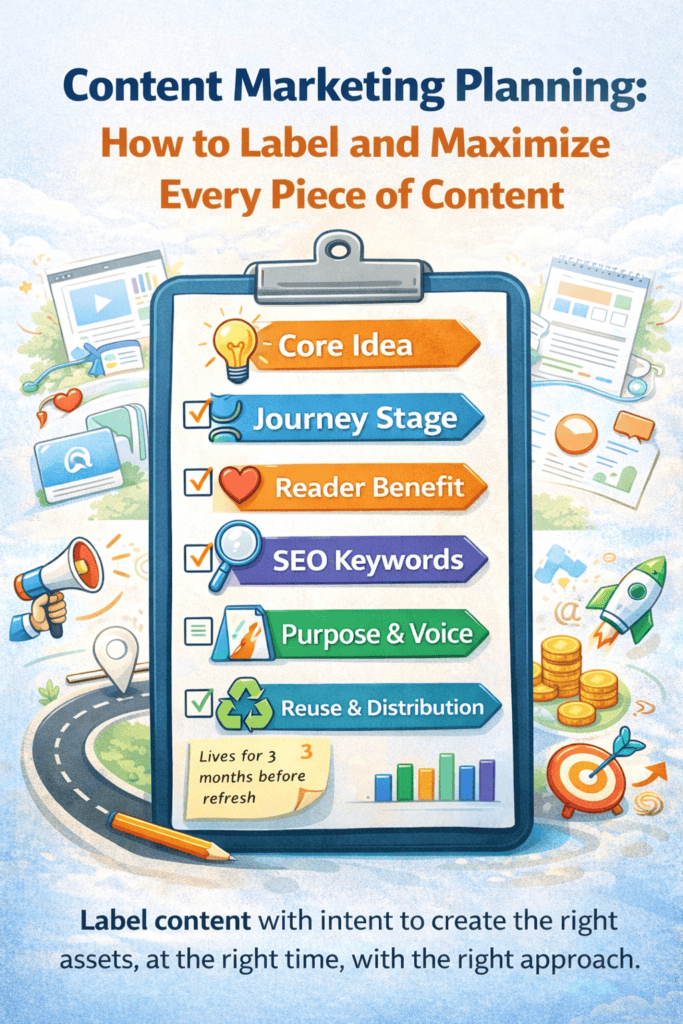
Most marketing teams waste time guessing at intent and rewriting content that misses the mark. Expert content marketing avoids this by labeling each piece upfront so writers know exactly what to create, how it will be used, and why it matters.
1. Start with the core idea
Define the big rock content: a webinar, research study, white paper, or pillar post. Clarify the problem it solves and the business objective it supports. Confirm alignment with brand voice and audience personas before any drafting begins.
2. Label the content for the customer journey
Awareness: educational, thought leadership, trends.
Consideration: comparisons, case studies, problem to solution guides.
Decision: testimonials, demos, ROI calculators, trials.
Post purchase and loyalty: onboarding tips, community content, how to succeed resources.
Pro tip: Mark every piece with its stage so your calendar stays balanced across the funnel.
3. Make it reader first, business second
Label the reader benefit in plain language before labeling the business purpose. Example: “Helps first time managers shortlist tools” is clearer than “Awareness.” This keeps empathy at the center and prevents self-serving content.
4. Identify the SEO keywords and strategy fit
Assign a primary keyword or topic cluster so the writer knows the angle, supported by natural questions the piece should answer. The aim is clarity of intent and strategic fit, not keyword stuffing.
5. Tag by purpose and voice
Purpose: educate, entertain, convert, or retain.
Voice and tone: authoritative, friendly, inspirational, or witty.
Labeling voice reduces rewrites, keeps multi author programs consistent, and ensures every asset feels on brand.
6. Plan repurposing before writing
Think hub and spoke. One core asset should yield multiple smaller pieces. Plan the formats up front and adapt the angle to each channel.
Blog spin offs that go deeper on a subtopic
LinkedIn carousel that highlights the key argument
Short form video that leads with an emotional hook
Infographic that distills a framework or data
Slide deck for sales enablement or webinars
Repurposing is not copy pasting. Adapt the content to the medium and audience context.
7. Define primary and secondary distribution channels
Choose the primary home for the content, then list secondary channels. Note how format and channel shape length, tone, and CTA. This prevents overlong drafts that do not translate well.
8. Set success metrics and CTAs
Decide what success looks like before drafting so writers can support it in structure and calls to action.
Label relevance: evergreen, seasonal, or reactive. Timeliness guides publishing priority and prevents good ideas from sitting in a queue.
10. Plan for reuse and refresh
Give each asset a shelf life and a review date. Decide when it should be updated, expanded, or re-distributed. This shifts the team from “create more” to “sustain better.”
11. Build a lightweight editorial workflow
Labels only help if they live in the workflow. Decide who assigns labels, who approves them, and how they are tracked through creation, review, and distribution. Keep ownership clear so work does not stall.
12. Use a simple checklist to remove guesswork
You do not need to publish a spreadsheet, but an internal template or checklist ensures every field is completed before writing begins. Suggested fields:
Customer journey stage
Reader benefit
Business goal
Primary keyword or topic cluster and key questions
Purpose and voice
Primary and secondary channels
Primary CTA
Success metrics
Shelf life and review date
Owner and approver
Example: Filling Out the Checklist
To make this real, here’s a fully filled-out version of the checklist for a single content piece. Here is how the checklist looks when applied to a single piece of content. A guide on building customer loyalty programs:
Customer journey stage: Consideration
Reader benefit: Help retail managers understand loyalty program options
Business goal: Position our brand as a trusted advisor for retention strategies
Success metrics: Number of downloads, demo requests, and LinkedIn shares
Shelf life and review date: Evergreen, review every 12 months
Owner and approver: Content strategist drafts, marketing manager approves
With this level of clarity, the writer knows exactly what to deliver, the marketer knows how it fits the strategy, and the business can measure its success without ambiguity.
Conclusion
Content planning is not busywork. It is the discipline that multiplies the impact of every idea and removes friction for writers. By labeling journey stage, reader benefit, keyword focus, purpose, voice, channels, metrics, and review plan, you will create content that is easier to write, easier to reuse, and more valuable to the business and the audience.
When writers have this clarity, content isn’t just easier to create — it’s faster, more consistent, and more likely to move the needle.
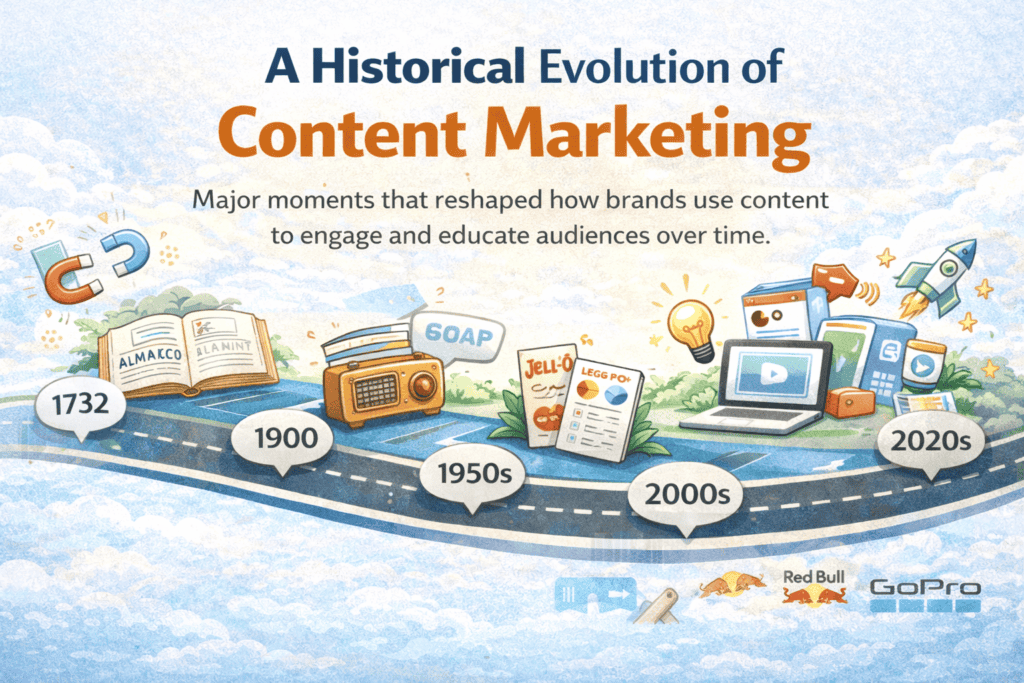
Content marketing has evolved for centuries, from brand-owned print guides and magazines to podcasts, video series, interactive tools, and creator collaborations. The timeline below highlights global milestones that reshaped how marketers educate, entertain, and build trust across B2B and B2C. Each entry shows how formats, distribution, and editorial practice progressed toward audience-first publishing.
Pre-1900s: Foundations of Branded Education and Audience Building
1732–1758 –Almanacs as practical, recurring content: Widely distributed farmer and household almanacs popularize the idea of recurring, problem-solving publications. Though not brand-owned in the modern sense, they establish the template for useful, serialized content that builds loyalty.
1801 –Industrial catalogs and handbooks: Manufacturers begin issuing illustrated catalogs and “how-to” pamphlets to educate buyers on safe and effective product use, foreshadowing modern customer education content.
1888 –Free guides as demand creation: Consumer packaged goods and household brands distribute recipe leaflets and homemaker guides, offering utility first and product references second.
1890s–1910s: Iconic Brand Publications
1895 –John Deere’s “The Furrow”: A farmer-focused magazine launches to share techniques, stories, and practical advice. It becomes a long-running example of audience-first brand publishing that educates rather than sells.
1900 –Michelin Guide (France): The tire maker releases a free travel guide with maps, repair tips, and recommendations to help motorists explore more and drive more, creating demand while delivering genuine utility.
1904 –Jell-O recipe books: Door-to-door distribution of free cookbooks turns a commodity dessert into a household staple by teaching uses, not touting features.
1912 –Club and community newsletters: Hobby and appliance brands begin mailing member bulletins with tips, customer stories, and project plans, cementing community as a growth lever.
1920s–1940s: Sponsored Storytelling and the Birth of Serial Formats
1933 –“Soap operas” on radio: Consumer goods companies sponsor serialized dramas aimed at homemakers. Entertainment becomes a vehicle for brand-adjacent storytelling that earns attention over time.
1936 –Brand booklets and field manuals: Equipment makers publish safety manuals, repair guides, and best practices, setting expectations that brands should be trusted educators.
1940s –Sponsored newsreels and programs: Brands underwrite recurring broadcast segments, aligning their names with valued, regular content rather than one-off ads.
1950s–1970s: Custom Publishing and Education at Scale
1950s –Corporate magazines and customer education: Enterprise brands launch print magazines and technical journals to teach customers how to get more value from complex products.
1962 –Thought-leadership journals: Technology and industrial firms publish periodicals sharing research, case studies, and frameworks, elevating expertise as a brand asset.
1970s –Direct mail newsletters: Financial and B2B companies scale recurring print newsletters that deliver analysis and practical insights, building subscriber bases long before email.
1980s–1990s: Custom Media, Brand Magazines, and Early Digital Publishing
1987 –LEGO fan magazines: Branded magazines for young builders blend projects, community features, and storytelling, showcasing participatory content and UGC before social media.
1993–1999 –Rise of custom publishing: Specialist agencies produce brand magazines and print inserts for retailers, airlines, and financial services, formalizing brand-owned media as a discipline.
1999 –Blog platforms arrive: Self-serve blogging tools make it simple for brands to publish ongoing articles, editorials, and guides without relying on publishers.
2000s: Always-On Digital Content Programs
2003–2006 –Corporate blogs and resource hubs: Brands adopt editorial calendars and topic clusters to answer audience questions in plain language, establishing the modern brand newsroom.
2004–2005 –Podcasting goes mainstream: The term “podcast” is coined and major directories emerge, opening a new channel for serialized brand shows and expert interviews.
2005 –YouTube launches: Video becomes accessible for brands; how-to series, behind-the-scenes, and product education content create durable libraries of evergreen value.
2006 –Inbound and lead magnets: Ebooks, templates, and webinars are packaged as high-value resources exchanged for permission, making gated content a core play.
2007 –Red Bull Media House: A brand formalizes itself as a media company, producing events, films, and magazines that prioritize culture and community over direct promotion.
2006–2009 –Signature video series: Entertaining educational shows like “Will It Blend?” prove that consistent concepts and repeatable formats build audience and brand recall.
2010s: Multimedia, Community, and Experiences
2010 –Content Marketing Institute: The practice gains formal codification through events, frameworks, and benchmarks, accelerating adoption across industries.
2012 –Long-form and interactive storytelling: Rich, scrollytelling experiences normalize multimedia articles. Brands follow with interactive explainers, assessments, and calculators.
2013–2016 –UGC-powered brands: Companies like GoPro and global travel brands scale user-generated content programs that showcase real customer stories at volume.
2014 –Feature-length brand entertainment: Major brands fund films and cinematic content, demonstrating that high-production storytelling can be credible and commercially effective.
2015–2019 –Owned communities and newsletters 2.0: Slack groups, forums, and revamped email newsletters become core retention engines, shifting focus from reach to depth.
2020s: Short-Form, Creators, and Intelligent Workflows
2020 –Virtual programming at scale: Webinars, livestreams, and digital events mature overnight, pushing brands to develop show formats and episodic series for remote audiences.
2020–2022 –Short-form video dominance: Global platforms popularize sub-60-second storytelling. Brands adopt hooks, series arcs, and native editing to teach quickly in-feed.
2021–2023 –Creator collaborations: Partnerships with independent creators produce co-branded education, deep dives, and community challenges that feel native to each platform.
2023–2025 –Generative AI in the workflow: Ideation, outlines, variants, and localization are accelerated by AI while human editors enforce standards for accuracy, originality, and voice.
Ongoing –Content as product: Brands package content into courses, certifications, and toolkits that deliver direct customer value and durable affinity beyond campaigns.
Organizing your company’s brand architecture can significantly impact marketing strategy, budgets, and growth.
The two ends of the spectrum are branded house and house of brands. In this post, we’ll introduce each concept with examples, then provide a comparison grid of positives and negatives from a marketer’s viewpoint.
Finally, we’ll look at one successful and one less successful real-world change in brand architecture with insights on why those transitions fared as they did.
What Is a Branded House? (One Unified Brand)
In a branded house strategy, the company itself is the master brand. All products, services, or sub-divisions share the primary brand name or identity. The goal is a unified brand experience. When customers trust the main brand, that goodwill extends to everything under its umbrella. A win for one product becomes a win for all.
Example:Apple is a classic branded house. Apple’s products and services – Apple iPhone, Apple Watch, Apple Music, Apple Pay, etc. – all carry the Apple name and ethos. Because of this, Apple can leverage its strong brand equity across every new offering. Another example is FedEx, which offers FedEx Express, FedEx Ground, FedEx Freight, and more – different services, but all clearly FedEx. This consistency in branding builds a cohesive identity and trust: if a customer trusts FedEx for shipping, they’re likely to trust FedEx Office or FedEx Freight, too.
The branded house approach works best when a company’s offerings target the same (or closely related) audience and share common values. All marketing efforts reinforce one name, creating synergy. However, as we’ll see, this focus comes with some trade-offs in flexibility and risk.
What Is a House of Brands? (Multiple Distinct Brands)
In a house of brands strategy, the company operates a portfolio of individual brands, each with its own identity, audience, and marketing. The parent company’s name may be downplayed or even unknown to consumers. This approach intentionally keeps brands separate so each can shine on its own.
Example:Procter & Gamble (P&G) is a quintessential house of brands. P&G owns Tide, Pampers, Gillette, Olay, Crest, Febreze, and many more, but consumers recognize each product brand independently; the P&G corporate brand stays in the background. Another example, Unilever, owns Dove, Axe, Ben & Jerry’s, Hellmann’s, etc., each with unique positioning. Customers may not even realize these disparate products share the same owner – and that’s by design.
This model is all about flexibility. Each brand can have a distinct image and target a specific segment without being constrained by a single umbrella identity. It’s great for tailoring offerings to different markets or price points and for isolating risk (one brand’s crisis won’t automatically harm the others). But maintaining many brands comes with higher complexity and costs, as we’ll explore next.
Comparing the Two Approaches: Pros and Cons
The table below summarizes key positives and negatives of branded house vs house of brands from a marketer’s perspective. This comparison grid is meant to be concise and scannable, highlighting how each strategy stacks up on important factors:
Aspect
Branded House
House of Brands
Brand Equity & Trust
Unified brand equity: One brand builds trust that benefits all offerings. Success in one product can boost credibility in others. Customers have a clear, consistent image of the company.
Independent brand equity: Each brand must build trust on its own merits. No automatic carry-over of reputation – but also one brand’s issues won’t tarnish the others.
Marketing Efficiency
Cost-effective marketing: Resources are focused on promoting a single brand, which is economical and efficient. One marketing campaign can lift all products. Shared messaging means less duplication of effort.
Higher marketing costs: Every brand requires its own marketing budget, strategy, and campaigns. It takes more time and money to build each brand from scratch. Efforts aren’t shared, so you may need multiple teams or agencies.
Brand Focus & Clarity
Clear brand story: Easy to present a unified message and identity. All products align with the master brand’s values and voice, which reinforces a clear market positioning.
Targeted positioning: Each brand can develop its own story and vibe tailored to a specific audience or niche. This allows precise positioning (e.g., one brand high-end, another budget) without confusing customers.
Flexibility & Innovation
Constrained flexibility: New products or markets must fit under the main brand’s umbrella. It can be challenging to launch offerings that diverge from the core brand image. Radical innovations might seem off-brand if they stray too far.
Maximum flexibility: Brands have freedom to innovate and even compete with each other. You can enter very different markets by creating or acquiring a new brand for each. If one brand needs a totally different personality or niche, that’s viable in this model.
Risk Management
Shared risk: The entire brand shares one reputation – a crisis or failure in one area can damage the whole company’s image. There’s a single point of failure in terms of brand trust.
Isolated risk: Brands act as firewalls for each other. If one product line has a scandal or flops, the damage is largely contained to that brand. The parent company and other sub-brands are less affected by one brand’s troubles.
Organizational Complexity
Simplified management: With one brand to manage, internal teams can stay aligned on branding, messaging, and strategy. Brand governance is easier – one logo, one website, one set of guidelines.
Complex structure: Juggling multiple brands means more complicated organization. Each brand may need separate teams or at least dedicated brand managers. Ensuring consistency within each brand (and avoiding internal brand conflicts) requires effort.
Market Segmentation
Broad reach, single brand: You use one brand to address multiple segments, which can work if segments are similar. However, if customer groups have very different needs or images of your brand, it’s harder to appeal to all equally under one name.
Niche targeting: Easier to segment markets by assigning different brands to different audiences or product categories. Each brand speaks directly to its target consumers (e.g., one brand for luxury buyers, another for bargain seekers) without one size fits all.
Digital Marketing & Data
Unified digital presence: Often a single website and social media presence for the master brand. This simplifies SEO and content strategy (all traffic and backlinks bolster one domain). Analytics are consolidated, giving a holistic view of performance. However, you’ll need to tag and segment data internally to see how individual products perform. Reporting is simpler at the top level (one brand’s metrics), but you must slice data by product/service to get granular insights.
Multiple digital funnels: Likely separate websites, social accounts, and analytics for each brand. This allows specialized SEO and campaigns (each site targets its own keywords and audience). You can dive deep into each brand’s metrics easily. However, reporting across the whole company is more complex – data is siloed by brand. Comparing performance or sharing customer data across brands may require extra integration. Expect to “slice and dice” data across several platforms when presenting company-wide marketing results.
Growth & Expansion
Brand stretching: Growth often comes by extending the main brand into new offerings. This can be efficient if the brand’s reputation aids the new venture (e.g., launching Google Drive benefited from the Google name). But if you expand into areas far from your core, the brand may not stretch comfortably or could lose focus. Acquisitions typically get rebranded into the one umbrella, which can risk losing the acquired brand’s loyal customers during transition.
Acquisition ready: A house of brands can readily absorb acquisitions and let them continue under their own names if desired. The company can operate in very diverse fields without confusing consumers (since each brand is distinct). You have the option to keep or change an acquired brand name based on its equity. On the flip side, building a cohesive culture and cross-selling across brands might be harder since each brand is distinct.
In short: A branded house offers efficiency, consistency, and a strong unified presence, but it puts all your eggs in one brand basket. A house of brands offers flexibility, targeted branding, and risk insulation, but demands more resources and careful management of many moving parts. Many companies actually blend these approaches. For example, a hybrid model where a strong parent brand exists alongside select sub-brands or endorsements (think Alphabet as a parent of Google, or Marriott with both Marriott-branded hotels and standalone names like Ritz-Carlton).
Lessons from Changing Brand Architecture
Choosing between a branded house and a house of brands isn’t a permanent, one-time decision. Companies often evolve their brand architecture as their business grows or strategy shifts. Let’s look at two historical examples: one where changing the brand structure proved effective, and one that faced challenges. These cases provide insight into what can go right or wrong when re-organizing your brands.
Effective Example: Google Becomes Alphabet (Expanding from One Brand to Many)
Google started as a classic branded house – everything from Search to Gmail to Maps carried the Google name. As the company ventured into new arenas (self-driving cars, health tech, venture capital, etc.), leadership saw the need for a structure that could foster these diverse projects without diluting the core Google brand. In 2015, Google surprised the business world by creating a new holding company, Alphabet, and making Google a subsidiary under that umbrella.
This move essentially shifted Google’s organization toward a hybrid brand architecture. Core consumer products stayed branded as Google (maintaining the familiar brand trust), while riskier or non-core ventures (like Waymo for autonomous cars, Verily for life sciences, Wing for drone delivery) were given their own independent brands under Alphabet. The result? Greater strategic flexibility. Each new business can develop its own identity and culture, pursue its industry, and even fail, without casting a shadow on “Google” itself.
From a marketing perspective, this separation helps because Google’s brand can remain focused on tech products and services consumers know, while the more experimental projects can craft specialized brands aimed at their unique stakeholders. It also simplified reporting and accountability: each Alphabet subsidiary could be evaluated on its own, and the company avoided the confusion of vastly different initiatives all marketed as “Google.” By most accounts, this reorganization has been effective – Google’s core brand remains strong, and Alphabet has the freedom to invest in multiple fields. The key insight is that if your one-brand strategy starts to strain under divergent business lines, moving toward a house-of-brands or hybrid model can protect your flagship brand while enabling innovation.
Cautionary Tale: Facebook Rebrands as Meta (Challenges in Re-Architecting a Brand)
In late 2021, Facebook, Inc. changed its name to Meta Platforms, signaling a shift from a single-brand focus to a broader architecture. The company now positions Meta as the parent brand overseeing Facebook (the social network), Instagram, WhatsApp, Oculus, and other products. The rationale was to align with the company’s growing ambitions in the “metaverse” and to differentiate the corporate identity from the Facebook app, which had been mired in controversy. In theory, this is a move towards an endorsed house-of-brands or hybrid structure – “Meta” is an umbrella, and the social apps remain individually branded. Executed well, this strategy can allow each product to stand on its own and prevent issues with one app from directly infecting the reputation of others.
However, Facebook’s rebranding to Meta illustrates that changing brand architecture alone isn’t a silver bullet. Thus far, the shift has had mixed results. On the positive side, Meta as a corporate brand gives the company room to pursue new initiatives (like VR/AR technologies under the Meta name) without everything being tied to the Facebook identity. And indeed, the average user now sees “from Meta” on Instagram and WhatsApp logins, subtly indicating a family of brands. From a marketing data standpoint, Meta can develop separate messaging and communities (the Horizon Worlds metaverse product, for example, has its own branding).
On the other hand, critics note that renaming the company didn’t instantly fix underlying issues. Facebook the app still faces trust and privacy challenges, which inevitably affect public perception of Meta as a whole. In essence, renaming without addressing core problems is only a cosmetic change. As one branding expert observed, renaming can “invite a breath of fresh air” if your business has evolved, but if it’s done mainly to escape a troubled reputation, it may be “too little, too late.” So far Meta’s stock performance and user sentiment suggest that while the new structure could be beneficial long-term, it hasn’t drastically altered the narrative. For marketers, this serves as a caution: shifting to a house-of-brands model for greater flexibility or PR reasons must be coupled with genuine improvements in products and customer experience. Simply slicing data or campaigns by brand (Facebook vs. Instagram vs. WhatsApp) doesn’t remove the need to maintain trust in each. In Meta’s case, time will tell if the new architecture truly enables the company’s next chapter or if consumers simply see it as the same old Facebook under a new name.
Conclusion: Making the Right Choice for Your Marketing Strategy
Deciding between a branded house and a house of brands comes down to your company’s goals, audience diversity, resources, and risk tolerance. From a marketing perspective, it’s crucial to consider how the choice will affect everything from brand storytelling to budget allocation and data analytics. A branded house simplifies your outward message and can concentrate your SEO, content, and advertising efforts for maximum impact on one brand. A house of brands lets you craft pinpoint marketing for each offering and buffer your other brands from any one product’s issues – but requires juggling multiple marketing plans and careful coordination.
Actionable insight: Before committing, envision your marketing and reporting under each model. How will your digital marketing be organized – one website or many? One set of social channels or separate profiles for each brand? How easily can you slice and dice your data to see which product is performing or which audience is responding? As Hinge Marketing notes, measuring ROI for one unified brand is far simpler than doing so across “multiple parallel brands.” Make sure your analytics infrastructure (tracking, dashboards, KPIs) can handle whichever structure you choose. For instance, if you run distinct brands, plan on a way to aggregate results to see the whole company picture when needed.
In summary, both approaches have merits. A startup or professional services firm might lean toward a branded house to build awareness quickly and economically, whereas a conglomerate or consumer products company might adopt a house of brands to capture different markets and minimize cross-brand fallout. Some of the world’s best marketers navigate a hybrid path, selectively applying a unified brand where it strengthens the story and spinning up new brands where customization wins. By understanding the pros and cons through a marketing lens, you can architect your brand portfolio in a way that aligns with your business strategy and sets you up for long-term success.
Sephora has deployed augmented reality and artificial intelligence tools such as Virtual Artist, Color IQ, AI skin diagnostics, chatbots and virtual try-ons to give customers personalized, immersive beauty experiences.
These tools have helped Sephora boost confidence, reduce product returns, improve shade match accuracy, and kept it ahead of competitors in the digital beauty space.
The innovations show how blending technology with retail can create competitive advantage.
Customers have generally responded very positively to Sephora’s VR and AI tools. Many users appreciate being able to virtually try on makeup, see realistic foundation matches, and get skin diagnostics without guesswork. These tools are often cited in reviews and social media as reducing friction in online shopping and improving confidence in buying decisions. The media has praised Sephora’s innovations as industry-leading. However there have also been challenges in terms of accuracy (lighting, device differences), inclusivity (shade ranges), privacy concerns around image uploads, and ensuring in-store versions of technology are up to par with digital.
Why It Matters Today
Sephora’s approach matters because:
Consumer expectations for personalization are rising, especially for inclusive shade matching and skincare recommendations.
Virtual try-ons and AI diagnostics reduce risk for consumers, especially post-COVID where in-person sampling may be less comfortable.
Competing retailers are also investing heavily in digital tools; staying ahead can drive loyalty, conversion, and operational efficiencies.
Privacy, diversity and ethical AI are key trends: being accurate, inclusive, transparent matters.
3 Takeaways
Invest in accurate, inclusive shade matching: tools like Color IQ that handle depth, undertone, saturation make a difference in customer trust and loyalty.
Omnichannel digital-physical integration is essential: virtual try-ons, AR mirrors, diagnostic tools must work both online and in stores to deliver full value.
Transparency, user feedback, and iteration are key to overcoming challenges around technology limitations, privacy, and shade inclusivity.
Notable Quotes and Data
“Since its launch, Sephora stores have generated 14 million Color IQ matches.”
“By 2018, within two years of launching the app, Sephora Virtual Artist saw over 200 million shades tried on, and over 8.5 million visits to the feature.”
“Sephora tells Digital Commerce 360 that its new Color IQ technology—which launched in September 2021—accounts for depth, undertone, and saturation to recommend the best products that closely match customers’ skin tones.”
Full Case Narrative
Sephora’s journey into artificial intelligence and virtual reality reflects its broader strategy of using technology to enhance customer experience. For years, buying beauty products meant trial and error: guessing foundation shades, experimenting with lipsticks, and relying on in-store testers. Sephora saw an opportunity to solve these pain points with data, computer vision, and augmented reality. The company introduced several major initiatives that now define its reputation as an innovator in beauty retail.
Color IQ: Launched in 2012 in partnership with Pantone, Color IQ was Sephora’s first major step into precision technology. The handheld device scanned a customer’s skin to generate a unique color code that corresponded to the best matching foundation shades across Sephora’s vast catalog. Later updates added the ability to measure undertone, depth, and saturation, which made the system even more accurate. Customers loved that it solved one of the biggest frustrations in makeup shopping: buying the wrong shade. While Ulta and other competitors later introduced virtual matching tools, Sephora’s combination of in-store technology and Pantone’s scientific rigor gave it credibility. The challenges were practical ones: device calibration, rolling it out across hundreds of stores, and ensuring inclusivity for all skin tones.
Virtual Artist: In 2016, Sephora unveiled its Virtual Artist app, which let customers try on lipsticks, eyeshadows, foundation, and even false lashes using augmented reality. The feature exploded in popularity, generating more than 200 million virtual try-ons within two years. Customers enjoyed experimenting with shades they might not have tried in store, while Sephora benefited from lower return rates and higher conversion. Still, AR technology has its limits: differences in lighting, camera quality, and skin undertones sometimes reduced realism. Ulta launched GLAMlab in response, but Sephora kept an edge by constantly updating the app, adding tutorials, and bringing the experience into physical stores via kiosks.
AI-Driven Skin Diagnostics: Building on these successes, Sephora introduced Smart Skin Scan and other AI-powered tools that analyze customer selfies to detect skin concerns such as dryness, texture, or fine lines. The system then recommends tailored skincare routines, bringing dermatologist-style guidance directly to shoppers’ smartphones. This empowers customers to make more confident choices and drives product sales. However, challenges include ensuring accuracy across diverse skin tones, safeguarding privacy with image uploads, and managing user expectations. Competitors like L’Oréal’s ModiFace offer similar tools, but Sephora stands out by integrating diagnostics with its loyalty program and vast product inventory.
Chatbots and Virtual Beauty Assistants: To complement AR and AI tools, Sephora added chatbots to its app and messaging platforms. These virtual assistants answer questions, suggest products, and even book in-store services. While less glamorous than Virtual Artist, they deliver practical value by giving customers immediate access to advice. Natural language limitations sometimes frustrate users, but the service reflects Sephora’s strategy of meeting shoppers wherever they are—online, in-app, or in-store.
Taken together, these initiatives show Sephora’s willingness to invest early in technology that directly enhances the shopping journey. The company has faced challenges in scaling devices, ensuring inclusivity, and maintaining realism in virtual tools, yet it consistently improves based on feedback. Compared to Ulta and L’Oréal, Sephora’s competitive advantage lies in integrating these innovations into a seamless omnichannel experience. This positions the brand as not just a retailer but a digital beauty advisor, reinforcing its leadership in a rapidly evolving industry.
Comparisons to Competitors
Ulta Beauty has its own AR tool, GLAMlab, and has acquired AI firms like QM Scientific to improve personalization. Ulta also experiments with virtual hairstyle try-ons and AI assistants, though the variety of price tiers across its catalog makes consistent matching more difficult.
L’Oréal owns ModiFace, the AR and AI technology that powers many beauty brands’ try-on features. Its strength lies in research and scale, but Sephora differentiates through its retail presence, Pantone-based device tech, loyalty integration, and direct customer experience.
Timeline
2012: Sephora launches Color IQ in U.S. stores with Pantone partnership.
2015: Expansion to Lip IQ and Concealer IQ services.
2016–2017: Virtual Artist adds thousands of products, expert looks, and tutorials.
2021: Color IQ algorithm updated to include depth, undertone, and saturation.
2023–2025: Ongoing rollout of Smart Skin Scan, AR mirrors, and enhanced app integrations.
What Happened Next?
Sephora continues to expand and refine its VR and AI tools. Virtual Artist and Smart Skin Scan are now deeply integrated into its app and website, while in-store kiosks bring digital experiences to physical locations. The company is actively working on inclusivity in shade matching, improving diagnostic accuracy, and ensuring consistency across devices. With competitors narrowing the gap, Sephora must keep innovating on transparency, privacy, and user experience to stay ahead.
One Sentence Takeaway
Sephora proves that combining AR and AI with inclusivity, accuracy, and omnichannel design can transform customer trust and loyalty into long-term competitive advantage.
When I am reading a book, I cannot help but spot typos, clunky phrases, inconsistencies, and places where clarity could be improved. Most people skim past these things. I notice them immediately and I have done it my whole life in books, websites, and marketing materials.
Why Work With Me as a Non-Fiction Proofreader
Active non-fiction reader: I have read more than 1,000 books, with most focused on business and marketing. I know the genre, the patterns readers expect, and where manuscripts often lose clarity.
Marketing and QA background: Years in digital marketing and software testing trained me to find what is off and explain why. My notes go beyond grammar to structure, flow, consistency, and reader experience.
The ADHD advantage: My brain happily locks onto details others miss. Authors have told me my feedback surfaced issues that other reviewers and early readers did not mention.
What I Offer Right Now
I provide friendly, helpful proofreading and reviewer feedback for non-fiction books, especially business and marketing. I am happy to read advance copies in exchange for early access and the chance to help you put out your best possible work.
No tiers or pricing packages for now. If you want a simple, honest read with practical notes you can use, I am your person.
Proofreading in the Wild
I document interesting errors and marketing misses I spot. A few recent examples:
If you’d like me to proofread or beta read your non-fiction book, reach out here – contact Dave. Just send me a quick note about your book and we can go from there.
Preferred format: Kindle (epub) files work best because I can highlight directly and capture screenshots as I go. I can also work with Word or PDF if that’s what you have.
Turnaround: I typically return a full read with feedback within two weeks. You’ll get my notes along the way as I am reading, so you see both real-time reactions and end-to-end feedback.
“People value brands that help give them an identity and a sense of belonging to a herd.”
“Human beings will nearly always choose the easiest option over time (and then post-rationalize their decision).”
“People tend to buy the brands that they most easily recall. Simple as that.”
Book Theme
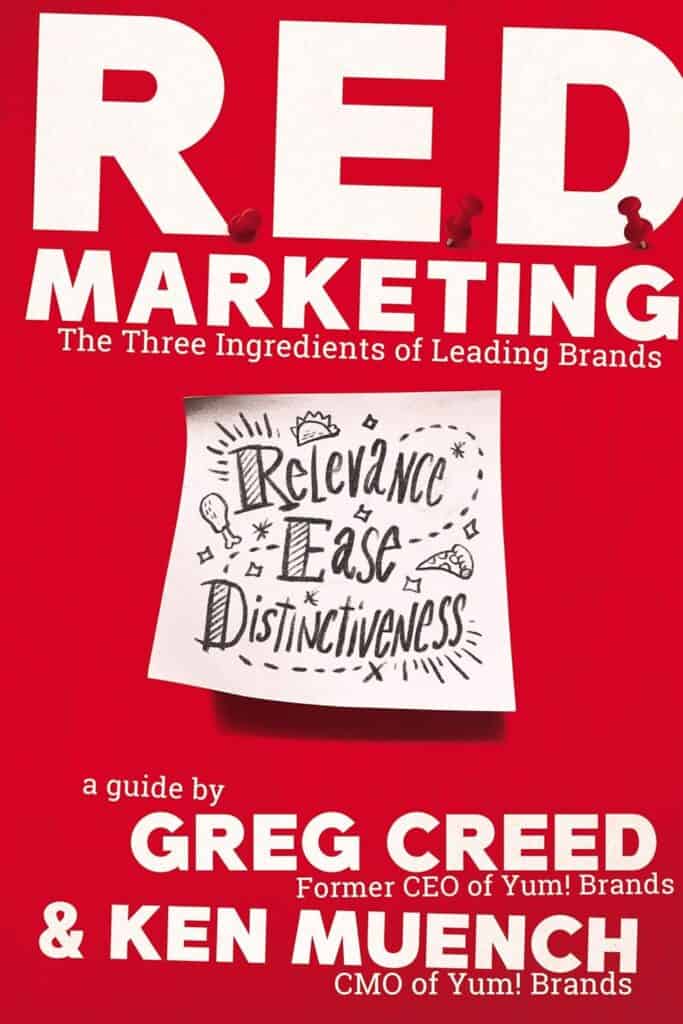
R.E.D. Marketing by Greg Creed and Ken Muench advocates a simple, holistic framework for building brands based on three core ingredients: Relevance, Ease, and Distinctiveness. The central theme is that truly effective marketing requires excelling in all three areas – making a brand meaningfully relevant to consumers, extraordinarily easy to notice and purchase, and memorable through distinctive brand assets. The book’s big idea is that by combining cultural insights, frictionless customer experience, and unique brand cues, marketers can drive sustainable brand growth.
Why You Should Read This Book
This book is a frank, practical guide for marketers and strategists seeking proven methods rather than theory. Creed and Muench share a blueprint derived from their success at Yum! Brands (KFC, Taco Bell, Pizza Hut), cutting through academic jargon with simple frameworks and engaging stories. Readers will learn what really works to drive sustainable brand growth, backed by real-world examples and the latest findings in neuroscience and consumer behavior. In a fast-changing marketing landscape (even tested by the pandemic), the R.E.D. approach provides a unifying playbook that is easy to understand and implement, making marketing efforts more focused, nimble, and fun. For anyone tired of buzzwords and looking for actionable strategy, this book offers a clear roadmap grounded in evidence and actual results.
Key Ideas and Arguments Presented
1. The R.E.D. Formula: Marketing works in three ways – a brand must be Relevant to a real consumer need, Easy to access (and recall), and Distinctive in consumers’ minds. All three ingredients are essential; if any are weak, brand growth will stall. This trio forms the backbone of every discussion in the book.
2. Holistic Brand Building: The authors emphasize excelling in all three areas simultaneously. It’s not enough to have a culturally cool brand (relevance) if it’s hard to find or buy, or to have an easily available product if it’s forgettable. Leading brands weave relevance, ease, and distinctiveness together into one strategy for long-term results.
3. Cultural Relevance: Brands should tap into cultural “codes” and trends to give products deeper meaning in people’s lives. A brand needs to stand for something that resonates with the zeitgeist or social values of its audience. The book illustrates this with examples like shifting from “diet” culture to themes of authenticity and wellness. When people feel a brand aligns with their identity or the “herd” they aspire to, they’re more likely to adopt it.
4. Functional Relevance: Beyond culture, relevance also means fitting into consumers’ everyday routines. The authors stress expanding the number of Category Use Occasions (CUOs) – the situations or needs for which your brand is the go-to choice. For instance, Taco Bell’s famous “Fourth Meal” campaign added a new late-night eating occasion for the brand. The more use-cases or occasions a brand can fulfill, the more frequently it will be purchased, driving growth.
5. Social Relevance: A brand should spur conversation – “buzz” – so that people are naturally talking about it in their social circles:. Word-of-mouth and cultural buzz make a brand feel like the one everyone should be buying. The book cites stunts like Taco Bell’s pop-up hotel or Red Bull’s space jump as ways to get people talking. When everyone is talking about your brand, others feel they’re missing out if they don’t buy in.
6. Ease to Access (Remove Friction): “Ease” is presented as equally critical yet often overlooked by marketers. This means ensuring the brand is easy to find, buy, and use. The authors argue that reducing friction in the customer journey – from discovering the product to ordering and receiving it – will win customers over because humans tend to choose the path of least resistance. R.E.D. Marketing urges marketers to consider convenience, distribution, and the user experience as part of marketing strategy (not leave it solely to operations). In practice, brands that are readily accessible in stores, online, or via delivery will “ultimately win”, so marketers must collaborate to strip away barriers (long lines, confusing apps, slow websites, etc.).
7. Ease to Notice (Mental Availability): The book aligns with the insight from marketing science that advertising should reach as many category buyers as possible. Creed and Muench argue against over-segmentation – don’t waste time micro-targeting tiny niches. Instead, use mass reach media to make sure your brand is easily noticed by “everyone in your category”. They also stress creating memorable ads that trigger emotion, since messages that cause an emotional reaction get remembered longer. By building broad mental availability (being the brand people instantly recall when a need arises), you make purchasing decisions easy for consumers.
8. Distinctiveness over Differentiation: Rather than obsessing over being “radically different,” the authors echo a key modern marketing principle: it’s more important to be distinctive than just different. Distinctiveness means using consistent, ownable brand assets – logos, colors, characters, taglines, even sounds – so that your brand is unmistakable and top-of-mind. The book shows that brands with unique, repetitive cues (think of KFC’s Colonel, or the Taco Bell bell sound) build memory structures that make them easier to recall. Over time, that mental availability beats out minor differences in product features. In fact, the authors note “distinctiveness beats even excellence” in product, if nobody remembers who you are.
9. Modern Science vs Old Beliefs: Throughout the book, Creed and Muench address the conflict between data-driven marketing science and traditional marketing habits. For example, old-school marketers might chase differentiation or narrow targeting, whereas R.E.D. preaches broad reach and distinctiveness as proven by empirical studies (citing works like How Brands Grow). The authors weave in findings from neuroscience and behavioral economics to back up their framework, debunking myths like “we must convert non-users with persuasion.” Instead, they suggest ensuring you’re salient and easy enough that customers come to you when ready.
10. The Importance of Fun and Agility: Finally, the tone of the book reminds marketers that marketing should be exciting and creative, not just analytical. The R.E.D. system, while rooted in research, encourages bold ideas (stunts, cultural memes, witty ads) that make brands enjoyable and shareable. Creed and Muench also highlight how having a clear framework allows teams to be more focused and agile, especially in chaotic times. In the wake of challenges like the pandemic, sticking to R.E.D. fundamentals can keep a brand on course when others flounder.
Book Outline
R.E.D. Overview: Early chapters lay out the basics of the Relevance, Ease, Distinctiveness framework. The authors define each pillar clearly (Relevance to culture/needs, Ease of access and mental availability, Distinctiveness via brand assets) and preview how these will be explored. Readers get a “big picture” figure or diagram showing that cultural, functional, and social relevance combined with ease (to notice & to buy) and distinctiveness lead to effective marketing.
Part I – Relevance: This section is broken into three chapters focusing on the sub-components of Relevance. The first is Cultural Relevance, which delves into understanding cultural trends and instilling the brand with meaning that consumers find culturally important. Next is Functional Relevance, centered on identifying category use occasions and innovating products or messaging to fit those usage situations. Then comes Social Relevance, emphasizing word-of-mouth, social media buzz, and creating talk value so that the brand stays in the social conversation. Each of these chapters includes examples (e.g., how KFC tapped into local cultural insights in different countries, or how Taco Bell created new menu occasions) and ends with key tips for making a brand more relevant in that dimension. Notably, the “Social Relevance” chapter is playfully subtitled “I’ll Have What She’s Having!” to highlight the power of social influence.
Part II – Ease: The next part of the book examines Ease in two dimensions: “Easy to Access” and “Easy to Notice.” The Easy to Access chapter (Chapter 8) walks through the entire customer journey from the perspective of convenience. It identifies points of friction – finding where to buy, ordering, paying, waiting, receiving the product, etc. – and offers strategies to streamline each step. The following chapter, Easy to Notice (Chapter 9), focuses on marketing communications and media strategy. It discusses how to maximize reach among all potential customers and how to craft memorable advertising (with emotional triggers and creative consistency) so that the brand stays top-of-mind. The authors cite research and Yum! case studies to show that easy availability + easy recall leads to bigger market share.
Part III – Distinctiveness: Here the authors argue that many marketers under-invest in creating and relentlessly using distinctive brand assets. One chapter, “How to Be Distinctive,” provides guidance on developing unique brand cues and maintaining consistency over time, with examples of brands that own certain colors, symbols, or taglines in consumers’ minds. Another chapter consists of “Distinctiveness Exercises” (Chapter 14) – practical workshops for brand teams. For instance, the book includes an illustration of Hello Kitty’s branding elements to demonstrate how a brand can inventory its distinctive assets. The Hello Kitty example breaks down the iconic red bow, the stylized font, the white cat silhouette with whiskers, and color scheme, showing how consistently these elements are used to make the character instantly recognizable. Such exercises encourage readers to catalog and evaluate their own brand’s assets for uniqueness and consistency.
Conclusion and Further Reading: The book concludes with a rallying call that marketing grounded in R.E.D. principles will drive long-term growth, and that marketers should continuously learn and stay curious. The authors even provide a reading list of influential marketing books and research. They explicitly suggest reading Byron Sharp’s How Brands Grow (for the science of broad reach and mental availability) and then Douglas Holt’s How Brands Become Icons (for cultural branding) to get both perspectives. This underscores that R.E.D. Marketing synthesizes multiple schools of thought. The closing notes encourage marketers to keep observing culture, experimenting, and sharing insights within their teams, ensuring that the R.E.D. approach becomes an ongoing, fun part of their marketing culture.
Key Takeaways
Greg Creed and Ken Muench distill decades of experience into a simple truth: a brand grows when it’s relevant, easy, and distinctive.
The most important conclusions can be summarized as follows.
Success comes from hitting all three notes – relevance, ease, distinctiveness – together. If your marketing strategy lacks one of these, plug the gap.
Make your brand culturally meaningful and socially buzzworthy, but also tied to real usage needs in people’s lives.
Make your product ridiculously easy to find and buy; remove any friction because consumers will gravitate to the path of least resistance.
Invest in distinctive brand assets and consistent messaging – you want to stick in people’s memories so they recall you first when a need arises
Another takeaway is that marketers should embrace evidence-based practices (like broad reach media and emotional advertising) over outdated dogmas. The R.E.D. system is ultimately about focus and simplicity: it gives marketers a checklist to ensure their brand is showing up where it counts (in culture, in the consumer’s routine, at the point of purchase, and in memory). Following this framework can align teams and significantly “increase marketing effectiveness” as demonstrated at Yum! Brands. In short, a R.E.D.-optimized brand is one that people feel good about, can obtain with ease, and never forget.
Key Techniques
The book doesn’t just stay high-level – it offers concrete techniques and tools to put R.E.D. into practice. One notable tool is the “Ease Safari.” This is an exercise where you go on a “safari” through the customer’s buying journey for your brand (and even a competitor’s) to hunt for friction points. The authors provide a rubric (Figure 8.2 in the book) that breaks down each step: finding where to order, choosing a product, placing the order, payment, waiting, receiving the product, consuming it, and post-purchase follow up.
At each step, you mark if the experience is Green (smooth), Yellow (some friction), or Red (problematic). By scoring your brand’s ease versus competitors, you can pinpoint exactly where you need to improve convenience or speed. This hands-on technique encourages marketers to view buying through the customer’s eyes and is a direct way to apply the Ease principle.
Another technique is conducting a Distinctive Brand Asset Audit. The authors show how to list out all your brand’s signature elements (logos, slogans, colors, characters, sounds, etc.) and assess them for uniqueness and consistency. Using examples like the Hello Kitty case, they illustrate measuring which assets are most recognized and associated with the brand. Marketers are advised to then relentlessly use and protect these top assets across every touchpoint to cement distinctiveness. If certain assets aren’t pulling their weight, consider refining them. This exercise translates the abstract concept of “be distinctive” into a practical project for brand teams.
On the Relevance front, Creed and Muench suggest cultural trend mapping as a technique. While not branded with a fancy name, the idea is to regularly study cultural shifts and emerging consumer values (e.g., the rise of plant-based eating, or changes in social media behavior) and then brainstorm how your brand can authentically connect to those trends. In the book, they recount how Yum! Brands created internal “cultural briefs” and even set up WhatsApp groups with young trendsetters to keep a pulse on cultural movements. For functional relevance, a technique is Category Use Occasion analysis – basically, charting all possible occasions for using your category and identifying gaps or new occasions to target. Taco Bell’s late-night “fourth meal” was born from such analysis, revealing an unmet occasion their restaurants could serve. By systematically expanding when and how consumers use your product, you grow relevance.
Lastly, the authors champion a disciplined approach to mass marketing with memory in mind. They advise creating an “always on” plan to reach all potential buyers (for example, using TV, broad digital, or outdoor ads) rather than hyper-targeting small segments. A key technique here is testing ads for emotional punch and branding: does your campaign both evoke feeling and clearly tie to your brand’s distinctive cues? The book references the principle that ads which trigger emotion make the brand easier to recall later. So, a practical tip is to evaluate creative with that lens – if it doesn’t move people or isn’t branded strongly, go back to the drawing board. By combining these techniques – the Ease Safari, asset audits, trend mapping, usage occasion mapping, and memory-focused advertising – marketers can operationalize the R.E.D. approach in their day-to-day work.
Author’s Qualifications
Greg Creed is the former CEO of Yum! Brands, one of the world’s largest restaurant companies. Over a 40-year career in marketing and operations, he helped build global brands like KFC, Pizza Hut, and notably led a major turnaround at Taco Bell. Creed’s marketing savvy was demonstrated in campaigns such as “Think Outside the Bun” and product innovations like the Doritos Locos Taco, which became a cultural phenomenon. His leadership at Yum! saw significant growth, and he brings a high-level executive perspective to the book, showing how R.E.D. principles drive results at scale (over 50,000 restaurants in 150+ countries under his watch).
Ken Muench is the Chief Marketing Officer of Yum! Brands and co-founder of the company’s internal think tank, Collider Lab. With 25+ years in marketing strategy, Muench has a background in cultural anthropology and consumer insights. He pioneered the R.E.D. marketing system alongside Creed, first as an outside agency partner and then within Yum! after Collider Lab was acquired. Ken’s specialty is “marketing science” – he acts as a “master aggregator of marketing discoveries,” scanning research in neuroscience, psychology, and global case studies to inform strategy. Prior to Yum!, he led strategy at advertising agencies and has won awards for innovative campaigns. In short, Muench is the architect of much of the R.E.D. framework, ensuring it’s grounded in data and behavioral science. Together, Creed (the bold marketing leader) and Muench (the analytical strategist) combine practical corporate experience with cutting-edge theory, making them well-qualified guides on what drives brand growth.
Comparison to Similar Books
R.E.D. Marketing stands on the shoulders of other marketing thought leaders, and the authors are upfront about it. In fact, they encourage readers to explore works like Byron Sharp’s How Brands Grow and Jenni Romaniuk’s Building Distinctive Brand Assets. Fans of Sharp will recognize his influence in the R.E.D. framework: the emphasis on reaching all category buyers (mental and physical availability) and on distinctive brand assets directly echoes Sharp’s principles. What Creed and Muench add is a stronger dose of cultural marketing – an area Sharp largely downplays. In that sense, R.E.D. Marketing bridges Sharp’s evidence-based marketing with Douglas Holt’s cultural branding ideas. They cite Holt’s How Brands Become Icons as the “other side” of the argument and integrate it by making cultural relevance one of the three pillars. Compared to pure data-driven texts, R.E.D. Marketing is more conversational and example-rich, similar in tone to books like Eat Your Greens (which they also reference) that compile real marketers’ insights.
Unlike traditional marketing handbooks (or academic textbooks like Kotler’s Marketing Management), R.E.D. Marketing is not a laundry list of the 4 Ps or a treatise on branding theory – it’s closer in spirit to books like Donald Miller’s StoryBrand or Byron Sharp’s works in that it offers a clear framework and challenges some conventional wisdom. For example, where many classic books stress differentiation, Creed and Muench align more with Sharp in saying distinctiveness and relevance trump having a unique selling proposition for its own sake. Readers who enjoyed Building Distinctive Brand Assets will find the Distinctiveness section of R.E.D. very complementary, as it provides the why and how behind using brand assets (even including exercises to identify them). Similarly, those who liked Mark Ritson’s practical approach to marketing fundamentals will appreciate that R.E.D. is down-to-earth and not overly academic.
In contrast to some newer marketing books that focus heavily on digital marketing tactics or data analytics, R.E.D. Marketing keeps its recommendations high-level and principle-based, ensuring they are timeless. It’s more about strategy than tactics, akin to How Brands Grow in its universality. In summary, if you imagine a Venn diagram between Sharp’s scientific marketing laws and Holt’s cultural strategy, R.E.D. Marketing sits in the overlap, delivering “the best of both” in a digestible playbook. It distinguishes itself by insisting that ease (customer convenience) is part of the equation – something many other branding books ignore.
Target Audience
Marketing professionals: Anyone working in marketing, from brand managers to CMOs, will find value. The book is designed so that even “the greenest of marketing professionals” can grasp the blueprint and start applying it, while seasoned marketers will get a useful refresher on fundamentals that truly drive growth. It’s especially useful for brand strategists and campaign planners looking to boost effectiveness.
Business leaders and executives: CEOs, founders, and general managers who want to understand how marketing can sustainably grow the business will benefit. The framework is simple enough for non-marketers to appreciate, and as one CEO reviewer noted, it’s a “must-read for all brand builders and business leaders” who need a clear, powerful blueprint for marketing.
Students and newcomers to marketing: For MBA students or new marketing hires, R.E.D. Marketing provides an accessible entry point. It covers a lot of ground (from cultural insights to media strategy) in plain language and with vivid examples. One early reviewer noted that as a new student of marketing, they found it “simple, straightforward, and full of practical advice,” and it did a great job making important concepts easy to understand.
Advertising and agency professionals: Folks in ad agencies – whether creatives, account planners, or media buyers – can use R.E.D. to better align their work with client brand goals. The American Marketing Association’s CEO praised the book as a wake-up call to focus on relevance, ease, and distinctiveness, which suggests that even those creating ads can recalibrate their approach using these principles (e.g. ensuring creative is distinctive and easy to recall, not just clever).
Entrepreneurs and small business owners: If you’re running a small or medium business without a big marketing department, this book can serve as a crash course in what really matters. Its lessons are just as applicable to a local startup as to global brands. Creed and Muench’s advice (like remove friction, be part of culture, stand out uniquely) can help an owner prioritize limited marketing resources effectively.
Critical Response to the Book
R.E.D. Marketing has generally been well-received, especially among industry practitioners, though it has drawn a mix of praise and some critique. On the positive side, many readers and reviewers call it a “game-changing guide” and celebrate the simplicity of the framework. They highlight the engaging real-world examples and the fact that the book breaks down complex marketing ideas into practical strategies that can be applied across industries. Endorsements from high-profile CEOs and marketing leaders (like David Gibbs of Yum! and Diane Dietz of Rodan+Fields) reinforce that the book’s advice is sound and valuable for business growth. Several reviewers also note that the writing is clear and the lessons are easy to absorb, making it accessible to a wide audience. The inclusion of illustrations and tools (like the Ease Safari worksheet and diagrams) has been appreciated for adding an interactive element to the learning experience.
On the critical side, some experienced marketers found the content less groundbreaking. A few reviews mention that for veterans the book can feel a bit “basic” or repetitive of well-known concepts. One NetGalley reviewer commented that parts of the book felt like a prolonged introduction and that the truly “concrete” strategies only kicked in about 4 chapters in. There were remarks about the tone, with one reader feeling the authors spent a lot of time touting their successes at Yum! (“braggy,” as one put it) rather than diving straight into teaching the framework. Additionally, because many examples skew toward fun B2C campaigns (fast-food, retail stunts, etc.), readers in B2B or more serious industries wondered how easily the ideas translate to their context. However, even among some skeptics, the consensus is that the core principles of R.E.D. are sound – it’s often the presentation or depth that drew critique. In summary, most find it a useful and enjoyable marketing playbook, while a minority wished for less fluff and more advanced insight. The authors’ decision to write in third person and include personal anecdotes was a stylistic choice that not everyone loved, but the framework itself – Relevance, Ease, Distinctiveness – emerges unscathed as a valuable contribution to marketing literature.
One Sentence Takeaway
To build a leading brand, make it deeply relevant to consumers’ lives, utterly easy to access and recall, and unmistakably distinctive at every touchpoint.