
10 must have project management tool features

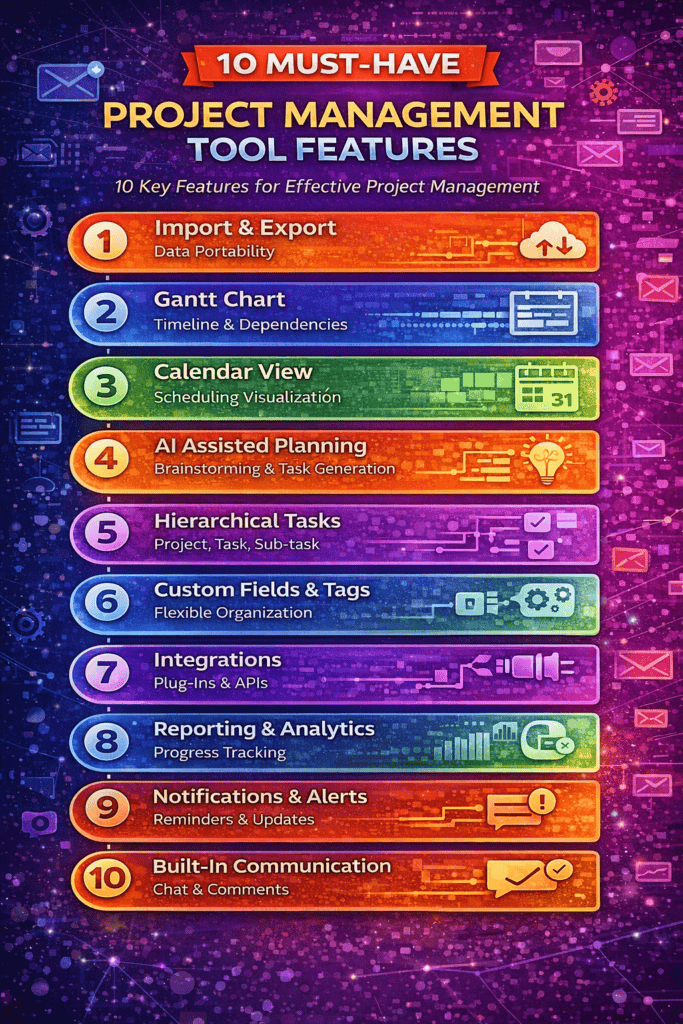
10 Must-Have Project Management Tool Features

Reading Time: 4 minutes

Choosing a new project management (PM) tool can feel overwhelming. There are hundreds, maybe even thousands, on the market. Yet with so many options, the decision often comes down to whether a tool has the right features.
Structured project management correlates strongly with success. One survey found that organized marketers are 674% more likely to report project success than their peers.

Conversely, 97% of agencies reported a major campaign challenge in the last year, often due to workflow issues. Instead of trial-and-error, use a feature checklist to instantly vet any tool.

In this post we outline ten must-haves. If a candidate lacks one of these, move on. You do not want to waste time on a partial solution.

1. Import and Export (Data Portability)

Before you commit, verify that the new tool can import your existing data and, just as importantly, export it later. Any migration should ideally be automated, for example by supporting CSV or JSON imports for tasks, users, and project details. That way you avoid keyboard crunching hundreds of records. Equally critical is the ability to export all your data in open formats. Make sure you will not be locked in. If the vendor cannot easily give you a full project dump on demand, it is a red flag.

2. Gantt Chart (Timeline and Dependencies)

A Gantt chart view is essential for visualizing schedules and task dependencies. With a Gantt chart you can instantly see which tasks are on the critical path and which resources are overloaded. Without it, you are forced to guess if a delay in Task A will cascade into Task B. With a Gantt chart, any slippage is obvious and you can reallocate resources. If your project management tool cannot map out schedules and dependencies in a timeline view, you will quickly lose visibility on complex projects.

3. Calendar View

Alongside Gantt charts, a calendar view is vital for scheduling sanity. A built-in team calendar prevents common issues like accidentally assigning work on vacation days or missing recurring events. Ideally, the calendar stays in sync with individual schedules and integrates with Google or Outlook. This helps avoid double-booking resources or scheduling meetings on holidays. A live calendar ensures your timeline is realistic and avoids extra time juggling spreadsheets or invites.

4. AI Assisted Planning (Brainstorming and Task Generation)

Artificial Intelligence is rapidly emerging in project management tools. While it is still early, look for platforms that build AI into their roadmap. AI can supercharge planning. Some tools let you brainstorm or write a project summary and then have AI turn it into tasks. AI features can automate repetitive task management and extract action items from planning notes. At minimum, pick a vendor that is experimenting with AI features so you will be ready as this technology matures.

5. Hierarchical Tasks (Project, Task, Sub-task)

Your project management tool must support a proper task hierarchy. In practice this means at least three levels: the overall project, then tasks, then sub-tasks. This mirrors the Work Breakdown Structure used in project management best practices. Without this structure, you end up with one flat list and lose clarity. At a minimum, ensure the tool lets you set up tasks and at least one layer of subtasks so you can capture all the work without oversimplifying.

6. Custom Fields, Tags, and Priorities

Every team has its own processes, so you need customizable meta data. This means custom tags, labels, statuses, or fields that reflect your workflow. In practice, this allows you to create your own tags or labels, custom priority levels, and custom workflow stages. Do not settle for a rigid tool that forces you into one-size-fits-all fields. Your tool should flex to match your processes. Custom tags and statuses let you slice and organize work in ways that make sense for your team.

7. Integrations (Plug-Ins and API)

No project management tool is an island. Check that it integrates with your other apps. Modern teams use a stack of tools such as calendars, chat apps, finance systems, and file sharing. Your PM system must connect with them. Integrations create a single source of truth and cut out manual copy-paste. At a minimum, ensure the tool offers plugins or APIs for your key apps. If it lacks the integrations you rely on, expect extra work or costly engineering.

8. Reporting and Analytics

A tool that only manages tasks is only half the story. You need built-in reporting to analyze progress and trends. Good project management software turns data into dashboards and reports on demand. This lets you answer questions like which projects are burning budget and which clients had more delays. Look for pre-built report templates and customizable dashboards. If the tool lacks reporting, you will have to export all the data into spreadsheets, defeating the purpose of having software in the first place.

9. Notifications and Alerts

Even the best project management tool can become frustrating if every little change pings everyone. You want granular, configurable notifications. The ideal tool lets each user pick what they are notified about and how they receive updates. This kind of fine control cuts through the noise so you stay informed but not overwhelmed. Look for features like per-project or per-task notification settings, roles-based alerts, and options to snooze or batch notifications. A balance between visibility and focus is critical.

10. Built-In Communication (Chat and Comments)

Your project management platform should be a hub for team communication, not just task lists. This means either built-in chat channels or rich comment threads on tasks. The goal is to keep all project discussion in context. Many tools let you comment on a task and tag teammates so discussions stay attached to work items. Beyond comments, some tools include live chat or integrate tightly with Slack or Teams. Ideally, your team should be able to post updates, share files, and clarify tasks inside the same system you use to schedule work.

In Summary

With thousands of options out there, this ten-item checklist will quickly weed out tools that cannot support your process. If a tool lacks easy data import and export, or does not have a real timeline view, or will not let you organize tasks the way you work, it is not worth the headache. A strong project management tool should adapt to your workflow, not the other way around. Invest the time up front to verify these features. The right tool will keep your marketing campaigns and all projects on track while your team focuses on doing the work.

10 Must-Have Project Management Tool Features Read More »

case study als ice bucket challenge

Case Study: How the ALS Ice Bucket Challenge Raised $220M for Nonprofit Marketing

Reading Time: 5 minutes

Brief Summary

In 2014, the ALS Ice Bucket Challenge became a global viral social media sensation.

Participants filmed themselves dumping ice water on their heads and nominated friends to do the same, all to raise awareness and donations for amyotrophic lateral sclerosis (ALS).

Widely shared by celebrities and everyday people, the challenge engaged over 17 million participants worldwide and raised roughly $115 million ($220 internationally) for ALS research.

It created a cultural moment and demonstrated the power of fun, user-driven marketing campaigns for social causes.

Company Involved

ALS Association: The American nonprofit organization dedicated to ALS research and patient care (see als.org).

Marketing Topic

  1. Social Media Marketing
  2. Viral Marketing
  3. Influencer Marketing

Public Reaction or Consequences

Viral Sensation: The campaign dominated social media and news. Facebook users posted over 17 million Ice Bucket videos and countless celebrities (Bill Gates, Justin Timberlake, Leonardo DiCaprio, etc.) took the challenge. It became a global meme.

High Praise (and Some Criticism): Public response was largely positive; ALS donations and awareness surged. However, critics called it “slacktivism” and noted issues like waste of water and occasional self-promotion.

Media Buzz: Coverage was intense across outlets (Time, CNN, BBC, etc.), making ALS a trending topic. No legal backlash occurred, instead, the campaign boosted ALS’s brand and cultural relevance.

Why It Matters Today

Power of Simplicity: The Ice Bucket Challenge proves that a simple, easy-to-share idea can explode on social platforms.

Influencer and Community Leverage: It shows how tapping networks, friends nominating friends, celebrities amplifying reach, can rapidly scale a campaign.

Cause Marketing Blueprint: Modern nonprofits and brands still use challenge-based campaigns, think TikTok or Instagram trends, learned from this success.

Digital Activism: In an age of memes and influencer economy, the case highlights how entertainment and philanthropy can combine to engage younger audiences.

Trust and Transparency: It underscores that even fun campaigns must maintain clear purpose and accountability, relevant to today’s emphasis on ethical marketing and data privacy.

3 Takeaways

1. Keep It Simple and Shareable: The Ice Bucket Challenge’s easy rules, dump ice water, post video, nominate, drove massive sharing. Clear calls to action make campaigns go viral.

2. Leverage Networks and Celebrities: Personal nominations and A-list participants rapidly expanded the campaign’s reach. Engaging influencers can catapult awareness.

3. Plan for Scale and Transparency: Prepare for success. ALS had to reorganize quickly to manage the surge of funds and maintain donor trust. Always communicate clearly how donations are used.

Notable Quotes and Data

“They inspired over 17 million people around the world… The Challenge raised awareness of the disease worldwide and raised $115 million”.

“Facebook users posted more than seventeen million videos of dousing… countless celebrities—Bill Gates, Justin Timberlake, Leonardo DiCaprio—got drenched for the cause.”

“It raised a reported $220 million worldwide for A.L.S. organizations”.

Full Case Narrative

Volunteers at an Ice Bucket Challenge event rally others to donate and spread awareness of ALS. The Ice Bucket Challenge began as a grassroots effort in the summer of 2014. It originated with friends and families of ALS patients, like golfer Chris Kennedy in Florida and ALS patients Pat Quinn and Pete Frates, connecting an existing ice-water stunt to the disease. Pete Frates posted a viral challenge video on July 31, 2014, and that is widely cited as the turning point when the campaign “really went viral”. Participants would either dump ice water on themselves or donate to ALS research, then nominate others. This simple loop of user-generated videos spread rapidly through Facebook and Twitter.

Major celebrities and public figures soon joined, helping push it global. Figures like Mark Zuckerberg, Oprah Winfrey, and even President Obama, via donation, were connected to the challenge. Media outlets amplified the story daily. By early August, the ALS Association reported an unprecedented influx of donations, over $15.6 million from hundreds of thousands of donors in days. The Association itself had not launched the campaign but quickly embraced it, updating its messaging and donation links to capitalize on the momentum.

By late 2014, the results were historic. Roughly $115 million had been donated to the U.S. ALS Association, compared to about $15 million in the same period the previous year, and global contributions hit around $220 million. ALS research funding and clinics expanded: independent reports note that the challenge enabled dozens of new research grants and even discoveries of new ALS-related genes. Public awareness soared, ALS became a household name, topping Google search charts for 2014.

The campaign also offered lessons. Its success came from a simple, social concept and peer-to-peer network effects. Critics had feared it was just hype, “slacktivism,” but analyses showed lasting benefits. As New Yorker writer James Surowiecki observed, the Ice Bucket Challenge “changed the face of A.L.S. forever”. On the downside, many participants never donated; studies found that most who took the challenge did not give money, so the ALS Association had to navigate a huge, one-time surge and find ways to keep engagement high after the fad faded. In summary, the Ice Bucket Challenge stands as a landmark story in viral social marketing: it achieved extraordinary reach and fundraising by tapping user creativity and networks, but it also showed that sustainable impact requires clear purpose, planning, and transparency.

Timeline (key events)

July 15, 2014: Chris Kennedy posts an early ice-bucket video linking the challenge to ALS.

July 31, 2014: Pete Frates uploads an ALS-tagged challenge video, which sparks a surge in participation.

August 4, 2014: The ALS Association reports receiving $15.6M from new and existing donors in days.

August–October 2014: Donations peak, roughly $115M to ALS Association, and global media coverage spreads awareness.

August 1, 2015: ALS organizations attempt a repeat annual challenge, “Last Summer,” but it gains little traction compared to 2014.

What Happened Next?

After the Ice Bucket Challenge, the ALS Association redirected the windfall into accelerated research, clinical care, and patient services. They published reports showing that the donations funded five new gene discoveries and other breakthroughs. Rather than trying to relive the 2014 frenzy, ALS organizers focused on sustaining the momentum through awareness campaigns and social media, for example, they now promote annual fundraising events online with challenge-style content.

The Ice Bucket Challenge left a mark on the nonprofit sector. Many charities saw how digital, participatory campaigns can engage donors and especially younger audiences. Social-media “challenge” campaigns, like variations of running or jumping stunts, or Movember mustache challenges, became a common tactic. Marketers learned that combining a fun viral element with a clear cause can spark massive engagement. Even today, organizations plan campaigns with shareable hashtags, videos, and personal nomination features inspired by ALS’s model. In short, nonprofits now routinely include social marketing experts and interactive content strategies in their toolbox, a legacy of the Ice Bucket Challenge’s success.

One Sentence Takeaway

Even a fun viral stunt needs a clear purpose and plan: the Ice Bucket Challenge showed that simple, shareable marketing can ignite action, but long-term impact comes from aligning hype with real trust and strategy.

Sources and Citations

TIME: How the ALS Ice Bucket Challenge Actually Started – Timeline of the challenge’s origin, July 2014.

The New Yorker: What Happened to the Ice Bucket Challenge? – Analysis of the viral campaign’s impact, participant numbers, funds raised.

Vox: The Ice Bucket Challenge and the pitfalls of viral charity – Discussion of participation stats and outcomes, 2.4M videos, $115M.

ALS Association: Ice Bucket Challenge Overview – Official summary of the campaign, 17M participants, $115M raised.

The Fiscal Times: How ALS Hijacked the Ice Bucket Challenge and Raised Millions – News report on early fundraising figures, $15.6M by Aug 4, 2014.

Public Relations Case Studies: ALS Ice Bucket Challenge – Academic case study detailing strategy and aftermath, organizational restructuring.

Case Study: How the ALS Ice Bucket Challenge Raised $220M for Nonprofit Marketing Read More »

a free permanent read it later system

Stop Losing Articles: A Free, Permanent Read-It-Later System

Reading Time: 4 minutes

On May 22, 2025, Mozilla announced that Pocket would shut down on July 8, 2025, with data export available until October 8, 2025.

Like many readers, I had years (and thousands) of articles in Pocket. When the shutdown notice hit, I went looking for a replacement and discovered what I actually needed from a read-it-later system.

My must-haves

  • Permanent copy, offline: not just cached, but a file I own that survives if the web page changes or disappears.
  • Free: at least for the core workflow; I was not looking to pay a subscription this time.
  • Mobile-first: most of my saving and reading starts on my phone.
  • Easy highlighting and a clean reading experience.
  • Organization: simple folders or tags for organization and to find things later.
  • (Nice to have) Voice: hear articles read aloud.

The search (a lot of apps, a lot of dead ends)

I tried a long list of apps in the stores and brainstormed with LLMs about edge cases and workflows. Many tools were great readers but failed my permanent copy test on the free tier. Some felt risky due to slow development, and others were more complex than I wanted.

The solution I landed on

I stopped chasing another service and went native:

Save to PDF -> Store in a cloud folder -> Highlight in a standard reader.

  • Permanent: each saved article becomes a PDF I own.
  • Portable: I keep them in one cloud folder (I use pCloud) with subfolders by topic or by year and month.
  • Readable and highlightable: opening the PDF in Apple Books makes highlighting easy; annotations are saved in the file.
  • Voice: on iPhone, Speak Screen can read any open PDF aloud; I can also open in Books and use Speak Screen there.

How I save on phone (two taps)

  1. Share menu in the browser -> Print -> pinch out the preview -> Save to Files -> my Read It Later folder.
  2. If I want to highlight immediately, Open in Books.

How I save on laptop

  • Print -> Save as PDF to the same cloud folder.
  • For a pixel-perfect offline copy, I may also save an HTML snapshot with the SingleFile browser extension, but the PDF is my forever copy.

Moving years of Pocket links

I exported my Pocket data as a CSV and asked an LLM to help automate turning thousands of saved links into permanent PDFs. It produced a small local tool that runs on my computer: a Node.js script that opens each URL in headless Chrome (Puppeteer), extracts a clean article view with Mozilla Readability, sanitizes the HTML, and prints a tidy PDF directly into my cloud folder. No servers and no third-party accounts.

What the LLM built

  • Tech stack: Node.js, Puppeteer (headless Chrome), @mozilla/readability for clean article content, sanitize-html for safety, plus csv-parse, slugify, and yargs.
  • CSV aware: points at the Pocket CSV, detects the URL column, and can skip archived rows (I skipped anything marked “archive” in column E).
  • PDF only: a switch to write PDFs only so the folder stays clean.
  • Wayback fallback: if a page is gone or shows a “Just a moment…” interstitial, it pulls the closest Internet Archive snapshot and saves that instead.
  • Filename template: I set filenames to the article title only.
  • Resume friendly: start and limit options let me continue where I left off or process in batches if my laptop sleeps.
  • Reporting: a JSON report lists successes and any failures, plus a tiny triage script to print URLs to retry.

The result: a neat archive of permanent, highlightable PDFs in my cloud drive. For dead links, the Wayback fallback rescued many of them. Manual saving is fine for small libraries, but automation made a large migration realistic.

What I learned (and wish I had known sooner)

  • Offline is not the same as permanent. Many apps cache articles, but if the source page changes or disappears, your copy can break. A file you control (PDF or HTML) is the safest bet.
  • Own your library. Standard formats, plain folders, and a cloud drive you already use beat lock-in.
  • Highlighting matters. PDFs in Books are easy to mark up and the annotations stay with the file across devices.
  • Voice is built in. System text-to-speech like Speak Screen on iOS can read PDFs without a subscription.
  • Services come and go. Pocket’s shutdown reminded me to choose workflows that survive app closures.

My current setup (feel free to copy it)

  • Capture: Print to PDF from phone and laptop into /Read It Later on my cloud drive.
  • Organize: subfolders like Research, Ideas, and How-To, or year and month (for example, 2025/08). Filenames are the article title.
  • Read and mark up: open in Apple Books for highlights and notes.
  • Listen: use Speak Screen to read any open PDF aloud.
  • Search: system search finds titles and often PDF text; the folder structure covers the rest.

Why this works for me

It is simple, durable, and free. I do not worry about an app’s future, and I do not lose articles when the web changes. I can still use read-it-later apps as inboxes if I want, but the keepers live in my own archive.

Stop Losing Articles: A Free, Permanent Read-It-Later System Read More »

comparing free behavior analytics solutions

Comparing Free Behavior Analytics Solutions: Hotjar, Microsoft Clarity, and Mouseflow

Reading Time: 2 minutes

As a business grows its martech stack, website analytics is usually one of the first tools selected, most often Google Analytics because it is free and connects directly to Google Ads. Website analytics tells you what happened. Before long, answering why it happened becomes critical. That is where behavior analytics comes in: session replay, heatmaps, and lightweight feedback that reveal the reasons behind the numbers.

Martech landscape: These tools fit in the Behavior Analytics / Experience Analytics family within the Scott Brinker (chiefmartec) landscape.

Free plan comparison (2025)

Legend: ✓ = included   — = not included   Limited = included with caps (see notes)

A) Core limits

Tool Sessions / Recordings Data retention Heatmaps Sites / Projects Team seats
Hotjar (Basic) 35/day 365 days Unlimited 1 site per plan Unlimited
Microsoft Clarity Up to 100k recs/day (per project) 30 days (recordings) Unlimited Unlimited Unlimited
Mouseflow (Free) 500/month 1 month Unlimited 1 website Unlimited

B) Feature checklist (free tiers)

ToolSession replayHeatmap typesFunnels / FormsSurveys / FeedbackIntegrations (examples)Mobile apps
Hotjar✓Click, Scroll (web)—Limited (3 widgets, 20 responses/mo)HubSpot, GA, Slack (incl.)Web only (no native SDK)
Clarity✓Click, Scroll, Area, Attention, Conversion—— (surveys not included)GA4, Google Ads, MS AdsWeb + Mobile SDK (iOS/Android)
Mouseflow✓Click, Scroll, Attention, Move, GeoLimited (1 funnel & 1 form report)Limited (1 feedback survey)GA, HubSpot, 20+ plug-and-playWeb (no native SDK)

C) Privacy defaults

ToolPII masking / keystrokesNotes
HotjarMasked by defaultCan allow specific fields if needed.
ClarityMasking “Balanced” by defaultStrict & Relaxed modes available.
MouseflowIPs & keystrokes masked by defaultVisual privacy tools to exclude elements.

Notes

  1. Clarity limits: Clarity is free-forever and unsampled for typical sites; however, it keeps up to 100,000 recordings per project per day and then samples if you go beyond that volume.
  2. Hotjar Ask (free): Basic includes 3 active widgets and 20 responses/month; unlimited questions per survey.
  3. Mobile support: Hotjar supports websites and web apps; it does not provide native mobile SDKs. Clarity supports native iOS/Android via SDK. Mouseflow is web-focused.

Also consider (free tiers exist)

  • Lucky Orange (100 sessions/mo free)
  • PostHog (generous free usage incl. session replay & product analytics)
  • Heap (up to 10k sessions/mo free)
  • Smartlook (≈3k sessions/mo free)
  • LogRocket (≈1k sessions/mo free)

Sources (selected)

Quick research notes (why the values above are what they are)

  • Hotjar Basic: Free plan allows up to 35 sessions per day, unlimited heatmaps, 365 day storage for Observe data, HubSpot integration on free, and unlimited team members.
  • Microsoft Clarity: Free forever with unlimited heatmaps and projects. Recordings are retained 30 days. The service keeps up to about 100,000 recordings per project per day before sampling. Includes GA4 and Google Ads integrations plus a mobile SDK.
  • Mouseflow Free: Includes 500 recordings per month, one website, one month retention, and limited funnels, forms, and feedback, typically one of each.

Background and ownership

Hotjar is part of Contentsquare following an acquisition announced in September 2021. The Hotjar product continues to operate under its own brand with free and paid plans.

Comparing Free Behavior Analytics Solutions: Hotjar, Microsoft Clarity, and Mouseflow Read More »

case study toys r us amazon

Case Study: How Toys R Us Lost Its Digital Edge to Amazon

Reading Time: 3 minutes

Brief Summary

Toys “R” Us signed a ten-year exclusive deal with Amazon in 2000, which redirected its online sales to Amazon and delayed its own eCommerce efforts.

When Amazon breached the deal by expanding toy vendors, Toys “R” Us sued and ended the agreement—but it had already lost critical digital momentum.

Company Involved

Toys “R” Us, once the world’s largest dedicated toy retailer, focused on toys and baby products.

Marketing Topic

  • Search Engine Optimization
  • eCommerce Channel Strategy
  • Branding
  • Customer Experience
  • Competitive Positioning

Public Reaction or Consequences

Media and analysts viewed the exclusive Amazon deal as a strategic error that gave digital dominance away. The lawsuit restored control, but not runway. Concurrently the company struggled under burdensome private equity debt, and customers migrated to more convenient digital alternatives.

Why It Matters Today

Exclusive partnerships with third-party platforms can stall direct customer relationships. Control of your own eCommerce channel is vital today. Debt from private equity reduces flexibility for innovation. In the digital age, adaptability and omnichannel experience are core to survival.

3 Takeaways

1. Exclusive channel deals can undermine long-term brand control.
2. Heavy leveraged debt restricts innovation and adaptability.
3. Delayed digital transformation is costly in swiftly evolving markets.

Notable Quotes and Data

  1. “The agreement meant that Toys R Us had no autonomous online presence — customers who tried to visit ToysRUs.com were redirected to Amazon.”
  2. “Amazon began to allow other toy vendors to sell on its site in spite of the deal… Toys R Us missed the opportunity to develop its own e-commerce presence early on.”
  3. Toys “R” Us “paid Amazon $50 million a year plus a cut of sales” for exclusivity.

Full Case Narrative

In 2000, Toys “R” Us entered a ten-year exclusive agreement with Amazon to be the sole supplier of toys and baby products on Amazon’s platform. ToysRUs.com redirected traffic to Amazon, sacrificing its online storefront while Amazon gleaned customer insights.

The relationship initially seemed advantageous, but once Amazon began allowing other sellers in the category, Toys “R” Us sued in 2004. A court ruled in its favor in 2006, awarding about $51 million in damages and ending the agreement.

Yet during these years Amazon surged ahead in e-commerce. When Toys “R” Us launched its site, consumer habits had shifted and momentum was gone.

Additionally, a 2005 private equity buyout saddled the company with nearly $5 billion in debt, leading to $400 million annual interest payments that limited investment in stores and the digital channel.

These combined pressures—debt, digital displacement, and decline in store relevance—led Toys “R” Us to file for bankruptcy in 2017, culminating in U.S. store closures in 2018.

Timeline

2000: Exclusive Amazon deal begins.
2004: Lawsuit filed against Amazon.
2006: Court ends deal; Toys “R” Us regains e-commerce control.
2005: PE acquisition imposes heavy debt.
2017: Bankruptcy filed.
2018: U.S. stores shuttered.

What Happened Next?

Post-liquidation, the brand returned via licensing, including partnerships with Target, Amazon (fulfillment), and Macy’s. Yet none restored its former market dominance.

One Sentence Takeaway

Toys “R” Us ceded crucial years of e-commerce control to Amazon via an exclusive agreement and, burdened by private equity debt, was unable to catch up—resulting in its decline in a fast-changing retail world.

Sources and Citations

What Went Wrong: The Demise of Toys R Us – on the Amazon deal’s impact and lost momentum.

How Amazon Took Down Toys R Us – exclusive agreement details and Amazon’s strategic positioning.

Toys “R” Us – Wikipedia – overview of partnership, bankruptcy, and revival attempts.

Business Insider – How Amazon May Have Led to Toys ‘R’ Us’ Demise – commentary on the deal’s delay effect on e-commerce build.

Retail Dive – Inside the 20-Year Decline of Toys R Us – insights on debt’s impact on innovation and store upkeep.

Case Study: How Toys R Us Lost Its Digital Edge to Amazon Read More »

market your way to growth

Market Your Way to Growth by Philip and Milton Kotler Book Summary

Reading Time: 12 minutes

Market Your Way to Growth: 8 Ways to Win by Philip Kotler and Milton Kotler (2013) introduces eight strategic pathways to achieve business growth even in the toughest economic climates.

In the face of slow growth and limited customer demand, the authors argue that companies can still thrive by creatively expanding and adapting their marketing strategies.

The book outlines actionable methods – from increasing market share and innovating offerings to forging partnerships with governments – showing that by embracing these pathways, businesses can outperform competitors and prosper in a low-growth world.

Top Three Quotes

  • “Innovate or die.” – This blunt directive underscores the critical importance of continuous innovation for maintaining competitiveness and driving growth. Companies that fail to innovate risk obsolescence in fast-changing markets.
  • “The customer is the only one who can fire us all.” – Emphasizes that customer satisfaction and loyalty are fundamental to a business’s survival. Ultimately, it’s the customer who determines a company’s success or failure, so their needs must be at the center of every strategy.
  • “A brand for a company is like a reputation for a person.” – Highlights the vital role of brand development in establishing a company’s identity and credibility. A strong brand builds trust with customers, much like a good reputation does for an individual, and this trust translates into sustained growth.

Book Theme

Market Your Way to Growth centers on how businesses can achieve sustainable growth in a slow-growth economy through strategic marketing initiatives. Philip and Milton Kotler argue that even when overall economic conditions are sluggish, companies can still find ways to expand by pursuing a broad range of marketing-driven growth strategies. The book introduces eight key pathways to growth – including boosting market share, cultivating customer loyalty, building strong brands, continuous innovation, international expansion, mergers/acquisitions, corporate social responsibility, and public sector partnerships – as the primary avenues for companies to “win” despite economic headwinds. The overarching message is that firms should not resign themselves to stagnation; instead, they must proactively leverage multiple strategies (often beyond the one or two traditional approaches they’ve relied on) to spark new growth opportunities.

Why You Should Read This Book

  • Proven strategies: This book delivers tried-and-tested marketing strategies for achieving growth, backed by the Kotlers’ decades of research and industry experience. Each strategy is illustrated with examples, making it clear how successful companies have implemented these ideas.
  • Adaptability: The guidance is applicable in both low-growth and high-growth environments, helping readers learn how to adapt their marketing approach to different economic conditions. Whether your market is stagnating or booming, the book provides relevant tactics for adjusting your strategy.
  • Holistic view: Market Your Way to Growth offers a comprehensive toolkit of growth avenues, from traditional methods like increasing market share to more unconventional tactics like partnering with governments. This broad perspective ensures you consider all possible paths to expansion, not just a single formula.
  • Actionable insights: Kotler and Kotler provide practical advice and tools that you can directly apply to your business. The book is filled with checklists, examples, and clear recommendations – making it a hands-on guide for executives and marketers looking to implement growth strategies immediately.

Key Ideas and Arguments Presented

  1. “Grow or die” – the imperative of continuous growth: The Kotlers start with the premise that if a business isn’t growing, it’s effectively dying. In today’s rapidly changing environment, standing still means falling behind. Companies must continually seek growth opportunities, especially in challenging times, or risk obsolescence.
  2. Grow by building your market share: One key strategy is to expand market share by outperforming competitors. Gaining a larger slice of the existing market can be achieved through better products, aggressive marketing, superior customer service, or more efficient operations. By taking share from rivals, a company can grow even when the overall market is flat.
  3. Grow by developing committed customers and stakeholders: The authors stress the importance of cultivating loyal, long-term relationships with customers, employees, and investors. When customers are highly satisfied and engaged, they not only become repeat buyers but also advocates for the brand. Likewise, committed stakeholders (like enthusiastic shareholders and employees) provide stability and support for growth initiatives.
  4. Grow by developing a powerful brand: Building a strong brand is presented as a cornerstone of growth. A powerful brand creates differentiation in the marketplace and fosters trust and credibility. The book argues that brand equity – the value of having a well-known, respected brand – translates into customer preference and pricing power, fueling long-term growth.
  5. Grow by innovating new products, services, and experiences: Continuous innovation is crucial to staying ahead of the curve. The Kotlers advocate investing in new product development, service improvements, and even new business models or customer experiences. Innovation keeps a company relevant to changing customer needs and opens up new revenue streams, aligning with the mantra “innovate or die.”
  6. Grow by international expansion: When domestic markets are saturated or growing slowly, expanding into international markets can tap into high-growth opportunities abroad. The book discusses entering emerging markets and developing regions as a way to find new customers. It emphasizes understanding local cultures and regulations, suggesting that success abroad requires adaptation of products and marketing strategies to fit each market.
  7. Grow by mergers, acquisitions, and alliances: Market Your Way to Growth also highlights strategic mergers and partnerships as a rapid expansion route. By acquiring other companies or forming alliances/joint ventures, a business can quickly gain access to new technologies, products, customer bases, or geographic markets. This approach can accelerate growth much faster than organic expansion, though it comes with challenges like integrating different corporate cultures.
  8. Grow by building an outstanding reputation for social responsibility: The authors argue that demonstrating corporate social responsibility (CSR) can drive growth by enhancing a company’s reputation. When a firm actively contributes to society – through ethical practices, sustainability, and community engagement – it earns goodwill that translates into customer preference and loyalty. In an age of conscious consumers, a strong CSR reputation can differentiate a brand and open up new customer segments.
  9. Grow by partnering with government and NGOs: The final pathway involves collaborating with governments and non-governmental organizations to create mutual value. By partnering on infrastructure projects, education and social programs, or policy initiatives, companies can gain access to new funding, large-scale contracts, or underserved markets. These public-sector partnerships can not only solve social challenges but also drive business growth in areas a company might not reach alone.

Book Outline

  • Introduction: Preparing to Master the Eight Pathways to Growth – Sets the stage by describing the low-growth economic environment and the need for new marketing-driven growth strategies (introduces nine global megatrends affecting business).
  • Chapter 1: Grow by Building Your Market Share – Strategies for increasing market share in existing markets (e.g. beating competitors through better value, promotions, distribution).
  • Chapter 2: Grow through Developing Committed Customers and Stakeholders – How to deepen customer loyalty and stakeholder engagement (e.g. improving customer satisfaction, loyalty programs, cultivating employee and investor commitment).
  • Chapter 3: Grow by Developing a Powerful Brand – Guidance on building and managing a strong brand to support growth (covering brand identity, positioning, and consistent brand messaging).
  • Chapter 4: Grow by Innovating New Products, Services, and Experiences – Emphasizes innovation processes and culture; how creating new offerings and experiences can drive significant growth.
  • Chapter 5: Grow by International Expansion – Discusses entering foreign markets to find new growth, including evaluating which countries to enter, adapting to local needs, and overcoming barriers in global expansion.
  • Chapter 6: Grow by Mergers, Acquisitions, Alliances, and Joint Ventures – Explores growth via inorganic strategies: acquiring businesses or partnering with other companies to quickly add capabilities, products, or access new markets.
  • Chapter 7: Grow by Building an Outstanding Reputation for Social Responsibility – Shows how investing in CSR and ethical practices can enhance brand reputation and attract customers, thereby fueling growth.
  • Chapter 8: Grow by Partnering with Government and NGOs – Explains how collaborating with government agencies and NGOs can open opportunities (such as large projects or emerging market initiatives) that also drive business growth.
  • Epilogue: Summarizes how companies can integrate these eight pathways and encourages leaders to continually seek new growth avenues even in a low-growth world.

(Each chapter delves into one of the eight growth strategies, providing case studies and practical tips on implementation.)

Key Takeaways

  • Eight pathways to growth: There is no single silver bullet for growth; the book identifies eight major strategies that businesses can pursue in combination to achieve sustainable expansion. Companies should evaluate all these pathways – from boosting market share to forming partnerships – to determine which best fit their situation rather than relying on just one approach.
  • Continuous innovation is essential: Innovate or die is a recurring lesson. The Kotlers emphasize that continuous innovation in products, services, and business models is crucial to stay competitive and meet changing customer needs. Organizations must foster a culture of innovation and be willing to reinvent themselves to avoid stagnation.
  • Global expansion unlocks growth: For companies in mature markets, international expansion can be a powerful engine of growth. By entering high-growth emerging markets or underserved regions, businesses can access new customer bases. The book notes, however, that succeeding internationally requires careful market research, cultural adaptation, and risk management to navigate local conditions.
  • Brand and reputation matter: Building a strong brand and a positive reputation — particularly through social responsibility — creates long-term value. A trusted brand attracts and retains customers, and socially responsible practices enhance credibility. One takeaway is that intangible assets like brand equity and goodwill can directly contribute to a company’s growth by differentiating it from competitors.
  • Leverage partnerships and acquisitions: Growth can often be accelerated through strategic combinations – such as mergers, acquisitions, alliances, or public-private partnerships. Kotler’s message is that collaborating with or acquiring other organizations can provide new capabilities, technologies, or market access that would be hard to build alone. However, the book also cautions that these moves require due diligence and alignment of goals to be successful (cultural fit and integration planning are critical).

Key Techniques

  • Segmentation, targeting & positioning (STP): The authors reinforce the classic marketing process of identifying target segments, defining a clear positioning, and then executing with the right marketing mix (the “4 Ps”: product, price, place, promotion). This disciplined approach ensures that growth strategies are grounded in a deep understanding of the customer and market.
  • Formal innovation processes: To make innovation repeatable, Market Your Way to Growth advocates instituting structured innovation management techniques. For example, companies can implement a stage-gate process for new product development, encourage internal brainstorming initiatives, and collaborate with customers or startups. Such formal processes ensure a steady pipeline of new ideas and reduce time-to-market for innovations.
  • Brand-building framework: The book provides a playbook for strengthening your brand as a growth driver. Key steps include developing a clear brand identity and story, maintaining consistent visuals and messaging, delivering on brand promises at every touchpoint, and actively monitoring your brand’s reputation. By building a recognizable and trusted brand, a company can command customer loyalty and price premiums that fuel growth.
  • Customer engagement and feedback loop: In the era of empowered consumers, Kotler urges businesses to actively listen and respond to customer feedback. Companies should monitor online reviews, social media, and other channels to gather customer insights, and then quickly address issues or adapt offerings. Techniques like loyalty programs, personalized communication, and community-building are recommended to deepen customer engagement. Engaging customers not only boosts retention but can turn them into advocates who spur growth through word-of-mouth.
  • Thorough market research (“reconnaissance”): A recurring tactical advice is to do your homework before pursuing growth moves. “Time spent on reconnaissance is seldom wasted,” the book reminds readers. This translates into techniques like comprehensive market research, competitive analysis, and pilot testing strategies in small areas before full rollout. By investing in upfront analysis, companies can make informed strategic decisions and avoid costly missteps, thereby increasing the success rate of growth initiatives.
  • Measuring and managing CSR impact: When implementing corporate social responsibility programs, the Kotlers suggest measuring their impact to ensure these efforts support business goals. Techniques include comparing sales or market share in communities where the company engages in CSR versus those where it doesn’t, gathering customer feedback on the company’s social efforts, and tracking metrics like brand sentiment. By treating CSR initiatives with the same rigor as other investments (setting objectives and measuring results), companies can maximize the growth benefits of being socially responsible.
  • Strategic partnership execution: For growth through mergers, acquisitions, or alliances, the book provides guidance on execution. It stresses the importance of careful partner evaluation and integration planning. Companies are advised to conduct thorough due diligence, ensure cultural and strategic fit, and have a clear post-merger integration plan or alliance roadmap. By doing so, they can more successfully leverage partnerships to quickly scale into new markets or product areas without derailing their existing business.

Author’s Qualifications

  • Philip Kotler: Widely regarded as a leading authority on marketing, Philip Kotler is the S.C. Johnson Distinguished Professor of International Marketing at Northwestern University’s Kellogg School of Management. He has authored dozens of influential books (including the seminal textbook Marketing Management and other works like Marketing 3.0, Ten Deadly Marketing Sins, etc.) that have defined modern marketing practice worldwide. Kotler has been ranked among the top global management thinkers (Financial Times ranked him #4, and Wall Street Journal ranked him #6). Often called the “father of modern marketing,” he is known for pioneering concepts such as STP (segmentation, targeting, positioning) and the 4 Ps, and he has advised many large companies on marketing strategy.
  • Milton Kotler: Milton Kotler is an accomplished global marketing strategist and consultant. He is the Chairman of Kotler Marketing Group (KMG) USA, based in Washington, DC, and of KMG China in Beijing – recognized as one of China’s top marketing consultancy firms. Milton brings international expertise, having advised businesses on strategies for entering and succeeding in markets like China. He is also the author of A Clear-Sighted View of Chinese Business Strategy and a frequent contributor to the Chinese business press. His background complements Philip’s academic prowess with on-the-ground strategic consulting experience, especially in emerging markets.

Comparison to Similar Books

Market Your Way to Growth stands out by covering a broad spectrum of growth strategies in one volume, whereas many other business books focus on a single approach. For example, Blue Ocean Strategy (W. Chan Kim & Renée Mauborgne) advocates creating new market space to make competition irrelevant, which is a single strategy; in contrast, Kotler’s book discusses eight different avenues ranging from traditional tactics to innovative partnerships. This breadth means the book is very comprehensive, though it inevitably trades off depth in each area – indeed, some reviewers noted it doesn’t go as deep into each topic as more specialized books do.

Compared to Philip Kotler’s own earlier works, Market Your Way to Growth is more of a practical playbook. His famous textbook Marketing Management covers the fundamentals of marketing theory, whereas this book zeroes in on actionable strategies for growth. Kotler’s Marketing 3.0 and Marketing 4.0 books examine high-level shifts (like value-driven marketing and digital transformation), but Market Your Way to Growth focuses on implementing strategies in the current economic climate. It also complements Kotler’s other strategy-focused titles; for instance, in Winning Global Markets he explores succeeding in high-growth emerging markets, while in this book global expansion is just one of several strategies presented.

Readers who enjoyed broad strategy books like Good to Great (Jim Collins) or The Alchemy of Growth might find Kotler’s multi-faceted approach refreshing, as it combines elements of marketing, innovation, and corporate strategy. However, unlike those narrative-driven books, Market Your Way to Growth is structured more as a guide or handbook with clear sections for each growth path. It’s an ideal read for those who want a one-stop resource covering many growth techniques, rather than having to read separate books on branding, innovation, globalization, etc.

Target Audience

  • Corporate executives and business leaders: Especially those in large companies or mature industries who are seeking growth in a slow-growth or saturated market. The book speaks directly to C-suite and senior managers responsible for strategic growth planning.
  • Marketing managers and strategists: Professionals in marketing and business development roles who want a comprehensive overview of growth strategies to update their playbook. The Kotlers’ insights help marketers rethink and broaden their strategy beyond the basics.
  • Entrepreneurs and SME owners: While the tone targets big business, small and medium-sized enterprise owners can also draw valuable ideas (often by scaling down or adapting the strategies). In fact, smaller firms might implement changes faster – the book’s lessons on innovation, branding, and customer focus are highly relevant to startups and growing SMEs.
  • MBA students and business scholars: Kotler’s work is foundational in marketing academia, and this book can serve as a case-study-rich supplement for students learning about strategic marketing planning. It distills key concepts into practical strategies, bridging theory and real-world application.
  • International business developers: Managers and consultants involved in global expansion or emerging markets will find the global perspective of the book useful. The chapters on international growth and public-sector partnerships are tailored for those looking to enter new regions or work with governments/NGOs, offering guidance on navigating cross-border challenges.

Critical Response to the Book

Market Your Way to Growth has received a moderately positive reception overall, with an average rating around 4 out of 5 stars. Readers praise the book for its insightful overview of growth strategies and appreciate that it compiles many tactics in one place. In particular, marketing professionals at larger companies have found the advice on innovation, customer focus, and branding to be a valuable refresher. Some reviewers noted that the international examples and discussions of emerging markets make the book globally relevant and informative. Entrepreneurs and readers from small businesses also pointed out that, although the book is geared toward big firms, several of the strategies (like building a brand or leveraging social media for customer engagement) are indeed useful for smaller players as well.

From my perspective, while the book provides valuable insights, I noticed a few inaccuracies in the examples used. The description of Net Promoter Score (NPS) was not correct: NPS is measured on a 0–10 scale, with detractors defined as 0–6, passives as 7–8, and promoters as 9–10. In addition, the oft-cited Chevy Nova story, which claims the car failed in Latin America because “No va” means “doesn’t go,” is a marketing myth and not supported by historical sales data. These points don’t diminish the overall value of the book but do suggest that some anecdotes should be fact-checked against more reliable sources.

On the critical side, a few commentators felt that certain chapters lacked depth, as the book covers eight broad topics rather than diving deeply into one area. For instance, those looking for a detailed how-to on mergers and acquisitions or on innovation management might find the treatment in this book relatively high-level. Additionally, some readers mentioned that if you are already familiar with Kotler’s classic frameworks and have read other marketing books, Market Your Way to Growth may not present radically new concepts so much as a well-organized consolidation of known strategies. Nonetheless, the consensus is that the book is a handy “checklist” of growth ideas and a solid reference for brainstorming strategic options, even if it’s not a step-by-step manual for each path.

One Sentence Takeaway

To sum up: Market Your Way to Growth shows that even in a sluggish economy, companies can achieve enviable growth by pursuing a diversified set of marketing strategies – from strengthening core markets and innovating, to expanding globally and partnering with stakeholders – rather than relying on any single growth formula.

Market Your Way to Growth by Philip and Milton Kotler Book Summary Read More »