“Customers don’t care how hard it is. In the best case they push through when it’s not a connected experience, and in the more likely case they move on to something else.”
“If content is king, context is key – and connected data makes context possible.”
“At its heart, the promise of the CDP is not only solving disparate data, but also solving for unified business processes, putting customers at the center of every decision.”
Book Theme
Customer Data Platform explains how Customer Data Platforms (CDPs) unify fragmented customer data, resolve identities across known and unknown sources, and enable companies to deliver personalized, consistent, and privacy-compliant customer experiences across marketing, sales, commerce, and service.
Why You Should Read This Book
Any business leader or marketer struggling with data silos, disconnected teams, or the inability to personalize at scale will benefit from this book. It provides a roadmap to using CDPs to transform raw data into actionable insights, orchestrate customer journeys, and stay competitive in a privacy-first, digitally driven marketplace.
Key Ideas and Arguments Presented
Disconnected data and organizational silos prevent seamless customer engagement.
CDPs unify “known” PII-based data with “unknown” pseudonymous data to create a golden record of the customer.
The “Privacy Paradox” reflects consumers’ desire for personalization while also fearing misuse of their data.
First-party data, obtained with consent, is the foundation for future-proof marketing.
Identity resolution and cross-device management are essential to connect fragmented interactions.
CDPs provide systems of insight (Customer 360) and systems of engagement (real-time personalization).
AI and machine learning amplify CDPs by enabling predictive analytics, segmentation, and attribution.
Customer journeys have shifted from linear funnels to orchestrated, real-time, contextual experiences.
True digital transformation requires not only technology but also organizational alignment and governance.
Beyond marketing, CDPs fuel value in sales, service, commerce, and enterprise decision-making.
Book Outline
Introduction: The Pizza Challenge, Perils of Personalization, Disconnected Data
The Customer Data Conundrum
The Brief, Wondrous Life of Customer Data Management
What Is a CDP, Anyway?
Organizing Customer Data
Build a First-Party Data Asset with Consent
Building a Customer-Driven Marketing Machine
Adtech and the Data Management Platform
Beyond Marketing
Machine Learning and Artificial Intelligence
Orchestrating a Personalized Customer Journey
Connected Data for Analytics
Summary and Looking Ahead
Key Takeaways
Personalization is expected, but only possible with unified, high-quality data.
CDPs evolve from CRM and DMP, combining both known and unknown data.
Privacy-first approaches build trust and enable sustainable data strategies.
AI enhances marketing impact but requires solid data foundations.
Organizations must dismantle silos and align teams around customer-centric goals.
Key Techniques
Identity resolution: connecting fragmented customer records into a unified profile.
Data onboarding: matching offline known data with online identifiers.
Consent-based data collection strategies to overcome the Privacy Paradox.
CDP working model: teams, platforms, use cases, and operating models.
Customer journey orchestration using prescriptive, predictive, and real-time interaction management.
Machine-learned segmentation and attribution for deeper insights.
Author’s Qualifications
Martin Kihn, a former Gartner research VP and digital marketing strategist, and Christopher B. O’Hara, a marketing technology executive specializing in data platforms, bring deep expertise in martech, analytics, and enterprise transformation. Their combined experience makes them trusted guides on customer data innovation.
Comparison to Similar Books
Compared to Data Driven (by the same authors), this book dives deeper into CDPs as the next evolution of data strategy. It complements books like Competing on Analytics by Davenport and Harris, while being more practical and CDP-specific than broader digital transformation works like Digital Transformation Playbook.
Target Audience
CMOs and marketing executives
Chief Data Officers and analytics leaders
Digital transformation and innovation teams
MarTech and AdTech professionals
Customer experience and service leaders
Enterprise architects and IT leaders
B2B and B2C marketers aiming for personalization at scale
Critical Response to the Book
The book has been praised for translating highly technical concepts into accessible narratives, with real-world case studies (e.g., Casey’s, Coca-Cola). Critics highlight its comprehensive scope, bridging strategy, technology, and practical application. Some note the broadness may overwhelm beginners, but for practitioners it is a go-to guide.
One Sentence Takeaway
To compete in a customer-first world, businesses must unify their people data with CDPs, overcoming silos and privacy challenges to deliver personalized, trusted, and orchestrated experiences across every touchpoint.
“The ’40/40/20 Rule’ makes this clear: 40% of a campaign’s success comes from targeting the right audience, 40% from the offer itself, and 20% from everything else.”
“There is no sale without marketing and no marketing without sales.”
“If content is king, context is key.”
Book Theme
Full Funnel Marketing centers on the Predictable Pipeline Method—a framework for aligning marketing, sales, and customer success teams to create scalable, consistent revenue growth through full-funnel marketing orchestration.
Why You Should Read This Book
This book is essential for B2B leaders and marketers seeking a clear, actionable framework to align teams, sharpen their Ideal Customer Profile (ICP), and orchestrate go-to-market strategies that eliminate inefficiencies and drive long-term growth.
Key Ideas and Arguments Presented
Defining and auditing your Ideal Customer Profile (ICP) is the foundation of successful marketing.
Understanding the human side of B2B buying—committees, roles, and psychology—is crucial.
Trust is built through consistent, audience-centered messaging and reputation.
Content must be contextual, continually refreshed, and strategically repurposed.
The buyer’s journey is non-linear, requiring adaptive, personalized engagement strategies.
Sales and marketing alignment is mandatory for predictable revenue growth.
Technology supports strategy—it is not the strategy itself.
Metrics and KPIs provide accountability and shared visibility across teams.
Internal orchestration is as important as external buyer engagement.
Predictable growth comes from removing friction and focusing on high-value accounts.
Book Outline
Target Market
Messaging & Content
Buyer’s Journey & Sales Cycle
Resources & Technology
Metrics & KPIs
Go-to-Market Motion
Go-to-Market Orchestration
Key Takeaways
ICP clarity drives efficiency and growth.
Customer journeys are complex and require flexibility.
Sales and marketing must align on goals, data, and personas.
Trust and reputation accelerate pipeline velocity.
Technology must fit strategy, not replace it.
Key Techniques
The 40/40/20 Rule for campaign success.
Building validated buyer personas using data and sales insights.
Content taxonomy and repurposing (“Content Legos”).
Account-based GTM strategies.
Shared playbooks for cross-team alignment.
ICP audits to ensure ongoing market fit.
Author’s Qualifications
Matt Heinz is President of Heinz Marketing, with decades of experience in B2B demand generation, pipeline growth, and go-to-market consulting. His team contributes insights, blending research and practical application for modern marketing organizations.
Comparison to Similar Books
Compared to ABM is B2B or Challenger Sale, this book is more comprehensive in covering both sales and marketing orchestration. Unlike tactical-only books, it balances frameworks with actionable processes, making it similar in approach to Play Bigger but focused on pipeline predictability.
Target Audience
B2B marketing leaders
Sales executives seeking better alignment with marketing
Demand generation and revenue operations professionals
CEOs and founders of growth-stage companies
Customer success leaders integrating with sales/marketing
MarTech and RevOps specialists
Critical Response to the Book
The book is praised for being highly practical and grounded in real-world applications. Critics highlight its clear frameworks, digestible chapters (many derived from proven blog posts), and its relevance for modern, complex B2B buying environments.
One Sentence Takeaway
Building a predictable pipeline requires aligning every function—marketing, sales, and success—around a clear customer profile, unified strategy, and adaptive orchestration to drive sustainable growth.
Box plots (also called box-and-whisker plots) are powerful tools for visualizing distributions, spotting outliers, and quickly understanding how your data is spread. Here’s how to decode one.
Invented by statistician John Tukey in the 1970s, box plots — also known as box-and-whisker plots — offer a compact way to visualize the distribution of data. Whether you are analyzing website behavior, survey results, or scientific measurements, a box plot helps you quickly see the center, spread, and any unusual values in your dataset.
In this post, we will walk you through how to read a box plot step-by-step using real sample data, and explain what each component — from the box to the whiskers to the outliers — really means.
What Is a Box Plot?
A box plot summarizes five key numbers, sometimes called the five-number summary from a dataset:
Minimum
First Quartile (Q1)
Median (Q2)
Third Quartile (Q3)
Maximum
It also highlights outliers — extreme values that fall far outside the typical range.
Why Use It?
Box plots are useful because they:
Show the spread and central tendency of data
Reveal outliers that could skew averages
Let you compare distributions across groups at a glance
Reading a Box Plot Example
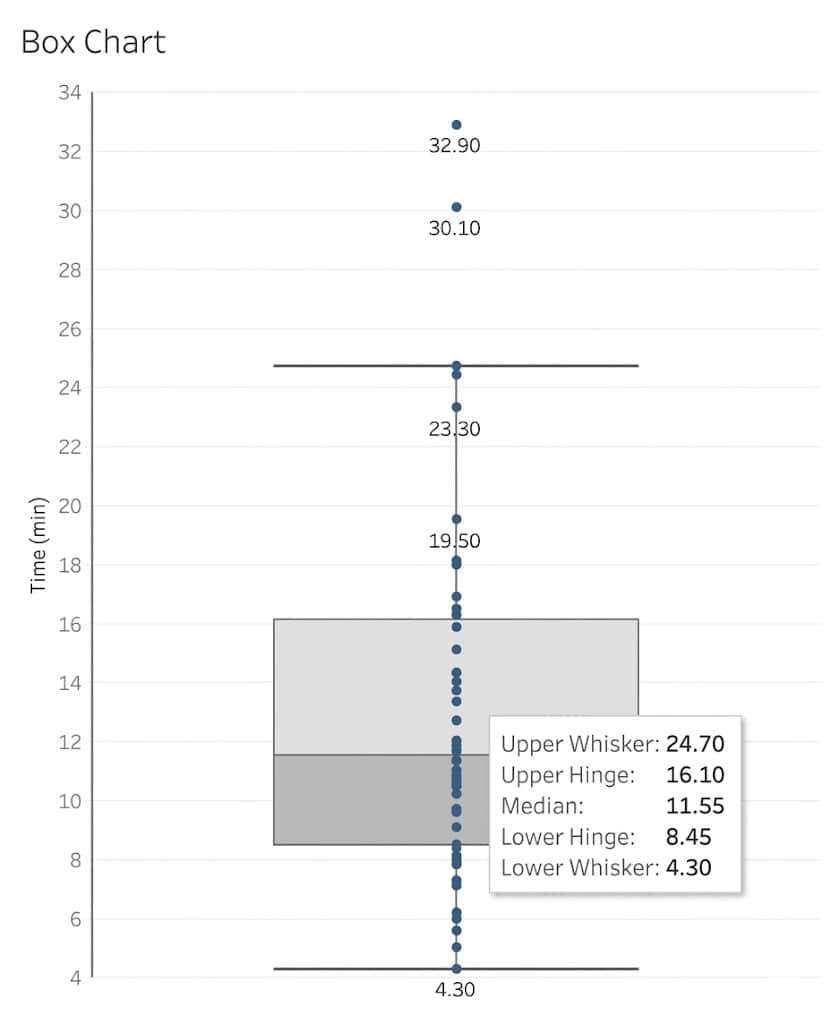
The graph below is based on how much time each customer spent browsing on the Acme Inc website. There are 50 customers represented in the dataset.
The Box (Middle 50 Percent): The shaded box spans from Q1 = 8.45 minutes to Q3 = 16.10 minutes. This means half of all shoppers spent between 8.45 and 16.10 minutes browsing.
The Line Inside the Box (Median): The horizontal line within the box is the median value (Q2). In this case, the median is 11.55 minutes — half of all observations fall below this value, and half above it.
The Whiskers: The lines extending from either side of the box are called whiskers. These represent the range of data that falls within 1.5 times the interquartile range (IQR). The lower whisker reaches down to 4.3 minutes, and the upper whisker stretches to 24.7 minutes.
The Outliers: Any values beyond the whiskers are plotted as individual points. In this dataset, two customers spent an unusually long time on the site — 30.1 and 32.9 minutes — and are considered outliers.
How Were the Outliers Calculated?
To find outliers and build a box plot, we first need the IQR (interquartile range):
Any values above 27.575 or below -3.025 are considered outliers. Since two customers spent 30.1 and 32.9 minutes on the site — well above the upper fence — they are flagged as outliers.
What This Tells Us
The box plot reveals several key insights:
Most customers spend between 8 and 16 minutes browsing.
The typical session length (median) is 11.5 minutes.
A small number of users spent over 30 minutes on the site — well beyond normal behavior.
This visual summary is far more powerful than a simple average. It helps marketers and analysts quickly spot patterns, design better experiences, and make data-driven decisions.
Final Thoughts
Box plots may look simple, but they tell a rich story. Whether you are in marketing, UX, analytics, or research — being able to read a box plot gives you a clear edge. It is a fast way to summarize large datasets and zoom in on what really matters: the center, the spread, and the surprises.
In 2008, Starbucks launched an online crowdsourcing platform called My Starbucks Idea to invite customers into a two-way dialogue.
Facing slumping sales and waning customer sentiment, the coffee giant asked its fans to submit and vote on ideas to improve the Starbucks experience.
This bold experiment quickly yielded popular innovations, from free in-store Wi-Fi to new menu items like cake pops that Starbucks actually implemented in stores.
By actively listening and acting on customer feedback, Starbucks rebuilt trust and reinvigorated its brand loyalty.
Marketers still hail this case as proof that empowering customers can transform a business.
Company Involved
Starbucks: A Seattle-based global coffeehouse chain known for its innovative customer experience and community-focused brand.
Marketing Topic
Customer Experience
Social Media (Crowdsourcing)
Public Reaction or Consequences
The public’s response to My Starbucks Idea was overwhelmingly positive. Customers flocked to the site; hundreds of ideas poured in within hours of launch and over 100,000 votes were cast in the first week. Some early skeptics dismissed it as a mere “online suggestion box,” but the heavy participation and Starbucks’ visible follow-through impressed marketing experts. The platform fostered a vibrant community of Starbucks fans who felt heard. Within a year, Starbucks had gained over 5 million Facebook fans, reflecting the buzz generated by this customer-centric approach. By engaging its audience as collaborators, Starbucks not only generated goodwill but also sparked a wave of free publicity. The company was widely praised as a pioneer of brand community building, and business commentators pointed to My Starbucks Idea as a model for crowdsourced innovation in marketing. There was little backlash; instead, Starbucks saw stronger loyalty and a rejuvenated brand image as a direct consequence of openly listening to its customers.
Why It Matters Today
• Crowdsourcing as Strategy: Starbucks proved that customers can be partners in innovation, not just consumers. In today’s era of social media and co-creation, this lesson is even more relevant for brands seeking authentic engagement.
• Trust through Transparency: The case highlights how being transparent about feedback (and acting on it) builds trust. Modern consumers, concerned with privacy and brand authenticity, reward companies that openly listen and respond to their ideas.
• Community-Driven Marketing: My Starbucks Idea foreshadowed the rise of online brand communities. As marketers now leverage AI and digital platforms to personalize experiences, Starbucks’ example shows that true loyalty comes from genuinely involving your community.
3 Takeaways
1. Listen and Act: Inviting customer feedback is only powerful if you act on it. Starbucks earned loyalty by quickly implementing popular ideas – showing customers their voices mattered.
2. Be Transparent: Starbucks openly communicated which ideas were under review or being executed. This transparency in decision-making kept customers engaged and fostered trust, even when not every idea could be adopted.
3. Customers as Co-Creators: Treating customers as partners can rejuvenate a brand. By co-creating products and experiences with its fans, Starbucks strengthened its community and gained a competitive edge that competitors couldn’t easily replicate.
Notable Quotes and Data
• “We don’t know what the next big idea from our customers may be, but we’re thrilled to keep listening, engaging and making adjustments to improve the Starbucks experience for fans everywhere,” said Starbucks VP Alex Wheeler on the program’s 5th anniversary.
• Over 150,000 ideas were submitted in five years, and Starbucks implemented 277 of those suggestions, from splash sticks to new latte flavors.
• Thanks to customer ideas, Starbucks introduced popular offerings (e.g. free Wi-Fi, mobile ordering) and sells 5.8 million cake pops each year, turning fan suggestions into revenue.
Full Case Narrative
Background (2008): Starbucks had exploded to over 15,000 stores worldwide but was losing its shine by the late 2000s. Rapid expansion had diluted the Starbucks mystique, customer loyalty was eroding, and a global recession was hitting sales of $4 lattes. Returning CEO Howard Schultz acknowledged the brand needed to refocus on customers to revive its fortunes. Instead of a typical top-down marketing campaign, Starbucks chose a radically different path: ask the customers themselves.
Launching “My Starbucks Idea”: In March 2008, Starbucks unveiled My Starbucks Idea, a first-of-its-kind online community for customers to post suggestions, vote on others’ ideas, and discuss improvements. Developed with Salesforce.com (inspired by Dell’s IdeaStorm platform), the site was simple and transparent. Users could submit ideas, see and vote on all submissions, and crucially, see which ideas Starbucks was actually putting “Under Review” or marked as “Implemented.” Starbucks staffed the platform with moderators (“Idea Partners”) from different departments to ensure good ideas got in front of decision-makers. There was no costly ad blitz to promote it: just notices on Starbucks.com and in stores inviting customers to share suggestions. Yet Starbucks’ devoted fan base jumped at the chance. Over 300 ideas came in within the first hour. Customers suggested everything from a loyalty punch-card, to free birthday drinks, to better recycling in stores – virtually any way to improve their Starbucks experience.
Customer Ideas in Action: What set My Starbucks Idea apart was Starbucks’ commitment to act on the feedback. Within months, the company started rolling out changes based on popular suggestions. For example, many users asked for a way to keep their coffee from spilling; soon, those small green “splash stick” stoppers appeared in stores, courtesy of a customer idea. Free in-store Wi-Fi? Starbucks had already planned it, but the site reinforced how crucial it was, and by 2010 free Wi-Fi became standard at all locations. Customers on the site clamored for loyalty rewards – Starbucks responded by expanding its Starbucks Card rewards program, including the popular free birthday drink perk. New flavors and drinks were suggested as well: fan ideas led to the Hazelnut Macchiato and seasonal favorites like the Pumpkin Spice Latte becoming reality. Even the tiny cake pops at the register stemmed from customer requests for petite treats, and Starbucks now sells millions of them annually. In total, Starbucks implemented hundreds of ideas from the community. By 2013 (five years in), over 150,000 ideas had been submitted and 277 ideas were brought to life in some form. Every time Starbucks announced a change on the site (whether a big new product or a small tweak like store layout) it sent a powerful message that the customers were shaping the company.
Results and Impact: My Starbucks Idea helped Starbucks turn around at a critical time. The genuine engagement rekindled customer affection for the brand, even as the economy recovered. Starbucks’ sales and loyalty metrics saw an uptick alongside the initiative. After two years of declines, Starbucks returned to growth; by 2010, revenues were rising nearly 10% and profit margins improving again. Industry observers noted that while competitors like Dunkin’ Donuts focused on price wars, Starbucks had tapped into something deeper: a sense of ownership among its customer community. The company’s social media presence also took off organically; millions followed Starbucks on Facebook and Twitter, where the brand shared top ideas and thanked contributors. The press dubbed it a “crowdsourcing success story,” and marketing thought leaders highlighted Starbucks as an example of how listening can be a powerful brand strategy. Pete Blackshaw of Nielsen Online noted that most brands shy away from too much customer input, but Starbucks turned feedback into an opportunity. By giving customers a voice, Starbucks strengthened their emotional investment in the brand. Many participants became even more loyal – after all, they could walk into a Starbucks and see their idea (or another fan’s idea) in action.
Challenges and Keys to Success: Running My Starbucks Idea was not without challenges. With thousands of suggestions coming in, Starbucks had to set up processes to filter and prioritize ideas. A dedicated team triaged suggestions and gave frank feedback on those that weren’t feasible (for instance, explaining that a popular idea for coffee ice cubes couldn’t work in stores without freezers). This honest communication was crucial – by transparently addressing why certain ideas wouldn’t happen, Starbucks maintained community goodwill and avoided frustration. The platform’s design also helped keep users engaged: an algorithm floated popular ideas to the top, and Starbucks introduced a blog to visibly update users on progress. The quick implementation of “quick win” ideas (like the splash sticks) early on signaled that Starbucks was truly listening, which encouraged more participation. Equally important, Starbucks celebrated contributors – often thanking or even featuring the customers whose ideas were adopted, giving fans a personal stake in the brand’s success. In essence, Starbucks treated its customers as co-creators. This cultural shift – seeing customers as “partners” in innovation – was a key to the program’s effectiveness.
Evolving and Continuing the Legacy: My Starbucks Idea ran for nearly a decade, continually churning out improvements. By 2017, Starbucks quietly retired the standalone website, as engagement naturally migrated to the Starbucks mobile app and other social media channels. But the spirit of My Starbucks Idea lives on. Starbucks integrated customer feedback loops into its ongoing operations – from active social media listening to soliciting ideas through its loyalty Starbucks Rewards app. Today, Starbucks boasts over 30 million Rewards members who provide feedback and ideas via the app and online, essentially continuing the co-creation process on newer platforms. The company’s marketing strategy remains deeply customer-centric: many recent initiatives (such as adding alternative milks, designing store community spaces, or sustainability programs like reusable cups) have roots in customer suggestions and preferences. The success of My Starbucks Idea solidified a core lesson for Starbucks: innovation and loyalty flourish when you give your customers a seat at the table. Even as technology and trends evolve, Starbucks continues to leverage that insight, ensuring the brand stays relevant and beloved by the people it serves.
Timeline
• March 2008:My Starbucks Idea launches at Starbucks’ annual meeting, making Starbucks one of the first major brands to crowdsource ideas from its customers.
• 2009: Early customer-inspired changes roll out, like splash stick cup plugs and free Wi-Fi in all stores, signaling Starbucks’ commitment to the ideas pouring in.
• March 2013: Starbucks celebrates five years of My Starbucks Idea with over 150,000 ideas submitted and hundreds implemented – including new drinks, loyalty rewards, and in-store improvements.
• 2017: Starbucks retires the My Starbucks Idea website after nearly a decade of crowdsourced innovation, shifting focus to its mobile app and social media for ongoing customer engagement.
What Happened Next?
Starbucks emerged from the late-2000s crisis stronger than ever, thanks in part to its renewed customer focus. After My Starbucks Idea, the company doubled down on digital engagement. It built one of the industry’s most successful mobile apps and reward programs, which today personalizes offers and gathers customer feedback at scale. Starbucks’ sales growth continued through the 2010s, and the brand climbed to new heights. In 2023 Starbucks reported record revenues of $36 billion. The marketing strategy initiated by My Starbucks Idea – treating customers like a community whose opinions matter – is now a pillar of Starbucks’ identity. The company frequently interacts with customers on Twitter, Instagram, and other platforms, often incorporating popular suggestions (for example, introducing oat milk nationwide after demand surged online). Far from facing any lasting damage, Starbucks turned a potential downturn into a story of customer-driven success. Its ability to adapt and innovate with its customers has helped Starbucks remain the world’s leading coffeehouse chain. In essence, Starbucks learned to never stop listening – a strategy that keeps its brand both resilient and relevant in a fast-changing market.
One Sentence Takeaway
Empowering and listening to your customers isn’t just feel-good rhetoric; as Starbucks showed, it can rejuvenate a brand’s growth, loyalty, and innovation when you make customers true partners in your marketing strategy.
Philip Kotler, often called the father of modern marketing, introduced the idea that products can fall into one of eight distinct demand states.
These range from Negative Demand (customers actively dislike the product) to Full Demand (sales exactly meet supply) to Unwholesome Demand (desire for harmful products).
Kotler emphasized that marketing is about managing demand – controlling its level, timing and nature to meet business goals.
Classifying your product into the correct demand state helps you pick the right strategy: whether to educate the market, stimulate sales, or even discourage consumption.
Negative Demand
Definition: Negative demand occurs when a significant portion of the target market dislikes a product so much that they might even pay to avoid it. In other words, customers have an aversion to the offering rather than mere indifference.
Example: Kotler cites vegetarians’ aversion to meat as a classic example of negative demand. Other examples include widespread reluctance to go to the dentist or get vaccinations – services people need but actively resist.
Marketer Actions:
Investigate Objections: Use research and feedback to understand why consumers reject your product. It may be due to bad experiences, misconceptions, or poor positioning.
Reframe Messaging: Adjust your branding or education efforts. For instance, emphasize the benefits (e.g. the long-term health payoff of dental care) through educational campaigns.
Build Trust: Consider promotions or guarantees to reduce resistance. Sometimes lower prices or trial offers can change perceptions over time.
No Demand (Nonexistent Demand)
Definition: No demand is when consumers are unaware of or uninterested in your product. They simply don’t recognize a need or know your solution exists.
Example: Many innovations start here. Before electric cars went mainstream, most people weren’t searching for them. Similarly, early on no one was asking for ride-sharing apps or smartwatch features until they saw the possibilities.
Marketer Actions:
Educate the Market: Create awareness of the problem and show how your product solves it. Use content marketing, demos, or free trials to connect product benefits to customer needs.
Highlight Hidden Needs: Help people discover needs they didn’t know they had. For example, explain the hidden costs of car fuel to sell electric vehinces, or illustrate new lifestyles a smartwatch enables.
Long-Term Engagement: Invest in brand awareness and education. Convert no-demand requires time – first convince customers to care before focusing on sales.
Latent Demand
Definition: Latent demand exists when customers share a strong need but no existing product satisfies it. The desire is there, but the solution either doesn’t exist yet or isn’t known.
Example: Think of innovations like noise-canceling headphones, ride-sharing apps, or novel fitness wearables. Before they appeared, people had unmet needs (quieter workspaces, easier travel, better health tracking) but no solution on the market.
Marketer Actions:
Innovate to Fill the Gap: Develop new products or services that meet the unmet need. R&D and innovation are key.
Assess Demand: Research how many customers share this latent need and what they’d pay. Use market studies or pilot launches to gauge potential demand.
Launch and Educate: Once a solution exists, make it clear how it satisfies the latent need. Use vivid messaging and, if appropriate, a price-skimming launch strategy to capture early adopters’ willingness to pay.
Faltering (Declining) Demand
Definition: Declining demand (or faltering demand) means sales are falling over time. In Kotler’s terms, it’s when current demand is below past levels and is expected to keep dropping without intervention.
Example: Many technologies have this pattern: DVD players declined with streaming, landline phones declined with mobile, and print newspapers declined with online news. Kotler notes that developed markets for cigarettes and CDs exemplify faltering demand as healthier or digital alternatives emerge.
Marketer Actions:
Analyze Causes: Identify why demand is shrinking. Is it due to new competitors, shifting tastes, or replacement technologies? Use customer research to diagnose the issue.
Revitalize or Niche: Try repositioning, improving, or bundling the product. For example, bundle a declining product with a stronger one, or target a niche market where the need remains strong.
Maintain Price if Viable: Sometimes it’s wiser to avoid steep discounts. Kotler’s pricing insight suggests sustaining the price (or even raising it) to milk the remaining loyal customers rather than triggering a short-term spike that won’t last.
Plan Exit: If revival isn’t feasible, consider phasing out the product gracefully and redirecting resources to growing areas.
Irregular (Seasonal/Variable) Demand
Definition: Irregular demand refers to sales that fluctuate substantially over time (seasonal, cyclical or random spikes).
Example: Many products are seasonal. Beachwear and ice cream peak in summer; winter gear peaks in cold months. Industries like tourism or fitness see predictable highs and lows (e.g. ski resorts vs. beach resorts, or gym memberships each January).
Marketer Actions:
Smooth Demand: Use promotions or discounts to boost sales in slow periods. For example, offer off-season sales or bundle deals to encourage purchases during typical lulls.
Flexible Pricing: Adopt high/low pricing (yield management). Airlines and hotels raise prices in peak season and lower them off-season to better match demand with supply.
Off-Season Products: Introduce complementary products or services to fill downtime (e.g. a ski resort offering summer hiking tours) or market to different segments to even out usage.
Full Demand
Full demand requires active maintenance, not inaction. The goal is to keep demand at the organization’s desired level while preserving customer satisfaction and operational reliability. Monitor repeat purchase, cancellations, stock availability, service capacity, competitor moves, and changing preferences so small shifts do not turn full demand into faltering or overfull demand.
Definition: Full demand is a balanced state where current sales exactly meet the desired level of sales.
Example: This occurs in stable, mature markets. For instance, a long-established consumer staple (like table salt) may have steady demand that matches manufacturing capacity. Companies in this state are neither over- nor undersupplied.
Marketer Actions:
Maintain Equilibrium: Focus on customer satisfaction and retention rather than aggressive growth.
Fair Pricing: Avoid drastic price changes. Kotler recommends an “Every Day Fair Price” approach to signal stability and deter competitors.
Monitor Trends: Stay alert to changes in preferences or competition that could disrupt the balance.
Selective Innovation: Introduce improvements cautiously so as not to unbalance a healthy market.
Overfull Demand
Demarketing is the matching task for overfull demand. Its purpose is not to eliminate demand; it is to bring demand back in line with capacity, service standards, inventory, or a deliberately chosen customer mix. General demarketing reduces overall demand, while selective demarketing steers demand away from less profitable, less suitable, or harder-to-serve segments.
Definition: Overfull demand occurs when more customers want the product than you can serve. Demand exceeds the supply capacity (or the organization’s desired level).
Example: This happens with cult products or during shortages. Think of instant sell-outs of concert tickets, toy crazes at holiday season, or toilet paper hoarding in a crisis. Kotler notes demarketing situations (like the California energy crisis) as classic overfull demand cases.
Marketer Actions:
Demarketing: Deliberately cool demand. Kotler himself coined this term for situations where demand outpaces supply. Tactics include raising prices, reducing advertising, or rationing supply to reduce demand.
Targeted Pricing: Use higher prices or premium tiers to deter non-core buyers and align demand with capacity.
Scale Up: If the surge is sustainable, invest in capacity expansion (increasing production or distribution) for the long run.
Unwholesome Demand
Countermarketing is the matching task for unwholesome demand. Unlike demarketing, which manages excess demand for a capacity-constrained offer, countermarketing seeks to reduce demand because the pattern of consumption can harm individuals or society. It may emphasize risks, restrict promotion, encourage safer substitutes, or support behavior-change initiatives.
Definition: Unwholesome demand refers to products that many consumers want but which are harmful or socially undesirable. In Kotler’s framework, these attract demand that society would rather discourage.
Example: Classic examples include tobacco, excessive junk food, addictive video games, or illicit drugs. Consumers may crave them, but health or ethical considerations mean society (and often regulators) want consumption to drop.
Marketer Actions:
Social Marketing: Use public health campaigns or ethical marketing to reduce consumption. Partner with NGOs or governments to educate consumers (e.g. anti-smoking ads, healthy eating promotions).
Product Reformulation: If possible, make the product less harmful (e.g. reduced-sugar versions of foods) to shift it out of the “unwholesome” category.
Corporate Responsibility: Acknowledge the issue. Implement CSR programs that support healthier alternatives or support research to mitigate harm.
Kotler’s 8 demand states at a glance: The framework connects each market condition to a specific marketing-management task. Marketers do not use one strategy for every demand problem; they adjust the level, timing, and nature of demand based on the condition they observe.
Demand state
Kotler marketing task
Strategic goal
Negative demand
Conversional marketing
Convert aversion into acceptance
No demand
Stimulational marketing
Create awareness and interest
Latent demand
Developmental marketing
Develop a solution for an unmet need
Faltering demand
Remarketing
Revitalize weakening demand
Irregular demand
Synchromarketing
Synchronize demand with capacity
Full demand
Maintenance marketing
Maintain the desired demand level
Overfull demand
Demarketing
Reduce demand to a manageable level
Unwholesome demand
Countermarketing
Discourage harmful consumption
How the states fit together: Most demand-management decisions can be organized around three capacity conditions. Underdemand includes negative, no, latent, faltering, and irregular demand, where demand must be created, restored, or better timed. Adequate demand is full demand, where the priority is maintaining alignment between sales and capacity. Overdemand is overfull demand, where demand exceeds the organization’s desired level. Unwholesome demand is distinct because the objective is to reduce socially harmful consumption rather than simply balance capacity.
How to diagnose your demand state: Start with a defined market segment and compare current demand with your desired sales level and available capacity.
Customers avoid or resist the offer: negative demand.
Customers neither know nor care about the offer: no demand.
Customers describe a need that available offers do not satisfy: latent demand.
Demand is falling versus earlier periods: faltering demand.
Demand rises and falls by season, day, or event: irregular demand.
Demand reliably matches the desired sales level: full demand.
Orders, waitlists, or traffic exceed service capacity: overfull demand.
Demand exists, but reducing consumption benefits consumers or society: unwholesome demand.
Modern examples make the framework easier to apply:
Negative demand: buyers resist a software migration after a poor onboarding experience.
No demand: a business is unaware that an AI governance tool could solve an emerging compliance problem.
Latent demand: apartment residents want dependable EV charging, but available options do not meet their needs.
Faltering demand: a physical-media rental business loses customers as streaming substitutes improve.
Irregular demand: travel bookings surge during school breaks and fall during off-peak periods.
Full demand: a mature staple brand consistently sells at its planned production level.
Overfull demand: ticket demand for a limited live event exceeds available seats.
Unwholesome demand: demand for addictive gambling products prompts harm-reduction efforts.
Why Categorizing Demand States Helps Marketers
Classifying a product into one of these demand states offers a powerful strategic lens. Kotler reminded us that marketing managers should regulate demand across products. For example, a “no demand” product signals an awareness challenge, whereas “overfull demand” calls for demarketing tactics. As a summary puts it, Kotler’s framework “gives you a lens to understand where your audience is and how to move them forward”. In practice, knowing the demand state helps allocate resources and shape the marketing mix appropriately – whether to educate the market, maintain momentum, or dampen demand.
In short, Kotler’s demand states serve as a roadmap. They help marketers diagnose market conditions and decide whether to stimulate, sustain, or reduce demand. This categorization ensures that strategy is aligned with the product’s reality, making marketing efforts more effective and focused.
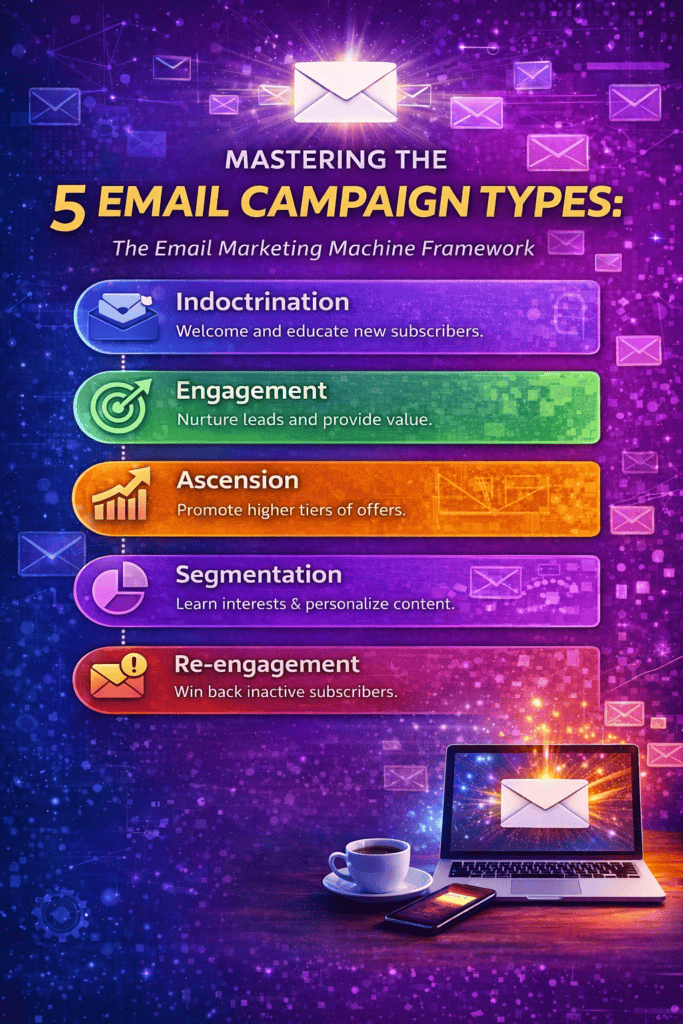
In email marketing, experts often classify campaigns into five main types:
Indoctrination
Engagement
Ascension
Segmentation
Re-engagement
This five-stage framework was popularized by marketing expert Ryan Deiss (founder of DigitalMarketer and author of Invisible Selling Machine), who outlined it in a 2014 blog post. Each campaign type corresponds to a different stage of the subscriber journey – from a brand-new signup to a dormant customer – and together they form an “Email Marketing Machine.”
In this post, we’ll explain each type, give a concrete example and an outline to follow for creating it, and share key stats, best practices, and tips. (B2B and B2C marketers can apply these concepts interchangeably; the examples will cover both contexts.)
Indoctrination Emails
Example: A newly-registered user for a cloud storage service receives a welcome email from Apple iCloud. Indoctrination campaigns (often called welcome series) are sent immediately after someone subscribes or signs up. Their goal is to welcome and educate the new subscriber about your brand, reinforcing that they made a good choice joining your list. For instance, a software startup might send a 2-3 email series: an initial thank-you and brief intro, followed by content that highlights company values or top features. Indoctrination emails should:
Welcome and introduce new subscribers to your brand.
Reinforce the benefits of being on your list.
Set expectations (what kinds of emails and how often they’ll receive).
Tell them what to do next, e.g. explore a resource or check out your home page.
Showcase your brand voice and personality.
Outline:
1. Subject line: Friendly greeting (e.g. “Welcome to [Brand]!”) that reminds them why they signed up.
2. Body: Thank them and briefly explain who you are and why your brand matters. Include a clear statement of what value they’ll get (e.g. exclusive content, special discounts).
3. Expectations: Explain how often you email and what topics they’ll hear about.
4. Call to action (CTA): Encourage a small next step (e.g. “Visit your dashboard” or “Check out our most popular guide”).
5. Signature/Branding: Use your logo, brand colors and voice throughout so the email feels cohesive.
Best practices: Write in a warm, personal tone and keep content concise. Include one clear CTA per email. Mobile-optimize your design (over 80% of emails are opened on mobile) and use brief paragraphs and buttons that are easy to tap. Don’t push a sale too early – instead focus on building trust.
Engagement Emails
Example: After downloading a whitepaper, a lead gets this HubSpot email offering a relevant webinar. Engagement campaigns are triggered by a subscriber’s action and are designed to move them closer to a conversion. For example, if a webinar attendee downloads a guide on SEO, you might send a follow-up email series promoting your SEO training course. These emails are interest-based and should prescribe the next logical step based on what you know about the subscriber.
Outline:
1. Trigger: Identify a subscriber action (e.g. clicked a link about topic X, made a small purchase, or signed up for an event).
2. Subject line: Reference that action/interest (e.g. “Next steps on [Topic]” or “Since you downloaded [Guide]…”).
3. Body: Acknowledge their action and offer something relevant (a product, a deeper content piece, a webinar, etc.) that fits their interest. Use social proof or benefits to persuade.
4. CTA: A clear call (e.g. “Get started,” “Register now,” or “Read the full article”).
5. Follow-up: Plan a short sequence (2–3 emails) that builds urgency or additional value (like a reminder or testimonial).
Best practices: Ensure your offer truly matches the lead’s interest – otherwise you risk annoying them. Reference their previous action explicitly to personalize the message. Keep the ask appropriate: don’t push for a purchase if they’re still just learning about you. Use one primary CTA button and include secondary text links for safety. Test subject lines and button copy. According to benchmarks, triggered emails like these average around a 45% open rate, higher than generic newsletters.
Ascension Emails
Example: A customer who just bought a basic WordPress theme receives an upsell email from StudioPress offering a theme bundle. Ascension campaigns target customers right after a purchase (or conversion) to encourage them to buy more or upgrade. The idea is to “ascend” buyers to higher tiers of value. For instance, if someone buys a monthly subscription, you might email them with a special offer to upgrade to an annual plan, or add-on services. Ascension emails should:
Thank them for their purchase and reinforce the positive choice.
Offer a logical upsell or cross-sell (a related product, premium version, or service).
Use social proof or success stories to justify the upsell (e.g. “80% of our members eventually upgrade”).
Include a strong CTA (e.g. “Upgrade now and save 20%”).
Make timing clear: Send soon after the initial purchase, when excitement and goodwill are high.
Outline:
1. Subject line: Reference their recent purchase (e.g. “You might like this too…” or “Upgrade your [product] experience”).
2. Body: Express appreciation (“Thanks for being a customer!”) then introduce the next offer. Focus on benefits (“Get [advantage] with our premium plan”) not just features.
3. Proof: Include a testimonial or number (“Join 1,000+ users who upgraded”).
4. CTA: Prominent button linking to the upsell page (consider adding a limited-time discount to encourage quick action).
5. Conclusion: Close with a reminder of how easy it is to upgrade or the deadline of the offer.
Best practices: Don’t be pushy: ensure the upsell genuinely adds value. Keep the email concise, with one main CTA. It’s often effective to send 2–3 emails in an ascension series, gradually increasing incentive (e.g. first email invites, second reminds of limited time). Use order data to personalize (mention the product they bought). Also ensure formatting is clean and mobile-friendly. Many companies find that ascension series significantly increase customer lifetime value.
Segmentation Emails
Example: Marriott sends an email listing travel packages (beach, city, adventure, family) and asks users to click their top interest, so it can send more targeted deals. A segmentation campaign is a broadcast email sent to your entire list (or a broad segment) with the goal of learning more about subscriber interests. Essentially, you give recipients choices and then split your list based on their clicks or responses. For example, an online retailer might email all customers with product categories (“Shoes,” “Bags,” “Clothing,” “Accessories”) and use the click data to tag each subscriber for future targeted campaigns.
Outline:
1. Audience: Often sent to your full list or a large segment (e.g. “All Subscribers”).
2. Subject line: Pose a question or tease choices (“Which [Category] are you most interested in?”).
3. Body: Briefly explain that you’d like to tailor your emails. List clear options (can be text links or big buttons/images for each category). E.g. “What topics help you most? (Click one)”.
4. Interaction: Use unique tracking links for each option so your ESP can auto-tag the subscriber’s interest.
5. Follow-up: Immediately after, trigger tailored follow-ups to each group (e.g. send Product A offers to those who clicked “Option A”).
Best practices: Keep the choices limited (3–5 maximum) to avoid choice paralysis. Make each option’s CTA obvious and large (buttons or images). Clearly explain why you’re asking (“Help us send only the emails you care about”). Segmentation emails can dramatically boost engagement: segmented campaigns drive 30% more opens and 50% more clicks than non-segmented ones. Also, ensure each segment’s follow-up is timely and relevant, so subscribers immediately see the benefit of having self-segmented.
Re-engagement Emails
Example: LinkedIn sends a “We noticed you haven’t opened our emails in a while” message to inactive subscribers, offering to adjust preferences or re-subscribe. Re-engagement (or win-back) campaigns target subscribers who have become inactive (no opens or clicks for 1–2 months). The goal is to recapture their interest or gracefully clean your list. For instance, a retailer might offer a one-time discount to customers who haven’t purchased in 6 months, or a newsletter might ask inactive readers if they still want to receive updates.
Outline:
1. Segment: Identify inactivity (e.g. hasn’t opened in 60 days).
2. Subject line: Make it personal and intriguing (“We miss you, [Name]!” or “Is this goodbye?”).
3. Body: Remind them why they subscribed and mention what they’ve been missing. Offer an incentive or fresh content (“Come back for 20% off!” or “Check out what’s new”).
4. CTA: A clear button (e.g. “Reactivate my account,” “See what’s new,” or “Take me back”).
5. Final reminder: If using multiple touches, send 1–2 follow-ups. Promise they’ll be removed if they still don’t engage, to justify urgency.
Best practices: Keep the tone friendly and remind them of past value rather than blame them. Make the offer clear and appealing. Use only one CTA and avoid clutter. Strong re-engagement campaigns see 30–50% open rates, much higher than normal. If there’s still no response after 2–3 tries, it’s better to remove them to protect deliverability. Also, remind customers they can always re-subscribe later, to keep the exit courteous.
Other Email Campaign Types to Consider
Beyond these five core categories, marketers often use other email types:
Transactional Emails: Order confirmations, receipts, shipping notices, password resets, etc. These are mandatory service messages, not salesy. They have extremely high open rates (~80–85%. Keep them concise and on-brand. You can subtly include related product recommendations, but the main goal is clarity and customer service.
Newsletter/Content Emails: Periodic newsletters or content digests that provide value (blog posts, tips, news). These keep your audience engaged long-term. Use a single-column layout, one main theme per email, and one CTA (e.g. “Read More”). Segment if possible (e.g. separate B2B and B2C editions). Newsletter CTRs typically range from 2–4%, so focus on engaging headlines and mobile-friendly design.
Cart Abandonment/Reminder Emails: For eCommerce, emailing people who left items in their cart can recover lost sales. For example, send one reminder 1 hour after abandonment, another after 24 hours, and a final after 72 hours. Use images of the abandoned products and a clear “Complete Your Purchase” CTA. Studies show three abandonment emails can drive ~69% more orders than just one, recovering up to 30% of lost sales.
Lifecycle/Anniversary Emails: Triggers based on dates or milestones (welcome anniversaries, birthdays, subscription renewals). For example, sending a birthday email with a special offer can generate significantly higher response (one study found birthday emails drove a 481% increase in transactions compared to generic emails. Always personalize and make these feel special.
Feedback/Survey Emails: After a purchase or event, ask for feedback (e.g. a Net Promoter Score or short survey). Keep it brief and mobile-optimized. You might offer a small incentive (“Get 10% off next order”) to boost response. Use the answers to improve segmentation and service.
Design and Implementation Tips
Across all email types, follow these design best practices: use a clear, branded template with one main CTA button above the fold. Limit each email to a single-column layout if possible and a single primary message. Write concise copy and use bullet points or subheads to break up text. Always include a preview text (preheader) along with your subject line. Optimize for mobile (over 80% of opens happen on smartphones, use large fonts, tappable buttons, and scale images properly. Include descriptive alt text for images. Personalize where you can (first names, tailored content) to increase engagement. And don’t forget compliance: always include a visible unsubscribe link and honor opt-outs immediately.
Sources
This framework of five email types is based on Ryan Deiss’s “Email Marketing Machine” approach. The examples, stats, and best practices come from recent industry research and reports and email marketing blogs. All performance statistics are from 2023–2025 sources to ensure up-to-date guidance.