martech handbook

The Martech Handbook by Darrell Alfonzo Book Summary

Reading Time: 4 minutes

Top Three Quotes

  • “The biggest challenge in Martech today is too many tools and too little strategy.”
  • “You have to let strategy drive technology and not the other way around.”
  • “To only think about technology is also a trap because you’ll miss out on all the strategic and creative value that humans bring to creating meaningful customer experiences.”

Book Theme

The Martech Handbook by Darrell Alfonso is about building and managing an effective marketing technology stack to attract, engage, and retain customers. The book provides a clear step-by-step framework for understanding and selecting marketing tools that drive business value across all areas of marketing. In essence, it bridges the gap between marketing strategy and technical tools, showing marketers how to leverage technology (from automation and data platforms to analytics) in a strategic, customer-centric way. Alfonso covers everything from why businesses need MarTech and what key categories exist, to how to design a cohesive tech stack and govern it for long-term success. The central theme is that technology should serve marketing strategy (and improve customer experience), not overwhelm or mislead it.

Why You Should Read This Book

If you’re a marketer or business leader navigating today’s digital marketing landscape, this book is a must-read because it demystifies the complex world of marketing technology in a practical, jargon-free manner. The Martech Handbook is often described as the “bible” for modern marketers who need to understand how tools and platforms can drive marketing success. You should read it if you’ve ever felt overwhelmed by the thousands of marketing software options or unsure how to integrate technology into your strategy. Darrell Alfonso gives you a field guide: a blend of strategic advice, real-world examples (case studies from companies like Spotify and Amazon), frameworks, and checklists. By reading this book, you will learn where to begin with MarTech, how to avoid common pitfalls, and how to make technology work for your specific marketing goals. In short, it’s a valuable roadmap to help marketers become more data-driven, efficient, and customer-centric by using the right tech in the right way.

Key Ideas and Arguments Presented

  1. Start with Strategy, Not Tools: A core argument is that marketing strategy should drive tech decisions, not the other way around. Alfonso warns against letting shiny new tools dictate your marketing approach. Instead, define your goals and then find technology to achieve those outcomes. Every business is unique, so “every martech stack should be bespoke,” tailored to your strategy and customer journey.
  2. Too Many Tools = Trouble: The biggest challenge is overload without a unifying strategy. With over 9,000 tools, companies often end up with fragmented systems, data silos, and wasted resources. Alfonso argues for a minimalist, needs-driven approach.
  3. Customer Obsession is Key: Great marketing begins with an obsession over the customer experience. Tech should enhance how you attract, engage, convert, and delight customers, not replace understanding them.
  4. MarTech is Omnichannel and Holistic: It spans the entire marketing ecosystem and must connect channels and data. Effective implementation aligns marketing, sales, and customer success.
  5. Core Components of a Martech Stack: Most teams need a Marketing Automation Platform, Customer Data Platform, and Customer Relationship Management system as foundational tools.
  6. Avoid “Feature Frenzy” & Shiny Objects: Don’t adopt tools for hype’s sake. Choose the best tool for your needs.
  7. Importance of Data and Integration: Unified, governed data enables better personalization and measurement. Avoid “shelfware”.
  8. Scaling and Governance: Maintain your stack with documentation, processes, and metrics.
  9. Getting Buy-In: Ensure leadership and end-user support for MarTech adoption.
  10. Continual Improvement: Regularly evaluate and optimize your stack.

Book Outline

  1. Introduction – The Rise of Marketing Technology
  2. The Business Need for Martech
  3. Key Categories of Martech
  4. What is a Martech Stack?
  5. The Framework for Effective Martech Stack Design
  6. The Core Business Systems and Platforms for Every Marketing Team
  7. Identifying Value-Add Marketing Platforms and Tools
  8. Principles for Robust and Scalable Martech Stack Management
  9. Martech Measurement, Monitoring, and Governance
  10. Getting Buy-In
  11. Continual Improvement

Key Takeaways

  • MarTech is essential to marketing success.
  • Strategy must precede technology selection.
  • Avoid tool sprawl; quality over quantity.
  • Customer-centricity should be the guiding principle.
  • Focus on foundational platforms first.
  • Train and involve stakeholders.
  • Continually optimize and refine your stack.

Key Techniques

  • MarTech Stack Design Framework
  • Worst-Case Scenario Exercise
  • Martech Discovery Questionnaire
  • Core Platforms Checklist
  • Principles of Stack Management
  • Case Studies and Real-World Examples
  • Frameworks and Checklists

Author’s Qualifications

Darrell Alfonso is an award-winning MarTech leader with over 15 years of experience. He led marketing operations at Amazon Web Services and has consulted for major corporations. Recognized as a “Top Martech Marketer to Follow” and a two-time Adobe Marketo Champion, Alfonso is also a marketing instructor and industry speaker.

Comparison to Similar Books

This book offers a broad, practical foundation for MarTech, in contrast to works like Scott Brinker’s Hacking Marketing (which focuses on agile principles) or Customer Data Platforms by Chris O’Hara (which focuses solely on data management). Alfonso’s approach is holistic, making it a great entry point before diving into niche areas.

Target Audience

  • Marketing newcomers and juniors
  • Marketing students and academics
  • Marketers with limited MarTech experience
  • Marketing managers evaluating new tech
  • Non-marketing executives and cross-functional teams
  • Tech professionals entering marketing
  • Busy marketing leaders/CMOs needing a primer

Critical Response to the Book

The book has been praised for clarity, comprehensiveness, and practical frameworks. Endorsed by top MarTech leaders like Scott Brinker, it’s described as essential reading for modern marketers. The only critique is its introductory nature, which is ideal for beginners but less so for highly advanced practitioners.

One Sentence Takeaway

At its core, The Martech Handbook teaches that successful modern marketing isn’t about chasing every new tool, but about strategically aligning the right technology with customer-focused marketing strategy to drive business results.

The Martech Handbook by Darrell Alfonzo Book Summary Read More »

a historical evolution of marketing technology martech

A Historical Evolution of Marketing Technology (Martech)

Reading Time: 11 minutes

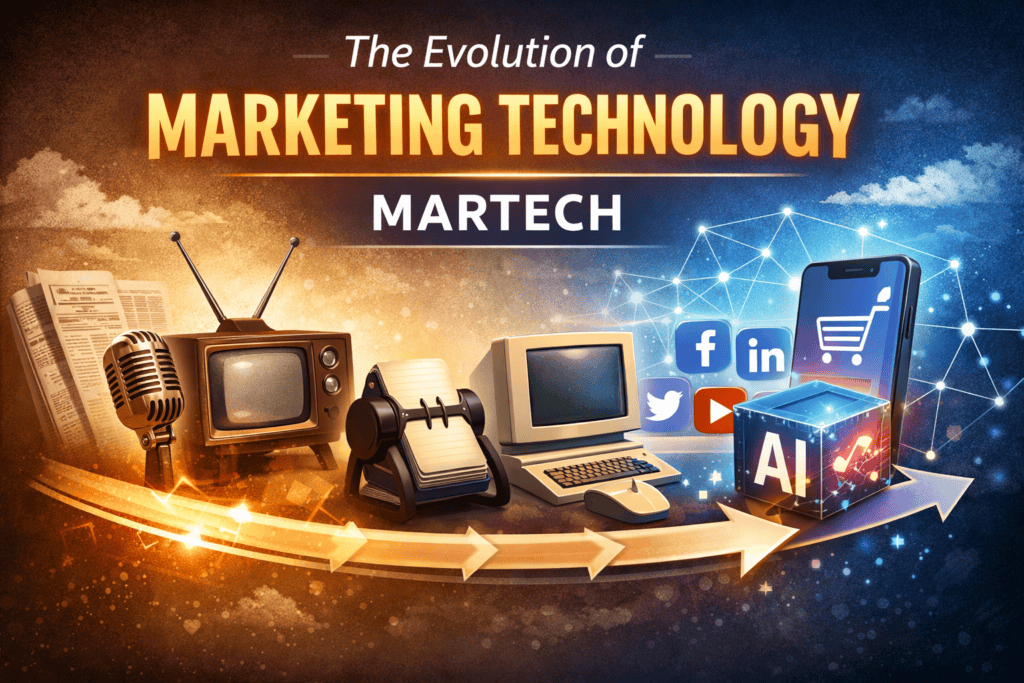
Marketing technology – or martech – has evolved over more than a century, from the first media advertisements to today’s AI-powered digital ecosystems. Below is a timeline of key milestones in the history of martech, highlighting how new channels, tools, and regulations have shaped the industry. Each brief milestone captures a pivotal development (spanning B2B and B2C marketing) that pushed marketing into a new era.

1920s–1940s: Broadcast Media and Early Advertising

1922 – Radio advertising debuts: New York’s WEAF station airs the first paid radio commercial on August 22, 1922 – a 15-minute spot for a real estate firm. This introduced a new marketing channel (“toll broadcasting”) to reach mass audiences in their homes. Radio quickly proved its value for advertisers, creating a template for sponsored content on the airwaves.

1941 – Television’s first commercial: On July 1, 1941, before a baseball game broadcast, NBC’s WNBT in New York aired the first TV ad – a 10-second Bulova Watch Co. spot. It simply showed a clock face and announced the time, costing Bulova only $9. This moment marked the birth of TV advertising, which would grow into a multi-billion-dollar industry in the decades to come.

1950s–1980s: Database Marketing and CRM Origins

1950s – From Rolodex to mainframes: Marketers managed customer contacts on paper until the Rolodex, invented in 1956, became a popular tool for organizing leads and client info. By the 1960s, forward-looking companies started using mainframe computers to store customer data, moving beyond manual card files. This era saw the concept of database marketing emerge as businesses began electronically tracking customers for direct mail campaigns.

1985 – Early CRM software: The first software for managing customer relationships appeared. Notably, TeleMagic was released for MS-DOS in 1985, described as an “electronic Rolodex” that did more than store contacts – it integrated with word processors and helped sales reps prioritize leads. This laid groundwork for modern CRM systems.

1987 – Contact management goes mainstream: A program called ACT! (Activity Control Technology) launched as one of the first PC-based contact management softwares. Originally built for sales, ACT! let users digitally store and retrieve customer info – earning the nickname “digital Rolodex.” It proved the demand for dedicated tools to organize and follow up with prospects.

1990 – Integrated sales & marketing platform: The CRM concept advanced with the release of GoldMine in 1990 – the first software to combine contact information, calendar scheduling, email, and sales pipeline data in one system. GoldMine’s all-in-one approach foreshadowed the unified marketing suites to come, showing how sales and marketing data together could drive customer outreach more effectively.

1990s: The Rise of Digital Marketing and Early Automation

1993 – Sales force automation: Entrepreneur Tom Siebel founded Siebel Systems in 1993, pioneering sales force automation software for enterprises. Siebel’s platform (initially for sales management, later expanding to marketing modules) became the market leader in the mid-90s, popularizing the idea that large companies could centrally manage leads, customer contacts, and communications. This momentum helped evolve what we now call CRM software.

1994 – First banner ad & online advertising: The very first web banner ad was displayed in 1994 on HotWired.com (a digital offshoot of Wired magazine). It was an AT&T ad with the teaser “Have you ever clicked your mouse right here?” – and an astounding click-through rate of ~44% (far above today’s averages around 0.3%). This marked the birth of internet advertising. Soon after, companies like DoubleClick (founded 1996) began offering ad-serving platforms, allowing marketers to display and track ads across many websites. The late ’90s saw an explosion of ad networks and ad servers, setting the stage for targeted and measurable online marketing.

1995 – “CRM” becomes a term: By the mid-90s, software for managing sales and marketing contacts had matured, and the term customer relationship management (CRM) was officially coined around 1995. The formal name gave a unified identity to tools and practices that tracked customers from initial contact through purchase and beyond. Multiple sources credit either Siebel Systems, marketing academic Jagdish Sheth, or Gartner Group with popularizing “CRM”. From this point, CRM became a core part of the business technology lexicon.

1998 – Search engine marketing is born: GoTo.com (later Overture) launched the first pay-per-click search advertising platform in 1998, introducing the model of bidding on keywords. This innovation meant marketers could pay for their ads to appear alongside search results, only paying when users clicked. It was a precursor to Google’s approach and proved immensely successful. (By early 2000s, search ads would become one of the biggest drivers of online marketing.)

1999 – Marketing automation emerges: Eloqua launched in 1999 and is widely credited as the first modern marketing automation platform. Initially built as a digital chatbot, Eloqua pivoted to helping marketers track and nurture leads via email and web campaigns. It introduced features like automated email sequencing, web form integration, and lead scoring – allowing marketers to respond to prospect “buying signals” online. Eloqua’s success spearheaded an entire marketing automation industry in the 2000s (including players like Pardot and Marketo), fundamentally changing how B2B companies handle lead generation.

1999 – The SaaS revolution (Salesforce): This year also saw the founding of Salesforce.com (by Marc Benioff), which offered CRM entirely as a web-based software-as-a-service. In an era dominated by on-premise software, Salesforce’s model of hosting customer data in the cloud and delivering updates over the internet was revolutionary. By eliminating complex installations and providing subscription pricing, Salesforce paved the way for widespread adoption of cloud-based marketing tools. The success of its CRM (now the largest in the world) proved that businesses were ready to embrace SaaS for critical marketing operations.

2000s: Search, Social Media, and Mobile Transform Marketing

2000 – Google AdWords and modern PPC: Google entered online advertising in a big way with the launch of AdWords in 2000. AdWords (now Google Ads) introduced a self-serve platform for pay-per-click ads, initially alongside search results and later across the web via the Google Display Network. This innovation brought sophisticated keyword targeting and auction-based ad pricing to the masses. By offering cost-per-click bidding and precise audience targeting, Google dramatically scaled digital advertising – helping advertisers small and large reach customers globally. Paid search and display advertising quickly became core tactics in every marketer’s toolkit.

2004–2006 – The social media marketing frontier: The mid-2000s gave rise to social networks like Facebook (opened to the public in 2006), YouTube (2005), and Twitter (2006). These platforms created entirely new channels for marketers to engage consumers. Brands began crafting social media marketing strategies – from organic content to early social ads – to tap into viral sharing and online communities. Facebook introduced its first advertising options around 2005–2006, allowing companies to target users based on profile data. This era also saw the emergence of social media management tools to schedule posts and monitor engagement. As one analysis noted, tech giants like Facebook (and Google and Apple) built new ecosystems in this period that reshaped how brands communicate, giving marketers avenues like app stores and social feeds to reach customers.

2007 – The smartphone revolution (mobile marketing): Apple’s release of the iPhone in 2007 catalyzed a sea change in marketing. Smartphones put email, web, and apps into everyone’s pocket, making mobile marketing a centerpiece of strategy. Early mobile ads were clunky (often just downsized desktop banners), but the rapid proliferation of 3G internet and app usage forced innovation. Marketers recognized that phones were becoming the first screen for consumers. By late 2000s, brands were investing in mobile-responsive websites, SMS campaigns, and in-app ads. In parallel, the iPhone’s success spurred the rise of mobile app analytics and push notifications as marketing tools. Apps in every category – from social media to gaming – became new platforms for advertising and customer engagement. In short, smartphones profoundly changed consumer behavior, and marketing tactics evolved accordingly to meet people on the go.

2007 – Programmatic advertising begins: Around the same time, digital advertising underwent another leap with the advent of real-time bidding (RTB) on ad exchanges. In 2007, ad tech companies introduced RTB systems that let advertisers bid on individual ad impressions in milliseconds, via automated platforms. This was the dawn of programmatic advertising, where buying and selling of ad space became algorithm-driven. Programmatic buying enabled unprecedented targeting (by user behavior or demographics) and efficiency in ad spend. By the early 2010s, programmatic would dominate display advertising, extending to video and even traditional media. Marketers now had to master demand-side platforms (DSPs) and data management platforms (DMPs) to optimize their ad campaigns, reflecting how technology and automation were redefining media buying.

2010s: Martech Matures – Explosion of Tools, Data, and Privacy Focus

2011 – Chiefmartec’s landscape & the Martech boom: The marketing technology “landscape” was first charted in 2011 by blogger Scott Brinker (chiefmartec.com). His initial infographic organized about 150 marketing tools into a few categories. This was eye-opening at the time – few realized how many software solutions were already serving marketers. It also effectively gave a name to the space (“martech”). Over the next few years, Brinker updated the landscape annually, and the growth was staggering. By 2014, his graphic featured ~1,000 solutions; by 2015 it was ~1,800 (which observers already found “frightening” in its complexity). This period saw thousands of startups and new products targeting every niche of marketing, from automation and analytics to content, social, and e-commerce tools. The landscape symbolized the fragmentation and innovation in marketing tech – and became a handy barometer of the industry’s size. (In addition, 2014 marked the inaugural MarTech Conference in Boston, which Brinker launched to bring the growing community together and debate issues like “suites vs. best-of-breed” solutions.)

2013 – Customer Data Platform (CDP) is defined: As marketers accumulated data across many channels, the need for unified customer profiles grew. In 2013, analyst David Raab identified a new class of software to meet this need and coined the term “Customer Data Platform.” In an influential blog post, Raab described “a new type of system” that collects data from multiple sources, matches it to the same customer, and then syndicates insights to other tools. He “hereby christened” it a Customer Data Platform. Later that year, Raab published the first industry report on CDPs, profiling 11 early vendors. By 2016, CDPs appeared on Gartner’s Hype Cycle and a dedicated CDP Institute formed, validating this as a major martech category. CDPs filled a gap left by CRM and DMP systems – enabling marketers to own and utilize first-party customer data for personalization in a privacy-compliant way.

2017 – “Martech 5000”: 5,000+ solutions and counting: The proliferation of marketing tools reached a milestone in 2017 when Brinker’s annual landscape surpassed 5,000 solutions (5,381 to be precise). He dubbed that year’s edition the “Martech 5000”, underscoring how vast the ecosystem had become. For perspective, the 2011 landscape had 150 tools – so in just six years the number of martech products grew by over 3,500%. These solutions spanned advertising, content, data, e-commerce, social, and more – illustrating that for virtually every marketing function, dozens of specialized tools existed. This explosion was fueled by low barriers to building software (cloud, open-source, APIs) and a huge influx of venture funding into marketing and advertising tech startups. Marketers in 2017 faced an unprecedented array of choices (and complexity) in assembling their marketing stacks.

2018 – GDPR and the privacy paradigm shift: On May 25, 2018, the EU General Data Protection Regulation (GDPR) came into force, representing the toughest data privacy law to date. GDPR set a global standard for how personal data must be handled – requiring explicit user consent for data collection, giving individuals rights to access or delete their data, and threatening fines up to 4% of worldwide revenue for violations. This had sweeping implications for martech: email lists required re-permissioning, cookies and tracking needed consent banners, and data security and governance became top-of-mind. GDPR also inspired similar regulations around the world. Marketers had to adopt a privacy-by-design mindset, ensuring their technology (from CRM to analytics to ad platforms) complied with new restrictions. The era of legally mandated respect for consumer data had fully arrived, reshaping marketing strategies and the features of marketing software (e.g. built-in consent management).

2018 – Enterprise marketing clouds consolidate (Adobe buys Marketo): A notable industry development in 2018 was the continued consolidation of major marketing software providers into enterprise “cloud” suites. For example, Adobe acquired Marketo in October 2018 for $4.75 billion, bringing a leading B2B automation platform into the Adobe Experience Cloud. This followed other big deals in the years prior (Oracle buying Eloqua in 2012, Salesforce buying ExactTarget/Pardot in 2013). By late 2010s, a handful of tech giants (Adobe, Salesforce, Oracle, IBM, SAP, etc.) had each assembled broad marketing clouds via acquisitions – offering everything from email and automation to analytics and e-commerce under one umbrella. While this promised integrated suites, it also sometimes slowed innovation. In parallel, a “best-of-breed” approach persisted, with new startups continuing to enter the martech space, ensuring that even as some companies merged, the overall number of tools kept rising.

2020s: The Era of Intelligence, Integration, and Regulation

2020 – COVID-19 accelerates digital-first marketing: The global pandemic drastically accelerated digital transformation in marketing. With in-person channels shut down, companies pivoted to webinars, virtual events, email outreach, and e-commerce in an unprecedented way. The crisis initially prompted fears of martech consolidation or budget cuts, but in reality it boosted martech adoption: businesses had no choice but to rely on digital tools to reach customers. The pressure to digitize customer experiences in 2020 ended up expanding the martech sector. By the end of 2020, total marketing technology solutions numbered around 8,000, up from ~7,000 in 2019. In other words, even during an economic shock, the martech landscape grew ~13% that year. The pandemic underscored the resilience of martech and entrenched many new tools (for virtual meeting, digital collaboration, online customer service, etc.) into the marketer’s everyday stack.

2020 (Jan) – CCPA ushers in U.S. privacy law: The California Consumer Privacy Act took effect on January 1, 2020, becoming the first major U.S. law akin to GDPR. CCPA granted California residents new rights over their personal data – including the right to know what data is collected, to delete data, and to opt out of its sale. Effectively a de facto national standard, CCPA required businesses (above certain size thresholds) to update privacy policies, add “Do Not Sell My Info” links on websites, and handle consumer data requests. For marketers, compliance meant greater transparency in data practices and often a reduction in third-party data usage for targeting. The era of the “Wild West” of data collection in marketing was coming to an end in the U.S., following Europe’s lead. (CCPA enforcement began July 2020, and its success led to an even stronger California Privacy Rights Act, plus similar laws in other states in subsequent years.)

2022 – Nearly 10,000 martech solutions: After a brief hiatus, Scott Brinker released an updated Marketing Technology Landscape in 2022 and found 9,932 solutions on the market – up from ~8,000 in 2020. Despite some consolidation (almost 1,000 companies had exited via acquisition or shutdown in two years), the sector’s net growth continued to astound at +24% since 2020 and +5,233% since 2011. The long tail of martech proved very long: for every tool acquired, another new startup launched. The landscape’s creators noted that as big marketing platforms (like HubSpot or Salesforce) opened up marketplaces, it spurred even more specialized apps plugging into those ecosystems. By 2022, marketers were increasingly focused on integration – stitching together many niche apps via APIs – as the secret to managing such a vast stack. The takeaway: the martech industry was still in high-growth, innovative mode, a decade after its first boom.

2023 – AI takes center stage: The release of generative AI models (such as OpenAI’s GPT-3/ChatGPT in late 2022) sparked a new wave of martech innovation in 2023. Vendors across the spectrum rushed to embed AI capabilities into marketing tools – from AI copywriting and image generation for content creation, to AI-driven chatbots for customer service, to predictive analytics for personalization. This AI fever led to an explosion of new startups and features. By 2024, over 1.8 million AI projects existed on GitHub, and tens of thousands of developers were building AI-driven marketing apps. In effect, AI became the latest must-have layer in martech stacks. For marketers, 2023 was a turning point where tasks like writing email subject lines or segmenting audiences could be assisted (or even fully handled) by intelligent algorithms. This trend also raised new ethical and quality considerations – but there is broad expectation that AI-powered martech can dramatically improve efficiency and optimization in campaigns.

2024 – 14,000+ solutions (and counting): The 2024 martech landscape report counted 14,106 products, a ~27% increase from the prior year. Incredibly, that’s about 100× growth in available martech products since the first landscape in 2011. The industry’s compound annual growth rate in tool count has been roughly 42% over 13 years. Even more striking: the churn has been low – only ~2% of tools from 2023 dropped out by 2024 – indicating that many solutions manage to survive or get acquired rather than shut down. The landscape creators noted that the martech industry has a persistent “long tail.” About half of the products are from small firms or startups, each carving out a niche. While not all will thrive, new ones constantly emerge to replace those that fade. By 2024, marketers have shifted from asking “will martech consolidate?” to accepting that a heterogeneous, ever-evolving stack is the norm – with integration, data unification, and agile marketing operations being key to harnessing all this technology.

2025 (Forecast) – A data-driven, AI-powered future: Martech shows no signs of slowing. Global spending on marketing technology is projected to reach around $175–$180 billion in 2025, and continue growing at ~11% CAGR to nearly $300 billion by 2030. The number of solutions in the ecosystem may exceed 15,000 this year. Analysts predict a continued focus on AI, customer data, and privacy: more marketing workflows will be automated or augmented by AI, more brands will invest in first-party data platforms (especially as third-party cookies are phased out), and regulations (like Europe’s ePrivacy or new U.S. state laws) will demand even tighter data governance. In essence, marketing technology is moving toward smarter integration – using AI to connect the dots between channels and personalize experiences, while also ensuring compliance and consumer trust. As the martech industry passes the 100× growth mark since 2011, marketers in 2025 are challenged – and empowered – by an unprecedented arsenal of tech tools to win customers’ hearts in the digital age.

Sources

Sources: The timeline above was compiled from industry analyses, historical reports, and news sources, including Scott Brinker’s ChiefMartec reports on the growth of the martech landscape, historical accounts of CRM and marketing automation evolution, and coverage of major regulatory changes like GDPR. These references (and others cited inline) offer a deeper dive into each milestone of marketing technology’s evolution.

A Historical Evolution of Marketing Technology (Martech) Read More »

case study apple get a mac

Case Study: Apple’s “Get a Mac” vs. PC Ads: The Campaign That Reshaped Tech Marketing

Reading Time: 3 minutes

Brief Summary

Apple’s “Get a Mac” advertising campaign from 2006 to 2009 personified Mac and PC in witty TV spots that highlighted ease of use, security, and simplicity.

The work quickly boosted Apple’s image and Mac sales, with Apple reporting 1.3 million Macs sold in the July 2006 quarter and a 39 percent sales increase for the fiscal year.

Microsoft later replied with the “I am a PC” effort, but Apple had already framed the narrative of Mac as the modern and friendly choice.

Company Involved

Apple created the campaign with TBWA Media Arts Lab. Justin Long portrayed Mac and John Hodgman portrayed PC in a minimalist white set that kept the focus on the comparison.

Marketing Topic

  • Advertising
  • Branding
  • Product Positioning

Public Reaction or Consequences

The ads became a cultural reference point, widely shared and parodied. Apple credited the period following launch with substantial sales momentum, including an additional two hundred thousand Macs sold after the campaign began and a 39 percent full year sales increase in 2006. The campaign won major industry awards and helped reposition Mac as approachable and cool. Some commentators criticized the tone as smug, which shows the risk inherent in comparative advertising. Microsoft pivoted with “I am a PC” to rebuild pride and shift attention away from Vista’s issues.

Why It Matters Today

It demonstrates how challenger storytelling can redefine a category, how tone in comparative advertising can help or hurt, why speed of response matters in narrative control, and how product truth must support the claim or the market will reject the message.

3 Takeaways

1. Make technical benefits human. Personify differences so everyday users grasp the value without specs.

2. Control the narrative before your rival does. Slow reactions cede cultural ground that is hard to win back.

3. Back claims with product reality. Advertising accelerates momentum only when it aligns with real experience.

Notable Quotes and Data

One month after launch Apple saw an increase of two hundred thousand Macs sold, and by July 2006 Apple reported 1.3 million Macs sold with a 39 percent sales increase for the fiscal year. Source: Wikipedia: Get a Mac.

Adweek later called “Get a Mac” the best advertising campaign of the decade. Source: Adweek: Apple’s Get a Mac, the Complete Campaign.

Critique on tone: “Smug superiority can be off putting as a brand strategy.” Source: Slate: Mac Attack.

Full Case Narrative

In 2006 Apple needed a broader Mac audience in a market where Windows dominated. The answer was a simple stage with two characters. “Hello, I am a Mac.” “And I am a PC.” Each spot humorously surfaced a single comparison such as virus resistance, ease of setup, or fewer interruptions. When Windows Vista arrived to mixed reviews, Apple leaned into cultural truth about intrusive prompts and compatibility headaches. The format made technical points memorable and shareable.

Results followed quickly. Apple’s reported unit lift and the 39 percent 2006 sales increase aligned with the campaign’s early momentum. Recognition arrived as well, including top effectiveness honors and later Adweek’s campaign of the decade. The work spread through parodies and became shorthand in pop culture for a product comparison that felt human and clear.

Microsoft initially tested abstract celebrity work, then pivoted to “I am a PC” with real users to reclaim identity and pride. The response improved tone but did not directly address Vista concerns, which Apple satirized with spots about spending on advertising rather than fixing the product. The eventual Windows 7 launch reset the product story, while Apple retired the series after more than three years and over sixty ads.

The lesson is that advertising can set the frame, but the product must carry it. Apple’s claims resonated because they lined up with lived experience. Microsoft improved outcomes once the underlying product improved. Timing and tone shaped how each message landed during a period when technology brands were defining their identities for mainstream consumers.

Timeline

May 2006: Apple launches the first “Get a Mac” commercials.

January 2007: Windows Vista launches and Apple releases new comparative spots that reflect user frustrations.

September 2008: Microsoft launches “I am a PC” to counter Apple’s framing.

October 2009: Windows 7 launches to positive reviews and Apple winds down the campaign.

What Happened Next?

Apple shifted away from direct comparison and focused future creative on product benefits and ecosystem stories. Microsoft moved forward with Windows 7 messaging that highlighted listening to customers and value narratives like “Laptop Hunters.” The rivalry informed later brand storytelling across the industry, where personality and clarity continued to outperform feature lists.

One Sentence Takeaway

A simple and human story can reframe a category, but the message only endures when the product reality supports it and when rivals respond with speed and substance.

Sources and Citations

Wikipedia: Get a Mac

Adweek: Apple’s Get a Mac, the Complete Campaign

The New York Times: Hey, PC, Who Taught You to Fight Back

CIO: Apple vs. Microsoft Vista: Who is Winning the Ad Battle

Slate: Mac Attack

Case Study: Apple’s “Get a Mac” vs. PC Ads: The Campaign That Reshaped Tech Marketing Read More »

top email marketing kpis that actually matter

Top Email Marketing KPIs That Actually Matter

Reading Time: 6 minutes

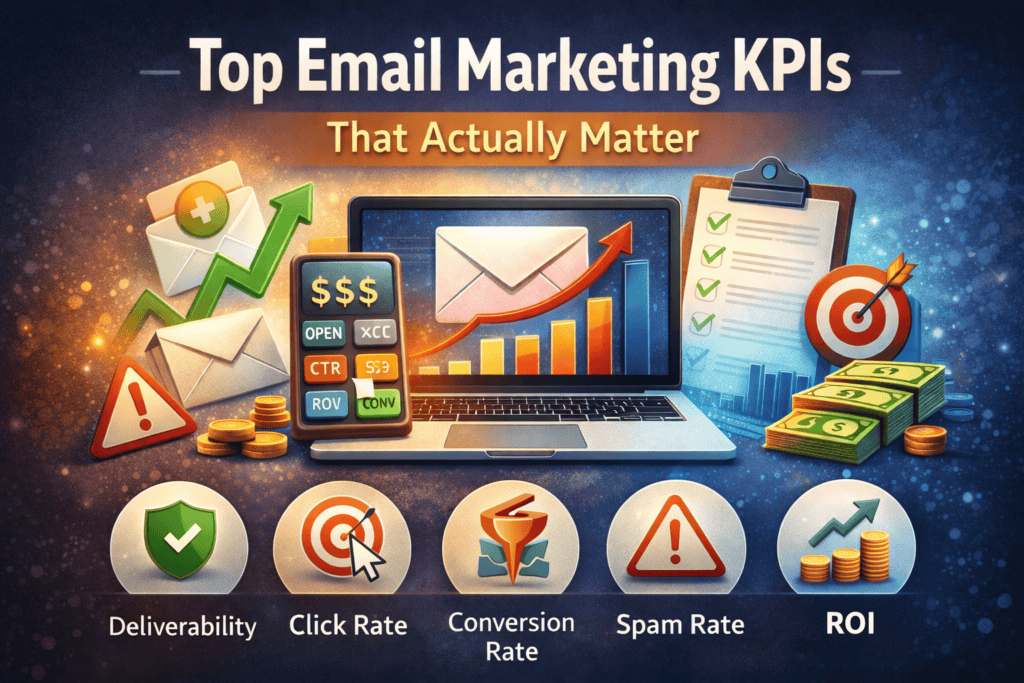
Email marketing remains one of the most effective channels for businesses, but tracking every metric available can lead to data overload. Not all metrics are created equal. Some are mere “vanity metrics”—numbers that look impressive but offer little strategic value.

Instead, marketers should focus on a core set of key performance indicators (KPIs) that directly impact engagement, conversions, and revenue. Email marketing can generate over $10 billion (with a “B”) in revenue, with an average return on investment of about $36 for every $1 spent (3600% ROI). Given this potential, it’s crucial to concentrate on the KPIs that truly matter for your email campaigns.

Essential Email Marketing KPIs

Deliverability Rate (Bounce Rate)

Deliverability rate measures the percentage of emails that successfully reach subscribers’ inboxes. It is essentially the inverse of the bounce rate (emails that could not be delivered).

It’s calculated as (Number of bounced emails / Number of emails sent) × 100%.

A good bounce rate is under 2%, which means you’re achieving about 98% deliverability. This KPI matters because if emails aren’t delivered, they can’t be opened or clicked. High bounce rates can harm your sender reputation and skew your other metrics (since undelivered emails aren’t giving you any engagement data). Keeping your list clean by removing invalid addresses (especially those that “hard bounce”) is essential to maintain a healthy deliverability rate.

Open Rate

Open rate is the percentage of delivered emails that recipients opened.

It’s calculated as (Emails opened / Emails delivered) × 100%.

Historically, an open rate of around 20% to 40% was considered a good benchmark, indicating effective subject lines and send times. However, due to privacy changes, this metric has become less reliable. Apple’s Mail Privacy Protection (MPP), introduced in 2021, automatically pre-loads email content (including tracking pixels) even if the user doesn’t actually open the email. This causes inflated open rate numbers.

In other words, your reports might show sky-high opens that aren’t reflecting real engagement. While you should still monitor open rate trends (e.g., sudden drops or increases), don’t rely on open rate alone to judge success. Instead, use it alongside other engagement metrics (like clicks and conversions) and pay more attention to the direction of your open rate over time rather than the absolute percentage.

Click-Through Rate (CTR)

Click-through rate (CTR) is the percentage of email recipients who clicked at least one link in your email.

It’s calculated as (Number of clicks / Number of emails delivered) × 100%.

CTR shows how engaging your email content and call-to-action are, since it measures the step beyond just opening. On average, email campaigns see around a 2% overall CTR, and marketing-specific emails average about 1.8% CTR. If your CTR is higher, that’s a strong sign your content resonated. If it’s lower, you may need to work on more compelling content or clearer calls-to-action.

To improve CTR, ensure your email copy is relevant and your buttons or links stand out with an enticing offer. Also, remember that CTR is influenced by open rate to an extent. If nobody opens the email, they can’t click. So a good subject line (to drive opens) paired with engaging content (to drive clicks) works hand-in-hand to boost CTR.

Conversion Rate

Conversion rate is the percentage of email recipients who took the desired action after clicking through your email. “Conversion” can mean making a purchase, signing up for an event, filling out a form, or any goal you set for the campaign.

It’s calculated as (Number of people who completed the goal action / Number of emails delivered) × 100%.

This is one of the most critical KPIs because it directly ties your email to tangible results. Average email conversion rates are typically a few percent; for example, automated emails can see roughly 1% to 5% conversion rates on average (some high-performing campaigns achieve even higher).

If your conversion rate is low, consider optimizing the landing page your email links to, aligning your email content better with the offer, or segmenting your audience so the right people get the right message. Even small lifts in conversion rate can significantly boost your return on email marketing, since this metric translates directly into revenue or goal completions.

Unsubscribe Rate

Unsubscribe rate is the percentage of recipients who opt out of your mailing list after an email campaign.

It’s calculated as (Number of unsubscribes / Number of emails delivered) × 100%.

While some list churn is normal, you want this number to be as low as possible. Industry benchmarks show an average unsubscribe rate around 0.1%–0.2% for eCommerce emails. A sudden spike in unsubscribes can signal that your content or frequency is missing the mark with your audience. Monitoring unsubscribe rate helps you gauge overall list satisfaction; if it creeps up, it may be time to adjust your email content, targeting, or send frequency.

To keep unsubscribe rates low, always deliver relevant, valuable content and avoid blasting your entire list with emails that only appeal to a segment of your audience. Also, ensure subscribers have control over their subscription (for example, allow them to manage preferences) so those who aren’t interested can opt down to fewer emails instead of leaving entirely.

Spam Complaint Rate

Spam complaint rate is the percentage of recipients who report your email as spam.

It’s calculated as (Number of spam complaints / Number of emails sent) × 100%.

This metric is crucial for monitoring your sender reputation. Email service providers (like Gmail) heavily factor spam complaints into whether future emails land in the inbox or get diverted to spam folders. Aim to keep your spam complaint rate below 0.1% (one-tenth of one percent). A rate higher than that can quickly jeopardize your deliverability across the board.

High spam complaints usually indicate recipients weren’t expecting your message or found it irrelevant or misleading. To avoid complaints, always send to people who have explicitly opted in, set clear expectations about what content they’ll receive, and make it easy to unsubscribe (it’s better they leave your list than mark you as spam). Keeping content relevant and not over-emailing subscribers will also help minimize the chance of complaints.

List Growth Rate

List growth rate tracks how fast your email list is growing (or shrinking). It accounts for new subscribers added and subtracts those who unsubscribed or bounced.

It’s calculated as (Number of new subscribers – Number of lost subscribers) / Total subscribers × 100%

List growth rate is typically measured over a period like per month. A healthy list growth rate shows you’re continuously expanding your reach to offset natural attrition. A common target is about 2.5% growth per period, though this can vary by organization. If your list growth rate is negative or very low, it means you could be losing subscribers as fast as you gain them, which will eventually hurt your email marketing results.

Improve list growth by making sign-ups easy and appealing—for instance, include clear email sign-up calls to action on your website, offer incentives (like a discount or useful downloadable content) for joining your list, and encourage satisfied customers to share or refer others. Remember, a larger list isn’t automatically better unless those subscribers are engaged, so focus on quality growth (attracting people who genuinely want to hear from you).

Return on Investment (ROI)

Email ROI measures how much revenue you earn from your email campaigns relative to what you spend on them. It’s often expressed as a ratio or percentage.

It’s calculated as (Total revenue from email campaigns / Total cost of email campaigns) × 100% to get an ROI percentage.

For example, if you spent $500 on email marketing in a month and it generated $5,000 in sales, your ROI is ($5,000/$500) × 100% = 1000%. Industry data shows email marketing’s ROI is exceptionally high, averaging around 3600% (meaning about $36 earned per $1 spent). This makes ROI one of the ultimate KPIs that demonstrates the value of email marketing. Tracking ROI helps you justify your email budget and optimize spend. If certain campaigns or list segments yield a higher ROI, you can allocate more resources to those.

To improve ROI, focus on strategies that increase conversion and customer lifetime value from emails (such as better segmentation, personalized content, and upsell/cross-sell campaigns) while keeping costs in check. Ultimately, ROI ties together many of the other KPIs: by improving deliverability, engagement, and conversion metrics, you will see the payoff in your email ROI.

Summary of Key Email KPIs

The table below summarizes the top email marketing KPIs and their typical benchmarks:

KPI How to Calculate Good Benchmark
Deliverability Rate (Delivered emails / Sent emails) × 100% ≥ 98% (Bounce Rate ≤ 2%)
Open Rate (Opens / Delivered emails) × 100% 20–40% (typical range; note: can be inflated by MPP)
Click-Through Rate (CTR) (Clicks / Delivered emails) × 100% ~2% average (all industries)
Conversion Rate (Conversions / Delivered emails) × 100% ~1–5% (varies by campaign type)
Unsubscribe Rate (Unsubscribes / Delivered emails) × 100% < 0.2% (lower is better)
Spam Complaint Rate (Spam reports / Sent emails) × 100% < 0.1% (critical to keep low)
List Growth Rate ((New subscribers – Lost subscribers) / Total list size) × 100% ≥ 2.5% per period
Email ROI (Revenue from emails / Cost of emails) × 100% ~3600% (i.e., $36 per $1 spent)

References

  1. Beefree.io – “8 Email Marketing Metrics That Actually Matter in 2024”
  2. Designity – “KPIs That Actually Matter in 2025 (And What You Can Ignore)”
  3. Shopify – “13 Email Marketing Metrics You Should Be Tracking in 2025”

Top Email Marketing KPIs That Actually Matter Read More »

a historical evolution of email marketing

A Historical Evolution of Email Marketing

Reading Time: 14 minutes

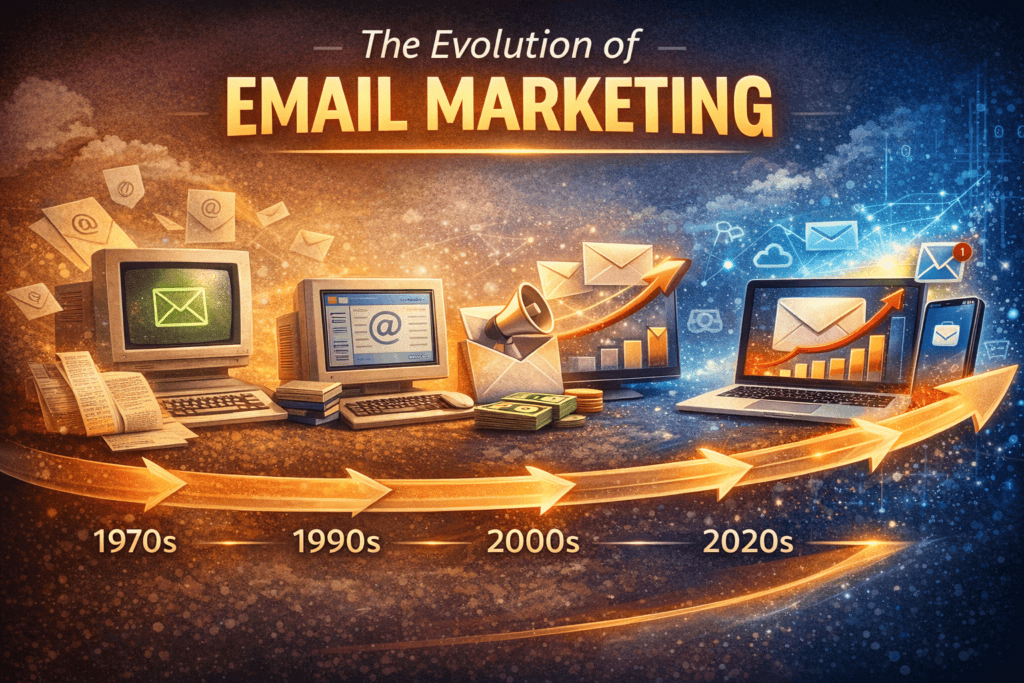
Email has come a long way since its humble beginnings on a mainframe in 1965 and its first network transmission in 1971.

From simple text messages shared between researchers to a global marketing powerhouse, email has evolved into one of the most resilient and effective digital channels available. This visual timeline traces the history of email marketing, spotlighting key innovations in technology, the rise of email service providers and automation platforms, and the impact of privacy regulations.

Whether you are a marketer, technologist, or digital history buff, this journey through the decades offers insight into how email became the cornerstone of modern marketing.

2025

Forecast – Email remains a cornerstone of digital communication, with global users projected to reach 4.6 billion by the end of 2025. Daily email volume is expected to exceed 380 billion messages, underscoring email’s enduring reach.

2024

April – Worldwide email users hit 4.48 billion, meaning over half of the world’s population now uses email. (For comparison, in 1997 there were only about 10 million email users.)

February – Gmail begins enforcing new bulk sender guidelines: senders must authenticate emails (SPF/DKIM), include one-click unsubscribe, and keep spam complaint rates under 0.3%. These measures, announced by Google in late 2023, aim to keep inboxes safer from spam.

2023

June – Apple introduces Mail app privacy updates (iOS 17’s Link Tracking Protection). The system now automatically strips tracking parameters from email links, further protecting user privacy and challenging email marketers’ tracking efforts.

June – Apple Mail Privacy Protection (announced in 2021) is fully impacting marketers’ metrics. By now, a large portion of Apple Mail users have enabled it, obscuring open-rate tracking by preloading images.

October – Google reveals plans to impose a strict spam complaint threshold (max 0.3% complaints) for bulk email senders starting 2024. Senders who exceed this (e.g. >3 complaints per 1,000 emails) risk having their messages throttled or blocked, prompting marketers to improve list hygiene and relevancy.

2021

June – Apple announces Mail Privacy Protection at WWDC 2021. This feature, launched with iOS 15/MacOS Monterey, hides recipients’ IP addresses and pre-loads email images, preventing senders from accurately tracking opens and location data. The shift foreshadows a more privacy-centric era for email marketing.

2020

July – The COVID-19 pandemic drives a massive shift to digital communication. Businesses worldwide increase their email outreach as in-person contact diminishes. eCommerce and webinar invitations surge in inboxes. Email volumes hit record highs, highlighting the medium’s resilience during global lockdowns.

January – California Consumer Privacy Act (CCPA) enforcement begins. Mirroring Europe’s GDPR, CCPA gives California residents greater control over personal data. Email marketers adjust by refining consent practices and data handling, as privacy legislation expands in the U.S.

2018

May 25 – EU General Data Protection Regulation (GDPR) comes into force, redefining email marketing rules globally. Marketers must obtain explicit consent for emails and honor data subject rights, or face hefty fines. GDPR’s strict standards influence privacy laws around the world.

October – Adobe acquires Marketo (a leading marketing automation platform) for \$4.75 billion:contentReference. This high-profile deal underscores the value of email and marketing automation technology in the digital marketing ecosystem, integrating Marketo’s tools into Adobe’s Experience Cloud.

2014

April – Google updates Gmail with an easy “Unsubscribe” link at the top of marketing emails:contentReference[oaicite:12]{index=12}. This prominent placement makes it simpler for users to opt out of mailing lists, reflecting industry pressure to improve email relevance and reduce spam complaints.

September – HubSpot (inbound marketing and automation platform) goes public on the NYSE, signaling the mainstream importance of marketing automation tools. HubSpot’s IPO follows that of Marketo (2013) and the Oracle–Eloqua deal (2012), marking a maturation of the marketing tech industry.

2013

May – Salesforce acquires ExactTarget for \$2.5 billion. ExactTarget, an email marketing and automation provider (known for its Marketing Cloud), becomes the core of Salesforce’s digital marketing suite. This reflects a trend of CRM and enterprise software companies investing heavily in email marketing capabilities.

May – Marketo (marketing automation platform) has its IPO on NASDAQ, highlighting investor confidence in email-driven marketing technology. Marketo’s platform, known for lead nurturing and analytics, helped cement “marketing automation” as an essential category for businesses.

2012

January – Tech companies including Google, Yahoo, and Microsoft collaborate to introduce DMARC (Domain-based Message Authentication, Reporting, & Conformance). DMARC, built on SPF and DKIM, allows senders to specify handling of failing messages and provides feedback reports. By completing the email authentication triad, DMARC significantly reduces phishing and spoofing, making marketing emails more trustworthy.

July – Canada enacts CASL (Canada’s Anti-Spam Legislation). At the time, it’s one of the world’s toughest email laws, requiring express consent for commercial emails and setting fines for violations. CASL’s passage extends the global trend of anti-spam and privacy regulations that email marketers must navigate.

December – Oracle Corporation acquires Eloqua, a pioneer in marketing automation (founded 1999), for \$871 million. This move by a major enterprise software company validates the importance of automated email marketing and customer nurturing in modern business strategies.

2010

May – Web design guru Ethan Marcotte coins “Responsive Web Design,” ushering in techniques to make web content (and emails) adapt to different screen sizes. By the mid-2010s, responsive email design becomes standard, ensuring marketing emails display properly on smartphones as mobile email usage soars.

2008

September – Google Chrome debuts as a new web browser, and Android OS launches on smartphones (HTC Dream). The late 2000s mobile and browser innovations further enable on-the-go email access and richer webmail apps, expanding when and how users read emails.

2007

June 29 – Apple releases the first iPhone, kicking off the smartphone revolution. Mobile email usage explodes, as users can now seamlessly check email anywhere with a full web browser and HTML email support in their pocket. Marketers respond by optimizing emails for mobile screens.

March – Pardot, a SaaS B2B marketing automation platform, is founded (Atlanta, USA). Pardot focuses on lead nurturing via email and is an early player in the B2B automation space. (It will later be acquired by ExactTarget/Salesforce in 2013.)

2006

June – HubSpot is founded, initially promoting “inbound marketing” to attract customers with content and then nurture them via email automation:contentReference. HubSpot’s launch marks the blending of email, content, and CRM for small businesses, offering an all-in-one marketing platform.

October – Marketo is founded in Silicon Valley. Marketo’s platform brings sophisticated email automation, lead scoring, and analytics to enterprise marketers. Along with Eloqua and HubSpot, Marketo will become synonymous with the marketing automation movement of the late 2000s.

2004

April 1 – Google launches Gmail, initially invite-only. Gmail offers a radical 1 GB of free storage (far more than rivals), threaded conversations, built-in search, and powerful spam filtering. Often thought an April Fool’s joke due to its launch date, Gmail quickly disrupts webmail: it attracts millions of users and raises expectations for email service quality.

2004 – DomainKeys Identified Mail (DKIM) is introduced as a new email authentication standard, via a collaboration between Yahoo! and Cisco. DKIM uses cryptographic signatures to verify an email’s domain sender, helping ISPs and recipients trust that marketing emails (like newsletters) actually come from the claimed domain and haven’t been tampered with in transit.

2004 – Campaign Monitor is founded in Australia (one of the first global email marketing services outside the US). Emphasizing beautifully designed emails and templates, it illustrates the growing international footprint of email marketing tools.

2003

January – The CAN-SPAM Act takes effect in the United States. As the first U.S. federal law regulating commercial email, CAN-SPAM requires senders to include an unsubscribe mechanism, valid physical address, and truthful subject lines, among other provisions. While not a strict opt-in law, it sets a baseline for email marketing practices and penalties for spammers.

2003 – Sender Policy Framework (SPF) is introduced. SPF allows domain owners to publish authorized outbound email servers via DNS. Mail servers begin checking SPF records to reject or flag emails from unauthorized sources. This standard helps reduce sender address forgery (spoofing), which is important for both deliverability and phishing prevention in marketing emails.

2002

August – Programmer Paul Graham publishes “A Plan for Spam”, describing Bayesian filtering to distinguish spam vs. legitimate emails. This academic work quickly influences spam filter development: email providers and software adopt Bayesian spam filters that learn common spam signals. The result is a significant improvement in blocking unwanted marketing emails and junk, and this technique remains a foundation of spam detection.

2001

June – Mailchimp launches as a dedicated email marketing service. Starting as a small bootstrapped tool, Mailchimp focuses on user-friendly campaign creation and grows rapidly. By offering templates, list management, and later a freemium model (2009), Mailchimp helps democratize email marketing for small businesses and becomes one of the world’s largest email service providers.

April – SpamAssassin, an open-source spam filter, is released. It introduces a scoring system that checks emails against many rules (including Bayesian analysis, blacklists, and later SPF/DKIM results). SpamAssassin becomes widely used on mail servers to filter out spam, benefiting legitimate marketers by improving overall inbox quality and trust in the email medium.

2000

December – ExactTarget is founded in Indianapolis, USA. An early email marketing software provider for businesses, ExactTarget offers campaign management and analytics. It exemplifies the dot-com era growth of dedicated email marketing companies. (ExactTarget will later expand into a broader marketing platform and be acquired by Salesforce in 2013.)

1999

October – Eloqua launches in Toronto, Canada, and is often credited as the first true marketing automation platform. Eloqua’s software allows B2B marketers to execute email campaigns, track responses, score leads, and automate follow-ups in one system. This innovation kick-starts the marketing automation industry, transforming how companies nurture prospects via email.

August – Marketer and author Seth Godin publishes “Permission Marketing,” advocating for emails sent only to users who opt-in or “raise their hand”. The book popularizes the term “permission-based email” and influences a generation of marketers to shift from mass spamming to a more customer-centric, consent-driven approach.

1998

October – Data Protection Act 1998 (UK) comes into effect. This law, updating earlier 1984 rules, strengthens requirements for how organizations handle personal data, including email addresses. It foreshadows future privacy directives and requires marketers in the UK/EU to use data (like email lists) responsibly and with consent—years ahead of GDPR.

March – The word “spam” (in the email context) is officially added to the Oxford English Dictionary. By now, unsolicited bulk email is enough of a nuisance that the term enters the popular lexicon (borrowed from a Monty Python sketch via early internet culture). Spam’s inclusion in the dictionary highlights the growing need to differentiate unwanted emails from legitimate communication.

1997

October 8 – Yahoo! Mail launches as a free webmail service. After Yahoo’s acquisition of RocketMail, it rebrands the service to millions of Yahoo users. Yahoo! Mail, offering 3 MB of storage and an @yahoo.com address, quickly becomes one of the largest email providers globally (especially as it’s integrated with Yahoo’s popular web portal).

October – Microsoft Outlook 97 is released as part of Office 97:contentReference, becoming a dominant desktop email client for businesses. Outlook’s integration of email with calendar and contacts, and its rich formatting options, empower email as a professional communication tool. It also gives marketers new capabilities (like HTML email support and eventually programmable add-ins for bulk mail merges).

December 31 – Microsoft acquires Hotmail for an estimated \$400 million:contentReference[oaicite:41]{index=41}. Hotmail’s 10+ million users are folded into MSN, and the service is later rebranded as MSN Hotmail. The acquisition underscores the strategic value of web-based email services and foreshadows the fierce competition (Microsoft vs Yahoo vs Google) in the email space.

1996

July 4 – Hotmail launches to the public. Co-founders Sabeer Bhatia and Jack Smith choose Independence Day to symbolize “freedom” from ISP-bound email. As one of the first free webmail providers, Hotmail (with its catchy “[username]@hotmail.com” addresses) allows users to access email from any internet-connected computer. It grows explosively, reaching millions of users within a year and validating web-based email as a new paradigm.

1996 – MAPS RBL (Real-time Blackhole List) is created by the Mail Abuse Prevention System. This was an early effort to publish a DNS-based blacklist of known spam senders’ IP addresses, so mail servers could block spam proactively. The RBL’s emergence shows the internet community’s early attempts to curb spam, a trend that will continue with more advanced blocklists and reputation systems used by ISPs.

1996 – Constant Contact is founded (as “Roving Software”) in Massachusetts. One of the first dedicated email marketing services for small businesses, Constant Contact provides easy tools for newsletters and list management. Its early success with SMEs demonstrates the demand for email marketing beyond large corporations, paving the way for widespread adoption by organizations of all sizes.

1993

February – America Online (AOL) launches its integrated email service to all subscribers, complete with the famous “You’ve Got Mail” voice greeting. As AOL’s membership balloons through the ’90s (eventually over 20 million), it introduces a broad consumer population to the delights and frustrations of email. The phrase “You’ve got mail” becomes synonymous with the dawning internet era, even inspiring a Hollywood movie in 1998.

January – The Mosaic web browser is released to the public. Mosaic is the first popular browser to display images inline with text, making the World Wide Web user-friendly. This development indirectly boosts email usage too: as more people come online via the web, they sign up for email accounts (often provided by early ISPs like AOL, CompuServe, and Prodigy). Mosaic’s success leads to Netscape Navigator (1994), accelerating the growth of the internet and web-based email services later in the decade.

1992

March – The MIME standard (Multipurpose Internet Mail Extensions) is published as RFC 1341. MIME defines how to format emails to include text in character sets beyond ASCII, as well as attachments like images, audio, video, and application files. This is a game-changer for email marketing: by the mid-90s, marketers can move from plain text emails to rich HTML emails with pictures, colors, and attachments, vastly increasing email’s visual and interactive appeal.

August – IBM Simon, the first device to combine phone and PDA features (often dubbed the first “smartphone”), is unveiled and demoed (shipping in 1994). Though primitive by modern standards, IBM Simon demonstrates email-on-the-go in embryonic form (it could send faxes and messages). It signals the coming mobile revolution which, a decade later, will make checking email on smartphones commonplace.

1991

Aug 9 – “Hello Earth!” Astronauts Shannon Lucid and James C. Adamson use an Apple Macintosh Portable on Space Shuttle Atlantis to send the first email from space. Transmitted via AppleLink (a proprietary network), their brief message (“…This is the first AppleLink from space…”) is later recognized by Guinness World Records. This milestone highlights email’s reach beyond our planet and the increasing ubiquity of digital communication.

1991 – HTML (HyperText Markup Language) is introduced by Tim Berners-Lee along with the first web server/browser. While intended for the web, HTML soon influences email as well; by the mid-90s, email clients start supporting HTML-formatted emails. The advent of HTML lays the foundation for webmail and graphical email content, which will become crucial for marketers (enabling newsletters that look like web pages).

1989

March – Tim Berners-Lee proposes the World Wide Web while at CERN. This invention (implemented in 1990) will drastically expand global connectivity. Within a few years, the web and email become the dual killer-apps of the Internet. By enabling easy information access and eventually browser-based email, the Web helps propel email into mainstream use by the mid-1990s.

June – Lotus Notes 1.0 is released by Lotus Development Corp. Lotus Notes is a pioneering client-server collaboration software that includes integrated email, calendaring, and databases. Through the 1990s, Lotus Notes becomes popular in enterprises worldwide for internal email and group coordination. It signifies the increasing complexity and importance of email in business workflows.

1989 – CompuServe and MCI Mail (early email services) establish gateways to the Internet. By connecting their proprietary networks to the broader Internet, these services allow users to exchange email with the growing internet email system. This interoperability is a key moment in unifying the world’s email into one global network, rather than isolated islands of communication.

1988

1988 – Microsoft Mail is introduced as Microsoft’s first email product for Mac and PC networks. It provides office workers on a LAN the ability to exchange electronic messages. Microsoft Mail (and later Microsoft Exchange Server in 1993) helps bring user-friendly email to many businesses, setting the stage for Outlook and the dominance of Microsoft in corporate email through the ’90s.

Nov 2 – The Morris Worm, one of the first internet worms, spreads across ARPANET, affecting thousands of computers. It’s notable here because it highlighted security vulnerabilities in network services (including sendmail, an email server). The Morris Worm prompts greater focus on email server security and indirectly on spam prevention. Not long after, the first anti-virus and network security tools emerge, which become important for protecting email systems.

1986

October – The Electronic Communications Privacy Act (ECPA) becomes law in the U.S. ECPA extends privacy protections to electronic communications (like emails), prohibiting interception or unauthorized access. This is one of the first legal recognitions that email deserves similar privacy as traditional mail or telephone calls, impacting how law enforcement and companies must treat email content.

1986 – LISTSERV is developed by Eric Thomas. Debuting on BITNET, it is the first software to automate email list management (subscription, unsubscription, mass mailing to subscribers). Before LISTSERV, managing a mailing list was tedious and manual. This innovation greatly scales email marketing, as now a single message can be automatically distributed to thousands of subscribers. LISTSERV’s technology is foundational for newsletters and discussion lists, and variants of it run to this day.

1985

March 15 – The first .com Internet domain, symbolics.com, is registered. Symbolics was a computer maker, and while this event is about the broader internet, it also marks the beginning of domain-based email addresses (user@domain.com). Over time, companies and individuals alike move from numeric or proprietary network addresses to the now-familiar domain email addresses. By the late ’80s, having a custom email domain becomes a status symbol for businesses.

1985 – America Online (AOL) is founded (originally as Quantum Computer Services). AOL would later become synonymous with dial-up internet and email in the ’90s. In the ’80s, online services like AOL and CompuServe offer email to subscribers on their closed networks. AOL’s founding is a precursor to the walled-garden email experience that tens of millions of users will have in the coming decade (until internet email interconnection becomes standard).

1983

Sept 27 – MCI Mail launches as one of the first commercial email services open to the public. Backed by MCI and led by Vint Cerf, MCI Mail allows anyone to sign up for an email address to send electronic messages. Uniquely, it can also send messages to fax, telex, or postal mail for delivery to non-digital recipients:contentReference[oaicite:60]{index=60}. MCI Mail’s debut, along with competitors like CompuServe Mail, marks the commercialization of email beyond academic or military networks.

1983 – The Domain Name System (DNS) is implemented. DNS replaces numeric IP addresses with domain names (like company.com). For email, this means addresses can be user@organization.com instead of user@xx.yy.zz. By introducing MX (Mail Exchange) records, DNS also enables proper routing of emails to mail servers for each domain. This development is critical for the growth of internet email, making addresses human-friendly and routing more robust as networks expand.

1983 – ARPANET switches to TCP/IP, and the Internet as we know it is born. Soon after, in 1983, the Simple Mail Transfer Protocol (SMTP) is formally specified and implemented on ARPANET:contentReference. SMTP (first proposed in 1980, finalized by RFC 821 in Aug 1982) becomes the universal protocol for sending email across the internet. By unifying various earlier mail systems under one standard, SMTP allows any computer on the growing Internet to email any other. This standardization is arguably the single most important step in email’s evolution into a global communication tool.

1982

1982 – “Emoticons” are born 🙂 🙂. Carnegie Mellon professor Scott Fahlman suggests using 🙂 and 🙁 in email or BBS posts to convey humor versus seriousness. This simple idea spreads and becomes part of online culture. Emoticons (and later emoji) make their way into marketing emails as well—by the 2000s, including a smiley in a subject line or message is a creative way for brands to add personality. It’s a reminder that email is not just technical, but also about human expression.

1982 – SMTPS (Secure SMTP) conceptually appears (though not standardized yet). This year also sees IBM release PROFS (an enterprise email system), and X.400 email standards are published (as part of OSI). Throughout the early 1980s, many organizations are deploying email on local networks or proprietary systems. However, most of these systems can’t yet talk to each other – the dominance of SMTP over X.400 and other closed systems will be decided by the early 1990s in favor of SMTP, helped by the growth of the Internet.

1980

1980 – Work begins on SMTP, the Simple Mail Transfer Protocol. Internet pioneers like Jon Postel start drafting how email can be reliably delivered across the ARPANET using a standardized method rather than ad-hoc approaches. This effort to create one unified email protocol reflects the need for interoperability as more computers and networks join the early Internet. (An initial spec, RFC 788, comes in 1981, with the durable RFC 821 arriving in 1982.)

1980 – The @ symbol goes mainstream. Although Ray Tomlinson introduced @ in 1971 for ARPANET addresses, by the early ’80s this symbol is cemented as the standard for email addressing globally. Other networks and software adopt the user@host format. The @ character, little-used in prior decades, becomes iconic—now synonymous with reaching someone electronically.

1978

May 3 – Gary Thuerk of Digital Equipment Corp sends the first-ever mass unsolicited email, advertising a new DEC computer model to 400 ARPANET users. This notorious message (essentially a proto-spam) earns Thuerk the title “Father of Spam.” While it also reportedly generated \$12–13 million in sales, the backlash was immediate—recipients complained about network resources and etiquette. Thuerk was warned not to do it again. This event is the genesis of email marketing (and spam); it demonstrated email’s power for promotion, albeit at the cost of annoying people. The tension between effective marketing and recipient consent traces back to this very first “email blast.”

1977

1977 – Email standards take shape: ARPANET researchers publish RFC 733, one of the first attempt to standardize the format of email messages. It defines headers like “To:, From:, Subject:” which are still in use today. While RFC 733 will be superseded by RFC 822 in 1982, this work in the late ’70s on formalizing email ensures that messages can be understood across different systems. It’s a key step from the improvised early emails toward a robust, universal system.

1976

March 26 – Queen Elizabeth II sends an email! Using the ARPANET’s email system during a visit to the Royal Signals and Radar Establishment (UK), she becomes the first head of state (and royal) to transmit an email message. Her account username was “HME2” (“Her Majesty, Elizabeth II”), and this demonstrated that even the highest-profile individuals were taking note of new communication tools. This event was nicknamed “Mail” (after the cable code for the Queen). It showed the world that email wasn’t just for computer scientists—anyone could use it, even monarchs.

1971

Late 1971 – Ray Tomlinson, a programmer working on ARPANET, sends the first network email between two computers:contentReference[oaicite:73]{index=73}. Before this, electronic messages could only be left for users of the same machine. Tomlinson adapts a program called SNDMSG and uses the “@” symbol to separate the user’s name from the host computer name (choosing @ to mean “at”). The test message was something like “QWERTYUIOP”. This humble beginning on ARPANET in 1971 is the birth of email as we know it. Tomlinson’s innovation opens the door for networked email communication and earns him credit as email’s inventor. In his own words, email was a “no big deal” innovation—but it became one of the most important developments in communication technology.

1965

1965 – At MIT, researchers implement an experimental “Mailbox” feature on a time-sharing system (CTSS). Users on the same mainframe computer can leave text messages for others to read later – essentially the first electronic mail (though not over a network). Similar systems appear on early mainframes (like SDC’s Q32 and IBM’s systems). While this wasn’t network email, it proved the concept of electronic message passing. These early developments set the stage for Ray Tomlinson and others: by demonstrating the usefulness of electronic messaging, they laid the groundwork for true email across networks.

A Historical Evolution of Email Marketing Read More »

10 tips for choosing the right social media listening solution without wasting time or money

10 Tips for Choosing the Right Social Media Listening Solution (Without Wasting Time or Money)

Reading Time: 3 minutes

Shopping for a social media listening tool can feel overwhelming. With so many options and overlapping features, how do you know what actually matters? If you visit MartechMap.com, you’ll see something staggering: there are currently 599 tools listed under Social Media Marketing and Monitoring. That number will only grow. And no one has time to evaluate hundreds of vendors. That’s why it’s critical to know your use cases and focus on the features that will actually move the needle. This guide highlights 10 must-have capabilities to help you filter out the noise, skip the fluff, and invest in a tool that delivers.

1. Real-Time Monitoring and Smart Notifications

You should be able to choose how often you’re alerted—immediately, daily, or weekly—based on the importance of the keyword or situation. Real-time alerts are vital for crisis management. Just as important is the ability to control the volume so you’re not drowning in notifications.

2. Broad and Relevant Source Coverage

The best tools cover all the major platforms—Facebook, Instagram, X (Twitter), LinkedIn, Reddit, YouTube, news sites, blogs, forums, and even podcasts. Not every tool includes every channel, so make sure it tracks where your audience actually talks.

3. Search Power and Noise Reduction

Expect to tweak your keyword lists over time, but the tool shouldn’t make that feel like a part-time job. Look for Boolean search support and filtering options to reduce irrelevant mentions while ensuring you still catch every valuable signal. You want maximum relevance, minimal noise.

4. Sentiment and Context Clarity

Most tools promise sentiment analysis, but the accuracy is rarely reliable. If sentiment matters to your business, plan on doing a manual review. The good tools offer extras like word clouds, keyword context, and trending terms to help you see how your brand is being talked about, even when sentiment scoring falls short.

5. Competitive Benchmarking and Share of Voice

Want to know how you stack up? Look for features like Share of Voice tracking, competitor comparison dashboards, and the ability to track competitor keywords or brand names. Seeing where you win (and where you don’t) helps focus your efforts.

6. Trend Detection and Strategic Insights

Some of the most helpful features I’ve seen include: presence scores that track brand momentum, trending hashtags and links, and most active sites driving discussions. These help you understand what’s gaining traction and where conversations are happening.

7. AI-Powered Insights and Strategic Recommendations

Don’t fall for the “AI” buzzword. Ask what it actually does. Strong tools use AI to analyze patterns, summarize themes, flag unusual trends, and recommend where to focus based on what’s working. It should help you act, not just observe.

8. Data Export, Integration, and Manual Import Options

This tool will likely live in a data silo, so make sure you can get your data out. Look for support for CSV exports, custom report builders, and API access (but verify whether that API is included in your plan or comes at a cost). Bonus points if you can manually upload your own data to supplement the platform’s findings.

9. Reporting and Collaboration Features

Dashboards should be easy to customize and share. Can you set up automated reports? Invite multiple team members? Some tools limit the number of users or dashboards unless you upgrade. Don’t get caught off guard.

10. Pricing Transparency and Plan Limits

Beyond the monthly cost, be sure to understand your limits: How many mentions per month? How many keywords? Are sentiment filters, exports, or competitive tracking included or extra? Plan limits can become deal-breakers as your needs grow.

Final Thoughts

The right tool depends on your goals. Don’t get swayed by flashy dashboards alone. Ask the hard questions, dig into plan limits, and test real-world use cases. If sentiment accuracy, integrations, or competitor tracking are important to you, don’t assume they’ll “just work.”

10 Tips for Choosing the Right Social Media Listening Solution (Without Wasting Time or Money) Read More »