In this post, I’m diving into the Audience Insights section of Pinterest Analytics. This is a powerful but often overlooked tool for advertisers and content creators.
The metrics are the same across each tab. You’re just choosing which audience you want to analyze.
Each tab includes two breakdowns:
Total Audience: Users who have seen or engaged with your Pins in the last 30 days.
Engaged Audience: Users who have engaged with your Pins (saved, clicked, etc.) in the last 30 days.
Note: The date range is fixed at 30 days. There is currently no way to adjust this.
What’s in the CSV Export and How You Can Use It
You can export your insights to CSV. While it’s an aggregated report, there is quite a bit to unpack. The export includes the following columns:
Category and Bulk Sheet Category: General interest areas (e.g., Food and Drink, Home Decor, Women’s Fashion).
Percent of Audience: How much of your audience falls into that category.
Affinity: A key metric that shows how much more likely your audience is to engage with that interest compared to the general Pinterest audience.
Interest and Bulk Sheet Interests: More specific niches under the broader categories.
Use Cases for the CSV Data:
Creative Targeting: See what your audience cares about most and tailor content or ads accordingly.
Content Planning: If a large percent of your audience has an affinity for “Meal Prep,” it may be time for more recipe Pins.
Audience Comparison: Filter by category or sort by highest affinity to uncover underserved interest areas.
Keyword Expansion: Discover niche interests to use in Pinterest SEO or ad targeting.
What does affinity mean?
Affinity is a relative score. For example, an affinity of 3.0 means your audience is three times more likely to engage with a specific interest than the average Pinterest user. This helps you prioritize content that truly resonates.
Audience Charts You’ll Find in the Dashboard
Pinterest also includes a few simple but powerful visualizations:
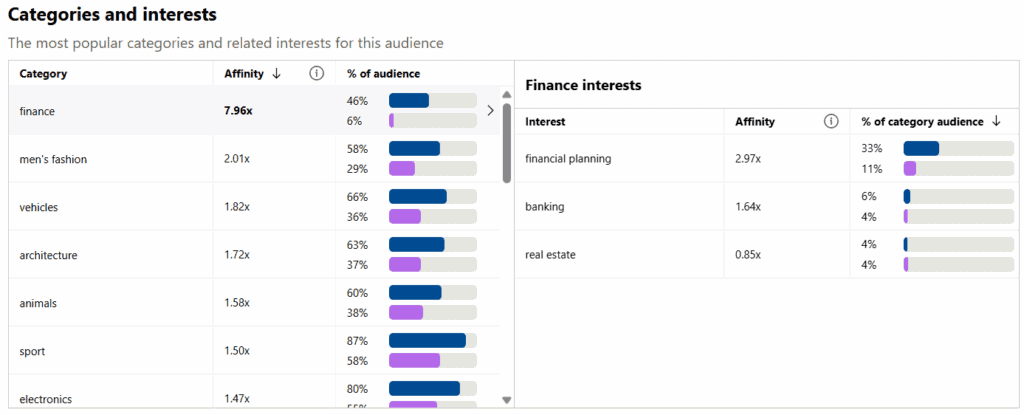
Categories and Interests: Bar chart showing which topics dominate your audience.
Age: Breakdown of users by age bracket (18–24, 25–34, etc.).
Gender: Percentage of your audience identifying as female, male, or unspecified.
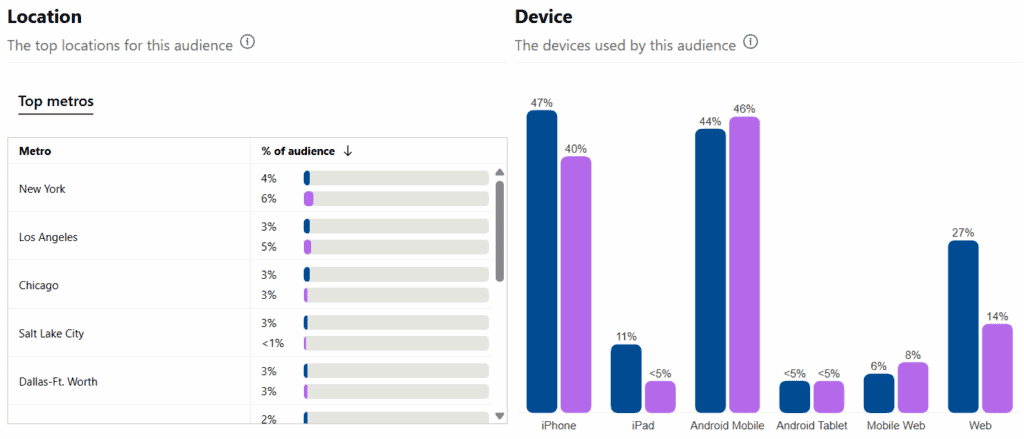
Location: U.S. states ranked by percentage of your audience.
Device: See if your audience uses iPhone, Android, web, or tablet most often.
Below are examples of each chart to help you visualize the type of data Pinterest provides. While you can view insights for your business, the general Pinterest audience, or a combination of both, the charts shown here display my engaged audience side by side with Pinterest’s overall engaged audience. This comparison view helps illustrate how your audience differs from the broader platform trends.
Why This Matters for Marketers and Advertisers
Pinterest Audience Insights is built with advertisers in mind. Here’s how to extract more value from it:
Target Smarter: Use the affinity and category breakdowns to align your ad targeting with actual behavior.
Spot Gaps: Is your audience heavily skewed to one age group or gender? Adjust your content strategy or expand your reach.
Localized Content: Knowing where your audience is concentrated may impact seasonal or regional creative choices.
Test with Confidence: Combine high-affinity interests with new ad formats to test what works. For example, if “DIY” scores high, try Idea Pins or short-form videos.
Final Thoughts
Audience Insights is more than a reporting tool. It’s a compass. Used well, it helps you go beyond vanity metrics and build a content and advertising strategy rooted in real user behavior.
Even if you’re not running Pinterest Ads yet, this data can sharpen your organic strategy and prep you for future success when you are ready to invest.
Apple’s 2007 launch of the first iPhone became a watershed moment in tech and marketing.
A masterful buildup of hype culminated in long lines of eager buyers and wall-to-wall media coverage on release day.
The iPhone combined a phone, iPod, and internet communicator in one device, a revolutionary concept that Apple sold with brilliant storytelling and showmanship.
This launch not only upended the mobile phone industry, but also demonstrated how savvy marketing can turn a product unveiling into a global cultural event.
Company Involved
Apple Inc., the company at the center of this story was a computer and iPod maker that entered the mobile phone market with the iPhone in 2007. Apple’s strong brand loyalty and reputation for innovation set the stage for an unprecedented product debut.
Marketing Topic
Product Positioning
Launch Strategy
Branding
This case touches on how Apple positioned a new product category, orchestrated a high-profile launch event, and leveraged its branding to generate excitement.
Public Reaction or Consequences
Mac enthusiasts lined up at an AT&T store in New York City on June 29, 2007, eagerly awaiting the first iPhone’s debut. The public’s reaction to the iPhone launch was overwhelming. Hype had built up for months, with tech blogs and fans speculating on the “Jesus phone,” leading hundreds to camp out in front of stores before the 6 p.m. release. Cheers erupted as doors opened, and Apple sold out of many initial shipments. Within 74 days, Apple sold its one-millionth iPhone, a pace that vastly outstripped the iPod’s early adoption rate.
The media hailed the iPhone as “the most anticipated gadget of all time,” and consumers treated the launch like a pop culture moment. However, not everyone was convinced at first. Industry leaders scoffed – Microsoft’s CEO Steve Ballmer infamously laughed at the $500 price and the lack of a keyboard, calling it “the most expensive phone in the world” with “no appeal for business customers.” Some early adopters also voiced frustration when Apple cut the iPhone’s price by $200 just two months after launch. Apple’s CEO Steve Jobs responded by apologizing and issuing $100 credits to first buyers, an unusual “my bad” that underscored Apple’s commitment to its loyal customers.
Despite these hiccups, the overall public response was wildly positive. The iPhone’s intuitive touch-screen, sleek design, and “all-in-one” value proposition generated praise. By 2008, a more affordable iPhone 3G on a faster network sent sales into the stratosphere. Apple sold over 10 million units of the iPhone 3G in just five months. The launch’s success had immediate consequences: it reset consumer expectations for phones, forced competitors to rethink their products, and made Apple a dominant player in the mobile industry.
Why It Matters Today
Redefined Product Launches: Apple’s iPhone event set a template for turning product launches into must-watch events. Today’s tech companies still strive to replicate that level of anticipation and buzz.
Innovation Meets Storytelling: The case highlights that even groundbreaking innovation needs great marketing. Apple framed the iPhone in terms of lifestyle benefits (music, phone, internet in one) rather than tech specs, a lesson in storytelling that modern marketers apply to everything from AI gadgets to electric cars.
Customer Trust and Brand Loyalty: The iPhone launch shows the value of nurturing a loyal fanbase. Apple’s quick response to the price-cut backlash (offering credits and acknowledging customer trust) exemplifies how brands benefit long-term by treating early customers as partners. In an era of social media and instant feedback, maintaining customer goodwill is more crucial than ever.
3 Takeaways
Build Anticipation (But Deliver on It): Apple spent months stoking curiosity – from Steve Jobs’ teaser announcement to controlled leaks – knowing that “anticipation [would grow]” and make the launch “one of the most heralded product splashes” ever. The payoff was huge buzz and early sales. Marketers should cultivate excitement for new products through previews and storytelling, but must ensure the product truly meets the hype.
Sell the Experience, Not Just the Product: The iPhone was marketed as a life-changing tool, “an iPod, a phone, and an internet communicator” in one. Apple’s launch presentation focused on how the device simplifies your life (music, communications, web in your pocket) rather than technical specs. This user-centric positioning – highlighting experience over features – taught marketers that framing a product around customer lifestyle and needs creates stronger emotional impact.
Honor Customer Loyalty: Early iPhone buyers were so enthusiastic they paid $599 and waited in line for hours. When Apple dropped the price soon after, those loyal fans felt betrayed. Jobs admitted, “Our early customers trusted us, and we must live up to that trust…,” offering $100 credits to make things right. The takeaway: trust is a priceless asset. Effective marketing isn’t just about the launch day; it’s also about sustaining goodwill. Brands should be prepared to listen and respond to customer feedback, especially from core fans, to maintain a positive reputation.
Notable Quotes and Data
“An iPod, a phone, an internet mobile communicator… These are not three separate devices!” – Steve Jobs, unveiling the iPhone’s all-in-one nature at Macworld 2007
“$500?… that is the most expensive phone in the world. And it doesn’t appeal to business customers because it doesn’t have a keyboard.” – Microsoft CEO Steve Ballmer, 2007
“One million iPhones in 74 days… it took almost two years to achieve this milestone with iPod.” – Steve Jobs, Sept 2007
Full Case Narrative
Background and Context: In the early 2000s, the mobile phone industry was dominated by brands like Nokia, BlackBerry, and Motorola. These companies focused on utility and business users, offering phones with physical keyboards and limited internet functionality. Meanwhile, Apple was known primarily for its iPod and Macintosh computers. In 2005, Apple began exploring the possibility of combining a phone, music player, and internet device into one revolutionary product. Steve Jobs spearheaded this effort, recognizing that smartphones were the future and that Apple could offer a better experience through software and design integration.
What the Company Did: On January 9, 2007, at the Macworld Conference, Steve Jobs introduced the iPhone to the world with the now-famous line: “Today, Apple is going to reinvent the phone.” The presentation emphasized that the iPhone was three devices in one – an iPod, a phone, and an internet communicator – and showcased its innovative multi-touch screen interface. Apple partnered exclusively with AT&T as its U.S. carrier, creating both hype and early criticism. Marketing relied heavily on secrecy, anticipation, and storytelling rather than traditional advertising.
Why They Did It: Apple’s objective was to disrupt the stagnant mobile phone market by offering a sleek, user-friendly device that combined phone functionality with internet access and music playback. The company aimed to make the phone more than just a business tool. They wanted to make it an essential lifestyle device for consumers. Their go-to-market strategy centered on delivering a premium, emotionally resonant product that emphasized design and usability over specs.
What Happened Next: The iPhone launched in the United States on June 29, 2007. Customers lined up outside Apple Stores, creating a media spectacle. The phone sold 270,000 units in the first weekend and 1 million units within 74 days. Despite early complaints about the price ($499–$599) and exclusive AT&T contract, the response was overwhelmingly positive. Apple responded to backlash over a sudden price cut by offering a $100 store credit to early adopters, reinforcing brand loyalty. In 2008, Apple launched the App Store alongside the iPhone 3G, transforming the iPhone into a platform and further accelerating growth.
Reflection and Analysis: Apple’s launch of the iPhone is now considered one of the most successful product introductions in business history. The combination of visionary leadership, innovative product design, and masterful storytelling created a powerful brand moment. Apple sold over 6 million first-generation iPhones and quickly followed with yearly iterations that expanded functionality and appeal. The iPhone redefined not just phones, but how consumers interacted with technology – from how we communicate and work to how we shop, navigate, and entertain ourselves. The marketing lessons are numerous: focus on user experience, build anticipation, control the narrative, and always be prepared to listen and respond to customers. Apple’s ability to turn a launch event into a cultural moment is something marketers continue to study and emulate.
One Sentence Takeaway
A revolutionary product plus a brilliant marketing strategy can not only dominate the market – it can redefine consumer culture and expectations for years to come.
Timeline
Jan 9, 2007: Steve Jobs unveils the iPhone at Macworld Expo, calling it “reinventing the phone”. The announcement generates massive media buzz.
June 29, 2007: iPhone goes on sale in the U.S. Thousands line up at Apple and AT and T stores nationwide for the 6 PM launch. Around 270,000 units are sold in the first weekend.
Sept 5, 2007: Apple announces a $200 price cut on the 8GB iPhone, dropping it to $399. Early purchasers complain about the sudden drop.
Sept 6, 2007: Steve Jobs issues an open apology to iPhone early adopters and offers a $100 store credit, saying Apple needs to “do a better job taking care” of loyal customers.
Nov 2007: iPhone launches in the UK, Germany, and France, extending the hype overseas (with huge lines in European cities as well).
July 11, 2008: The iPhone 3G launches along with the App Store, dramatically expanding the iPhone’s capabilities with third-party apps and driving even greater adoption.
What Happened Next?
The iPhone’s successful launch was not a one-off event. It was the beginning of a new era for Apple and mobile technology. In 2008, Apple introduced the App Store, unlocking an ecosystem of third-party apps that became a force-multiplier for iPhone’s value. The company continued releasing a new iPhone model roughly every year, each launch accompanied by similar fanfare and media attention.
Apple’s approach to marketing – secretive development, a big reveal, and emphasis on how products enrich lives – has remained consistent because the 2007 playbook proved effective. In the years following, Apple grew to become one of the world’s most valuable companies, largely on the back of the iPhone’s success. By 2023, over 2.3 billion iPhones had been sold worldwide. The device that skeptics once laughed off ended up reshaping communication, commerce, and culture (from how we hail taxis to how we consume news).
Competitors did catch up in many ways: Google’s Android now powers the majority of smartphones globally, offering more choices at various price points. Yet, Apple has maintained a fiercely loyal customer base and outsized profit share of the industry. Its premium branding and integrated ecosystem (iCloud, App Store, etc.) keep iPhone customers coming back.
Notably, the marketing ethos demonstrated in the first iPhone launch – sell the vision, create a sense of occasion, and build a community of believers – is evident in Apple’s product launches to this day. Companies in industries far beyond tech have studied and emulated Apple’s launch strategies, whether it’s movie studios with surprise trailers or auto makers with teaser campaigns for new models.
As for the initial doubters: Steve Ballmer later admitted he “wished he’d thought of” Apple’s carrier-subsidy model and ecosystem approach. BlackBerry’s co-CEOs lamented not reacting faster to the iPhone. In hindsight, the launch was a case study in how quickly a market can shift when a company combines innovation with marketing prowess.
Today, an iPhone launch is not just a product release – it’s a news event. Millions watch the live-streamed keynotes, and people still line up (or log in) to be first to own the latest model. The business lessons from the original iPhone launch – about managing hype, positioning a product, and respecting customers – continue to be relevant for startups and Fortune 500 firms alike. The case of the iPhone shows that marketing, when done right, doesn’t just sell a product: it can establish a long-term brand legacy.
In the world of data visualization, no chart type has endured more ridicule than the pie chart. “Hate” might sound extreme, but not when you’ve seen pie charts with legends longer than your arm. The human brain struggles to compare slices, especially when there are more than five. And no, turning your pie chart into a donut doesn’t solve the problem.
As a quick aside, I’d argue there’s one chart worse than the pie: the 3D chart. Thankfully, they’ve mostly faded from use. When they do appear, Excel is usually the culprit, since most modern BI tools have banned this visual crime. The 3D chart feels like a relic of the ‘80s, when we thought holograms were the future (remember Jem and the Holograms?). Not everyone has moved on.
But there’s another chart type that deserves scrutiny—and it’s not even a chart.
Enter: the snapshot.
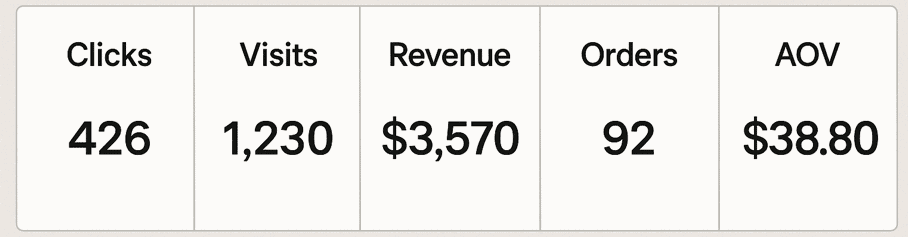
You’ve seen them. A single number in a tidy little box: Clicks. Revenue. Orders. AOV. Just a figure, standing alone like it says everything. But numbers without context don’t tell the full story. In fact, they can mislead.
Let me explain with a personal story.
My oldest daughter was diagnosed with type 1 diabetes at just 15 months old. Overnight, our lives changed. At that time, the only way to monitor her blood sugar was through a finger poke. The meter might read “104,” which sounds great. But without context, that number raised more questions than answers. Was she rising fast or crashing hard? Had the insulin taken effect, or was the food still digesting?
Back then, we didn’t have the continuous feedback loop a Dexcom now provides. Just snapshots. Her mom would check her repeatedly throughout the night to avoid dangerous highs or the terrifying lows that once led to a seizure. We had numbers—but not the story behind them.
That’s the danger with snapshots in dashboards, too.
The most common question they provoke: “Is that good or bad?”
If your dashboard is for an audience deeply familiar with the data, a snapshot might work. But if you’re building for an executive team—or anyone less immersed—you need more context. What’s normal? What’s the trend? Are we up, down, or flat?
Dashboards often sacrifice depth for space, so these horizontal bars of data seem efficient. I’ve created plenty myself. But just like that blood sugar reading, the number alone isn’t enough.
“Your power as a marketing leader comes not from what you know, but from what you do.”
“If you want to lead, you must make a choice: the choice to move beyond the marketing function.”
“Great marketing leaders mobilize people: bosses, colleagues, teams, and themselves.”
Book Theme
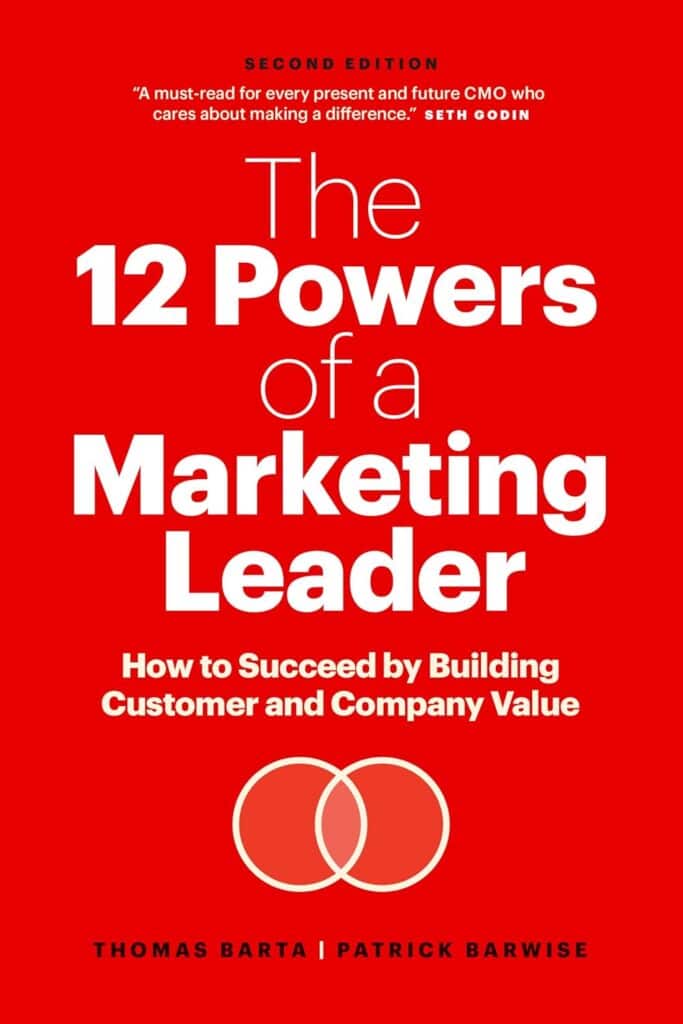
The 12 Powers of a Marketing Leader has as its central theme is that marketing leadership is not about technical skills or creativity alone. It’s about mobilizing people across the organization. The authors outline 12 essential “powers” that successful marketing leaders use to gain influence, drive growth, and lead change.
Why You Should Read This Book
It’s backed by the world’s largest leadership study on marketers (68,000+ executive assessments).
The book offers actionable steps for marketers who feel stuck or undervalued.
It bridges the gap between marketing execution and organizational leadership.
It’s highly relevant for CMOs, aspiring leaders, and cross-functional teams.
You’ll learn how to gain influence beyond your function and show business impact.
Key Ideas and Arguments Presented
Marketing is leadership. It’s not enough to be good at campaigns. You must drive strategy and change.
Leadership is not a title, it’s a choice. Influence starts with the decision to lead.
Credibility comes from impact. You must show how marketing delivers real business results.
Mobilize others. Great marketing leaders inspire and engage bosses, peers, and teams.
Marketing can’t succeed in isolation. Cross-functional collaboration is critical.
Build trust. Trust is the foundation of team success.
You must be both analytical and emotional. Winning hearts and minds is essential.
Early wins matter. Deliver returns fast to gain buy-in and momentum.
Inspiration is a skill. Learn how you inspire others and use it intentionally.
Marketers need courage. You must aim higher and challenge the status quo.
Book Outline
Introduction
Doing Marketing Isn’t the Same as Leading Marketing
Section I: Mobilize Your Boss
Power #1: Tackle Only Big Issues
Power #2: Deliver Returns, No Matter What
Power #3: Work Only with the Best
Section II: Mobilize Your Colleagues
Power #4: Hit the Head and the Heart
Power #5: Walk the Halls
Power #6: You Go First
Section III: Mobilize Your Team
Power #7: Get the Mix Right
Power #8: Cover Them in Trust
Power #9: Let the Outcomes Speak
Section IV: Mobilize Yourself
Power #10: Fall in Love with Your World
Power #11: Know How You Inspire
Power #12: Aim Higher
Final Sections
It’s Time for Your Launch
Appendix: About the Research
Key Takeaways
Marketing leadership is defined by your ability to influence, not just execute.
Bosses need marketers to solve big problems, not small ones.
Marketers must show ROI clearly and quickly.
Emotional intelligence is just as important as technical know-how.
Trust and inspiration are essential tools for building strong teams.
Marketing leaders must go beyond marketing—into strategy, operations, and finance.
Internal influence (“walking the halls”) is a daily leadership task.
You need to know what inspires people and use it deliberately.
Key Techniques
Mobilize Your Boss: Understand and align with their top goals.
Tackle Only Big Issues: Focus your time on high-stakes problems.
Deliver Returns, Fast: Prioritize early wins to build influence.
Walk the Halls: Build informal alliances and social capital internally.
Cover Them in Trust: Empower your team by assuming trust, not control.
Let the Outcomes Speak: Track and communicate your results, relentlessly.
Know How You Inspire: Identify your style of influence and amplify it.
Author’s Qualifications
Thomas Barta is a former McKinsey partner and global marketing leadership expert who led the largest global study of marketing leadership. Patrick Barwise is an Emeritus Professor of Management and Marketing at London Business School, known for his work on customer-focused strategy and marketing effectiveness.
Comparison to Similar Books
Compared to “This Is Marketing” by Seth Godin: Godin focuses on philosophy and brand connection, while The 12 Powers emphasizes internal leadership and corporate influence.
Compared to “Playing to Win” by Lafley and Martin: Both stress strategy, but The 12 Powers applies it directly to marketers leading across departments.
Compared to “Leaders Eat Last” by Simon Sinek: Sinek focuses on general leadership culture; Barta and Barwise provide practical steps specific to marketers.
Target Audience
Mid-level marketers ready to lead
CMOs seeking more influence in the C-suite
Cross-functional leaders collaborating with marketing
Business students in leadership and marketing tracks
Marketing consultants and executive coaches
CEOs looking to elevate their marketing team’s impact
Critical Response to the Book
Well-reviewed by global CMOs, marketing professors, and leadership experts.
Praised for being actionable, research-based, and directly applicable to real work settings.
Some readers wish for more B2C creative examples, but most value the strategic guidance.
One Sentence Takeaway
To become a powerful marketing leader, you must go beyond campaigns and take responsibility for mobilizing people, driving strategy, and delivering business growth.
3M’s Post-it Note is a classic story of a product born from accident and saved by smart marketing.
In 1968, a 3M scientist inadvertently created an adhesive that stuck lightly but lacked a strong bond. Instead of shelving this “failed” invention, a colleague realized it could make a handy removable note.
Years of persistence and a clever sampling campaign eventually turned these sticky notes into a runaway hit. This case matters because it shows how innovation, perseverance, and savvy go-to-market strategy can transform a near-failure into a worldwide phenomenon.
Company Involved
3M Company, a Minnesota-based multinational innovation company known for products like Scotch tape and Post-it Notes.
Marketing Topic
Innovation (Serendipitous Product Development)
Product Launch Strategy (Sampling and Market Education)
Public Reaction or Consequences
At first, the reaction to Post-it Notes was underwhelming. Early market tests and surveys were negative, and major office-supply distributors even dismissed the idea as “silly.” But once consumers got to try the product (through free samples in the “Boise Blitz”), over 90% said they would buy it. The broader public response quickly turned overwhelmingly positive. The notes spread organically as people stuck them on documents sent to others. Co-inventor Art Fry noted it “was always a self-advertising product” that aroused curiosity and demand. Within a few years, Post-its became an office staple worldwide and a pop culture icon (even appearing in movies and a Museum of Modern Art exhibit). The success brought 3M significant sales and cemented its reputation for innovation.
Why It Matters Today
• Embrace “Failure” in Innovation: Post-it’s creation proves the value of an innovation culture that allows experimentation. 3M famously let employees spend 15% of their time on side projects, a practice that helped spur inventions like Post-its and is emulated by modern tech companies.
• Educating the Market: Often customers don’t know they need something truly new until they experience it. 3M had to teach users how to use sticky notes. “No one knew they needed such a thing until they were presented with it.” Marketers today face similar challenges when launching innovative products.
• Power of Sampling and Virality: Post-it’s breakthrough came from letting people try it. The free sample campaign turned indifferent consumers into fans, illustrating the power of product trials. Once in use, the product essentially marketed itself via word-of-mouth, a dynamic every marketer seeks in the age of social sharing.
3 Takeaways
1. Perseverance Can Turn Mistakes into Gold: What started as a “failed” adhesive became a hit because 3M’s team refused to give up on it. Internal champions like Spencer Silver and Art Fry kept pushing until they found the right application. Marketers should not rush to discard a product that doesn’t succeed at first. Sometimes a pivot or a new angle can unlock its value.
2. Let Consumers Experience the Value: When launching a novel product, showing is better than telling. 3M’s big breakthrough came from putting Post-its in users’ hands via free samples. Once people tried the convenient sticky notes, demand skyrocketed. The lesson: free trials, demos, or samples can overcome skepticism and create authentic demand for something new.
3. Cross-Pollinate Ideas and Listen to Users: The Post-it Note was born when one employee’s problem met another’s unused invention. This cross-functional collaboration was key. Innovative solutions often emerge when ideas are shared across teams and when companies pay attention to everyday user frustrations. Encouraging open idea exchange can lead to creative breakthroughs that a single siloed team might miss.
Notable Quotes and Data
• “I’d spun my wheels a long time trying to find a product I could put my adhesive on…none of them were big enough to pursue.” – Spencer Silver, describing his low-tack glue as a “solution waiting for a problem to solve.”
• 90% – The proportion of people in 3M’s 1978 test market who said they would buy Post-it Notes after trying them for free.
• “It was always a self-advertising product because customers would put the notes on documents they sent to others… and then go out and buy a pad for themselves.” – Co-inventor Art Fry on how Post-its essentially marketed themselves through use.
Full Case Narrative
Background & Invention: In 1968, Dr. Spencer Silver, a chemist at 3M, was tasked with developing a super-strong adhesive – but instead he accidentally created a very weak, pressure-sensitive glue. This new adhesive had an unusual property: it could stick to surfaces yet peel off easily without leaving residue. For years, Silver promoted this invention inside 3M as an idea in search of a use. He believed it was unique and useful, but colleagues could not see an immediate application. Silver’s persistence was remarkable – he earned the nickname “Mr. Persistent” for his refusal to give up – yet by the early 1970s his low-tack glue was still a solution without a problem.
The “Eureka” Moment: The breakthrough came in 1974 through a colleague named Art Fry. Fry sang in his church choir and used scraps of paper to mark hymnal pages – but the placeholders kept falling out. One Sunday, frustrated by lost bookmarks, Fry remembered Silver’s odd adhesive. He realized that a light adhesive could make an ideal bookmark: it would stick to a page but not damage it upon removal. Fry had a flash of insight to coat small pieces of paper with Silver’s glue. Working within 3M’s culture that encouraged side projects, Fry teamed up with Silver to develop the idea. They created prototype sticky notes and started using them to pass messages around the office. Fry later recalled feeling a rush of excitement at this moment: it dawned on him that what they had was not just a bookmark but a whole new way to communicate. The tiny notes proved incredibly handy for leaving notes that would stick and re-stick anywhere. This was the birth of the Post-it Note concept.
Initial Launch & Setbacks: Convincing 3M to commercialize the idea took patience. After refining the product – including finding a way to apply the glue to paper uniformly – 3M launched the sticky notes under the name “Press ’n Peel” in 1977, testing them in four cities. The results were disappointing. Consumers were unfamiliar with the concept, and initial marketing did not effectively convey the utility of the product. Some market research participants even deemed the product unnecessary or trivial. By 1978, 3M was close to canceling the project due to lackluster test sales. It was a discouraging setback: the company had an innovative product, but people did not realize they needed it.
The Boise Blitz – Marketing Turns the Tide: Instead of giving up, 3M’s marketing team tried a bold experiment in 1978. They believed if people could just try the product, they would love it. So, in a last-ditch effort, 3M flooded the office market in Boise, Idaho with free samples of the sticky notes – a campaign that became known as the “Boise Blitz.” Secretaries, receptionists, and office workers around the city received pads of the product to test out. The impact was immediate and dramatic: once people experienced the convenience of these removable notes, demand surged. Approximately 90% of those who tried the free samples said they would buy the product afterwards. Equally important, the product began to advertise itself. Business users would stick the notes on documents sent to others, who in turn discovered this curious little yellow note and wanted their own pads. This word-of-mouth effect verified what Art Fry had observed – the Post-it Note sold itself by showing its value in use.
Explosion of Popularity: Armed with the evidence of enthusiastic consumer response, 3M rebranded the product with a catchy new name “Post-it Note” and launched it nationwide on April 6, 1980. This time, it was a smash hit. Virtually overnight, Post-it Notes became a must-have office supply across America. Sales far exceeded expectations, and the product quickly expanded to Canada and Europe by 1981. The distinctive canary-yellow pads – a color chosen simply because the lab next door had scrap yellow paper – were soon on desks everywhere. Users kept finding new uses – marking up documents, leaving reminders on doors, flagging pages – fueling even more demand. The viral “pass-it-along” nature of Post-its created a network effect: every time someone received a note, a new potential customer was born.
By the mid-1980s, the Post-it Note was not only a commercial success but a cultural phenomenon. In 1985, Time magazine declared Post-it Notes one of the best products of the previous 25 years. The product won design awards and earned 3M’s internal accolades for its creators. It even achieved pop-culture fame – for example, the 1997 film “Romy and Michele’s High School Reunion” jokingly fictionalized the invention of Post-its, and a 2003 episode of “Sex and the City” featured a breakup via Post-it note. The Museum of Modern Art inducted the Post-it Note into its permanent design collection as a humble masterpiece of everyday design. All this from an idea that almost did not see the light of day.
Why It Worked (Analysis): Several factors contributed to Post-it’s success. First, the product genuinely solved a common problem – leaving temporary notes – in a simple, elegant way. It met an unarticulated need. Second, 3M’s corporate culture of innovation played a huge role. The company allowed employees like Silver and Fry to experiment outside their core projects. That culture meant a quirky idea could survive long enough to prove itself. Third, 3M’s marketing strategy was crucial. Rather than rely on traditional advertising to explain a new behavior, they got the product into people’s hands. The free sampling approach created a community of advocates who understood the product’s value and spread the word. In modern terms, 3M generated product-led growth – letting the product itself convert users into buyers. Finally, the Post-it Note benefitted from excellent execution: a memorable name, a distinctive color, and expansion into different sizes and colors as demand grew. It was small and inexpensive, making it easy for anyone to try and for it to become a staple purchase.
Timeline
1968: Spencer Silver at 3M accidentally invents a low-tack, reusable adhesive while trying to make a stronger glue.
1974: Art Fry conceives the idea of using Silver’s adhesive to create sticky bookmarks for his hymnal.
1977: The product (initially named “Press ’n Peel” memo pads) is test-marketed in four U.S. cities. The results are disappointing.
1978: 3M executes the “Boise Blitz” in Idaho, giving away free samples to office workers. The campaign is a huge success.
April 6, 1980: Post-it Notes officially launch nationwide in the United States. They become an instant hit.
1981: Post-it Notes debut in Canada and Europe as international demand grows.
1985: Time magazine names Post-it Notes one of the top consumer products of the past 25 years.
1990s–2000s: Product line expands, Post-its appear in pop culture, and are included in museum design exhibits.
What Happened Next?
After the explosive success of Post-it Notes, 3M fully capitalized on its new creation. The company extended the Post-it product line to include a variety of colors, sizes, and formats. They even developed Super Sticky versions. 3M introduced digital Post-it software and mobile apps to meet evolving needs. The brand’s messaging today highlights creativity and collaboration, maintaining relevance in a digital age. The story of the Post-it Note helped define 3M’s innovation culture and remains a shining example of how perseverance, sampling strategy, and product-led marketing can result in enduring success.
One Sentence Takeaway
Even a failed glue can become a global marketing triumph. The Post-it case shows that innovation thrives when you persist with good ideas and let customers experience a product’s value directly.
If it has been more than 10 years since I saw a movie, it might as well be brand new to me. So, when my daughter recently recommended The Intern, I gave it another watch — and I am glad I did.
I had already rated it an 8 back when it came out, which is higher than its 7.1 score on IMDb. It did not take long to remember why.
It is not just a charming film with great performances. It is a great movie about the business world — about startup chaos, leadership choices, generational wisdom, and the real weight of trying to balance it all.
Rewatching it through the lens of a marketer, I saw even more layers worth unpacking. Here are a few timeless lessons The Intern still teaches us in 2025.
1. Do Not Underestimate Experience: Ageism Is Bad for Business
In a youth-obsessed startup culture, it is easy to overlook what older professionals bring to the table. Robert De Niro’s character, Ben, does not just fill a desk. He brings steadiness, emotional intelligence, and practical problem-solving.
Age diversity is not just a checkbox. It is a strategic advantage.
“Experience never gets old. It gets sharper.”
2. Delegating Is Smart, But Abdicating Is Not
Anne Hathaway’s character, Jules, is stretched thin because she has not figured out what to let go of. Most of use have been there.
We glorify hustle culture, but if everything runs through one person, nothing scales. Great leaders know how to delegate with intention, while still remaining present.
3. Culture Does Not Run on Autopilot
The startup Jules runs has all the trappings of a modern culture. Open office layout. Casual dress. Startup buzz. But the emotional culture is fraying. Why? Because when the leader is overwhelmed, the culture goes untended.
Culture is built moment by moment. And marketers know it is part of your brand story too.
“A great company culture doesn’t happen by accident. You get it by showing up.”
4. Work-Life Balance Is a Leadership Responsibility
Jules is burning the candle at both ends, and the impact on her personal life is real. This is not just a subplot. It is a business problem.
Burned-out leaders make reactive decisions, miss strategic pivots, and lose good people. Balance is not a luxury. It is part of sustainable leadership.
5. Mentorship Should Go Both Ways
Ben becomes a quiet mentor to many of the younger team members, but he also learns from them. It is the perfect example of reverse mentorship. Older professionals offer life experience, while younger teammates share fresh skills and perspectives.
Marketing teams especially benefit from this synergy. Tools are evolving fast, but timeless principles still apply.
“Innovation and experience are not rivals. They are partners.”
6. Empathy Is a Superpower
Ben does not push himself into meetings or shout for attention. He listens. He supports. He notices what others miss.
In marketing and in leadership, empathy builds trust faster than any slogan. It is how we connect with customers, coworkers, and ourselves.
7. Business Is Personal and That Is Okay
This movie works because it reminds us that people bring their whole selves to work — stress, dreams, insecurities, relationships, and all. You can run a tight business and still be a kind, thoughtful human being. In fact, that is probably the only way to succeed long term.
So whether you’re leading a startup, managing a team, or just trying to market with more heart, give The Intern a rewatch. You might find it speaks to you more now than it did back then.