linkedin impressions

What Happened When I Cut My LinkedIn Post Frequency in Half

Reading Time: 2 minutes

Earlier this year, I published a post about what I learned from posting every business day on LinkedIn for a full month. Since then, I’ve kept experimenting and paying close attention to what’s working and what’s sustainable.

From January 1 to May 14, I posted on LinkedIn every business day minus holidays. But starting May 14, I made a strategic shift to publish only twice a week—on Tuesdays and Thursdays.

I wasn’t burned out or running out of ideas. But I received some thoughtful feedback from a former colleague to scale back so I could focus more on my MBA and job search. I took that advice seriously despite cutting back on something I loved.

So, did posting less often hurt my reach or engagement?

Impressions: Consistent Results, Slightly Fewer Spikes

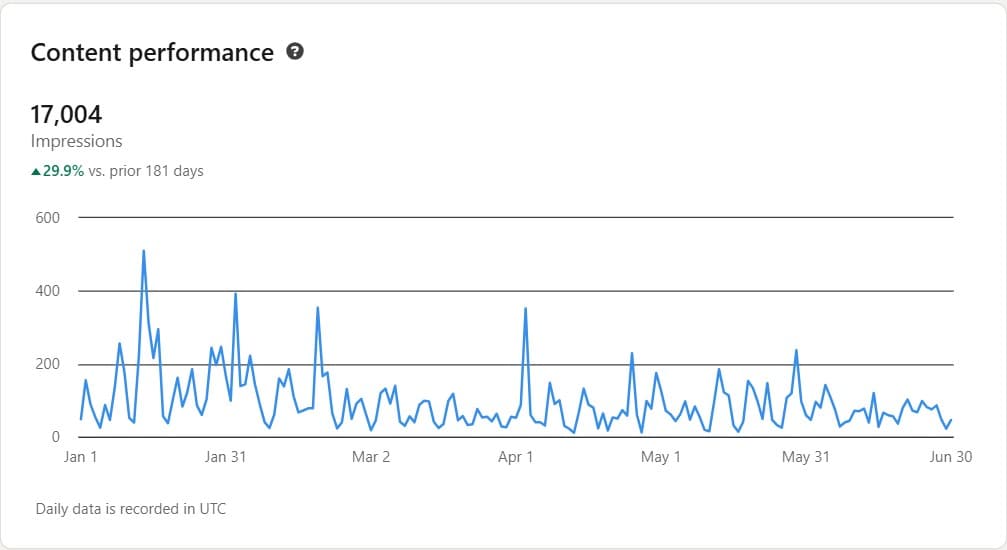
From January through June, I earned over 17,000 impressions on my LinkedIn posts, up nearly 30% compared to the previous 181-day period. Even after scaling back, my overall reach didn’t drop significantly. The volume stayed consistent. What did change is the number of dramatic spikes. Earlier in the year, I saw several big jumps in visibility. Since May 14, the trend has been flatter, which could be due to reduced post volume, or simply the nature of the topics I’ve been covering lately.

But the key takeaway? Less frequent posting hasn’t hurt performance in any meaningful way.

Engagement: Holding Steady, Even Improving

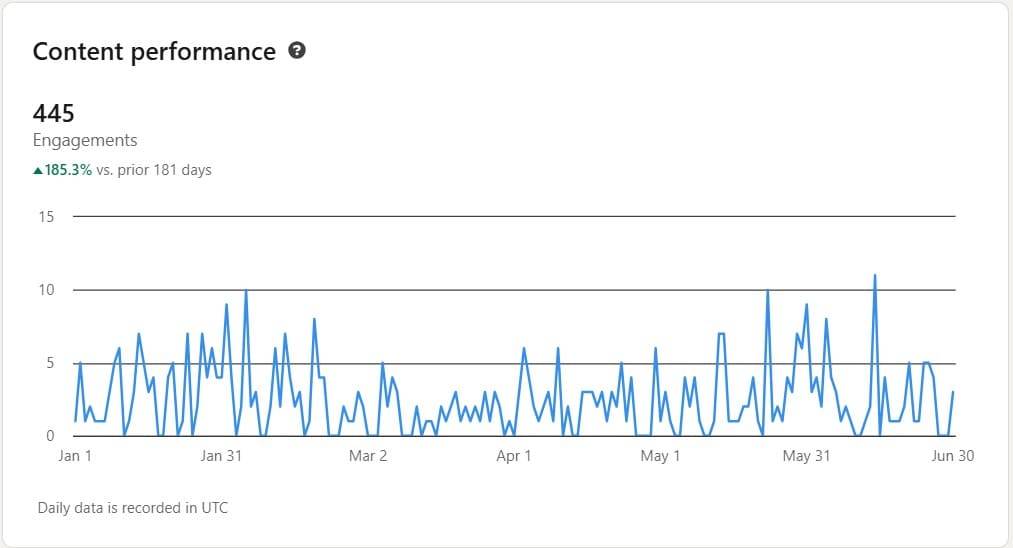
Even more interesting is the engagement. My posts generated 445 engagements—a jump of 185% from the previous period. That’s comments, reactions, and shares, which reflect how the audience is actually interacting with my content.

Since May 14, I’ve seen strong bursts of engagement, even with just two posts per week. In some cases, the engagement looks higher than what I saw while posting daily. This suggests a few things:

  • Quality over quantity is working. Posting less hasn’t dulled my impact. It may have sharpened it.
  • Intentional content resonates more. With fewer posts, each one stands out more and gives people space to respond.
  • Consistency still matters. Even at twice a week, maintaining a regular rhythm helps keep my audience connected.

I didn’t disappear. I just got more focused. And the data shows that approach is paying off.

Final Thoughts

This small experiment has reminded me that posting daily isn’t the only way to grow. For me, twice a week feels sustainable and effective, and it gives me room to create better content while pursuing other goals.

I’ll keep tracking, updating these charts, and adjusting along the way. If you’re wondering whether to scale back your own content schedule, know this: staying visible doesn’t mean staying overwhelmed. Be consistent, stay intentional, and measure what matters.

Have you adjusted your posting cadence before? I’d love to hear what changed for you.

What Happened When I Cut My LinkedIn Post Frequency in Half Read More »

case study lego turnaround 2

Case Study: Lego Turnaround From Broken Bricks to Blockbuster

Reading Time: 8 minutes

Brief Summary

LEGO, the Danish toy maker famous for its plastic bricks, nearly went bankrupt in the early 2000s due to falling sales and strategic missteps.

Yet it staged one of the most remarkable turnarounds in corporate history. By refocusing on its core product and creative play ethos, cutting back on bloated diversifications, and smartly leveraging partnerships (like Star Wars, Marvel, and Harry Potter franchises), LEGO transformed from a company on the brink of collapse into the world’s most powerful toy brand.

This case study explores how LEGO rebuilt its empire brick by brick, and what marketers can learn from its revival and recent successes.

Company Involved

The company at the center is The LEGO Group, a privately held Danish toy company founded in 1932 (name derived from “leg godt”, meaning “play well”). LEGO is best known for its interlocking plastic bricks that have inspired generations of builders worldwide.

Marketing Topic

  • Strategy
  • Product Positioning
  • Branding

Public Reaction or Consequences

LEGO’s dramatic comeback drew widespread praise. Business media hailed it as possibly “the greatest turnaround in corporate history.” The public response to LEGO’s new direction was overwhelmingly positive – children and adult fans alike returned to the brick. By 2014, LEGO had overtaken Mattel to become the world’s largest toy maker, a feat fueled by excitement for its revitalized products. Culturally, LEGO became cooler than ever: The LEGO Movie (2014) opened at #1 with a $69 million weekend, showing the brand’s newfound cultural cachet. Instead of backlash, LEGO’s changes earned fan loyalty and nostalgia-driven goodwill, turning its plastic bricks into a cross-generational phenomenon once again.

Why It Matters Today

Core Focus in a Diversified World: In an era when companies chase new trends (from metaverse to AI), LEGO’s story underlines the value of focusing on core brand strengths. Sticking to what you do best, while adapting it cleverly, can outperform scattershot diversification.

Customer-Centric Innovation: The case shows the power of listening to your audience. By co-creating with fans and aligning products with customer passions (e.g. tie-ins to beloved franchises), LEGO stayed relevant in changing times. This is a lesson for today’s marketers to build communities and innovate with their consumers.

Brand Resilience and Adaptation: In a fast-evolving market, even legacy brands must continually reinvent themselves. LEGO’s turnaround is a blueprint for resilience – combining creative marketing (movies, licensed IPs) with operational discipline. It’s a reminder that brand revival is possible even amid digital disruption, through agile strategy and authentic brand experiences.

3 Takeaways

1. Never Neglect Your Core Competency: LEGO nearly collapsed by overextending into businesses far from its core. The turnaround began when it refocused on what made LEGO great, the brick and creative play. Marketers should remember to build on their brand’s unique strengths rather than chasing every new trend.

2. Listen and Co-Create with Your Audience: Reconnecting with customers was pivotal for LEGO. The company solicited feedback, added fan-requested features (like new brick colors and themes), and partnered with franchises its customers loved – e.g. Harry Potter sets that flew off shelves. The lesson is to involve your community in product innovation and respond to what they value.

3. Strategic Partnerships Amplify Marketing: Rather than go it alone, LEGO smartly collaborated with popular IPs (Star Wars, Marvel, DC, etc.) and media projects. These partnerships expanded LEGO’s reach and created win-win marketing moments (toys promoting movies and vice versa). Marketers can leverage aligned partnerships to tap into new audiences while strengthening their brand’s appeal.

Notable Quotes and Data

“We’re running out of cash… [and] likely won’t survive,” LEGO CEO Jørgen Vig Knudstorp warned colleagues at the height of the crisis. This candid admission underscored how dire the situation was in 2003.

26% sales plunge: In 2003, LEGO’s sales were collapsing at a rate of roughly 26–30% per year, and the company lost 1.4 billion DKK (≈£150 million) that year. Burdened by about $800 million in debt, the 71-year-old family-owned firm was nearly out of cash.

“Focus on the one, iconic product… get more kids to play with it,” advised The New Yorker (noting LEGO’s strategy vs. rivals). Indeed, LEGO’s refusal to abandon its core product became the bedrock of its comeback, proving that innovation can flourish around a strong core rather than away from it.

Full Case Narrative

The LEGO Group had enjoyed decades of success selling its patented plastic bricks, famously never posting a loss from its founding in 1932 up until the late 1990s. By the 1980s, LEGO was the world’s most popular toy, synonymous with creative play. However, in the 1990s the industry landscape shifted rapidly. Video games and electronic toys captured kids’ attention, and cheaper clone brands began undercutting LEGO’s market. In response, LEGO overreacted and lost its strategic focus. The company diversified into all sorts of ventures – from LEGO-branded clothing and watches to publishing, video game development, even operating its own Legoland theme parks. These moves stretched the brand thin and drained resources, all while LEGO’s core plastic brick sets suffered from a lack of innovation and identity. By trying to be “more than just a toy company,” LEGO forgot what made it special in the first place.

LEGO’s missteps came to a head by 2003. After years of declining results, the company found itself on the brink of bankruptcy. Sales had plummeted double digits, leaving major retailers with a glut of unsold LEGO stock by early 2003. Internally, costs were out of control: at one point LEGO had swollen to over 14,000 different pieces and elements in its inventory, driving its manufacturing costs sky-high. Meanwhile, splashy ventures like the theme parks were losing money and sucking funds from the profitable toy business. An internal review revealed shocking inefficiencies – in some cases LEGO was selling high-tech sets (with motors or electronics) for less than they cost to produce. Debt mounted to over $800 million, and the company was reportedly losing nearly USD $1 million every single day by 2004. Private equity firms began circling this family-owned firm as a potential bankruptcy buyout. The crisis was so severe that a young LEGO executive, Jørgen Vig Knudstorp, told colleagues “we’re on a burning platform” and warned that LEGO might not survive much longer.

In October 2004, at the height of the turmoil, 35-year-old Jørgen Vig Knudstorp was appointed CEO of LEGO. It was a bold move – Knudstorp was the first non-family CEO and a relative newcomer. Yet this “rookie” outsider would become the unlikely savior of LEGO. Knudstorp had spent his initial years at LEGO studying the company’s problems and gathering input from employees and customers. He concluded that LEGO had “lost the plot” – it had confused rampant growth with success and forgotten its core mission. Upon taking the helm, Knudstorp’s strategy was essentially to rebuild LEGO by going back to basics.

He immediately refocused the company on its core product: the classic LEGO brick and the creative building experience it offers. Extraneous ventures were cut or sold off. In 2005, LEGO divested its ownership of the money-losing Legoland theme parks and shed other non-core businesses and licensing flops that had been distractions. Knudstorp also slashed the bewildering array of LEGO pieces and sets – cutting the number of unique LEGO pieces by more than 50%. This simplification dramatically lowered production costs and complexity. Internally, he brought a sense of urgency and discipline that had been lacking. For example, under previous management LEGO didn’t even know the exact cost breakdowns of many products; Knudstorp instilled basic financial rigor to stop the bleeding.

Crucially, the new CEO also reoriented LEGO’s culture toward its consumers – namely, kids and the loyal adult fans of LEGO. He brought in child development experts and had LEGO designers observe children at play to gather insights. LEGO staff returned to the mindset of their end-users: how kids build, what sparks their imagination, what frustrates or bores them. This customer-centric approach helped LEGO designers create more appealing sets. Instead of telling kids how to play, LEGO went back to enabling kids to “build and unbuild” freely, recapturing the creative magic of the brick. Knudstorp also welcomed input from the fan community. The company launched initiatives for fans to submit design ideas (which later became the LEGO Ideas crowdsourcing platform) and even hired some top fan builders as designers. Handing some creative control to devoted LEGO enthusiasts was a novel step, but it helped inject fresh innovation that was still true to the LEGO spirit.

At the product level, LEGO made a conscious decision to trim the wild experiments and double down on themes that worked. The early 2000s had seen LEGO try everything from action figures to strange hybrids that strayed from its interlocking bricks. Under the new strategy, LEGO shifted back to sets that emphasized building and imagination – but with modern twists. One successful move was to integrate popular licensed themes in a balanced way. LEGO had dabbled in licensing characters (its Star Wars sets launched in 1999 were a hit), but now it fully leveraged these partnerships while keeping the LEGO DNA in the products. Soon, LEGO introduced new lines tied to blockbuster franchises like Harry Potter, Batman, and Marvel’s Avengers, blending beloved characters with LEGO’s build-and-play format. These licensed sets attracted waves of new customers because kids (and adult collectors) loved building their favorite movie scenes and superheroes. At the same time, LEGO nurtured its own original themes (such as LEGO City, Technic, and later Ninjago and Friends), ensuring it wasn’t solely dependent on Hollywood hits.

Another pillar of the turnaround was marketing and brand experience. During the crisis, LEGO’s brand had started to feel stale and fragmented. Knudstorp’s era re-energized the brand with a clear, kid-focused identity: LEGO stood for creativity, quality, and fun. Marketing campaigns now highlighted kids’ imaginative creations and the limitless possibilities of LEGO bricks, rather than gimmicky side products. The company also embraced digital media in a smart way. Instead of trying to build a video game empire in-house (which had failed before), LEGO licensed its IP to experienced game developers. The result was a string of successful LEGO video games (like LEGO Star Wars: The Video Game in 2005) that both earned revenue and promoted the toy brand, without LEGO having to manage game development. Similarly, LEGO ventured into movies not by traditional advertising, but by making the play itself the star – The LEGO Movie in 2014 was essentially a 100-minute advertisement for creativity, yet it captivated audiences and critics with its humor and heart, generating over $469 million globally. This “content marketing” approach turned LEGO into not just a toy maker but an entertainment brand, boosting its profile and sales of tie-in products.

The impact of these changes was dramatic. LEGO’s financial free-fall was arrested by 2005, and by 2006 the company returned to profitability. Over the next few years, LEGO grew at an astounding rate. From 2004 to 2014, LEGO’s revenues quadrupled, and operating profits grew even faster. By 2010, just six years after near-bankruptcy, LEGO had become one of the toy industry’s biggest success stories – its profits in 2008–2010 alone quadrupled, outpacing even tech darlings like Apple in growth rate. In 2014, LEGO surged past Mattel to become the world’s #1 toy company by revenue and profit. That year, LEGO reported an annual profit of 8.2 billion DKK (approximately $900 million) – about the same as what tech giant Facebook earned that year. This was nine straight years of record-breaking growth for LEGO, a near-miraculous turnaround from the dark days of 2003.

Equally important, LEGO’s brand was reborn. In 2015, Brand Finance named LEGO the “world’s most powerful brand,” even ahead of iconic names like Ferrari. The British Association of Toy Retailers had already voted LEGO “Toy of the Century,” and LEGO’s ubiquitous Minifigure characters even outnumbered humans on the planet by that point. Such accolades reflected a brand stronger than ever. Through the late 2000s and 2010s, LEGO became ingrained in pop culture – from YouTube videos made by fans, to celebrity endorsements (even English football star David Beckham spoke publicly about relaxing by building LEGO sets). The LEGO movies (including The LEGO Batman Movie in 2017) further solidified that LEGO could seamlessly bridge toys and entertainment, delighting audiences while reinforcing the core product. In short, LEGO didn’t just recover financially; it rekindled the emotional connection with its audience.

Timeline

1932: LEGO is founded in Denmark by Ole Kirk Christiansen.

1999: LEGO introduces licensed Star Wars sets, signaling a shift.

2003: LEGO nears bankruptcy with heavy losses and $800M debt.

2004: Knudstorp becomes CEO and launches the turnaround strategy.

2014: The LEGO Movie releases and LEGO becomes #1 toy company.

2024: LEGO surpasses $10B in revenue, with blockbuster franchises driving growth.

What Happened Next?

LEGO’s revival has proven sustainable. After its turnaround in the late 2000s, the company kept its momentum by sticking to the principles that saved it. Rather than return to reckless expansion, LEGO pursued disciplined growth, entering new markets and product categories carefully…

One Sentence Takeaway

LEGO’s comeback proves that when a brand is falling apart, rebuilding by refocusing on what made it iconic, while still innovating around that core, can turn near-failure into phenomenal success.

Sources and Citations

The Guardian – How LEGO Clicked: the super brand that reinvented itself

CNA – How a rookie brought LEGO back from the brink

The Guardian – LEGO builds record profit

Business Insider – How LEGO came back from the brink of bankruptcy

Smithsonian – LEGO is the biggest toy company in the world

LEGO Group – 2022 Annual Results

LEGO Group – 2024 Record Results

Case Study: Lego Turnaround From Broken Bricks to Blockbuster Read More »

marketing with ai for dummies

Marketing with AI for Dummies by Shiv Singh Book Summary

Reading Time: 3 minutes

Top Three Quotes

Version 1.0.0
  1. “AI isn’t replacing marketers—it’s supercharging them.”
  2. “Marketing will be less about guessing and more about predicting.”
  3. “The future of marketing lies in creating deeply personalized experiences at scale.”

Book Theme

The Marketing with AI for Dummies book centers around how artificial intelligence is transforming marketing by automating repetitive tasks, improving customer insights, and enhancing personalization which enables marketers to be more strategic, efficient, and data-driven.

Why You Should Read This Book

  • Learn how AI tools can elevate every aspect of marketing from customer segmentation to content creation.
  • Get practical, real-world use cases of AI in email marketing, paid media, SEO, and customer journey mapping.
  • Understand the ethical considerations and best practices for implementing AI responsibly.
  • Stay competitive in a rapidly evolving digital landscape by upskilling in AI.

Key Ideas and Arguments Presented

  • AI is a tool for augmentation, not replacement. It enhances creativity and strategic thinking.
  • Data is the fuel for AI. Quality input data is essential for accurate AI outcomes.
  • AI enables hyper-personalization by analyzing customer behavior and preferences at scale.
  • Predictive analytics and machine learning can forecast customer needs and optimize timing.
  • AI simplifies content generation by auto-creating or suggesting blog posts, product descriptions, or emails.
  • Chatbots and virtual assistants can significantly enhance customer service and response times.
  • AI is transforming ad targeting and optimization with real-time bidding and adaptive campaigns.
  • Ethics and transparency in AI are crucial for maintaining customer trust.
  • AI is not plug-and-play. It requires the right infrastructure, training, and human oversight.
  • Marketers need to evolve their skills to include data analysis, prompt engineering, and AI literacy.

Book Outline

  • Introduction to AI in Marketing
  • AI in Content Marketing
  • AI for Social Media and Influencer Strategy
  • Personalization and Predictive Analytics
  • Using AI in Paid Media and SEO
  • Customer Service and Chatbots
  • AI Tools and Technologies for Marketers
  • Challenges, Risks, and Ethics of AI
  • Future-Proofing Your Marketing Career

Key Takeaways

  • AI can make marketers smarter, not obsolete.
  • It’s critical to choose the right tools that align with your goals.
  • AI is already in many platforms (e.g., Google Ads, HubSpot) and can be used without deep coding knowledge.
  • Ethical AI use matters—bias and privacy must be managed.
  • Marketers who embrace AI now will lead the next generation of customer engagement.

Key Techniques

  • Prompt optimization for better AI output in content tools.
  • Customer segmentation models using AI clustering.
  • Predictive lead scoring based on behavioral data.
  • A/B testing with AI automation to speed up conversion insights.
  • AI-driven email subject line testing using natural language processing.

Author’s Qualifications

Shiv Singh’s background:

  • Former SVP of Marketing at Visa and digital marketing leader at PepsiCo.
  • Advisor to AI and tech startups.
  • Recognized thought leader in digital transformation and brand strategy.
  • Co-author of multiple marketing-related books and frequent keynote speaker.

Comparison to Similar Books

Target Audience

  • Digital marketers looking to modernize their strategy
  • CMOs and marketing executives evaluating AI solutions
  • Small business owners exploring automation tools
  • Marketing students or professionals wanting to stay relevant
  • Content creators and social media managers using AI tools
  • Customer experience and CRM managers
  • Marketing consultants advising on tech adoption

Critical Response to the Book

  • Praised for simplifying a complex topic without dumbing it down
  • Recognized for actionable insights and relatable examples
  • Appreciated by both beginners and mid-level marketers for its tool-based recommendations

One Sentence Takeaway

Marketing with AI isn’t about replacing people. It’s about equipping marketers to create smarter, faster, and more personalized campaigns at scale.

Marketing with AI for Dummies by Shiv Singh Book Summary Read More »

,
marketing sin01 click here

The Biggest Marketing Sins and How to Avoid Them

Reading Time: 4 minutes

Marketing may be full of buzzwords and best practices, but some habits are just plain harmful. This growing list of marketing sins uses humor and satire to highlight real issues that can quietly ruin your results. The images may make you laugh, but the lessons behind them are serious. Review each one to make sure you’re not unknowingly guilty. And if you are, now’s the time to repent.

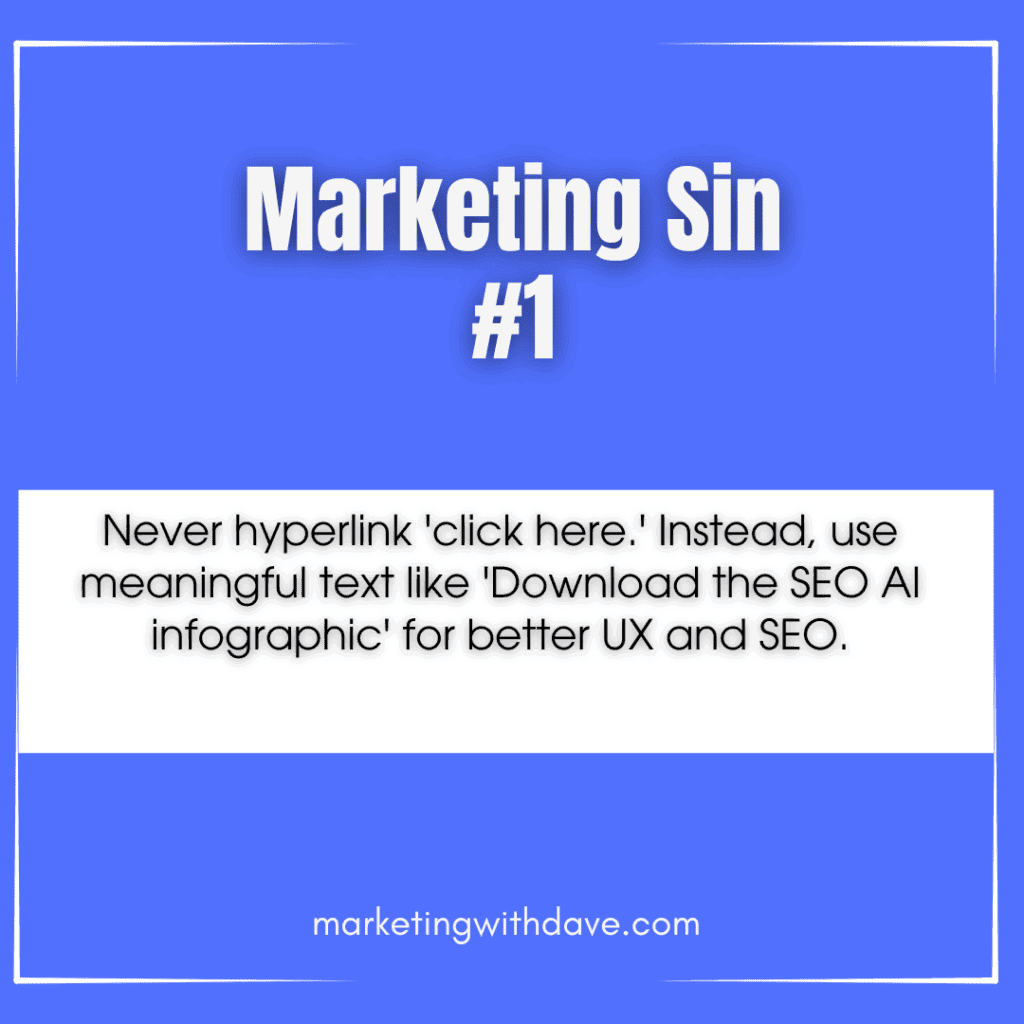
Marketing Sin #1: Using Click Here Hyperlink Text

Using ‘click here’ is lazy and ineffective. Instead, use descriptive text that tells visitors and search engines what to expect—don’t waste a valuable opportunity!

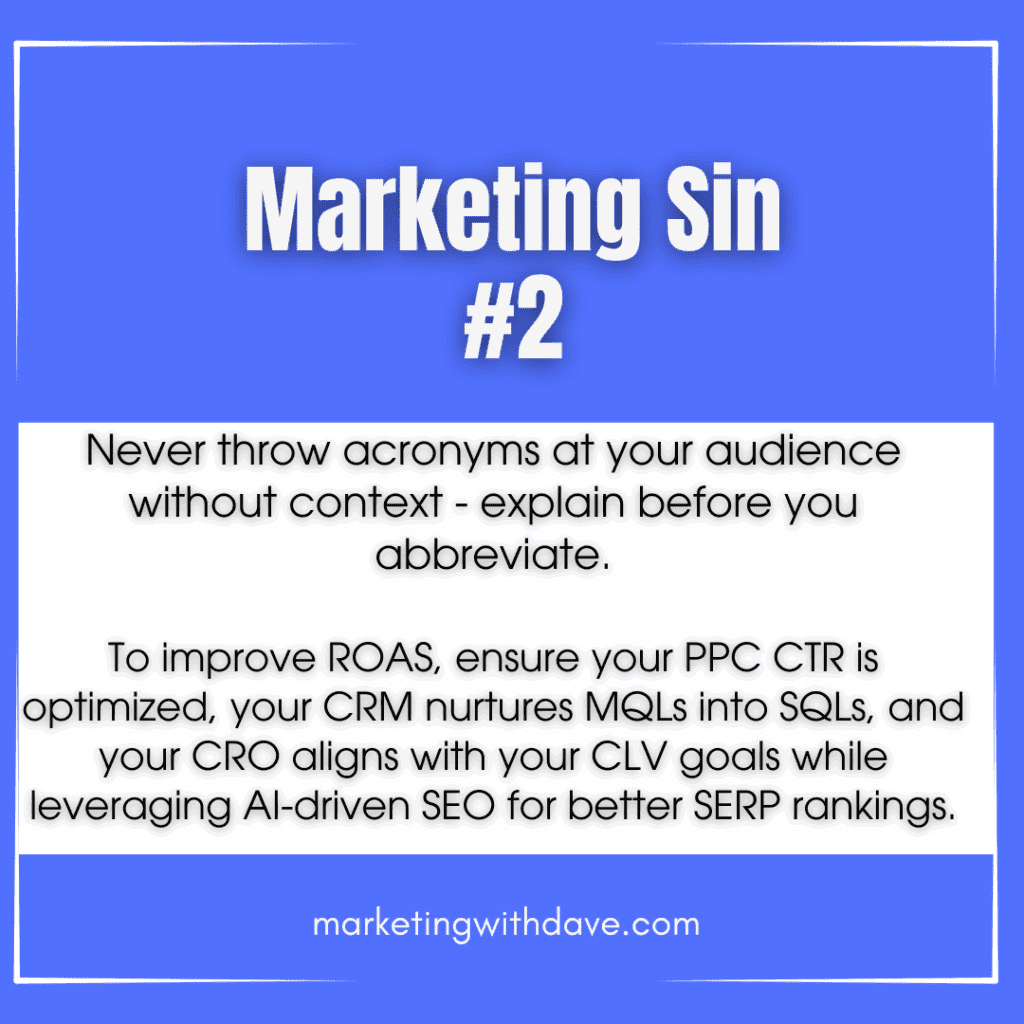
Marketing Sin #2: Using Acronyms Without Context

If your goal in communication is to be understood, meaning you adapt your message to your audience, this will likely never be a problem. But when acronyms get tossed around without context, especially outside your internal team, confusion kills momentum. Explain first, then abbreviate.

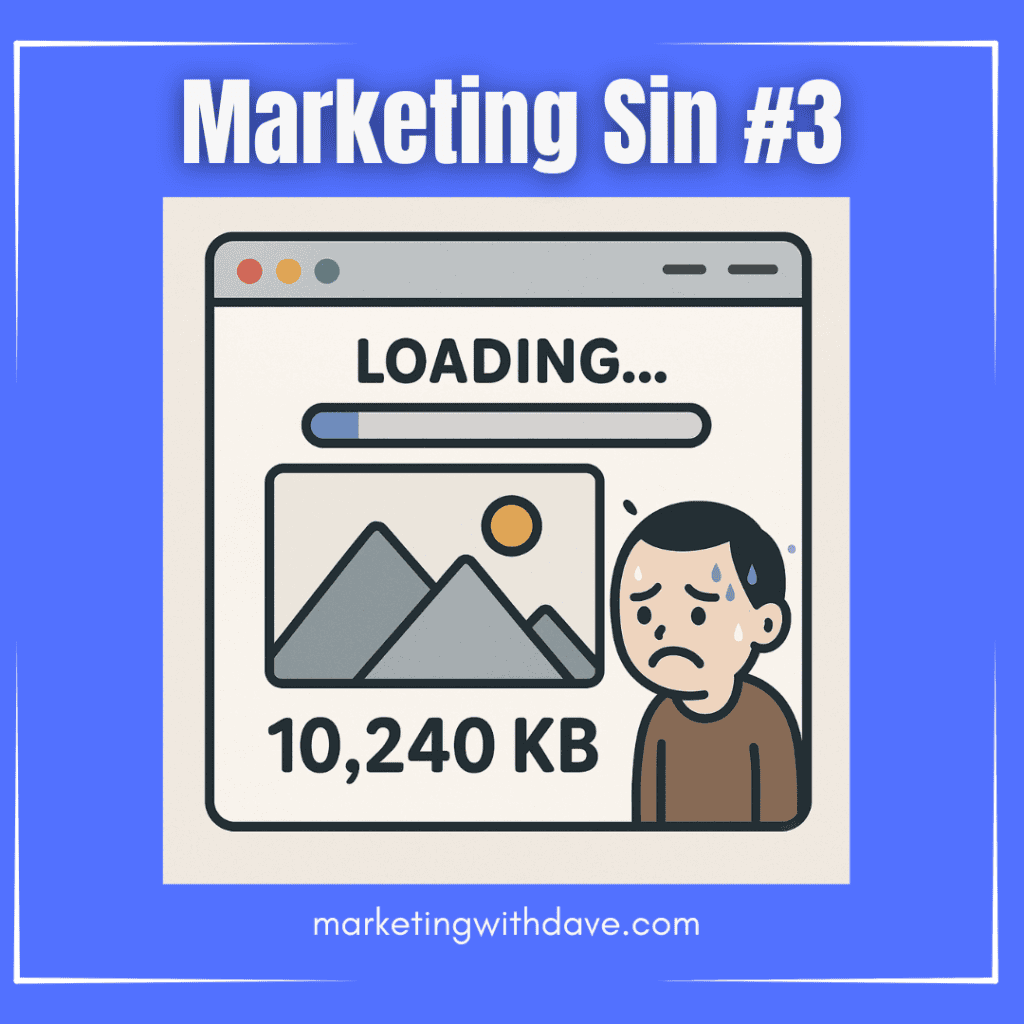
Marketing Sin #3: Using Images That Are Too Large

Is your website crawling because of massive image files?

Keep this in mind:

  • Most images should be under 100 KB
  • Use JPEGs for photos and PNGs only when transparency or sharp lines are needed
  • Work with your designer to balance quality and size

Faster load times = better UX, better SEO, and better conversions. Don’t let bloated images sink your performance.

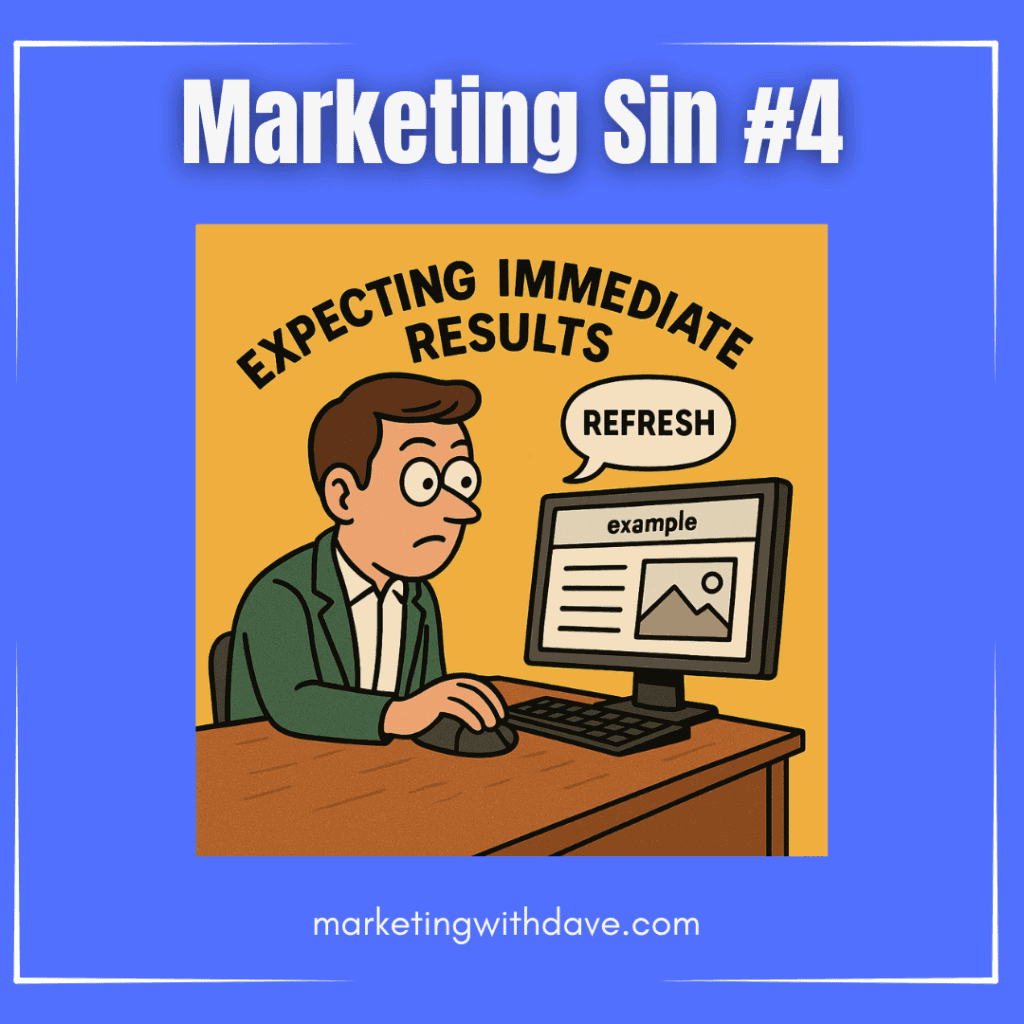
Marketing Sin #4: Expecting Immediate Results

A cartoon man sits at a computer, repeatedly hitting refresh, looking frustrated. Text above reads Marketing Sin #4: Expecting Immediate Results. Website marketingwithdave.com appears at the bottom.

Some of the most effective marketing work is the most unsexy. It’s rinse and repeat. It’s consistency.
SEO takes time. Brand awareness takes repetition.
And while you may be sick of your messaging, most of your audience is just starting to notice.
Results come from showing up again and again.
Patience is a marketing superpower.

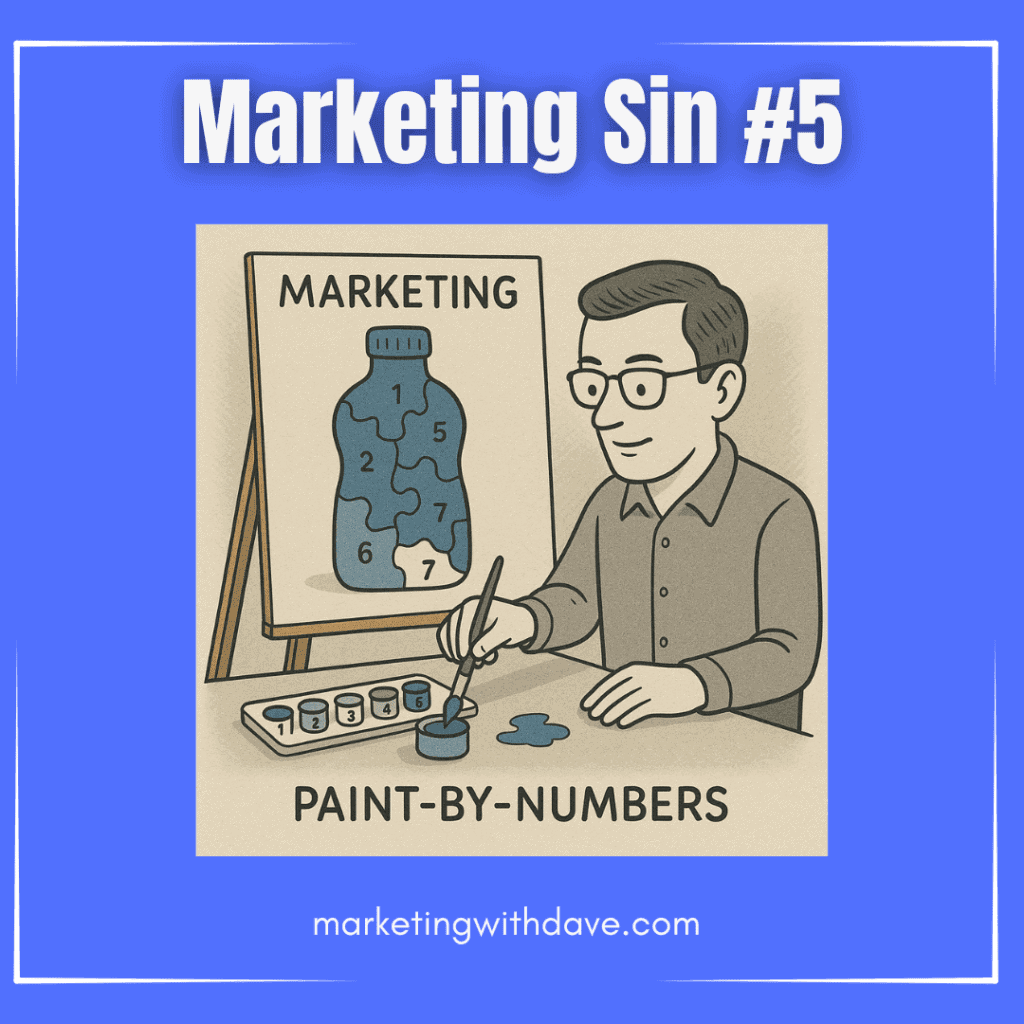
Marketing Sin #5: Assuming Marketing Success is Paint By Numbers

Success in one campaign doesn’t guarantee success in the next.

Marketing isn’t paint-by-numbers. What worked once won’t necessarily work again without adjustment. Your audience may have changed. The market, the platform, the timing—even the mood of the world could be different.

Treat every campaign like it’s your first: with curiosity, context, and a fresh set of eyes.

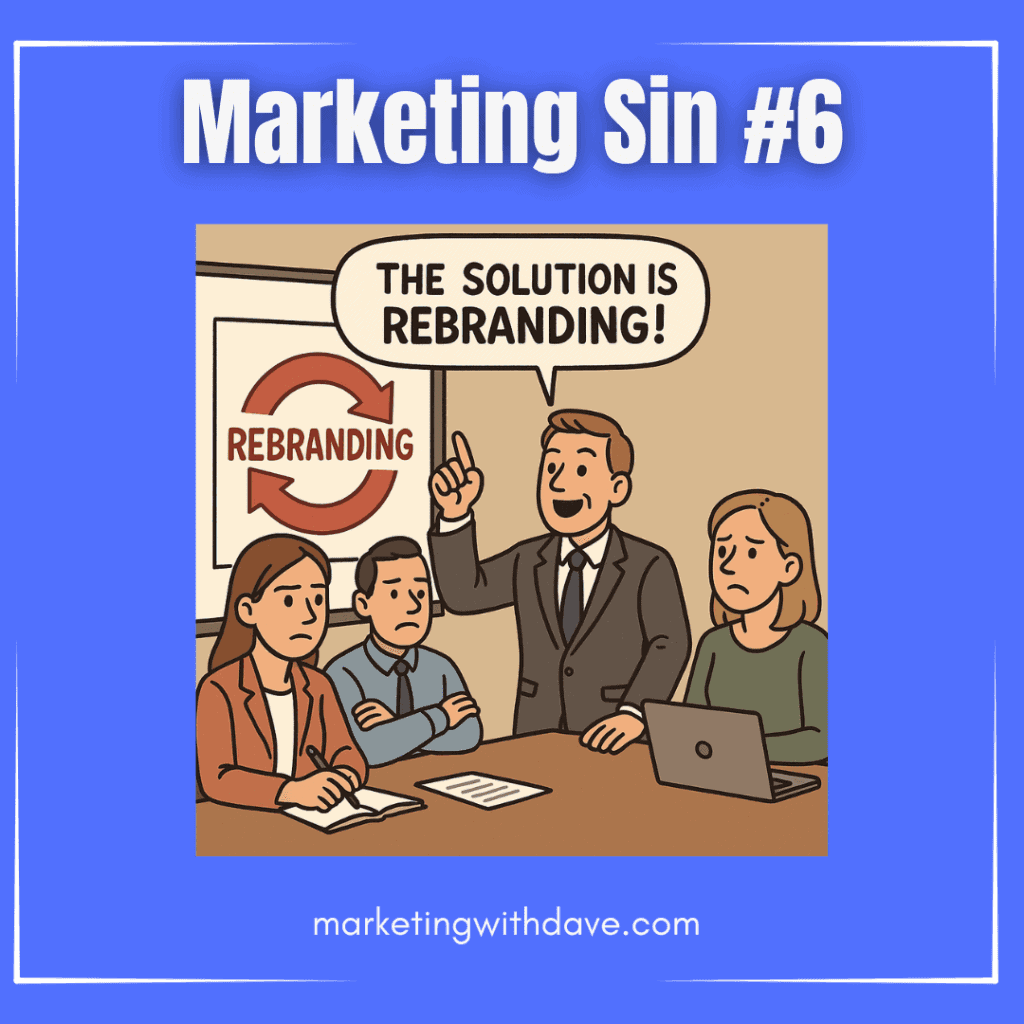
Marketing Sin #6: Using Rebranding to Avoid Real Problems

Rebranding isn’t a magic wand. Too often, it’s used as a knee-jerk reaction to underperforming campaigns or leadership shakeups. While rebranding can be a powerful strategic move when done right, using it to cover deeper issues can be a costly distraction that doesn’t fix the root issue.

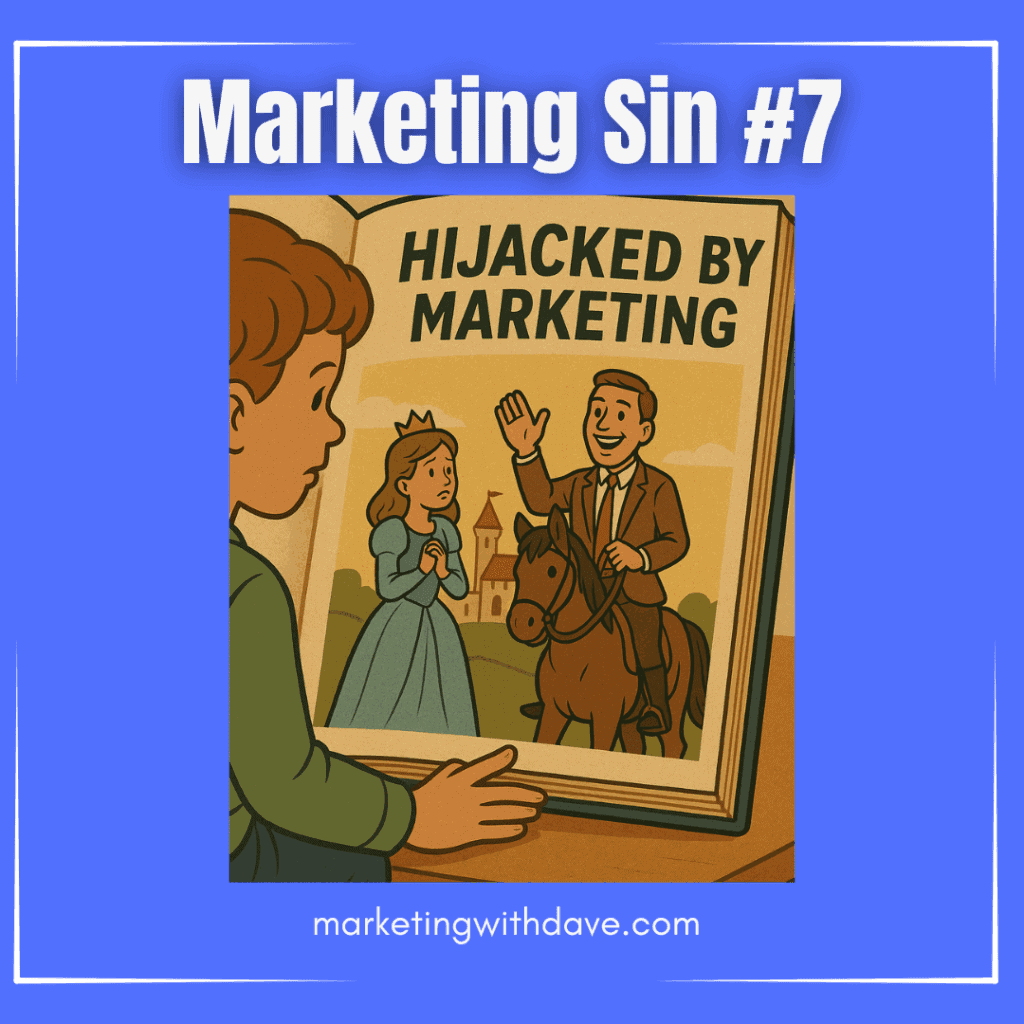
Marketing Sin #7: Letting Marketing Steal the Spotlight

If every post is about your product features or company milestones, you’re making yourself the star. Flip it—your customer is the hero. You’re the guide.

Educate 80%, self-promote 20%. Be the guide, not the hero. Your audience is here for value, not a one-way sales pitch.

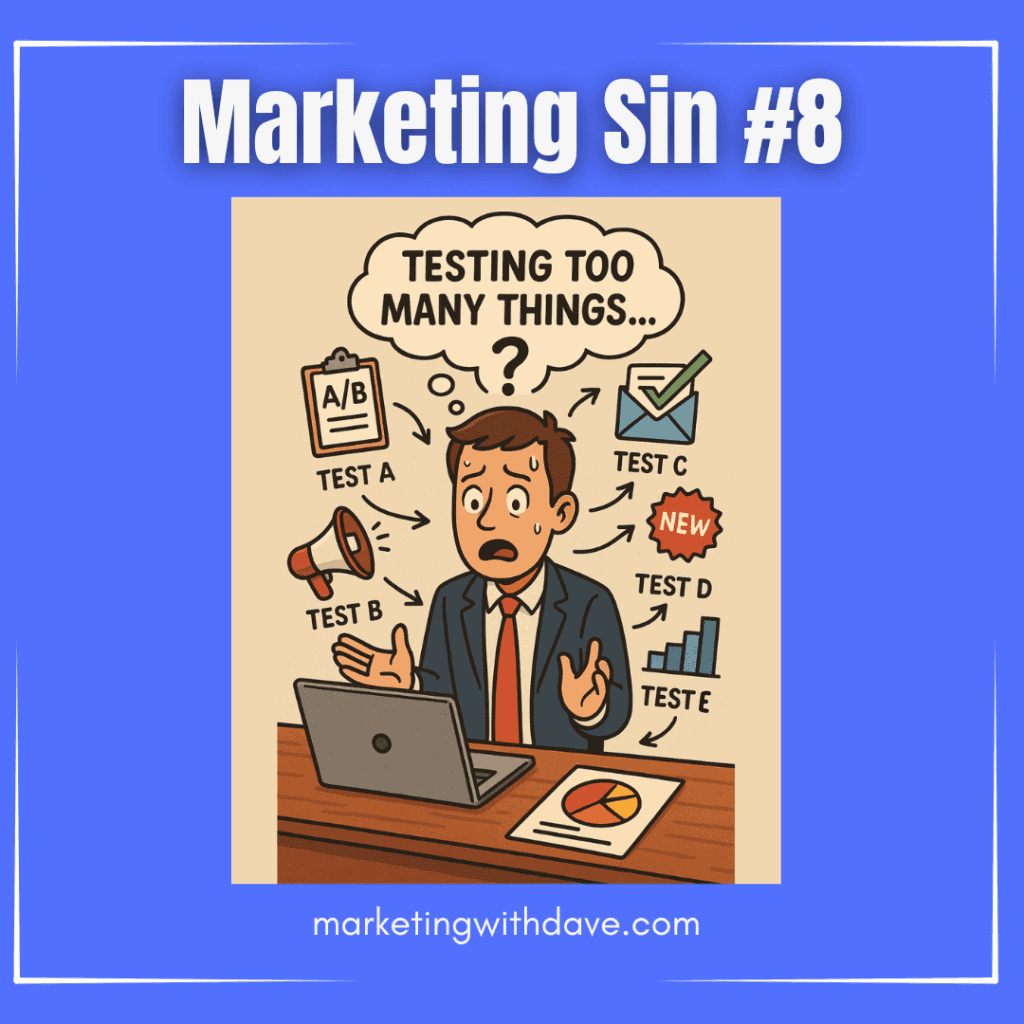
Marketing Sin #8: Testing Too Many Things At Once

Stacking too many tests at once is like pulling five Jenga pieces at the same time. When it all crashes, you don’t know which move did it.
The goal of every test? A clear learning you can build on.

If you don’t isolate your variables, you won’t know what caused the lift (or the flop).

Test strategically. Learn something. Repeat.

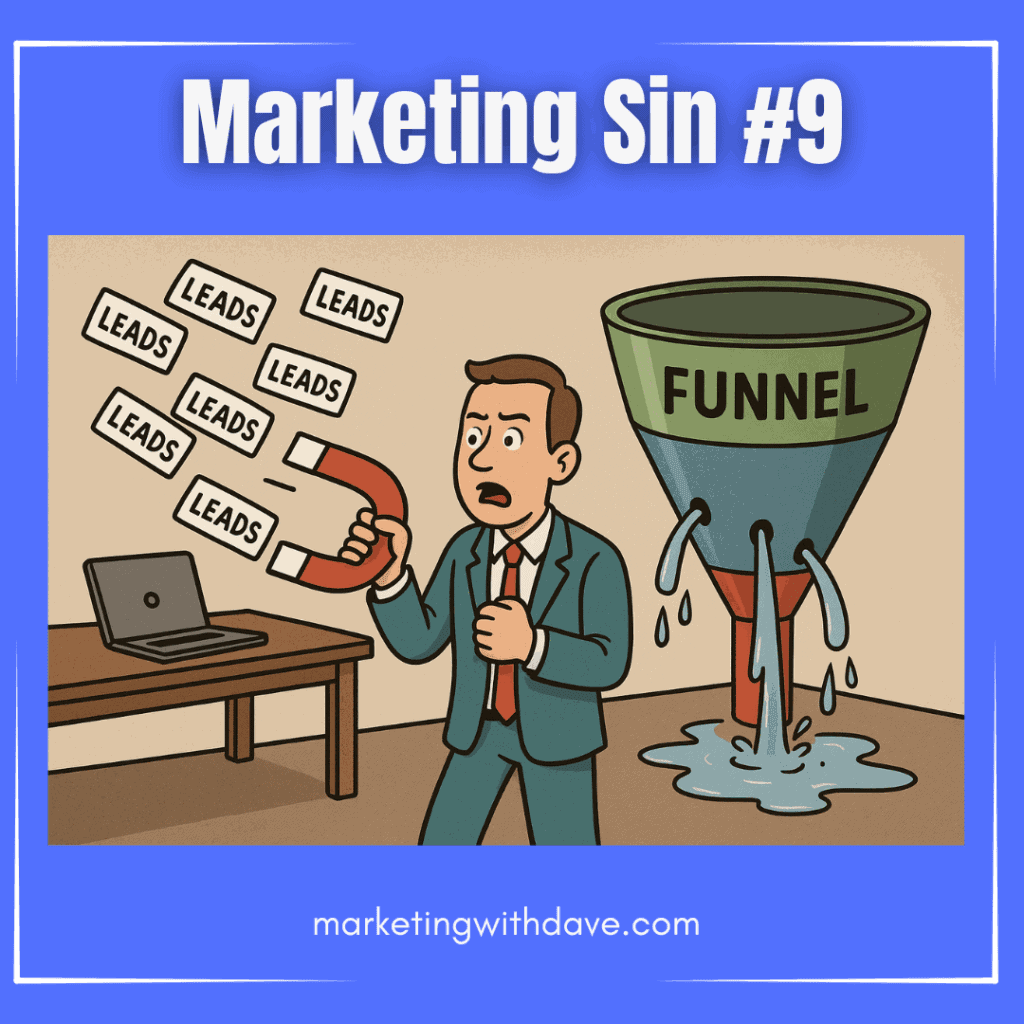
Marketing Sin #9: Chasing Leads With a Leaky Funnel

More traffic won’t fix a broken system. Before you chase leads, fix the funnel.

  • If you’re losing people after the click, it’s not a lead problem
  • Scaling chaos just multiplies waste
  • A healthy funnel boosts ROI without increasing ad spend

Got high traffic or engagement but low conversions? Seeing big drop-offs between steps? Leads not turning into customers? You’re likely leaking revenue at every stage.

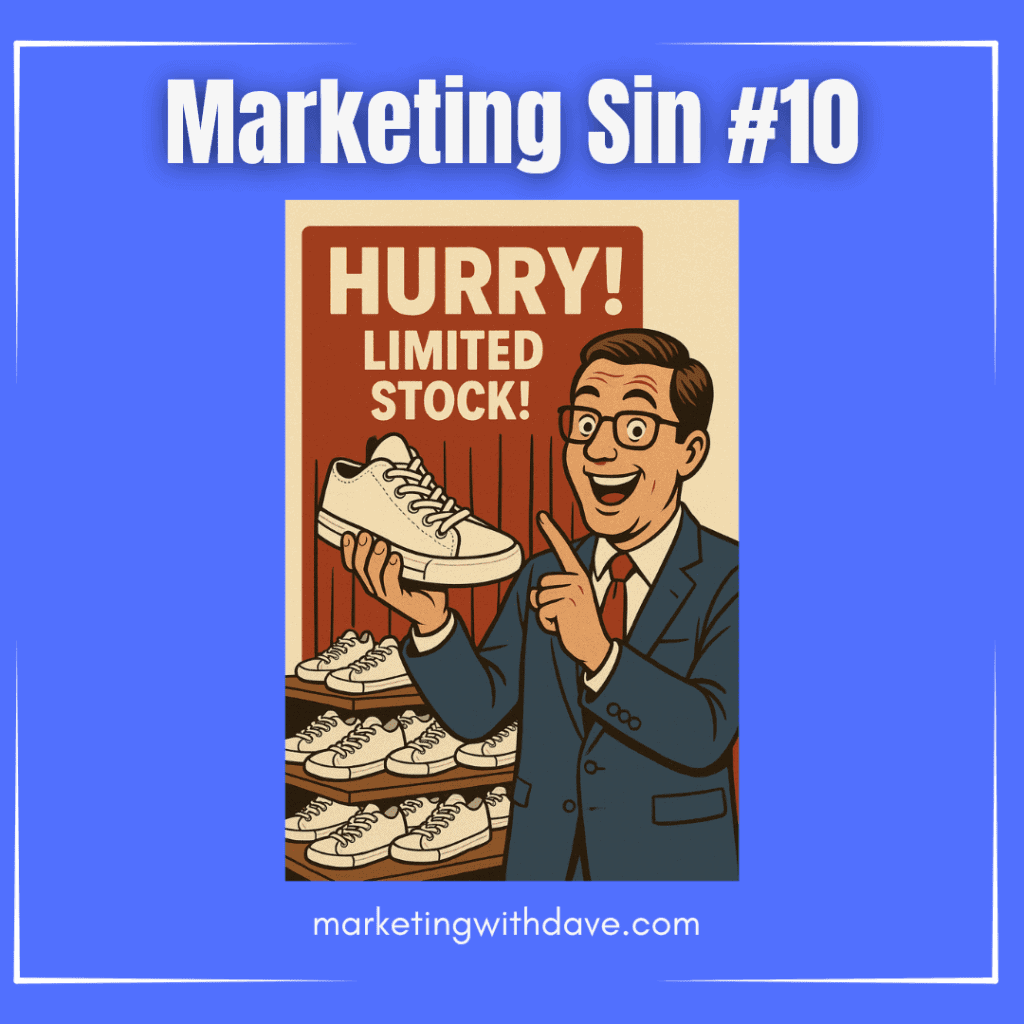
Marketing Sin #10: Creating a False Urgency

Scarcity works, but only when it’s real. Faking urgency erodes trust fast. Even if customers don’t catch it right away, building relationships on hype instead of honesty is a losing game. Be real. Be clear. Be credible.

Which of these sins have you seen lately? Got one I missed? Drop a comment and let’s add it to the list.

The Biggest Marketing Sins and How to Avoid Them Read More »

where to promote your free or discounted book 11 no cost websites for authors

Where to Promote Your Free or Discounted Book: 11 No-Cost Websites for Authors

Reading Time: 2 minutes

Promoting a free or discounted book can quickly get expensive, but it doesn’t have to. If you’re using Amazon KDP (Kindle Direct Publishing), you can run a free book promotion for up to five days every 90 days. These windows are perfect opportunities to list your book on websites that don’t charge anything to help spread the word.

The websites in this list let you promote your book at no cost, and many are beginner-friendly. Just keep in mind: you get what you pay for. These platforms are a great starting point to test interest and see how much traction your book can gain organically. After trying a few, you can evaluate whether any are worth pursuing further through their paid tiers or explore other paid advertising options.

Tier 1: Websites That Ask for Both a Start and End Date

These websites request both the first and last day of your promotion, meaning they are likely taking action to promote your book during that exact window. Whether that’s featuring it in a newsletter, highlighting it on their home page, or including it in a genre-specific roundup, these are the websites most actively coordinating with your promotional schedule. If you’re planning a time-limited free or discounted book promotion, start here.

WebsiteSubmission LinkNotes
Best Book MonkeySubmit your book
Book Angel (UK)Submit your bookSubmission page may trigger browser security warnings, but still accepts entrie
Free Book TipsSubmit your book
It’s Write NowSubmit your bookYou will be notified if selected

Tier 2: Websites That Ask for a Single Promotion Date

These platforms only require you to provide a start date or a single promotion day. While they may not align as precisely with a multi-day campaign, they still offer a great chance to get extra visibility, especially if you’re doing a one-day push or want to spread mentions across several days during your promo window.

WebsiteSubmission LinkNotes
Awesome GangSubmit your book
Book PraiserSubmit your bookYou will be notified if selected
Discount BookmanSubmit your book

Tier 3: Websites That List Your Book

These platforms don’t require any start or end dates for your promotion. Instead, they’ll list your book on their website once you submit it. While they may not provide time-sensitive exposure, they can still help with long-term discoverability, especially for free books or permanent price drops.

WebsiteSubmission LinkNotes
Crave BooksSubmit your book
Pretty HotSubmit your book
Snicks ListSubmit your book
eReaderIQSubmit your bookCan’t make changes once submitted

If you’re serious about marketing your book but working with a tight budget, these free platforms are a great place to start. Keep in mind that results can vary widely depending on your genre, timing, and presentation. Try a few during your next Amazon KDP free promotion window and track which ones drive the most downloads or engagement.

Did we miss one of your favorite free promotion websites? Let us know in the comments. We will keep this list updated as new resources emerge.

Where to Promote Your Free or Discounted Book: 11 No-Cost Websites for Authors Read More »

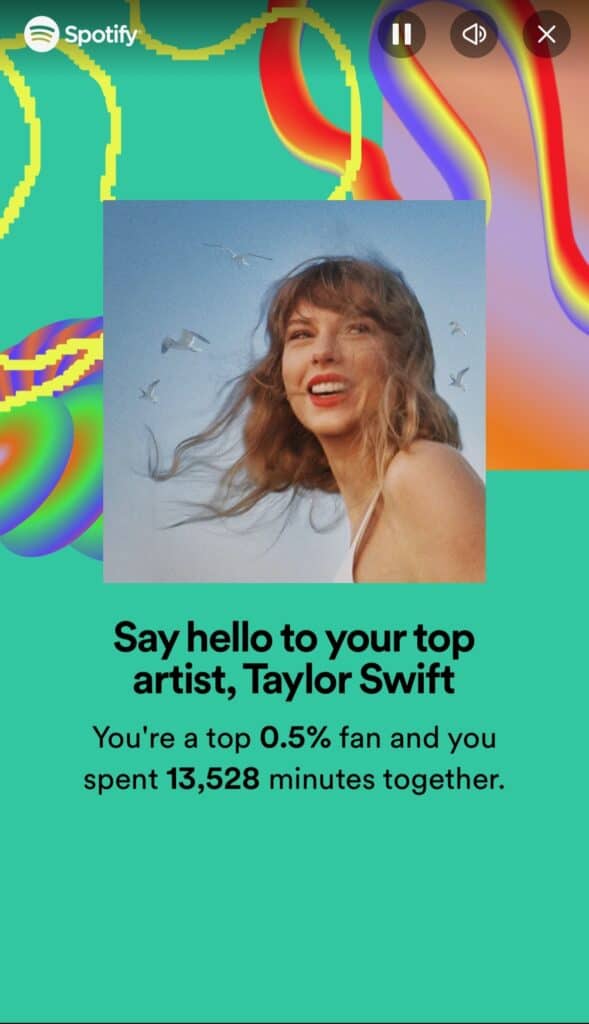
Taylor Swift's Spotify Wrapped profile showing top artist, 0.5% fan, and 13,528 minutes listened, with colorful abstract background and a photo of Taylor Swift.

Case Study: How Spotify Wrapped Became a Viral Phenomenon and When It Backfired

Reading Time: 9 minutes

Brief Summary

Spotify’s Wrapped is an annual year-end recap that turns user listening data into a shareable story and a marketing powerhouse. Launched in 2016, Wrapped grew into a viral cultural moment each December as millions of users eagerly share personalized insights about their music habits.

This campaign brilliantly showed customers how they use Spotify, sparking conversations and free promotion across social media. However, a bold 2024 revamp (with heavy doses of AI-generated content) struck a wrong chord, drawing user backlash.

This case study examines how Spotify’s data-driven campaign became a viral hit, why the 2024 edition faced negative reactions, and what marketers can learn about balancing innovation with user experience.

Company Involved

Spotify, a leading music streaming service with over 500 million users worldwide (as of 2025) is at the center of this story. Spotify’s platform popularized music streaming and leverages personalized data for user engagement.

Marketing Topic

  • Personalization
  • Social Media Marketing
  • Customer Experience

Public Reaction or Consequences

Public response to Spotify Wrapped has historically been overwhelmingly positive. Each year, the colorful, personalized summaries dominate social feeds as users proudly post their top songs and artists. Wrapped became a cultural phenomenon – from casual listeners to celebrities, everyone joined the conversation, giving Spotify enormous viral reach with minimal paid advertising. The sense of community (“Hey, I also listened to that!”) and lighthearted competition (“I streamed more minutes than you!”) fueled friendly buzz and free publicity for Spotify.

However, the 2024 edition of Wrapped sparked a rare public backlash. Users flooded TikTok, Twitter (X), and Reddit with complaints, calling the 2024 experience “lazy” and saying it “flopped” due to a lackluster design and missing favorite features. Spotify had removed popular components like the “top genres” stat and the fun “Sound Town” feature (which in 2023 matched users to cities based on listening).

Meanwhile, Spotify added new AI-driven elements that many found off-putting, including a personalized “Wrapped AI Podcast” that used an artificial voice to recap one’s year. The public reaction was swift and negative: “boring,” “AI overkill,” and “barebones” were common descriptors from disappointed fans. Memes and critical posts went viral, and even loyal Spotify users praised Apple Music’s simpler Replay recap for outshining Spotify’s offering that year. In short, an initiative once lauded for delighting users faced a wave of criticism that dented Spotify’s social media sentiment (at least temporarily).

Why It Matters Today

Power of Personalization: Spotify Wrapped demonstrates how turning user data into a personal narrative can drive massive engagement. In an era of data-driven marketing, consumers respond to brands that reflect their story – and they’ll voluntarily promote it.

Beware the Tech “Fad” Trap: The 2024 backlash shows that blindly jumping on the AI bandwagon can backfire. Incorporating new tech in marketing must serve a real user desire. Otherwise, it feels gimmicky and may alienate loyal customers.

Competitive Imitation: Wrapped’s success has influenced an entire industry – from Apple Music’s Replay (launched 2019) to YouTube Music’s Recap and Deezer’s new Year End feature. Marketers should note that a great idea will be copied. Continuous improvement is key to staying ahead.

3 Takeaways

1. Make it Personal (and Fun): Personalized content that focuses on the customer – not the brand – can turn users into enthusiastic ambassadors. Spotify succeeded by giving users a fun way to talk about themselves, not just about Spotify.

2. If It Ain’t Broke, Don’t “AI” Fix It: Consistency and user-centric design matter. Adding trendy tech for its own sake (or removing beloved features) can ruin a good thing. Innovation should never trump listening to your core users.

3. Encourage Sharing and Community: Design marketing experiences that people want to share. Wrapped works because it’s visually engaging, easily shareable, and creates a sense of community and competition among users, all without additional ad spend.

Notable Quotes and Data

“120 million. That’s how many users accessed their Wrapped in 2021… In 2021, 60 million users shared their Wrapped graphics to social media.” – Forbes (via Spotify) on Wrapped’s viral reach.

“We weren’t just talking about ourselves… We were giving people an interesting way to talk about themselves.” – Alex Bodman, Spotify VP of Creative, on why Wrapped resonates.

“If you look at the numbers, it was the biggest Wrapped we’ve ever had. But there was more negative feedback than we’ve seen before.” – Gustav Söderström, Spotify CPO, acknowledging the 2024 Wrapped backlash.

Full Case Narrative

Background: Spotify first experimented with year-end summaries in 2015 with a “Year in Music” review, but 2016’s rebranded Spotify Wrapped truly set the template. The concept was simple yet groundbreaking: give users a fun, glossy recap of their own listening habits each year. At a time when digital privacy debates were rising, Spotify managed a clever twist – presenting user data back to the user as a gift. This turned what could have been seen as “tracking” into a celebration of personal taste. By packaging statistics like top songs, favorite genres, and total minutes streamed into a colorful story with shareable graphics, Spotify tapped into a fundamental human impulse: the desire for self-expression and social sharing.

Rise of a Viral Phenomenon: Over the next few years, Spotify Wrapped grew exponentially. The company integrated it into the Spotify app by 2019, making participation frictionless. Each December, Wrapped’s bright, pop-art visuals and personal factoids (e.g. “You were in the top 5% of Taylor Swift listeners this year”) took over social networks. In 2021, over 120 million users accessed Wrapped and 60 million shared their results – a fourfold increase in engagement from 2017. Celebrities and influencers joined in, posting their eclectic music tastes, which only fueled FOMO among fans and friends. As one marketing analysis noted, “Wrapped is one of the biggest marketing success stories in recent history. For a few weeks every year, Spotify’s marketing team grows by tens of millions [of users]. In essence, Spotify found a way to make its users do the marketing: by giving them content worth bragging about.

Why It Worked: Spotify Wrapped hit the marketing sweet spot by combining personalization, social currency, and timing. Alex Bodman, Spotify’s Global Executive Creative Director, explained that the campaign succeeded because it wasn’t about Spotify – it was about the users themselves. Wrapped let people “show off” their unique music identity in a friendly way. The design was optimized for sharing (tall smartphone-friendly images, ready to post). Wrapped also fostered a sense of community: people compared their results, joked about their quirks, and felt part of a global event. Critically, Spotify Wrapped felt celebratory and not creepy – it uses first-party data that users knowingly generate by listening to music, and presents it back in aggregate form. This circumvented the privacy concerns that often accompany data-driven campaigns. As one digital agency put it, “Wrapped… is unintrusive, internal data science at work with fun outputs… delivered in a colorful and creative way. That’s a killer combo!”. In other words, Spotify earned user trust by making data fun and focusing on emotions (nostalgia, pride, humor) rather than overtly marketing the service.

Spotify also kept Wrapped fresh with new features each year. For example, 2021 introduced an “Audio Aura” that visualized your music vibe with colors, 2022 added a “Listening Personality” test (like a Myers-Briggs for music), and 2023 gave users “Sound Town” (matching your listening to a city) and a playful “Me in 2023” character persona. These updates generated new buzz annually, while maintaining the familiar core experience. By 2023, Wrapped engaged a record 227 million monthly active users on Spotify – a stunning figure that underscored how central the campaign had become to Spotify’s brand.

Competitors Take Note: The runaway success of Spotify Wrapped did not go unnoticed. In 2019, Apple Music launched its own year-in-review called Replay, and other platforms like YouTube Music soon offered similar recap features. Initially, these copycats were seen as less fun or polished – Apple’s Replay, for instance, lacked the flashy visuals and shareability and was often ridiculed in memes as the poor imitation of Wrapped. Yet, by 2024, Apple had significantly improved Replay (adding highlight reels, personalized insights, and easily shareable graphics), to the point that many users declared Apple Music Replay 2024 “100× better than Wrapped” in the wake of Spotify’s missteps. This competitive dynamic shows how one innovative campaign can set a new industry standard: Spotify’s idea was so good that every major streaming service felt it had to offer something similar or risk looking outdated.

The 2024 Campaign – Pushing the Limit: Enter December 2024, Spotify Wrapped’s much-hyped tenth anniversary edition. Expectations from users were sky high – and Spotify attempted its boldest update yet. The 2024 Wrapped doubled down on artificial intelligence and automation. Most notably, Spotify partnered with Google’s NotebookLM AI to generate a personalized podcast for each user, where an AI “host” duo would ostensibly chat about your listening year. On paper, it sounded cutting-edge: what if an AI could talk you through your music stats as if you’re listening to a radio show about you? In practice, however, the execution faltered badly. Users reported that the AI-driven podcast got basic facts wrong – one user’s podcast bizarrely announced, “You listened to five hundred and four hundred and ninety eighty-one minutes this year,” a nonsensical (and incorrect) statistic. The AI commentary also veered into cringe-worthy territory. In one example, the AI said, “Back in April, it seems like you were embracing those pumpkin spice strut-pop vibes,” to which its co-host asked, “What’s that?” – the first AI voice then explained, “Think upbeat pop anthems perfect for those crisp autumn days.” The problem? It was absurd to reference autumn (pumpkin spice season) in April. Such missteps made the AI feel disconnected from reality and users’ actual experiences.

At the same time, Spotify’s 2024 Wrapped inexplicably removed or pared down features that users loved. The detailed breakdown of top genres? Gone. The fun custom cards like “Me in 2023” and the Sound Town groups from the previous year? Nowhere to be found. The overall interface was described as more generic, with many users complaining it felt like a “barebones” slideshow of stats without the quirky, gamified elements of past years. As a result, what was meant to be an innovative twist ended up diminishing the experience. Longtime fans who looked forward to Wrapped felt let down – the special spark was missing.

Backlash and Fallout: The public reaction to Wrapped 2024 was immediate and intense, especially on social media. Within hours of launch, critical posts amassed: “Spotify Wrapped went all-in on AI and everyone hates it,” blared one headline. On Reddit, a top-voted thread bluntly proclaimed, “Spotify delivered a barebones experience that offered no payoff,” comparing it unfavorably to Apple’s more straightforward recap. Tech journalists noted that they could hardly find anyone with positive sentiments about Wrapped that year. Many users simply found the AI content unnecessary and tone-deaf – as one commenter quipped, “I made it about 30 seconds [into the AI podcast] before I turned it off”. The phrase “AI overkill” started trending in discussions about Spotify. Even worse, some users encountered outright errors in their Wrapped stats (a likely byproduct of the new data processing); people reported seeing artists in their Top Songs whom they hadn’t listened to all year. This undermined the trust and accuracy that is core to Wrapped’s appeal. After all, if your personal recap is wrong, it loses credibility and enjoyment.

Media outlets piled on. Adweek noted Spotify had joined the list of brands facing backlash for using generative AI in marketing, highlighting how listeners felt the Wrapped campaign had become “lazy” by relying on auto-generated content. The general consensus: Spotify had lost sight of what made Wrapped great (the human touch, the personal feel) in an attempt to seem trendy with AI. Crucially, no one had asked for an AI podcast – users were perfectly happy with the traditional format. The lesson for marketers was stark: introducing a flashy new technology means nothing if it doesn’t improve the customer experience. As Inc. put it, “Spotify seems to have lost sight of what people actually like about Wrapped and replaced it with something no one was asking for.”.

Spotify’s Response: Internally, the negative buzz was impossible to ignore. In early 2025, Spotify’s executives openly acknowledged the issue. Gustav Söderström, Spotify’s Chief Product Officer, admitted that while Wrapped 2024 reached more users than ever, it also drew unprecedented negative feedback. He noted that users missed some of the “things people loved from years before” and that perhaps Spotify shouldn’t have removed those elements. CEO Daniel Ek also conceded that the company “got it wrong” with the execution of that campaign. These candid admissions are somewhat rare in the marketing world, and they underscore just how beloved Wrapped is – Spotify couldn’t afford to alienate its core user base on this signature feature.

Timeline

Late 2015: Spotify launches “Your Year in Music,” a precursor to Wrapped.

Dec 2016: The first Spotify Wrapped debuts.

2019: Wrapped is fully integrated into the app.

2021: Wrapped goes viral with over 120 million users and 60 million shares.

2023: Record 227 million monthly active users engage with Wrapped.

Dec 2024: Wrapped rolls out AI features, sparking backlash.

Mid 2025: Spotify executives acknowledge missteps and promise course correction.

What Happened Next?

After the 2024 stumble, Spotify moved quickly to course-correct. Executives openly acknowledged the user backlash and promised a better balance of innovation and fan-favorite features in 2025. Competitors continue to push their own year-end summaries, and Spotify is working to ensure Wrapped remains the leader by restoring trust and engagement. Features that focus on fun, data accuracy, and community may define the future of Wrapped – not AI novelty for its own sake.

One Sentence Takeaway

Spotify Wrapped proves the power of personal data in marketing – when you hand the mic to your customers, they’ll sing your praises, but hit a wrong note and the crowd will let you know.

Sources and Citations

Contentgroup – “I’m Wrapped in Spotify Wrapped” (Nov 2023)

Adweek – “Spotify is the Latest Brand Facing AI Backlash Over Wrapped Campaign” (Dec 2024)

TechRadar – “Apple Music Replay walked all over Spotify Wrapped in 2024” (Dec 7, 2024)

TechRadar – “Spotify admits it made mistakes with Wrapped 2024 – here’s what could change” (June 4, 2025)

MusicAlly – “Spotify execs talk superfans, AI and Wrapped 2024 backlash” (May 30, 2025)

Spotify Newsroom – “We’re Commemorating a Decade of Spotify Wrapped…” (Dec 4, 2024)

Case Study: How Spotify Wrapped Became a Viral Phenomenon and When It Backfired Read More »