what is marketing the 10 functions of marketing

SWOT Analysis for Owala Water Bottles Using Oncely AI Tool

Reading Time: 2 minutes

I performed a SWOT analysis for Owala water bottles using manual research. No AI was used, just the old school internet to find and compile the strengths, weaknesses, threats, and opportunities for Owala.
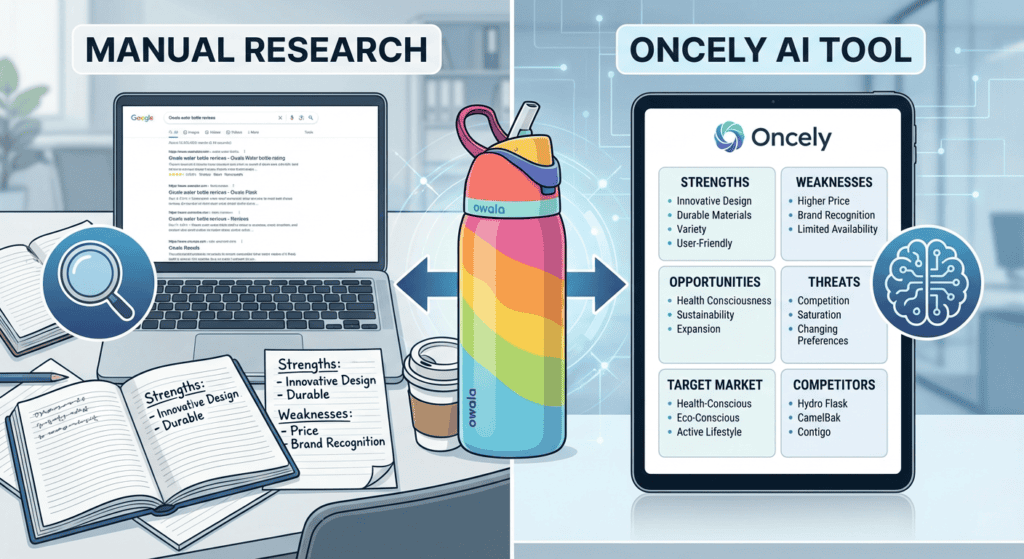
I discovered Oncely, an AI tool that will perform a SWOT analysis for you. Below are those results which you can compare with my manual research version. Overall, it’s comparable and I was impressed. Of course, with anything AI, trust a little and verify a lot. I would use Oncely the next time I need to perform a SWOT analysis.

Strengths

  • Innovative Design: Owala bottles feature a unique design with a built-in straw and a wide mouth for easy filling and cleaning.
  • Durable Materials: Made from high-quality, BPA-free materials, ensuring safety and longevity.
  • Variety of Colors and Sizes: Offers a wide range of colors and sizes to appeal to diverse consumer preferences.
  • User-Friendly Features: Includes a one-handed push-button lid for easy access to hydration on-the-go.

Weaknesses

  • Higher Price Point: Owala bottles may be more expensive than traditional plastic bottles, potentially limiting their market.
  • Brand Recognition: As a relatively newer brand, Owala may struggle with brand awareness compared to established competitors.
  • Limited Availability: May not be available in all retail locations, affecting accessibility for potential customers.

Opportunities

  • Growing Health Consciousness: Increased consumer focus on hydration and healthy living can drive demand for reusable water bottles.
  • Sustainability Trends: With rising awareness of environmental issues, promoting the eco-friendly aspects of Owala bottles can attract eco-conscious consumers.
  • Expansion into New Markets: Opportunities to expand into international markets or new demographic segments.

Threats

  • Intense Competition: Strong competition from established brands like Hydro Flask, CamelBak, and Contigo.
  • Market Saturation: The water bottle market is crowded, making it difficult to differentiate the brand effectively.
  • Changing Consumer Preferences: Shifts in consumer behavior or preferences towards different hydration solutions (e.g., flavored waters, smart bottles) could impact sales.

In-Depth Results

The following target market and competitors sections are what you get when choosing the in-depth setting.

Target Market
Health-Conscious Consumers: Individuals focused on fitness and hydration.
Eco-Conscious Shoppers: Consumers looking for sustainable and reusable products.
Active Lifestyle Enthusiasts: People engaged in outdoor activities, sports, and travel.

Competitors
Hydro Flask: Known for high-quality insulated bottles.
CamelBak: Popular for hydration packs and bottles with built-in straws.
Contigo: Offers a range of travel mugs and water bottles with spill-proof features.
This SWOT analysis provides a comprehensive overview of Owala water bottles, highlighting key areas for strategic focus and potential growth.

What’s Next

Once you’ve completed your SWOT analysis, the next step is putting it into action. See how we used Owala’s SWOT insights to shape a strategic marketing campaign.

SWOT Analysis for Owala Water Bottles Using Oncely AI Tool Read More »
swot analysis for owala water bottles

SWOT Analysis for Owala Water Bottles

Reading Time: 2 minutes

When it comes to innovative hydration solutions, Owala has made a significant splash in the market. Known for their stylish, functional water bottles designed with features like flip-top lids, built-in straws, and triple-layer insulation, Owala focuses on making it easier—and more enjoyable—to stay hydrated. Competing with industry giants like Hydro Flask, Yeti, and S’well, Owala differentiates itself through bold designs, user-friendly features, and a commitment to sustainability.

New to SWOT analysis? If you’re looking for a deeper explanation of the framework, start with SWOT Analysis: Strengths, Weaknesses, Opportunities and Threats Explained. If you want to see how these insights can be turned into action, check out How to Use SWOT Analysis for a Winning Marketing Campaign. Curious how AI compares with manual research? I also created this same SWOT using Oncely AI so you can compare the results.

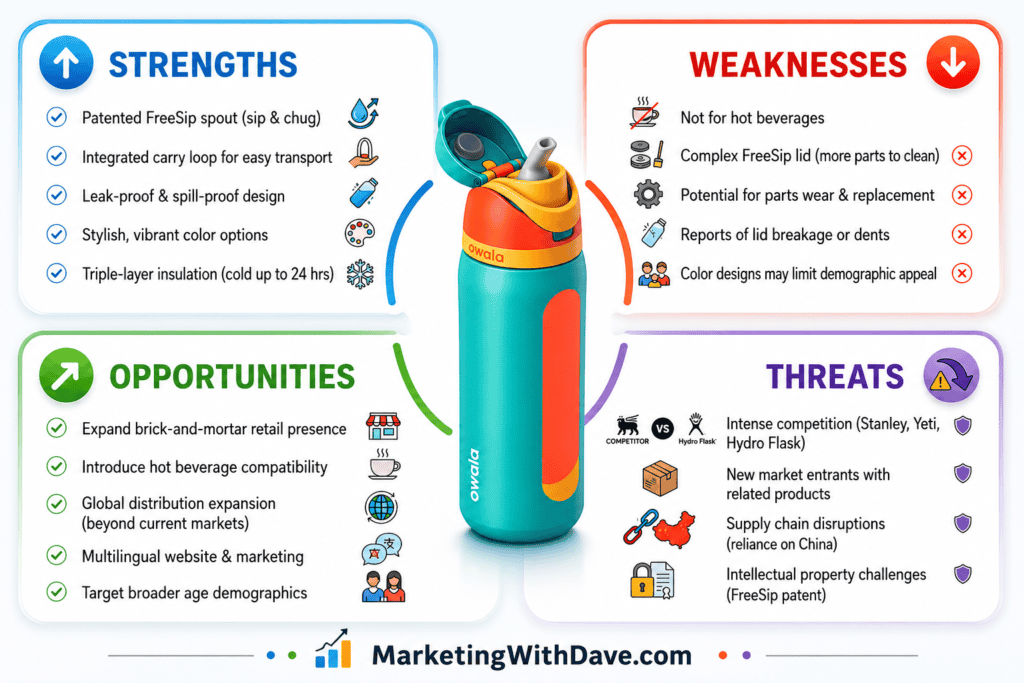
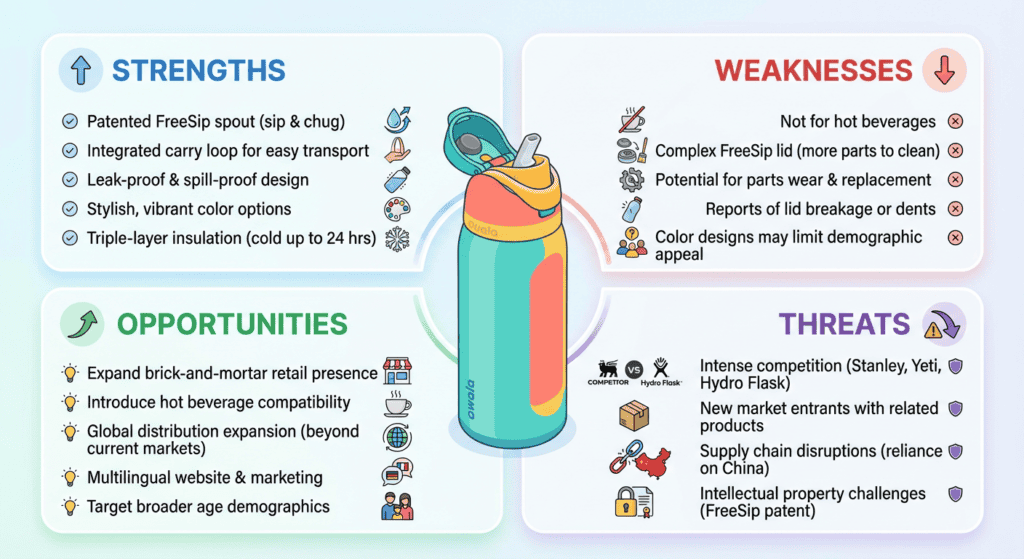
Here is the SWOT analysis I performed for Owala.

Strengths

  1. Patented FreeSip spout with a flip-top lid that allows for both sipping and chugging.
  2. Easier to transport with the integrated carry loop.
  3. Designed to be leak-proof and spill-proof.
  4. Stylish and vibrant color designs.
  5. Ice cold for up to 24 hours.

Weaknesses

  1. Not intended for hot beverages.
  2. FreeSip contains more parts resulting in more cleaning challenges.
  3. FreeSip contains more parts resulting in parts wearing out or needing to be replaced.
  4. Lids breaking or bottle denting issues more likely than competitors.
  5. Vibrant color designs targeting a younger, more active demographic may not appeal to other segments.

Opportunities

  1. Available in more brick-and-mortar retailers.
  2. Support hot beverages like its competitors (Stanley for example).
  3. Expand distribution outside of the US, Canada, UK, and Australia.
  4. Support non-English website and marketing content.
  5. Target other age groups outside young adults and children.

Threats

  1. Brand recognition compared to well-established brands like Stanley, Yeti, and Hydro Flask.
  2. New entrants that are already well-positioned in related markets or with related products.
  3. Supply chain disruptions like with covid; China is a significant material source.
  4. Being unable to protect or continue developing its intellectual property, the patented FreeSip.

SWOT Analysis for Owala Water Bottles Read More »

top 10 companies that turned me into a loyal fan

Top 10 Companies That Turned Me Into a Loyal Fan

Reading Time: 4 minutes

The Power of Brand Ambassadors and Loyal Customers

Reader Beware: Any blog post tagged as “Data Driven David” may not be as related to marketing as most of my content. I truly love data and love it even more when it is well visualized and wrapped in a great story — now, that’s good marketing.

In today’s hyper-competitive market, having loyal customers isn’t just a nice-to-have—it’s a game-changer. Loyal customers don’t just buy from you repeatedly; they become your brand ambassadors, spreading the word organically because they genuinely believe in what you offer. Word-of-mouth marketing, fueled by passionate advocates, carries more weight than any ad campaign. Think about it: when someone you trust raves about a product, aren’t you more inclined to try it? That’s the magic of customer loyalty.

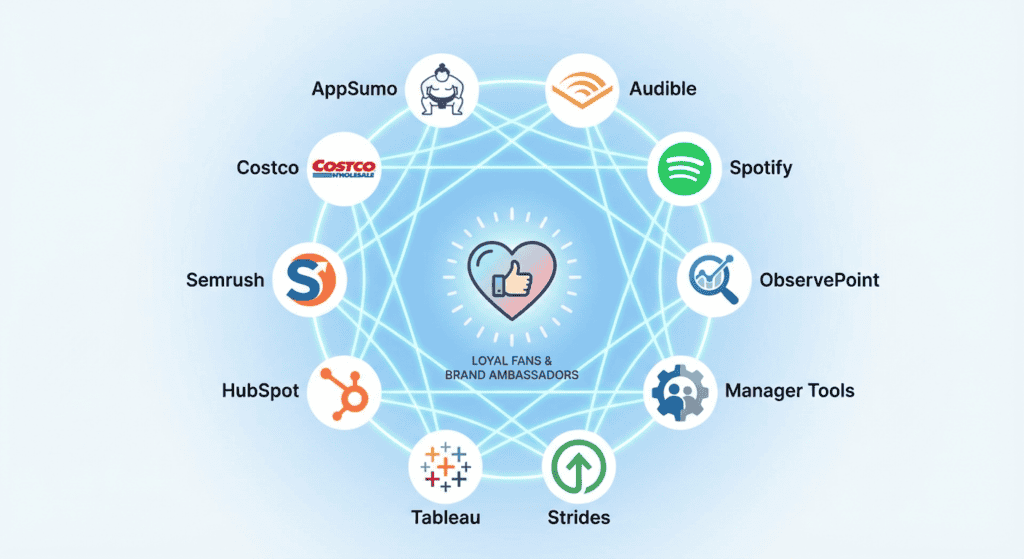
To highlight this, I’m sharing 10 companies that I absolutely love, often talk to others about, and feel they separate themselves from others. From compiling this list, I noticed there is both a service and product component that makes me so adamant about them and that there is an aspect that makes them authentic from their peers. These are not followers or me too companies.

1. AppSumo

AppSumo is a marketplace for entrepreneurs, offering lifetime deals on software tools that help businesses grow. What makes them unique is their ability to uncover hidden software gems and provide unbeatable lifetime deals on products typically new to the market. I have been a customer since 2016. have evaluated well over 100 products, and absolutely love the no hassle refund allowing me to try these offerings for 60 days.

2. Audible

Audible is the world’s leading provider of audiobooks, podcasts, and spoken-word entertainment. I love Audible because of their product breadth, amazing service that is helpful and even recommends listens I may like, great 2 for 1 and other promotions throughout the year, and a high quality product. I have been a customer since 2004, long before they were acquired by Amazon and before audio listening was mainstream.

3. Spotify

Spotify is a music streaming platform that gives you access to millions of songs, podcasts, and playlists worldwide. What sets Spotify apart is its personalized recommendations and of course, their Spotify wrapped that comes out the end of the year highlighting your listening consumption. Countless companies have done their own wrapped but rarely hit the mark.

4. ObservePoint

ObservePoint offers data governance and tag auditing solutions to ensure accurate digital analytics tracking. Their platform is invaluable because it automates the tedious process of validating analytics, ensuring data-driven decisions are based on reliable, clean data. Aside from being a powerful must have product for any B2B website, their entire staff is something special. So willing to help and often finding custom solutions in hours. It’s rare to see an employee base with such a passion for what they are doing.

5. Manager Tools

Manager Tools is a management consulting firm that provides practical guidance for becoming a better leader through podcasts, training, and resources. I’m hooked on their no-nonsense, actionable advice that you can implement immediately to improve team performance and personal leadership skills. The founders, Mark and Mike, are not as involved as years past but all of their advice is best practice and in the weeds detailed. I have listened to their podcast since the beginning.

6. Strides

Strides is a goal and habit-tracking app designed to help you stay organized and motivated in achieving your personal and professional goals. What I love about Strides is its intuitive interface and flexible tracking options, making it incredibly easy to monitor progress and to track just about any goal in any way you can imagine. I am tracking around 15 goals a year in this app.

7. Tableau

Tableau is a powerful data visualization tool that helps people see and understand their data through interactive dashboards. The magic of Tableau lies in its ability to turn complex data sets into beautiful, easy-to-understand visuals that tell compelling stories with just a few clicks. I started using Tableau in 2011, long before acquired by Salesforce and even then was an incredibly powerful data visualization tool for its time. Tableau is one of the few visualization tools that you are proud to show management.

8. HubSpot

HubSpot is an all-in-one inbound marketing, sales, and customer service platform that helps businesses grow better. What makes HubSpot stand out is its user-friendly interface combined with powerful automation features, making marketing and CRM tasks feel effortless and highly effective. Their journey has been impressive since the early days when they had an entertaining and actionable content shared on their podcasts targeting small and medium businesses. What they provide for free is second to none and they are becoming the source for just about any marketing topic.

9. Semrush

Semrush is an all-in-one digital marketing toolkit for SEO, content marketing, competitor research, PPC, and social media marketing. I love Semrush because it’s like having a marketing Swiss Army knife—offering deep insights into SEO and competitive analysis that help fine-tune strategies for maximum impact. I have been using their product since at least 2015 and have written an article claiming them as the best SEO audit tool.

10. Costco

Costco is a membership-based warehouse club offering bulk products at discounted prices, from groceries to electronics. What makes Costco irresistible is its unbeatable value, high-quality product selection, and the thrill of discovering unexpected finds with every visit (plus, who doesn’t love the free samples? The rotisserie chicken and hot dog that haven’t changed price since I was a kid and the effortless return policy is mind blowing awesome.

Top 10 Companies That Turned Me Into a Loyal Fan Read More »

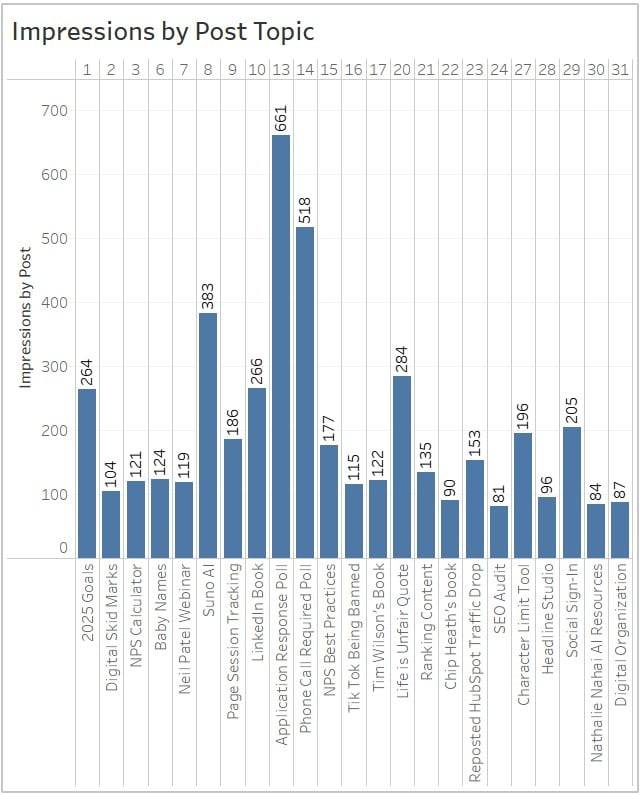
Line graph showing impressions by post over a month, highlighting peaks and fluctuations in LinkedIn engagement.

What I Learned Posting on LinkedIn Every Day for a Month

Reading Time: 3 minutes

I set a simple goal to post on LinkedIn every business day in January—no expectations, just trying to share valuable digital marketing insights with every post. Now that January’s wrapped up, here’s how it went:

Key Metrics:

  • 4,716 impressions
  • 121 average impressions per post
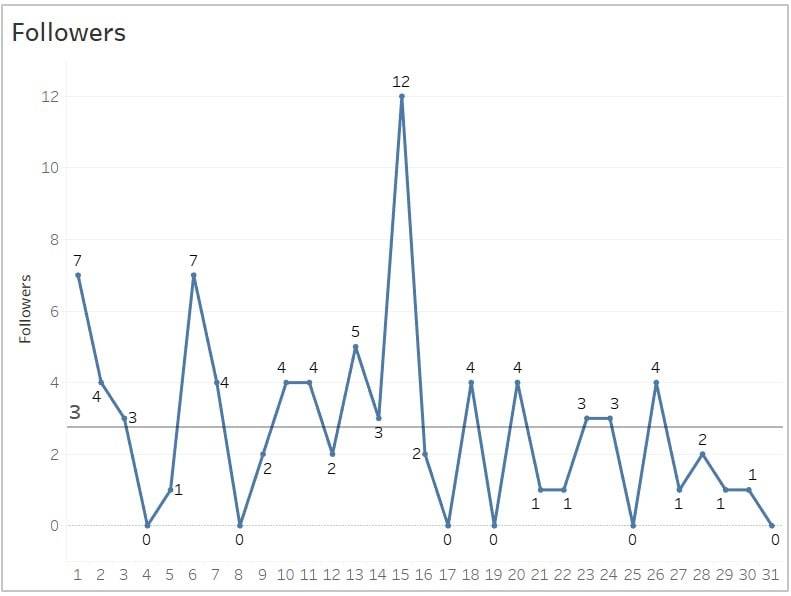
  • 85 new followers
  • 73 reactions
  • 25 comments
  • 14 reposts
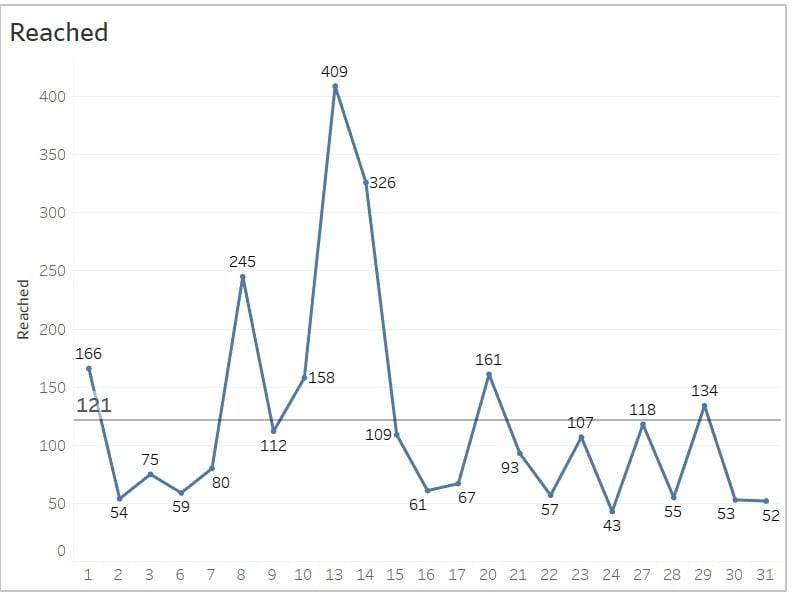
  • Reach per post ranged from 52 to 409

Insight #1: Topics and Hashtags Matter Most

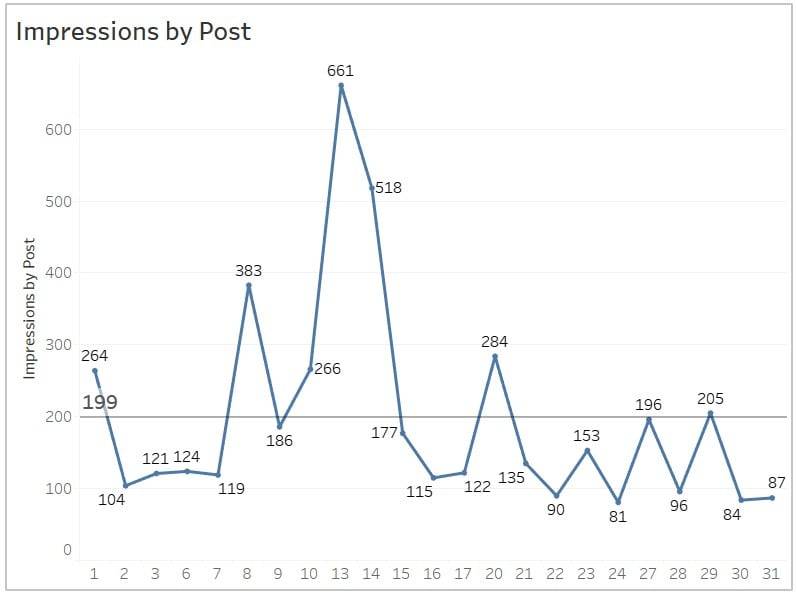
While I didn’t expect hockey stick growth for any metric, I did expect impressions to gradually increase over time, but the data told a different story. Impressions fluctuated based on the popularity of individual posts rather than building momentum. The hashtags used and post relevance seemed to be the real game-changers.

Line graph showing impressions by post over a month, highlighting peaks and fluctuations in LinkedIn engagement.

Insight #2: Don’t Forget the Weekends

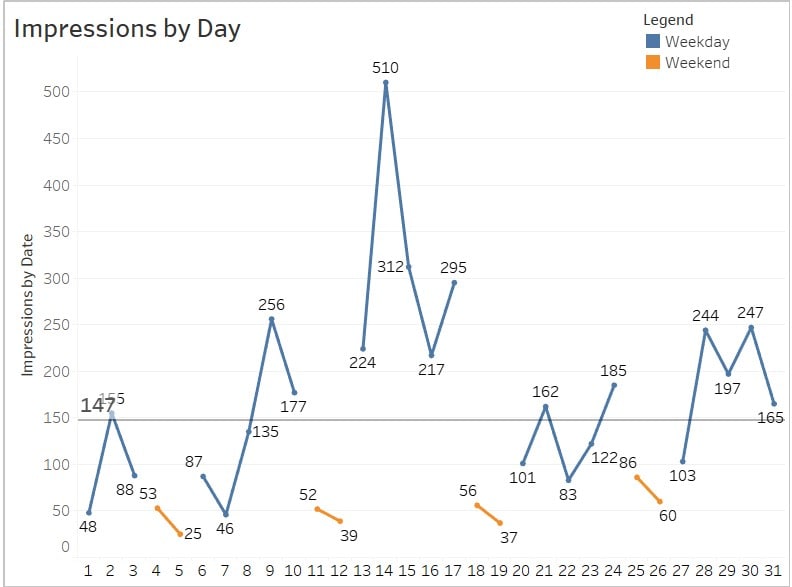
I expected low weekend traffic since I only posted Monday through Friday, but impressions remained consistent and even beating out some of my weaker posts. This shows LinkedIn content has a longer shelf life, and many professionals are active even on weekends, catching up or browsing casually. Posting on the weekend may be a worthwhile future test.

Insight #3: The Most Relevant Content Wins

LinkedIn is a website for professionals so it’s not a stretch to think content focused on professional growth, networking, and the job search process would perform best. My posts discussing if job applications should receive email responses and if phone calls should be required at certain interview stages significantly outperformed all others, proving that topics directly tied to career experiences resonate most with the audience.

Insight #4: Follower Growth Matches Impression Trend

Follower gains fluctuated daily, with noticeable spikes aligning with highly engaging content. The largest surge occurred on the 15th, suggesting that standout posts can significantly boost growth. Maintaining a regular posting schedule would likely help sustain a steady follower increases over time.

Insight #5: Engaging Content Expands Reach

Reach showed similar fluctuations to follower growth, with peaks corresponding to days when content resonated strongly with the audience. This pattern highlights that while consistency is key, creating posts that spark interest and interaction can significantly amplify visibility beyond your immediate network.

Line graph showing daily reach with peaks on days 13 and 14, illustrating engagement trends from posting on LinkedIn for a month.

What I Learned Posting on LinkedIn Every Day for a Month Read More »

15 essential net promoter score nps best practices for valid and actionable results

15 Essential Net Promoter Score (NPS) Best Practices for Valid and Actionable Results

Reading Time: 2 minutes

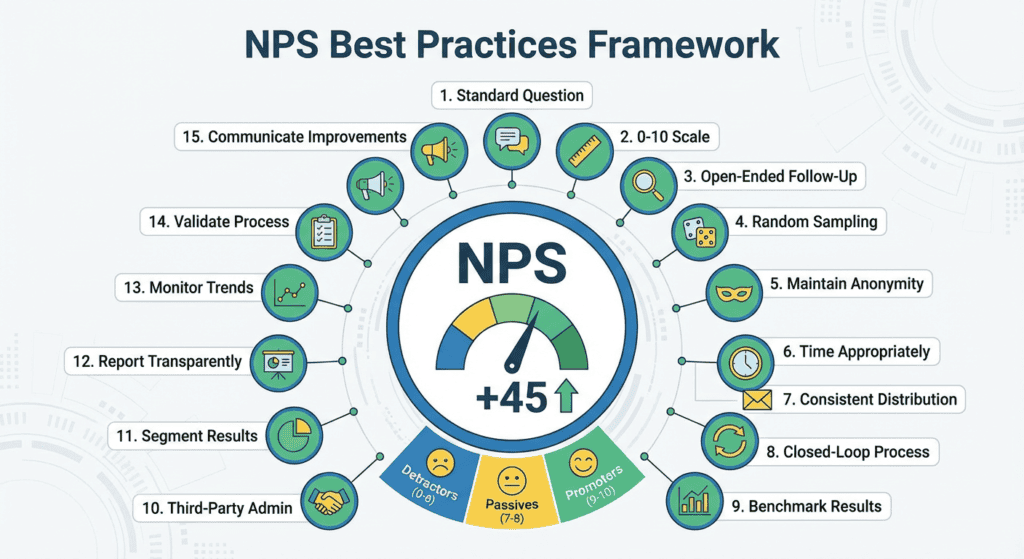
To ensure your Net Promoter Score (NPS) process is valid, reliable, and capable of withstanding external stakeholder scrutiny, follow these best practices outlined by Fred Reichheld and other NPS experts:

1. Use the Standardized NPS Question

The NPS methodology is built around a single question: “How likely are you to recommend [Company/Product] to a friend or colleague?” This ensures consistency and comparability across industries and organizations.

2. Follow the 0-10 Scale

Use the 0-10 rating scale, where:

  • Promoters score 9-10.
  • Passives score 7-8.
  • Detractors score 0-6.

This scale is critical for calculating the NPS score correctly.

3. Include Open-Ended Follow-Up Questions

Ask respondents to explain their score with a follow-up question like: “What is the primary reason for your score?” This provides actionable insights beyond the numerical score.

4. Ensure Random Sampling for Valid Results

To avoid bias, ensure your survey reaches a representative sample of your customer base. Random sampling prevents skewed data that might misrepresent customer sentiment.

5. Maintain Anonymity for Honest Feedback

Ensure respondents feel safe sharing honest opinions. Communicate that responses will remain anonymous, which encourages candid feedback.

6. Time the Survey Appropriately

Send surveys at key moments in the customer journey, such as:

  • After a purchase.
  • Following a customer service interaction.
  • Periodically during the customer lifecycle.

Timing should align with moments that are likely to influence customer perceptions.

7. Use a Consistent Survey Distribution Method

Stick to a single channel (email, SMS, in-app, etc.) for consistent results, or clearly segment results by distribution method to avoid mixing data from different channels.

8. Act on Feedback with a Closed-Loop Process

Respond promptly to detractors to resolve issues and improve their experience. Thank promoters and encourage them to share testimonials. This demonstrates that customer feedback leads to real action.

9. Benchmark Your NPS

Compare your score to industry benchmarks and your historical performance. Use third-party resources like NPS Benchmarks to contextualize your results.

10. Engage a Third Party for Administration

Using a third-party service to administer the survey can ensure objectivity, reduce bias, and reassure external stakeholders of the process’s integrity.

11. Segment Your NPS Results

Analyze scores by customer demographics, regions, or product lines. Segmentation helps identify specific areas of strength and weakness.

12. Report Results Transparently

Present NPS findings to management and external stakeholders in a clear and transparent way. Include:

  • Overall score.
  • Segmented insights.
  • Verbatim customer feedback.
  • Actions taken based on feedback.

13. Monitor Trends Over Time

Track your NPS over months or years to measure the impact of changes in your business. Look for patterns in promoter and detractor behavior.

14. Validate Your NPS Process

Regularly audit your NPS process to ensure it aligns with best practices. Validate that:

  • Sampling is unbiased.
  • Scales and questions are used consistently.
  • Feedback is acted upon.

15. Communicate Improvements to Customers

Close the feedback loop with customers by letting them know how their input has led to tangible improvements. This reinforces trust and encourages future participation.

By following these best practices, you can ensure that your NPS process is robust, actionable, and credible in the eyes of both internal and external stakeholders.

15 Essential Net Promoter Score (NPS) Best Practices for Valid and Actionable Results Read More »

entrepreneurial marketing

Entrepreneurial Marketing by Philip Kotler Book Summary

Reading Time: 2 minutes

Top 3 Quotes

  • “The best marketing doesn’t feel like marketing; it feels like helping.” – Emphasizes the shift from transactional to relational marketing.
  • “Entrepreneurs must market not just their products but also their ideas, their vision, and themselves.” – Highlights the multi-faceted nature of entrepreneurial marketing.
  • “In an era of disruption, agility and creativity are the most important marketing assets.” – Underlines the need for adaptability in today’s fast-paced markets.

Book Theme

Entrepreneurial Marketing focuses on how entrepreneurial ventures can leverage innovative and cost-effective marketing strategies to compete in dynamic and resource-constrained environments.

Why You Should Read This Book

Entrepreneurial Marketing provides actionable strategies for building brand equity, engaging customers, and scaling operations in competitive markets without relying on traditional marketing playbooks.

Key Ideas or Arguments Presented

  • Customer-Centricity: Understand and deliver exceptional value to your target audience.
  • Agility: Stay flexible to pivot strategies in response to market changes.
  • Innovation on a Budget: Creativity often trumps capital in entrepreneurial marketing.
  • Storytelling: Build emotional connections with customers through compelling narratives.
  • Digital Transformation: Leverage digital tools and platforms to amplify your reach.
  • Networking and Partnerships: Collaboration can unlock growth opportunities.
  • Metrics and Analytics: Data-driven decisions are crucial for sustainable success.
  • Brand Building: A strong brand identity can differentiate you from competitors.
  • Personal Branding: Entrepreneurs themselves must be the face of their businesses.
  • Experimentation: Treat marketing as an iterative process, learning from failures.

Book Outline

  • The Entrepreneurial Mindset
  • Understanding Your Customer
  • Innovation and Value Creation
  • Digital Marketing for Entrepreneurs
  • Leveraging Storytelling and Branding
  • Building Agile Marketing Systems
  • Measuring Success in Entrepreneurial Marketing

Key Takeaways

  • Focus on delivering value and solving customer problems.
  • Marketing strategies must be adaptable and innovative.
  • Entrepreneurs should embrace risk and learn from failures.
  • Digital tools are indispensable for modern marketing success.

Key Techniques

  • Value Innovation: Focus on creating unique customer value rather than competing on price.
  • Rapid Experimentation: Use A/B testing and MVPs to refine marketing strategies.
  • Customer Co-Creation: Engage customers in product development and marketing campaigns.

Author’s Qualifications

Philip Kotler is a renowned marketing expert and professor emeritus at Northwestern University’s Kellogg School of Management. Known as the “Father of Modern Marketing,” he has authored over 80 books and is celebrated for his contributions to marketing theory and practice.

Comparison to Similar Books

Target Audience

  • Entrepreneurs and startup founders
  • Small business owners
  • Marketing professionals in resource-constrained environments
  • Students of marketing and business
  • Innovators and product developers
  • Freelancers and consultants
  • Digital marketers

Critical Response to the Book

Entrepreneurial Marketing has been praised for its practical insights and accessible language. Critics commend Kotler for blending theory with actionable advice, making it a valuable resource for both beginners and seasoned professionals.

One Sentence Takeaway

Entrepreneurial marketing is about creativity, agility, and customer-focus, enabling ventures to thrive by delivering exceptional value in competitive markets.

Entrepreneurial Marketing by Philip Kotler Book Summary Read More »