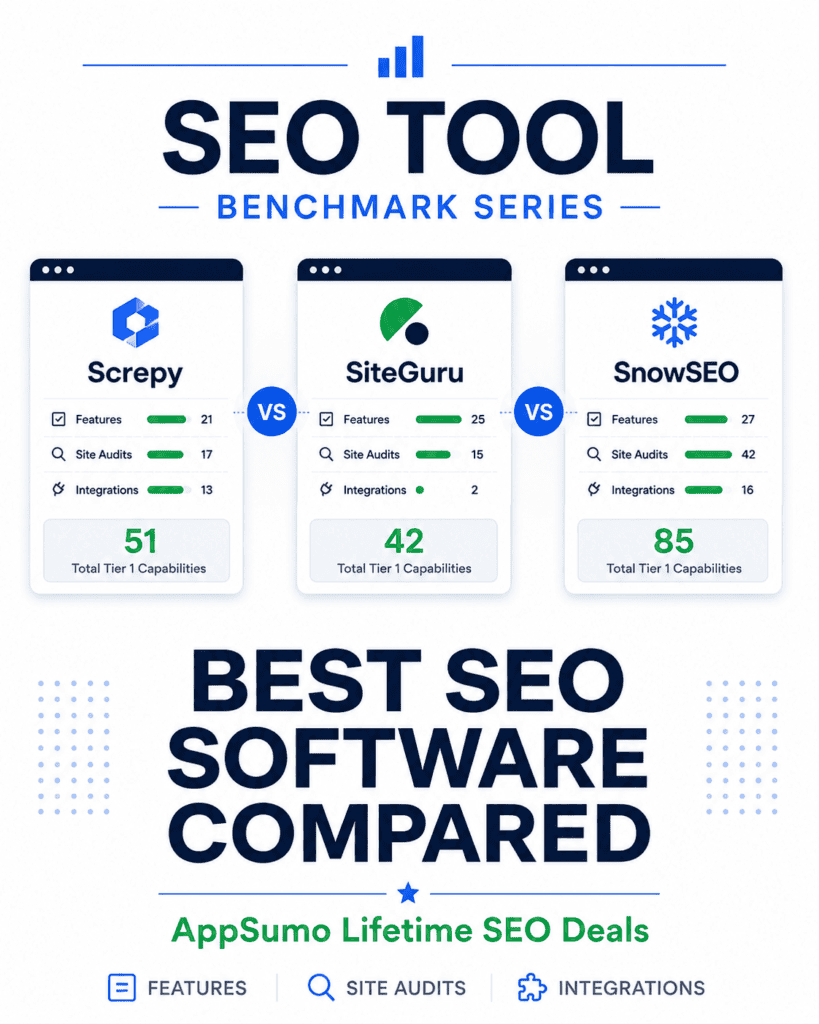
This page is part of my SEO Tool Benchmark Series, where I compare AppSumo SEO tools I have purchased and tested across their most important capabilities. Other comparisons in the series examine site audits and integrations.
SEO platforms can include dozens of menu items, settings, reports, and small conveniences. Listing every one of them would make this comparison harder to use rather than more helpful. This benchmark focuses on the capabilities most likely to influence a buying decision.
The comparison is divided into traditional SEO, AI search, content and workflow, reporting, and platform capacity. AI search is still developing quickly, so that section currently focuses on whether each platform offers the capability. As the category matures, future comparisons may examine the depth of the data and metrics each feature provides.
How the Feature Benchmark Works
This benchmark is intentionally curated rather than exhaustive. Closely related features may be grouped or presented together when separating them would add complexity without helping someone choose between products.
A checkmark means the capability is included in the AppSumo Tier 1 plan used for this comparison. An upgrade symbol means the capability is available only on a higher AppSumo tier. Numbers and limits are shown when they are more useful than a simple checkmark.
Legend
✅ Included: Available in the AppSumo Tier 1 plan used for this comparison.
⬆️ Upgrade required: Available only on a higher AppSumo tier.
Blank: The capability has not been verified for that platform and should not automatically be interpreted as unsupported.
🟢 Available: Currently available as an AppSumo lifetime deal.
— Confirmed unavailable: I confirmed that the platform does not offer the capability.
⚪ Deal no longer available: Previously sold on AppSumo but not currently active.
Affiliate disclosure: If you purchase through my link, I may earn a small commission at no additional cost to you. I only recommend tools I have personally purchased or tested.
SEO Tool Feature Comparison
Traditional SEO
These are the capabilities most closely associated with established SEO work, including keyword discovery, rank tracking, competitor research, backlinks, technical monitoring, and site auditing.
Capability
Screpy
SiteGuru
SnowSEO
Backlink Analysis
⬆️
⬆️
—
Disavow Management
⬆️
—
—
Manual Backlink Tracking
—
✅
—
Referring Domain Analysis
⬆️
—
—
Backlink Opportunities Based on Competitors
—
⬆️
—
Competitor Analysis
—
3 competitors
✅
Competitor Ad Analysis
⬆️
—
—
Core Web Vitals Monitoring
25 pages
✅
✅
Google Map Rank Tracking
50 checks per week
—
—
Keyword Cannibalization
—
✅
✅
Keyword Research
3 searches per day
—
250 searches per month
Keywords Tracked
150
100
50
Organic Keyword Intent
✅
—
—
Rising and Falling Keywords
✅
✅
✅
Rising and Falling Pages
✅
✅
✅
SERP Analysis
✅
—
—
Site Audit
✅
✅
✅
Site Audit Exclusion Options
—
✅
✅
Striking Distance Keywords
✅
✅
—
Top SERP Positions Tracked
Top 10
Top 100
Top 100+
Uptime Monitoring
Every 1+ minutes
—
—
AI Search, GEO and AEO
AI search is evolving rapidly, so this section focuses on whether each capability exists today rather than measuring its depth or quality. These capabilities track how brands, pages, and competitors appear in AI-generated answers rather than relying only on traditional search rankings. As the category matures, future versions of this benchmark will compare the depth and quality of these capabilities.
Capability
Screpy
SiteGuru
SnowSEO
AI Brand Mentions
—
—
✅
AI Citation Analysis
—
—
✅
AI Prompt Management
—
—
✅
AI Referral Pages
—
✅
—
AI Search Visibility
—
✅
✅
AI Sentiment Analysis
—
—
✅
Content and Workflow
These features help plan, create, improve, or prioritize SEO work. They range from content generation and topic planning to recommendations that help determine what to work on next.
Capability
Screpy
SiteGuru
SnowSEO
AI Article Creation
✅
—
✅
AI Recommendations for Focus Keywords
—
✅
—
AI Updates to Existing Articles
—
—
✅
Branded Keyword Analysis
—
✅
✅
Custom Keyword Segments
✅
—
—
Internal Link Suggestions
—
⬆️
—
Prioritized Task List
✅
✅
✅
Topic Clusters
—
—
✅
Reporting
Reporting features determine how easily SEO data can be reviewed, organized, monitored over time, or shared with clients and stakeholders.
Capability
Screpy
SiteGuru
SnowSEO
Click-Through Report
—
✅
—
Google Algorithm Update Impact
—
✅
—
Report Builder
✅
✅
✅
Report Templates and Widgets
✅
✅
✅
Scheduled Reports
—
✅
✅
Site Changes Log
—
✅
—
Site Tree
—
✅
—
Platform Features and Limits
These features and limits don’t define the SEO methodology of a platform, but they can influence whether it fits your website, your team, and the way you prefer to work.
Capability
Screpy
SiteGuru
SnowSEO
AI Support Assistant
—
—
✅
Chrome Extension
✅
—
—
Dark Mode
✅
—
✅
Pages Crawled
5,000
500
500
Users
10
Unlimited
1
How to Interpret the Feature Comparison
The tool with the most checkmarks is not automatically the best choice. A platform may offer fewer total capabilities while providing stronger depth in the areas most important to you.
Screpy offers broader crawl limits and several traditional SEO and SERP capabilities.
SiteGuru emphasizes actionable SEO monitoring, reporting, and workflow guidance.
SnowSEO combines traditional SEO with the broadest collection of AI search and AI-assisted content capabilities in this comparison.
The most useful way to evaluate this table is to identify the few capabilities that would meaningfully change how you work. Features you will never use should not carry the same weight as the functions that solve your most important SEO problems.
This page is the hub for my SEO Tool Benchmark Series, where I compare SEO software I have personally purchased and tested through AppSumo.
Feature lists rarely tell the full story. Two tools can both advertise site audits, keyword tracking, AI visibility, or integrations while offering very different depth and limits underneath. Rather than relying on marketing claims or an arbitrary overall score, these benchmarks compare what each platform actually includes.
Explore the SEO Tool Benchmarks
Feature Benchmark Compares the capabilities most likely to influence a buying decision: traditional SEO, AI search, content and workflow tools, reporting, and platform limits. Compare SEO tools features ->
Site Audit Benchmark Compares what each platform can inspect: technical SEO, content and links, PageSpeed, mobile usability, security, social metadata, structured data, and international SEO. Compare site-audit capabilities ->
Integration Benchmark Compares connections to core SEO data, AI assistants, development tools, publishing systems, APIs, and Model Context Protocol. Compare SEO tool integrations ->
How the SEO Tool Benchmark Works
Each benchmark compares the capabilities available in the AppSumo Tier 1 plan. This gives a consistent baseline and answers a practical question: what do you actually get when you buy the entry level lifetime deal?
Capabilities that require a higher tier are noted on the detailed comparison pages but excluded from the Tier 1 totals shown here. Numeric allowances, such as tracked keywords, users, crawl limits, or searches, count as included when they are available at Tier 1.
Affiliate disclosure: If you purchase through my link, I may earn a small commission at no additional cost to you. I only recommend tools I have personally purchased or tested.
SEO Software Benchmark Results
A platform with more verified capabilities is not automatically the best choice. One specialized capability can be more valuable to you than ten features you will never use. The totals below measure breadth, not quality.
Capability totals reflect the current benchmark and may change as features are added, removed, or further verified. Higher tier capabilities are not included.
What Each SEO Platform Does Best
Screpy
Screpy is strongest in traditional SEO monitoring, SERP research, and developer-oriented access. Its Tier 1 plan includes 5,000 crawled pages, 150 tracked keywords, SERP analysis, Google Map rank tracking, configurable uptime monitoring, a Chrome extension, API access, and integrations with Codex, Cursor, and GitHub Copilot.
Its site audit covers 17 verified capabilities, slightly more than SiteGuru but substantially fewer than SnowSEO’s 42. Screpy covers important fundamentals such as titles, headings, canonical tags, image optimization, thin content, security headers, and Core Web Vitals, but it does not currently match SnowSEO’s depth in broken links, redirects, indexing, security, and detailed PageSpeed checks.
Several backlink and competitor features require a higher AppSumo tier and are therefore excluded from the Tier 1 total.
SiteGuru is strongest in actionable SEO guidance, reporting, and team-friendly workflow features. Its Tier 1 plan includes keyword cannibalization, striking-distance keywords, prioritized tasks, site-change tracking, scheduled reports, click-through reporting, and unlimited users.
Its main limitation is integration breadth. SiteGuru has only two verified Tier 1 integrations, Google Analytics and Google Search Console, compared with 13 for Screpy and 16 for SnowSEO. Connections to ChatGPT, Claude, Cursor, and MCP require an upgrade. That may not matter to someone primarily looking for clear recommendations and reporting, but it makes SiteGuru less suitable for integration-heavy or AI-assisted workflows.
SiteGuru is no longer available as an active AppSumo deal, but it remains a useful benchmark for existing owners and for evaluating newer platforms.
SnowSEO has the broadest Tier 1 capability coverage in this comparison, with 85 verified capabilities across features, site audits, and integrations. It leads the audit benchmark with 42 verified checks and provides especially broad coverage of performance, security, mobile usability, redirects, indexing, and international SEO.
SnowSEO also has the most developed AI-search offering in this comparison. It is the only platform currently credited with AI Brand Mentions, AI Citation Analysis, AI Prompt Management, and AI Sentiment Analysis, while also supporting AI Search Visibility.
Its biggest differentiation is that it goes beyond identifying problems. SnowSEO can create content, update existing articles, publish through WordPress or SnowCMS, and attempt automated fixes. Those changes still need careful review, as my meta-description test demonstrated. Its most obvious Tier 1 constraint is the single-user limit, compared with SiteGuru’s unlimited users.
Start with the capabilities that would meaningfully change how you work, not the tool with the highest total.
Choose Screpy when traditional rank tracking, SERP research, monitoring, crawl capacity, or developer integrations matter most.
Choose SiteGuru when actionable recommendations, reporting, and multi-user access matter more than integrations or AI-search depth.
Choose SnowSEO when audit breadth, AI-search visibility, content workflows, and automated remediation are the priorities.
These are directional strengths, not universal recommendations. Tier limits and the specific capabilities you need should drive the final decision.
SEO Tool Benchmark Methodology
This benchmark is based on hands-on use, platform documentation, AppSumo plan details, and capabilities I have personally verified. It is intentionally selective rather than an exhaustive inventory of every menu item or setting.
Each comparison page explains its own legend and how related capabilities are grouped. The benchmark will continue to evolve as products change and new tools become available.
Screpy combines technical SEO auditing, rank tracking, and uptime monitoring with something I haven’t seen in competing tools: built-in MCP integrations that connect directly with ChatGPT, Claude, Gemini, and other AI assistants. I bought Screpy back in August 2022, and it’s remained a solid SEO platform that I’ve continued using. When Screpy shipped a major platform rebuild earlier this month, I wanted to see what had changed and if I would still recommend it today.
The timing also lines up with another interesting development. SiteGuru recently wrapped up a remarkable five-year run on AppSumo. With SiteGuru gone, Screpy becomes one of the first SEO lifetime deals I would evaluate. The two tools overlap heavily in technical SEO, but each has noticeably different strengths. If you already own Screpy, this review will help you decide whether the rebuild is worth another look. If you’re considering buying it for the first time, I’ll walk through what impressed me most, where it still falls short, and whether it’s the right SEO platform for your workflow.
If you’re also evaluating other AppSumo SEO tools, see my independent SEO Tool Benchmark Series comparing SnowSEO, Screpy, and SiteGuru across verified features, site audits, and integrations.
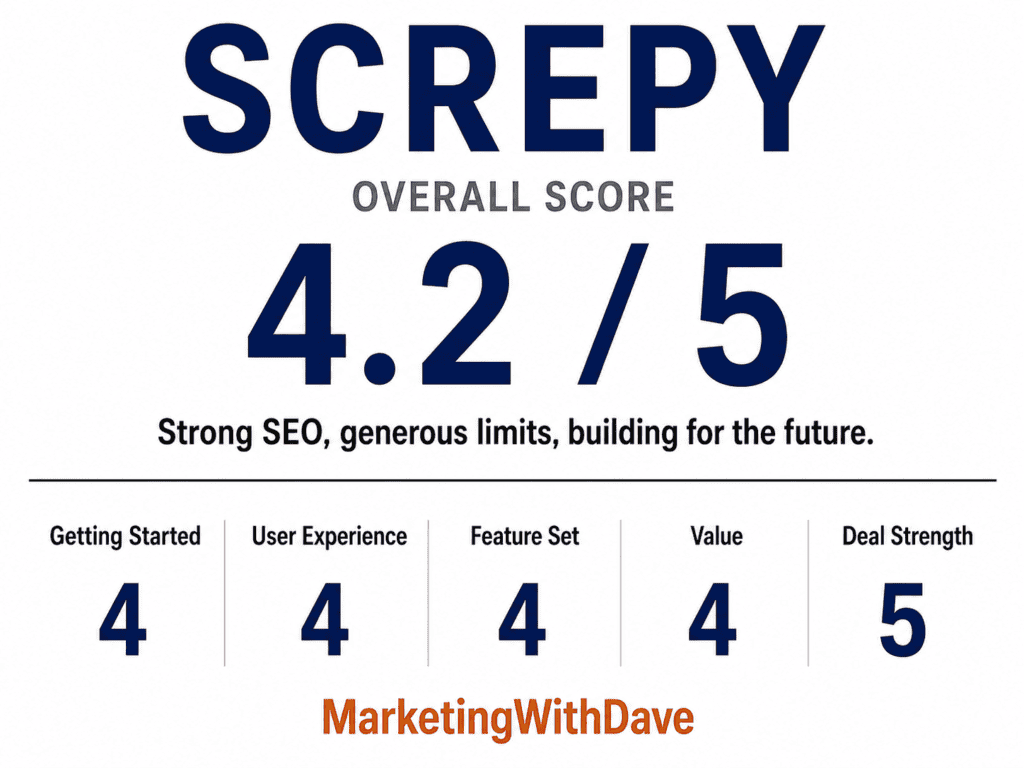
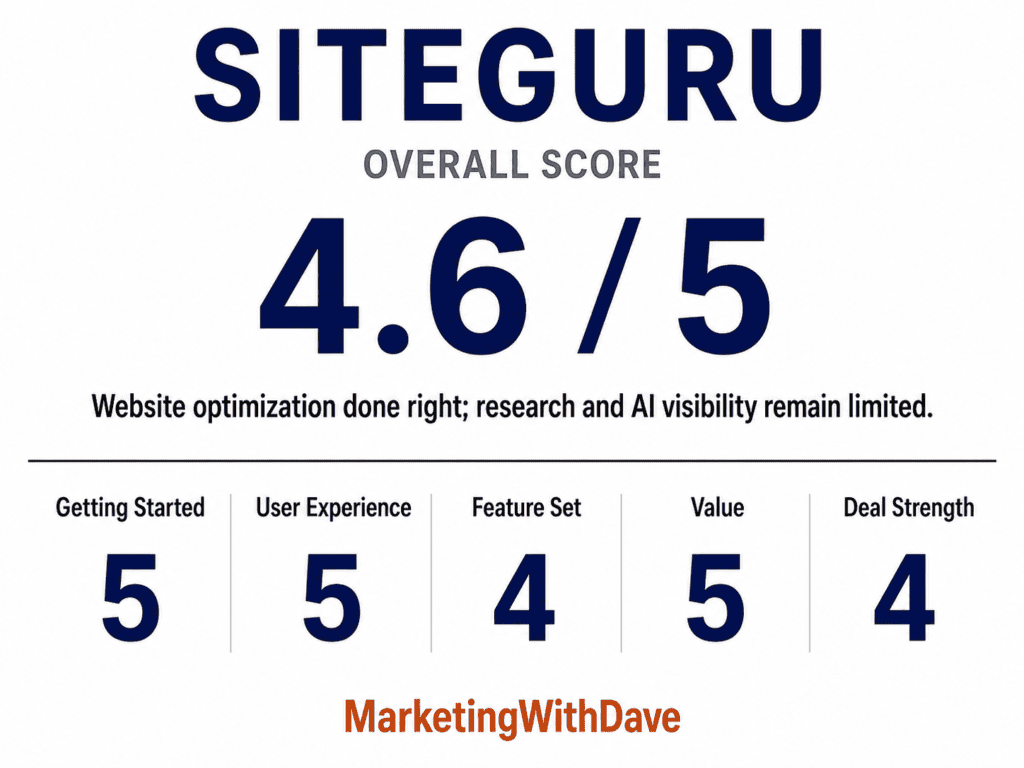
Overall Score
Why 4.2/5: Strong SEO fundamentals, generous limits, and an ambitious roadmap, held back by shallow rank tracking and missing AI Search Visibility.
Affiliate disclosure: If you purchase through my link, I may earn a small commission at no additional cost to you. I only share tools I have used myself.
The 30-Second Decision
Buy Screpy if: You want one dashboard covering technical SEO audits, rank tracking, Google Map ranking, PageSpeed monitoring, and uptime alerts, with generous crawl and keyword allowances and native AI assistant integrations through MCP.
Skip it if: You need dedicated backlink analysis, competitor comparison, or scheduled client reporting today, or you’re expecting a full AI Search Visibility feature with prompt and citation tracking.
What Stood Out: What I Liked and What I Didn’t
Before the full walkthrough, here is the short version of what separates Screpy from other tools I have tested, and what held it back.
What I Liked
Native AI assistant integrations. Screpy connects directly to ChatGPT, Claude, Gemini, Cursor, and GitHub Copilot through its API and MCP support. I have not seen this built into a similarly priced SEO tool.
Chrome extension. Quickly view SEO insights for the page you’re visiting without opening the Screpy dashboard. It’s a small convenience that makes checking pages much faster during day-to-day work.
Keyword and Rank Tracking. Monitor keyword rankings over time with historical trends and visibility into how your target terms are performing. While the tracker currently focuses on the top 10 Google results, it’s still a useful way to monitor your most important keywords.
5,000 crawled pages per project. Significantly higher than most tools at this price point, including SiteGuru’s 500-page limit.
150 tracked keywords per project. A solid allowance for small business sites and solopreneur portfolios.
Google Map Ranking tracking. Rarely included in comparable SEO tools, and a real advantage for anyone running or supporting a local business.
A visibility metric column in the keyword data. A small addition, but one I have not seen in most other platforms, and it adds useful context to raw ranking numbers.
What I Didn’t Like
Rank Tracker only shows the first 10 Google results. This was my single biggest disappointment with the tool. Screpy has explained that Google restricts reliable access to deeper result pages, and points users toward Search Console and Organic Keywords for broader visibility with richer data. That’s a fair explanation, but tracking only page one of Google is a meaningful limitation if you’re trying to watch movement out of page two or three.
AI Search Visibility is referenced in parts of the marketing, but the functionality isn’t available today. Screpy’s marketing references AI-driven insights, but there is currently no feature that tracks how your brand shows up in ChatGPT, Perplexity, or other AI answer engines. The team confirmed it’s on the roadmap, so I hope to revisit this section in a future update.
Several features require connecting through Cloudflare. This means changing your domain’s nameservers, which is a real step, not a checkbox. Cloudflare’s free plan covers what Screpy needs, so there’s no added cost, but it’s worth knowing this isn’t a five-minute setup for everyone.
You can’t sort most columns by clicking the header. A small thing, but it slows down scanning larger data tables.
Keyword Research results disappeared once I navigated away from the screen during testing, though the team told me a fix was already in progress and expected within a day or two.
No backlink analysis, competitor comparison, or scheduled reports. Backlink data sits behind an upgrade, and there’s no way to automatically send white-label reports on a schedule.
Would I buy Screpy again today? Yes, but with clear expectations. For most small businesses, freelancers, agencies, and website owners, Screpy offers an impressive amount of functionality for the price. It’s one of the more compelling SEO lifetime deals available today, particularly for buyers who value generous limits and active product development.
Pros and Cons
Pros
Cons
5,000 crawled pages per project, well above comparable tools
150 tracked keywords per project
Native AI assistant integrations with ChatGPT, Claude, Gemini, Cursor, and GitHub Copilot via MCP
Google Map Ranking tracking, rare at this price point
Visibility metric column adds useful context to keyword data
37-point site audit covering technical, content quality, security, and social tag issues
Responsive team that fixed or acknowledged several issues while I was testing
Strong long-term AppSumo rating (4.6 from 900+ verified purchasers)
Rank Tracker limited to the first 10 Google results per keyword
AI Search Visibility is marketed but not yet functional
Several features require a Cloudflare nameserver change to set up
Most data tables can’t be sorted by clicking column headers
No backlink analysis, competitor comparison, or scheduled reports
What Screpy Actually Does
Screpy centers on five areas: Search Console insights, technical SEO auditing, keyword rank tracking, PageSpeed and Core Web Vitals monitoring, and uptime alerts, all rolled up into white-label reports.
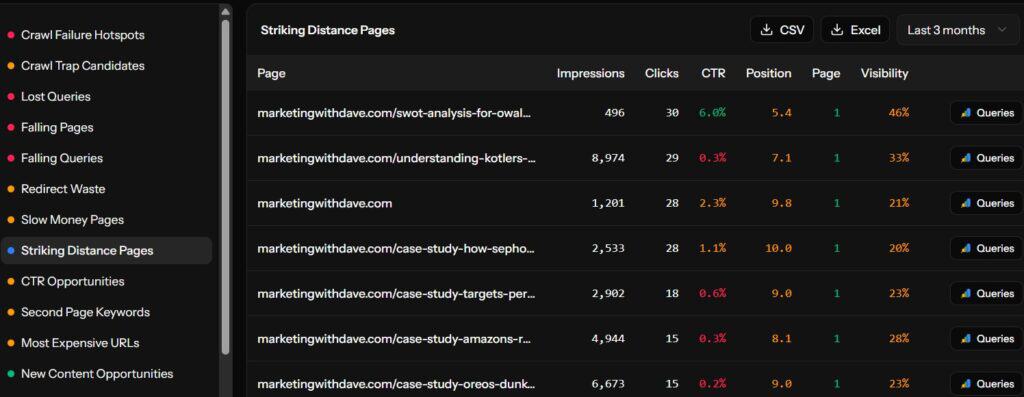
Search Console insights pull in your clicks, impressions, average position, and CTR, and let you compare date ranges to spot new keywords, lost keywords, and pages with high impressions but weak click-through rates.
Technical SEO audit crawls up to 5,000 pages per project and checks for broken links, redirect issues, crawlability problems, duplicate content, structured data issues, and more, organized into a single health score with prioritized, page-level fixes.
Keyword rank tracking covers up to 150 keywords per project across desktop and mobile, with historical position data and a Google Map Ranking feature for local search visibility.
PageSpeed and Core Web Vitals monitoring covers up to 25 URLs per project using Google Lighthouse data, tracking LCP, CLS, and INP alongside recommendations for improving load speed.
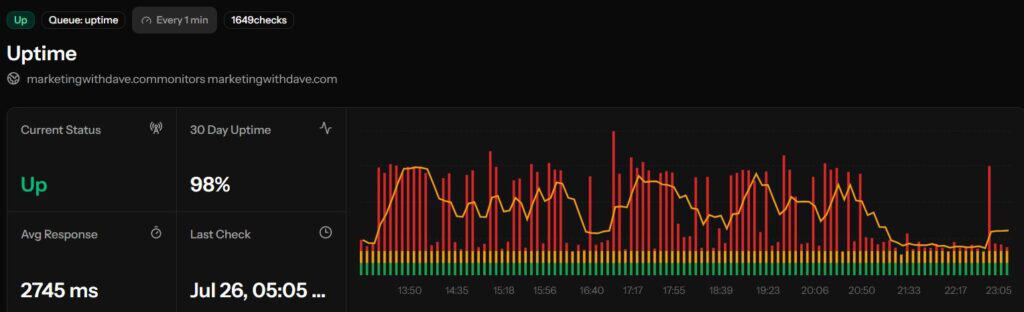
Uptime monitoring checks your site continuously and alerts you the moment it goes down, with downtime history to help spot recurring hosting problems.
I own Screpy, SiteGuru, and SnowSEO, and I’ve spent considerable time using all three. The comparison below uses each product’s AppSumo tier 1 plan so you’re comparing like for like.
Feature
Screpy
SiteGuru
SnowSEO
Pages crawled per project
5,000
500
500
Keywords tracked per project
150
100
50
Top SERP positions tracked
10
100
163+
Google Map Ranking
Yes
No
No
AI Search Visibility tracking
Coming soon
Yes
Yes
Native AI assistant / MCP integrations
Yes
Upgrade only
Yes
Backlink analysis
Upgrade only
Upgrade only
Coming soon
Scheduled reports
No
Yes
Yes
The comparison above highlights where each tool stands today. Screpy has made significant progress with its platform rebuild, generous crawl limits, and native AI assistant integration. SiteGuru still sets the standard for actionable SEO recommendations, while SnowSEO has evolved into a legitimate SEO platform with strong AI Search Visibility capabilities. Which is the best fit ultimately depends on what you’re trying to accomplish.
My Experience With Screpy
Getting Started
Basic setup is straightforward, but several of Screpy’s more advanced features require routing your domain through Cloudflare, which means changing your nameservers at your registrar. It’s a real step, not just a checkbox, so budget a little extra time for it if you’re not already using Cloudflare.
The Dashboard and Data Tables
The dashboard is clean and organizes overview metrics, crawl health, on-page SEO, and rank tracking into clearly labeled tabs. One recurring frustration during testing was that most data tables can’t be sorted by clicking the column headers, which slows down scanning a large project for the biggest issues.
Site Audit
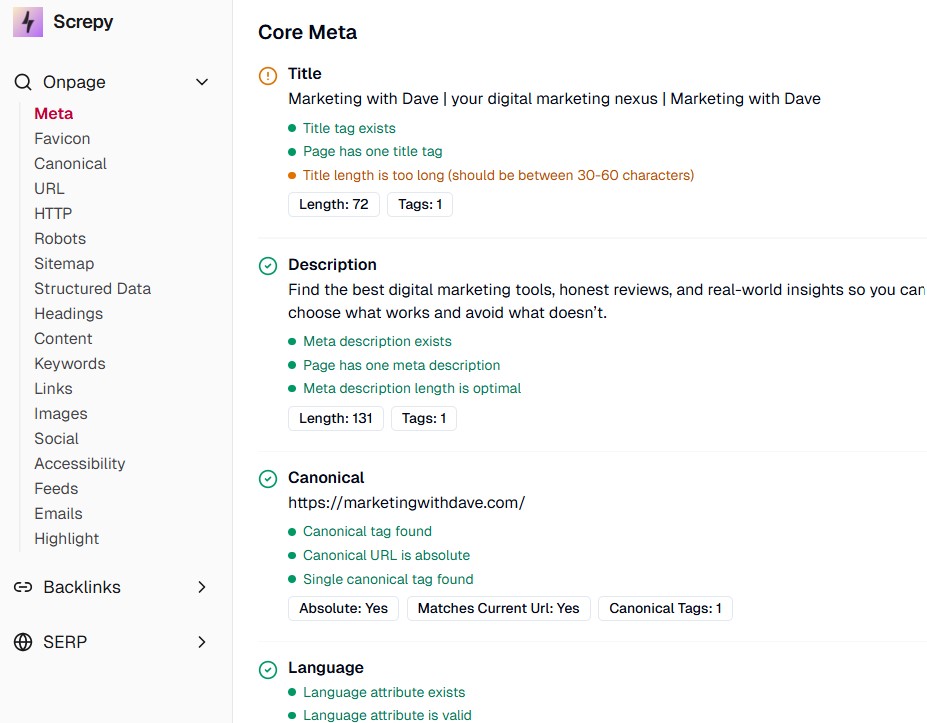
The audit covers 37 individual checks spanning canonicals, headings, meta descriptions, page titles, images, structured data, social tags, and security headers like CSP and HSTS. That’s a broader security-focused checklist than most comparable audit tools include. Each issue is scored and tied to affected pages, which makes prioritization straightforward.
Keyword Research and Rank Tracking
Screpy tracks up to 150 keywords per project with historical position data across desktop and mobile. The standout addition is Google Map Ranking, tracked weekly, which is genuinely useful for local businesses and rarely shows up in tools at this price point.
The one significant limitation, and my single biggest disappointment with the tool, is that the Rank Tracker only shows the first 10 Google results for any tracked keyword. Screpy has been direct about why: Google restricts reliable access to deeper result pages, and the team points users toward Search Console and Organic Keywords data for a fuller picture with richer detail. That’s a reasonable explanation, but it means the Rank Tracker by itself won’t tell you where you sit beyond page one, which matters if you’re trying to track movement out of page two or three.
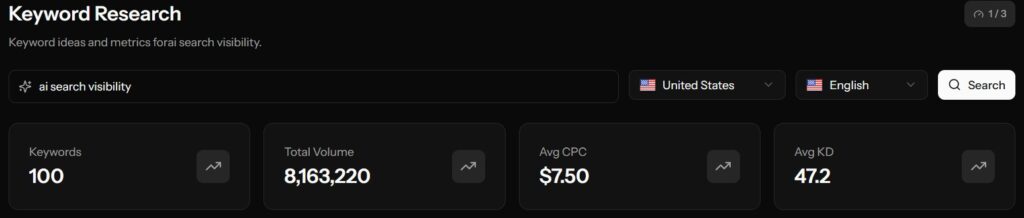
Keyword Research is capped at 3 searches a day, and during my testing, the results disappeared once I navigated away from the screen. Screpy’s team told me a fix was already coming within a day or two of my flagging it, which was true of several smaller issues I raised during this review. The team’s responsiveness throughout testing was consistently a bright spot.
With URL Segments you can group keywords by URL path and create custom segments to monitor how sections of your site perform over time. For example, I can create a segment for all of my software reviews or all SEO-related content instead of looking at every tracked keyword together. It’s a thoughtful feature that makes large keyword sets much easier to analyze.
SERP Analysis
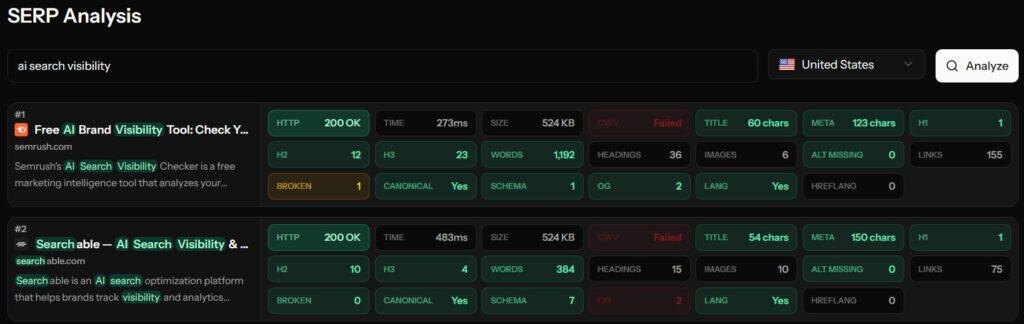
Screpy also includes a SERP Analysis tool that lets you inspect the pages currently ranking for a keyword. Instead of only seeing where your page ranks, you can quickly review the competing results and better understand what you’re up against before creating or updating content. It’s a practical addition that fits naturally into keyword research and content planning.
AI Assistant Integrations
This is where Screpy differentiates itself the most. The platform now supports API access and MCP integrations with ChatGPT, Claude, Gemini, Cursor, and GitHub Copilot, letting you pull Screpy data directly into an AI workflow or connect your own account for custom article and report generation. I haven’t seen this level of AI assistant integration in a comparable SEO tool at this price point, and it’s a meaningful forward-looking addition.
The AI Visibility Gap
Screpy’s marketing references AI-driven insights, but there is currently no feature that tracks how often your brand is cited or referenced across ChatGPT, Perplexity, Google AI Overviews, or other AI answer engines. That kind of AI Search Visibility tracking is increasingly common in newer SEO platforms, and Screpy doesn’t have it yet despite alluding to it. This was my biggest disappointment with the platform for that reason. The team confirmed AI search tracking is on the roadmap, so I hope to revisit this section in a future update.
What’s Missing
Backlink data and competitor analysis both sit behind an upgrade rather than being included, and there’s no way to schedule white-label reports to go out automatically. None of these are deal-breakers on their own, but buyers who specifically need backlink monitoring or scheduled client reporting should know those aren’t part of the current feature set.
Support
Support was a consistent strength throughout testing. Multiple smaller issues I raised, including the keyword research data disappearing, were acknowledged quickly and in some cases fixed within minutes. Throughout my testing, I also found the founder to be active in the AppSumo questions section and genuinely interested in customer feedback, which is a good sign for where the product is headed.
Where Screpy Fits
Screpy is a strong fit for: local businesses that benefit from Google Map Ranking, agencies managing multiple client sites with white-label reporting, freelancers and solopreneurs who want broad SEO coverage without juggling several tools, and anyone curious about connecting SEO data into an AI assistant workflow.
Screpy is not the right fit for: enterprise SEO teams, anyone whose work depends heavily on deep backlink analysis, large agencies needing scheduled automated reporting, or anyone looking to fully replace Ahrefs or Semrush.
What Screpy Is Not
Screpy is not Ahrefs or Semrush, and it’s not attempting to be. Those platforms have deep backlink databases and mature keyword research tooling built over many years. Screpy also isn’t currently a dedicated AI visibility or GEO platform, despite some marketing language suggesting otherwise. What Screpy is: a broad, actively developed technical SEO and monitoring dashboard with a genuinely useful set of core features, generous usage limits for the price, and a differentiated integration story through AI assistant connections.
Pricing and Plans
Screpy currently has two AppSumo offers depending on whether you’re an AppSumo Plus member, and the plan structure has been evolving alongside this month’s platform rebuild. Rather than listing pricing and limits that may change, I’d recommend checking the current deal page for the latest plans, tiers, and feature availability before buying.
Try It Risk-Free: AppSumo’s 60-Day Refund Policy
AppSumo’s 60-day refund window gives you enough time to connect your site, run a full audit, and test the rank tracker and keyword research limits before committing.
Bottom Line
I’ve owned Screpy since August 2022, and watching it evolve into this month’s rebuild has been reassuring rather than concerning. The core strengths are still there: generous crawl and keyword limits, Google Map Ranking, a 37-point site audit, PageSpeed monitoring, uptime alerts, and a genuinely novel set of AI assistant integrations through MCP. That’s a solid all-in-one package for small business owners, local businesses, and solopreneurs who don’t want to juggle four separate tools.
The honest gaps are the Rank Tracker’s 10-result limit, which is a real constraint and my single biggest disappointment with the tool, and an AI Search Visibility feature that’s referenced in the marketing but not yet built. There’s also no backlink analysis, competitor comparison, or scheduled reporting today. The team was responsive to every issue I raised during testing, which matters for a platform in the middle of a rebuild.
For most small businesses, freelancers, agencies, and website owners, Screpy offers an impressive amount of functionality for the price. It’s not perfect today, but it’s one of the most interesting SEO lifetime deals currently available, and I’m excited to see where the team takes it next.
This content is for educational purposes and reflects my hands-on experience using the product and the information publicly available at the time of writing. Always evaluate tools based on your specific business needs, goals, and workflows before making a decision.
Not every SEO tool needs to do everything. Some help you research a market you do not fully understand yet by finding competitors, discovering keywords, analyzing backlinks, and identifying content opportunities. Others help you improve the website you already have.
SiteGuru sits primarily in the second camp.
SiteGuru is an AppSumo lifetime deal that combines technical SEO audits, content optimization, Google Search Console data, Google Analytics reporting, and prioritized recommendations inside one unusually approachable platform.
I purchased SiteGuru for MarketingWithDave.com, a content-heavy website with hundreds of published pages. I was not looking for another platform that would produce thousands of keyword ideas or encourage me to publish AI-generated content. I needed something that could help me understand what was happening across the website I already built, identify worthwhile improvements, and make those improvements dead simple to take action.
SiteGuru isn’t trying to be an all-in-one enterprise SEO platform. Instead, it focuses on helping you optimize and improve the website you already own through a thoughtful workflow that combines technical audits, content optimization, Google Search Console insights, and ongoing monitoring in one intuitive interface.
If you’re also evaluating other AppSumo SEO tools, see my independent SEO Tool Benchmark Series comparing SnowSEO, Screpy, and SiteGuru across verified features, site audits, and integrations.
Affiliate disclosure: If you purchase through my link, I may earn a small commission at no additional cost to you. I only share tools I have used myself.
SiteGuru is a strong option if you want a clear, prioritized list of improvements for an existing website, with technical audits, content checks, Google Search Console reporting, and Google Analytics data organized inside one intuitive dashboard. It is a weaker fit if your primary needs are competitor research, backlink strategy, broad keyword discovery, AI citation monitoring, or automated content creation, and it is not a realistic Semrush, Ahrefs, or enterprise replacement.
The quickest way to understand SiteGuru is this: traditional SEO research platforms help answer “what should I create or target next.” SiteGuru mostly helps answer “what should I improve on the website I already have.” That distinction doesn’t excuse every missing feature, but it explains why the product feels cohesive rather than like a bundle of unrelated SEO tools.
SiteGuru is best suited for bloggers, content publishers, small marketing teams, agencies, and business owners who want a straightforward way to improve an existing website. It’s especially valuable if you already use Google Search Console and Google Analytics, as SiteGuru builds on that data with clear, prioritized recommendations. It’s also one of the best SEO platforms for people taking SEO seriously for the first time, thanks to its intuitive interface and approachable learning curve.
SiteGuru is a weaker fit if competitor research, backlink analysis, advanced internal linking, index monitoring, or white-label reporting are core requirements, as those capabilities are either limited or not included in the base lifetime deal.
Why I Bought SiteGuru
MarketingWithDave.com has grown to hundreds of published pages. Keeping that amount of content technically healthy, properly linked, accurately indexed, and consistently optimized is not something I can reliably manage from memory or a collection of spreadsheets.
What I really wanted wasn’t another SEO crawler. I wanted a system that could continuously review the website I already built, tell me what deserved attention first, help me fix it, and confirm the issue was actually resolved. That simple workflow is where SiteGuru stands apart.
What SiteGuru Actually Does
SiteGuru brings several website optimization functions together inside one platform:
Technical SEO audits covering broken links, redirects, canonical URLs, sitemap inclusion, indexability, structured data, OpenGraph tags, headings, alt text, and PageSpeed
Content optimization covering titles, meta descriptions, focus keywords, headings, and internal competition (keyword cannibalization)
Google Search Console reporting covering keyword positions, impressions, clicks, new keywords, lost keywords, and branded traffic
Google Analytics reporting covering traffic sources, top pages, and referral traffic, including AI assistant traffic
Ongoing monitoring through page timelines, recent activity tracking, and weekly emails
Multi-site organization through customizable reports, multiple websites per account, exports, and custom fields
My Experience With SiteGuru
SiteGuru may have the best user experience of any marketing platform I’ve used.
That sounds like a bold statement considering I’ve evaluated hundreds of marketing tools over the years, but the interface deserves it. Every report seems to exist for a reason, every navigation choice feels intentional, and instead of overwhelming me with data, the product organizes SEO into a workflow that’s surprisingly easy to follow.
That clarity shows up most in how I actually work through the tool. My typical workflow looks like this: I find an issue in the audit, open the affected page, use an AI-generated suggestion when one is offered, make the change in WordPress, then go back into SiteGuru and ask it to verify the fix. That find, fix, and verify loop is the main reason SiteGuru feels like more than another website crawler, and it’s the biggest reason I keep coming back to it instead of letting audit findings pile up unaddressed.
The Find, Fix, and Verify Workflow in Practice
Broken-link reporting was my favorite example of this loop working well. SiteGuru shows exactly where a broken link occurs on the page, not just that one exists somewhere on the site. I can make the correction, then ask SiteGuru to recheck the page and confirm the fix landed.
I’ve used the same loop to improve weak page titles: SiteGuru flags the issue, offers an AI-generated suggestion, I implement it in WordPress, and the page-level report reflects the update once I ask it to check again.
This workflow sounds simple, but it’s surprisingly rare. Many SEO tools excel at finding problems. Far fewer make fixing them feel this organized.
Technical and Page-Level SEO Audits
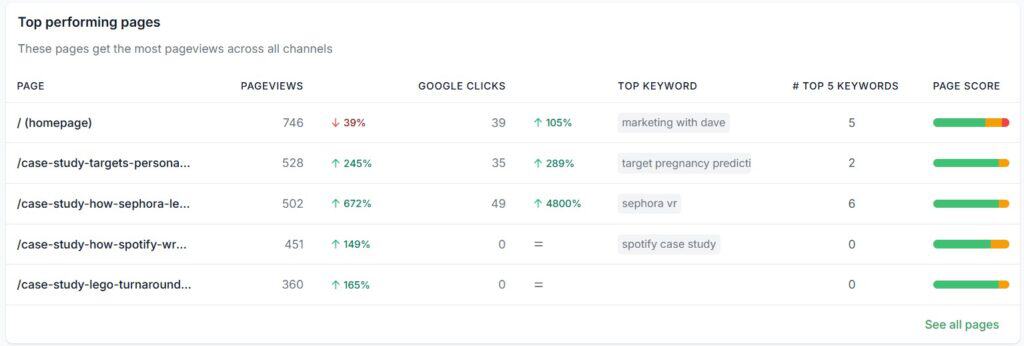
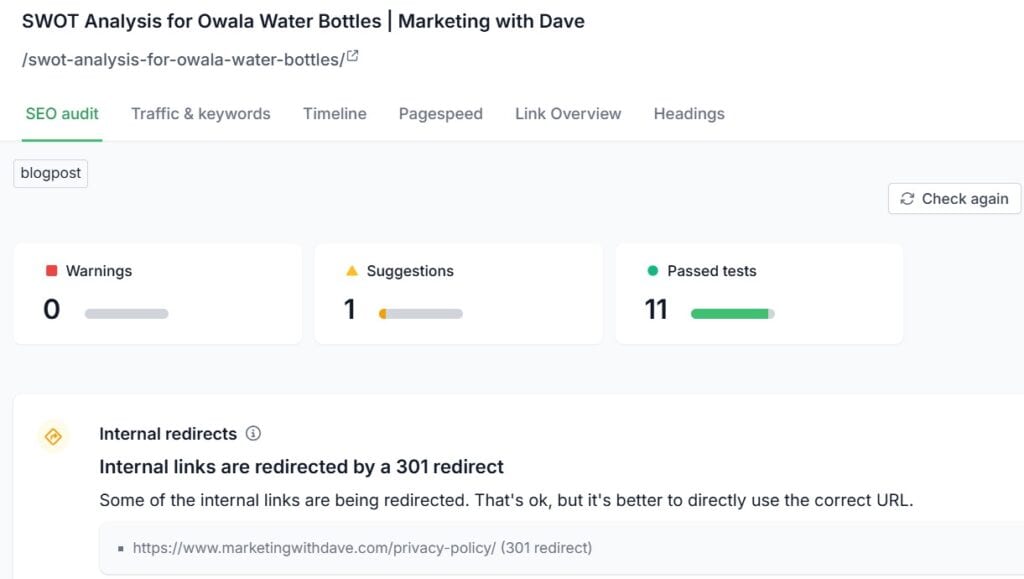
SiteGuru’s page-level reporting is one of the strongest parts of the platform. Each URL combines SEO audit findings, traffic and keyword data, page timeline, PageSpeed score, link overview, and heading structure in one place. Instead of jumping between half a dozen reports, nearly everything I need to understand a page lives in one place
The audit checks areas such as meta descriptions, page titles, canonical URLs, indexability, sitemap inclusion, internal redirects, image alt text, structured data, OpenGraph tags, internal links, headings, and PageSpeed. I also like that SiteGuru displays passed tests alongside warnings and recommendations, which gives useful confirmation that those areas were actually checked rather than silently skipped.
PageSpeed Reporting
SiteGuru makes it easy to identify which pages have weak PageSpeed scores and group them by severity, which is useful for deciding where performance work is needed. It does not replace Google PageSpeed Insights or Lighthouse for deeper diagnosis of specific Core Web Vitals, JavaScript, image, or server issues. SiteGuru answers “which pages deserve attention.” Google’s tools still answer “why is this specific page slow.”
Search Insights and Keyword Reporting
SiteGuru’s keyword reporting is built around Google Search Console data rather than a proprietary keyword database, organized into reports that are considerably easier to act on than scrolling through a raw GSC export. The Search Insights section includes All Keywords, Tracked Keywords, New Keywords, Low-Hanging Fruit, Lost Keywords, and Branded Keywords.
The reports themselves aren’t revolutionary. The organization is. SiteGuru takes information that already exists inside Google Search Console and reorganizes it into workflows that are dramatically easier to act on.
Low-Hanging-Fruit Keywords
This report highlights keywords and pages already close to stronger rankings, connecting each opportunity to a page-level checklist instead of making me manually filter thousands of Search Console queries. It’s one of the more practical reports because it focuses on improving positions I already have rather than chasing new topics.
New and Lost Keywords
New Keywords shows terms the site recently began ranking for, with impressions, clicks, positions, and the top associated page. Lost Keywords shows the opposite: terms that disappeared or declined, along with how many impressions and clicks they previously generated. Not every lost keyword deserves action, since Search Console often surfaces low-volume or loosely related queries, but the report is useful for spotting meaningful changes that might otherwise get buried in GSC.
Branded and Non-Branded Traffic
SiteGuru makes it easy to define branded terms and separate branded from non-branded search performance, showing clicks, top keywords, top pages, and performance over time for each. This is especially helpful for understanding whether organic traffic is reaching new audiences or mostly capturing people who already know the brand.
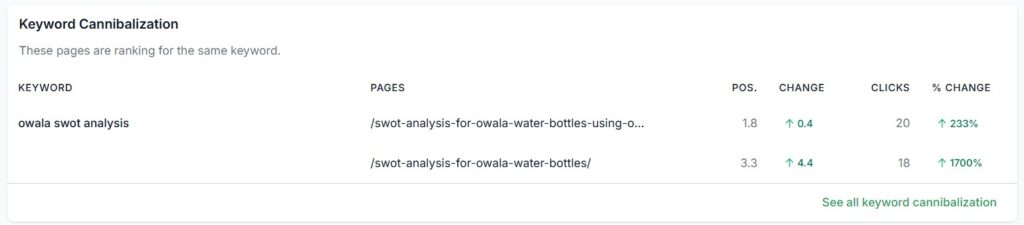
Keyword Cannibalization
SiteGuru also includes a keyword cannibalization report to identify multiple pages ranking for the same keyword. My report didn’t surface current cannibalization issues during testing, but it’s a valuable report to have available on a site with hundreds of articles and overlapping topic clusters.
Growing and Declining Content
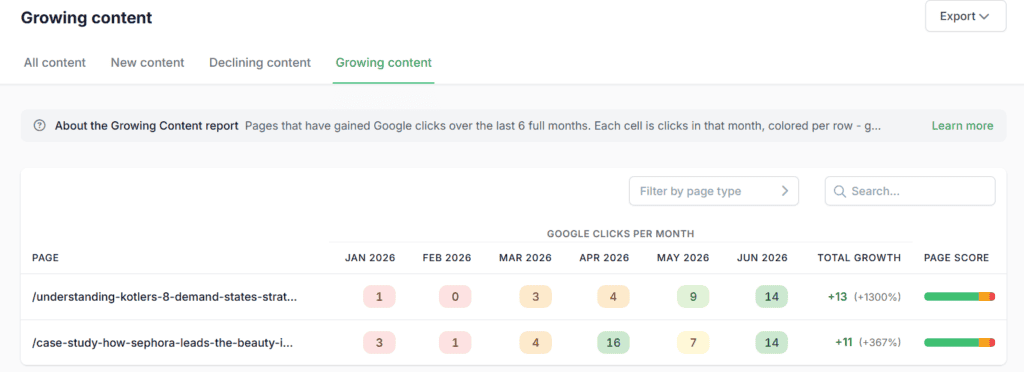
The Growing Content and Declining Content reports give a six-month view of individual page performance, with monthly clicks displayed across each row and color changes that quickly reveal momentum. It’s a much faster way to spot a page gaining or losing traction than scanning a raw export.
One frustration: the New Content report, which tracks newly published pages, sits behind the paid Pro add-on. Since it’s based on the website’s own content rather than external data, it feels like a natural extension of the Growing and Declining reports rather than a separate paid tier.
The Google Update Report
This is one of the most distinctive features I found inside SiteGuru. You can select from a dropdown of Google algorithm updates going back to 2023 and compare website performance before and after the selected update, including Google clicks, impressions, organic search sessions, total visits and users, a visibility timeline, and both declining and winning pages.
I haven’t seen many SEO platforms make Google update analysis this approachable. SiteGuru is also careful to note that correlation doesn’t prove the update caused the change, since competition, seasonality, and publishing activity can all play a role. That caveat makes the report more credible, not less useful.
SiteGuru’s Google Analytics integration brings direct traffic, organic search, AI assistants, organic social, referral traffic, and individual platforms and sources into the same reporting environment. It’s more than a technical SEO dashboard; it gives a practical view of how search, social, referrals, and AI traffic fit together.
AI Visibility: Useful Referral Data, Not Full Visibility Tracking
One thing I found refreshing was the founder’s candor about AI visibility. In the AppSumo Q&A, he openly questioned whether today’s AI visibility tools can reliably measure and report AI search visibility. Whether you agree with that position or not, I appreciate that SiteGuru hasn’t rushed to add flashy AI metrics simply because the market expects them. Instead, the platform focuses on measurable referral traffic from AI assistants while taking a more conservative approach to broader AI visibility reporting.
That doesn’t mean the feature is complete. If you’re looking for custom prompt tracking, citation monitoring, representation analysis, or competitive AI visibility monitoring, dedicated platforms like ZeroRank currently provide much deeper functionality. SiteGuru’s AI reporting is useful, but today it’s best viewed as referral analytics rather than a comprehensive AI visibility platform.
As someone who spends a lot of time evaluating AI visibility tools, I appreciated that SiteGuru resisted inventing metrics it couldn’t confidently measure.
Weekly Email Insights
SiteGuru sends regular email summaries surfacing clicks, sessions, top pages, top keywords, and low-hanging-fruit opportunities. There’s nothing revolutionary about the emails individually; their value is behavioral. One thing I didn’t expect was how effective the weekly emails were. They aren’t flashy. They’re simply good at bringing me back into the product with something worth fixing. That ongoing engagement is a big reason I expect SiteGuru to stay part of my regular workflow.
Page Timelines and Recent Activity
SiteGuru tracks recent website activity, including newly discovered pages, removed pages, and title changes, and connects those events to individual URLs. Most SEO tools tell you what problems currently exist. SiteGuru also does a good job of showing what recently changed, which becomes increasingly useful as a website grows.
Custom Fields and Multi-Site Organization
Custom Fields let you add your own business data to websites in the account and display selected fields inside the advanced dashboard, such as monthly software or hosting costs, hosting provider, CMS platform, client owner, contract dates, renewal dates, account priority, or internal notes. This is less important for someone managing one website, but potentially valuable for an agency or marketer responsible for a portfolio of sites. Data can be entered manually or uploaded through a CSV or Excel file.
Site Architecture and Site Tree
The Site Tree provides a visual representation of how pages are organized and connected across the website. It’s not a report I expect to open every day, but it’s a useful alternative to analyzing site architecture through a spreadsheet or raw crawler export, and it can help identify unusually deep content, isolated sections, or structural patterns worth reviewing on larger websites.
Focus Keywords and the Missing WordPress Integration
The Focus Keywords feature initially interested me. SiteGuru suggests relevant queries based on Search Console data, lets you select important terms, and creates a practical checklist intended to improve the page’s ranking for that keyword.
The weakness is workflow duplication. SiteGuru does not integrate with WordPress SEO plugins such as Yoast, and support told me that integration is not currently planned. I already maintain focus keyphrases inside Yoast, so manually recreating a second keyword database inside SiteGuru across hundreds of pages isn’t especially appealing. The feature still has value for users who don’t maintain focus keywords elsewhere, but a Yoast, Rank Math, or AIOSEO integration would make it considerably more useful for WordPress publishers.
What SiteGuru Does Not Include
Buyers shopping for an SEO platform deserve a clear understanding of what’s missing, regardless of how SiteGuru positions itself.
No Traditional Competitor Research in the Lifetime Deal
SiteGuru is not designed to reverse-engineer competitor traffic, keyword portfolios, backlink profiles, or content strategies the way Semrush or Ahrefs does. Competitor analysis is included in the optional Pro add-on, but it remains much lighter than a dedicated competitive research platform. Competitor awareness is a legitimate part of SEO even for a focused optimization tool, and it’s an area I’d like to see continue developing.
No Broad Keyword Discovery
SiteGuru organizes keywords from Google Search Console and allows you to add terms manually. It doesn’t function as a traditional keyword discovery database with search volume, difficulty, related-query, or market research capabilities. The reports are useful for understanding what the site already ranks for, and much less useful for discovering opportunities outside your current search footprint.
The Optional Pro Add-On
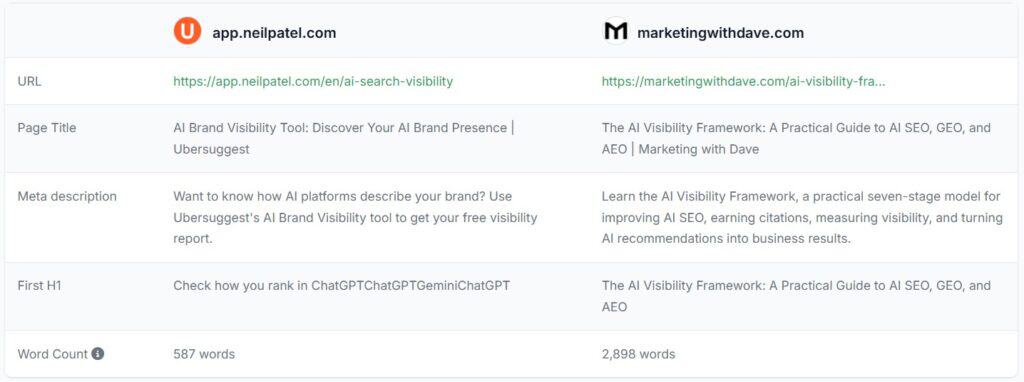
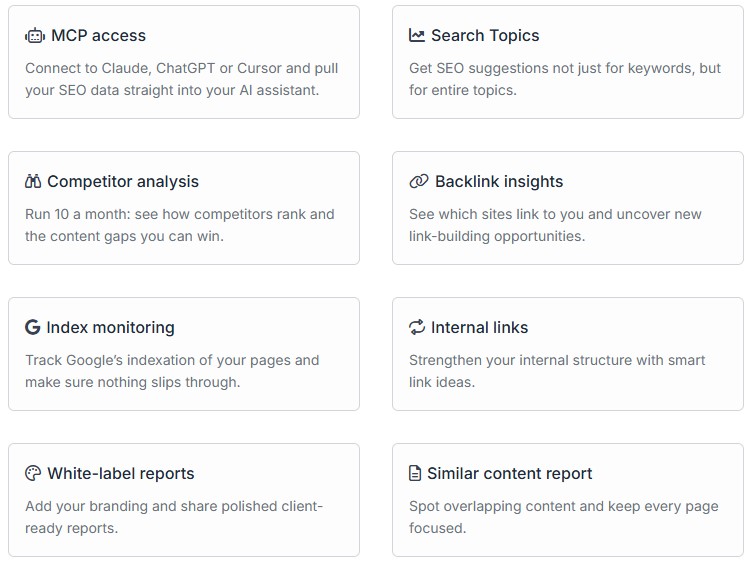
Several additional features are available through a separate Pro add-on that normally costs $29 per month: MCP access, Search Topics, competitor analysis, backlink insights, index monitoring, internal-link suggestions, white-label reports, and the Similar Content report.
Some of this makes sense as a recurring cost. Backlink databases, competitor research, AI processing, and external search data can carry genuine ongoing infrastructure and licensing costs, so including unlimited access inside a one-time lifetime purchase may not be economically practical. The paywall feels more frustrating when a feature is closely tied to the website optimization workflow already included in the base deal.
The features I most wish were part of the lifetime deal:
Internal-link suggestions, because improving internal structure is one of the most valuable and time-consuming tasks on a large content website
Index monitoring, because confirming that important pages remain indexed feels closely connected to ongoing website health
The New Content report, because monitoring newly published content is a natural extension of the included Growing and Declining Content reports
To be clear, the lifetime deal isn’t completely missing internal-link reporting. SiteGuru checks whether pages receive internal links and identifies certain internal-link conditions in the base deal. What requires the Pro add-on is the smart recommendation engine that identifies specific linking opportunities.
Exports and Reporting
Most SiteGuru reports can be exported as CSV or XLSX files, which lets me sort and filter data outside the platform, combine reports with other SEO datasets, share findings with someone else, analyze larger groups of pages with spreadsheets or AI tools, and keep historical snapshots. The base lifetime deal includes customizable reports, but fully white-labeled reports belong to the Pro add-on.
What I Liked and What Needs Work
What I Liked
What Needs Work
Exceptionally intuitive interface
No substantial competitor research in the lifetime deal – added July 2026
Clear, prioritized recommendations
No broad keyword discovery database
Fast find, fix, and verify workflow
Internal-link suggestions require the Pro add-on
Strong page-level optimization reports
Index monitoring requires the Pro add-on
Google Update Report is unusually useful
No WordPress or Yoast integration for Focus Keywords
Growing and Declining Content reports are easy to understand
Backlink insights are weak without the paid add-on
Most reports support CSV or XLSX export
AI Visibility is limited to referral reporting
Custom Fields are valuable for multi-site management
New Content, Search Topics, and Similar Content are gated
Same core features across AppSumo tiers
Base reports are customizable but not fully white-labeled
Pricing and AppSumo Plans
The SiteGuru AppSumo lifetime deal starts at $79 for one website and 500 pages, with higher tiers increasing the number of websites and pages available.
Every AppSumo tier receives the same core feature set. Higher tiers purchase additional capacity rather than unlocking a less restricted version of the software, which is a fairer structure than deals where the entry tier is heavily limited.
SiteGuru vs Semrush, Ahrefs, and Enterprise SEO Platforms
If you’re hoping SiteGuru replaces BrightEdge, Semrush, Ahrefs, or another complete SEO platform in one inexpensive AppSumo purchase, it won’t satisfy that expectation today, and that’s true of most lifetime SEO deals. SiteGuru currently represents a subset of a larger SEO stack:
Need
SiteGuru Fit
Technical website audits
Strong
Page-level optimization
Strong
Search Console reporting
Strong
Google Analytics reporting
Strong
Ongoing website monitoring
Strong
Content performance reporting
Strong
Competitor intelligence
Limited
Keyword discovery
Limited
Backlink research
Limited without Pro
Internal-link suggestions
Pro only
AI citation and prompt monitoring
Limited
AI content generation
Not included
SiteGuru makes more sense as part of an SEO toolkit than as a replacement for every tool inside that toolkit.
Bottom Line
SiteGuru helped me realize something I’ve been missing in SEO software.
The goal isn’t to collect more reports.
The goal is to consistently improve the website you already have.
That’s what SiteGuru does exceptionally well. It organizes technical SEO, content optimization, Search Console reporting, Google Analytics, and page-level recommendations into a workflow that keeps pulling me toward the next meaningful improvement instead of another dashboard.
It’s not the most comprehensive SEO platform I’ve used, and it doesn’t replace competitor intelligence, keyword research, or backlink analysis. What it does provide is one of the clearest and most usable systems I have found for improving a content-rich website. The interface is excellent, the recommendations are understandable, the page-level workflow makes implementation easy, the weekly emails keep me engaged, and the Google Update Report provides context I haven’t seen presented this cleanly elsewhere.
Some functionality is genuinely missing, and other capabilities require the optional Pro subscription, most notably internal-link suggestions and index monitoring, which is the part of the deal I’d most like to see change. Buyers should understand those boundaries before purchasing. But SiteGuru succeeds at the job it’s most committed to: helping website owners identify what needs improvement, complete the work, and verify that it was fixed. For a content-heavy website like mine, that’s enough to make it one of the strongest website optimization tools I’ve found on AppSumo.
This content is for educational purposes and reflects my hands-on experience using the product and the information publicly available at the time of writing. Always evaluate tools based on your specific business needs, goals, and workflows before making a decision.
Everyone is talking about GEO or if you prefer, AEO.
Everyone has an opinion.
Few people are asking the practical question:
How much of your limited marketing time should actually go toward GEO and AEO?
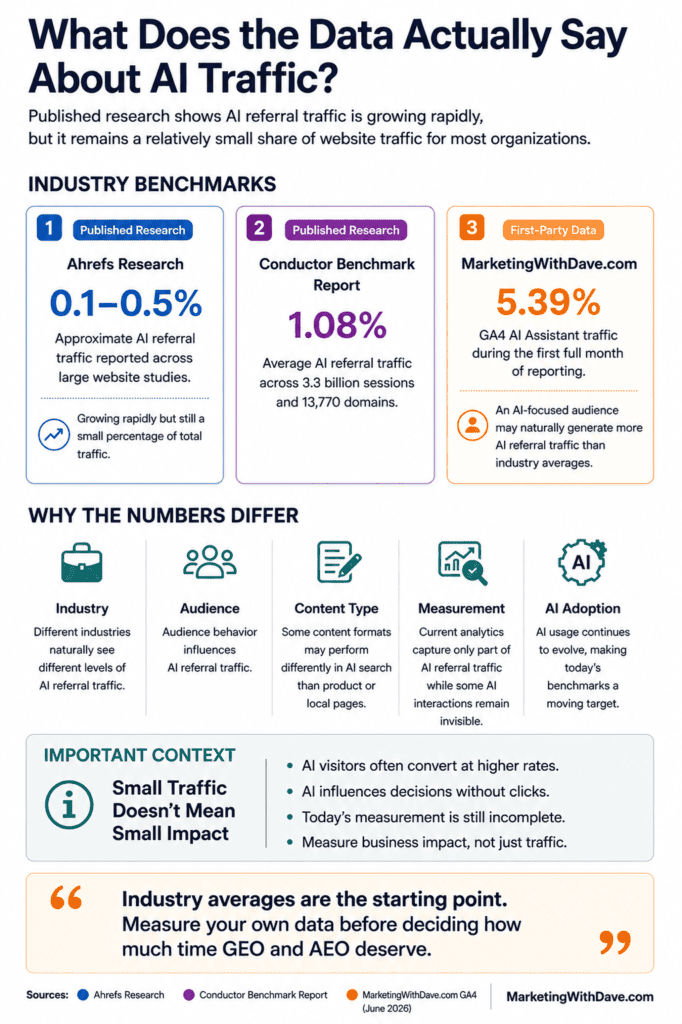
Not in five years. Not once AI search reaches critical mass. Today, based on the traffic, conversion, and visibility data we currently have.
This article is my attempt to answer that question with evidence first and opinion second.
A Quick Note About GEO, AEO, and AI Visibility
The marketing industry has not agreed on a single name for optimizing visibility inside AI-generated answers.
You may see it described as:
Answer Engine Optimization, or AEO
Generative Engine Optimization, or GEO
AI Search Optimization
AI SEO
AI Visibility
The terms are not perfectly interchangeable, but they are often used to describe overlapping goals: helping a brand, product, or piece of content appear accurately and prominently when an AI system answers a question.
I generally prefer the broader term AI visibility, but the strategic question remains the same regardless of which acronym you prefer.
How much of your attention should this emerging channel receive right now?
Why This Question Matters
Every new marketing trend competes for the same limited resource:
Your attention.
Every hour spent rewriting a perfectly good article specifically for AI is an hour you are not spending on conversion optimization, email, link building, customer research, paid acquisition, social media, or the next useful piece of content.
That does not mean GEO and AEO are distractions. It means the opportunity has a cost.
Good strategy is not about doing everything that might work. It is about deciding where your next hour, dollar, or experiment has the best chance of producing a meaningful return.
Before asking whether GEO works, marketers should ask a more useful question:
Given what we know today, how much of a finite week should go toward it?
How Much Traffic Is AI Search Actually Sending?
AI traffic is growing. That part is not especially controversial.
The more important question is how large it is compared with the traffic websites still receive from Google, direct visits, referrals, email, social media, and other established channels.
The exact percentage changed between studies, but the overall finding was consistent:
AI traffic was growing rapidly while remaining small in absolute terms.
That distinction matters. A channel can grow several hundred percent from a very small starting point and still represent a minor portion of a typical website’s traffic.
Conductor
Conductor’s 2026 AEO and GEO Benchmarks Report analyzed 3.3 billion sessions across 13,770 domains. It found that AI referral traffic accounted for an average of 1.08% of total website traffic.
Neil Patel later highlighted the study publicly, which is where I initially encountered the number. The underlying analysis, however, came from Conductor.
That attribution may seem like a small detail, but it matters. Marketers should be able to trace a statistic back to the organization that collected and analyzed the data.
Conductor’s average was higher than the earlier Ahrefs figures, but both sources pointed in the same general direction:
AI referrals are increasing
Industry and audience affect the results
AI still represents a small share of traffic for most websites
Webflow
Webflow has reported a different but equally important measurement: conversion quality.
In a Webflow 2026 presentation on its AEO maturity model, Webflow reported that AI-sourced visitors converted at approximately six times the rate of unbranded organic search traffic. The company also reported that 8% of its self-service signups came from LLM-sourced traffic during the period discussed.
This is self-reported company data rather than an independent, multi-site study. It should not be treated as a universal conversion benchmark.
It is still useful evidence that a relatively small traffic channel may produce disproportionate business value.
AI Traffic Benchmark Summary
Source
Reported AI Traffic or Performance
Evidence Type
What I Took Away
Ahrefs
Generally under 1%, with published figures around 0.1% to 0.5%
Large multi-site studies
AI traffic is growing quickly but remains small for most websites
Conductor
1.08% average traffic share
Benchmark study covering 3.3 billion sessions
Industry and audience can create substantial variation around the average
MarketingWithDave.com
5.39% of sessions during the first full month of GA4 AI Assistant reporting
One website and one month of first-party data
An AI-focused marketing audience may significantly over-index for AI referrals
Webflow
Approximately 6x conversion compared with unbranded organic search
Self-reported company case study
AI traffic may be worth more than its raw volume suggests
No single row should be treated as a universal benchmark.
Together, however, they support a fairly defensible conclusion:
AI referral traffic is real, growing, and still a relatively small portion of total website traffic for most organizations.
What I Am Seeing on MarketingWithDave.com
GA4 began reporting an AI Assistant default channel in May 2026, making some AI referral traffic easier to identify without creating a custom channel group.
During June 2026, the first full month in which that channel appeared in my reporting, AI Assistant traffic accounted for 5.39% of sessions on MarketingWithDave.com.
That is approximately five times the 1.08% average reported by Conductor.
I do not think that means the industry benchmarks are wrong. I think it demonstrates why your own data matters more than a broad average.
That content attracts marketers who are already using ChatGPT, Gemini, Claude, and other AI platforms as part of their research and daily work.
A local service business, restaurant, dental practice, or traditional eCommerce store may see a very different traffic mix.
My 5.39% figure is therefore not a benchmark for other websites. It is a useful first-party example of how dramatically niche and audience can affect AI referral traffic.
It may also understate AI’s actual influence.
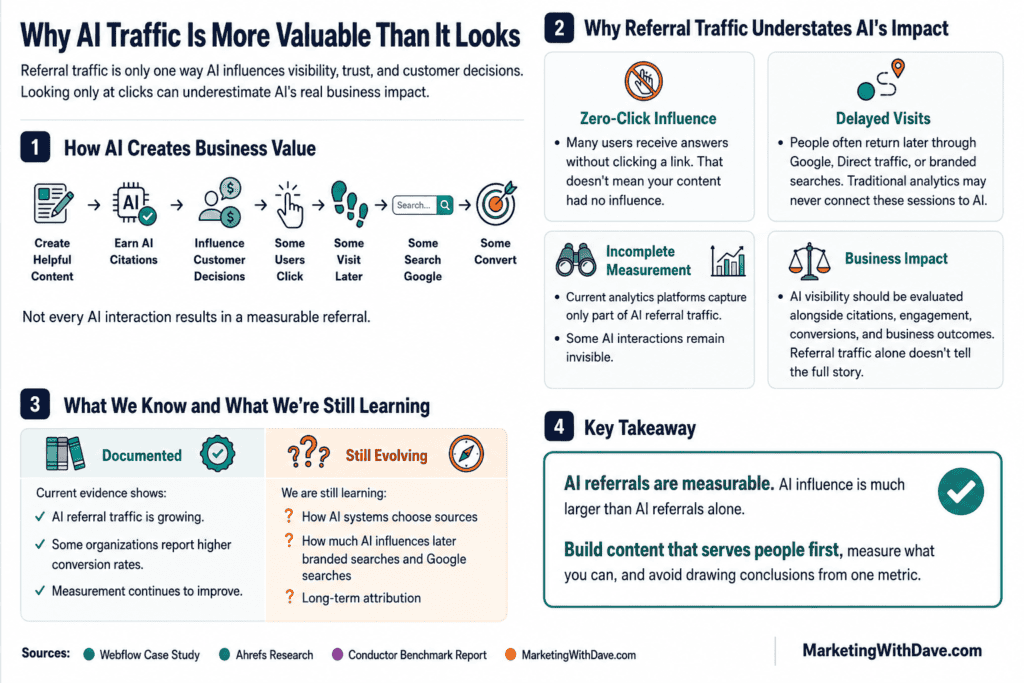
Why AI Traffic May Be More Valuable Than It Looks
If AI visitors behaved exactly like traditional organic visitors, allocating effort based on traffic share would be relatively straightforward.
Five percent of traffic might receive roughly five percent of the attention.
The available evidence suggests it is not that simple.
AI visitors may arrive later in the decision process
A traditional search visitor might land on a page after typing a short, broad keyword into Google.
An AI user may have already spent several minutes asking detailed follow-up questions, comparing options, establishing criteria, and narrowing the available choices before clicking a source.
That visitor can arrive with greater context and stronger intent.
This is one plausible explanation for why Webflow and other companies have reported stronger conversion rates from AI-referred traffic.
It is not proof that every AI visitor is more valuable. It is a reasonable explanation for an increasingly common observation.
Visibility can matter without a click
Traffic is only one outcome of AI visibility.
A brand can influence a buying decision when an AI assistant:
Recommends its product
Uses its research as a source
Mentions it during a comparison
Repeats one of its key messages
Describes it accurately as an authority in a category
None of those outcomes necessarily produces an immediate website visit.
That is why measuring AI visibility requires more than reviewing referral sessions. My broader AI Visibility Framework covers traffic alongside citations, mentions, accuracy, sentiment, and business outcomes.
Zero-click behavior is not new
AI did not invent zero-click search.
Search engines have answered weather questions, calculations, definitions, local queries, and many informational searches directly on their results pages for years.
Generative answers are expanding that behavior into longer and more complex questions.
This means a decline in clicks does not necessarily mean a brand has disappeared from the customer journey. It may mean the influence is occurring in a place that traditional web analytics cannot fully observe.
Why AI Traffic Measurement Is Still Incomplete
AI traffic is easier to identify than it was a year ago.
It is still far from perfectly measured.
GA4’s AI Assistant channel depends on identifiable referral information. When the referrer is removed or obscured, the visit may be classified somewhere else, including Direct or Unassigned.
Current reporting can also miss or separate several forms of AI-assisted discovery:
Some AI platforms may not be included in the native channel definition
Visits without preserved referral data may appear as Direct
Google AI Overview and AI Mode traffic may be classified as Organic Search
A user may discover a brand in an AI answer but return later through another channel
An AI answer may influence a decision without generating any website visit
For those reasons, the 5.39% visible in my GA4 reporting is best viewed as a measured minimum, not a complete accounting of AI-assisted discovery.
That does not mean the missing traffic all belongs in the AI category. My Unassigned traffic, for example, can contain many types of sessions and should not simply be relabeled as AI.
It means current analytics cannot give us a perfectly clean number.
A separate guide on how to measure AI traffic in GA4 would be useful because this topic quickly becomes too detailed for the current article. For now, the practical takeaway is simple:
Use the AI traffic you can identify as a baseline, but do not assume it captures AI’s full influence.
What Is Documented, Observed, and Still Unknown?
One of the biggest problems in GEO and AEO content is that documented findings, practitioner observations, and educated guesses are often presented with the same level of certainty.
My AI Source Preference Matrix uses a similar distinction to separate what is documented from what is observed, inferred, or unknown.
Documented
AI referral traffic is growing across the major studies reviewed in this article
Google still drives substantially more website traffic than AI assistants for most organizations
AI referral traffic varies significantly by industry, audience, and website
GA4 can now identify some AI Assistant traffic as a distinct channel
AI-generated answers can influence users without producing a referral visit
Observed
AI-referred visitors often convert at a higher rate than standard organic traffic
Question-focused content appears frequently in AI-generated answers
Recently updated pages are heavily represented in several citation studies
Brands with strong, consistent third-party mentions tend to appear more often in AI answers
Clear headings, tables, summaries, and structured answers appear to make content easier for AI systems to use
These patterns are supported by case studies, platform analyses, and repeated practitioner observations.
The exact causal mechanisms are still not fully understood.
Unknown
Exactly how each AI platform selects, weights, and ranks sources
How much a Google ranking directly causes AI visibility
How much the apparent relationship between SEO and AI citations reflects shared quality signals instead
Which individual optimization tactics will remain effective as models and retrieval systems change
How much AI-assisted influence occurs without a measurable referral visit
That final list is longer than most AEO content is willing to admit.
Good marketing decisions do not require perfect certainty. They require a clear understanding of the available evidence, honest acknowledgment of its limits, and a willingness to adjust when better information arrives.
How Much Time Should You Spend on GEO and AEO?
Here is my current answer:
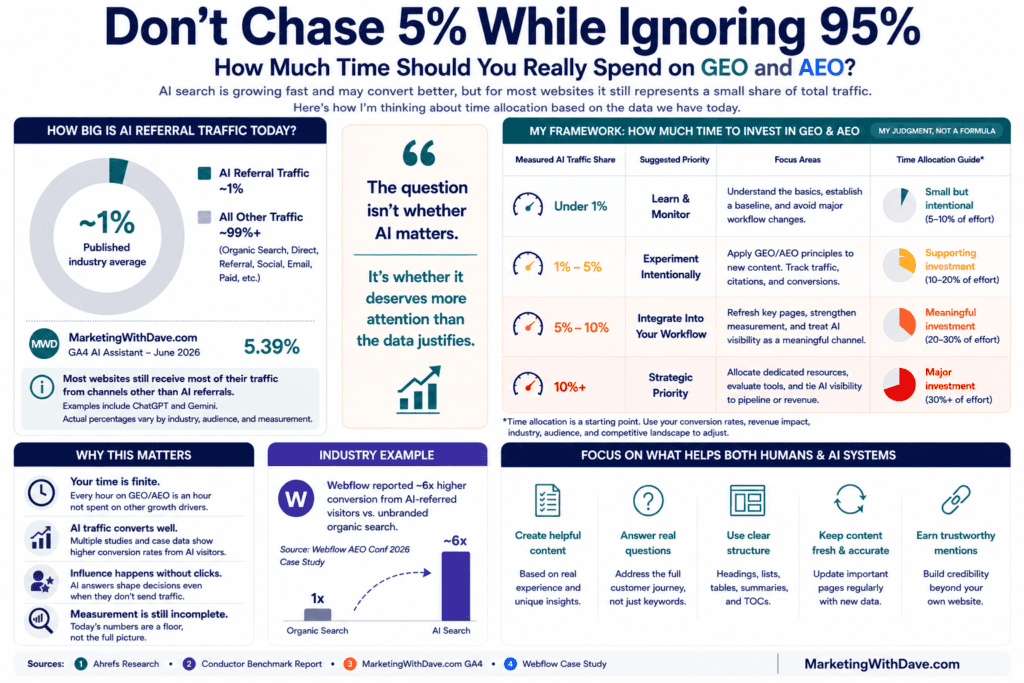
Do not chase 5% while ignoring 95%.
If AI currently sends 5% of your traffic, it probably deserves more than 5% of your attention.
The channel is growing. The visitors may convert better. The influence may extend beyond the clicks you can measure.
But that does not mean it deserves 80% or 100% of your strategy.
For most organizations, Google Search and other established channels are still producing the overwhelming majority of measurable traffic and revenue.
The following framework is not a mathematical formula. It is a practical starting point for deciding how aggressively to invest based on what you are seeing today.
Measured AI Traffic Share
Suggested Priority
Practical Focus
Under 1%
Learn and monitor
Understand the fundamentals, establish a baseline, and avoid major workflow changes
1% to 5%
Begin intentional experimentation
Apply AEO principles to new content and track whether traffic, citations, and conversions improve
5% to 10%
Integrate AEO into the content workflow
Refresh important pages, strengthen measurement, and treat AI visibility as a meaningful secondary channel
More than 10%
Treat AI as a strategic acquisition channel
Allocate dedicated resources, evaluate tools, and connect AI visibility to pipeline or revenue
Traffic percentage should not be the only factor.
A company receiving 2% of its traffic from AI with a conversion rate six times higher than organic search may reasonably invest more than a company receiving 5% of low-quality AI traffic.
Your decision should also consider:
Conversion rate
Revenue or lead value
Industry adoption
Audience behavior
Competitive visibility
The importance of organic acquisition to the business
The framework gives you a place to start. Your actual business results should determine where you go next.
Where Should You Start?
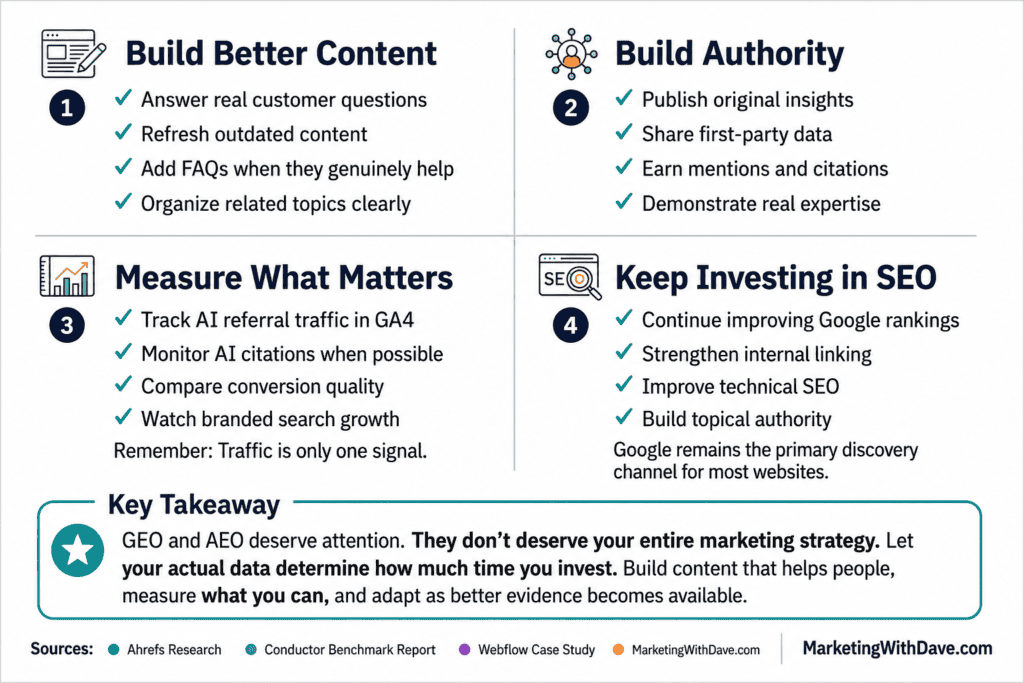
The encouraging part is that most foundational AEO work also supports traditional SEO.
You do not need to choose between creating content that ranks and content that gets cited.
Start with improvements that benefit both:
Create original, useful content based on real experience
Answer the specific questions your customers ask throughout the buying process
Use clear headings and logical page structure
Add tables of contents when they improve navigation
Include FAQs when readers have natural follow-up questions
Keep important pages accurate and current
Use appropriate schema and descriptive metadata
Build credible mentions beyond your own website
Measure traffic and conversions rather than relying only on visibility scores
These practices are unlikely to become wasted work even if the terminology, platforms, and optimization tools continue to change.
Whether someone discovers your content through Google, ChatGPT, Gemini, Claude, Perplexity, or another system, that person is still looking for the same thing:
A trustworthy answer to a real problem.
Frequently Asked Questions
Does GEO/AEO replace SEO?
No. Google still drives the large majority of measurable organic traffic for most websites, and many practices that support AI visibility also support SEO. These include creating useful content, answering real questions, building topical authority, improving site structure, and keeping important information current.
AEO and SEO should be treated as complementary strategies rather than competing choices.
What is the difference between GEO and AEO?
GEO commonly stands for Generative Engine Optimization and focuses on visibility inside generative AI systems. AEO commonly stands for Answer Engine Optimization and focuses on appearing inside direct answers.
In practice, marketers often use AEO, GEO, AI SEO, and AI visibility to describe overlapping work. The industry has not yet standardized the terminology.
How much AI referral traffic is normal?
Broad studies from Ahrefs and Conductor suggest that many websites currently receive less than 1% to slightly more than 1% of their traffic from identifiable AI referrals.
That average can vary substantially based on industry, audience, content, and measurement methodology. MarketingWithDave.com recorded 5.39% during June 2026, but an AI-focused marketing audience is more likely to use AI assistants than the audience of a typical small business website.
How do I measure AI referral traffic in GA4?
GA4 now includes an AI Assistant default channel that identifies traffic from certain recognized AI referrers. No custom configuration was required for this channel to begin appearing in my reporting.
The channel does not capture every AI-influenced visit. Some platforms may be excluded, stripped referral information can move visits into Direct, and Google AI features may appear under Organic Search.
For that reason, the AI Assistant channel should be treated as a useful baseline rather than a complete measurement of AI’s influence.
Do AI-referred visitors convert better than organic search visitors?
Several companies and studies have reported stronger conversion rates from AI-referred visitors, but the reported improvement varies widely.
Webflow reported approximately six times higher conversion than unbranded organic search in its own funnel. That is a useful case study, but it should not be treated as a universal benchmark.
Marketers should compare conversion rates using their own analytics and business outcomes.
Does ranking well in Google improve AI visibility?
There appears to be a relationship between traditional search visibility and AI citations, but the mechanism is not fully understood.
A highly ranked page may receive more AI visibility because the system relies on search results. It may also rank and receive citations because both systems recognize similar signals of quality, relevance, authority, or usefulness.
The evidence supports continued investment in SEO. It does not yet prove that improving a Google ranking will directly cause a proportional increase in AI citations.
Should a small business invest in GEO and AEO?
Yes, but the investment should remain proportionate to the opportunity.
A small business should first make sure its website is technically accessible, its products and services are clearly explained, its business information is accurate, and its content answers real customer questions.
Those fundamentals support SEO, AEO, local visibility, conversion, and the overall customer experience.
Should I rewrite all of my existing content for AI?
No.
Begin with pages that already receive traffic, generate leads, support an important product, or answer high-value customer questions.
Refresh content when you can make it more accurate, useful, complete, or easier to navigate. Rewriting content solely to satisfy an assumed AI preference can consume a great deal of time without producing a measurable return.
Practical Time Allocation Framework
More than the raw traffic percentage alone may suggest, especially if AI visitors convert well or the channel is growing quickly for your audience.
Less than the most aggressive commentary recommends, especially when AI remains a small portion of your traffic and established channels are still driving most of your results.
Start with improvements that benefit SEO and AEO together. Increase your investment as your own traffic, visibility, conversion, and revenue data justify it.
Final Thoughts
The debate should not be SEO or GEO/AEO.
It should be how to build content that deserves both rankings and citations.
AI search is not replacing traditional search overnight. It is expanding the ways people discover information, evaluate options, and encounter brands.
That deserves intentional experimentation.
It does not justify abandoning the channels that still generate most of your traffic and revenue.
Measure your own data. Apply the practices that improve both human experience and machine understanding. Increase your investment as the opportunity becomes more meaningful for your specific audience and business.
AI visibility is not one tactic. It is a chain of connected stages.
Most AI search advice jumps straight to optimization: add schema, create an llms.txt file, publish comparison pages, update content more often, or track prompts in an AI visibility dashboard.
Those tactics may matter, but they only make sense when you understand where they fit.
That is why I think marketers need a practical AI visibility framework.
Why AI Visibility Feels So Confusing
Traditional SEO gave marketers a relatively simple mental model.
Create a page. Rank higher. Earn clicks. Generate business.
AI search does not work that cleanly.
A buyer may ask ChatGPT a question, refine it several times, compare vendors, ask for alternatives, and make a decision without ever clicking a search result.
That does not mean SEO is dead. It means the journey has changed.
This emerging discipline is often called Generative Engine Optimization (GEO), Answer Engine Optimization (AEO), or AI SEO. None of those terms are perfect, and none have become universal. I tend to use AI visibility because it describes the practical question marketers are trying to answer:
Is my brand, content, product, or expertise showing up when AI systems answer important questions?
But even that question is only the beginning.
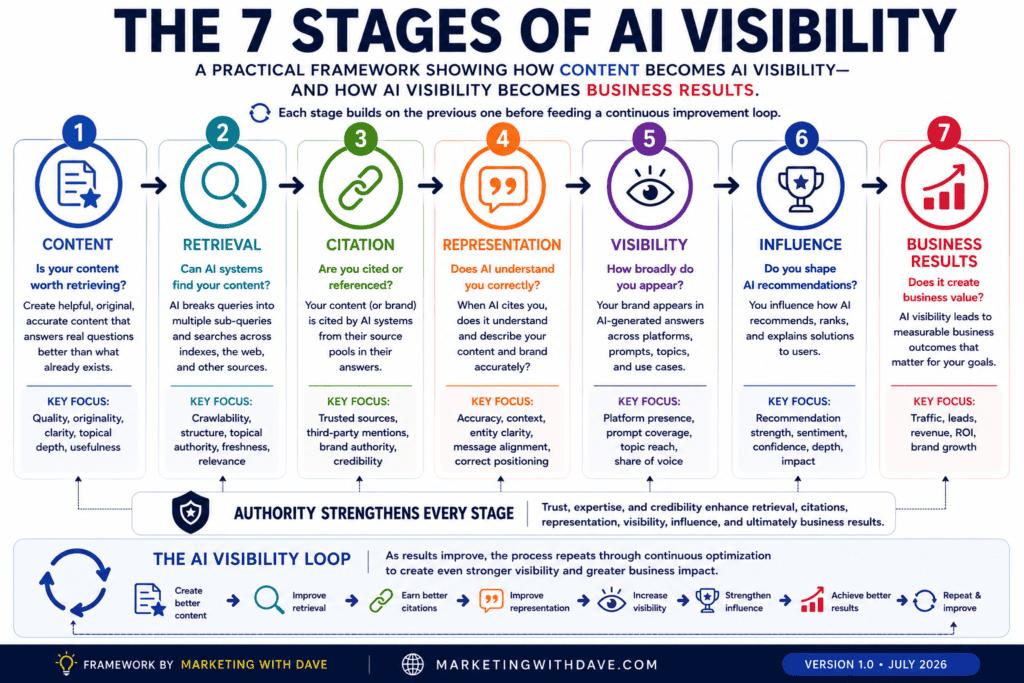
The 7 Stages of AI Visibility
Think of AI visibility as seven connected stages:
Content
Retrieval
Citation
Representation
Visibility
Influence
Business Results
Each stage builds on the previous one.
You cannot influence a buyer if you are not visible. You cannot be visible if you are never cited or referenced. You cannot be cited if your content is not retrieved. And you cannot be retrieved if you have not created something useful enough for AI systems to find, understand, and use.
Authority sits across the entire framework. It is not a single stage. It strengthens every stage. Strong brands, trusted sources, third-party mentions, clear expertise, and consistent entity signals can all improve the chances that your content is retrieved, cited, represented accurately, and trusted.
1. Content: Create Something Worth Retrieving
Everything starts with content.
AI systems cannot cite, summarize, recommend, or reference information they cannot find or understand.
But simply publishing more content is not enough. The content most likely to matter in AI search is usually clear, specific, useful, and meaningfully different from what already exists.
Strong AI-ready content often includes:
Original research
Firsthand testing
Practical examples
Clear definitions
Concise answers
Helpful comparisons
Strong topical organization
Sections that can stand alone as complete answers
This is where traditional SEO still matters.
Fast pages, crawlable HTML, clear headings, internal links, schema markup, topical authority, and helpful content all remain important. AI visibility does not replace SEO. It builds on top of it.
Retrieval is where AI visibility becomes different from traditional SEO.
In classic SEO, a user types a search query and a search engine returns ranked results.
In AI search, the process can be more complex.
A single user question may be broken into multiple hidden sub-queries. This is often described as query fan-out or agentic retrieval. Instead of only looking for pages that match the original prompt, an AI system may run several related searches in the background, gather information from different sources, and synthesize the final answer.
That changes the optimization problem.
Your content may be cited not because it perfectly matches the original question, but because one section of your page is the best answer to one of the hidden sub-questions.
For example, a buyer might ask:
“What is the best AI visibility tool for a small marketing team?”
Behind the scenes, an AI system may need to answer several smaller questions:
What is AI visibility?
Which tools track AI visibility?
Which tools are affordable for small teams?
Which tools support ChatGPT, Perplexity, Gemini, or Google AI Overviews?
Which tools provide prompt tracking, citation analysis, or competitor monitoring?
A page that answers one of those sub-questions clearly may have a better chance of being retrieved than a generic page trying to answer everything at once.
This is why passage-level clarity matters. AI systems often need specific answer blocks, not just long articles.
Retrieval also varies by platform. Google AI Overviews, ChatGPT Search, Perplexity, Claude, Copilot, and Gemini do not all rely on the same systems or source preferences. Some appear to lean more heavily on live web retrieval. Others rely more on search indexes, partner sources, documentation, forums, publishers, or product ecosystems.
Traditional SEO trained marketers to think about rankings.
AI search pushes marketers to think more seriously about citations.
When an AI system produces an answer, it may cite or reference information from many places:
Your website
Product documentation
Third-party reviews
Reddit threads
YouTube videos
LinkedIn posts
Industry publications
Comparison pages
Customer discussions
Official support documentation
This is one of the biggest mindset shifts in AI visibility.
Your website still matters, but your AI reputation may be shaped by sources you do not own.
If AI systems repeatedly encounter your brand in trusted third-party contexts, that can strengthen how your brand is understood. If competitors are cited in those places and you are absent, they may become easier for AI systems to recommend.
This is where citation intelligence becomes useful. Tools like GrackerAI can help identify which sources AI systems are citing and where competitors may be earning visibility you are missing.
4. Representation: Make Sure AI Gets You Right
This distinction is becoming increasingly important as marketers begin measuring AI visibility.
An AI system may cite a page but summarize it poorly. It may mention your brand but describe the wrong use case. It may include your product in a list but fail to explain why it matters. It may even cite a source in support of a claim the source does not fully support.
That means citation alone is not enough.
Marketers need to ask:
Did AI describe the brand accurately?
Did it understand the product or service correctly?
Did it connect the brand to the right use case?
Did it explain the value proposition clearly?
Did it confuse the brand with another entity?
Did it cite the source in a way that actually reflects what the source says?
This matters because AI visibility can create both opportunity and risk.
A brand can appear in an AI answer and still be misunderstood. A product can be cited and still be framed weakly. A company can show up and still lose influence if the explanation is inaccurate, generic, or incomplete.
Representation is the bridge between citation and visibility. It asks whether AI is not only finding you, but understanding you correctly.
5. Visibility: Measure Whether You Show Up
Visibility is the stage most AI visibility tools focus on today.
This is where marketers ask:
Does my brand appear?
Which prompts mention me?
Which competitors appear instead?
Which AI platforms mention my brand?
Which sources are being cited?
Is my visibility improving or declining?
These are useful questions.
Before AI visibility platforms existed, most marketers were guessing. Now tools like ZeroRank, SnowSEO, GrackerAI, Visby, and others make it possible to observe patterns across selected prompts and platforms.
But visibility has a major limitation.
It is sampled.
No tool can measure every possible AI conversation a buyer might have. A dashboard can only track the prompts you choose, the platforms it supports, and the time period being monitored.
That does not make these tools useless. It makes interpretation important.
A visibility score is not a complete measurement of the market. It is a directional signal based on a selected set of conversations.
6. Influence: Understand Whether You Shaped the Answer
Visibility asks whether your brand appeared.
Influence asks whether your brand shaped the recommendation.
Those are not the same thing.
Imagine two brands:
Brand A
Brand B
Appears in 90% of tracked responses
Appears in 40% of tracked responses
Usually listed fourth or fifth
Often recommended first
Mentioned briefly
Explained with confidence
High visibility
Lower visibility, stronger influence
Which brand is in the better position?
A basic appearance-rate dashboard might favor Brand A.
But commercially, Brand B may be far more powerful.
This is why AI visibility alone is not enough.
Eventually, marketers will need to understand:
Recommendation strength
Recommendation position
Explanation depth
Confidence
Sentiment
Source authority
Accuracy of representation
Fit between the recommendation and buyer intent
Influence is harder to measure than visibility, but it is closer to what marketers actually care about.
The goal is not simply to be mentioned by AI.
The goal is to become part of how AI understands the category, compares options, and recommends solutions.
7. Business Results: Connect AI Visibility to Outcomes
The final stage is business results.
This is also the hardest stage to measure.
Traditional SEO often relied on clicks, landing pages, conversions, and attribution models. AI search makes that harder because influence can happen without a click.
A buyer may see your brand recommended by ChatGPT, research you later through Google, visit your site directly, ask a colleague, watch a YouTube review, or return weeks later through another channel.
That journey is difficult to attribute cleanly.
Still, business results matter.
The goal of AI visibility is not to win a dashboard score. The goal is to create more qualified awareness, trust, demand, leads, sales, or opportunities.
Useful signals may include:
AI referral traffic
Branded search growth
Direct traffic changes
Higher-quality leads
More mentions in sales conversations
More third-party references
Improved conversion rates from high-intent pages
More prospects arriving already familiar with your brand
None of those signals are perfect.
But together, they can help marketers understand whether AI visibility is turning into real business value.
Why Authority Strengthens Every Stage
Authority is not a separate box in the framework because it affects everything.
Authority can influence whether content is retrieved. It can influence whether a source is cited. It can influence whether AI systems describe a brand confidently. It can influence whether users trust the recommendation.
Authority may come from many places:
Strong website content
Consistent brand mentions
Trusted third-party citations
Expert commentary
Original research
Customer reviews
Industry recognition
Clear entity signals
Active participation in relevant communities
This is why AI visibility cannot be solved only with on-page SEO.
Your owned content matters. Your broader reputation matters too.
A Note on AI Visibility Statistics
One challenge in this space is that many AI visibility statistics circulate without a clear primary source.
You may see exact percentages repeated across multiple articles, but when you try to trace the number back to an original study, the source is often unclear.
That does not mean every statistic is wrong. It does mean marketers should be careful.
This framework intentionally focuses less on unverified numbers and more on the structure of the problem. The exact percentages will change. The relationship between content, retrieval, citation, representation, visibility, influence, and business results is more likely to remain useful.
The AI Visibility Loop
The framework is not a one-time checklist.
It is a continuous improvement loop.
Create better content
Improve retrievability
Earn better citations
Improve representation
Track visibility
Evaluate influence
Connect results back to business outcomes
Then repeat.
This loop matters because AI visibility is not stable. Citation patterns can shift. Platforms can change retrieval behavior. Competitors can publish better content. New sources can become trusted. Old pages can lose freshness.
The brands that improve fastest will likely be the brands that learn fastest.
Recommended Tools by Stage
No tool covers the entire AI visibility framework perfectly. Different tools help with different stages.
Several stages remain difficult to measure well today.
Representation, Influence, and Business Results still rely heavily on manual review, analytics, customer feedback, and human judgment. While AI visibility platforms continue to evolve, no single tool currently measures these stages comprehensively.
The important question is not “Which tool should I buy?”
The better question is:
Which stage of the framework am I trying to improve?
The important thing is not buying every AI visibility tool. The important thing is knowing which question you are trying to answer.
If you are trying to improve content structure, you need one kind of tool. If you are trying to monitor prompts, you need another. If you are trying to understand citation sources, you need a different workflow.
Bringing It All Together
The AI Visibility Framework is not an attempt to reverse-engineer every ranking signal inside every AI platform.
No one outside those companies has that level of visibility.
Instead, this framework provides a common language for understanding, measuring, and improving AI visibility.
Create content worth retrieving.
Understand how AI systems find information.
Earn citations across the web.
Make sure AI represents you accurately.
Measure visibility carefully.
Evaluate influence, not just mentions.
Connect the work back to business results.
Then keep improving.
AI visibility is still an emerging discipline, and the tactics will keep changing. But marketers who understand the system will be better prepared than marketers chasing isolated tips.
The future of AI visibility will not belong to the people making the loudest claims.
It will belong to the people willing to test, measure, update, and stay honest about what they actually know.
Frequently Asked Questions
What is AI visibility?
AI visibility is the degree to which your brand, content, product, or expertise appears in AI-generated answers from systems like ChatGPT, Gemini, Claude, Perplexity, Copilot, and Google AI Overviews.
Is AI visibility the same as SEO?
No. AI visibility builds on SEO, but it is not identical to SEO. Traditional SEO focuses heavily on rankings, clicks, and search engine results pages. AI visibility focuses on whether AI systems retrieve, cite, summarize, mention, and recommend your brand or content.
What is the difference between GEO, AEO, and AI visibility?
GEO usually refers to Generative Engine Optimization. AEO usually refers to Answer Engine Optimization. AI visibility is a broader measurement concept focused on whether and how your brand appears in AI-generated answers. The terms overlap, and the industry has not fully standardized the language yet.
Why does retrieval matter in AI search?
Retrieval matters because AI systems often gather information before generating an answer. If your content is not retrieved, it is unlikely to be cited, summarized, or recommended. Query fan-out makes this even more important because a single prompt may trigger multiple hidden sub-queries.
Does being cited by AI mean my brand was recommended?
No. Being cited means your content or brand may have been referenced. It does not automatically mean AI recommended you, represented you accurately, or influenced the user’s decision.
Why is representation important?
Representation matters because AI systems can mention or cite a brand while still describing it inaccurately, incompletely, or weakly. A brand can be visible without being understood correctly.
Which AI visibility metrics matter most?
Useful metrics include appearance rate, share of voice, prompt-level visibility, citation sources, recommendation position, sentiment, explanation depth, and brand accuracy. Over time, recommendation strength and influence may become more important than basic mention counts.
Can AI visibility tools measure every possible buyer conversation?
No. AI visibility tools track selected prompts and platforms. They are useful for observing patterns, but they sample a portion of the conversation space rather than measuring every possible buyer interaction.
Where should marketers start?
Start with content that already matters to your business. Improve its clarity, structure, originality, and usefulness. Then monitor whether that content appears in AI-generated answers, which competitors appear instead, and which sources AI seems to trust.