Most marketing failure looks like marketing success right up until it does not.
More impressions. More leads. More tools. More posts. More activity.
That is what makes it dangerous. The scoreboard can look busy while the fundamentals are quietly breaking underneath.
The 7 deadly sins of marketing are not moral failures. They are strategic traps.
The 7 deadly sins of marketing
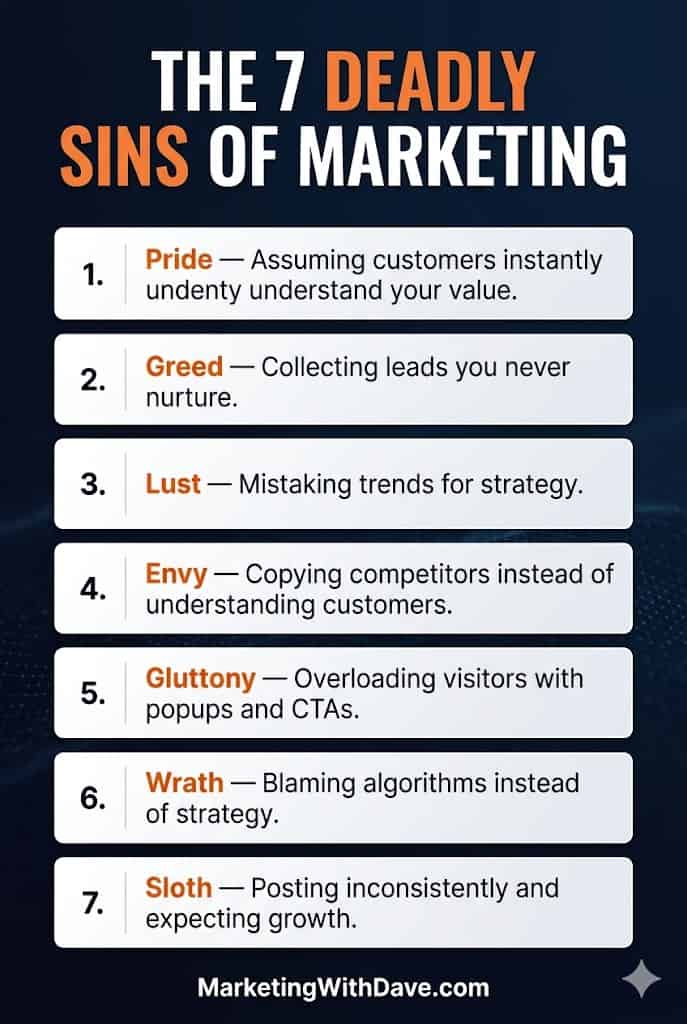
The 7 Deadly Sins of Marketing infographic showing seven common marketing mistakes including pride, greed, lust, envy, gluttony, wrath, and sloth.
1. Pride
Pride: Assuming customers instantly understand your value.
Internal clarity can be dangerous. The more your team understands the product, the harder it becomes to see the customer’s confusion.
That is how brands end up with messaging that makes perfect sense in meetings and very little sense in the market.
2. Greed
Greed: Collecting leads you never nurture.
A lead without follow-up is just an unfinished conversation.
The deeper problem is that lead volume often gets treated like a proxy for pipeline health. It lets the team feel productive while momentum quietly stalls.
3. Lust
Lust: Mistaking trends for strategy.
A trend can create attention. Strategy creates direction.
This is the brand jumping into short-form video with no point of view, testing every new AI tool without a workflow, or copying a format because everyone else seems to be using it.
That is not innovation. It is motion without a compass.
4. Envy
Envy: Copying competitors instead of understanding customers.
Competitor imitation is tempting because it feels like research. It has social proof. It carries less risk of being visibly wrong.
But copying competitors often means inheriting their assumptions without knowing if those assumptions fit your audience.
Your competitors can show you the market. Your customers show you the truth.
5. Gluttony
Gluttony: Overloading visitors with popups and CTAs.
Every extra CTA (call to action) is a vote of no confidence in your primary offer.
If a web page needs five competing prompts, the problem may not be the visitor’s attention span. It may be that the web page never made the next step obvious enough.
Those things matter, but they shoulder the blame more often than they should.
Sometimes the offer is unclear. Sometimes the content is forgettable. Sometimes the audience is wrong. Sometimes the measurement is weak.
Blaming the algorithm puts the solution out of reach.
7. Sloth
Sloth: Posting inconsistently and expecting growth.
Inconsistency is not always laziness. More often, it is a symptom of not having a clear enough point of view.
When you know what you stand for, showing up gets easier because you are not reinventing the brief every time you open a blank document.
Growth rewards sustained relevance, not random bursts of activity.
The vanity metrics problem
Vanity metrics make these sins harder to see.
Ten million impressions and three conversions may look impressive in a report, but attention that never turns into trust, action, or revenue is not telling the full story.
The better question is simple: did the marketing move the right people closer to the right action?
Fixing the fundamentals still wins
The point of naming these sins is to catch the patterns before they become expensive.
Marketing does not need more noise. It needs sharper thinking.
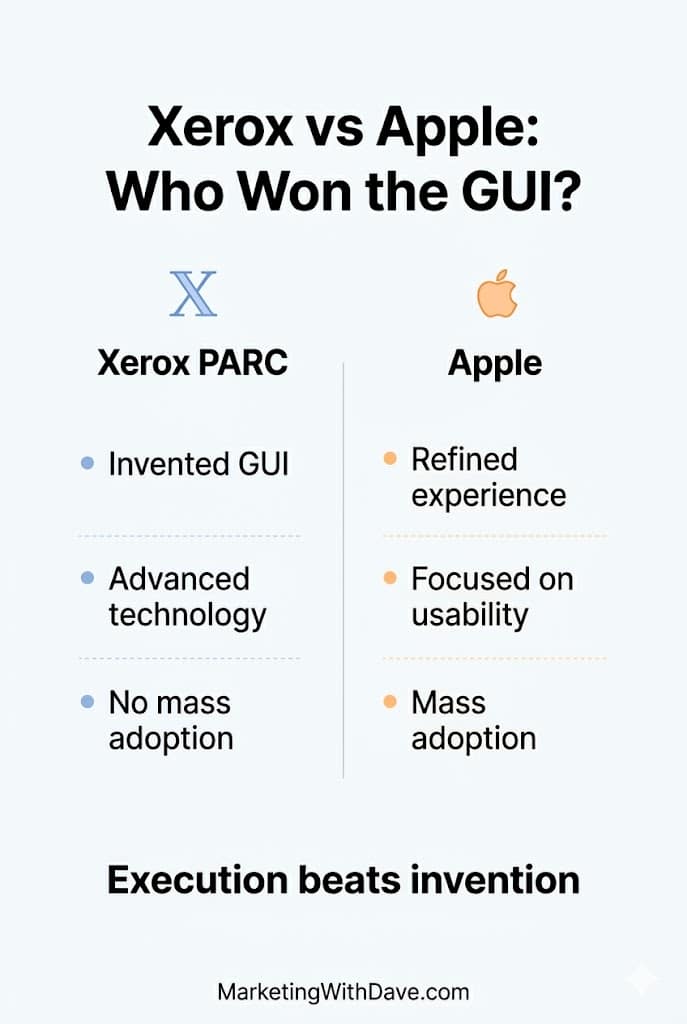
Xerox PARC created many of the core technologies behind modern computing, including the graphical user interface, the mouse, and networked personal computers.
Despite inventing these foundational ideas, Xerox failed to bring them to market effectively. Apple later adopted and refined many of these concepts, launching the Lisa and Macintosh and ultimately defining the personal computing category.
This case highlights a recurring truth in marketing and business: innovation alone does not win, execution does.
Company Involved
Xerox Corporation, a technology company best known at the time for its dominance in copiers and document systems.
Marketing Topic
Innovation vs. execution
Product commercialization strategy
Market positioning and category creation
Public Reaction or Consequences
At the time, Xerox’s innovations at PARC were largely invisible to the broader market. The Alto and Star systems were not widely adopted due to high cost, limited distribution, and unclear positioning. Meanwhile, Apple’s Macintosh generated significant public attention and excitement, introducing a wider audience to graphical computing in a more accessible format. Over time, Xerox PARC became widely known as one of the most famous examples of missed opportunity in business history, while Apple was credited with popularizing and commercializing the interface paradigm.
Why It Matters Today
Innovation must be paired with a clear path to market
Category creation matters more than feature invention
3 Takeaways
Execution matters more than invention. Xerox built groundbreaking technology, but Apple translated similar ideas into products people could understand and use.
Market readiness beats technical superiority. The Alto was advanced, but the Macintosh was accessible, which mattered more for adoption.
Innovation must connect to business strategy. Without alignment between research, product, and leadership, even great ideas fail to reach the market.
Notable Quotes and Data
Xerox PARC developed the graphical user interface years before it reached mass adoption
Apple’s Macintosh (1984) became the defining product that introduced GUI computing to the mainstream
Full Case Narrative
In the 1970s, Xerox PARC (Palo Alto Research Center) was one of the most advanced research environments in the world. Engineers and scientists there developed technologies that would define the future of computing, including the graphical user interface, the computer mouse, and early forms of networked workstations. The Alto computer embodied many of these innovations, offering a vision of personal computing that was years ahead of its time.
Despite these breakthroughs, Xerox struggled to translate innovation into commercial success. The company’s core business was built around copiers and document systems, and its leadership remained focused on that foundation. PARC operated more as a research lab than a product organization, and there was no strong system in place to convert experimental technology into scalable products.
In 1979, Apple engineers visited Xerox PARC and saw these innovations firsthand. What they recognized was not just a set of features, but a new model for how computers could work. Apple took these ideas and focused on making them usable, simplified, and aligned with a clear product vision. This led to the development of the Lisa and, more importantly, the Macintosh.
While the Macintosh was not as technically advanced as some PARC systems, it was designed for real users. It was more approachable, more affordable, and built as a cohesive product rather than a research demonstration. Apple’s focus was not on inventing the interface, but on delivering it in a way that people could adopt.
Xerox built breakthrough technology but never built a distribution strategy to match. Apple didn’t just simplify the interface. They controlled how it reached users. Distribution, not invention, is what ultimately determines who wins.
Xerox eventually attempted legal action against Apple, claiming improper use of its ideas, but the effort failed. By that point, the market had already moved. Apple had established itself as a leader in personal computing, and the opportunity Xerox once held had passed.
The failure was not technological. It was strategic. Xerox had the innovation but lacked the execution, alignment, and market focus to capitalize on it. Apple succeeded because it connected product, usability, and go-to-market strategy into a unified approach.
Timeline
1970s: Xerox PARC develops the Alto and foundational GUI technologies
1979: Apple engineers visit Xerox PARC
1981: Xerox releases the Star workstation
1983: Apple launches the Lisa
1984: Apple launches the Macintosh
Late 1980s: Xerox pursues legal action against Apple
What Happened Next?
Xerox continued to operate as a leader in document technology but did not establish itself in personal computing. Apple built on the success of the Macintosh and continued refining the graphical interface, eventually shaping modern computing experiences across devices. Xerox PARC remains respected as an innovation hub, but its legacy is often defined by what it failed to commercialize.
One Sentence Takeaway
Inventing the future is not enough if you cannot bring it to market.
Attribution models influence how marketers allocate budget, but most teams misunderstand what they are actually showing. Strategic frameworks such as the PERO media type model can help marketers balance paid, earned, rented, and owned media investments.
If you give too much credit to the wrong channel, you will eventually over invest in the wrong tactic. If you under-credit upper funnel work, you may starve the channels that create future demand. If you over-credit last click, you may convince yourself that bottom funnel activity is carrying the whole business when it is really just harvesting demand created elsewhere.
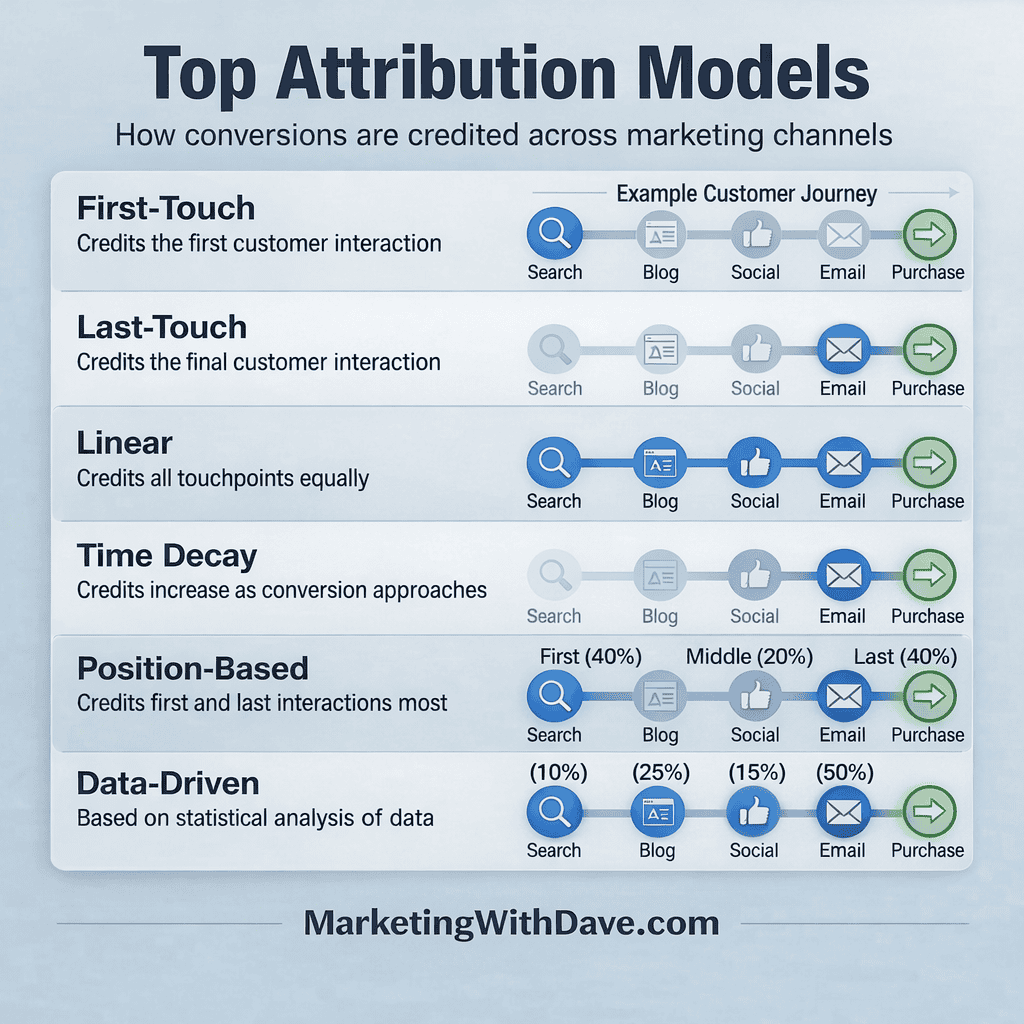
The visual below compares six of the most common attribution models and shows how credit shifts across a simple customer journey from Search to Blog to Social to Email to Purchase.
Why attribution models matter more than most marketers realize
Most marketers do not have a measurement problem as much as they have an interpretation problem. The dashboard may be working. The tags may be firing. The reports may be populating. But if the organization does not understand how conversion credit is being assigned, decisions quickly drift away from reality.
This is where attribution models become useful. They are not perfect mirrors of truth. They are frameworks for understanding how different touchpoints may have contributed to a result. Each model tells a different story, and each one can be useful in the right context.
Each attribution model answers a different question:
First-touch answers: What introduced the customer to us?
Last-touch answers: What closed the deal?
Linear answers: What supported the full journey?
Time decay answers: What mattered most as the decision approached?
Position-based answers: What started and finished the journey?
Data-driven answers: What actually influenced conversion based on observed behavior?
This is the key idea. There is no single “best” attribution model. The right model depends on the decision you are trying to make.
Quick summary of attribution models
First-touch: Best for understanding awareness. Weak at measuring conversion influence.
Last-touch: Best for measuring closing channels. Ignores earlier interactions.
Linear: Best for balanced visibility. Assumes all touchpoints are equal.
Time decay: Best for short or momentum-driven journeys. Undervalues early discovery.
Position-based: Best for balancing discovery and conversion. Still simplified weighting.
Data-driven: Best for advanced analysis with strong data. Depends heavily on data quality.
The six common attribution models in this graphic
1. First-Touch Attribution
First-touch attribution gives all credit to the first marketing interaction. In the example journey, Search gets the credit.
This model is useful when your main question is: What introduced the customer to us? It can be helpful for brand awareness analysis, top-of-funnel campaigns, and lead source reporting.
The weakness is obvious. It ignores everything that happened after that first interaction. That means it can overvalue discovery and undervalue nurturing, retargeting, and conversion support.
2. Last-Touch Attribution
Last-touch attribution gives all credit to the final marketing interaction before conversion. In the graphic, Email receives the credit.
This model is popular because it is simple. It often lines up with how businesses think about closing activity, especially in lead generation, ecommerce promotions, and email-heavy funnels.
The problem is that last-touch can make closing channels look stronger than they really are. A customer may have first discovered your brand through search, learned from a blog post, seen social proof, and only then clicked an email. If email gets all the credit, the rest of the journey disappears.
3. Linear Attribution
Linear attribution spreads credit evenly across the marketing touchpoints in the journey. Search, Blog, Social, and Email all share credit equally.
This model is useful when you want to acknowledge that multiple touches mattered and do not want to overemphasize either discovery or closing.
Its limitation is that not every touchpoint actually contributes equally. A quick social impression and a high-intent email click may not deserve the same value, even if linear attribution says they do.
4. Time Decay Attribution
Time decay attribution gives more credit to interactions closer to conversion. Earlier touches still matter, but later touches receive more weight.
This model is often useful in longer consideration cycles where momentum builds over time. It can make sense when later interactions truly do play a stronger role in helping the customer decide.
The caution here is that time decay can still undervalue the channels that created awareness and initial interest, especially when those channels are doing the hard work of entering the buyer into the journey.
5. Position-Based Attribution
Position-based attribution, often called the 40-20-40 model, gives substantial credit to the first and last interactions, then spreads the remaining credit across the middle touches.
In practice, this model reflects a common marketing reality. The first touch often matters because it created the opportunity. The last touch often matters because it helped close the action. The middle touches still matter, but usually as support rather than the primary driver.
For many teams, this is one of the most intuitive models because it balances discovery and conversion without pretending the journey was evenly weighted.
6. Data-Driven Attribution
Data-driven attribution uses observed conversion patterns to assign credit based on statistical contribution. In the image, Search receives 10%, Blog 25%, Social 15%, and Email 50%.
This is usually the most sophisticated option because it does not force every journey into a rigid formula. Instead, it attempts to learn from actual path behavior.
That said, data-driven attribution is only as useful as the quality of your measurement foundation. If your tracking is weak, your consent setup is inconsistent, your conversion definitions are muddy, or your traffic mix is noisy, the model can still produce misleading confidence.
The six models above are the most recognizable attribution frameworks, but they are not the only useful ways to think about marketing allocation.
Custom Weighted Attribution
Some organizations create their own weighting logic based on business knowledge, sales cycle length, funnel maturity, or product type. This can be useful when standard models do not reflect how the business really grows. The danger is that custom models can become political if they are built to justify existing budget choices instead of reveal reality.
Incrementality Testing
Incrementality asks a different question: what would have happened if this channel or campaign had not run at all? This is often more useful than attribution when you are trying to understand whether a channel created lift versus merely captured existing demand.
In other words, attribution distributes credit. Incrementality challenges whether the credit should exist in the first place.
Media Mix Modeling
Media mix modeling looks at broader patterns across time and tries to estimate the contribution of channels using aggregate data rather than user-level paths. This is especially relevant in privacy-constrained environments where user-level tracking is less complete than it used to be.
For larger brands, media mix modeling can help answer strategic budget questions that click-path attribution alone cannot answer well.
Marginal ROI and Saturation Analysis
One of the most useful allocation frameworks is not really an attribution model at all. It is the study of what happens as you invest more into a channel. The next dollar does not always perform like the last dollar. Every experienced marketer eventually learns this.
A channel can look amazing in attribution reports and still be at or near saturation. That is why budget allocation should never depend only on credited conversions. It should also consider diminishing returns.
How to actually use attribution models (not just understand them)
Most marketers make the same mistake. They pick one attribution model and treat it as truth.
The better approach is to compare models side by side.
Use first-touch to understand what creates demand. Use last-touch to understand what captures it. Use a balanced or data-driven model to evaluate how the journey works as a whole.
The insight comes from the differences between models, not from any single model by itself.
Attribution models are useful, but they are not truth machines. Each framework highlights different parts of the customer journey and introduces its own bias. Understanding those biases is what allows marketers to interpret the data correctly and make better allocation decisions.
Here is the kind of practical guidance that tends to matter most.
1. Never trust a single attribution view by itself.
Look at first-touch, last-touch, and a more balanced model side by side. If one channel only looks strong in one framework and weak in the others, that is worth investigating.
2. Separate demand creation from demand capture.
Branded search, email, direct traffic, and remarketing often look great because they are close to conversion. That does not mean they created the original demand.
3. Watch for channel cannibalization.
Sometimes a channel does not create incremental lift. It simply intercepts conversions that would have happened anyway. This is especially common in branded paid search, retargeting, and aggressive promo email programs.
4. Audit your conversion definitions.
Bad conversion design creates bad allocation decisions. If every micro-action is treated like a win, attribution reports can look impressive while actual business outcomes stay flat.
5. Do not confuse measurability with importance.
The easiest channels to track are not always the most important channels in the journey. Upper-funnel content, social influence, PR, word of mouth, and offline impact can be undercounted while measurable lower-funnel clicks get overpraised.
6. Budget decisions should consider volume, efficiency, and strategic role.
A channel may have a higher CPA but still deserve investment if it expands reach, builds future demand, or improves the whole funnel.
What is changing in the AI marketing world right now
AI is changing attribution and allocation in two important ways at the same time.
First, platforms are using more automation to decide targeting, creative matching, bidding, and optimization.
Second, marketers are being pushed to rely more on modeled and inferred performance rather than clean, user-level certainty.
That shift creates both opportunity and risk.
AI is helping platforms find more demand
Search and paid social platforms are increasingly leaning into AI-assisted campaign expansion, creative generation, and automated optimization. That means marketers can often unlock more reach and more combinations than a fully manual setup would have captured.
But the tradeoff is that the system becomes harder to inspect. You may get stronger performance while simultaneously having less obvious visibility into exactly why the performance improved.
Creative and landing page quality matter even more
As targeting and bidding become more automated, creative quality, message clarity, offer strength, and landing page experience become bigger levers. If the machine can distribute faster than before, weak inputs get exposed faster too.
That means allocation is no longer just about where you spend. It is also about what you feed the machine.
Modeled measurement is becoming normal
Privacy changes, consent requirements, and reduced user-level signal mean more reporting is influenced by modeled behavior. That does not make the data useless. It just means marketers need to stop pretending every decimal point is ground truth.
The practical answer is not to reject modeling. It is to validate performance from multiple angles: platform reports, analytics, CRM outcomes, controlled tests, and business results.
AI makes disciplined testing more important, not less
When platforms automate more of the delivery, marketers still need a way to verify whether outcomes are truly improving. That is why holdout tests, lift analysis, creative testing, and business-level validation matter so much. If you skip those steps, it becomes easy to mistake machine confidence for business truth.
What to look out for when using attribution for budget decisions
If you are using attribution data to guide marketing allocation, watch for these traps.
Over-crediting bottom funnel channels because they show up closest to conversion.
Under-crediting awareness channels because they do not close the sale directly.
Letting platform-reported results outrun CRM or revenue reality.
Assuming a channel is incremental when it may simply be intercepting existing demand.
Expanding budget into a channel that looks efficient only because it is still small.
Treating AI-generated recommendations as strategy instead of input.
A more mature way to think about marketing allocation
The best marketers do not ask, “Which attribution model is right?” They ask, “What decision am I trying to make, and which framework helps me make it with the least distortion?”
If you are trying to understand discovery, first-touch may help. If you are evaluating closing influence, last-touch may help. If you want a balanced directional view, position-based may help. If you have strong enough data and enough volume, data-driven may help. If you need to know whether a channel creates real lift, attribution alone is not enough and testing becomes essential.
That is the deeper lesson. Attribution is not the finish line. It is a lens. Use the lens that best fits the decision, then validate the result against actual business performance.
Final takeaway
Marketing allocation gets messy when teams expect one dashboard, one platform, or one attribution model to explain everything. Real customer journeys are more complex than that. They are multi-touch, uneven, and often partially hidden.
The goal is not perfect certainty. The goal is better decisions.
If you understand what each attribution framework emphasizes, what it ignores, and how it may bias your budget conversations, you are already ahead of most marketers.
And in an AI-shaped marketing world, that judgment matters even more than the model itself.
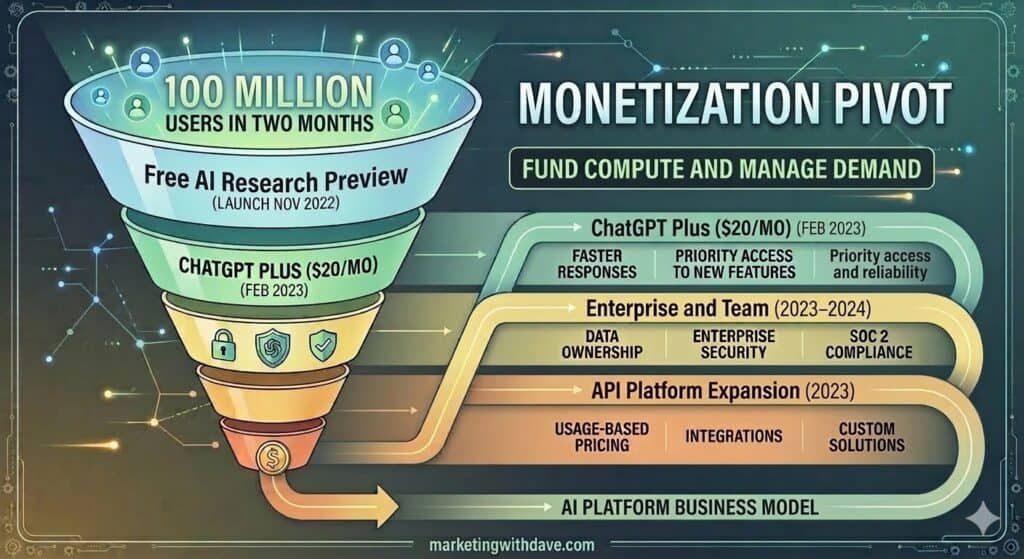
OpenAI launched ChatGPT as a free research preview to maximize adoption, collect feedback, and establish product habit. After rapid viral growth, it introduced paid tiers to manage demand and fund compute: ChatGPT Plus for individuals, enterprise offerings for organizations, and usage-based monetization through the API platform.
Over time, OpenAI layered additional tiers and began testing ads on lower-cost plans while publicly emphasizing that ads would not influence answers, highlighting the central tension in its monetization strategy: scale revenue while protecting trust, privacy, and a mission-led brand.
Company Involved
OpenAI (openai.com) is the organization at the center of this case study, with ChatGPT as the primary consumer product that created a mass-market funnel for paid subscriptions and enterprise adoption.
Marketing Topic
Strategy
Product positioning
Customer experience
Public Reaction or Consequences
ChatGPT’s free research preview turned into a cultural moment and a usage surge so large that it created both opportunity and pressure. OpenAI’s early positioning emphasized learning from users and collecting feedback, with free access during the research preview.
The product’s adoption curve quickly became part of the story itself. Reuters reported a UBS estimate that ChatGPT reached 100 million monthly active users in January 2023, roughly two months after launch, with Similarweb data cited in the same report. That scale made monetization feel less like an optional business decision and more like an inevitable next step to support infrastructure costs.
The subscription rollout for ChatGPT Plus introduced a clear trade: pay to avoid capacity constraints and get priority access. OpenAI framed Plus around general access during peak times, faster responses, and priority access to improvements.
As organizations began experimenting with ChatGPT, the dominant friction shifted from capability curiosity to risk concerns: data privacy, compliance, and deployment control. OpenAI’s enterprise positioning directly addressed those buyer objections, emphasizing ownership and control of business data, a claim that enterprise data is not used for training, plus security and compliance signals such as SOC 2 and encryption.
Why It Matters Today
• Freemium can be a deliberate research and distribution strategy when feedback loops and habit-formation are part of the product’s defensibility.
• Subscription tiers can be positioned around access and reliability first, which is often easier to sell than abstract feature bundles during rapid growth.
• Enterprise monetization in AI is as much about trust, security, and data governance as it is about model capability.
• AI vendors are increasingly balancing subscriptions with advertising on lower-cost tiers, but the trust constraints are higher than traditional search or social products because users treat conversations as personal and sensitive.
• OpenAI’s public messaging shows a modern monetization tension: fund compute-intensive products while insisting mission, privacy, and answer quality remain protected.
Takeaways and Notable Data
1. Freemium can be your fastest distribution channel, but it only works long-term if you design clear conversion paths tied to user pain, such as access, latency, or higher usage limits.
2. Enterprise monetization requires trust features that product marketing can explain in plain language: data ownership, training exclusions, and compliance signals that procurement teams recognize.
3. If you introduce ads in an AI assistant, you must explicitly separate incentives from outputs and communicate privacy boundaries, or you risk breaking the user’s mental model of objective assistance.
Notable Quotes and Data:
• Reuters reported a UBS estimate that ChatGPT reached 100 million monthly active users in January 2023, two months after launch.
• OpenAI priced ChatGPT Plus at $20 per month and positioned it around better access during peak times, faster responses, and priority features.
• OpenAI positioned ChatGPT Enterprise around business data control and stated it does not train on business conversations, while also highlighting SOC 2 compliance and encryption.
Full Case Narrative
OpenAI’s monetization story is easier to understand if you separate the narrative into three layers: a consumer growth engine, an enterprise trust engine, and a developer usage engine.
The consumer growth engine began with a research-preview framing. OpenAI introduced ChatGPT as a way to gather user feedback on strengths and weaknesses, and stated that usage was free during the research preview.
This free access acted like a massive public demo, and it turned the product into a social object that people shared. Reuters reported that ChatGPT was made available for free public testing on November 30, 2022, and that usage quickly reached over a million users within about a week.
Once the flood of demand was undeniable, OpenAI’s next challenge was sustainability. OpenAI has described the capital intensity of building advanced AI and said it estimated needing to raise on the order of $10 billion to build AGI, linking mission ambition directly to funding requirements.
The first mainstream consumer monetization step was ChatGPT Plus, positioned around reliability and access rather than only features.
Next came the enterprise trust engine, positioned around ownership and control of business data, training exclusions, and compliance signals such as SOC 2 and encryption.
In parallel, the developer usage engine monetized through the API platform with token-based pricing. OpenAI documented that, as of March 1, 2023, data sent to the OpenAI API is not used for training unless a customer opts in.
Over time, OpenAI expanded segmentation through additional plans, and then moved toward advertising on lower-cost tiers while stating that ads do not influence answers and that conversations remain private from advertisers.
Timeline
• November 30, 2022: ChatGPT launched for free public testing as a research preview.
• February 2023: ChatGPT Plus launched at $20 per month.
• March 1, 2023: OpenAI documented that API data is not used for training unless customers opt in.
• August 2023: ChatGPT Enterprise announced with enterprise security and privacy positioning.
• January 2024: ChatGPT Team introduced for self-serve business adoption.
• December 2024: ChatGPT Pro introduced at $200 per month.
• January to February 2026: OpenAI announced and began testing ads for Free and Go tiers, alongside published trust and privacy commitments.
What Happened Next?
Reuters reported that OpenAI’s CFO said annualized revenue exceeded $20 billion in 2025, alongside a major increase in computing capacity, reinforcing the business logic behind layered monetization.
One Sentence Takeaway
A free research preview created the largest possible top-of-funnel for habit formation, and OpenAI monetized the resulting demand by selling reliability, trust, and integration while trying to protect the integrity of its answers.
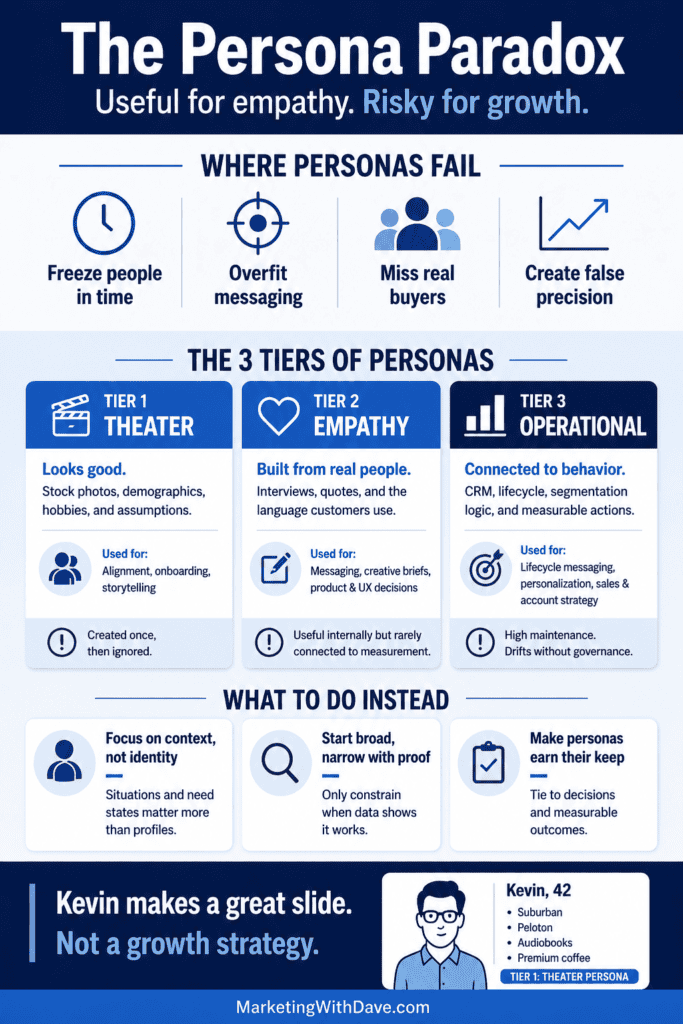
Kevin is 42. He lives in the suburbs. He owns a Peloton, listens to business audiobooks at 1.5x speed, prefers single-origin coffee, and drives a Volvo because it “balances safety and engineering.” He values innovation, wants brands to feel authentic, and responds best to messaging that blends aspiration with reassurance.
Kevin appears in slide decks across marketing departments everywhere. He guides targeting decisions, creative briefs, and sometimes entire media plans.
The problem is not that Kevin exists.
The problem is that markets do not behave like Kevin.
Personas can help teams align and build empathy. But when a static profile becomes the foundation of growth strategy, it can introduce more false precision than clarity. That is the persona paradox: useful for understanding people, risky when treated as the operating system for how markets work.
This is not an anti-persona argument. Personas are not dead. They are not useless. They are often overpromised, underused, and left to decay. The real issue is not that personas exist. The issue is what we expect them to do.
What personas are actually good for
At their best, personas help teams build shared language and empathy.
They can improve messaging, creative direction, and product decisions by making the customer feel less abstract. They can also help new team members ramp faster by explaining who the organization thinks it serves and why.
Used this way, personas are helpful. They clarify. They align. They inspire.
Where personas break down
Personas tend to fail when they are treated like precision instruments for targeting, budget allocation, and growth planning.
They often focus too heavily on identity traits, while purchase behavior is frequently driven by context, situation, and timing. A 25-year-old tech worker and a 65-year-old retiree can share the same need state on the same day. The context matters more than the profile.
Personas also freeze people in time. Customers change roles, budgets, life stages, and priorities. Markets shift faster than decks get updated. Without maintenance, personas decay into historical fiction.
And in many organizations, personas become stakeholder theater. They look polished, feel reassuring, and make uncertainty feel manageable, even when they never meaningfully influence decisions.
The three tiers of personas
Not all personas are created equal. Most frustration comes from Tier 1. Most value appears in Tier 2. Most teams say they want Tier 3, but very few operationalize it.
Tier
What it looks like
Where it helps
Common failure
How to improve it
Tier 1: The Theater Persona
Stock photo, demographics, hobbies, a catchy name, and a few assumptions
Executive alignment, onboarding, storytelling
Created once, then ignored. Becomes a slide, not a tool
Replace fluff with actual quotes, real objections, and evidence. Tie it to real decisions
Tier 2: The Empathy Persona
Built from interviews, qualitative research, and real language customers use
High maintenance burden. Drifts quickly if not governed
Assign ownership, update cadence, and success metrics. Treat it like a living system
Why growth strategy often punishes persona thinking
One of the most consistent lessons from marketing effectiveness research is that growth often comes from reaching more category buyers, including light and ultra-light buyers who do not fit neatly into tight profiles.
When teams over-commit to personas as targeting boundaries, they can unintentionally narrow reach, miss unexpected audiences, and overfit messaging to a small slice of the market.
That is why persona work should be treated cautiously when it becomes a gatekeeper for spend and scale.
A better way to use personas without letting them run the business
1. Use contexts, not caricatures
Instead of leading with identity, lead with situations and need states. Map the moments that bring people into your category. These are often more predictive than demographic labels.
2. Default to broad, narrow with evidence
Start wider than your instincts. Narrow only when you have repeatable, measurable proof that focusing improves outcomes without harming growth potential.
3. Make personas earn their keep
If a persona exists, it should influence something real. A creative decision. A messaging choice. A lifecycle path. A sales enablement asset. If nothing changes because the persona exists, it is probably theater.
4. Add a maintenance plan or do not build them
A persona without an update cadence is a future liability. Decide who owns it, how it is refreshed, what inputs update it, and what triggers a rethink.
5. Treat personas as inputs, not answers
Personas can be hypotheses about audiences. Testing determines whether those hypotheses hold. The goal is not to defend the persona. The goal is to discover what actually works.
A practical persona sanity check
Before investing in personas, ask:
1. What decision will this change?
2. What evidence will build it, and what evidence would invalidate it?
3. Who will own updates, and how often?
4. Are we using this for empathy and messaging, or as a substitute for strategy?
5. Are we narrowing reach before we have proof?
Where Personas Absolutely Make Sense
Personas are not inherently flawed. In certain contexts, they are not just helpful — they are necessary.
In niche B2B markets with a limited total addressable audience, clearly defined buyer roles can improve efficiency and reduce wasted outreach. When a small group of decision-makers controls purchasing, structured personas can sharpen messaging and sales enablement.
In product-led environments, personas built from qualitative research can guide UX decisions, feature prioritization, and onboarding flows. When grounded in real customer interviews and behavioral data, they can prevent generic product design.
Lifecycle marketing also benefits from persona thinking when it reflects real stage-based behaviors. Messaging to a first-time user, a repeat customer, and a dormant account should not be identical. Structured audience definitions can clarify those distinctions.
The key distinction is this: personas work best when they inform communication and experience design. They become risky when they dictate who the market is allowed to be.
The bottom line
Kevin makes for a great slide.
He does not make for a growth strategy.
Personas can align teams and inspire creative work. But markets are driven by situations, reach, and mental availability — not solely by perfectly described fictional profiles.
Use personas as a tool. Do not let them become your operating system.
References
The Sleeping Barber Podcast. “Personas, We Have a Problem.” Episode Summary
Ehrenberg-Bass Institute. “The Law of Brand User Profiles.” Read Article
Marketing Science / Ehrenberg-Bass. “The Value of the Bottom 80%.” Read Article
MI-3 Australia. “How Ex-P&G US Marketer Ditched Cohorts, Personas and Restrictive Segmentation.” Read Article
Adobe Business Blog. “The Customer Persona Is Dead? Long Live the Customer Profile.” Read Article
I have three daughters who are each brilliant in their own way. While none of them are planning a marketing career, my oldest, Chloe, created a doll industry market entry proposal for her March 2024 college marketing class that genuinely impressed me. It is thoughtful, research driven, and more practical than many real world marketing proposals I have seen, so with her permission I am sharing it here.
Executive Summary
In this presentation we will discuss how different brands have approached the doll
industry and how we can learn from it to create our own brand. We will find that
hair quality, articulation, and the story behind the dolls are what keep customers
interested and hold a doll’s value.
Introduction
Dolls have been around for a very long time, some dating all the way back from
2000 BC. These wooden dolls would lead us to where we are today- immersed in a
world filled with dolls of all kinds. Entering the market of dolls is tricky, due to the
wide variety and exhausted amount of types. In this report, the goal is to examine
our competition and find where we can best position ourselves.
Background
As we dive into our competition to see where best to position ourselves, we will be
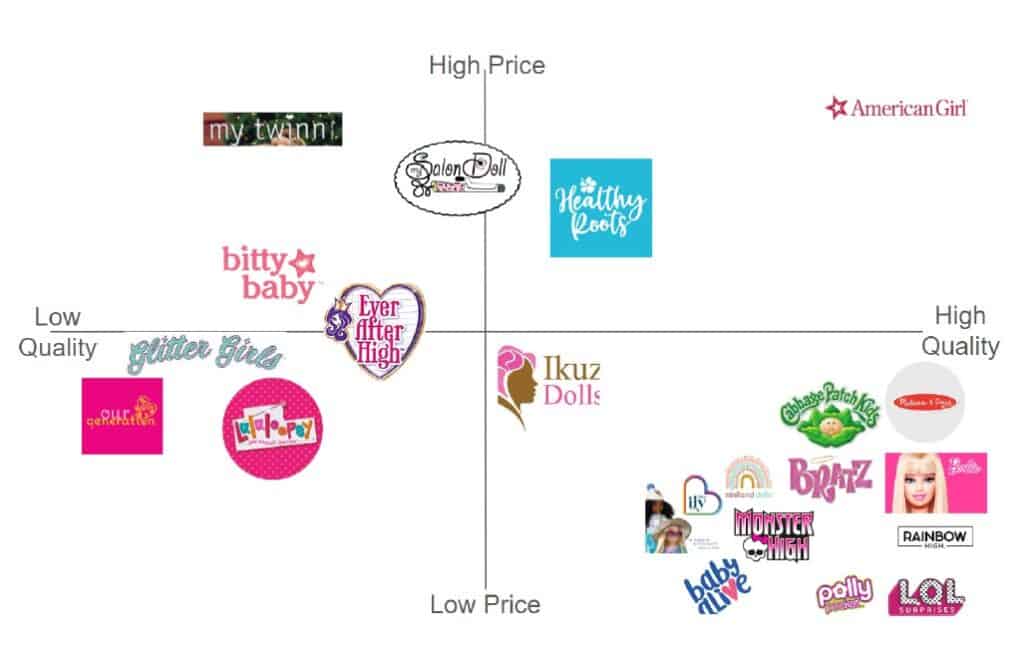
finding an average price, and also an average quality put on a scale of 1 to 10 (1
being very cheaply made and 10 being very high quality).
Competition
Monster High Dolls
Average Price: $27
Average Quality: 8.5
Summary: Designed for upper aged girls, monster high dolls allow
tweens to move from the princesses and into a more mature doll.
LalaLoopsy Dolls
Average Price: $35
Average Quality: 7
Summary: These dolls are designed for younger girls and have fun
bright colors with each doll designed towards a hobby. They are very
unique looking.
American Girl Dolls
Average Price: $150
Average Quality: 10
Summary: These dolls have a wide variety of ages they can appeal to due to the historic stories attached to each doll, and they are made of durable material.
Barbie Dolls
Average Price: $25
Average Quality: 10
Summary: With an iconic brand and well known name, Barbie is easily
one of the best selling doll brands of today. They make dolls that are
suited to a wide variety of ages from young girls to adults who love to
collect.
Melissa and Doug Dolls
Average Price: $32
Average Quality: 10
Summary: This brand is notorious for good quality toys for young ages,
their dolls are no different, Little girls will love this
doll.
Disney ILY 4Ever Dolls
Average Price: $29.99
Average Quality: 8
Summary: Fun Disney paraphernalia put onto dolls can be any little Disney fanatics dream. With lots of accessories, these dolls bring Disney to the next level.
Baby Alive Dolls
Average Price: $20
Average Quality: 9
Summary: Made of soft material and well weighted, these cute cartoon baby dolls are perfect for little girls and good for mom’s who can’t stand the life-like dolls.
Bratz Dolls
Average Price: $30
Average Quality: 9
Summary: These fashion forward and edgy dolls are quite
controversial. Mom’s don’t like the thought of their young girls being
flooded with ideas of “slutty fashion”.
Miniland Dolls
Average Price: $30
Average Quality: 9
Summary: With a light vanilla scent, these baby dolls are durable and
diverse.
Our Generation Dolls
Average Price: $35
Average Quality: 6
Summary: These cheaper dolls are a great
knock-off version of American Girl Dolls. For
those looking for a cheaper option, they have
come to the right place.
Healthy Roots Dolls
Average Price: $85
Average Quality: 9
Summary: Designed with young black girls in mind, this doll brand
features curly synthetic hair and diversity amongst other doll brands.
Ikuzi Dolls
Average Price: $40
Average Quality: 8
Summary: A wide variety of doll types, Ikuzi offers diversity in both the
kinds of dolls and what they look like.
L.O.L. Surprise! Dolls
Average Price: $20
Average Quality: 10
Summary: Lots of fun accessories and stories. These
dolls are very popular with girls today.
Glitter Girls Dolls
Average Price: $37
Average Quality: 7
Summary: Designed for young girls, so they are made of durable
plastic. Fun fashion with a touch of glitter.
Polly Pockets
Average Price: $20
Average Quality: 9
Summary: Small plastic dolls with lots of accessories, Polly Pockets are perfect for tween aged girls.
Rainbow High Dolls
Average Price: $24
Average Quality: 10
Summary: These dolls each have a color they represent and come with
lots of accessories.
Ever After High Dolls
Average Price: $45
Average Quality: 7
Summary: Based on fairy tale characters, these dolls have a fun nostalgia linked with their backstory with cute movies attached.
My Twinn Dolls
Average Price: $120
Average Quality: 7
Summary: These dolls are now discontinued,
but are good to mention, due to their
uniqueness. A girl could send in a picture of themselves, and the
company would personally design a “twin” for them.
My Salon Dolls
Average Price: $113
Average Quality: 8
Summary: These dolls are known for having real hair! For the girls that
love to style and wash hair, these are the dolls for
them.
Bitty Baby Dolls
Average Price: $80
Average Quality: 7
Summary: These dolls are soft and a good size, although they are
pricey considering they are just a regular baby doll.
Cabbage Patch Dolls
Average Price: $35
Average Quality: 9
Summary: Cabbage patch dolls are a long standing
brand because they have branded their product as
“adoptable”. These soft huggable bodies and yarn
hair warms your heart.
Results
Discussion and Recommendations
Based on the research that I have done, customers are more likely to spend money
on a doll when there is a story attached to it and there is a unique aspect. If the doll
is like any other, a customer won’t spend the money. Quality is important, but if
you’re above an 8 then you are pretty safe. Another observation is that customers
are very picky on the quality of their hair. When a customer complains about the
quality of the doll, they either mean the articulation or the hair.
My recommendation is that we find a niche aspect we can bring to the doll world
and put the majority of our money towards good articulation and hair.
Future Actions
As a company, I propose we make a line of collectible dolls for adult women. We can give each doll a unique background or history and focus our efforts on giving them fun outfits and lovely hair. Dolls are worth more and keep their value better when they have good quality and are beautifully made.
Conclusion
To conclude, as a company entering the doll industry, the research we have done
and analysis we have found, we have a good understanding of how best to find an
audience and keep them captivated.
Lessons Learned
This project was really eye opening as to what a marketer does. My Dad does digital
marketing and for years I have wondered what exactly he does every day. I feel this
project allowed me to see a little bit more into what my Dad does. I didn’t expect to
learn as much as I did with this. Reading through customer reviews and seeing the
different kinds of dolls available made me realize how much information is really
out there if you are going into a certain industry and want to make a new product.
I don’t think I will ever be a marketer, but doing this project gave me some new
found respect for those that do. I always assumed marketing was just a little artsy
business major, but I now understand how much analysis and thought goes into
simply putting out a product.
Something else I found interesting, is that my original thought as to what was going
to keep customers interested in dolls was not what it turned out to be. I thought
that the clothing and accessories were going to be what kept audiences captivated,
but it was their hair, articulation, and stories. It was fun to feel like I was learning
something new about a subject I have known about for years.
Overall, this was a fun project that allowed me to get hands on with the marketing world.