“Persistent, consistent, and frequent stories, delivered to an aligned audience, will earn attention, trust, and action.”
“Marketing is our quest to make change on behalf of those we serve, and we do it by understanding the irrational forces that drive each of us.”
“The most important lesson I can share about brand marketing is this: you definitely, certainly, and surely don’t have enough time and money to build a brand for everyone. You can’t. Don’t try. Be specific. Be very specific.”
Book Theme
This Is Marketing reframes marketing as the generous, ethical practice of helping people change for the better. Instead of chasing mass attention or short-term hacks, Seth Godin argues that modern marketing is about serving a clearly defined smallest viable audience, understanding their worldview, telling true stories that resonate, and earning trust over time by doing work that actually matters.
Why You Should Read This Book
It gives you a clear philosophy for ethical, human-centered marketing in an age of ad fatigue and algorithm-driven noise.
It helps you stop trying to reach “everyone” and instead focus on a specific audience you can truly serve and delight.
It connects strategy and day-to-day decisions: who you serve, what you offer, how you position it, and how you show up consistently.
It distills decades of Seth Godin’s marketing ideas into one coherent, accessible guide for working marketers.
It is especially helpful if you already know basic tactics and want a deeper, principled lens for deciding what to do (and what to stop doing).
Key Ideas and Arguments Presented
Marketing is about change, not hype. The real job of marketing is to create meaningful change for specific people, not just to get clicks, views, or short-lived attention.
Focus on the smallest viable audience. You do not need everyone; you need a small group of people for whom your work is incredibly valuable and who can sustain your business or mission.
People like us do things like this. Behavior is driven by worldview, identity, and group norms, so effective marketing aligns with the story people already tell themselves about who they are and what their people do.
Tell stories, build connections, and design experiences. Features and specs are secondary; what people really respond to are stories that make sense to them and experiences that reinforce those stories.
Trust and permission are core marketing assets. Instead of interrupting strangers, earn permission to talk to people who want to hear from you and protect that trust by being relevant and generous.
Treat different people differently. Mass-averaged messaging leads to bland work; segment by worldview and desire so you can craft specific messages and offers for specific groups.
Positioning and price are part of the story. Deciding who your product is for and who it is not for, and how you price it, shapes how people perceive its value, status, and fit.
Tribes and culture change matter more than one-off campaigns. Marketing is leading a group of people who share an idea or identity, helping them move together toward a desired change.
Funnels are journeys, not tricks. Awareness, consideration, and action are stages in a relationship; pushing people through a funnel without empathy or value erodes trust.
Because marketing works, it is a responsibility. The ability to shape culture and behavior means marketers have an obligation to use their influence with integrity, not manipulation.
Book Outline
The book is organized into short, idea-dense chapters that build a complete view of modern marketing. Key chapters include:
Not Mass, Not Spam, Not Shameful – why old-school interrupt-and-shout marketing is broken and what must replace it.
The Marketer Learns to See – understanding culture, noticing needs, and seeing opportunities for change.
Marketing Changes People Through Stories, Connections, and Experience – why story and experience drive action.
The Smallest Viable Market – focusing on a tiny audience you can actually serve well.
In Search of Better and Beyond Commodities – how customers define “better” and how to escape commodity status.
The Canvas of Dreams and Desires – mapping what your audience really wants and fears.
People Like Us Do Things Like This – identity, status, and group norms.
Trust and Tension Create Forward Motion – why people act and how to introduce honest, productive tension.
Status, Dominance, and Affiliation – understanding status-driven motivations.
A Better Business Plan – reframing strategy around who it is for and what change it creates.
Semiotics, Symbols, and Vernacular – using language and symbols your audience recognizes as their own.
Treat Different People Differently and Reaching the Right People – segmentation and focused outreach.
Price Is a Story – why pricing communicates value and status.
Permission and Remarkability in a Virtuous Cycle – earning permission by being worth talking about.
Trust Is as Scarce as Attention and The Funnel – how relationships actually develop.
Organizing and Leading a Tribe – turning customers into a community and movement.
Case Studies and Marketing Works, and Now It Is Your Turn – real-world examples and a call to action.
Marketing to the Most Important Person – centering the customer and the change you promise them.
Key Takeaways
Marketing is the act of making positive change for the people you seek to serve, not the act of shouting at everyone.
Trying to reach everyone leads to average products and average messaging; focusing on the smallest viable audience leads to depth, loyalty, and word-of-mouth.
People buy based on worldview, identity, and status; your stories, symbols, and experiences must match the way they already see themselves and their group.
Trust and permission are more valuable than reach; once someone trusts you and wants to hear from you, marketing becomes a service instead of an intrusion.
It is easier and smarter to design products and services for a particular audience than to build something and then hunt for anyone who might buy it.
Marketing is a long-term practice of showing up, keeping promises, and leading a tribe, not a one-time campaign or growth hack.
A strong brand is willing to say “this is not for you” to people outside its tribe so it can more powerfully serve those inside it.
Because marketing shapes culture, marketers have a responsibility to use their skills ethically and for work they are proud of.
Key Techniques
The five-step marketing process: invent something worth making, design it for a specific small group, tell a story that matches their worldview, spread the word in ways they welcome, and keep showing up consistently.
Smallest viable audience design: define the smallest group of people who can sustain your work, based on shared beliefs and desires, and tailor everything to serve them deeply.
The “who is it for, what is it for” test: clarify exactly who your product is for and what change it is supposed to create for them before you worry about tactics.
The three-part story structure: story of self (why you care), story of us (shared values and identity), and story of now (why the change matters today and what action to take).
Positioning with simple maps: plot competitors along two important axes (such as price vs. quality or simplicity vs. flexibility) to see where you can occupy a distinct, underserved position.
Creating honest tension: surface the gap between where your audience is and where they want to be, then offer your product or service as a credible path to close that gap.
“People like us” segmentation: define your audience in terms of identity and shared beliefs rather than demographics, then speak and act in ways that clearly signal “this is for people like us.”
Permission marketing: invite people to opt in, deliver valuable and relevant messages over time, and treat each interaction as a chance to deepen trust instead of just to close a sale.
Tribe building: give your audience ways to connect with you and with each other, highlight member stories, and communicate a clear vision so they can feel part of a movement, not just a customer list.
Author’s Qualifications
Seth Godin is a bestselling marketing author, entrepreneur, and teacher who has shaped how modern marketing is understood and practiced. He has written more than a dozen influential books, including Permission Marketing, Purple Cow, Tribes, and Linchpin, which have been translated into many languages and widely adopted by marketers and business leaders.
He founded Yoyodyne, one of the first online direct marketing companies, which was acquired by Yahoo, where he served as vice president of direct marketing. He also created the altMBA and other education programs that teach leadership and marketing to professionals worldwide, and he writes a long-running, widely-read daily blog on marketing and change.
Godin’s combination of hands-on entrepreneurial experience, decades of writing and teaching, and industry recognition make him a credible and influential voice on what effective marketing looks like today.
Comparison to Similar Books
Compared to Building a StoryBrand by Donald Miller, which gives a clear messaging framework to structure your brand story, This Is Marketing sits one level higher and focuses on who you serve, what change you promise, and how to earn trust so that any story you tell is grounded in the right strategy.
Compared to Contagious by Jonah Berger, which analyzes why ideas and products go viral, Godin is less focused on virality and more focused on serving a focused tribe over time; spreading ideas matters, but only after you know which people you exist to help.
Compared to Influence by Robert Cialdini or other persuasion-focused books, Godin acknowledges persuasion but insists that marketers use these tools inside a larger commitment to generosity, permission, and long-term trust.
Within Seth Godin’s own work, This Is Marketing acts like a synthesis and update of ideas from Permission Marketing, Purple Cow, and Tribes, combining remarkability, permission, and tribe-building into one coherent modern marketing philosophy.
Target Audience
Working marketers and brand strategists who want to move beyond tactics and campaigns to a more strategic, ethical practice.
Entrepreneurs and startup founders who need to find and delight their first true fans without massive ad budgets.
Small business owners who want to build loyal local or niche communities instead of competing on price alone.
Business and marketing students who want a modern, human-centered complement to traditional marketing textbooks.
Nonprofit, cause, and social impact leaders who need to mobilize people around ideas and behavior change, not just products.
Experienced marketers who feel burned out on manipulative tactics and want a more meaningful, sustainable way to practice their craft.
Critical Response to the Book
The book became an instant New York Times and Wall Street Journal bestseller, signaling strong interest and resonance with readers.
Many reviewers and practitioners praise its humane, ethical view of marketing and its focus on empathy, trust, and service rather than manipulation.
It is frequently recommended on lists of modern must-read marketing books as a mindset- and philosophy-setting text.
Some critics note that it feels like a collection or synthesis of Godin’s earlier work and that it can be high-level rather than a step-by-step tactical manual.
Overall, the response has been that it is more valuable as a compass and source of insight than as a how-to guide for specific channels or tools.
One Sentence Takeaway
Marketing that works and feels right is the disciplined, generous practice of choosing a specific group of people, understanding the change they seek, and serving them so well and so consistently that trust, stories, and culture shift in the process.
“Content has become the currency you use to buy attention.”
“People buy based on emotion, not logic—and your content must make them feel something.”
Book Theme
Content Marketing Made Easy centers on how to attract, engage, and convert your ideal audience through personality-driven, emotionally resonant content. It explains content marketing as both art and science—earning attention by giving value before asking for anything in return.
Why You Should Read This Book
Read Content Marketing Made Easy if you want a practical, story-rich, and highly actionable guide to modern marketing. Nemo translates decades of experience into a relatable framework anyone—entrepreneurs, freelancers, coaches, or marketers—can apply to build a loyal audience using blogs, podcasts, videos, and social media.
Key Ideas and Arguments Presented
Content = Currency – Attention must be earned through valuable, entertaining content.
Infotainment Wins – Combine useful information with engaging storytelling.
Emotion Drives Decisions – People buy based on emotion and justify later with logic.
Personality is Power – Infuse your unique voice into your content to stand out.
Niche Focus – “The riches are in the niches.” Hyper-targeted audiences convert best.
Value First Marketing – Offer free, high-quality content before making any ask.
Storytelling Converts – Real stories create emotional connections and memorability.
Automation and Systems – Use funnels, email sequences, and scheduling to scale impact.
The One-Question Survey – Ask audiences directly what they want most from your content.
Repurpose on Purpose – Reuse and reshape strong content across multiple formats.
Book Outline
Chapter 1: Step Zero – What is Content Marketing and How Does it Work?
Chapter 2: Seamless Selling – Content That Converts
Chapter 3: Idea Factory – How to Come Up With Content Your Audience Will Go Bananas For
Chapter 4: Gone Fishin’ – How to Set Up a Sales Funnel Using Content
Chapter 5: Create vs. Curate – Which One Should You Do?
Chapter 6: Simply Irresistible – How To Create Magnetic Content
Chapter 7: The Secret Sauce Nobody Else Can Replicate
Chapter 8: You Have To See It To Believe It
Chapter 9: Can We Talk? Listen To This Advice
Chapter 10: The Single Best Content Marketing Tool I’ve Ever Seen
Chapter 11–17: Strategies on social media, repurposing, automation, ROI, and next steps.
Afterword: Encouragement and reflection on faith, purpose, and storytelling.
Key Takeaways
Great content blends emotion, entertainment, and education.
Marketing today is about earning trust, not demanding attention.
Personal storytelling humanizes brands and attracts the right clients.
Asking your audience what they want outperforms guessing.
Content marketing is a repeatable system, not random inspiration.
Automation allows you to scale personal connection without burnout.
Success follows consistency and authenticity, not viral moments.
Key Techniques
Infotainment Formula: Information + Entertainment = Engagement.
One-Question Survey: “What do you want to know most about [topic]?”
Niche Targeting: Create audience-specific content with tailored language.
Value Ladder Funnel: Start with free, helpful content → build trust → offer paid products.
Repurposing System: Transform one strong idea into blogs, videos, and social posts.
Story Framework: Use personal experiences and customer stories to teach and sell.
Automation Tools: Calendars, autoresponders, and outsourcing to streamline workflow.
Author’s Qualifications
John Nemo is a bestselling author, LinkedIn marketing expert, and founder of Nemo Media Group. With a background in journalism and public relations, he has helped thousands of entrepreneurs, coaches, and businesses build lead-generating content strategies through his books, podcasts, and online courses.
However, Nemo’s tone is more conversational, faith-based, and deeply personal, combining step-by-step marketing guidance with motivational storytelling.
Target Audience
Entrepreneurs and solopreneurs
Coaches and consultants
Small business owners
Digital marketers and content creators
Freelancers building personal brands
Nonprofits and ministries wanting authentic engagement
Corporate professionals transitioning to independent work
Critical Response to the Book
Readers and influencers—including Chris Brogan, John Lee Dumas, and Bob Burg—praise the book for its authenticity, humor, and clarity. It is often cited as a refreshing antidote to over complicated marketing jargon, emphasizing real human connection and storytelling that sells naturally.
One Sentence Takeaway
Content marketing succeeds when you stop selling and start connecting – creating valuable, emotionally engaging stories that build trust, relationships, and results.
“Technology alone will not create better customer relationships—it’s the culture and structure that must evolve with it.”
“Generative AI may finally deliver on the decades-old one-to-one marketing promise, but only if companies put the customer’s interest first.”
“Trust is the foundation for creating value on both sides of any customer relationship.”
Book Theme
The New Science of Customer Relationships explores how artificial intelligence and data science are transforming customer relationships. It examines the gap between decades of marketing promises (like personalization and one-to-one marketing) and the reality of limited progress, proposing a new, evidence-based discipline called customer science—the use of AI, analytics, and organizational change to build trust-based, individualized customer engagement.
Why You Should Read This Book
Understand how AI and generative AI can realistically personalize marketing, sales, and service.
See why organizations—not technology—are the main barriers to effective customer relationships.
Learn how leading companies are already succeeding with AI-driven personalization.
Discover a practical roadmap for using AI ethically while protecting customer trust and privacy.
Gain insight from two of the most respected authorities in analytics and marketing technology.
Key Ideas and Arguments Presented
The one-to-one marketing dream remains unfulfilled—most firms still use mass tactics despite decades of customer data.
Generative AI now makes it technically possible to personalize at scale, but organizational culture and data integration lag behind.
Customer science combines rigorous data analysis, controlled experimentation, and continuous learning to improve relationships.
Data quality and definition issues (like who “the customer” really is) are the biggest obstacles to customer insight.
Better AI, data, and ethics must work together to transform marketing from manipulation to mutual value creation.
AI agents and automation can handle routine interactions, freeing humans for empathy-driven work.
Hyper-personalization requires collaboration across departments—marketing, sales, service, and analytics.
Ethics and transparency are essential; trust is the new competitive advantage.
The customer of tomorrow expects seamless, respectful, and intelligent interactions.
True personalization is not a one-time project but a sustained scientific process.
Book Outline
The Broken Promise of Customer Data and Technology – Why decades of innovation failed to produce real personalization.
The Future Is Here, but Unevenly Distributed – Case studies of companies succeeding with AI-driven customer engagement.
Better AI: Generative AI as a Catalyst for Change – How GenAI transforms customer relationships.
Better Data – Data strategy and quality as the foundation of customer science.
Better Personalization and Hyper-Personalization – How to tailor marketing for individuals.
Better Customer Voice Analysis and Action – Using AI to listen and respond effectively.
Better Task Automation with AI Agents – Automating repetitive customer tasks with intelligence.
Better Customer-Facing Operations – Integrating marketing, service, and operations for unified CX.
Better Customer Analytics and Data Science – Modern analytics for predictive, personalized insight.
Better Ethics – Navigating privacy, bias, and trust in AI-powered marketing.
The Customer of Tomorrow – Visionary outlook on how AI will reshape the customer experience.
Key Takeaways
Technology progress has outpaced organizational readiness.
Generative AI can finally make scalable personalization possible—but only when supported by ethical data use.
Customer trust is non-negotiable; value creation must serve both sides.
Customer science is a continuous cycle of experimentation, data integration, and improvement.
The future of marketing lies in transparent, data-driven empathy—using AI to understand, not exploit.
Key Techniques
Customer Science Framework: A continuous process of data collection, AI-driven analysis, and behavioral experimentation.
Hyper-Personalization Process: Combining structured and unstructured data for real-time, individualized offers.
AI Agent Integration: Deploying intelligent agents to handle routine customer interactions.
Voice of Customer (VoC) AI: Using sentiment and speech analytics to guide proactive responses.
Ethical AI Governance: Establishing policies that prioritize privacy, fairness, and long-term value.
Author’s Qualifications
Thomas H. Davenport: Distinguished Professor at Babson College, MIT Fellow, Senior Advisor to Deloitte, and author of over 25 books including Competing on Analytics. Recognized globally as one of the top voices in AI and data-driven business strategy.
Jim Sterne: Digital analytics pioneer, founder of the Marketing Analytics Summit, author of 12 books on marketing and AI, and advisor to leading global organizations on generative AI adoption.
Comparison to Similar Books
Comparable to Competing on Analytics (Davenport) and The One-to-One Future (Peppers & Rogers), this book blends AI innovation with practical business insight. Unlike purely technical AI guides or marketing casebooks, The New Science of Customer Relationships provides a scientific, ethical, and cross-functional framework for modern marketing transformation.
Target Audience
Marketing executives adopting AI
Data and analytics professionals
Customer experience and CRM leaders
Business strategists and consultants
Technology executives and product managers
Entrepreneurs in AI-driven industries
Academics and students studying digital transformation
Critical Response to the Book
Early readers and industry reviewers praise the book for being both visionary and grounded, offering a realistic path to personalization after decades of hype. It’s recognized as a must-read guide for aligning AI innovation with customer trust and long-term business value.
One Sentence Takeaway
The New Science of Customer Relationships reveals how organizations can finally fulfill the long-promised vision of one-to-one marketing through AI, data, and ethics—by putting customer trust and value at the heart of every decision.
“Content marketing is all about publishing useful information that helps your target audience.”
“Simply publishing content isn’t enough. You also need to promote that content.”
“Never has there been such an exciting opportunity for small and mid-size businesses… now it’s not the depth of your wallet but the depth of your words.”
Book Theme
Content Marketing For Dummies central theme is teaching businesses to think like publishers—creating meaningful, value-driven content across formats (blogs, video, social media, conversations) that engages audiences, builds trust, and drives long-term brand growth.
Why You Should Read This Book
It simplifies a complex, often intimidating topic.
Offers both theory and actionable tactics (from blogging to SEO to metrics).
Provides step-by-step guidance for beginners while also delivering insights useful for experienced marketers.
Helps you avoid common mistakes and focus on strategies that yield sustainable brand equity.
Key Ideas and Arguments Presented
Content marketing is about adding value before selling.
Success requires consistency, persistence, and restraint in messaging.
Use the 80/20 rule: 80% valuable content, 20% promotional.
SEO and search visibility are core benefits of publishing.
Integration across platforms is essential.
Measurement and refinement drive improvement.
Content marketing is a long-term, relationship-building strategy.
Book Outline
Part I: Getting Started with a Content Marketing Plan
Part II: Marketing with Long-Form Content
Part III: Marketing with Short-Form Content
Part IV: Engaging in Online Conversations
Part V: Achieving Long-Term Success
Part VI: The Part of Tens (tools, sites, resources)
Part VII: Appendixes (Quick Start Plans, Glossary)
Key Takeaways
Content marketing = consistent value, not sales pitches.
Brands must shift to an audience-centric approach.
Promotion is as important as creation.
Content fuels trust, loyalty, and word-of-mouth.
Long-term results require patience and commitment.
Key Techniques
SEO optimization for visibility.
Keyword research to target audiences.
Cross-promotion and interlinking content.
Design that enhances usability.
Monitoring online reputation with tools like Google Alerts.
Applying the 80/20 rule for balance in promotion.
Author’s Qualifications
Susan Gunelius is President & CEO of KeySplash Creative, Inc. She has 20+ years of marketing experience, including leadership roles at AT&T and HSBC. She has authored multiple marketing books, writes for Entrepreneur.com and Forbes.com, and speaks internationally on branding and content.
Comparison to Similar Books
Unlike Epic Content Marketing (Joe Pulizzi) or Everybody Writes (Ann Handley), which focus on advanced content strategy or writing quality, Content Marketing For Dummies is an accessible, practical beginner’s manual. It provides breadth (covering blogs, video, social, SEO) rather than deep dives into a single niche.
Target Audience
Small business owners
Marketing beginners
Entrepreneurs seeking growth
Bloggers/content creators
Corporate marketers transitioning to digital
Students learning marketing fundamentals
Professionals tasked with branding or communications
Critical Response to the Book
As part of the For Dummies series, it has been well-received for its clarity and accessibility. It’s not viewed as groundbreaking theory but rather as a practical, go-to reference for newcomers needing structured, step-by-step support.
One Sentence Takeaway
Content marketing success comes from creating consistent, valuable content that engages audiences and builds long-term brand relationships.
“People value brands that help give them an identity and a sense of belonging to a herd.”
“Human beings will nearly always choose the easiest option over time (and then post-rationalize their decision).”
“People tend to buy the brands that they most easily recall. Simple as that.”
Book Theme
R.E.D. Marketing by Greg Creed and Ken Muench advocates a simple, holistic framework for building brands based on three core ingredients: Relevance, Ease, and Distinctiveness. The central theme is that truly effective marketing requires excelling in all three areas – making a brand meaningfully relevant to consumers, extraordinarily easy to notice and purchase, and memorable through distinctive brand assets. The book’s big idea is that by combining cultural insights, frictionless customer experience, and unique brand cues, marketers can drive sustainable brand growth.
Why You Should Read This Book
This book is a frank, practical guide for marketers and strategists seeking proven methods rather than theory. Creed and Muench share a blueprint derived from their success at Yum! Brands (KFC, Taco Bell, Pizza Hut), cutting through academic jargon with simple frameworks and engaging stories. Readers will learn what really works to drive sustainable brand growth, backed by real-world examples and the latest findings in neuroscience and consumer behavior. In a fast-changing marketing landscape (even tested by the pandemic), the R.E.D. approach provides a unifying playbook that is easy to understand and implement, making marketing efforts more focused, nimble, and fun. For anyone tired of buzzwords and looking for actionable strategy, this book offers a clear roadmap grounded in evidence and actual results.
Key Ideas and Arguments Presented
1. The R.E.D. Formula: Marketing works in three ways – a brand must be Relevant to a real consumer need, Easy to access (and recall), and Distinctive in consumers’ minds. All three ingredients are essential; if any are weak, brand growth will stall. This trio forms the backbone of every discussion in the book.
2. Holistic Brand Building: The authors emphasize excelling in all three areas simultaneously. It’s not enough to have a culturally cool brand (relevance) if it’s hard to find or buy, or to have an easily available product if it’s forgettable. Leading brands weave relevance, ease, and distinctiveness together into one strategy for long-term results.
3. Cultural Relevance: Brands should tap into cultural “codes” and trends to give products deeper meaning in people’s lives. A brand needs to stand for something that resonates with the zeitgeist or social values of its audience. The book illustrates this with examples like shifting from “diet” culture to themes of authenticity and wellness. When people feel a brand aligns with their identity or the “herd” they aspire to, they’re more likely to adopt it.
4. Functional Relevance: Beyond culture, relevance also means fitting into consumers’ everyday routines. The authors stress expanding the number of Category Use Occasions (CUOs) – the situations or needs for which your brand is the go-to choice. For instance, Taco Bell’s famous “Fourth Meal” campaign added a new late-night eating occasion for the brand. The more use-cases or occasions a brand can fulfill, the more frequently it will be purchased, driving growth.
5. Social Relevance: A brand should spur conversation – “buzz” – so that people are naturally talking about it in their social circles:. Word-of-mouth and cultural buzz make a brand feel like the one everyone should be buying. The book cites stunts like Taco Bell’s pop-up hotel or Red Bull’s space jump as ways to get people talking. When everyone is talking about your brand, others feel they’re missing out if they don’t buy in.
6. Ease to Access (Remove Friction): “Ease” is presented as equally critical yet often overlooked by marketers. This means ensuring the brand is easy to find, buy, and use. The authors argue that reducing friction in the customer journey – from discovering the product to ordering and receiving it – will win customers over because humans tend to choose the path of least resistance. R.E.D. Marketing urges marketers to consider convenience, distribution, and the user experience as part of marketing strategy (not leave it solely to operations). In practice, brands that are readily accessible in stores, online, or via delivery will “ultimately win”, so marketers must collaborate to strip away barriers (long lines, confusing apps, slow websites, etc.).
7. Ease to Notice (Mental Availability): The book aligns with the insight from marketing science that advertising should reach as many category buyers as possible. Creed and Muench argue against over-segmentation – don’t waste time micro-targeting tiny niches. Instead, use mass reach media to make sure your brand is easily noticed by “everyone in your category”. They also stress creating memorable ads that trigger emotion, since messages that cause an emotional reaction get remembered longer. By building broad mental availability (being the brand people instantly recall when a need arises), you make purchasing decisions easy for consumers.
8. Distinctiveness over Differentiation: Rather than obsessing over being “radically different,” the authors echo a key modern marketing principle: it’s more important to be distinctive than just different. Distinctiveness means using consistent, ownable brand assets – logos, colors, characters, taglines, even sounds – so that your brand is unmistakable and top-of-mind. The book shows that brands with unique, repetitive cues (think of KFC’s Colonel, or the Taco Bell bell sound) build memory structures that make them easier to recall. Over time, that mental availability beats out minor differences in product features. In fact, the authors note “distinctiveness beats even excellence” in product, if nobody remembers who you are.
9. Modern Science vs Old Beliefs: Throughout the book, Creed and Muench address the conflict between data-driven marketing science and traditional marketing habits. For example, old-school marketers might chase differentiation or narrow targeting, whereas R.E.D. preaches broad reach and distinctiveness as proven by empirical studies (citing works like How Brands Grow). The authors weave in findings from neuroscience and behavioral economics to back up their framework, debunking myths like “we must convert non-users with persuasion.” Instead, they suggest ensuring you’re salient and easy enough that customers come to you when ready.
10. The Importance of Fun and Agility: Finally, the tone of the book reminds marketers that marketing should be exciting and creative, not just analytical. The R.E.D. system, while rooted in research, encourages bold ideas (stunts, cultural memes, witty ads) that make brands enjoyable and shareable. Creed and Muench also highlight how having a clear framework allows teams to be more focused and agile, especially in chaotic times. In the wake of challenges like the pandemic, sticking to R.E.D. fundamentals can keep a brand on course when others flounder.
Book Outline
R.E.D. Overview: Early chapters lay out the basics of the Relevance, Ease, Distinctiveness framework. The authors define each pillar clearly (Relevance to culture/needs, Ease of access and mental availability, Distinctiveness via brand assets) and preview how these will be explored. Readers get a “big picture” figure or diagram showing that cultural, functional, and social relevance combined with ease (to notice & to buy) and distinctiveness lead to effective marketing.
Part I – Relevance: This section is broken into three chapters focusing on the sub-components of Relevance. The first is Cultural Relevance, which delves into understanding cultural trends and instilling the brand with meaning that consumers find culturally important. Next is Functional Relevance, centered on identifying category use occasions and innovating products or messaging to fit those usage situations. Then comes Social Relevance, emphasizing word-of-mouth, social media buzz, and creating talk value so that the brand stays in the social conversation. Each of these chapters includes examples (e.g., how KFC tapped into local cultural insights in different countries, or how Taco Bell created new menu occasions) and ends with key tips for making a brand more relevant in that dimension. Notably, the “Social Relevance” chapter is playfully subtitled “I’ll Have What She’s Having!” to highlight the power of social influence.
Part II – Ease: The next part of the book examines Ease in two dimensions: “Easy to Access” and “Easy to Notice.” The Easy to Access chapter (Chapter 8) walks through the entire customer journey from the perspective of convenience. It identifies points of friction – finding where to buy, ordering, paying, waiting, receiving the product, etc. – and offers strategies to streamline each step. The following chapter, Easy to Notice (Chapter 9), focuses on marketing communications and media strategy. It discusses how to maximize reach among all potential customers and how to craft memorable advertising (with emotional triggers and creative consistency) so that the brand stays top-of-mind. The authors cite research and Yum! case studies to show that easy availability + easy recall leads to bigger market share.
Part III – Distinctiveness: Here the authors argue that many marketers under-invest in creating and relentlessly using distinctive brand assets. One chapter, “How to Be Distinctive,” provides guidance on developing unique brand cues and maintaining consistency over time, with examples of brands that own certain colors, symbols, or taglines in consumers’ minds. Another chapter consists of “Distinctiveness Exercises” (Chapter 14) – practical workshops for brand teams. For instance, the book includes an illustration of Hello Kitty’s branding elements to demonstrate how a brand can inventory its distinctive assets. The Hello Kitty example breaks down the iconic red bow, the stylized font, the white cat silhouette with whiskers, and color scheme, showing how consistently these elements are used to make the character instantly recognizable. Such exercises encourage readers to catalog and evaluate their own brand’s assets for uniqueness and consistency.
Conclusion and Further Reading: The book concludes with a rallying call that marketing grounded in R.E.D. principles will drive long-term growth, and that marketers should continuously learn and stay curious. The authors even provide a reading list of influential marketing books and research. They explicitly suggest reading Byron Sharp’s How Brands Grow (for the science of broad reach and mental availability) and then Douglas Holt’s How Brands Become Icons (for cultural branding) to get both perspectives. This underscores that R.E.D. Marketing synthesizes multiple schools of thought. The closing notes encourage marketers to keep observing culture, experimenting, and sharing insights within their teams, ensuring that the R.E.D. approach becomes an ongoing, fun part of their marketing culture.
Key Takeaways
Greg Creed and Ken Muench distill decades of experience into a simple truth: a brand grows when it’s relevant, easy, and distinctive.
The most important conclusions can be summarized as follows.
Success comes from hitting all three notes – relevance, ease, distinctiveness – together. If your marketing strategy lacks one of these, plug the gap.
Make your brand culturally meaningful and socially buzzworthy, but also tied to real usage needs in people’s lives.
Make your product ridiculously easy to find and buy; remove any friction because consumers will gravitate to the path of least resistance.
Invest in distinctive brand assets and consistent messaging – you want to stick in people’s memories so they recall you first when a need arises
Another takeaway is that marketers should embrace evidence-based practices (like broad reach media and emotional advertising) over outdated dogmas. The R.E.D. system is ultimately about focus and simplicity: it gives marketers a checklist to ensure their brand is showing up where it counts (in culture, in the consumer’s routine, at the point of purchase, and in memory). Following this framework can align teams and significantly “increase marketing effectiveness” as demonstrated at Yum! Brands. In short, a R.E.D.-optimized brand is one that people feel good about, can obtain with ease, and never forget.
Key Techniques
The book doesn’t just stay high-level – it offers concrete techniques and tools to put R.E.D. into practice. One notable tool is the “Ease Safari.” This is an exercise where you go on a “safari” through the customer’s buying journey for your brand (and even a competitor’s) to hunt for friction points. The authors provide a rubric (Figure 8.2 in the book) that breaks down each step: finding where to order, choosing a product, placing the order, payment, waiting, receiving the product, consuming it, and post-purchase follow up.
At each step, you mark if the experience is Green (smooth), Yellow (some friction), or Red (problematic). By scoring your brand’s ease versus competitors, you can pinpoint exactly where you need to improve convenience or speed. This hands-on technique encourages marketers to view buying through the customer’s eyes and is a direct way to apply the Ease principle.
Another technique is conducting a Distinctive Brand Asset Audit. The authors show how to list out all your brand’s signature elements (logos, slogans, colors, characters, sounds, etc.) and assess them for uniqueness and consistency. Using examples like the Hello Kitty case, they illustrate measuring which assets are most recognized and associated with the brand. Marketers are advised to then relentlessly use and protect these top assets across every touchpoint to cement distinctiveness. If certain assets aren’t pulling their weight, consider refining them. This exercise translates the abstract concept of “be distinctive” into a practical project for brand teams.
On the Relevance front, Creed and Muench suggest cultural trend mapping as a technique. While not branded with a fancy name, the idea is to regularly study cultural shifts and emerging consumer values (e.g., the rise of plant-based eating, or changes in social media behavior) and then brainstorm how your brand can authentically connect to those trends. In the book, they recount how Yum! Brands created internal “cultural briefs” and even set up WhatsApp groups with young trendsetters to keep a pulse on cultural movements. For functional relevance, a technique is Category Use Occasion analysis – basically, charting all possible occasions for using your category and identifying gaps or new occasions to target. Taco Bell’s late-night “fourth meal” was born from such analysis, revealing an unmet occasion their restaurants could serve. By systematically expanding when and how consumers use your product, you grow relevance.
Lastly, the authors champion a disciplined approach to mass marketing with memory in mind. They advise creating an “always on” plan to reach all potential buyers (for example, using TV, broad digital, or outdoor ads) rather than hyper-targeting small segments. A key technique here is testing ads for emotional punch and branding: does your campaign both evoke feeling and clearly tie to your brand’s distinctive cues? The book references the principle that ads which trigger emotion make the brand easier to recall later. So, a practical tip is to evaluate creative with that lens – if it doesn’t move people or isn’t branded strongly, go back to the drawing board. By combining these techniques – the Ease Safari, asset audits, trend mapping, usage occasion mapping, and memory-focused advertising – marketers can operationalize the R.E.D. approach in their day-to-day work.
Author’s Qualifications
Greg Creed is the former CEO of Yum! Brands, one of the world’s largest restaurant companies. Over a 40-year career in marketing and operations, he helped build global brands like KFC, Pizza Hut, and notably led a major turnaround at Taco Bell. Creed’s marketing savvy was demonstrated in campaigns such as “Think Outside the Bun” and product innovations like the Doritos Locos Taco, which became a cultural phenomenon. His leadership at Yum! saw significant growth, and he brings a high-level executive perspective to the book, showing how R.E.D. principles drive results at scale (over 50,000 restaurants in 150+ countries under his watch).
Ken Muench is the Chief Marketing Officer of Yum! Brands and co-founder of the company’s internal think tank, Collider Lab. With 25+ years in marketing strategy, Muench has a background in cultural anthropology and consumer insights. He pioneered the R.E.D. marketing system alongside Creed, first as an outside agency partner and then within Yum! after Collider Lab was acquired. Ken’s specialty is “marketing science” – he acts as a “master aggregator of marketing discoveries,” scanning research in neuroscience, psychology, and global case studies to inform strategy. Prior to Yum!, he led strategy at advertising agencies and has won awards for innovative campaigns. In short, Muench is the architect of much of the R.E.D. framework, ensuring it’s grounded in data and behavioral science. Together, Creed (the bold marketing leader) and Muench (the analytical strategist) combine practical corporate experience with cutting-edge theory, making them well-qualified guides on what drives brand growth.
Comparison to Similar Books
R.E.D. Marketing stands on the shoulders of other marketing thought leaders, and the authors are upfront about it. In fact, they encourage readers to explore works like Byron Sharp’s How Brands Grow and Jenni Romaniuk’s Building Distinctive Brand Assets. Fans of Sharp will recognize his influence in the R.E.D. framework: the emphasis on reaching all category buyers (mental and physical availability) and on distinctive brand assets directly echoes Sharp’s principles. What Creed and Muench add is a stronger dose of cultural marketing – an area Sharp largely downplays. In that sense, R.E.D. Marketing bridges Sharp’s evidence-based marketing with Douglas Holt’s cultural branding ideas. They cite Holt’s How Brands Become Icons as the “other side” of the argument and integrate it by making cultural relevance one of the three pillars. Compared to pure data-driven texts, R.E.D. Marketing is more conversational and example-rich, similar in tone to books like Eat Your Greens (which they also reference) that compile real marketers’ insights.
Unlike traditional marketing handbooks (or academic textbooks like Kotler’s Marketing Management), R.E.D. Marketing is not a laundry list of the 4 Ps or a treatise on branding theory – it’s closer in spirit to books like Donald Miller’s StoryBrand or Byron Sharp’s works in that it offers a clear framework and challenges some conventional wisdom. For example, where many classic books stress differentiation, Creed and Muench align more with Sharp in saying distinctiveness and relevance trump having a unique selling proposition for its own sake. Readers who enjoyed Building Distinctive Brand Assets will find the Distinctiveness section of R.E.D. very complementary, as it provides the why and how behind using brand assets (even including exercises to identify them). Similarly, those who liked Mark Ritson’s practical approach to marketing fundamentals will appreciate that R.E.D. is down-to-earth and not overly academic.
In contrast to some newer marketing books that focus heavily on digital marketing tactics or data analytics, R.E.D. Marketing keeps its recommendations high-level and principle-based, ensuring they are timeless. It’s more about strategy than tactics, akin to How Brands Grow in its universality. In summary, if you imagine a Venn diagram between Sharp’s scientific marketing laws and Holt’s cultural strategy, R.E.D. Marketing sits in the overlap, delivering “the best of both” in a digestible playbook. It distinguishes itself by insisting that ease (customer convenience) is part of the equation – something many other branding books ignore.
Target Audience
Marketing professionals: Anyone working in marketing, from brand managers to CMOs, will find value. The book is designed so that even “the greenest of marketing professionals” can grasp the blueprint and start applying it, while seasoned marketers will get a useful refresher on fundamentals that truly drive growth. It’s especially useful for brand strategists and campaign planners looking to boost effectiveness.
Business leaders and executives: CEOs, founders, and general managers who want to understand how marketing can sustainably grow the business will benefit. The framework is simple enough for non-marketers to appreciate, and as one CEO reviewer noted, it’s a “must-read for all brand builders and business leaders” who need a clear, powerful blueprint for marketing.
Students and newcomers to marketing: For MBA students or new marketing hires, R.E.D. Marketing provides an accessible entry point. It covers a lot of ground (from cultural insights to media strategy) in plain language and with vivid examples. One early reviewer noted that as a new student of marketing, they found it “simple, straightforward, and full of practical advice,” and it did a great job making important concepts easy to understand.
Advertising and agency professionals: Folks in ad agencies – whether creatives, account planners, or media buyers – can use R.E.D. to better align their work with client brand goals. The American Marketing Association’s CEO praised the book as a wake-up call to focus on relevance, ease, and distinctiveness, which suggests that even those creating ads can recalibrate their approach using these principles (e.g. ensuring creative is distinctive and easy to recall, not just clever).
Entrepreneurs and small business owners: If you’re running a small or medium business without a big marketing department, this book can serve as a crash course in what really matters. Its lessons are just as applicable to a local startup as to global brands. Creed and Muench’s advice (like remove friction, be part of culture, stand out uniquely) can help an owner prioritize limited marketing resources effectively.
Critical Response to the Book
R.E.D. Marketing has generally been well-received, especially among industry practitioners, though it has drawn a mix of praise and some critique. On the positive side, many readers and reviewers call it a “game-changing guide” and celebrate the simplicity of the framework. They highlight the engaging real-world examples and the fact that the book breaks down complex marketing ideas into practical strategies that can be applied across industries. Endorsements from high-profile CEOs and marketing leaders (like David Gibbs of Yum! and Diane Dietz of Rodan+Fields) reinforce that the book’s advice is sound and valuable for business growth. Several reviewers also note that the writing is clear and the lessons are easy to absorb, making it accessible to a wide audience. The inclusion of illustrations and tools (like the Ease Safari worksheet and diagrams) has been appreciated for adding an interactive element to the learning experience.
On the critical side, some experienced marketers found the content less groundbreaking. A few reviews mention that for veterans the book can feel a bit “basic” or repetitive of well-known concepts. One NetGalley reviewer commented that parts of the book felt like a prolonged introduction and that the truly “concrete” strategies only kicked in about 4 chapters in. There were remarks about the tone, with one reader feeling the authors spent a lot of time touting their successes at Yum! (“braggy,” as one put it) rather than diving straight into teaching the framework. Additionally, because many examples skew toward fun B2C campaigns (fast-food, retail stunts, etc.), readers in B2B or more serious industries wondered how easily the ideas translate to their context. However, even among some skeptics, the consensus is that the core principles of R.E.D. are sound – it’s often the presentation or depth that drew critique. In summary, most find it a useful and enjoyable marketing playbook, while a minority wished for less fluff and more advanced insight. The authors’ decision to write in third person and include personal anecdotes was a stylistic choice that not everyone loved, but the framework itself – Relevance, Ease, Distinctiveness – emerges unscathed as a valuable contribution to marketing literature.
One Sentence Takeaway
To build a leading brand, make it deeply relevant to consumers’ lives, utterly easy to access and recall, and unmistakably distinctive at every touchpoint.
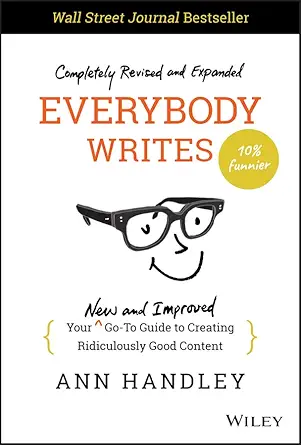
The core theme of Everybody Writes is that everybody is a writer in today’s digital world, and writing is both a practical skill and a powerful marketing tool. Handley argues that good writing is the foundation of effective content, communication, and connection.
Why You Should Read This Book
You should read Everybody Writes because it offers a clear, funny, and practical framework for improving all your content—from emails to landing pages to social posts. Whether you’re a marketer, entrepreneur, or professional, the book equips you with the skills to communicate clearly, tell authentic stories, and build trust with your audience.
Key Ideas and Arguments Presented
Writing is a habit, not an art—anyone can get better with practice.
All communication (emails, posts, blogs) counts as writing.
Content succeeds when it blends utility, inspiration, and empathy.
“The Ugly First Draft” is essential—write poorly first, then refine.
Clarity and brevity matter more than flashy words.
Brand voice should be consistent, but tone can adapt to context.
Storytelling makes your customer the hero, not your product.
Publishing is a privilege—content must respect the reader’s time.
Writing evolves with culture; authenticity and inclusivity matter more today.
Tools and processes (like the Writing GPS framework) can turn messy drafts into polished, effective work.
Book Outline
The book is organized into seven parts:
Part I: Writing Rules – how to write better and enjoy it more
Part II: Grammar and Usage – rules worth keeping (and breaking)
Part III: Voice Rules – finding and using your brand voice
Part IV: Story Rules – crafting authentic marketing stories
Part V: Publishing Rules – sharing responsibly and credibly
Part VI: 20 Things Marketers Write – practical writing for formats like email, social media, landing pages, and more
Part VII: Content Tools – helpful resources to improve your process
Key Takeaways
Good writing is accessible to everyone; it just takes practice.
Your words represent you and your brand; clarity is power.
Empathy for the reader is the foundation of great content.
Storytelling connects more than information ever will.
Consistency in voice builds trust and recognizability.
Key Techniques
The Writing GPS Framework: A 17-step process with three stages (Go, Push, Shine) to guide content creation.
The Ugly First Draft (TUFD): Write freely before editing.
“Dear Mom” Technique: Write as if explaining to someone who loves you but isn’t in your field.
Humor and Analogies: Use surprising comparisons and wit to engage readers.
Author’s Qualifications
Ann Handley is a pioneer in digital marketing and content strategy, Chief Content Officer at MarketingProfs, and a globally recognized keynote speaker. She has decades of experience helping businesses and individuals elevate their writing and content marketing.
Similar to Content Rules (which Handley co-authored), but this is a hands-on guide for daily writing tasks.
Target Audience
Marketing professionals
Content creators and copywriters
Entrepreneurs and small business owners
Social media managers
Students and professionals in business communication
Anyone who wants to improve their everyday writing
Critical Response to the Book
The book has been widely praised as funny, insightful, and indispensable. Seth Godin calls it essential for learning the craft of professional writing, while Joe Pulizzi places it alongside On Writing as required reading. Reviewers highlight its humor, clarity, and practicality, making it a modern classic for marketers and writers alike.
One Sentence Takeaway
Everybody can write better—and in today’s world, everyone must.