Books

social media roi

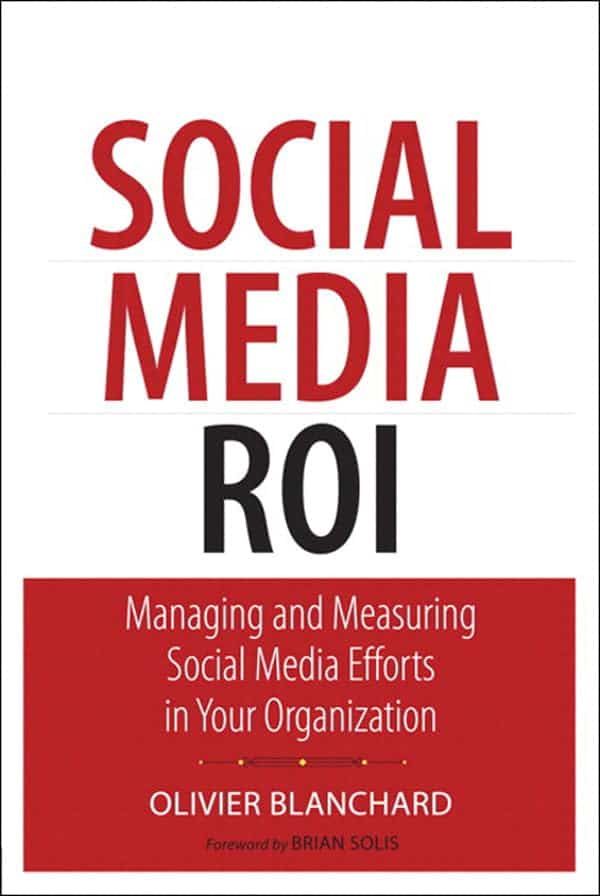
Social Media ROI by Olivier Blanchard Book Summary

Reading Time: 4 minutes

Top Three Quotes

  1. “The value of social media is not the platform, it is what you do with it.”
  2. “If you don’t understand how to measure ROI, you don’t understand business.”
  3. “Social media is not free. It takes time, it takes resources, and it takes money.”

Book Theme

Social Media ROI’s main theme is demystifying social media’s impact on business performance, focusing on how to measure, manage, and optimize social media activities to generate clear, quantifiable ROI.

Why You Should Read This Book

You manage marketing budgets and must demonstrate clear, measurable returns on investment to executives or stakeholders.

You need to prove the business value of social media initiatives and show how they contribute to revenue or cost savings.

You want to move beyond surface-level metrics such as likes, shares, and followers, and instead focus on meaningful business outcomes.

You are looking for a structured framework that helps integrate social media activities into your organization’s broader business objectives.

Key Ideas and Arguments Presented

Sustainability: Success requires long-term commitment and appropriate resource allocation over time.

Social Media Requires Business Alignment: Social media efforts must connect directly to overall business objectives.

ROI Must Be Defined Clearly: The return on investment in social media should be tied to measurable financial outcomes rather than vanity metrics.

Strategy Before Tactics: Many organizations jump into social platforms without a clear strategy, but the book emphasizes the need for thorough planning first.

The Importance of Governance: It is essential to establish policies, processes, and guidelines to manage risks and ensure consistency across teams.

Measurement Framework: Clear definitions of goals, key performance indicators, and success criteria are critical for tracking progress and impact.

Change Management: Adopting social media affects company culture and workflows, so managing this change intentionally is necessary.

Training and Enablement: Employees and teams require education on tools, processes, and expectations to be effective.

Customer Engagement: Listening to customers, responding effectively, and creating value for the audience are fundamental components of social media success.

Integration with Other Functions: Social media cannot operate in isolation and should be connected to sales, customer service, and product teams.

Book Outline

The following are the main sections and chapters as listed in the book:

  • I. Social Media Program Development
    • 1. Creating the Social Company
    • 2. Aligning Social Media to Business Goals
    • 3. Planning for Performance Measurement
    • 4. Establishing Clarity of Vision, Purpose, and Execution
  • II. Social Media Program Integration
    • 5. Understanding How Social Media Plugs into the Organization
    • 6. The People Principle
    • 7. Establishing Social Media Guidelines for the Organization
    • 8. Laying the Operational Groundwork for Effective Social Media Management
    • 9. The New Rules of Brand Communications in the Age of Social Media
  • III. Social Media Program Management
    • 10. Listening Before Talking
    • 11. Social Media and Digital Brand Management
    • 12. Real-Time Digital Support: Fixing Customer Service Once and for All
    • 13. Social Media Program Management: Putting It All Together
  • IV. Social Media Program Measurement
    • 14. Creating a Measurement Practice for Social Media Programs
    • 15. ROI and Other Social Media Outcomes
    • 16. F.R.Y. (Frequency, Reach, and Yield) and Social Media
    • 17. Social Media Program Analysis and Reporting

Key Takeaways

  1. Training and change management are critical elements that are often overlooked but essential for success.
  2. Social media ROI is achievable and measurable when objectives are clearly defined.
  3. Businesses must approach social media as an investment rather than treating it as a side project.
  4. Metrics should be linked to actual business outcomes instead of focusing only on engagement numbers.
  5. Establishing governance helps reduce risk and improve efficiency across teams.

Key Techniques

ROI Calculation Templates: Apply practical formulas and templates to quantify and demonstrate financial returns.

Measurement Frameworks: Define goals, key performance indicators, and conversion metrics early in the process.

Social Media Audit: Evaluate the current state of your social media presence and readiness for improvement.

Governance Model: Establish clear rules, escalation paths, and responsibilities to manage activity and risks.

Alignment Process: Connect social media objectives directly to overall business strategies and priorities.

Author’s Qualifications

Olivier Blanchard is a recognized expert in brand management and social business strategy. His background includes:

  • One of the earliest voices advocating for accountability in social media investments
  • Principal at BrandBuilder Marketing
  • Consultant for global brands across multiple industries
  • Frequent speaker on social media measurement and digital transformation

Comparison to Similar Books

Compared to Measure What Matters by Katie Delahaye Paine, Blanchard provides more comprehensive operational guidance for implementing ROI programs.

Compared to Groundswell by Charlene Li and Josh Bernoff, Social Media ROI is more focused on financial measurement rather than adoption strategies.

Unlike Trust Agents by Chris Brogan and Julien Smith, this book emphasizes processes and frameworks instead of storytelling.

Target Audience

  • Business Analysts responsible for marketing KPIs
  • Marketing Directors and Managers
  • Social Media Strategists
  • Digital Transformation Leads
  • CMOs and Executive Leadership
  • Small Business Owners who are serious about measurement
  • Consultants and Agency Professionals

Critical Response to the Book

Social Media ROI has been widely praised for:

  • Providing practical frameworks in an area often dominated by hype
  • Demystifying complex measurement concepts
  • Being accessible without oversimplification

Some critiques note:

Certain examples could be more current as platforms evolve

It assumes readers have some foundational marketing knowledge

One Sentence Takeaway

Social media only becomes valuable to business when you align it with strategy, measure its impact rigorously, and treat it as an investment that demands accountability.

Social Media ROI by Olivier Blanchard Book Summary Read More »

My Goodreads Data Story: Dashboards, an Interactive Chart, and 5-Star Recommendations

Reading Time: 2 minutes

Reader Beware: Any blog post tagged as “Data Driven David” may not be as related to marketing as most of my content. I truly love data and love it even more when it is well visualized and wrapped in a great story — now, that’s good marketing.

Since 2013, I’ve been tracking every book I’ve read in Goodreads. It’s been a fun way to look back on years of reading, especially since probably 80–90% of what I pick up is business-related, usually focused on marketing. In this post, I’m sharing some of my favorite charts and stats that highlight my reading habits over time. Whether you’re curious about how many books I’ve tackled or how many pages I’ve turned, you’ll find the details here.

If you’re interested, I’ve also put together a few Pinterest boards showcasing the books I’ve rated five stars across different genres:

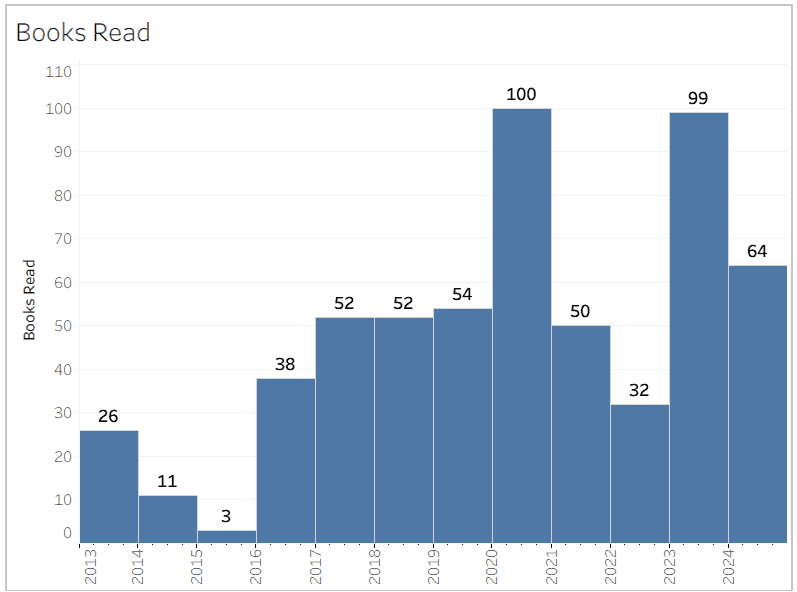
Despite what the chart below shows, I know I’ve reached my goal of reading 100 books in a year twice. My oldest daughter would probably dismiss this achievement since most of them were audiobooks.

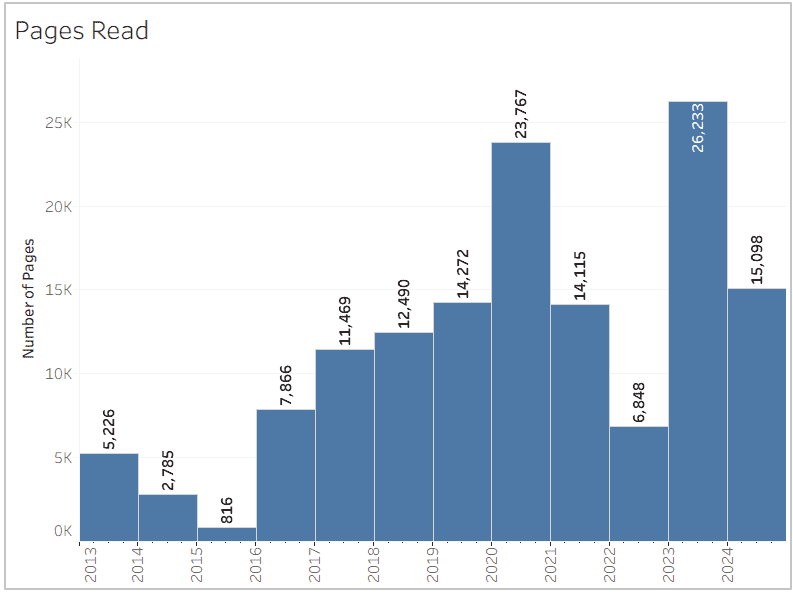
This next chart is similar, but instead of showing the number of books read, it tracks the number of pages. The data isn’t perfectly accurate because some books might be missing page counts, or the counts themselves might be incorrect, but most of the time it’s fairly reliable. Since I read a lot of business and religious books, many of them are under 200 pages. I considered combining this chart with the first one using a dual axis, with one as a line chart and the other as a bar graph. However, too many of the numbers overlapped and made the visual messy and confusing, even though it would have taken up less space than having two separate charts.

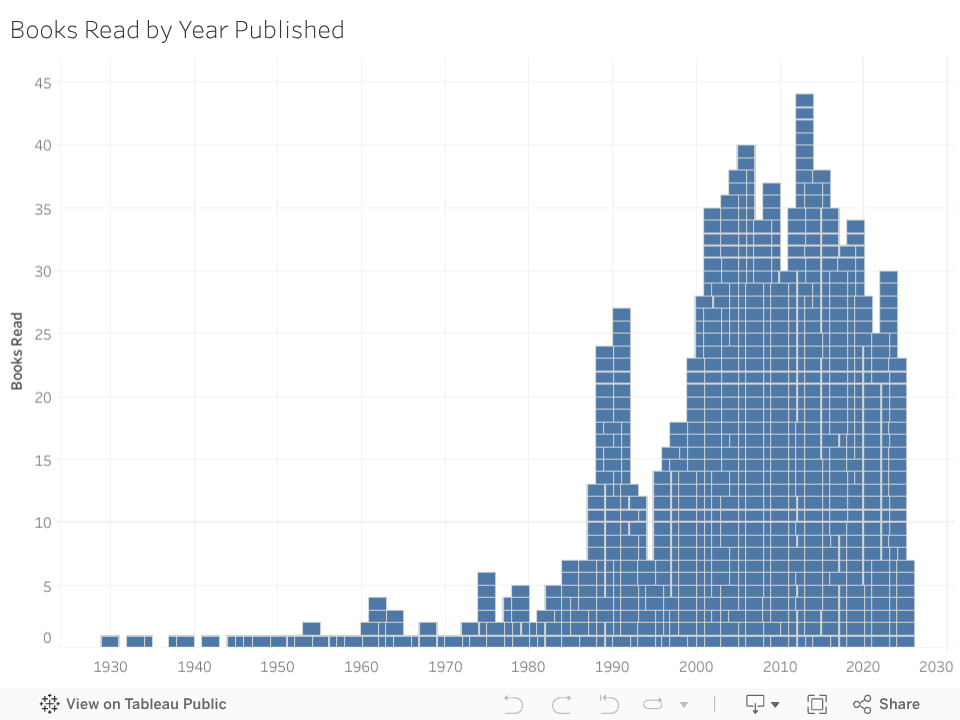
To date, I’m getting close to having read 1,100 books, and many of those were read before I started tracking in 2013. For the following chart, you can hover over any of the boxes by the year the book was published to see the book title, author, and my rating (if available). Earlier entries often lack ratings. This interactive chart is one of the great aspects of using Tableau.

My Goodreads Data Story: Dashboards, an Interactive Chart, and 5-Star Recommendations Read More »

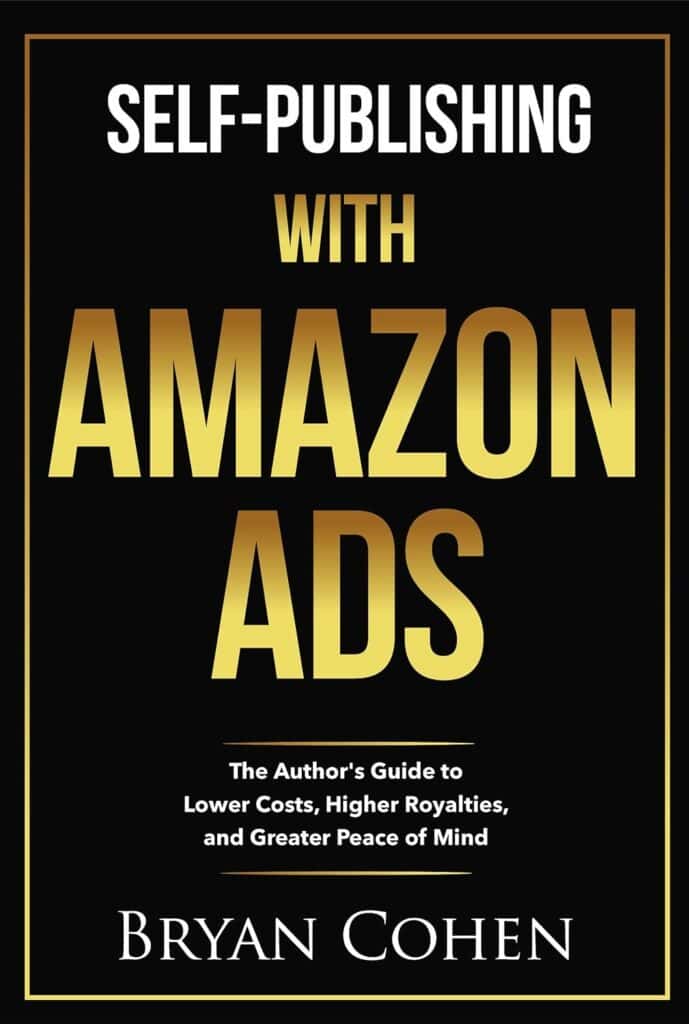
self publishing with amazon ads

Self-Publishing With Amazon Ads by Bryan Cohen Book Summary

Reading Time: 3 minutes

Top Three Quotes

  1. “Amazon ads can help any author grow with incremental improvements. And those small changes make big opportunities for the future.”
  2. “You can’t pay your car loan with a low ACoS, but you can pay it down with higher monthly profit.”
  3. “If you want something to last that long, then you don’t want to rush it.”

Book Theme

Self-Publishing With Amazon Ads is a hands-on, realistic guide for self-published authors to use Amazon Ads strategically to build long-term royalties, develop profitable advertising campaigns, and regain control of their author career.

Why You Should Read This Book

If you’re a self-published author frustrated with marketing methods that drain your time or money, Bryan Cohen’s approach offers sustainable, low-cost, repeatable strategies. This book focuses on mindset, profitability, and the importance of patience in building ad success, making it invaluable for anyone serious about long-term book sales on Amazon.

Key Ideas and Arguments Presented

  • Amazon ads are not a get-rich-quick tactic, but a long-term investment strategy.
  • Lower ad bids often lead to greater profitability than high bids.
  • Success with Amazon ads depends on consistent practice, not one-time hacks.
  • Understanding and targeting relevant keywords is critical for ad visibility and conversion.
  • Sales reporting in the Amazon ad dashboard can be misleading—track royalties and profit separately.
  • Authors must regularly monitor and optimize ad performance rather than set-and-forget.
  • Running ads leads to organic boosts like increased Amazon visibility and recommendations.
  • Learning your genre deeply is essential for ad targeting success.
  • Patience and a test-and-learn mindset are crucial for ad growth.
  • The author provides formulas and benchmarks to determine profitable ad bidding and expected outcomes.

Book Outline

  • Introduction
  • Chapter 1: Why Is It Worth Trying One More Book Marketing Thing?
  • Chapter 2: What Kind of Time Do I Need to Invest in Amazon Ads?
  • Chapter 3: How Do I Set Up Amazon Ads for Maximum Profit?
  • Chapter 4: How Do I Know If My Ads Are Working?
  • Chapters 5–12: Advanced strategies, keyword research, ad dashboard use, genre-based targeting, and more.
  • Epilogue
  • About the Author

Key Takeaways

  • Start slow and aim for profitability over visibility.
  • Target relevant readers rather than broad categories.
  • Use low bids (e.g., $0.39 for series starters and $0.34 for single books) to improve profit margins.
  • Track performance with the KDP dashboard rather than relying only on ad data.
  • Set aside weekly time for keyword research, ad creation, and optimization.
  • Focus your ad spend on your most profitable book first.
  • Relevancy and genre alignment significantly reduce costs.

Key Techniques

  • The Split Screen Method: Compare Amazon Ad Dashboard with KDP Reports for true profit tracking.
  • Low-Bid Strategy: Bid low (under $0.39) to maintain profitability and control costs.
  • Relevancy Targeting: Choose only hyper-relevant books and keywords to train the algorithm.
  • Weekly System: Research keywords, create 5–10 ads weekly, then analyze metrics in 15-minute sessions.

Author’s Qualifications

Bryan Cohen is a bestselling author, founder of Best Page Forward, and host of The Sell More Books Show. He has run Amazon ad workshops for over 30,000 authors and helped many reach over $10K/month in royalties.

Comparison to Similar Books

Compared to other books on Amazon Ads, Cohen’s book is practical, humble, and focused on low-budget long-term growth. It avoids hyped-up promises and emphasizes consistency and mindset, unlike many ad-centric books that push high-risk bidding or short-term tactics.

Target Audience

  • Self-published authors at any stage
  • Writers with limited marketing budgets
  • Authors struggling to understand Amazon Ads
  • Writers ready to commit to long-term growth
  • Authors who’ve tried other ad platforms without success
  • Genre fiction and nonfiction authors looking to scale
  • Those in KDP Select or Kindle Unlimited programs

Critical Response to the Book

The book was well-received, particularly in the indie author community. It was crowdfunded by over 600 authors via Kickstarter, and praised for being honest, approachable, and results-driven. The mix of narrative and instruction keeps it engaging and motivational.

One Sentence Takeaway

Amazon Ads, when used with strategy, low bids, and patience, can transform a self-published author’s career from stagnant to profitable.

Self-Publishing With Amazon Ads by Bryan Cohen Book Summary Read More »

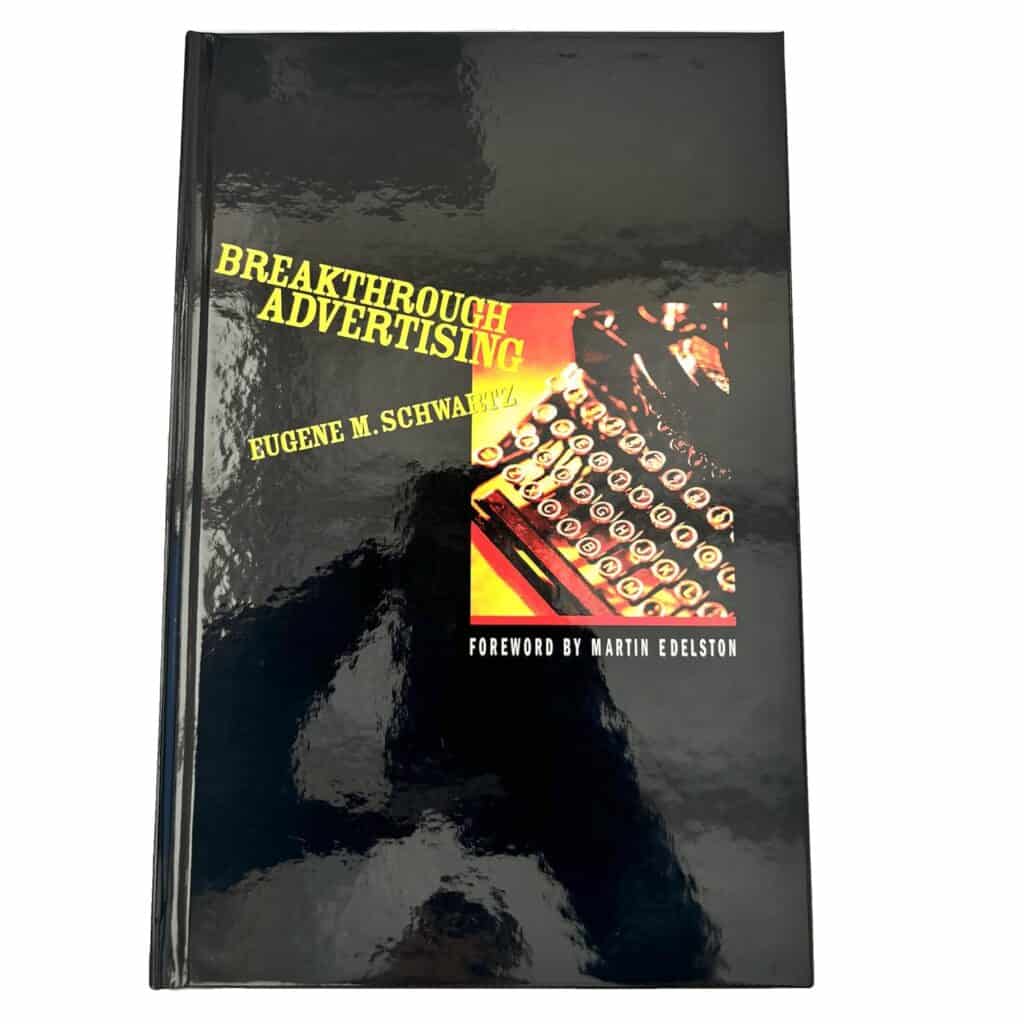
breakthrough advertising

Breakthrough Advertising by Eugene Schwartz Book Summary

Reading Time: 3 minutes

Top Three Quotes

  • “Copy cannot create desire for a product. It can only take the hopes, dreams, fears, and desires that already exist in the hearts of millions of people, and focus those already existing desires onto a particular product.”
  • “The greatest mistake marketers make is trying to create demand.”
  • “Your ad always begins with your market, and leads that market into your product.”

Book Theme

Breakthrough Advertising (not financially feasible to buy currently) centers on understanding and channeling existing consumer desires rather than attempting to create new ones. Schwartz emphasizes that successful advertising identifies the stage of awareness of the target audience and crafts messages that resonate with their existing desires and knowledge.

Why You Should Read This Book

This book is essential for marketers, copywriters, and business owners who seek to deepen their understanding of consumer psychology and enhance their advertising effectiveness. Schwartz provides a framework for identifying consumer desires and tailoring messages that align with their awareness levels, making it a timeless resource for crafting compelling advertisements.

Key Ideas and Arguments Presented

  • Mass Desire: Advertising should tap into existing mass desires rather than attempting to create new ones.
  • Stages of Awareness: Consumers exist in different stages of awareness about a product, ranging from unaware to fully aware. Effective advertising tailors messages to these stages.
  • Stages of Sophistication: Markets evolve, and so should advertising strategies. As markets become more sophisticated, advertisers must find new ways to present their products.
  • Headline Importance: The headline is crucial in capturing attention and should reflect the consumer’s stage of awareness and sophistication.
  • Seven Techniques of Breakthrough Copy: Schwartz outlines techniques such as intensification, identification, gradualization, redefinition, mechanization, concentration, and camouflage to enhance advertising copy.
  • Product Positioning: Positioning a product effectively involves understanding the market’s desires and presenting the product as the solution.
  • Mechanism of Action: Explaining how a product works can enhance credibility and appeal.
  • Emotional Appeal: Advertisements should connect with consumers on an emotional level to drive action.
  • Proof and Credibility: Providing evidence, testimonials, and demonstrations can build trust and persuade consumers.
  • Call to Action: A clear and compelling call to action is essential to guide consumers toward the desired response.

Book Outline

While the exact chapter titles are not publicly available, the book is structured to guide readers through understanding consumer desires, stages of awareness and sophistication, crafting headlines, writing compelling copy, and positioning products effectively.

Key Takeaways

  • Successful advertising channels existing desires rather than creating new ones.
  • Understanding the consumer’s stage of awareness and market sophistication is crucial.
  • Crafting compelling headlines and copy that resonate with the target audience’s desires and awareness levels enhances effectiveness.

Key Techniques

  • Intensification: Amplify the consumer’s desire for the product.
  • Identification: Align the product with the consumer’s self-image or aspirations.
  • Gradualization: Build the argument step by step to lead the consumer toward the desired conclusion.
  • Redefinition: Present the product in a new light to differentiate it from competitors.
  • Mechanization: Explain how the product works to satisfy the consumer’s desire.
  • Concentration: Focus the message on a single, compelling idea.
  • Camouflage: Present the advertisement as informative content to engage the consumer.

Author’s Qualifications

Eugene M. Schwartz was a renowned copywriter and advertising executive known for his expertise in direct-response advertising. His work has influenced generations of marketers and copywriters, and “Breakthrough Advertising” is considered a seminal text in the field.

Comparison to Similar Books

  • “Scientific Advertising” by Claude Hopkins: Focuses on the scientific approach to advertising, emphasizing testing and measurement.
  • “Ogilvy on Advertising” by David Ogilvy: Provides insights into advertising principles and practices from an agency perspective.
  • “The Boron Letters” by Gary Halbert: Offers practical advice on copywriting and direct marketing through personal letters.

“Breakthrough Advertising” stands out for its deep psychological insights into consumer behavior and its strategic approach to crafting persuasive messages.

Target Audience

  • Copywriters seeking to enhance their persuasive writing skills.
  • Marketing professionals aiming to understand consumer psychology.
  • Business owners looking to improve their advertising effectiveness.
  • Entrepreneurs developing marketing strategies for new products.
  • Advertising students studying foundational texts in the field.
  • Digital marketers focusing on direct-response campaigns.
  • Brand strategists interested in positioning and messaging.

Critical Response to the Book

“Breakthrough Advertising” is widely regarded as a classic in the advertising and marketing industry. Despite being out of print for years, it has maintained its reputation for providing timeless insights into consumer behavior and advertising strategy. Many professionals consider it an essential read for anyone serious about marketing.

One Sentence Takeaway

Effective advertising doesn’t create desire; it identifies and channels existing desires by aligning messages with the consumer’s awareness and sophistication levels.

Breakthrough Advertising by Eugene Schwartz Book Summary Read More »

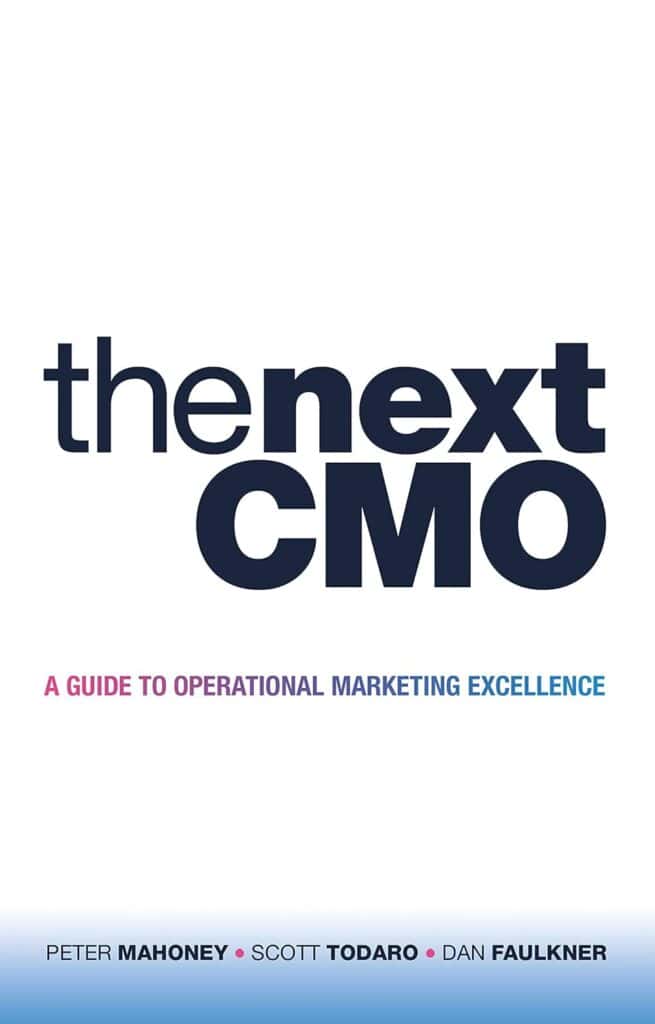
the next cmo

The Next CMO by Peter Mahoney Book Summary

Reading Time: 2 minutes

Top Three Quotes

  • “The problem with marketing isn’t the marketers—it’s that the tools used to manage the marketing function have not caught up with the incredible change that the function has seen.”
  • “Execution is the single biggest weakness in marketing planning.”
  • “Campaign managers used to exist in marketing teams… the role has been sidelined, but we believe it’s time for marketing campaign management to make a comeback.”

Book Theme

The Next CMO book is a guide to mastering operational marketing excellence—helping CMOs and marketing teams execute smarter and align every action to business outcomes.

Why You Should Read This Book

  • To improve your ability to lead marketing through planning, budgeting, and communication.
  • To benchmark your team’s operational effectiveness using the Operational Marketing Index.
  • To turn strategy into action with frameworks and templates that are immediately usable.

Key Ideas and Arguments Presented

  1. CMOs fail more from execution gaps than bad strategy.
  2. Operational discipline is a differentiator in high-performing teams.
  3. Budget mismanagement leads to chronic underspend.
  4. Goals-based planning aligns marketing with business value.
  5. Campaign managers are key to cross-functional success and strategic execution.
  6. Teams must embrace agile planning in a volatile landscape.
  7. Use marketing ROI to tell a whole-plan story, not just the highlights.
  8. A strong culture of operational excellence encourages truth-seeking, not cherry-picking.

Book Outline

  • 1. The Problem with Operational Marketing Leadership
  • 2. The Impact of Ineffective Marketing Execution
  • 3. Elements of Operational Marketing Excellence
  • 4. Marketing DNA: Stakeholders and Culture
  • 5. Building a Winning Marketing Plan
  • 6. Goals-Based Marketing
  • 7. Strategy Development
  • 8. Redefining Campaigns
  • 9. Managing the Budget
  • 10. The New ROI
  • 11. Reporting to the Board
  • 12. The Operational Marketing Index

Key Takeaways

  • Execution is the missing link in most marketing failures.
  • Planning must be connected to strategy, budget, and goals.
  • Operational frameworks drive better agility and clarity.

Key Techniques

  • Marketing Plan Framework (MPF)
  • Goals Pyramid
  • Operational Marketing Index
  • ROI Storytelling via RoMP
  • Campaign Execution Template

Author’s Qualifications

Mahoney, Todaro, and Faulkner bring 70+ years of combined experience in marketing, tech, and executive leadership, including founding Plannuh and leading at Nuance Communications.

Comparison to Similar Books

More operational than Seth Godin’s philosophy, more strategic than Donald Miller’s frameworks, and focused entirely on marketing unlike John Doerr’s general OKRs.

Target Audience

  • CMOs and aspiring marketing leaders
  • Marketing operations professionals
  • Startup founders handling marketing
  • Agencies wanting to up-level strategy
  • Marketing students and educators

Critical Response to the Book

The book’s first edition earned strong praise and adoption from the marketing community, prompting a deeper second edition filled with frameworks, benchmarks, and tools.

One Sentence Takeaway

Operational execution—not strategy alone—is what separates the next generation of successful CMOs.

The Next CMO by Peter Mahoney Book Summary Read More »

visualize this

Visualize This by Nathan Yau Book Summary

Reading Time: 2 minutes

Top Three Quotes

Version 1.0.0
  • “Visualization isn’t just about getting the cold hard facts. It’s also about feeling.”
  • “You can find stories that you might never have found with just formal statistical methods.”
  • “It’s not that the numbers lie. It’s the people who use the numbers who lie.”

Book Theme

Telling stories through data visualization. Visualize This explores how to make raw data understandable, beautiful, and compelling by using visual tools to uncover and communicate the stories hidden in the numbers.

Why You Should Read This Book

If you work with data—whether as a marketer, researcher, journalist, designer, or developer—this book will equip you to move beyond spreadsheets and create meaningful visuals that reveal the underlying narrative.

Key Ideas and Arguments Presented

  • Data tells stories—visualization helps communicate them.
  • Good design enhances clarity and emotion.
  • Visualization is a skill anyone can learn through practice.
  • The audience and purpose guide design decisions.
  • Use the right tools for your specific data needs.
  • Clean data is foundational to visualization.
  • Always ask: what story does this visualization tell?
  • Provide context—don’t rely on visuals alone.
  • Maps and timelines add crucial dimensions.
  • Creativity and humor can enhance engagement.

Book Outline

  1. Introduction
  2. Telling Stories with Data
  3. Handling Data
  4. Choosing Tools to Visualize Data
  5. Visualizing Patterns over Time
  6. Visualizing Proportions
  7. Visualizing Relationships
  8. Spotting Differences
  9. Visualizing Spatial Relationships
  10. Designing with a Purpose

Key Takeaways

  • Visualization is the bridge between raw data and human understanding.
  • Effective visuals serve a purpose, not just aesthetics.
  • Good design starts with knowing your data inside and out.
  • Practice and experimentation are essential to mastering this skill.

Key Techniques

  • Cleaning and formatting data (Python, Excel)
  • Choosing visualization tools (R, Illustrator, JavaScript)
  • Using small multiples to show change
  • Applying encoding and visual hierarchy
  • Incorporating spatial and temporal dimensions

Author’s Qualifications

Nathan Yau is a statistician and creator of FlowingData.com. He holds a Master’s degree from UCLA and is completing a Ph.D. focused on visualization. He’s worked with The New York Times, CNN, and other leading organizations.

Comparison to Similar Books

This book is more hands-on than Edward Tufte’s work and more technical than Storytelling with Data by Knaflic. It offers a perfect middle ground for practitioners looking to both learn tools and understand design thinking.

Target Audience

  • Data analysts and scientists
  • Journalists and storytellers
  • Graphic designers and UI/UX professionals
  • Business intelligence professionals
  • Policy analysts and researchers
  • Educators teaching data literacy
  • Developers building data-driven tools

Critical Response to the Book

Critics appreciated its practical focus and friendly tone. While some advanced users may find it too basic, it’s widely regarded as a strong foundational resource for newcomers and intermediate data visualizers.

One Sentence Takeaway

The best data visualizations don’t just show numbers—they tell stories that change how we see the world.

Visualize This by Nathan Yau Book Summary Read More »