Last updated March 2026
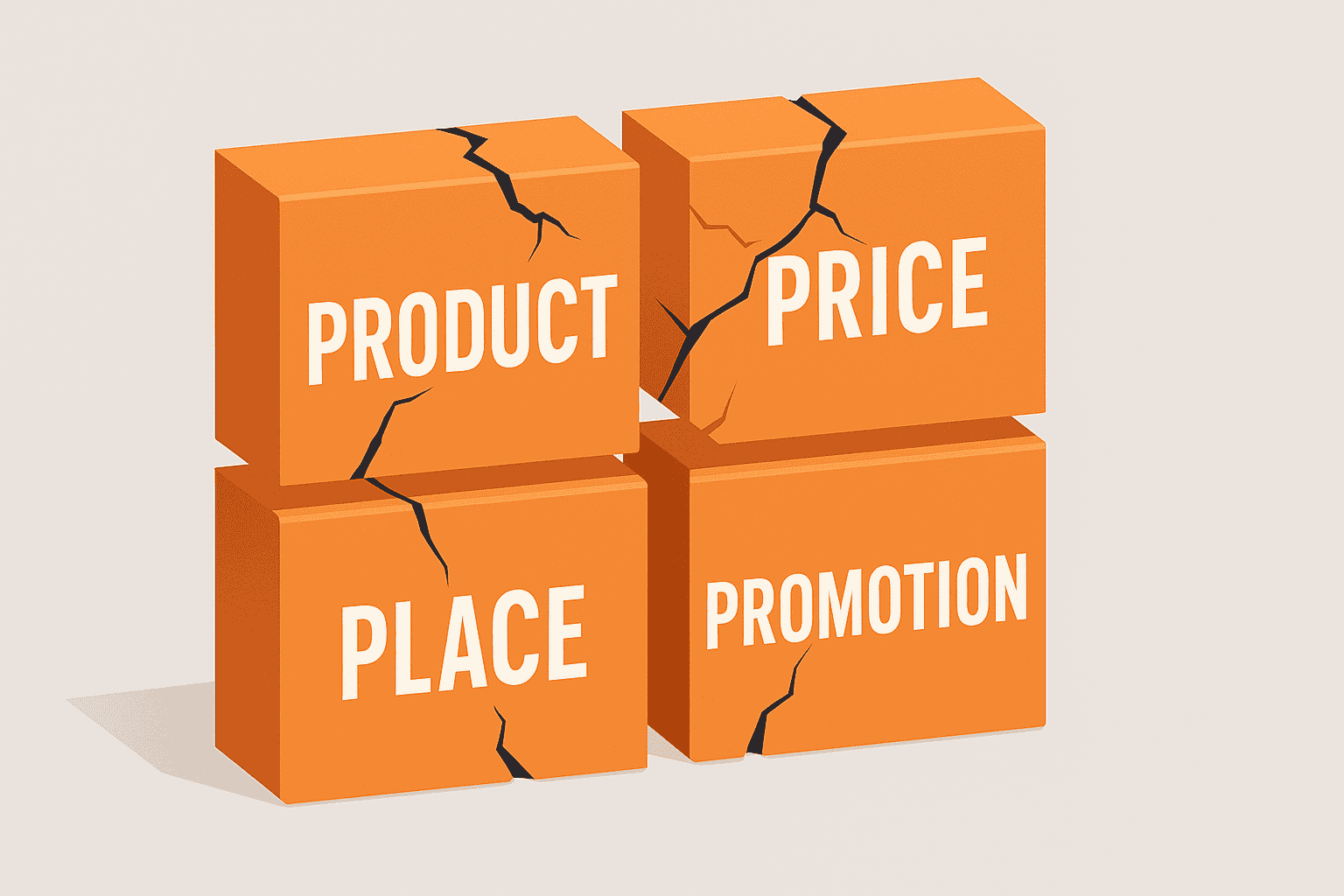
No, this isn’t clickbait. (And no, this isn’t like the perennial false alarm that “SEO is dead” – it’s not.) The classic 4 Ps of Marketing – Product, Price, Place, and Promotion – have outlived their usefulness in guiding modern marketing strategy.
The 4 Ps framework came about in 1960, introduced by E. Jerome McCarthy, a marketing professor at Michigan State University who would later be honored with the AMA Trailblazer Award and recognized as a top thought leader in marketing.
McCarthy’s 4 Ps concept (also known as the marketing mix) was first popularized in his textbook Basic Marketing: A Managerial Approach and became the cornerstone of marketing education for decades. It’s likely the first thing taught in any introductory marketing class. In my own MBA program (just this year), the marketing course still drilled the 4 Ps as a fundamental model.
Yet a lot has changed in the world since the 1960s, and unfortunately the 4 Ps no longer provide a proper foundation for marketers. The framework was conceived in an era dominated by manufacturing and tangible products – before widespread digital technology, before the internet, even before barcodes. For several decades the 4 Ps were incredibly valuable, giving businesses a simple roadmap to engage consumers and build competitive advantage. But today’s marketing environment bears little resemblance to that world. What once was a foundational model is now increasingly viewed as outdated and dangerously incomplete.
Below, I’ll briefly introduce the 4 Ps and then outline five key reasons why the 4 Ps framework is no longer sufficient in modern marketing.
What Are the 4 Ps of Marketing (and Why Were They Useful)?
The “4 Ps” of marketing refer to the four pillars of a traditional marketing strategy: Product, Price, Place, and Promotion. In a nutshell, this framework says that to successfully market something, you need to get the product right (offer something that meets customer needs), set the right price, distribute it in the right places, and promote it effectively to your target audience.
This concept was revolutionary in the mid-20th century because it organized marketing activities into a clear, actionable checklist. For decades, the 4 Ps model provided companies a practical roadmap for crafting campaigns and allocating resources – it fueled the growth of countless brands and even helped shape entire industries.
Why was it so valuable for so long? In the manufacturing-heavy economy of the 1960s–1980s, most businesses sold physical products. The 4 Ps gave managers a structured way to think about bringing those products to market: develop a good product, price it attractively, place it in stores (or sales channels) where customers can find it, and promote it via advertising and sales tactics. It was a simple, intuitive framework that was easy to teach and understand. However, marketing has evolved dramatically since then – and as we’ll see, the 4 Ps haven’t kept up.
Five Reasons the 4 Ps Framework Is No Longer Sufficient
- Marketing Only Controls One “P.” Perhaps the biggest practical flaw with the 4 Ps today is that in many companies, the marketing department only truly controls one of those Ps: Promotion. Product strategy is often owned by product development or R&D teams; Pricing is decided by finance or executive leadership; Place (distribution) might be handled by sales or logistics teams. Marketing, in practice, is frequently relegated to communications and advertising – i.e. the Promotion P. Recent industry surveys confirm this reality: only about one-third of marketers have any influence over their company’s pricing or distribution decisions, whereas nearly 89% do control advertising and communications. In other words, the classic 4 Ps model describes areas of decision-making that marketing as a function often doesn’t own. Teaching new marketers that they should manage all four areas sets an unrealistic expectation and ignores the siloed nature of many organizations. If “Marketing = 4 Ps” but marketers only execute one of those, the framework loses a lot of its relevance.
- It Ignores the Rise of Services. The 4 Ps were conceived in a product-centric era – the 1960s economy of mass-produced goods. But we no longer live in a strictly product-dominated world; services make up a huge part of modern economies (think finance, healthcare, software-as-a-service, consulting, etc.). The traditional 4 Ps framework doesn’t account for the unique challenges of marketing services, which are intangible and often involve customer experiences rather than physical goods. In fact, this gap was noticed decades ago: by the 1980s marketers had introduced three additional “Ps” (People, Process, and Physical evidence) precisely to adapt the marketing mix for services marketing. Those added elements cover things like service personnel, service processes, and the tangibles that shape a service experience – factors completely ignored by the original 4 Ps. A service business (e.g. a hotel, a bank, or a tech platform) can’t be fully described by just product, price, place, promotion. For instance, customer support process or the ambiance of a hotel lobby are crucial to the offering but don’t fit neatly into any of the original four categories. The result is that using only the 4 Ps provides an incomplete toolkit for marketers in service-driven industries.
- Brand Is Not One of the Ps. One glaring omission in the 4 Ps model is Brand – arguably the most important asset in marketing. Branding transcends any single “P”: it’s bigger than the product itself, and more enduring than any one promotion or price tactic. Yet the framework doesn’t explicitly include brand strategy at all. Marketing thought leaders have pointed out that “Brand comes before marketing” and that leaving brand out of the core framework means neglecting the primary driver of long-term customer preference. A strong brand is what creates loyalty, trust, and the long-term equity that makes customers buy a company’s product repeatedly (and even pay a premium for it). The absence of brand in the 4 Ps has led to overemphasis on short-term promotion at the expense of sustainable brand-building. Even Philip Kotler – the very scholar who helped cement the 4 Ps into marketing orthodoxy – has updated his thinking on this. Kotler now advocates an expanded 7-component marketing mix that explicitly adds Brand as a key element, noting that a trusted brand supplies extra value to customers and must be managed alongside product and price. If the “father of modern marketing” himself has added Brand to the mix, it’s a clear sign the original model was missing something crucial.
- It’s Not Customer-Centric (Inside-Out vs. Outside-In). Another fundamental criticism is that the 4 Ps framework is inward-looking and product-centric, rather than starting with the customer’s perspective. By design, it begins with a company deciding on a product, setting a price, determining distribution, and then promoting – an inside-out approach. Modern marketing, however, preaches outside-in thinking: start by understanding customer needs and desires, then build solutions (products or services) around those, and communicate in customer-centric ways. The 4 Ps make no mention of the customer at all! It’s assumed that if you get the product, price, place, promotion right, customers will buy – but this assumption often fails if you haven’t first figured out what the customer actually wants. This is why alternative frameworks like the 4 Cs were proposed in the 1990s (Consumer needs, Cost to the customer, Convenience, Communication) to reframe these elements from the buyer’s viewpoint. Even with later tweaks, the 4 Ps model remains “trapped within the original structure, which is product-centric. It starts with the product, not the customer, an approach which most marketers threw over years ago.” In today’s era of customer experience and relationship marketing, a framework that doesn’t put the customer front-and-center is fundamentally flawed.
- It’s Outdated in the Digital Age. Finally, the 4 Ps are simply a product of a different time. The framework was born over 60 years ago in a business environment that had no internet, no smartphones, no social media, no eCommerce – essentially none of the technological and cultural shifts that define today’s markets. Marketing in 2025 is about managing online and offline experiences, leveraging data analytics, engaging through digital communities, personalizing content, and iterating rapidly. The rigid 4 Ps model assumed a relatively static world where companies produced goods, pushed them out to retailers, ran some ads, and called it a day. That linear model doesn’t reflect how modern marketing works. Today, places are not just physical stores – they’re digital platforms and global supply chains. Promotion is no longer one-way advertising – it’s often two-way engagement and real-time conversations. Even the concept of price is more dynamic (think subscription pricing, freemium models, surge pricing algorithms). The old 4 Ps framework wasn’t built for this level of complexity and change. As one commentator put it, the 4 Ps “assume a static, unchanging marketplace” – which in our time is almost laughable. In an age of rapid disruption and empowered consumers, clinging to a 1960s-era checklist can cause marketers to miss the bigger picture. It can even hinder strategic thinking by focusing too narrowly on tactical levers and not enough on adaptation, innovation, and long-term value. Little wonder that experts say the 4 Ps are past their retirement age.
Closing Thoughts
None of this is to say that product, price, place, and promotion don’t matter anymore – they do. But they’re hygiene factors now; they’re simply not the whole story of what marketing entails today. The 4 Ps framework served its purpose in a bygone era, but continuing to rely on it as the primary model for marketing is like using a typewriter in the age of cloud computing.
Marketing has outgrown the 4 Ps, and it’s time we acknowledge that in both business practice and marketing education. In a future blog post, I will explore some of the better frameworks emerging to replace the 4 Ps – models that are more customer-centric, more inclusive of services and brand, and more attuned to the digitally driven, purpose-driven world we actually live in. For now, the key takeaway is that the old playbook needs an update. The marketing discipline must evolve beyond the 4 Ps or risk getting stuck in the past while the world moves on.
References
Max Abraham. Marketing Mix: Traditional 4Ps to Evolution of Marketing 7Ps. Management.org, Aug 27, 2024.
https://management.org/marketing-mix-4ps-to-7ps
Vincent van Vliet. E. Jerome McCarthy Biography (Marketing Mix – 4Ps). Toolshero, Apr 16, 2025.
https://www.toolshero.com/marketing/e-jerome-mccarthy/
Christian Sarkar & Philip Kotler. The 5th P is Purpose. The Marketing Journal, Mar 13, 2025.
https://www.marketingjournal.org/the-5th-p-is-purpose-kotler-sarkar/
Philip Kotler. The Past, Present, and Future of Marketing (Insights). AMA.org, Mar 12, 2024.
https://www.ama.org/marketing-news/the-past-present-and-future-of-marketing-insights-from-philip-kotler/
Helen Edwards. The 4Ps are wrong and out of date — please don’t bring them back! WARC, Sep 2023.
https://www.warc.com/content/paywall/article/warc-exclusive/the-4ps-are-wrong-and-out-of-date-please-dont-bring-them-back/151321
Charlotte Rogers. Most marketers don’t have influence over the 4Ps excluding promotion. Marketing Week, May 21, 2025.
https://www.marketingweek.com/marketers-influence-4ps-promotion/