Warning: Undefined array key "file" in /home/sites/37a/3/3c19782e61/public_html/marketingwithdave/wp-includes/media.php on line 1570
Warning: Undefined array key "width" in /home/sites/37a/3/3c19782e61/public_html/marketingwithdave/wp-includes/media.php on line 1584
Warning: Undefined array key "width" in /home/sites/37a/3/3c19782e61/public_html/marketingwithdave/wp-includes/media.php on line 1589
Warning: Undefined array key "height" in /home/sites/37a/3/3c19782e61/public_html/marketingwithdave/wp-includes/media.php on line 1589
Warning: Undefined array key "width" in /home/sites/37a/3/3c19782e61/public_html/marketingwithdave/wp-includes/media.php on line 1584
Warning: Undefined array key "width" in /home/sites/37a/3/3c19782e61/public_html/marketingwithdave/wp-includes/media.php on line 1589
Warning: Undefined array key "height" in /home/sites/37a/3/3c19782e61/public_html/marketingwithdave/wp-includes/media.php on line 1589
Reading Time: 5 minutes
Last updated May 2026
In the past, analyzing customer comments and reviews was hit-or-miss at best.
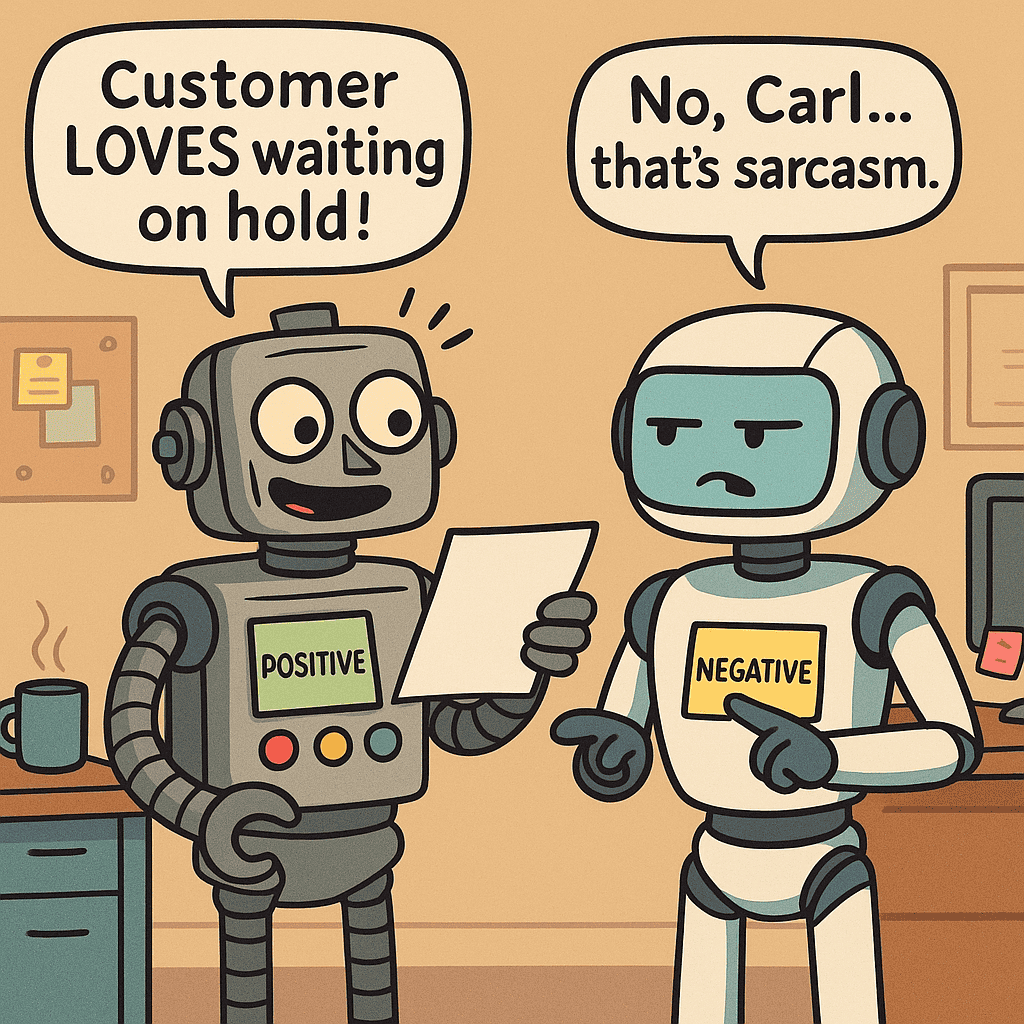
Early sentiment analysis tools often misread the emotional tone of unstructured text, especially when confronted with nuance. Sarcasm could be mistaken for sincere praise, and industry-specific terms could trigger false alarms. For example, insurance feedback might mention a “total catastrophe” or “flood loss” – terms that sound negative – even when the customer’s actual sentiment about their agent was positive.
Today, thanks to advances in artificial intelligence (AI), we can finally more reliably categorize unstructured sentiment data, grasping the true intent behind words.
The Challenge with Unstructured Sentiment (Before AI)
Human language is complex, and understanding sentiment isn’t as simple as counting positive or negative words. Some of the biggest hurdles historically included:
- Sarcasm and Irony: Sarcasm flips language on its head – “I just love being on hold for an hour,” one might say, meaning the opposite. Older sentiment algorithms struggled with this. They took words at face value, so positive words in a sarcastic sentence could trick them into a positive classification when the sentiment was actually negative. Likewise, genuinely appreciative comments with a few “negative” words (e.g. “our agent was a lifesaver during this total catastrophe”) could be mislabeled as negative. Without understanding context or tone, these tools were easily foiled by irony and sarcasm.
- Domain-Specific Language and Ambiguity: Words mean different things in different contexts. A phrase that sounds negative in one industry might be neutral or positive in another. Sentiment analysis has long been domain-dependent – the same words or expressions can indicate opposite sentiments in different domains. For instance, calling a video game “sick” is praise (slang for “awesome”), but a naive model might flag it as negative (thinking “sick” = ill/bad). Similarly, insurance or disaster-relief contexts include words like “damage,” “loss,” or “catastrophe” which describe events, not customer satisfaction.
- Limited Context Understanding: Older approaches often relied on simple rules or keyword lists. They struggled with negation (“not bad at all” could be misread as negative due to the word “bad,” when the sentiment is mildly positive). They also analyzed each sentence in isolation, missing the broader context that humans use to interpret meaning.
These challenges left marketers and analysts with unreliable results – sarcastic complaints tagged as positive sentiment, mixed messages, and the need for manual review. Fortunately, AI has turned this around.
How AI Transformed Sentiment Analysis
Modern AI-driven sentiment analysis isn’t your 2010s “bag-of-words” algorithm. It’s far more sophisticated, which means far more accurate. Here’s what changed and why sentiment categorization is now markedly better:
- Context is King: Today’s AI language models analyze text in context, not as isolated words. They evaluate the entire sentence (or even multiple sentences) to derive meaning. This means they catch nuances like negation and tone shifts.
- Advanced NLP Techniques: Breakthroughs in deep learning – particularly transformer-based models – have given sentiment analysis a giant leap forward. These models “read” text in a human-like way, considering nuance and even world knowledge.
- Learning from Huge Data (including Sarcasm and Slang): Modern AI is trained on vast amounts of text – from tweets and reviews to discussion forums. This exposure means the AI has “seen” countless examples of sarcasm, slang, and domain-specific usage.
One additional factor: cutting-edge sentiment tools can be fine-tuned to specific industries or contexts, allowing them to accurately interpret language that general models would still get wrong.
What AI Still Gets Wrong
Modern sentiment tools are dramatically better, but not infallible. A few limitations worth knowing:
Confidence matters: Good sentiment tools return a probability score, not just a label. If your tool isn’t surfacing confidence levels, you’re missing important signal about when to trust the output and when to take a second look.
Mixed sentiment: “The food was amazing, the service was a disaster” often gets flattened to a single label. Nuanced, multi-topic feedback still trips up many models.
Subtle sarcasm in short text: The same research on sarcasm detection that AI proponents cite also shows LLMs still require multi-step reasoning to reliably catch it. Short social posts remain harder than longer reviews.
Niche and low-resource domains: Fine-tuning helps, but models trained on general text can still misread highly specialized industry language they haven’t seen enough of.
Domain Adaptation and Customization: Cutting-edge sentiment tools can be fine-tuned to specific industries or contexts, allowing them to accurately interpret unique industry language.
Real-World Examples: Old vs. New Sentiment Categorization
| Comment | Old Approach Sentiment | Modern AI Sentiment |
|---|---|---|
| “I absolutely loved waiting an hour on hold.” | Positive (misread literally) | Negative (sarcasm detected) |
| “Great job, team. You broke it again.” | Positive (misread “great”) | Negative (clearly sarcastic) |
| “Just perfect… now nothing works.” | Positive (focus on “perfect”) | Negative (understood irony) |
| “Thanks a lot, now I’m locked out of my account.” | Positive (saw “thanks”) | Negative (understood frustration) |
| “Yeah, everyone loves seeing errors first thing in the morning.” | Positive (misled by “loves”) | Negative (sarcasm about errors) |
| “Oh great, another meeting that could have been an email.” | Positive (misread “great”) | Negative (weary sarcasm) |
| “Our house was destroyed in a flood – a total catastrophe – but our agent was incredible through it all.” | Negative (keying on “catastrophe”) | Positive (praise for the agent) |
| “My car was totaled, yet the claims process was fantastic.” | Negative (focus on “totaled”) | Positive (satisfaction with service) |
| “This party was sick!” | Negative (took “sick” literally) | Positive (understood slang for “amazing”) |
| “Not bad at all for a Monday.” | Negative (saw “bad”) | Positive (recognized the negation as a mild praise) |
Table: Ten example comments that would confuse old sentiment analysis but are correctly understood by modern AI. The old approach often relied on literal word sentiment, while new AI models grasp context, sarcasm, and slang to infer the true tone.
Why This Matters for Marketing and CX Professionals
- You Get True Customer Insights: Sarcasm, jokes, and snarky comments won’t fly under the radar as false positives. Your Voice of Customer analysis becomes trustworthy.
- Better Decision-Making: You can measure sentiment trends with confidence, making your reports actionable and reliable.
- Adaptability Across Channels and Industries: Whether it’s product reviews, support tickets, or survey responses, AI adapts to the context and industry language.
- Efficiency Gains: Teams no longer need to manually re-read comments to detect misclassifications, enabling faster action on real sentiment trends.
If your current sentiment tool only returns a positive or negative label with no confidence score attached, that’s the first thing worth re-evaluating.
Conclusion: From Hit-or-Miss to a Genuinely Useful Signal
We’ve entered a new era where unstructured sentiment data – the messy, honest, and nuanced text that customers produce – can be analyzed with a level of accuracy that was unheard of a few years ago. The tools have gotten genuinely good. But “genuinely good” isn’t the same as “done.” Mixed feedback, niche language, and short sarcastic posts still require human judgment to interpret correctly. The right frame isn’t that AI has replaced the analyst – it’s that AI has made the analyst’s job more tractable. You’re no longer drowning in manual review. You can now focus your attention where the signal is ambiguous rather than spending it on the obvious cases.
For marketers, customer experience professionals, and anyone working with feedback or social data, this is a game-changer. You can now take the pulse of customer sentiment with confidence, knowing that the insights reflect reality. AI has finally made the voice of the customer readable at scale – even when customers are being sarcastic, indirect, or industry-specific.
References
- Ingrid Fadelli (2023). “Can large language models detect sarcasm?” TechXplore.
- Kapiche (2024). “Sentiment Analysis: Guide for Businesses in 2024.” Kapiche Blog.
- Fang Yao & Yan Wang (2020). “Domain-specific sentiment analysis for tweets during hurricanes (DSSA-H): A domain-adversarial neural-network-based approach.” Computers, Environment and Urban Systems, 83, 101522
- Ben Yao, Yazhou Zhang, Qiuchi Li, & Jing Qin (2024). “Is Sarcasm Detection a Step-by-Step Reasoning Process in Large Language Models?” arXiv:2407.12725.